
Statistical Thermodynamics of the Perfect Monatomic Gas Valentim


- Slides: 13
Statistical Thermodynamics of the Perfect Monatomic Gas Valentim M B Nunes ESTT – IPT May 2019
The partition function allows the calculation of the properties of a system from the knowledge of the energy levels of particles.
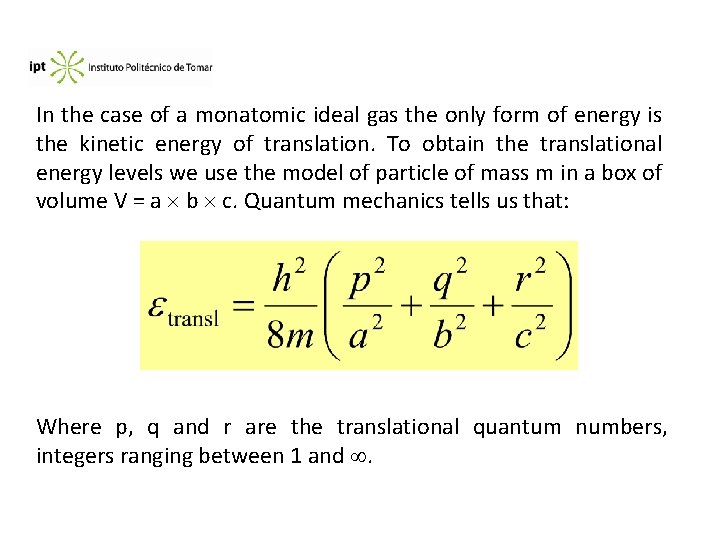
In the case of a monatomic ideal gas the only form of energy is the kinetic energy of translation. To obtain the translational energy levels we use the model of particle of mass m in a box of volume V = a b c. Quantum mechanics tells us that: Where p, q and r are the translational quantum numbers, integers ranging between 1 and .
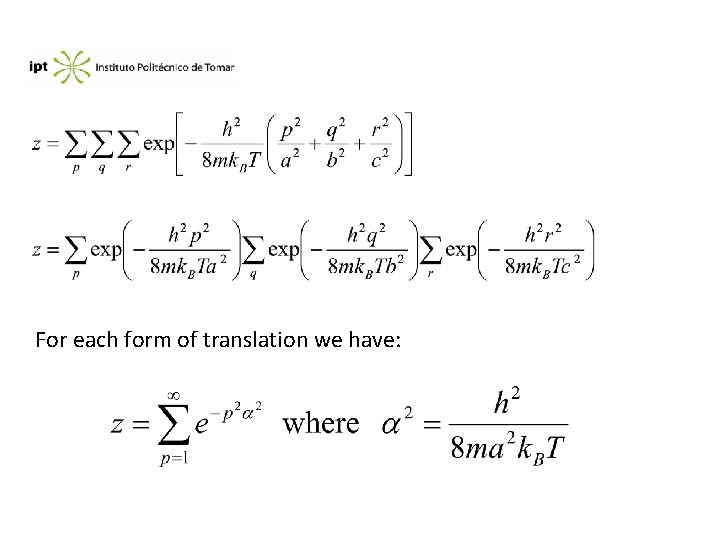
For each form of translation we have:
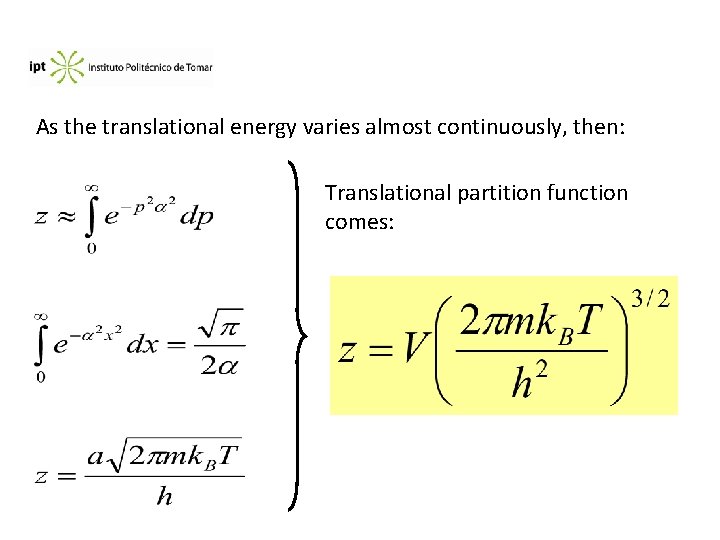
As the translational energy varies almost continuously, then: Translational partition function comes:
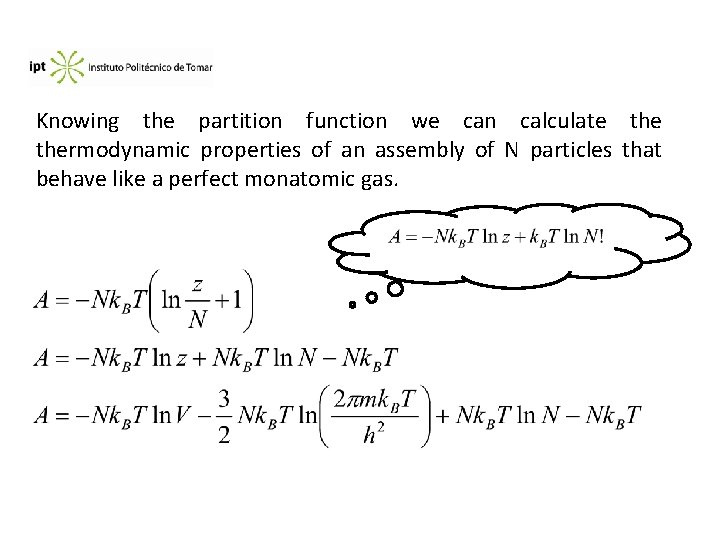
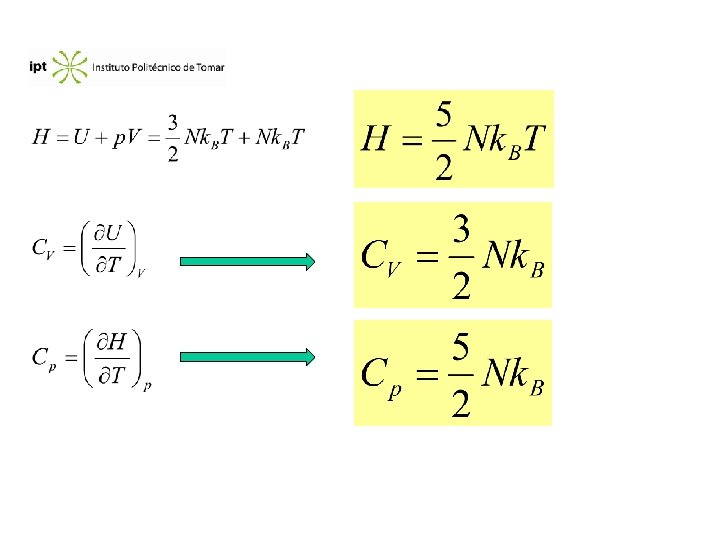
Knowing the partition function we can calculate thermodynamic properties of an assembly of N particles that behave like a perfect monatomic gas.
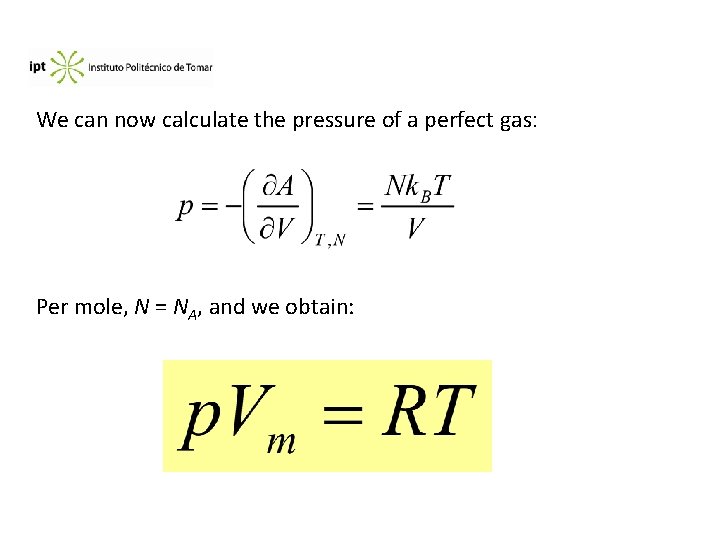
We can now calculate the pressure of a perfect gas: Per mole, N = NA, and we obtain:
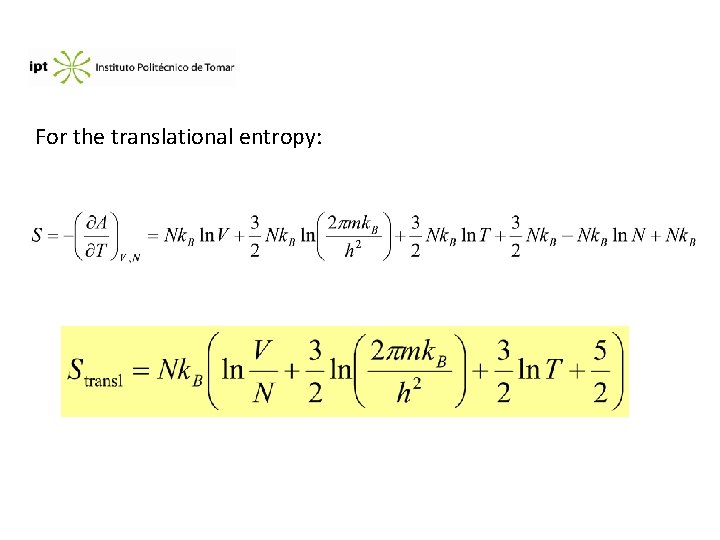
For the translational entropy:
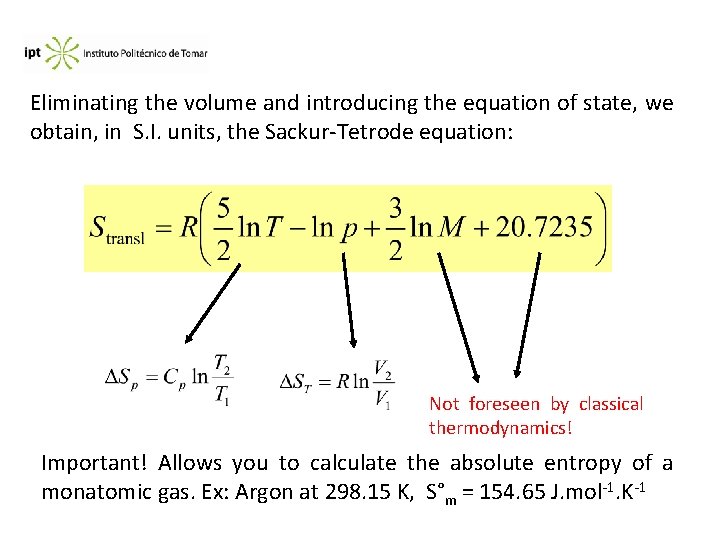
Eliminating the volume and introducing the equation of state, we obtain, in S. I. units, the Sackur-Tetrode equation: Not foreseen by classical thermodynamics! Important! Allows you to calculate the absolute entropy of a monatomic gas. Ex: Argon at 298. 15 K, S°m = 154. 65 J. mol-1. K-1
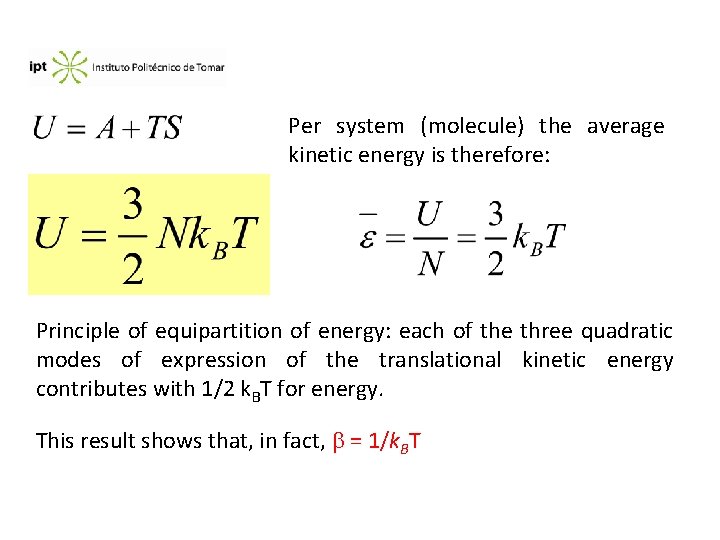
Per system (molecule) the average kinetic energy is therefore: Principle of equipartition of energy: each of the three quadratic modes of expression of the translational kinetic energy contributes with 1/2 k. BT for energy. This result shows that, in fact, = 1/k. BT
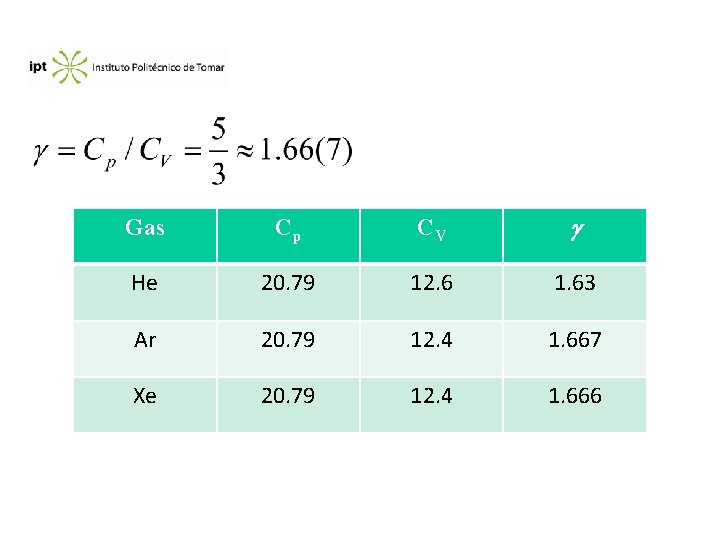
Gas Cp CV He 20. 79 12. 6 1. 63 Ar 20. 79 12. 4 1. 667 Xe 20. 79 12. 4 1. 666