
Statistical Theory of Nuclear Reactions UNEDF Sci DAC

- Slides: 13
Statistical Theory of Nuclear Reactions UNEDF Sci. DAC Annual Meeting MSU, June 21 -24, 2010 Goran Arbanas (ORNL) Kenny Roche (PNNL) Arthur Kerman (MIT/UT) Carlos Bertulani (TAMU) David Dean (ORNL)
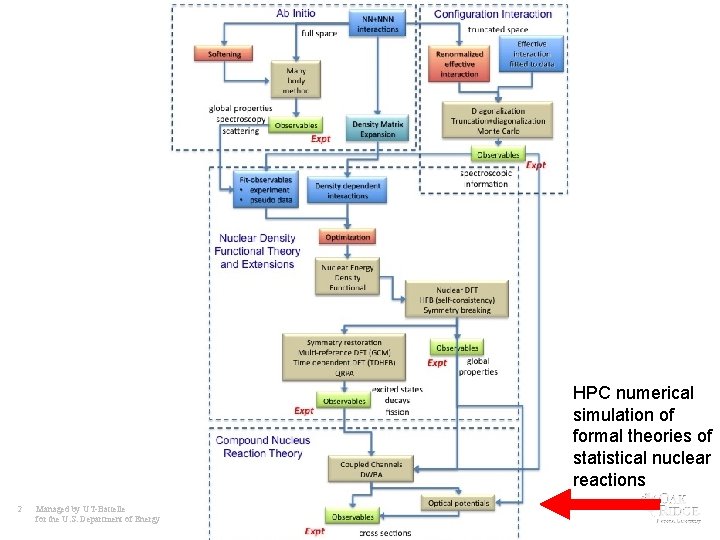
HPC numerical simulation of formal theories of statistical nuclear reactions 2 Managed by UT-Battelle for the U. S. Department of Energy Presentation_name
Year 5 Progress Report • Year 5 Reaction Deliverable #55: – “Examine energy-dependence of eigensolutions in the expansion for the KKM theory. ” • Year 5 Progress Report: – Prototyped energy dependence in KKM: • Intel MKL implementation of complex symmetric eigensolver on 12 cores – Massively parallel code in “ensemble” eigensolver of complex symmetric matrices (K. Roche). • In the meantime: loop through energies on the parallel code. • Related HPC contribution: 3 – Massively Parallel eigensolver for large (ensembles) of complex symmetric matrices Managed by UT-Battelle for the U. S. Department of Energy Presentation_name
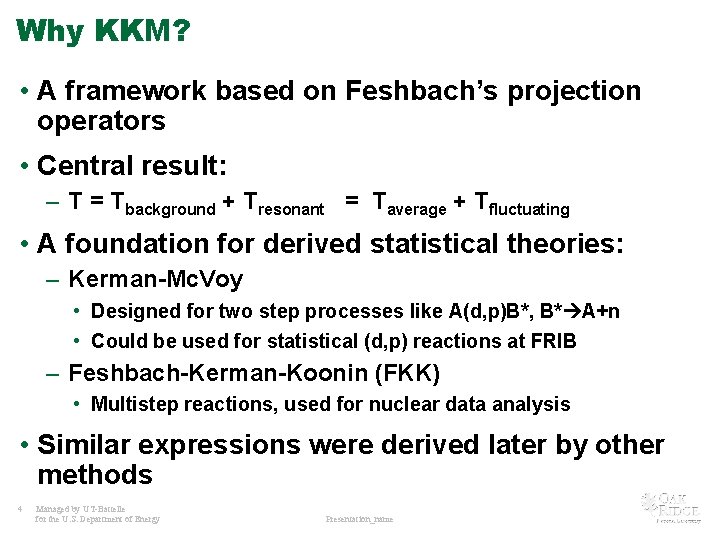
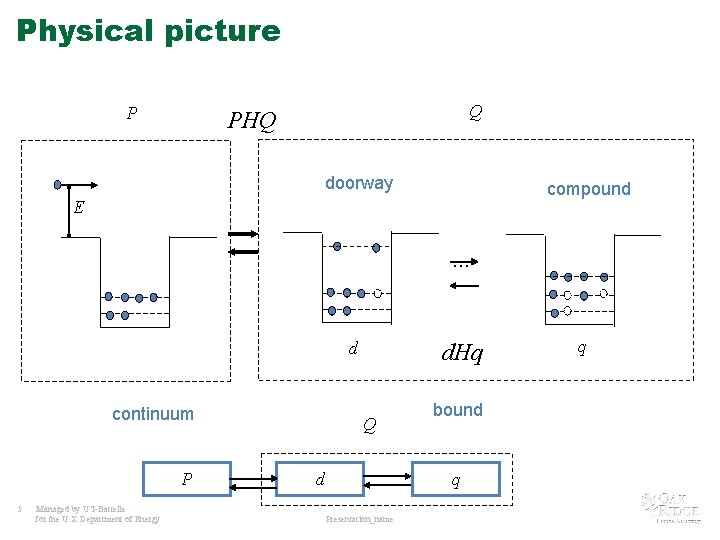
Why KKM? • A framework based on Feshbach’s projection operators • Central result: – T = Tbackground + Tresonant = Taverage + Tfluctuating • A foundation for derived statistical theories: – Kerman-Mc. Voy • Designed for two step processes like A(d, p)B*, B* A+n • Could be used for statistical (d, p) reactions at FRIB – Feshbach-Kerman-Koonin (FKK) • Multistep reactions, used for nuclear data analysis • Similar expressions were derived later by other methods 4 Managed by UT-Battelle for the U. S. Department of Energy Presentation_name
Physical picture P Q PHQ doorway compound E … d continuum P 5 Managed by UT-Battelle for the U. S. Department of Energy d. Hq Q d bound q Presentation_name q
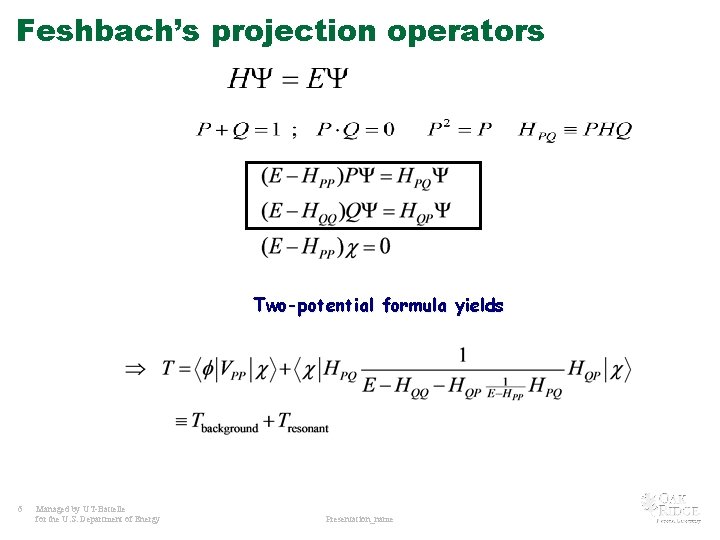
Feshbach’s projection operators Two-potential formula yields 6 Managed by UT-Battelle for the U. S. Department of Energy Presentation_name
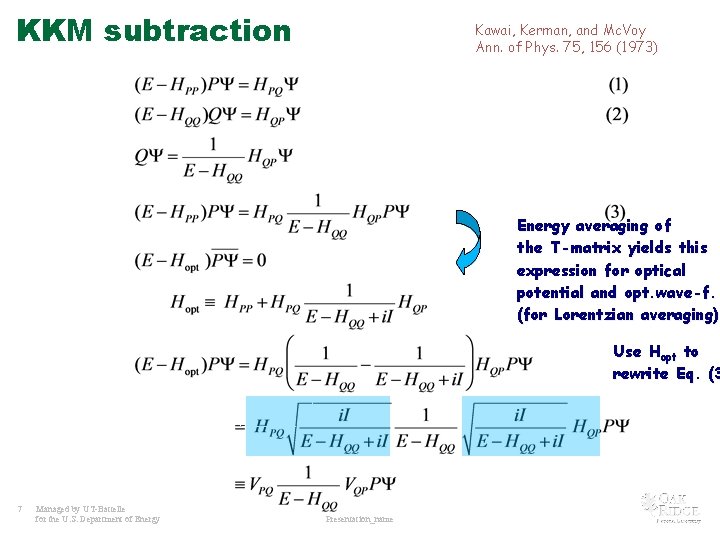
KKM subtraction Kawai, Kerman, and Mc. Voy Ann. of Phys. 75, 156 (1973) Energy averaging of the T-matrix yields this expression for optical potential and opt. wave-f. (for Lorentzian averaging) Use Hopt to rewrite Eq. (3 7 Managed by UT-Battelle for the U. S. Department of Energy Presentation_name
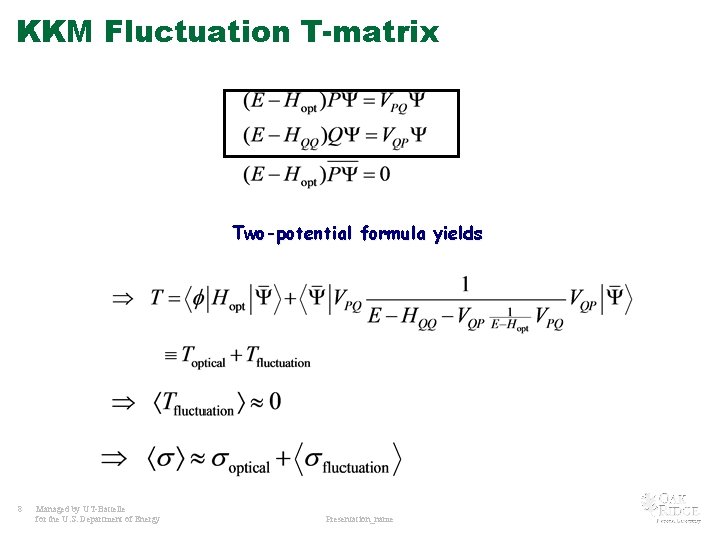
KKM Fluctuation T-matrix Two-potential formula yields 8 Managed by UT-Battelle for the U. S. Department of Energy Presentation_name
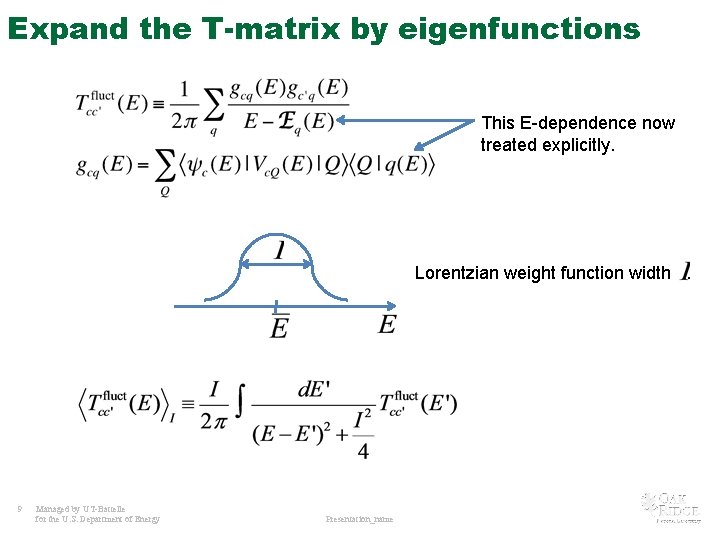
Expand the T-matrix by eigenfunctions This E-dependence now treated explicitly. Lorentzian weight function width. 9 Managed by UT-Battelle for the U. S. Department of Energy Presentation_name
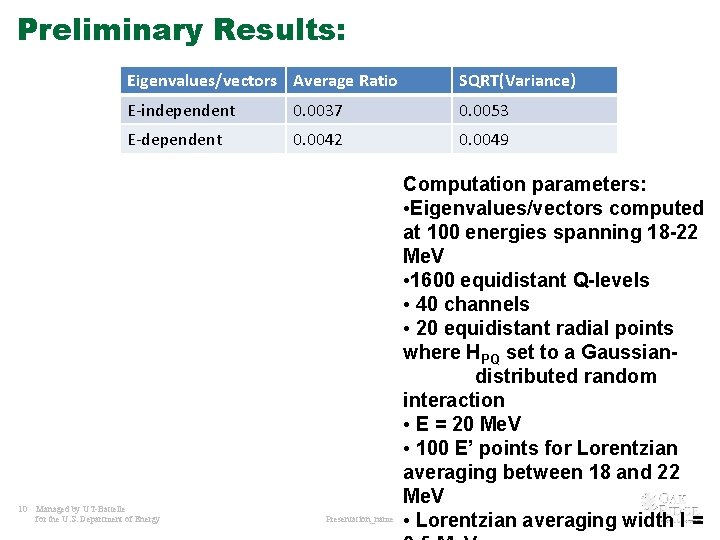
Preliminary Results: 10 Eigenvalues/vectors Average Ratio SQRT(Variance) E-independent 0. 0037 0. 0053 E-dependent 0. 0042 0. 0049 Managed by UT-Battelle for the U. S. Department of Energy Presentation_name Computation parameters: • Eigenvalues/vectors computed at 100 energies spanning 18 -22 Me. V • 1600 equidistant Q-levels • 40 channels • 20 equidistant radial points where HPQ set to a Gaussiandistributed random interaction • E = 20 Me. V • 100 E’ points for Lorentzian averaging between 18 and 22 Me. V • Lorentzian averaging width I =
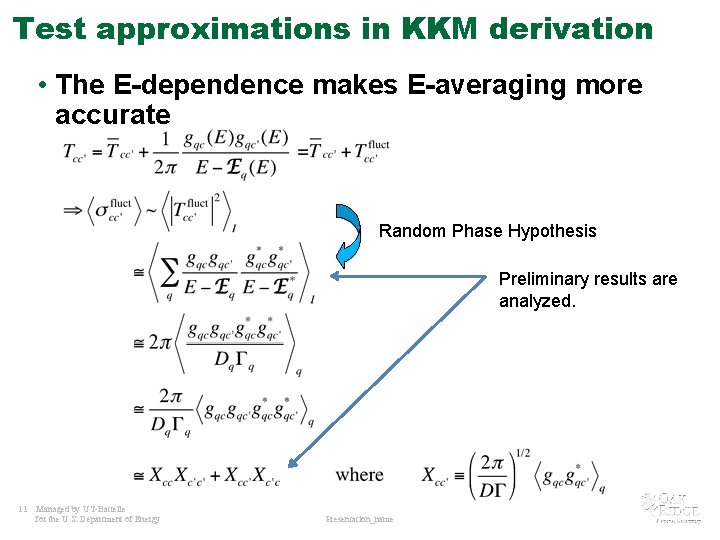
Test approximations in KKM derivation • The E-dependence makes E-averaging more accurate Random Phase Hypothesis Preliminary results are analyzed. 11 Managed by UT-Battelle for the U. S. Department of Energy Presentation_name
HPC progress report (by K. Roche) 12 Managed by UT-Battelle for the U. S. Department of Energy Presentation_name
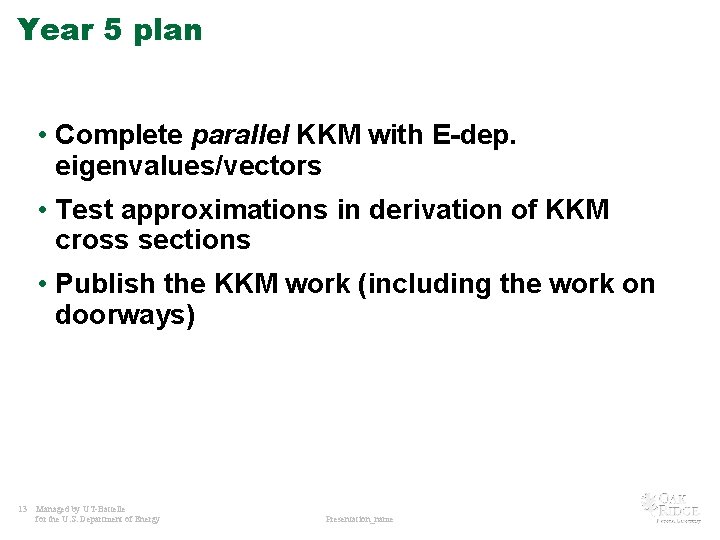
Year 5 plan • Complete parallel KKM with E-dep. eigenvalues/vectors • Test approximations in derivation of KKM cross sections • Publish the KKM work (including the work on doorways) 13 Managed by UT-Battelle for the U. S. Department of Energy Presentation_name