
Statistical NLP Spring 2011 Lecture 4 Speech Recognition

![Part of [ae] waveform from “had” § Note complex wave repeating nine times in](https://slidetodoc.com/presentation_image/8bc6f3cef234aede56d17ecb048ffbec/image-18.jpg "Part of [ae] waveform from “had” § Note complex wave repeating nine times in")
![Vowel [i] sung at successively higher pitches F#2 A 2 C 3 F#3 A](https://slidetodoc.com/presentation_image/8bc6f3cef234aede56d17ecb048ffbec/image-21.jpg "Vowel [i] sung at successively higher pitches F#2 A 2 C 3 F#3 A")

- Slides: 30
Statistical NLP Spring 2011 Lecture 4: Speech Recognition Dan Klein – UC Berkeley
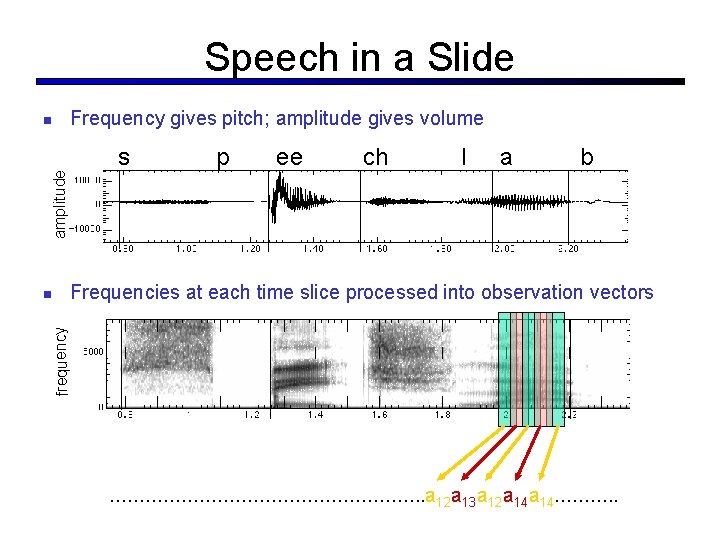
Speech in a Slide Frequency gives pitch; amplitude gives volume s amplitude ee ch l a b Frequencies at each time slice processed into observation vectors frequency p ………………………. . a 12 a 13 a 12 a 14………. .
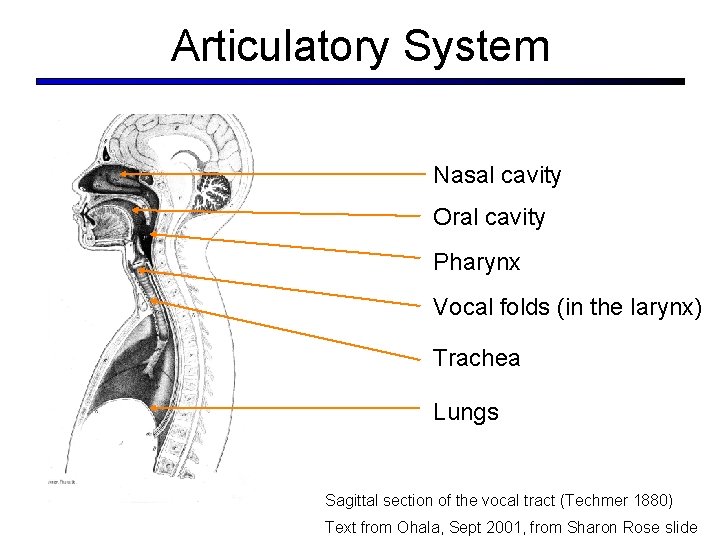
Articulatory System Nasal cavity Oral cavity Pharynx Vocal folds (in the larynx) Trachea Lungs Sagittal section of the vocal tract (Techmer 1880) Text from Ohala, Sept 2001, from Sharon Rose slide
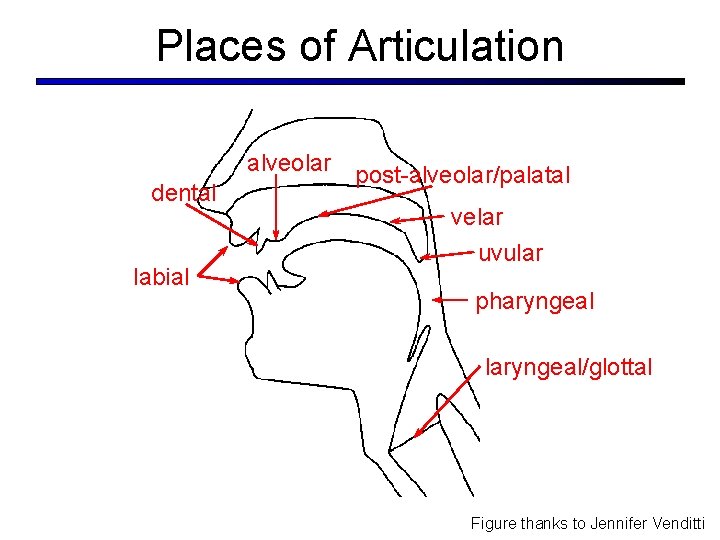
Places of Articulation dental labial alveolar post-alveolar/palatal velar uvular pharyngeal laryngeal/glottal Figure thanks to Jennifer Venditti
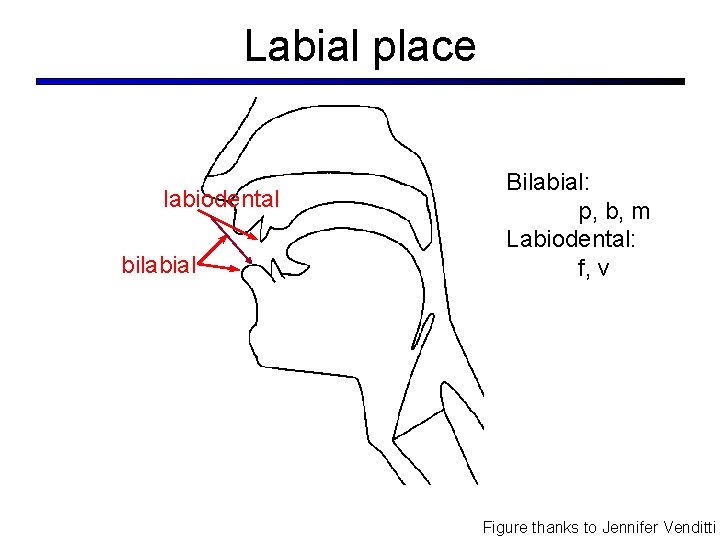
Labial place labiodental bilabial Bilabial: p, b, m Labiodental: f, v Figure thanks to Jennifer Venditti
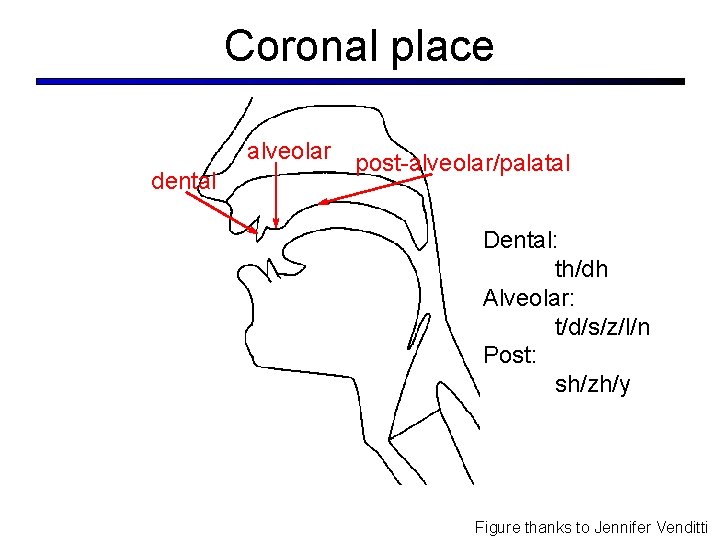
Coronal place dental alveolar post-alveolar/palatal Dental: th/dh Alveolar: t/d/s/z/l/n Post: sh/zh/y Figure thanks to Jennifer Venditti
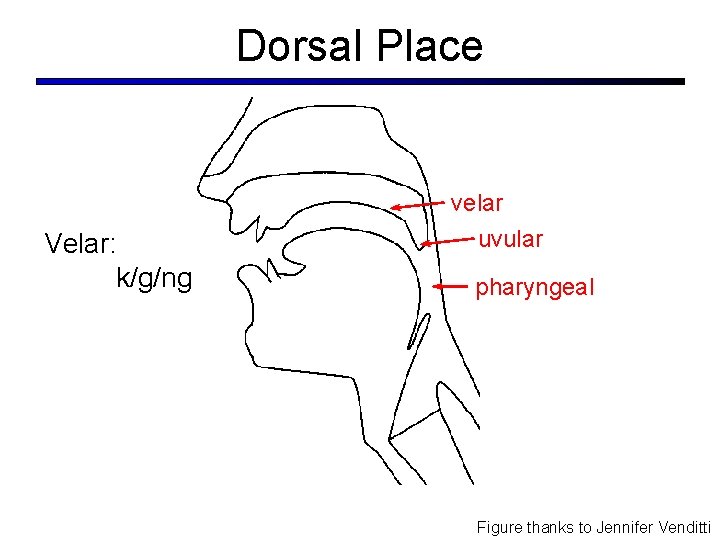
Dorsal Place Velar: k/g/ng velar uvular pharyngeal Figure thanks to Jennifer Venditti
Space of Phonemes § Standard international phonetic alphabet (IPA) chart of consonants
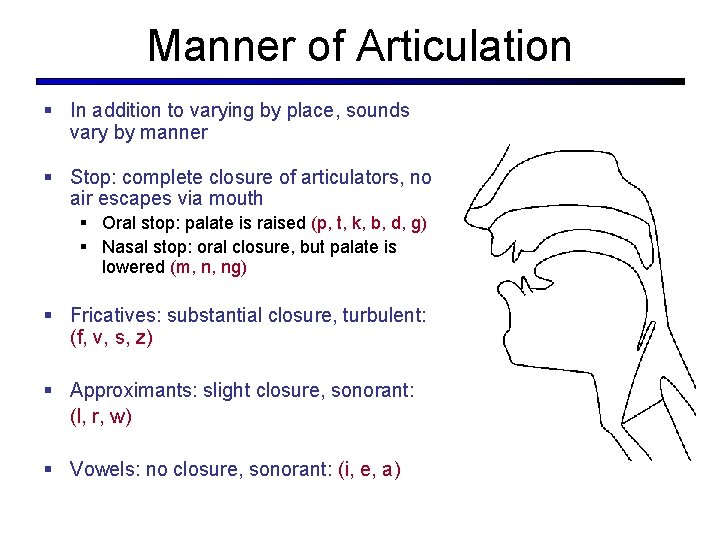
Manner of Articulation § In addition to varying by place, sounds vary by manner § Stop: complete closure of articulators, no air escapes via mouth § Oral stop: palate is raised (p, t, k, b, d, g) § Nasal stop: oral closure, but palate is lowered (m, n, ng) § Fricatives: substantial closure, turbulent: (f, v, s, z) § Approximants: slight closure, sonorant: (l, r, w) § Vowels: no closure, sonorant: (i, e, a)
Space of Phonemes § Standard international phonetic alphabet (IPA) chart of consonants
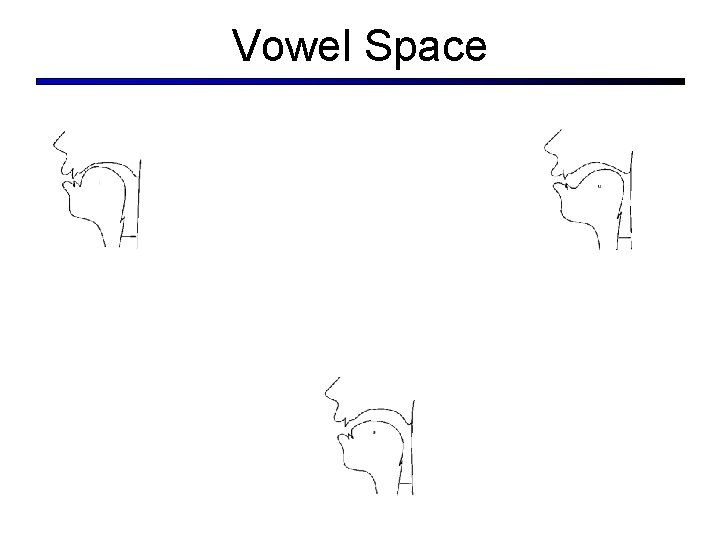
Vowel Space
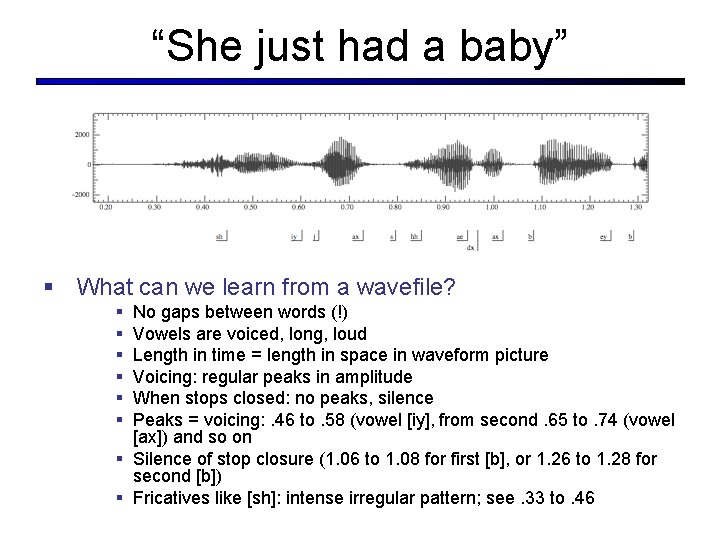
“She just had a baby” § What can we learn from a wavefile? § § § No gaps between words (!) Vowels are voiced, long, loud Length in time = length in space in waveform picture Voicing: regular peaks in amplitude When stops closed: no peaks, silence Peaks = voicing: . 46 to. 58 (vowel [iy], from second. 65 to. 74 (vowel [ax]) and so on § Silence of stop closure (1. 06 to 1. 08 for first [b], or 1. 26 to 1. 28 for second [b]) § Fricatives like [sh]: intense irregular pattern; see. 33 to. 46
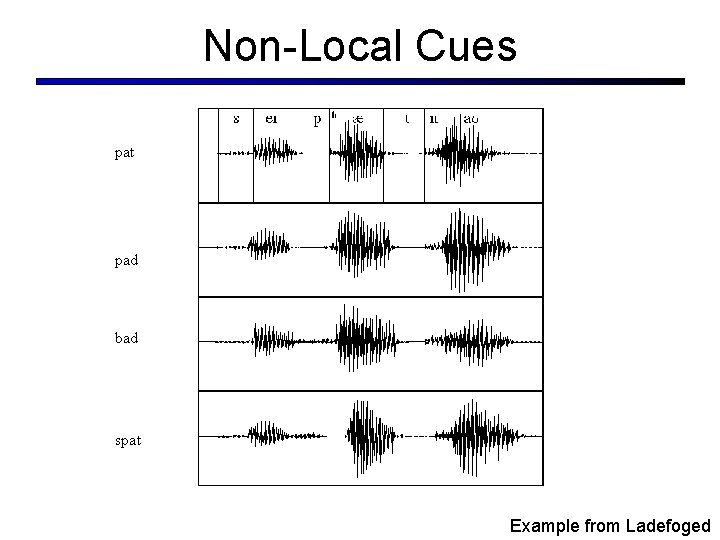
Non-Local Cues pat pad bad spat Example from Ladefoged
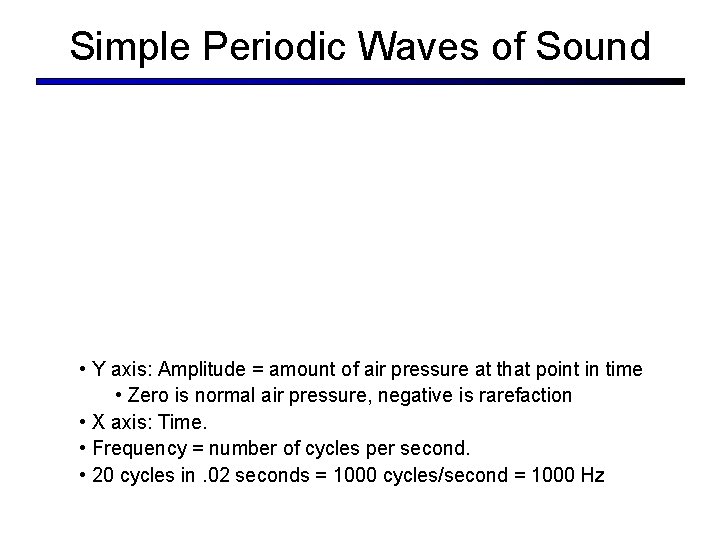
Simple Periodic Waves of Sound • Y axis: Amplitude = amount of air pressure at that point in time • Zero is normal air pressure, negative is rarefaction • X axis: Time. • Frequency = number of cycles per second. • 20 cycles in. 02 seconds = 1000 cycles/second = 1000 Hz
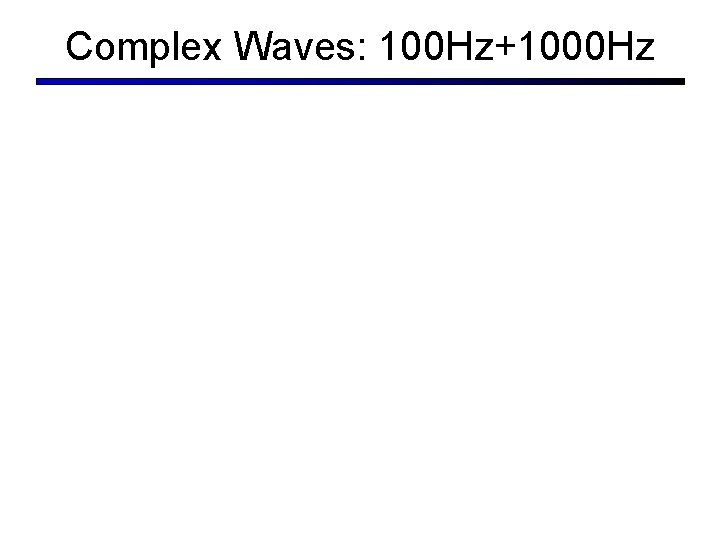
Complex Waves: 100 Hz+1000 Hz
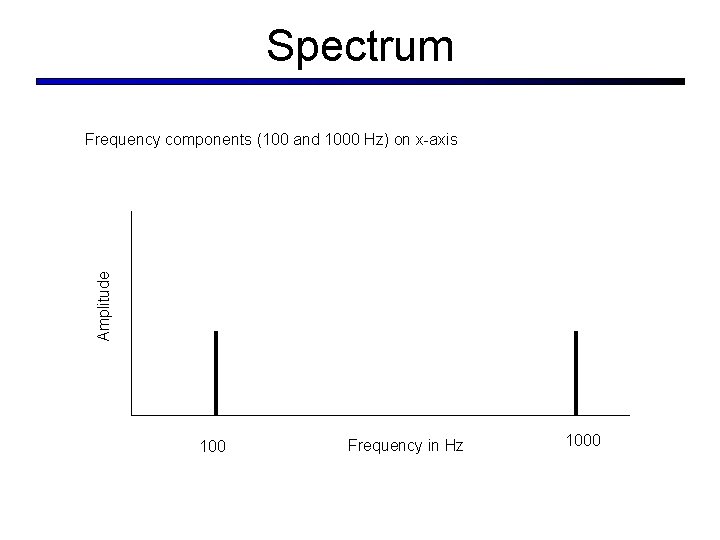
Spectrum Amplitude Frequency components (100 and 1000 Hz) on x-axis 100 Frequency in Hz 1000
Spectrum of an Actual Soundwave
Part of [ae] waveform from “had” § Note complex wave repeating nine times in figure § Plus smaller waves which repeats 4 times for every large pattern § Large wave has frequency of 250 Hz (9 times in. 036 seconds) § Small wave roughly 4 times this, or roughly 1000 Hz § Two little tiny waves on top of peak of 1000 Hz waves
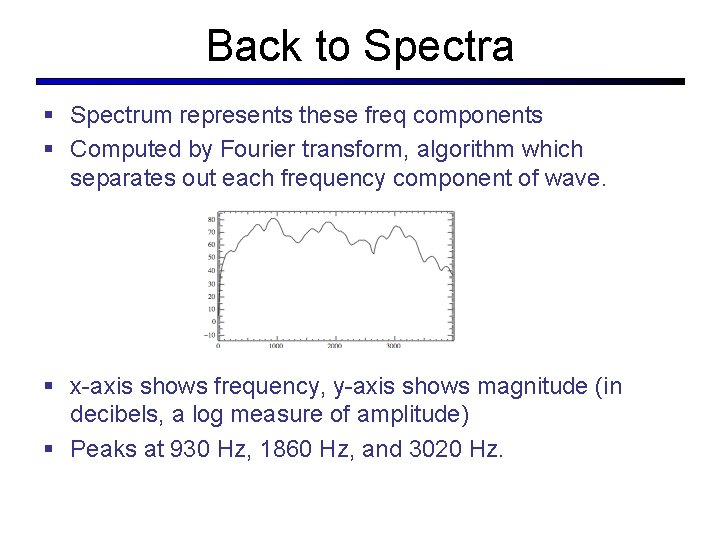
Back to Spectra § Spectrum represents these freq components § Computed by Fourier transform, algorithm which separates out each frequency component of wave. § x-axis shows frequency, y-axis shows magnitude (in decibels, a log measure of amplitude) § Peaks at 930 Hz, 1860 Hz, and 3020 Hz.
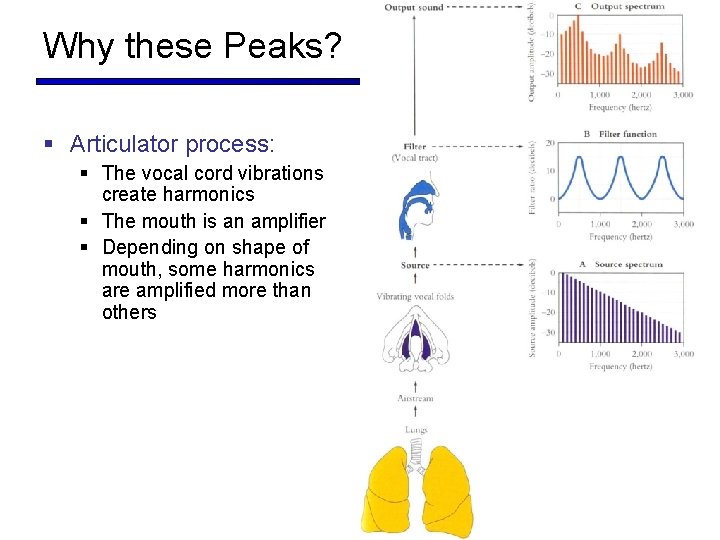
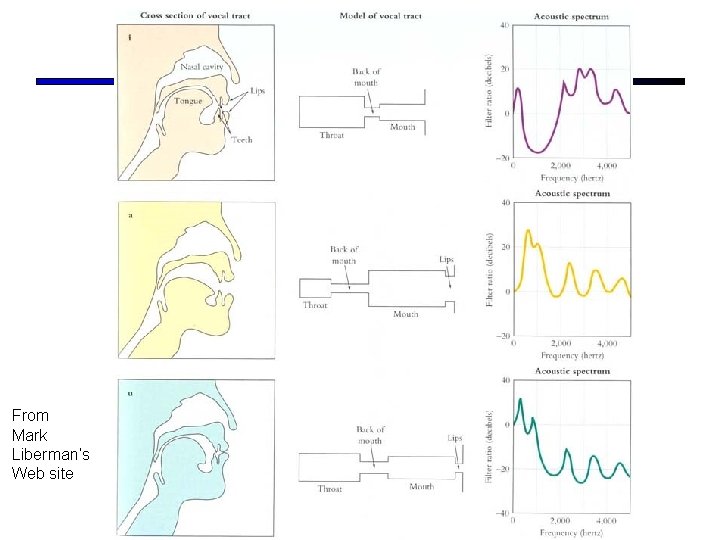
Why these Peaks? § Articulator process: § The vocal cord vibrations create harmonics § The mouth is an amplifier § Depending on shape of mouth, some harmonics are amplified more than others
Vowel [i] sung at successively higher pitches F#2 A 2 C 3 F#3 A 3 C 4 (middle C) A 4 Figures from Ratree Wayland
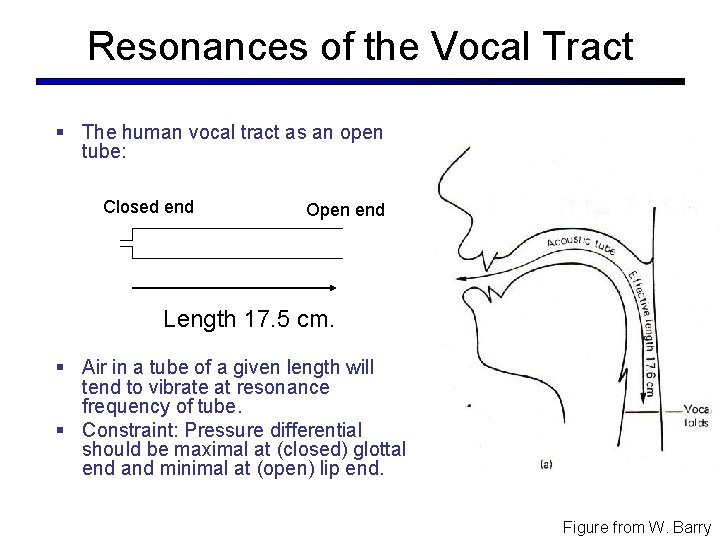
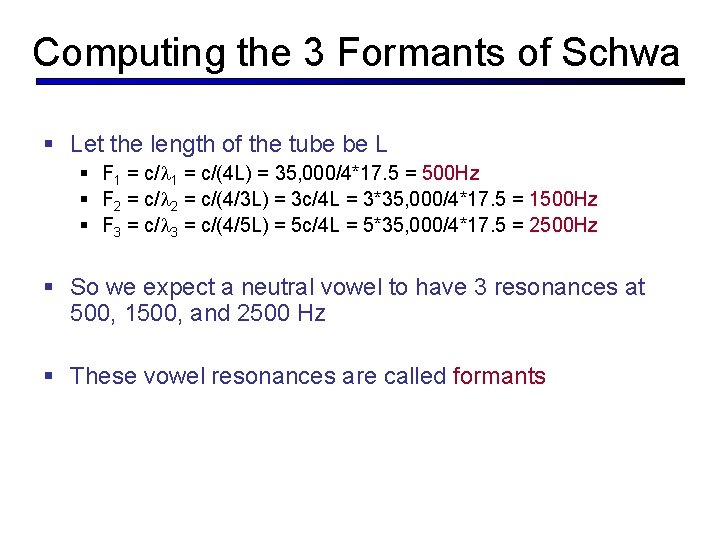
Resonances of the Vocal Tract § The human vocal tract as an open tube: Closed end Open end Length 17. 5 cm. § Air in a tube of a given length will tend to vibrate at resonance frequency of tube. § Constraint: Pressure differential should be maximal at (closed) glottal end and minimal at (open) lip end. Figure from W. Barry
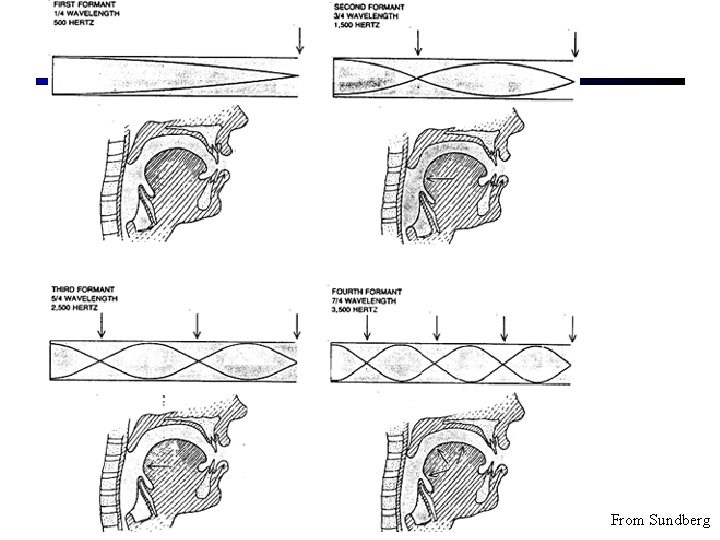
From Sundberg
Computing the 3 Formants of Schwa § Let the length of the tube be L § F 1 = c/(4 L) = 35, 000/4*17. 5 = 500 Hz § F 2 = c/(4/3 L) = 3 c/4 L = 3*35, 000/4*17. 5 = 1500 Hz § F 3 = c/(4/5 L) = 5 c/4 L = 5*35, 000/4*17. 5 = 2500 Hz § So we expect a neutral vowel to have 3 resonances at 500, 1500, and 2500 Hz § These vowel resonances are called formants
From Mark Liberman’s Web site
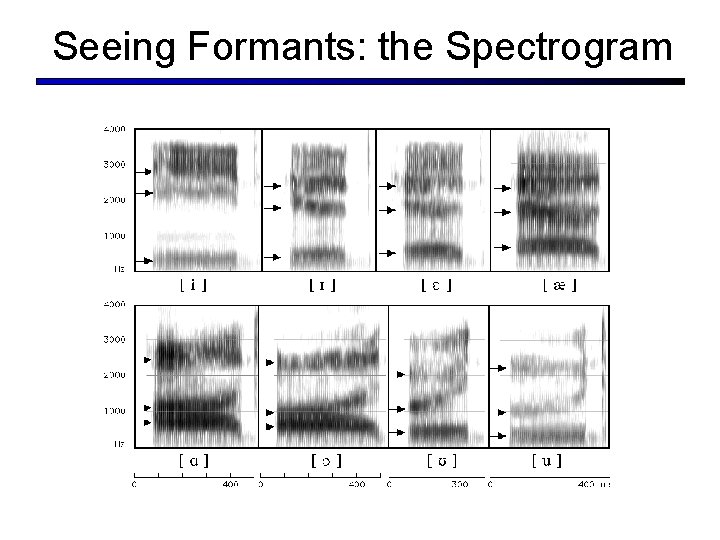
Seeing Formants: the Spectrogram
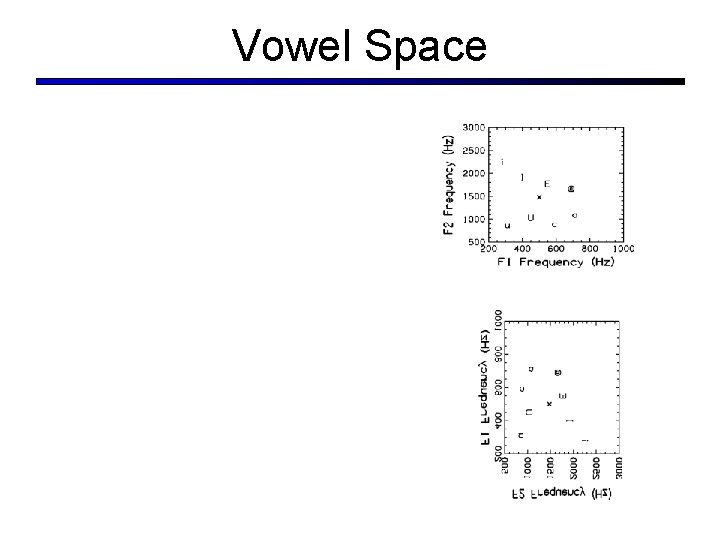
Vowel Space
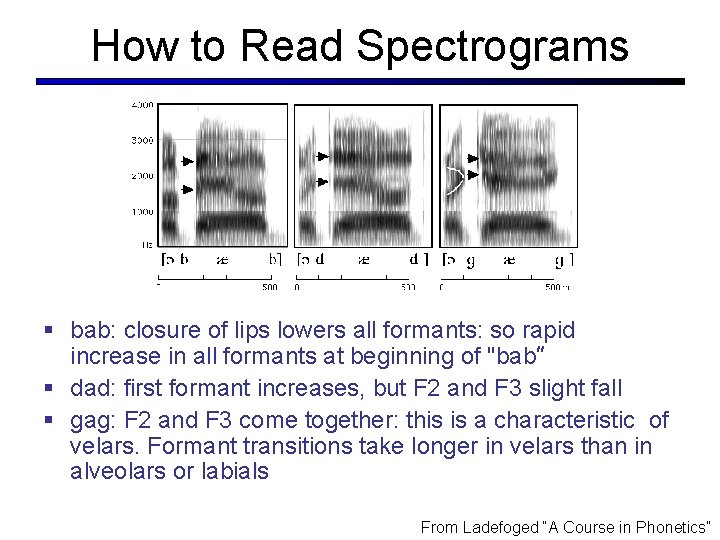
How to Read Spectrograms § bab: closure of lips lowers all formants: so rapid increase in all formants at beginning of "bab” § dad: first formant increases, but F 2 and F 3 slight fall § gag: F 2 and F 3 come together: this is a characteristic of velars. Formant transitions take longer in velars than in alveolars or labials From Ladefoged “A Course in Phonetics”
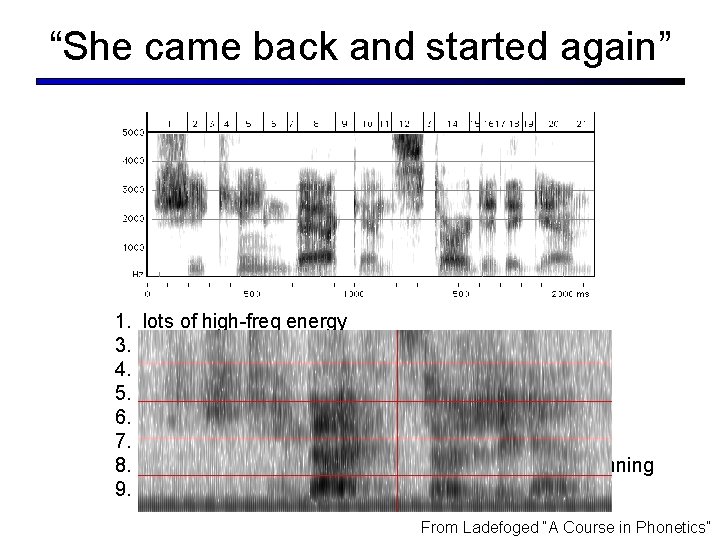
“She came back and started again” 1. 3. 4. 5. 6. 7. 8. 9. lots of high-freq energy closure for k burst of aspiration for k ey vowel; faint 1100 Hz formant is nasalization bilabial nasal short b closure, voicing barely visible. ae; note upward transitions after bilabial stop at beginning note F 2 and F 3 coming together for "k" From Ladefoged “A Course in Phonetics”