
Statistical NLP Spring 2010 Lecture 2 Language Models
- Slides: 51
Statistical NLP Spring 2010 Lecture 2: Language Models Dan Klein – UC Berkeley
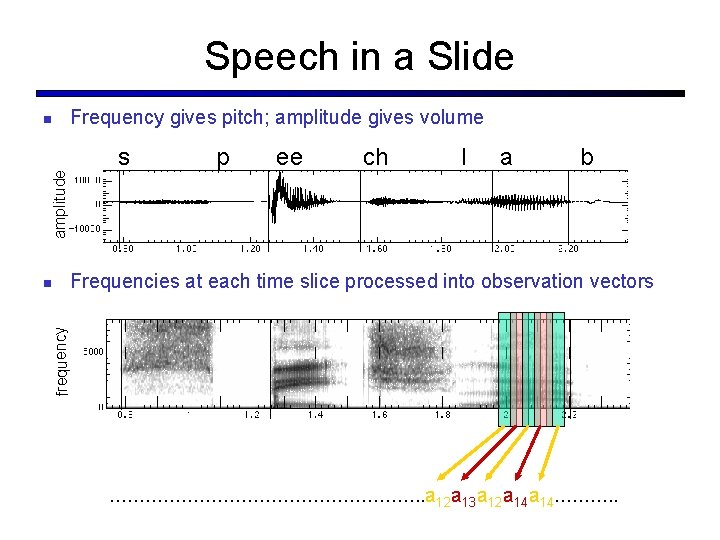
Speech in a Slide Frequency gives pitch; amplitude gives volume s amplitude ee ch l a b Frequencies at each time slice processed into observation vectors frequency p ………………………. . a 12 a 13 a 12 a 14………. .
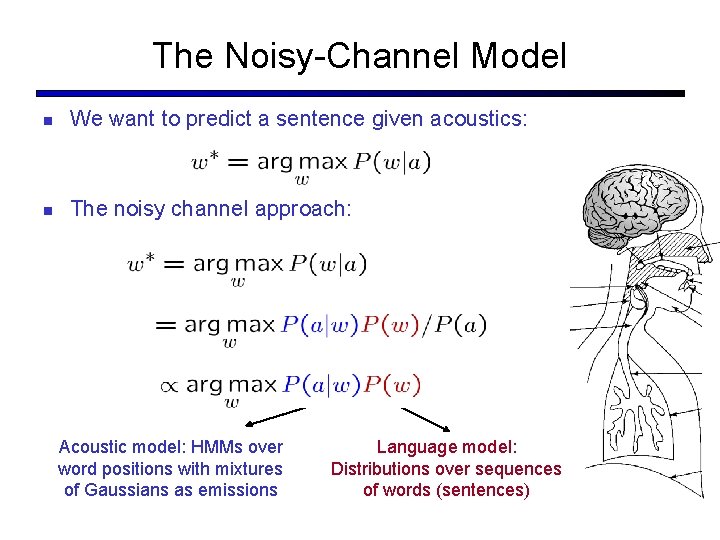
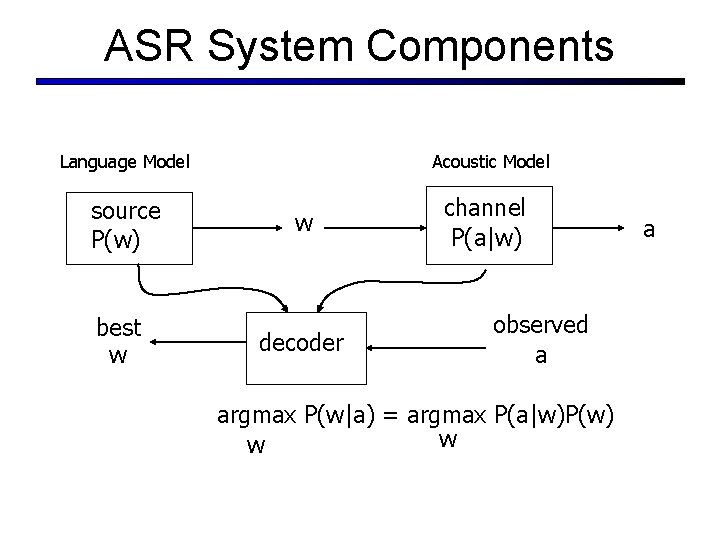
The Noisy-Channel Model We want to predict a sentence given acoustics: The noisy channel approach: Acoustic model: HMMs over word positions with mixtures of Gaussians as emissions Language model: Distributions over sequences of words (sentences)
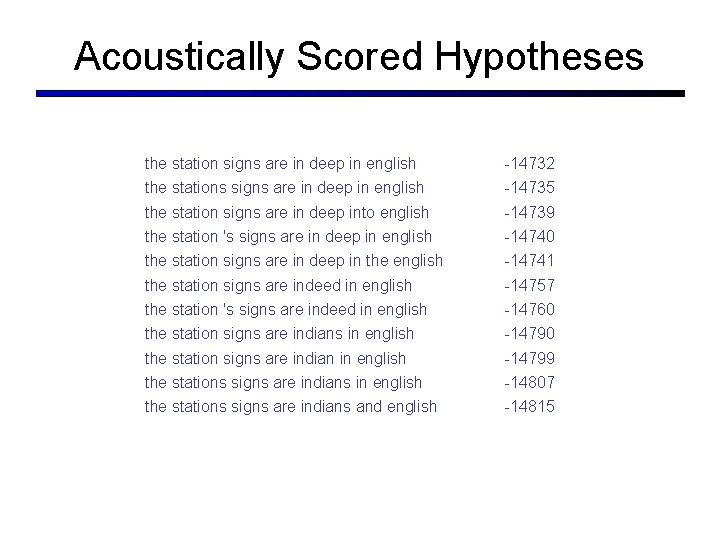
Acoustically Scored Hypotheses the station signs are in deep in english -14732 the stations signs are in deep in english -14735 the station signs are in deep into english -14739 the station 's signs are in deep in english -14740 the station signs are in deep in the english -14741 the station signs are indeed in english -14757 the station 's signs are indeed in english -14760 the station signs are indians in english -14790 the station signs are indian in english -14799 the stations signs are indians in english -14807 the stations signs are indians and english -14815
ASR System Components Language Model source P(w) best w Acoustic Model w decoder channel P(a|w) observed a argmax P(w|a) = argmax P(a|w)P(w) w w a
Translation: Codebreaking? § “Also knowing nothing official about, but having guessed and inferred considerable about, the powerful new mechanized methods in cryptography —methods which I believe succeed even when one does not know what language has been coded—one naturally wonders if the problem of translation could conceivably be treated as a problem in cryptography. When I look at an article in Russian, I say: ‘This is really written in English, but it has been coded in some strange symbols. I will now proceed to decode. ’ ” § Warren Weaver (1955: 18, quoting a letter he wrote in 1947)
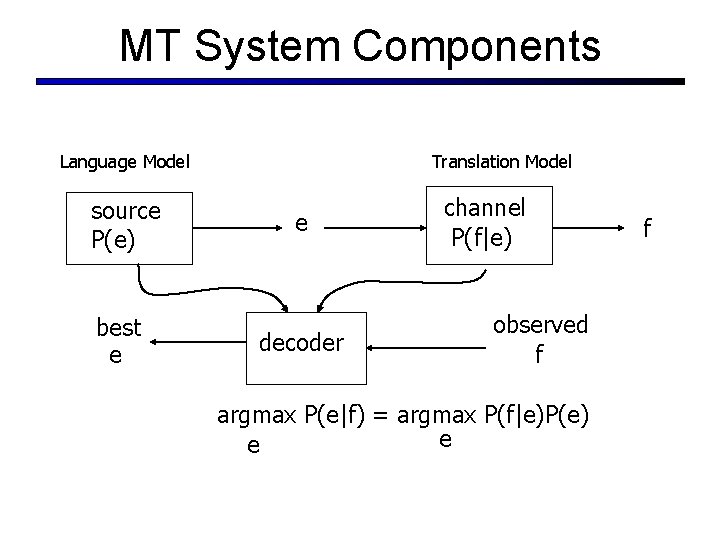
MT System Components Language Model source P(e) best e Translation Model e decoder channel P(f|e) observed f argmax P(e|f) = argmax P(f|e)P(e) e e f
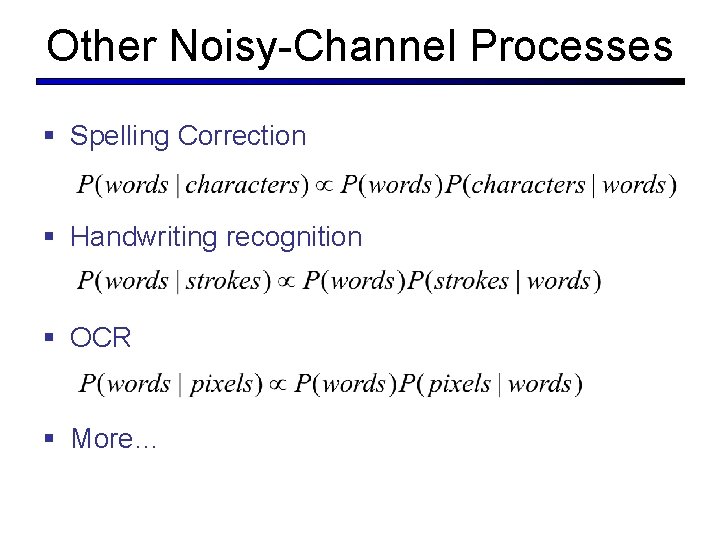
Other Noisy-Channel Processes § Spelling Correction § Handwriting recognition § OCR § More…
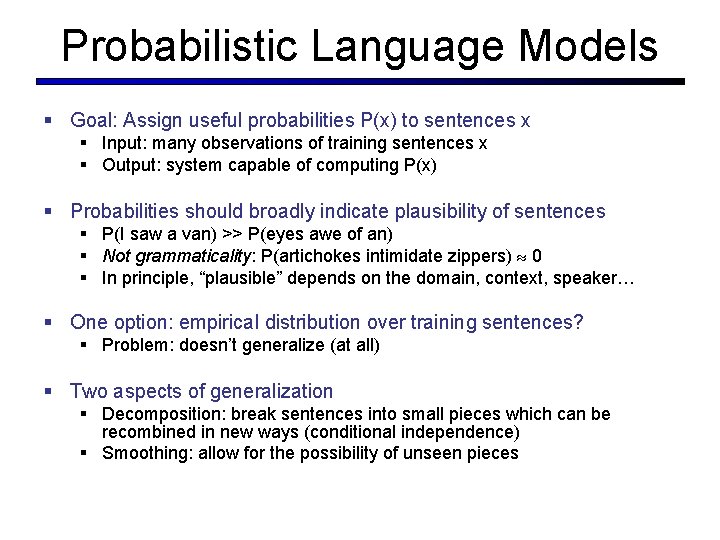
Probabilistic Language Models § Goal: Assign useful probabilities P(x) to sentences x § Input: many observations of training sentences x § Output: system capable of computing P(x) § Probabilities should broadly indicate plausibility of sentences § P(I saw a van) >> P(eyes awe of an) § Not grammaticality: P(artichokes intimidate zippers) 0 § In principle, “plausible” depends on the domain, context, speaker… § One option: empirical distribution over training sentences? § Problem: doesn’t generalize (at all) § Two aspects of generalization § Decomposition: break sentences into small pieces which can be recombined in new ways (conditional independence) § Smoothing: allow for the possibility of unseen pieces
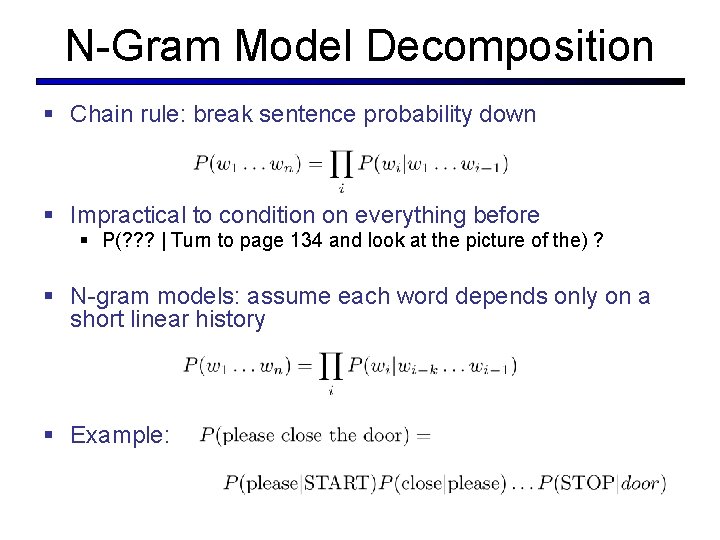
N-Gram Model Decomposition § Chain rule: break sentence probability down § Impractical to condition on everything before § P(? ? ? | Turn to page 134 and look at the picture of the) ? § N-gram models: assume each word depends only on a short linear history § Example:
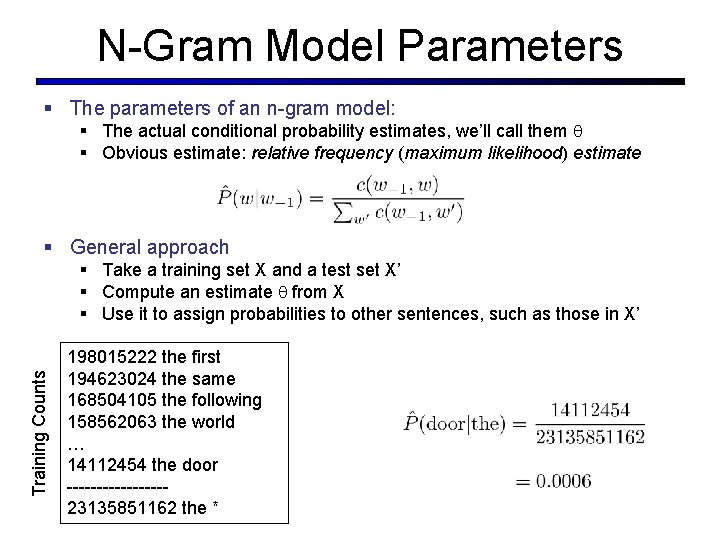
N-Gram Model Parameters § The parameters of an n-gram model: § The actual conditional probability estimates, we’ll call them § Obvious estimate: relative frequency (maximum likelihood) estimate § General approach Training Counts § Take a training set X and a test set X’ § Compute an estimate from X § Use it to assign probabilities to other sentences, such as those in X’ 198015222 the first 194623024 the same 168504105 the following 158562063 the world … 14112454 the door --------23135851162 the *
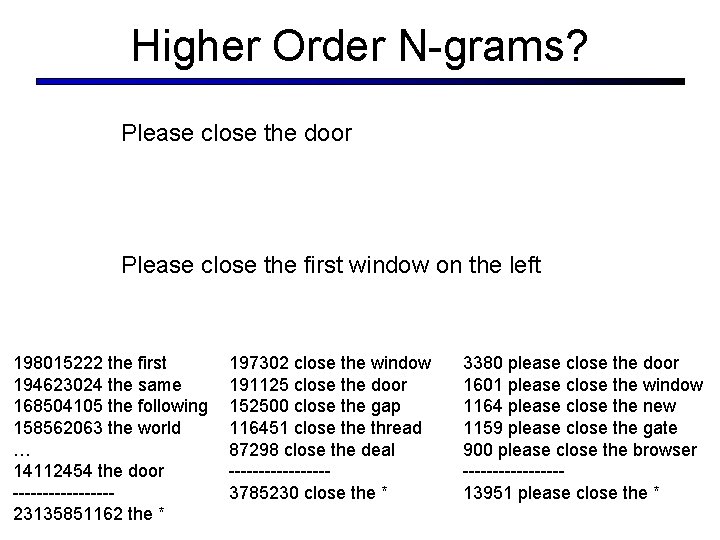
Higher Order N-grams? Please close the door Please close the first window on the left 198015222 the first 194623024 the same 168504105 the following 158562063 the world … 14112454 the door --------23135851162 the * 197302 close the window 191125 close the door 152500 close the gap 116451 close thread 87298 close the deal --------3785230 close the * 3380 please close the door 1601 please close the window 1164 please close the new 1159 please close the gate 900 please close the browser --------13951 please close the *
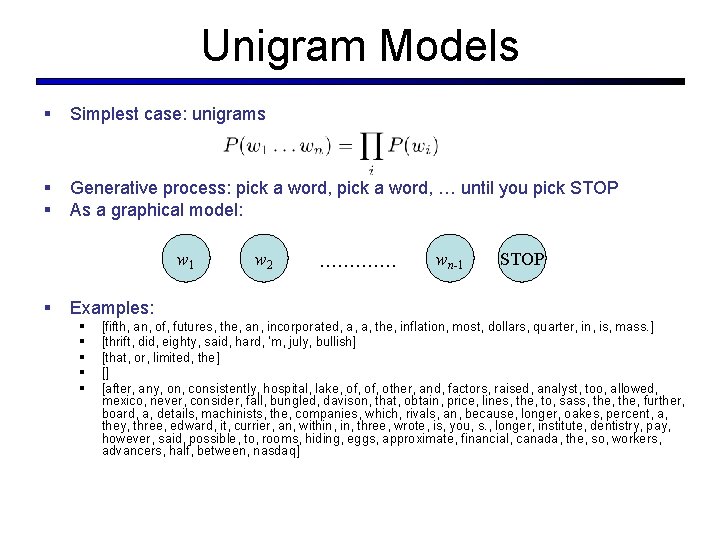
Unigram Models § Simplest case: unigrams § § Generative process: pick a word, … until you pick STOP As a graphical model: w 1 § w 2 …………. wn-1 STOP Examples: § § § [fifth, an, of, futures, the, an, incorporated, a, a, the, inflation, most, dollars, quarter, in, is, mass. ] [thrift, did, eighty, said, hard, 'm, july, bullish] [that, or, limited, the] [] [after, any, on, consistently, hospital, lake, of, other, and, factors, raised, analyst, too, allowed, mexico, never, consider, fall, bungled, davison, that, obtain, price, lines, the, to, sass, the, further, board, a, details, machinists, the, companies, which, rivals, an, because, longer, oakes, percent, a, they, three, edward, it, currier, an, within, three, wrote, is, you, s. , longer, institute, dentistry, pay, however, said, possible, to, rooms, hiding, eggs, approximate, financial, canada, the, so, workers, advancers, half, between, nasdaq]
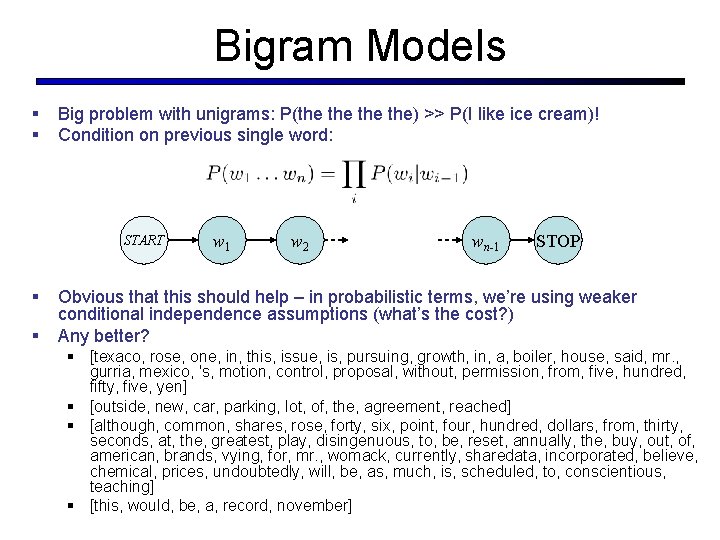
Bigram Models § § Big problem with unigrams: P(the the the) >> P(I like ice cream)! Condition on previous single word: START § § w 1 w 2 wn-1 STOP Obvious that this should help – in probabilistic terms, we’re using weaker conditional independence assumptions (what’s the cost? ) Any better? § [texaco, rose, one, in, this, issue, is, pursuing, growth, in, a, boiler, house, said, mr. , gurria, mexico, 's, motion, control, proposal, without, permission, from, five, hundred, fifty, five, yen] § [outside, new, car, parking, lot, of, the, agreement, reached] § [although, common, shares, rose, forty, six, point, four, hundred, dollars, from, thirty, seconds, at, the, greatest, play, disingenuous, to, be, reset, annually, the, buy, out, of, american, brands, vying, for, mr. , womack, currently, sharedata, incorporated, believe, chemical, prices, undoubtedly, will, be, as, much, is, scheduled, to, conscientious, teaching] § [this, would, be, a, record, november]
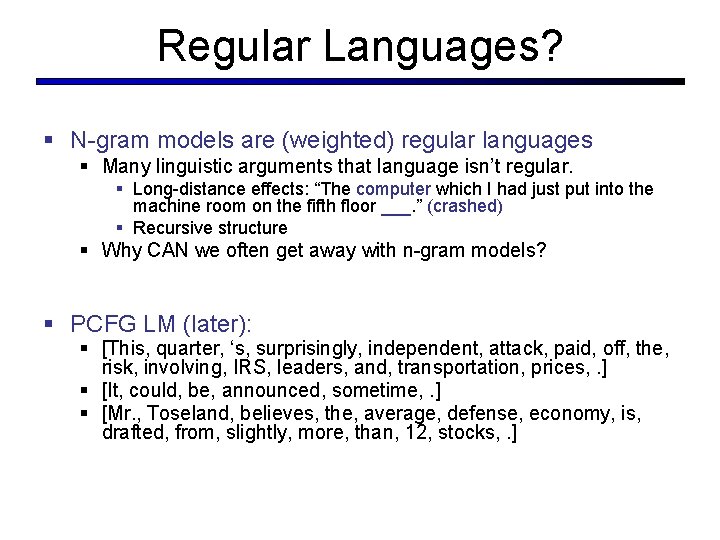
Regular Languages? § N-gram models are (weighted) regular languages § Many linguistic arguments that language isn’t regular. § Long-distance effects: “The computer which I had just put into the machine room on the fifth floor ___. ” (crashed) § Recursive structure § Why CAN we often get away with n-gram models? § PCFG LM (later): § [This, quarter, ‘s, surprisingly, independent, attack, paid, off, the, risk, involving, IRS, leaders, and, transportation, prices, . ] § [It, could, be, announced, sometime, . ] § [Mr. , Toseland, believes, the, average, defense, economy, is, drafted, from, slightly, more, than, 12, stocks, . ]
More N-Gram Examples
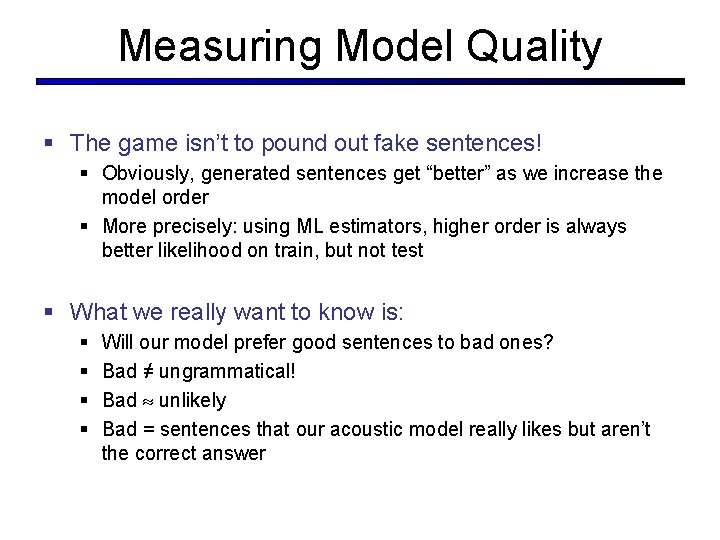
Measuring Model Quality § The game isn’t to pound out fake sentences! § Obviously, generated sentences get “better” as we increase the model order § More precisely: using ML estimators, higher order is always better likelihood on train, but not test § What we really want to know is: § § Will our model prefer good sentences to bad ones? Bad ≠ ungrammatical! Bad unlikely Bad = sentences that our acoustic model really likes but aren’t the correct answer
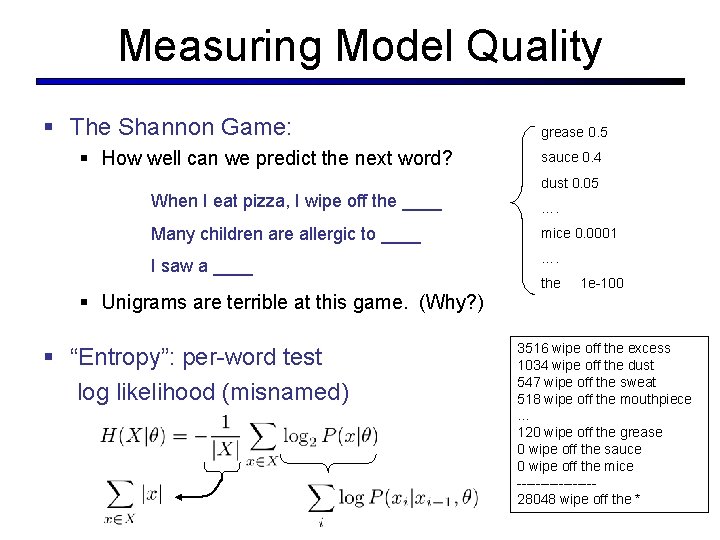
Measuring Model Quality § The Shannon Game: § How well can we predict the next word? grease 0. 5 sauce 0. 4 dust 0. 05 When I eat pizza, I wipe off the ____ …. Many children are allergic to ____ mice 0. 0001 I saw a ____ …. § Unigrams are terrible at this game. (Why? ) § “Entropy”: per-word test log likelihood (misnamed) the 1 e-100 3516 wipe off the excess 1034 wipe off the dust 547 wipe off the sweat 518 wipe off the mouthpiece … 120 wipe off the grease 0 wipe off the sauce 0 wipe off the mice --------28048 wipe off the *
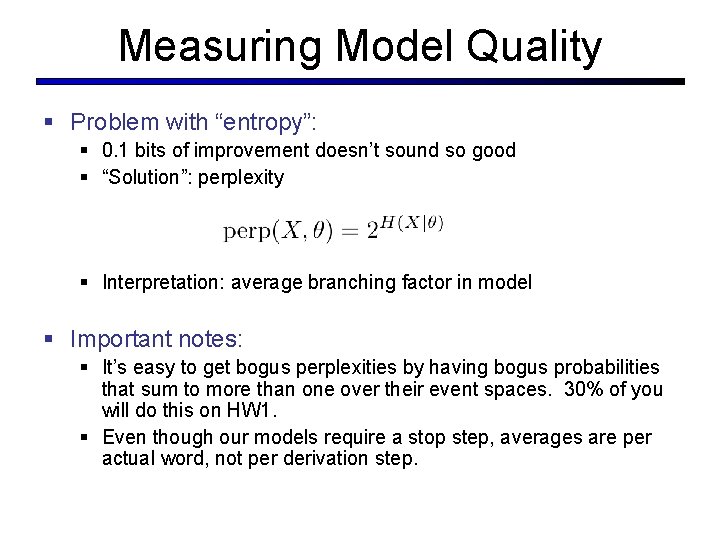
Measuring Model Quality § Problem with “entropy”: § 0. 1 bits of improvement doesn’t sound so good § “Solution”: perplexity § Interpretation: average branching factor in model § Important notes: § It’s easy to get bogus perplexities by having bogus probabilities that sum to more than one over their event spaces. 30% of you will do this on HW 1. § Even though our models require a stop step, averages are per actual word, not per derivation step.
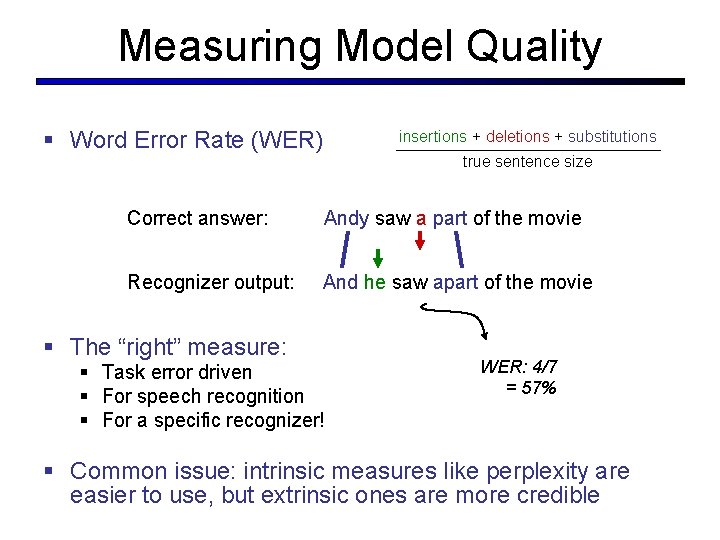
Measuring Model Quality § Word Error Rate (WER) insertions + deletions + substitutions true sentence size Correct answer: Andy saw a part of the movie Recognizer output: And he saw apart of the movie § The “right” measure: § Task error driven § For speech recognition § For a specific recognizer! WER: 4/7 = 57% § Common issue: intrinsic measures like perplexity are easier to use, but extrinsic ones are more credible
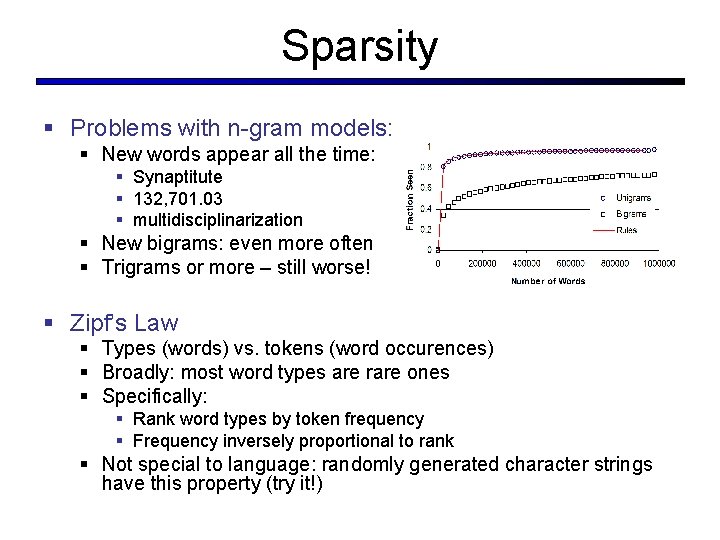
Sparsity § Problems with n-gram models: § New words appear all the time: § Synaptitute § 132, 701. 03 § multidisciplinarization § New bigrams: even more often § Trigrams or more – still worse! § Zipf’s Law § Types (words) vs. tokens (word occurences) § Broadly: most word types are rare ones § Specifically: § Rank word types by token frequency § Frequency inversely proportional to rank § Not special to language: randomly generated character strings have this property (try it!)
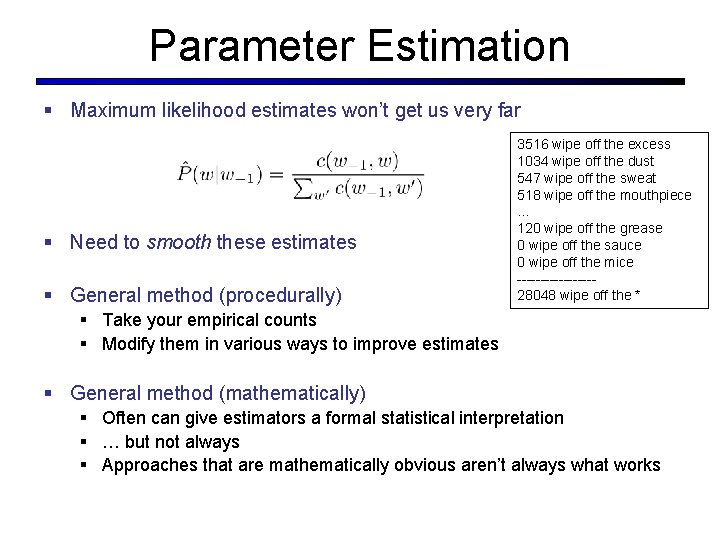
Parameter Estimation § Maximum likelihood estimates won’t get us very far § Need to smooth these estimates § General method (procedurally) 3516 wipe off the excess 1034 wipe off the dust 547 wipe off the sweat 518 wipe off the mouthpiece … 120 wipe off the grease 0 wipe off the sauce 0 wipe off the mice --------28048 wipe off the * § Take your empirical counts § Modify them in various ways to improve estimates § General method (mathematically) § Often can give estimators a formal statistical interpretation § … but not always § Approaches that are mathematically obvious aren’t always what works
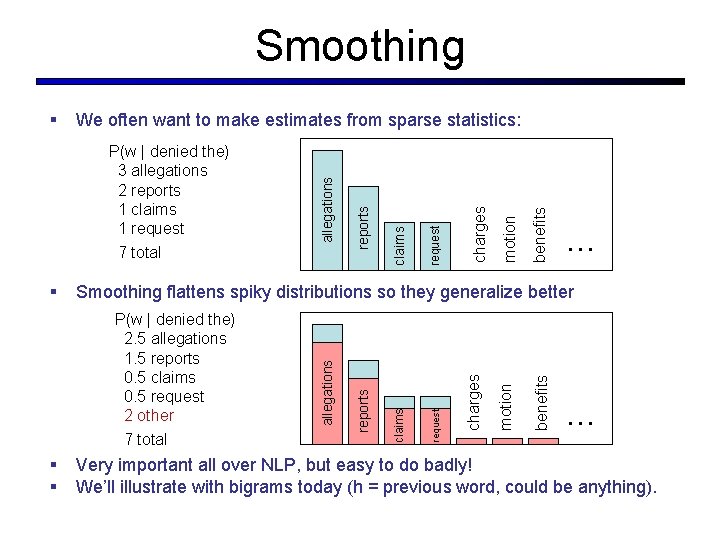
Smoothing benefits motion charges request claims reports P(w | denied the) 2. 5 allegations 1. 5 reports 0. 5 claims 0. 5 request 2 other 7 total § § … Smoothing flattens spiky distributions so they generalize better allegations § request 7 total claims P(w | denied the) 3 allegations 2 reports 1 claims 1 request reports We often want to make estimates from sparse statistics: allegations § … Very important all over NLP, but easy to do badly! We’ll illustrate with bigrams today (h = previous word, could be anything).
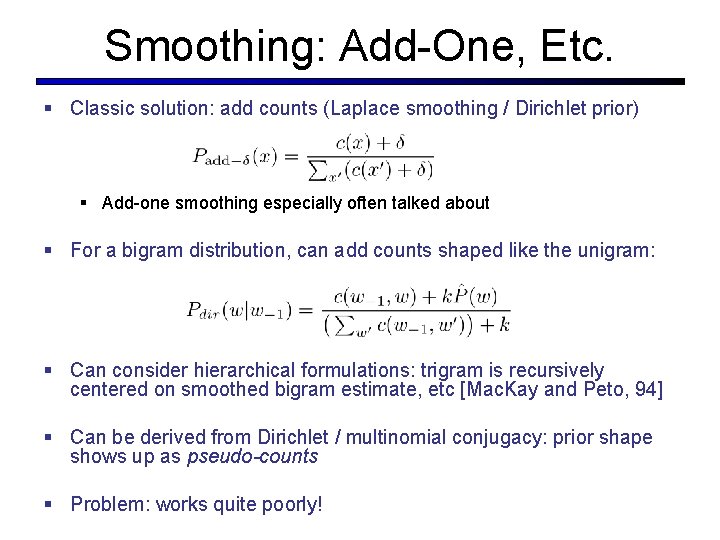
Smoothing: Add-One, Etc. § Classic solution: add counts (Laplace smoothing / Dirichlet prior) § Add-one smoothing especially often talked about § For a bigram distribution, can add counts shaped like the unigram: § Can consider hierarchical formulations: trigram is recursively centered on smoothed bigram estimate, etc [Mac. Kay and Peto, 94] § Can be derived from Dirichlet / multinomial conjugacy: prior shape shows up as pseudo-counts § Problem: works quite poorly!
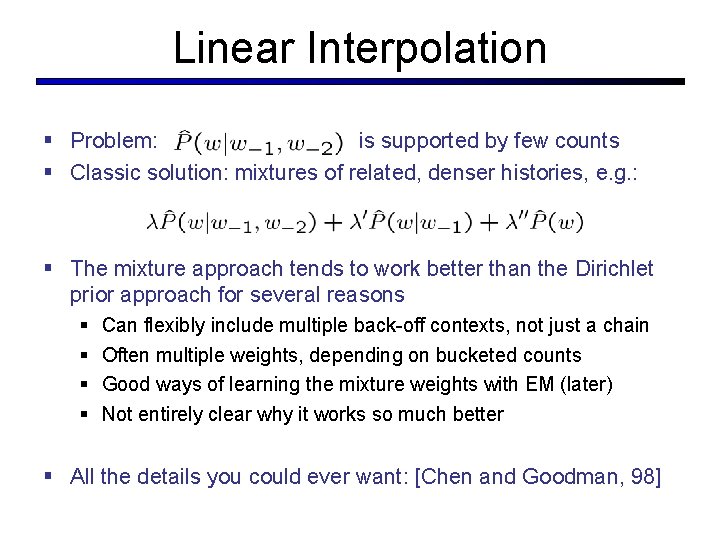
Linear Interpolation § Problem: is supported by few counts § Classic solution: mixtures of related, denser histories, e. g. : § The mixture approach tends to work better than the Dirichlet prior approach for several reasons § § Can flexibly include multiple back-off contexts, not just a chain Often multiple weights, depending on bucketed counts Good ways of learning the mixture weights with EM (later) Not entirely clear why it works so much better § All the details you could ever want: [Chen and Goodman, 98]
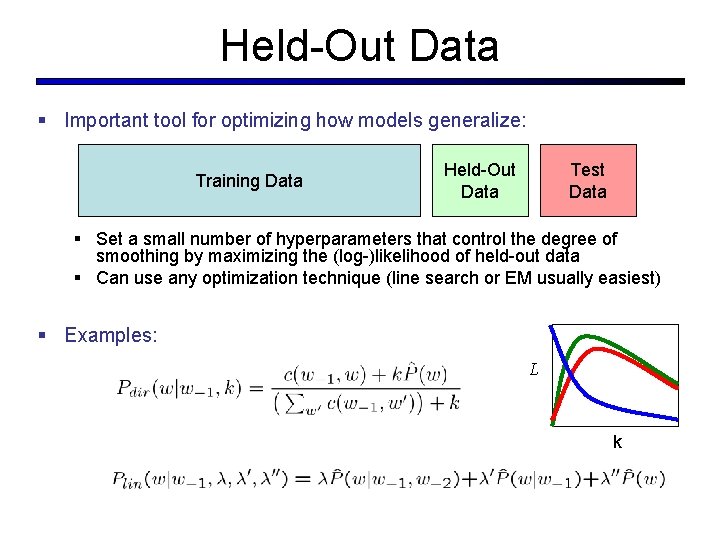
Held-Out Data § Important tool for optimizing how models generalize: Training Data Held-Out Data Test Data § Set a small number of hyperparameters that control the degree of smoothing by maximizing the (log-)likelihood of held-out data § Can use any optimization technique (line search or EM usually easiest) § Examples: L k
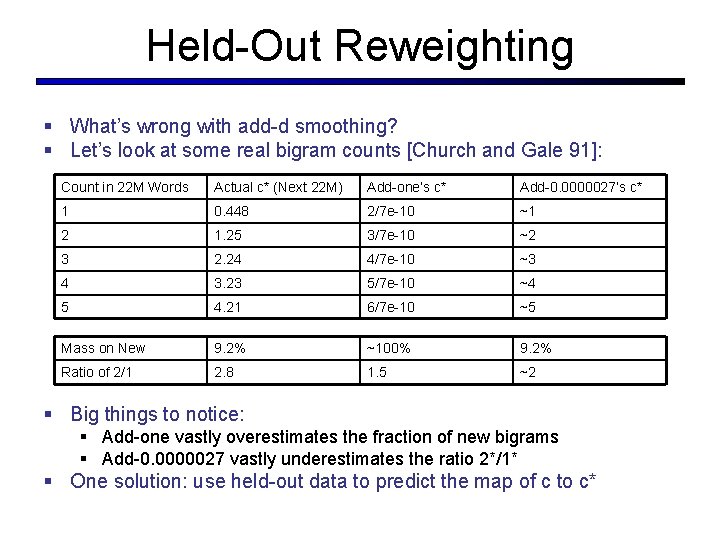
Held-Out Reweighting § What’s wrong with add-d smoothing? § Let’s look at some real bigram counts [Church and Gale 91]: Count in 22 M Words Actual c* (Next 22 M) Add-one’s c* Add-0. 0000027’s c* 1 0. 448 2/7 e-10 ~1 2 1. 25 3/7 e-10 ~2 3 2. 24 4/7 e-10 ~3 4 3. 23 5/7 e-10 ~4 5 4. 21 6/7 e-10 ~5 Mass on New 9. 2% ~100% 9. 2% Ratio of 2/1 2. 8 1. 5 ~2 § Big things to notice: § Add-one vastly overestimates the fraction of new bigrams § Add-0. 0000027 vastly underestimates the ratio 2*/1* § One solution: use held-out data to predict the map of c to c*
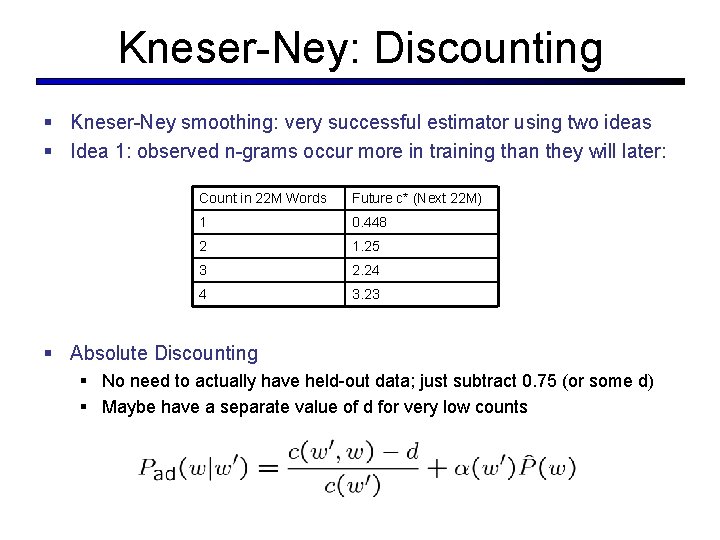
Kneser-Ney: Discounting § Kneser-Ney smoothing: very successful estimator using two ideas § Idea 1: observed n-grams occur more in training than they will later: Count in 22 M Words Future c* (Next 22 M) 1 0. 448 2 1. 25 3 2. 24 4 3. 23 § Absolute Discounting § No need to actually have held-out data; just subtract 0. 75 (or some d) § Maybe have a separate value of d for very low counts
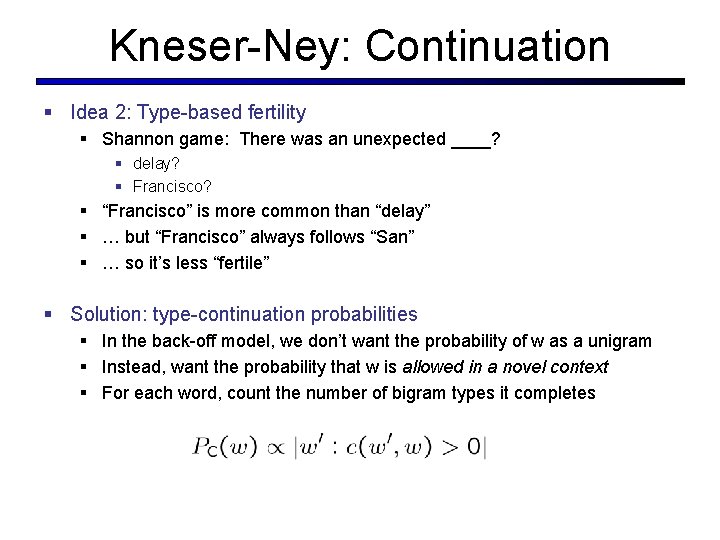
Kneser-Ney: Continuation § Idea 2: Type-based fertility § Shannon game: There was an unexpected ____? § delay? § Francisco? § “Francisco” is more common than “delay” § … but “Francisco” always follows “San” § … so it’s less “fertile” § Solution: type-continuation probabilities § In the back-off model, we don’t want the probability of w as a unigram § Instead, want the probability that w is allowed in a novel context § For each word, count the number of bigram types it completes
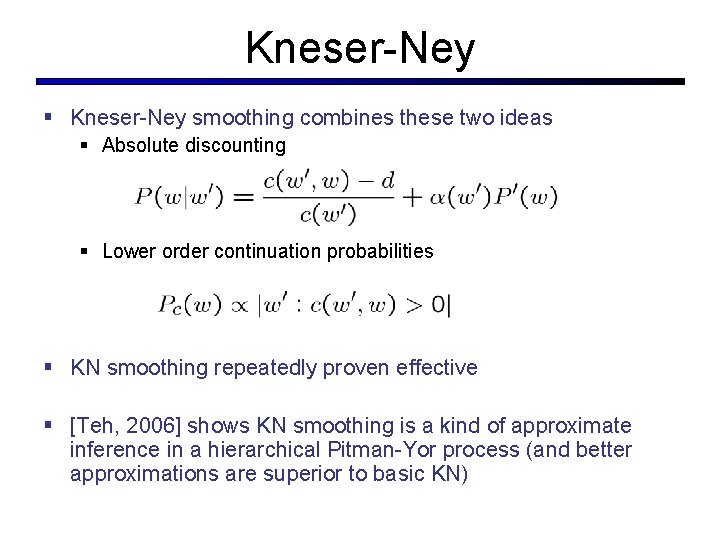
Kneser-Ney § Kneser-Ney smoothing combines these two ideas § Absolute discounting § Lower order continuation probabilities § KN smoothing repeatedly proven effective § [Teh, 2006] shows KN smoothing is a kind of approximate inference in a hierarchical Pitman-Yor process (and better approximations are superior to basic KN)
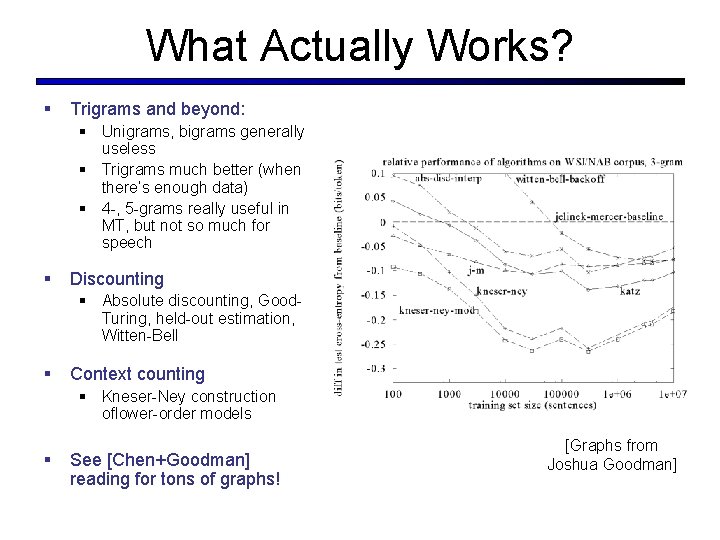
What Actually Works? § Trigrams and beyond: § Unigrams, bigrams generally useless § Trigrams much better (when there’s enough data) § 4 -, 5 -grams really useful in MT, but not so much for speech § Discounting § Absolute discounting, Good. Turing, held-out estimation, Witten-Bell § Context counting § Kneser-Ney construction oflower-order models § See [Chen+Goodman] reading for tons of graphs! [Graphs from Joshua Goodman]
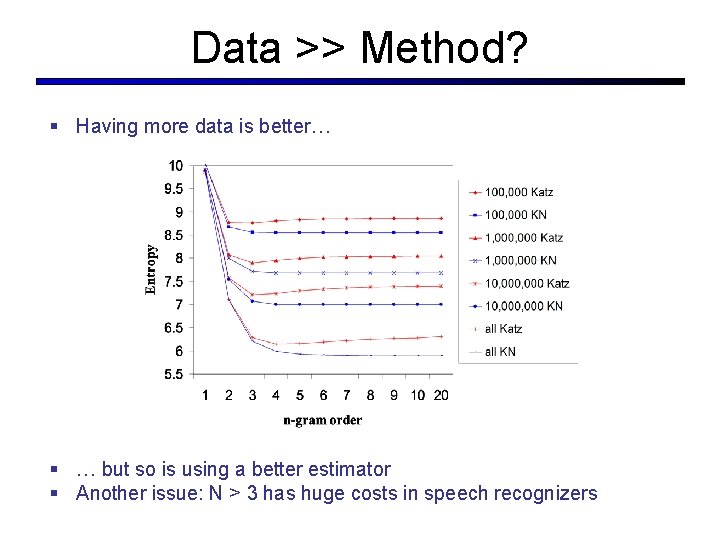
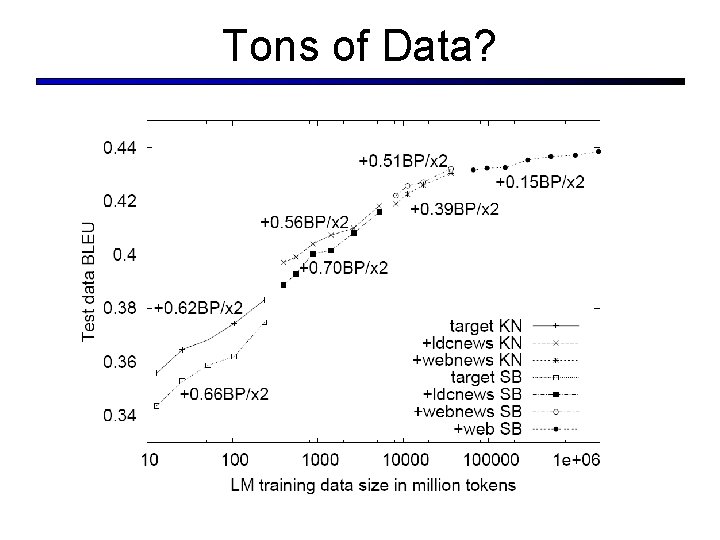
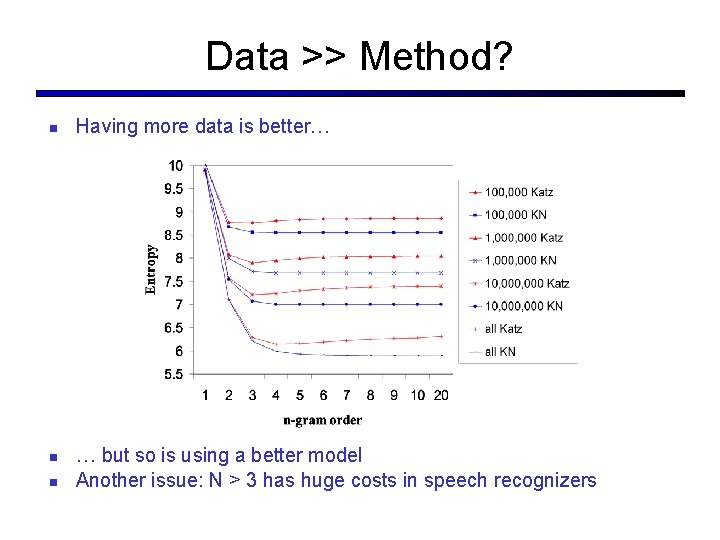
Data >> Method? § Having more data is better… § … but so is using a better estimator § Another issue: N > 3 has huge costs in speech recognizers
Tons of Data?
Beyond N-Gram LMs § Lots of ideas we won’t have time to discuss: § Caching models: recent words more likely to appear again § Trigger models: recent words trigger other words § Topic models § A few recent ideas § Syntactic models: use tree models to capture long-distance syntactic effects [Chelba and Jelinek, 98] § Discriminative models: set n-gram weights to improve final task accuracy rather than fit training set density [Roark, 05, for ASR; Liang et. al. , 06, for MT] § Structural zeros: some n-grams are syntactically forbidden, keep estimates at zero [Mohri and Roark, 06] § Bayesian document and IR models [Daume 06]
Overview § So far: language models give P(s) § Help model fluency for various noisy-channel processes (MT, ASR, etc. ) § N-gram models don’t represent any deep variables involved in language structure or meaning § Usually we want to know something about the input other than how likely it is (syntax, semantics, topic, etc) § Next: Naïve-Bayes models § We introduce a single new global variable § Still a very simplistic model family § Lets us model hidden properties of text, but only very non-local ones… § In particular, we can only model properties which are largely invariant to word order (like topic)
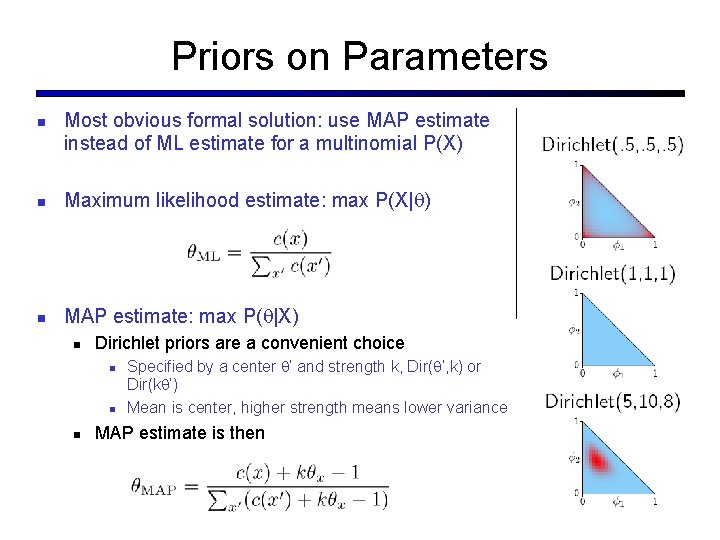
Priors on Parameters Most obvious formal solution: use MAP estimate instead of ML estimate for a multinomial P(X) Maximum likelihood estimate: max P(X| ) MAP estimate: max P( |X) Dirichlet priors are a convenient choice Specified by a center ’ and strength k, Dir( ’, k) or Dir(k ’) Mean is center, higher strength means lower variance MAP estimate is then
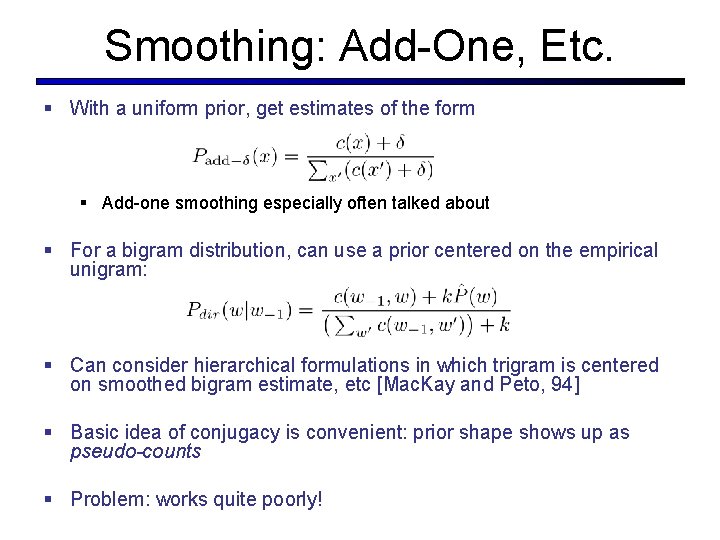
Smoothing: Add-One, Etc. § With a uniform prior, get estimates of the form § Add-one smoothing especially often talked about § For a bigram distribution, can use a prior centered on the empirical unigram: § Can consider hierarchical formulations in which trigram is centered on smoothed bigram estimate, etc [Mac. Kay and Peto, 94] § Basic idea of conjugacy is convenient: prior shape shows up as pseudo-counts § Problem: works quite poorly!
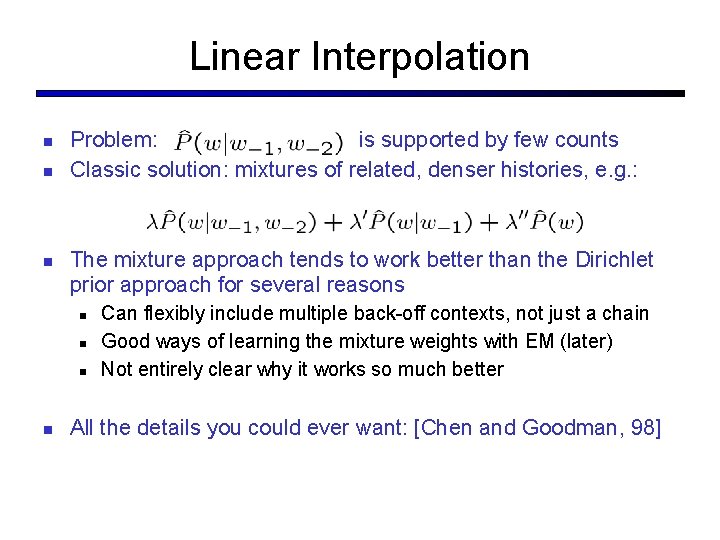
Linear Interpolation Problem: is supported by few counts Classic solution: mixtures of related, denser histories, e. g. : The mixture approach tends to work better than the Dirichlet prior approach for several reasons Can flexibly include multiple back-off contexts, not just a chain Good ways of learning the mixture weights with EM (later) Not entirely clear why it works so much better All the details you could ever want: [Chen and Goodman, 98]
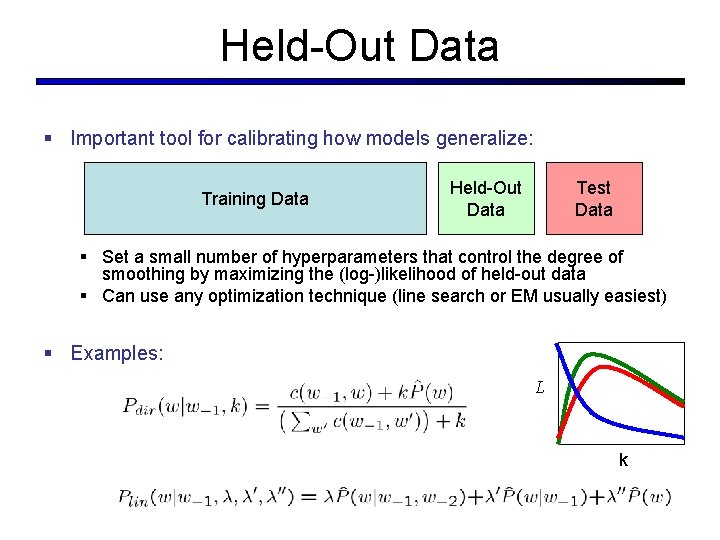
Held-Out Data § Important tool for calibrating how models generalize: Training Data Held-Out Data Test Data § Set a small number of hyperparameters that control the degree of smoothing by maximizing the (log-)likelihood of held-out data § Can use any optimization technique (line search or EM usually easiest) § Examples: L k
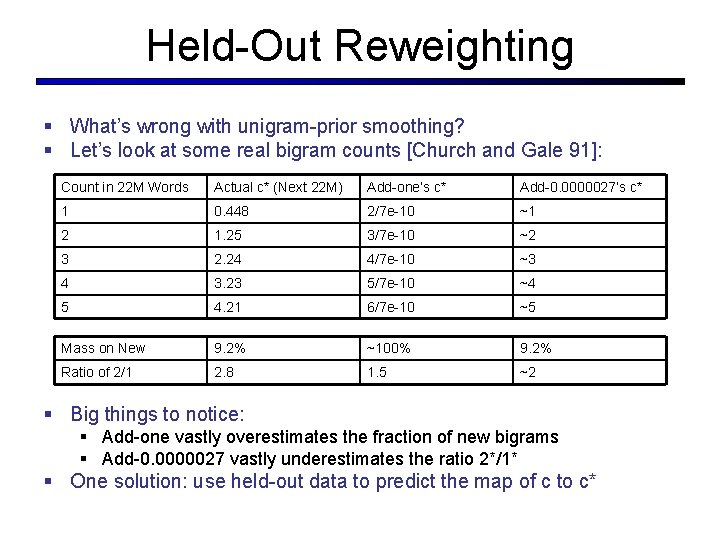
Held-Out Reweighting § What’s wrong with unigram-prior smoothing? § Let’s look at some real bigram counts [Church and Gale 91]: Count in 22 M Words Actual c* (Next 22 M) Add-one’s c* Add-0. 0000027’s c* 1 0. 448 2/7 e-10 ~1 2 1. 25 3/7 e-10 ~2 3 2. 24 4/7 e-10 ~3 4 3. 23 5/7 e-10 ~4 5 4. 21 6/7 e-10 ~5 Mass on New 9. 2% ~100% 9. 2% Ratio of 2/1 2. 8 1. 5 ~2 § Big things to notice: § Add-one vastly overestimates the fraction of new bigrams § Add-0. 0000027 vastly underestimates the ratio 2*/1* § One solution: use held-out data to predict the map of c to c*
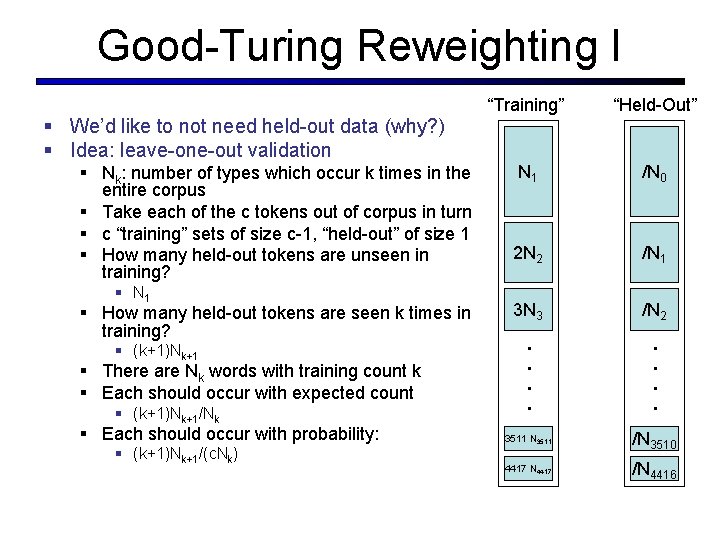
§ Nk: number of types which occur k times in the entire corpus § Take each of the c tokens out of corpus in turn § c “training” sets of size c-1, “held-out” of size 1 § How many held-out tokens are unseen in training? § N 1 § How many held-out tokens are seen k times in training? § (k+1)Nk+1 § There are Nk words with training count k § Each should occur with expected count § (k+1)Nk+1/Nk § Each should occur with probability: § (k+1)Nk+1/(c. Nk) “Held-Out” N 1 /N 0 2 N 2 /N 1 3 N 3 /N 2 . . § We’d like to not need held-out data (why? ) § Idea: leave-one-out validation “Training” . . Good-Turing Reweighting I 3511 N 3511 /N 3510 4417 N 4417 /N 4416
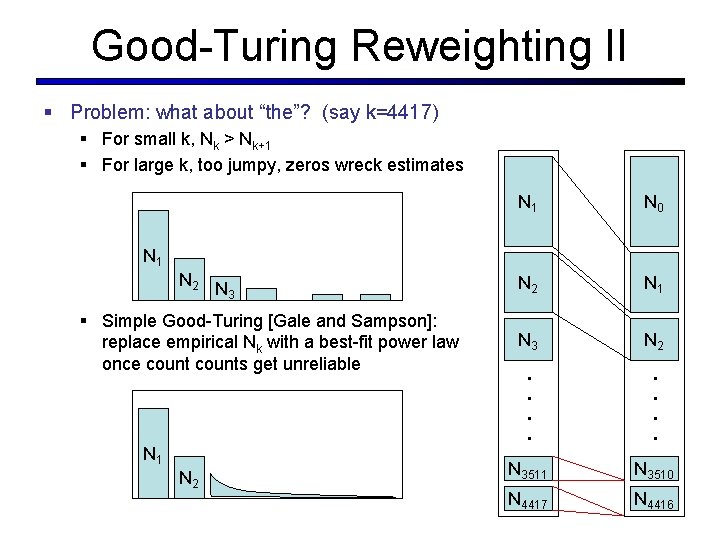
Good-Turing Reweighting II § Problem: what about “the”? (say k=4417) N 1 N 0 N 2 N 1 N 3 N 2 . . . . § For small k, Nk > Nk+1 § For large k, too jumpy, zeros wreck estimates N 1 N 2 N 3 § Simple Good-Turing [Gale and Sampson]: replace empirical Nk with a best-fit power law once counts get unreliable N 1 N 2 N 3511 N 3510 N 4417 N 4416
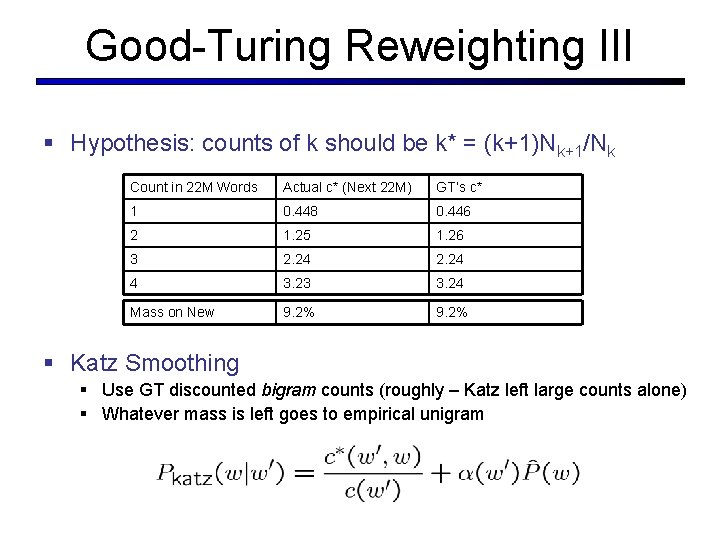
Good-Turing Reweighting III § Hypothesis: counts of k should be k* = (k+1)Nk+1/Nk Count in 22 M Words Actual c* (Next 22 M) GT’s c* 1 0. 448 0. 446 2 1. 25 1. 26 3 2. 24 4 3. 23 3. 24 Mass on New 9. 2% § Katz Smoothing § Use GT discounted bigram counts (roughly – Katz left large counts alone) § Whatever mass is left goes to empirical unigram
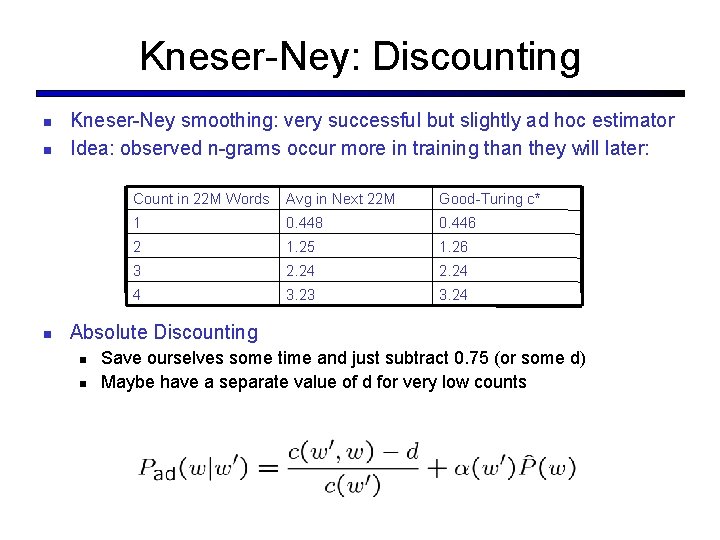
Kneser-Ney: Discounting Kneser-Ney smoothing: very successful but slightly ad hoc estimator Idea: observed n-grams occur more in training than they will later: Count in 22 M Words Avg in Next 22 M Good-Turing c* 1 0. 448 0. 446 2 1. 25 1. 26 3 2. 24 4 3. 23 3. 24 Absolute Discounting Save ourselves some time and just subtract 0. 75 (or some d) Maybe have a separate value of d for very low counts
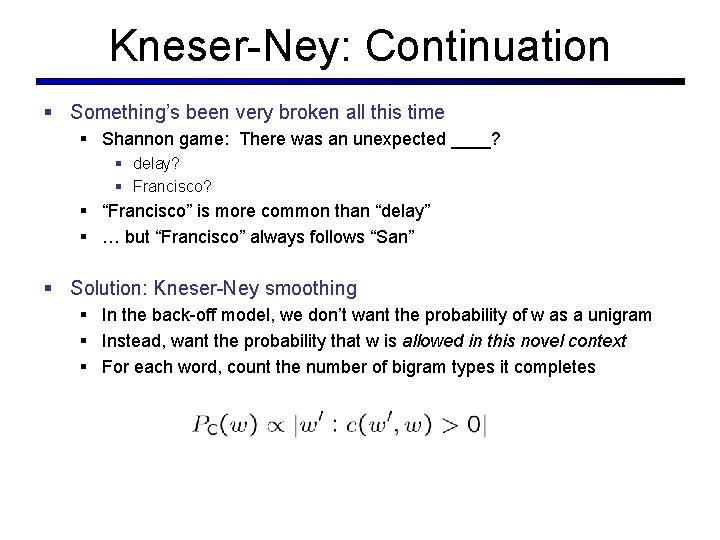
Kneser-Ney: Continuation § Something’s been very broken all this time § Shannon game: There was an unexpected ____? § delay? § Francisco? § “Francisco” is more common than “delay” § … but “Francisco” always follows “San” § Solution: Kneser-Ney smoothing § In the back-off model, we don’t want the probability of w as a unigram § Instead, want the probability that w is allowed in this novel context § For each word, count the number of bigram types it completes
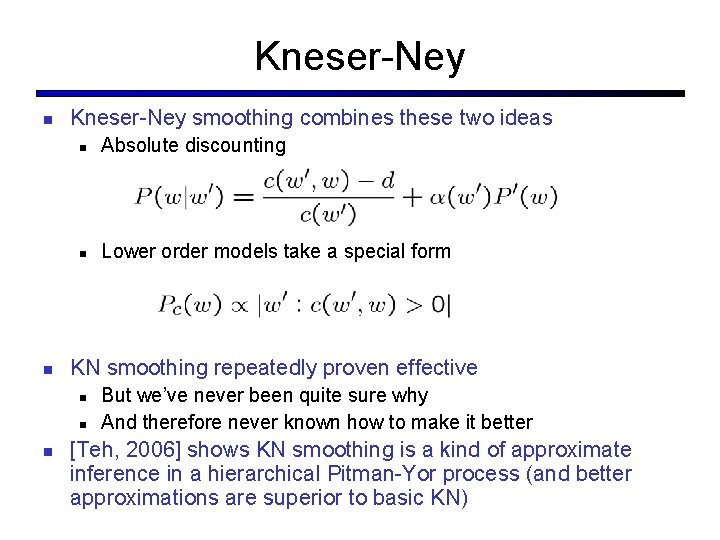
Kneser-Ney smoothing combines these two ideas Absolute discounting Lower order models take a special form KN smoothing repeatedly proven effective But we’ve never been quite sure why And therefore never known how to make it better [Teh, 2006] shows KN smoothing is a kind of approximate inference in a hierarchical Pitman-Yor process (and better approximations are superior to basic KN)
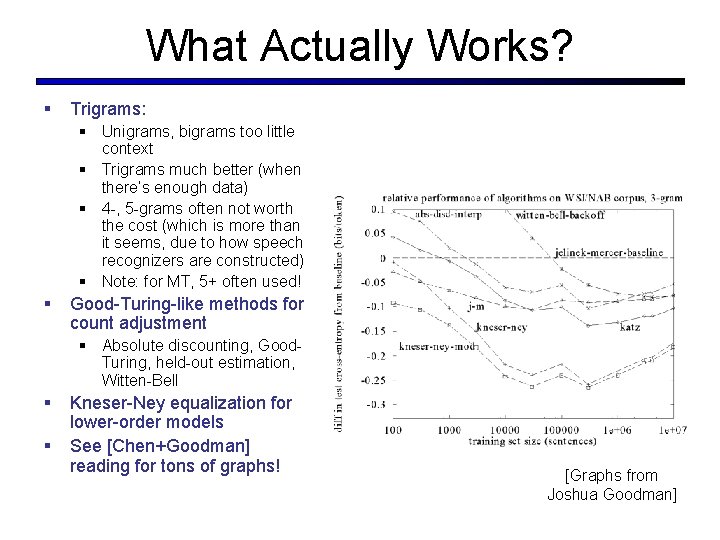
What Actually Works? § Trigrams: § Unigrams, bigrams too little context § Trigrams much better (when there’s enough data) § 4 -, 5 -grams often not worth the cost (which is more than it seems, due to how speech recognizers are constructed) § Note: for MT, 5+ often used! § Good-Turing-like methods for count adjustment § Absolute discounting, Good. Turing, held-out estimation, Witten-Bell § § Kneser-Ney equalization for lower-order models See [Chen+Goodman] reading for tons of graphs! [Graphs from Joshua Goodman]
Data >> Method? Having more data is better… … but so is using a better model Another issue: N > 3 has huge costs in speech recognizers
Beyond N-Gram LMs Lots of ideas we won’t have time to discuss: Caching models: recent words more likely to appear again Trigger models: recent words trigger other words Topic models A few recent ideas Syntactic models: use tree models to capture long-distance syntactic effects [Chelba and Jelinek, 98] Discriminative models: set n-gram weights to improve final task accuracy rather than fit training set density [Roark, 05, for ASR; Liang et. al. , 06, for MT] Structural zeros: some n-grams are syntactically forbidden, keep estimates at zero [Mohri and Roark, 06] Bayesian document and IR models [Daume 06]