
Statistical Model A statistical model for some data




- Slides: 48
Statistical Model • A statistical model for some data is a set of distributions, one of which corresponds to the true unknown distribution that produced the data. • The statistical model corresponds to the information a statistician brings to the application about what the true distribution is or at least what he or she is willing to assume about it. • The variable θ is called the parameter of the model, and the set Ω is called the parameter space. • From the definition of a statistical model, we see that there is a unique value , such that fθ is the true distribution that generated the data. We refer to this value as the true parameter value. STA 286 week 9 1
Examples • Suppose there are two manufacturing plants for machines. It is known that the life lengths of machines built by the first plant have an Exponential(1) distribution, while machines manufactured by the second plant have life lengths distributed Exponential(1. 5). You have purchased five of these machines and you know that all five came from the same plant but do not know which plant. Further, you observe the life lengths of these machines, obtaining a sample (x 1, …, x 5) and want to make inference about the true distribution of the life lengths of these machines. • Suppose we have observations of heights in cm of individuals in a population and we feel that it is reasonable to assume that the distribution of height is the population is normal with some unknown mean and variance. The statistical model in this case is where Ω = R×R+, where R+ = (0, ∞). STA 286 week 9 2
Point Estimate • Most statistical procedures involve estimation of the unknown value of the parameter of the statistical model. • A point estimate, , is an estimate of the parameter θ. It is a statistic based on the sample and therefore it is a random variable with a distribution function. • The standard deviation of the sampling distribution of an estimator is usually called the standard error of the estimator. • For a given statistical model with unknown parameter θ there could be more then one point estimate. • The parameter θ of a statistical model can have more then just one element. STA 286 week 9 3
Properties of Point Estimators • Let be a point estimator for a parameter θ. Then estimator if is an unbiased • The variance of a point estimator is Consider all possible unbiased estimators of some parameter θ, the one with the smallest variance is called the most efficient estimator of θ. STA 286 week 9 4
Common Point Estimators • A natural estimate for the population mean μ is the sample mean (in any distribution). The sample mean is an unbiased estimator of the population mean. • A common estimator for the population variance is the sample variance s 2. STA 286 week 9 5
Claim • Let X 1, X 2, …, Xn be random sample of size n from a normal population. The sample variance s 2 is an unbiased estimator of the population variance σ2. • Proof… STA 286 week 9 6
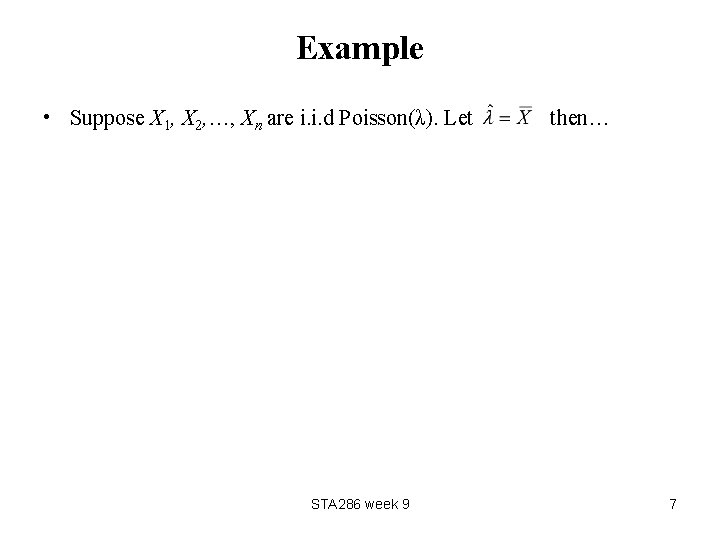
Example • Suppose X 1, X 2, …, Xn are i. i. d Poisson(λ). Let STA 286 week 9 then… 7
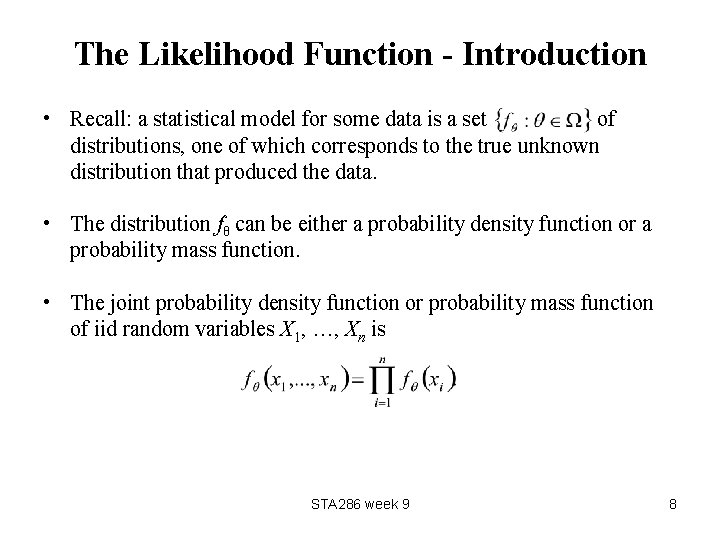
The Likelihood Function - Introduction • Recall: a statistical model for some data is a set of distributions, one of which corresponds to the true unknown distribution that produced the data. • The distribution fθ can be either a probability density function or a probability mass function. • The joint probability density function or probability mass function of iid random variables X 1, …, Xn is STA 286 week 9 8
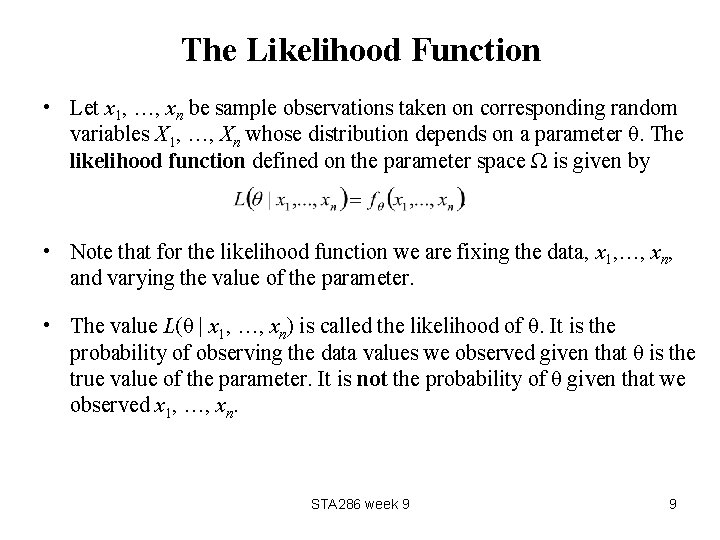
The Likelihood Function • Let x 1, …, xn be sample observations taken on corresponding random variables X 1, …, Xn whose distribution depends on a parameter θ. The likelihood function defined on the parameter space Ω is given by • Note that for the likelihood function we are fixing the data, x 1, …, xn, and varying the value of the parameter. • The value L(θ | x 1, …, xn) is called the likelihood of θ. It is the probability of observing the data values we observed given that θ is the true value of the parameter. It is not the probability of θ given that we observed x 1, …, xn. STA 286 week 9 9
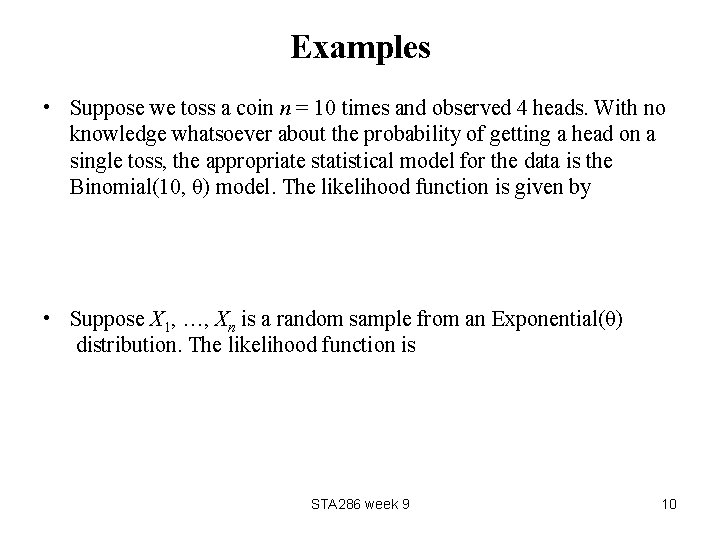
Examples • Suppose we toss a coin n = 10 times and observed 4 heads. With no knowledge whatsoever about the probability of getting a head on a single toss, the appropriate statistical model for the data is the Binomial(10, θ) model. The likelihood function is given by • Suppose X 1, …, Xn is a random sample from an Exponential(θ) distribution. The likelihood function is STA 286 week 9 10
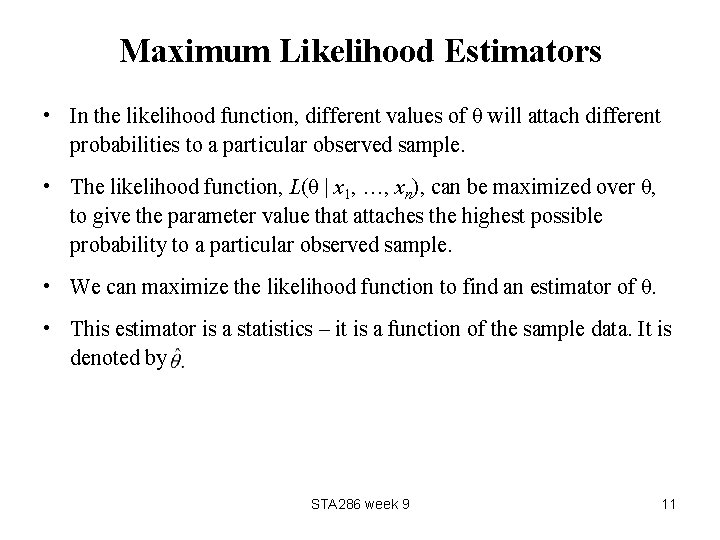
Maximum Likelihood Estimators • In the likelihood function, different values of θ will attach different probabilities to a particular observed sample. • The likelihood function, L(θ | x 1, …, xn), can be maximized over θ, to give the parameter value that attaches the highest possible probability to a particular observed sample. • We can maximize the likelihood function to find an estimator of θ. • This estimator is a statistics – it is a function of the sample data. It is denoted by STA 286 week 9 11
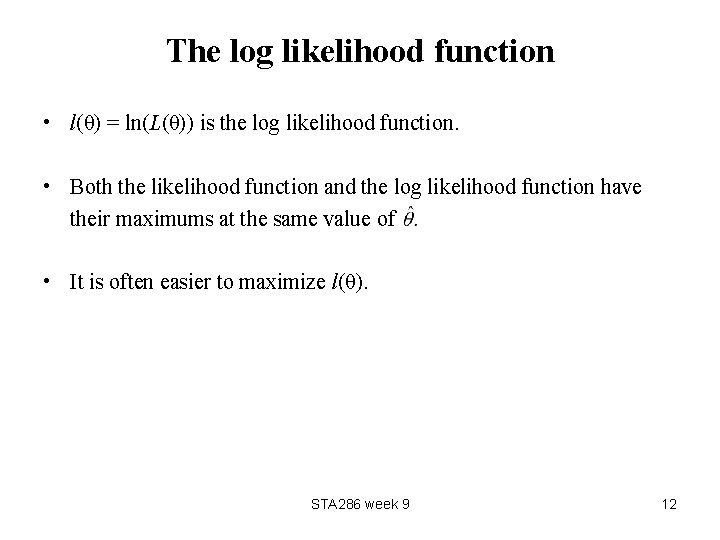
The log likelihood function • l(θ) = ln(L(θ)) is the log likelihood function. • Both the likelihood function and the log likelihood function have their maximums at the same value of • It is often easier to maximize l(θ). STA 286 week 9 12
Examples STA 286 week 9 13
Important Comment • Some MLE’s cannot be determined using calculus. This occurs whenever the support is a function of the parameter θ. • These are best solved by graphing the likelihood function. • Example: STA 286 week 9 14
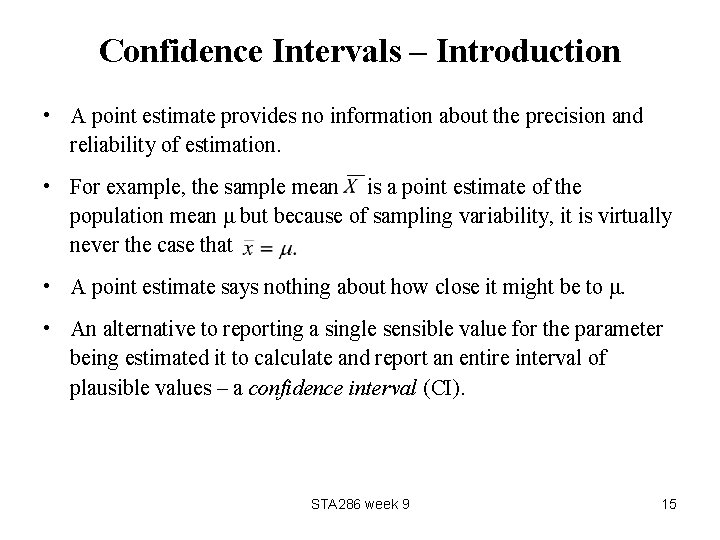
Confidence Intervals – Introduction • A point estimate provides no information about the precision and reliability of estimation. • For example, the sample mean is a point estimate of the population mean μ but because of sampling variability, it is virtually never the case that • A point estimate says nothing about how close it might be to μ. • An alternative to reporting a single sensible value for the parameter being estimated it to calculate and report an entire interval of plausible values – a confidence interval (CI). STA 286 week 9 15
Confidence level • A confidence level is a measure of the degree of reliability of a confidence interval. It is denoted as 100(1 -α)%. • The most frequently used confidence levels are 90%, 95% and 99%. • A confidence level of 100(1 -α)% implies that 100(1 -α)% of all samples would include the true value of the parameter estimated. • The higher the confidence level, the more strongly we believe that the true value of the parameter being estimated lies within the interval. • Ideally, we want a short interval with a high degree of confidence. STA 286 week 9 16
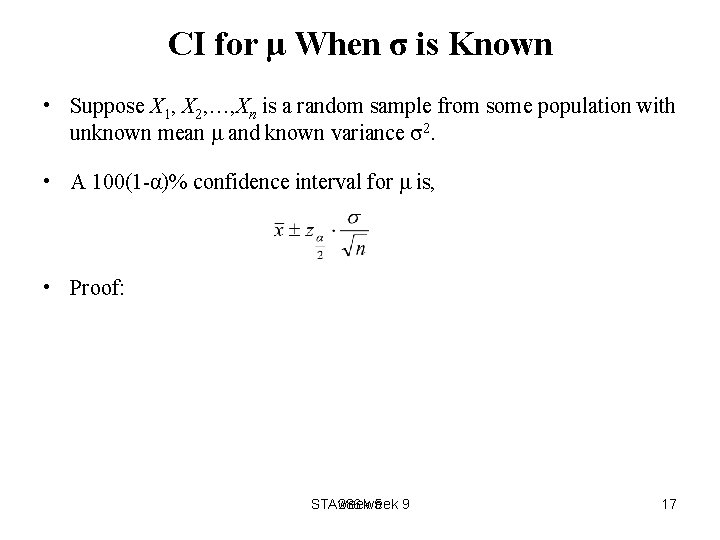
CI for μ When σ is Known • Suppose X 1, X 2, …, Xn is a random sample from some population with unknown mean μ and known variance σ2. • A 100(1 -α)% confidence interval for μ is, • Proof: STA 286 week 5 9 17
Example • The National Student Loan Survey collected data about the amount of money that borrowers owe. The survey selected a random sample of 1280 borrowers who began repayment of their loans between four to six months prior to the study. The mean debt for the selected borrowers was $18, 900 and the standard deviation was $49, 000. Find a 95% for the mean debt for all borrowers. STA 286 week 5 9 18
Width and Precision of CI • The precision of an interval is conveyed by the width of the interval. • If the confidence level is high and the resulting interval is quite narrow, the interval is more precise, i. e. , our knowledge of the value of the parameter is reasonably precise. • A very wide CI implies that there is a great deal of uncertainty concerning the value of the parameter we are estimating. • The width of the CI for μ is …. STA 286 week 5 9 19
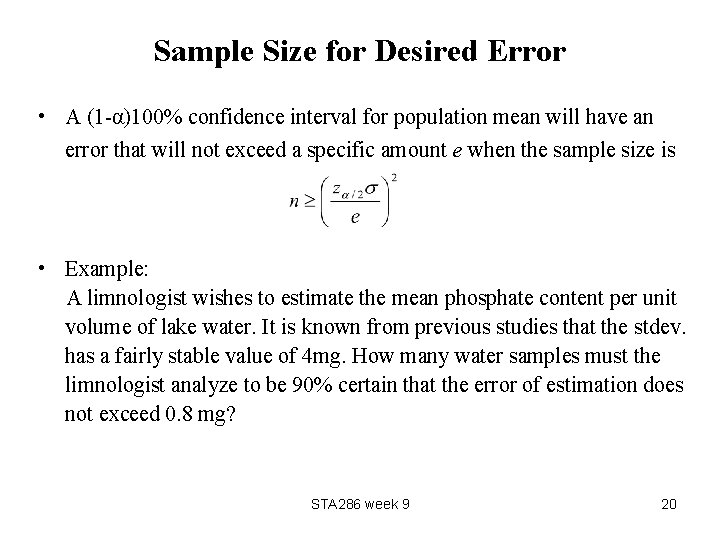
Sample Size for Desired Error • A (1 -α)100% confidence interval for population mean will have an error that will not exceed a specific amount e when the sample size is • Example: A limnologist wishes to estimate the mean phosphate content per unit volume of lake water. It is known from previous studies that the stdev. has a fairly stable value of 4 mg. How many water samples must the limnologist analyze to be 90% certain that the error of estimation does not exceed 0. 8 mg? STA 286 week 9 20
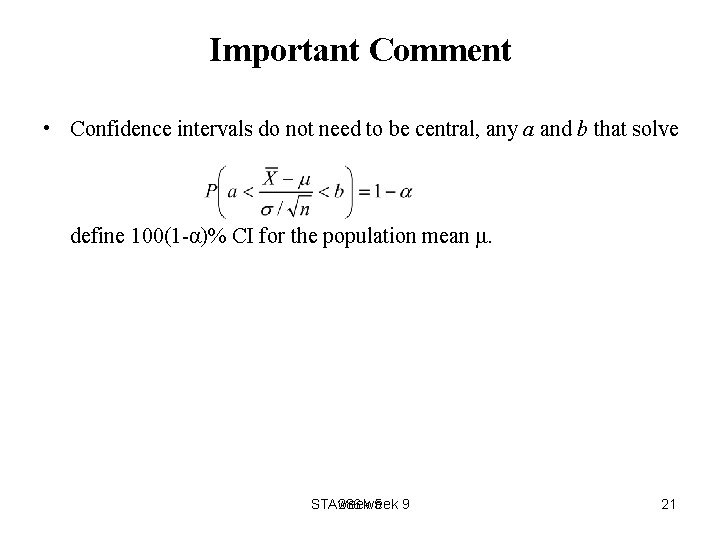
Important Comment • Confidence intervals do not need to be central, any a and b that solve define 100(1 -α)% CI for the population mean μ. STA 286 week 5 9 21
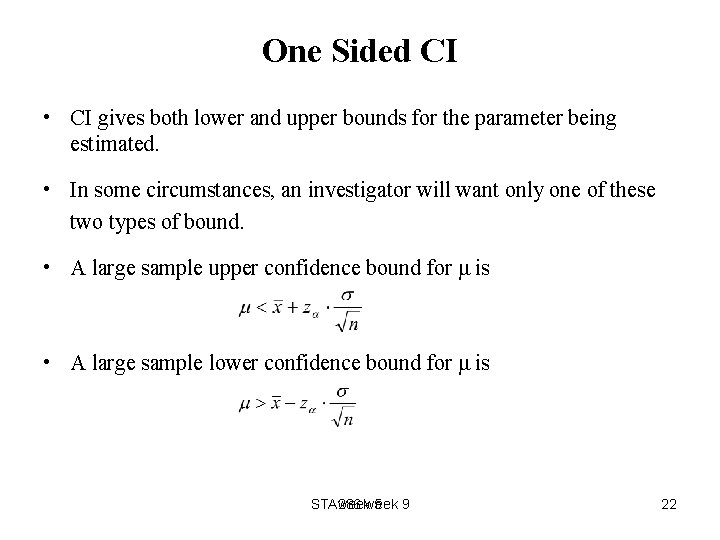
One Sided CI • CI gives both lower and upper bounds for the parameter being estimated. • In some circumstances, an investigator will want only one of these two types of bound. • A large sample upper confidence bound for μ is • A large sample lower confidence bound for μ is STA 286 week 5 9 22
CI for μ When σ is Unknown • Suppose X 1, X 2, …, Xn are random sample from N(μ, σ2) where both μ and σ are unknown. • If σ2 is unknown we can estimate it using s 2 and use the tn-1 distribution. • A 100(1 -α)% confidence interval for μ in this case, is … STA 286 week 5 9 23
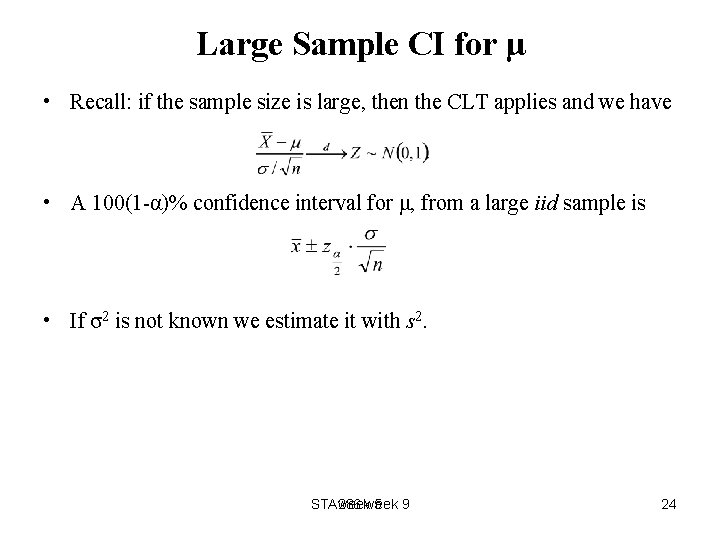
Large Sample CI for μ • Recall: if the sample size is large, then the CLT applies and we have • A 100(1 -α)% confidence interval for μ, from a large iid sample is • If σ2 is not known we estimate it with s 2. STA 286 week 5 9 24
Example – Binomial Distribution • Suppose X 1, X 2, …, Xn are random sample from Bernoulli(θ) distribution. A 100(1 -α)% CI for θ is…. • Example… STA 286 week 5 9 25
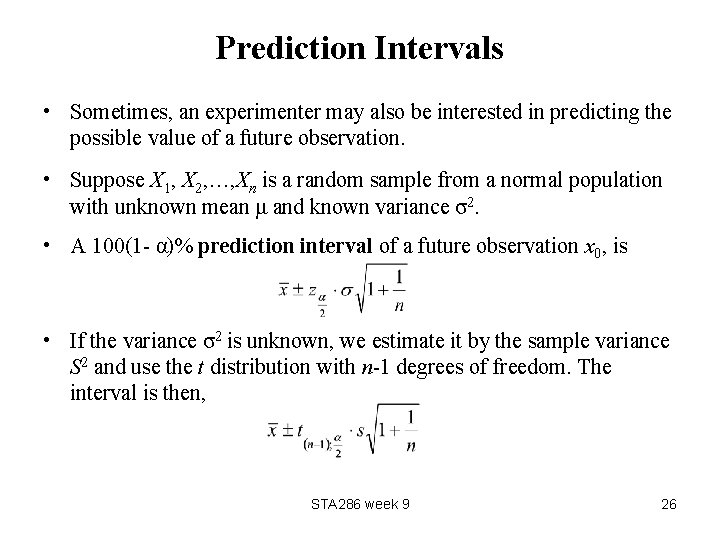
Prediction Intervals • Sometimes, an experimenter may also be interested in predicting the possible value of a future observation. • Suppose X 1, X 2, …, Xn is a random sample from a normal population with unknown mean μ and known variance σ2. • A 100(1 - α)% prediction interval of a future observation x 0, is • If the variance σ2 is unknown, we estimate it by the sample variance S 2 and use the t distribution with n-1 degrees of freedom. The interval is then, STA 286 week 9 26
Two Sample Problem • Sometimes we are interested in comparing means in two independent populations (e. g. mean income for male and females). • We will select two independent samples one from each population and use the sample means for the estimation of the difference between the population means. • Example: A medical researcher is interested in the effect of added calcium in our diet on blood pressure. She conducted a randomized comparative experiment in which one group of subjects receive a calcium supplement and a control group gets a placebo. STA 286 week 9 27
Case 1 – Variances are known • Two independent populations variances known… STA 286 week 9 28
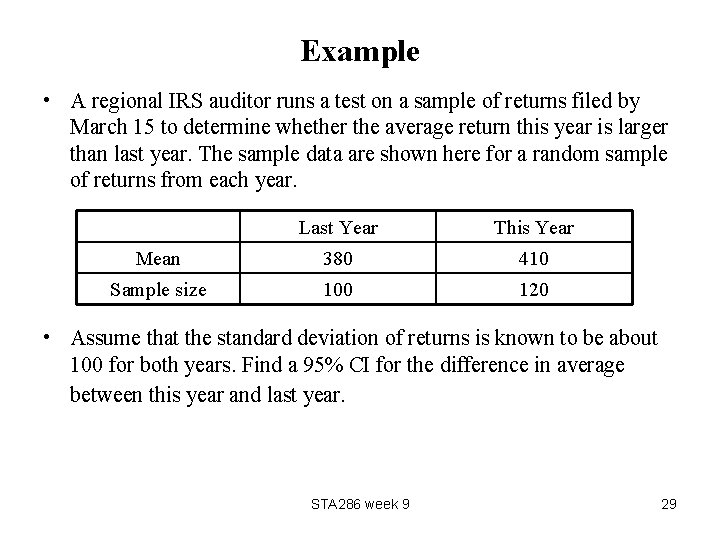
Example • A regional IRS auditor runs a test on a sample of returns filed by March 15 to determine whether the average return this year is larger than last year. The sample data are shown here for a random sample of returns from each year. Last Year This Year Mean 380 410 Sample size 100 120 • Assume that the standard deviation of returns is known to be about 100 for both years. Find a 95% CI for the difference in average between this year and last year. STA 286 week 9 29
Case 2 – Variances Unknown but Equal • Two independent populations, both are normal, variances are unknown but equal… STA 286 week 9 30
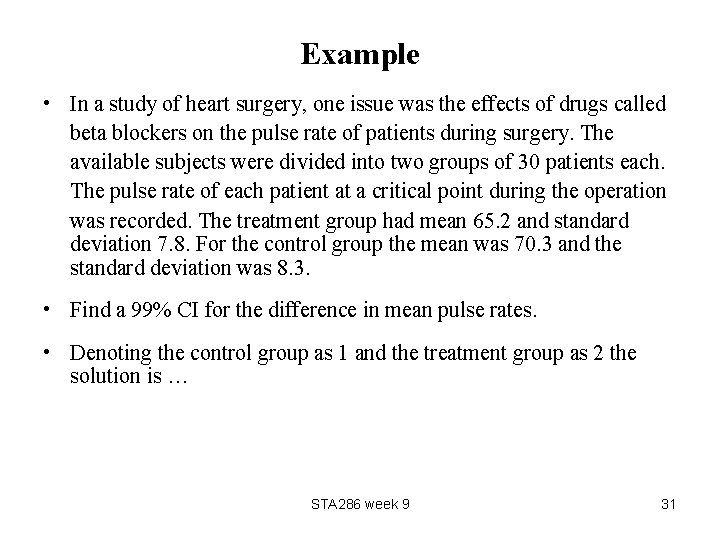
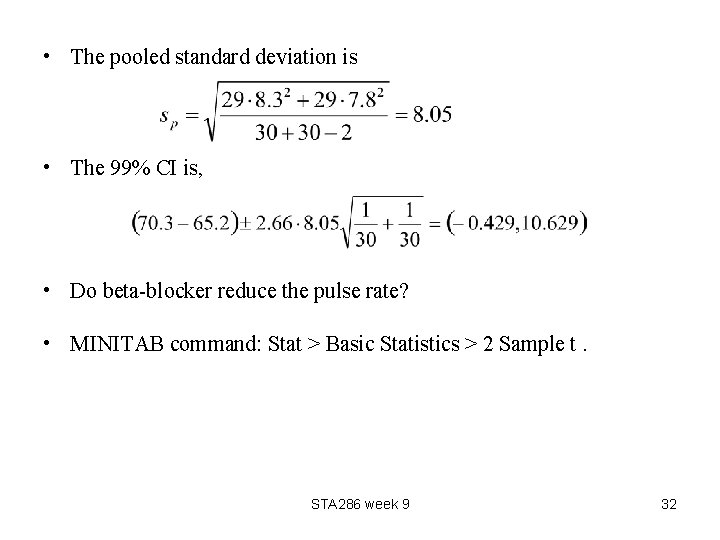
Example • In a study of heart surgery, one issue was the effects of drugs called beta blockers on the pulse rate of patients during surgery. The available subjects were divided into two groups of 30 patients each. The pulse rate of each patient at a critical point during the operation was recorded. The treatment group had mean 65. 2 and standard deviation 7. 8. For the control group the mean was 70. 3 and the standard deviation was 8. 3. • Find a 99% CI for the difference in mean pulse rates. • Denoting the control group as 1 and the treatment group as 2 the solution is … STA 286 week 9 31
• The pooled standard deviation is • The 99% CI is, • Do beta-blocker reduce the pulse rate? • MINITAB command: Stat > Basic Statistics > 2 Sample t. STA 286 week 9 32
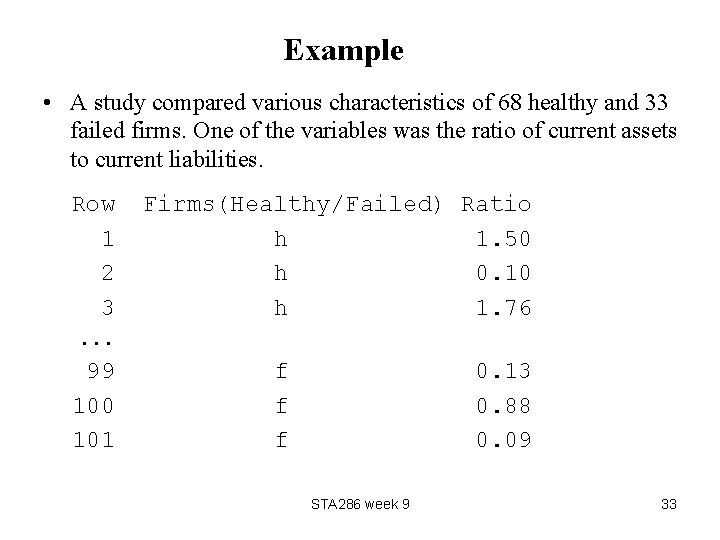
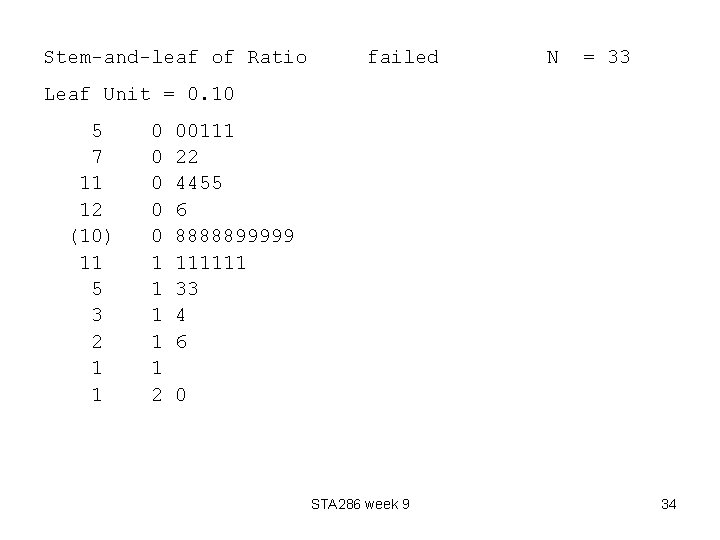
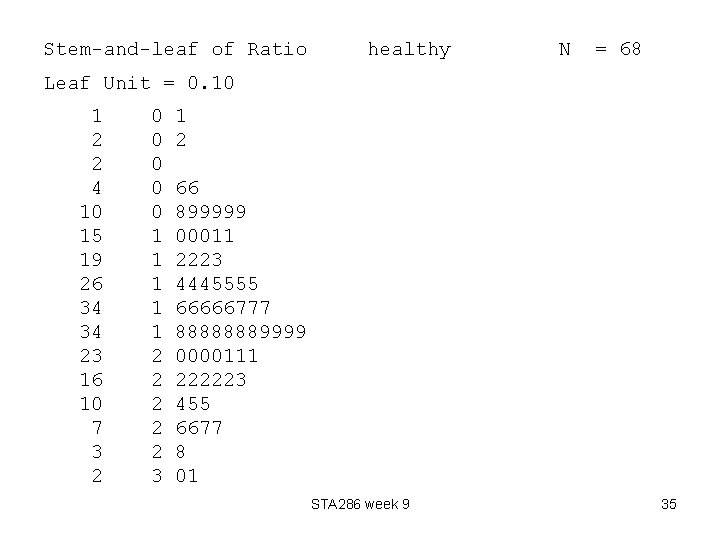
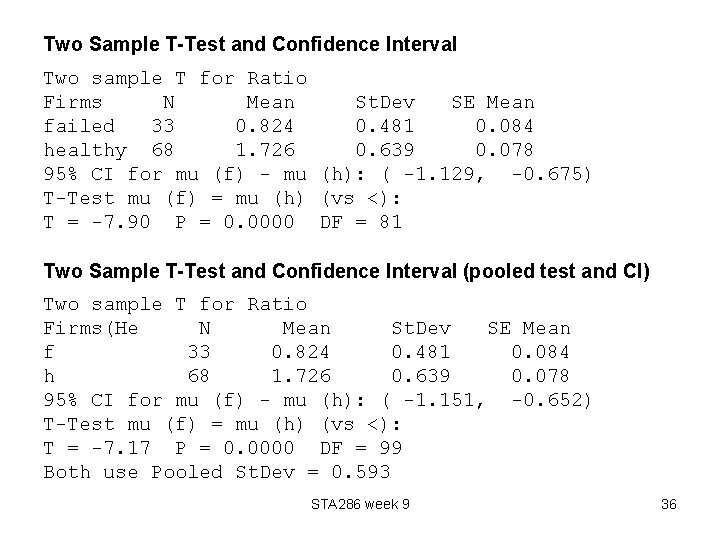
Example • A study compared various characteristics of 68 healthy and 33 failed firms. One of the variables was the ratio of current assets to current liabilities. Row 1 2 3 Firms(Healthy/Failed) Ratio h 1. 50 h 0. 10 h 1. 76 . . . 99 100 101 f f f 0. 13 0. 88 0. 09 STA 286 week 9 33
Stem-and-leaf of Ratio failed N = 33 Leaf Unit = 0. 10 5 7 11 12 (10) 11 5 3 2 1 1 0 0 0 1 1 1 2 00111 22 4455 6 8888899999 111111 33 4 6 0 STA 286 week 9 34
Stem-and-leaf of Ratio healthy N = 68 Leaf Unit = 0. 10 1 2 2 4 10 15 19 26 34 34 23 16 10 7 3 2 0 0 0 1 1 1 2 2 2 3 1 2 66 899999 00011 2223 4445555 66666777 88888889999 0000111 222223 455 6677 8 01 STA 286 week 9 35
Two Sample T-Test and Confidence Interval Two sample T for Ratio Firms N Mean St. Dev SE Mean failed 33 0. 824 0. 481 0. 084 healthy 68 1. 726 0. 639 0. 078 95% CI for mu (f) - mu (h): ( -1. 129, -0. 675) T-Test mu (f) = mu (h) (vs <): T = -7. 90 P = 0. 0000 DF = 81 Two Sample T-Test and Confidence Interval (pooled test and CI) Two sample T for Ratio Firms(He N Mean St. Dev SE Mean f 33 0. 824 0. 481 0. 084 h 68 1. 726 0. 639 0. 078 95% CI for mu (f) - mu (h): ( -1. 151, -0. 652) T-Test mu (f) = mu (h) (vs <): T = -7. 17 P = 0. 0000 DF = 99 Both use Pooled St. Dev = 0. 593 STA 286 week 9 36
Case 3 – Variances Unknown and Unequal • Two independent populations, both approximately normal, variances are unknown and unequal. . . STA 286 week 9 37
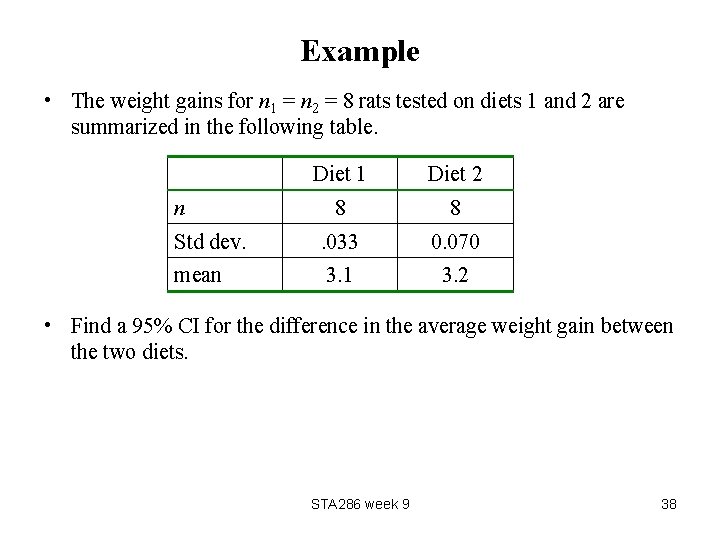
Example • The weight gains for n 1 = n 2 = 8 rats tested on diets 1 and 2 are summarized in the following table. Diet 1 Diet 2 8 8 Std dev. . 033 0. 070 mean 3. 1 3. 2 n • Find a 95% CI for the difference in the average weight gain between the two diets. STA 286 week 9 38
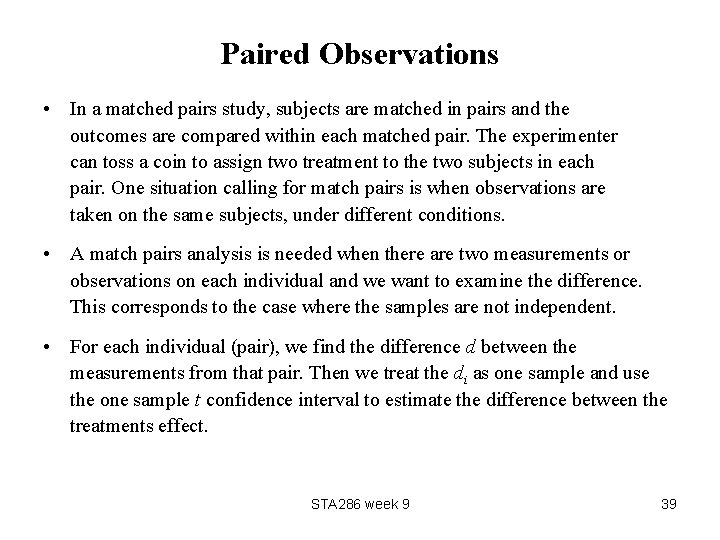
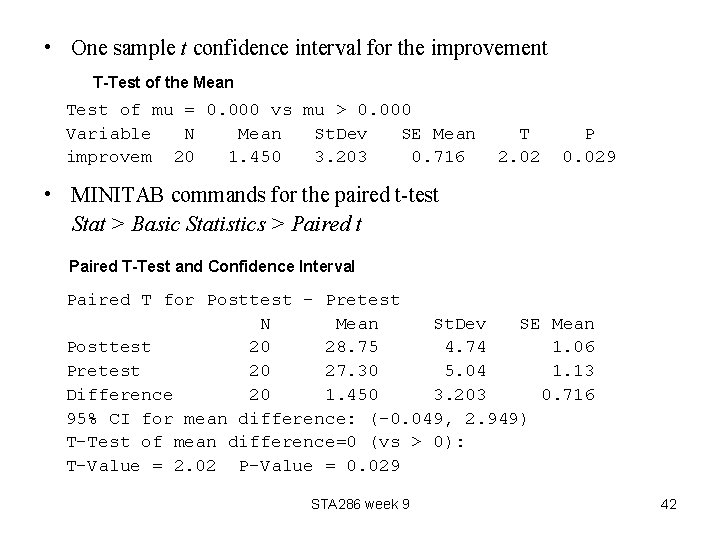
Paired Observations • In a matched pairs study, subjects are matched in pairs and the outcomes are compared within each matched pair. The experimenter can toss a coin to assign two treatment to the two subjects in each pair. One situation calling for match pairs is when observations are taken on the same subjects, under different conditions. • A match pairs analysis is needed when there are two measurements or observations on each individual and we want to examine the difference. This corresponds to the case where the samples are not independent. • For each individual (pair), we find the difference d between the measurements from that pair. Then we treat the di as one sample and use the one sample t confidence interval to estimate the difference between the treatments effect. STA 286 week 9 39
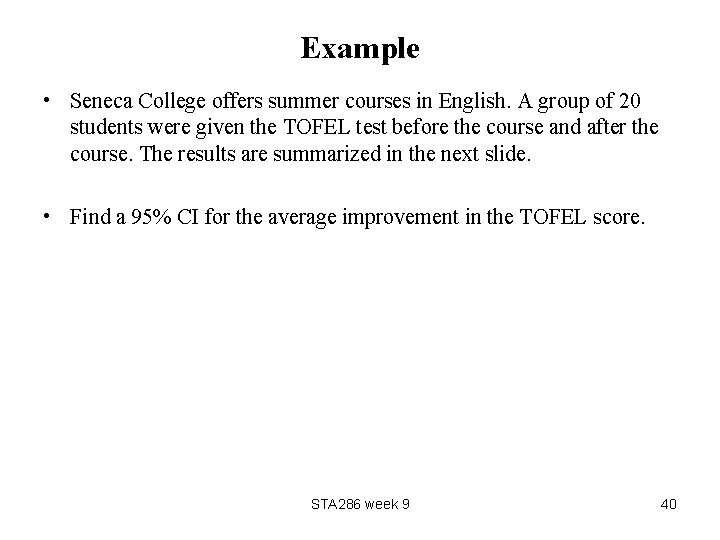
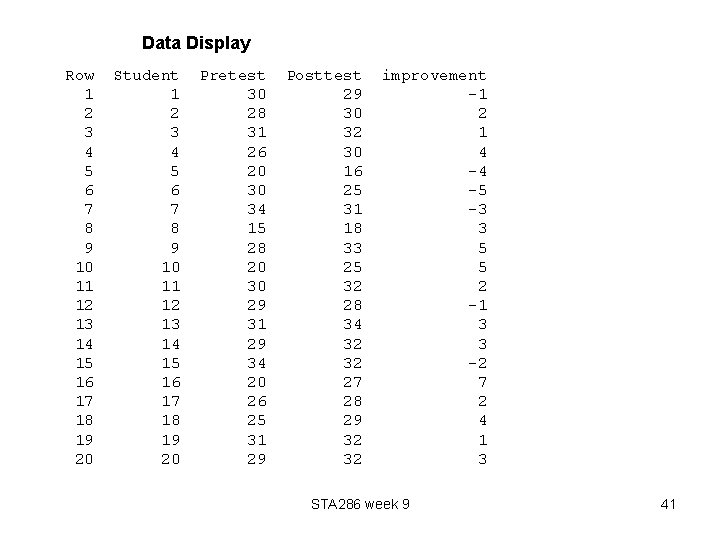
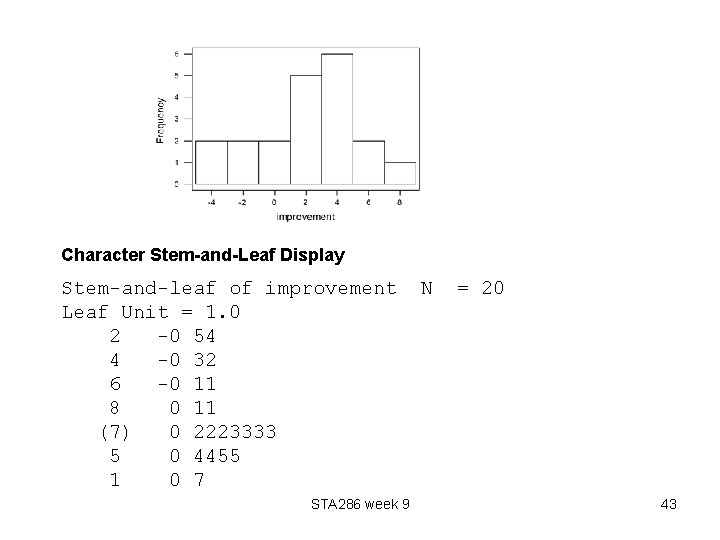
Example • Seneca College offers summer courses in English. A group of 20 students were given the TOFEL test before the course and after the course. The results are summarized in the next slide. • Find a 95% CI for the average improvement in the TOFEL score. STA 286 week 9 40
Data Display Row 1 2 3 4 5 6 7 8 9 10 11 12 13 14 15 16 17 18 19 20 Student 1 2 3 4 5 6 7 8 9 10 11 12 13 14 15 16 17 18 19 20 Pretest 30 28 31 26 20 30 34 15 28 20 30 29 31 29 34 20 26 25 31 29 Posttest 29 30 32 30 16 25 31 18 33 25 32 28 34 32 32 27 28 29 32 32 improvement -1 2 1 4 -4 -5 -3 3 5 5 2 -1 3 3 -2 7 2 4 1 3 STA 286 week 9 41
• One sample t confidence interval for the improvement T-Test of the Mean Test of mu = 0. 000 vs mu > 0. 000 Variable N Mean St. Dev SE Mean improvem 20 1. 450 3. 203 0. 716 T 2. 02 P 0. 029 • MINITAB commands for the paired t-test Stat > Basic Statistics > Paired t Paired T-Test and Confidence Interval Paired T for Posttest – Pretest N Mean St. Dev SE Mean Posttest 20 28. 75 4. 74 1. 06 Pretest 20 27. 30 5. 04 1. 13 Difference 20 1. 450 3. 203 0. 716 95% CI for mean difference: (-0. 049, 2. 949) T-Test of mean difference=0 (vs > 0): T-Value = 2. 02 P-Value = 0. 029 STA 286 week 9 42
Character Stem-and-Leaf Display Stem-and-leaf of improvement Leaf Unit = 1. 0 2 -0 54 4 -0 32 6 -0 11 8 0 11 (7) 0 2223333 5 0 4455 1 0 7 STA 286 week 9 N = 20 43
Summary STA 286 week 9 44
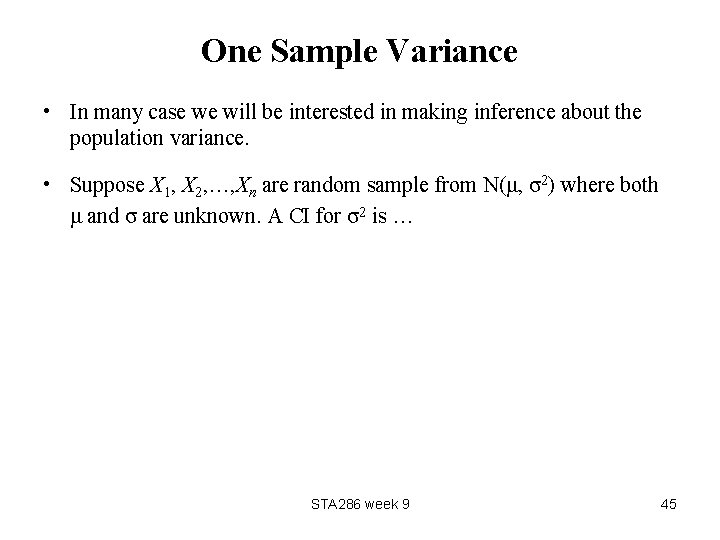
One Sample Variance • In many case we will be interested in making inference about the population variance. • Suppose X 1, X 2, …, Xn are random sample from N(μ, σ2) where both μ and σ are unknown. A CI for σ2 is … STA 286 week 9 45
Example STA 286 week 9 46
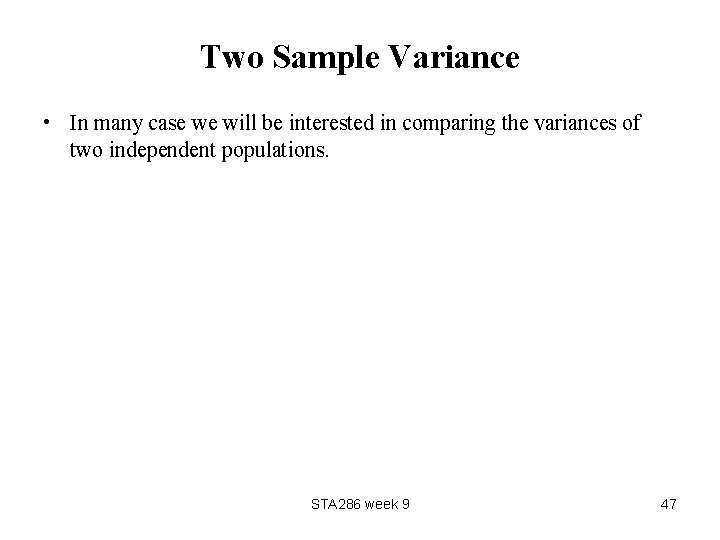
Two Sample Variance • In many case we will be interested in comparing the variances of two independent populations. STA 286 week 9 47
Example STA 286 week 9 48