
Statistical Methods Section Cande V Ananth Ph D
- Slides: 26
Statistical Methods Section Cande V. Ananth, Ph. D, MPH Columbia University, NY
Outline • • The expectations in AJOG Correct use of analytic methods Causality versus Confounding Missing data
Expectations in AJOG • Clean and transparent statistical analysis • Pushing the boundaries: Innovation – By design – By analytic methods • Addressing potential biases – No longer an option… a necessity!
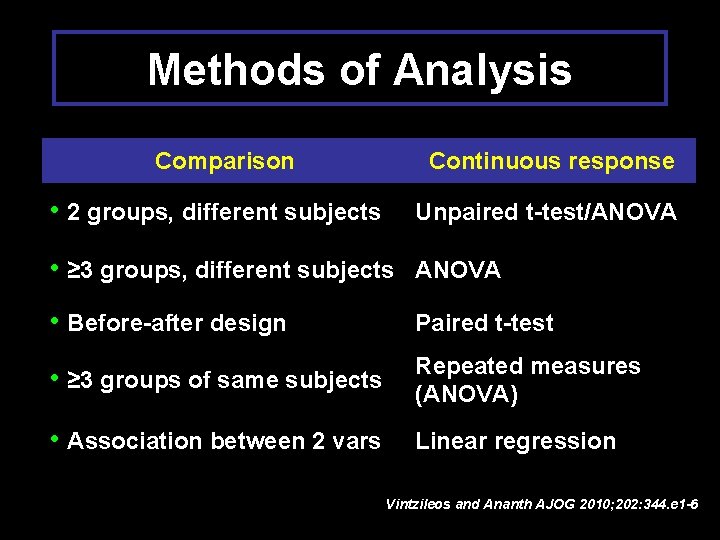
Methods of Analysis Comparison Continuous response • 2 groups, different subjects Unpaired t-test/ANOVA • ≥ 3 groups, different subjects ANOVA • Before-after design Paired t-test • ≥ 3 groups of same subjects Repeated measures (ANOVA) • Association between 2 vars Linear regression Vintzileos and Ananth AJOG 2010; 202: 344. e 1 -6
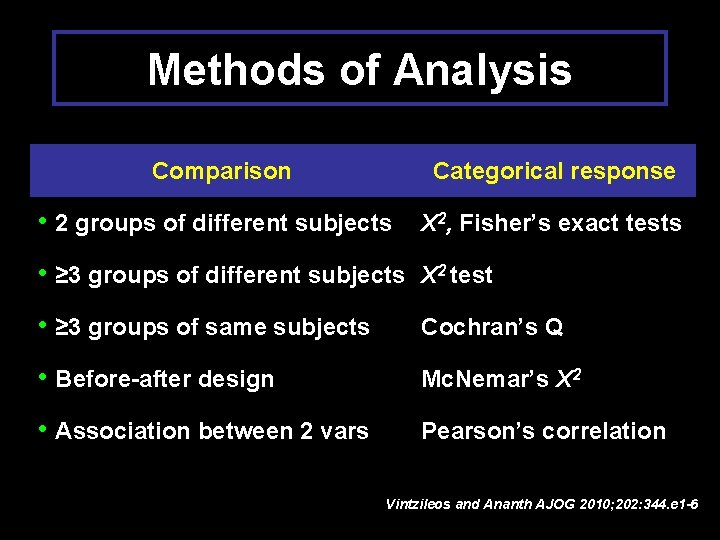
Methods of Analysis Comparison Categorical response • 2 groups of different subjects Χ 2, Fisher’s exact tests • ≥ 3 groups of different subjects Χ 2 test • ≥ 3 groups of same subjects Cochran’s Q • Before-after design Mc. Nemar’s Χ 2 • Association between 2 vars Pearson’s correlation Vintzileos and Ananth AJOG 2010; 202: 344. e 1 -6
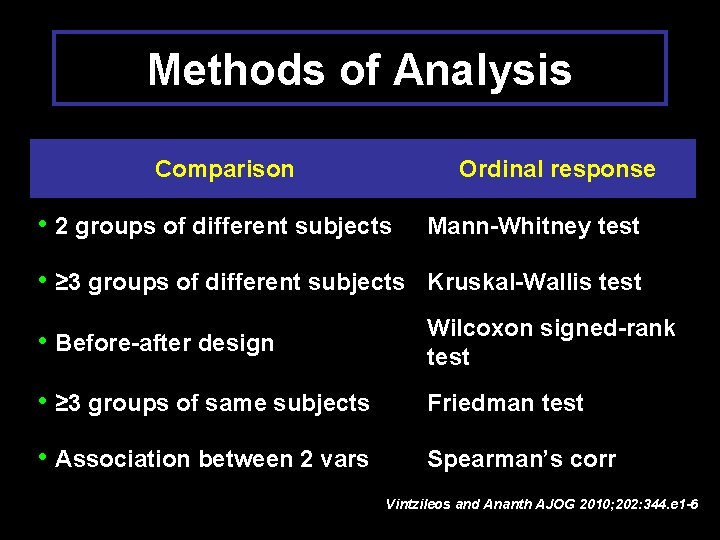
Methods of Analysis Comparison Ordinal response • 2 groups of different subjects Mann-Whitney test • ≥ 3 groups of different subjects Kruskal-Wallis test • Before-after design Wilcoxon signed-rank test • ≥ 3 groups of same subjects Friedman test • Association between 2 vars Spearman’s corr Vintzileos and Ananth AJOG 2010; 202: 344. e 1 -6
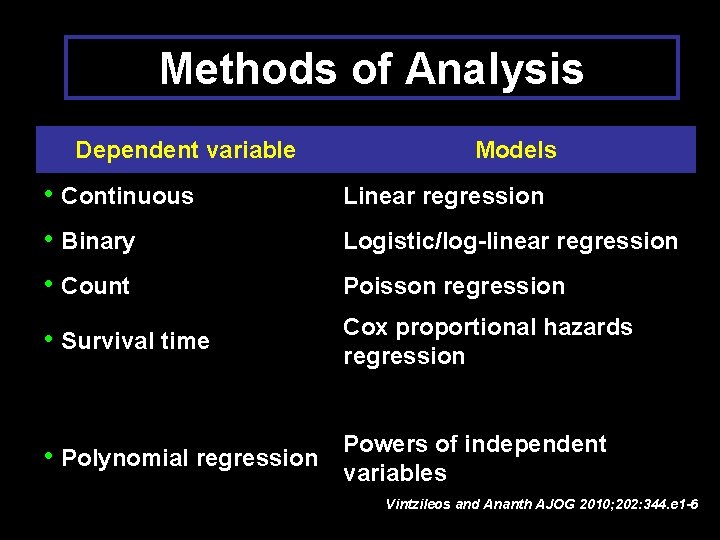
Methods of Analysis Dependent variable Models • Continuous • Binary • Count Linear regression • Survival time Cox proportional hazards regression • Polynomial regression Powers of independent variables Logistic/log-linear regression Poisson regression Vintzileos and Ananth AJOG 2010; 202: 344. e 1 -6
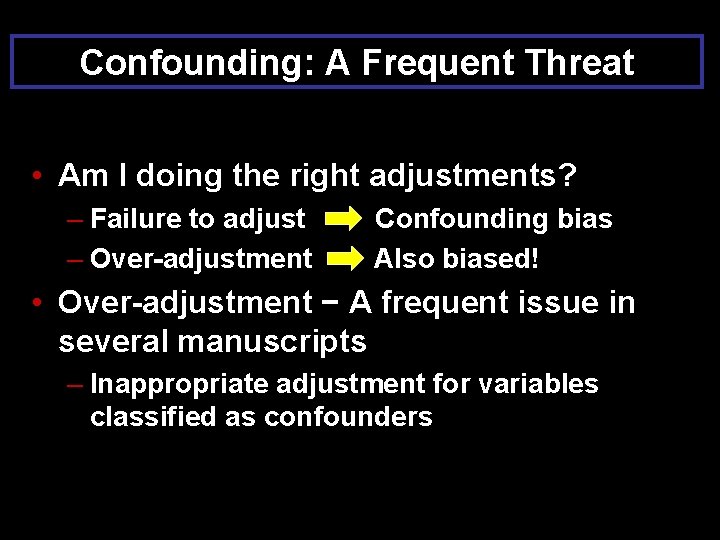
Confounding: A Frequent Threat • Am I doing the right adjustments? – Failure to adjust – Over-adjustment Confounding bias Also biased! • Over-adjustment − A frequent issue in several manuscripts – Inappropriate adjustment for variables classified as confounders
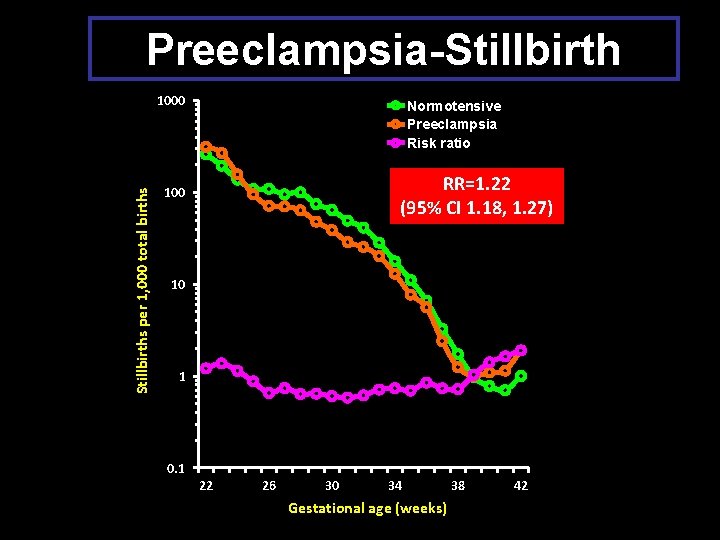
Preeclampsia-Stillbirths per 1, 000 total births 1000 Normotensive Preeclampsia Risk ratio RR=1. 22 (95% CI 1. 18, 1. 27) 100 10 1 0. 1 22 26 30 34 Gestational age (weeks) 38 42
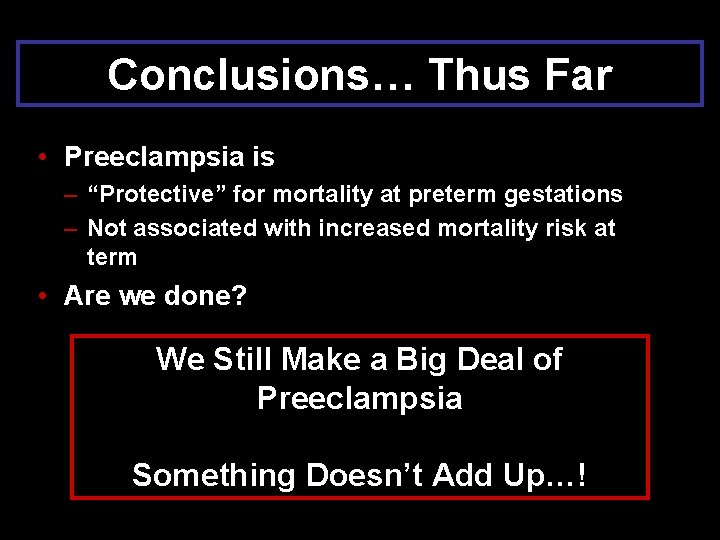
Conclusions… Thus Far • Preeclampsia is – “Protective” for mortality at preterm gestations – Not associated with increased mortality risk at term • Are we done? We Still Make a Big Deal of Preeclampsia Something Doesn’t Add Up…!
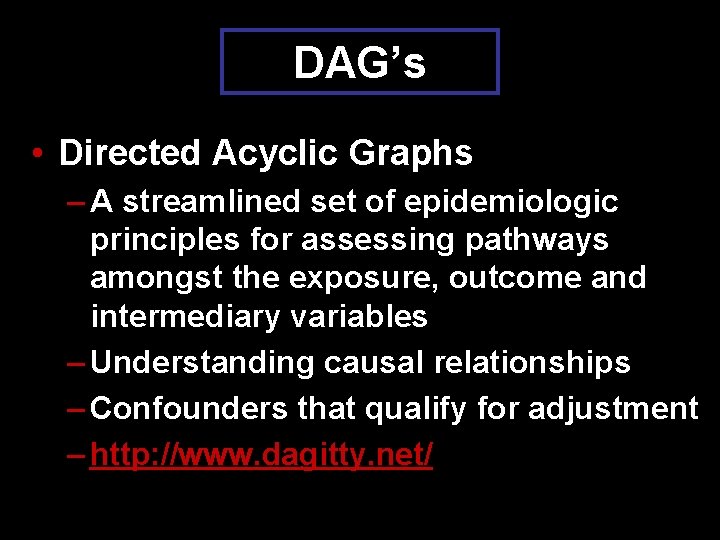
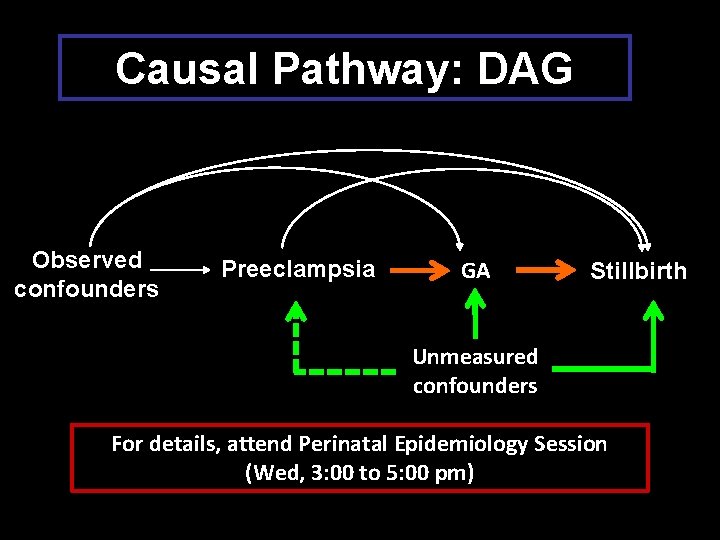
DAG’s • Directed Acyclic Graphs – A streamlined set of epidemiologic principles for assessing pathways amongst the exposure, outcome and intermediary variables – Understanding causal relationships – Confounders that qualify for adjustment – http: //www. dagitty. net/
Causal Pathway: DAG Observed confounders Preeclampsia GA Stillbirth Unmeasured confounders For details, attend Perinatal Epidemiology Session (Wed, 3: 00 to 5: 00 pm)
Missing Data • Missing data is very prevalent – More so in observational studies than RCT’s – Deleting missing observations can bias associations – Assigning missing observations to a new level can also lead to bias – Multiple imputation methodology
Results section Errors to avoid First Avoid Wrong Interpretation/Conclusions
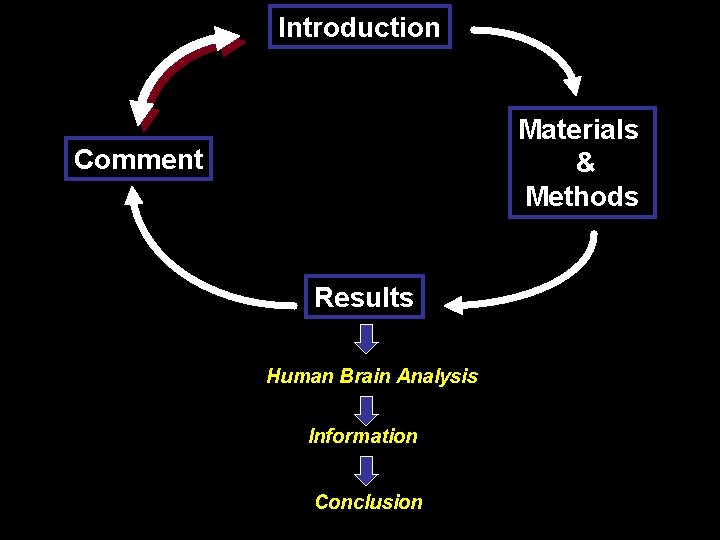
Introduction Materials & Methods Comment Results Human Brain Analysis Information Conclusion
Results • Transparency is essential • Give results for all outcome measures (primary and secondary) that are described under “Materials & Methods” • Do not give results of outcome measures which are not mentioned under “Materials & Methods” • Avoid redundancy Vintzileos and Ananth AJOG 2010; 202: 344. e 1 -6
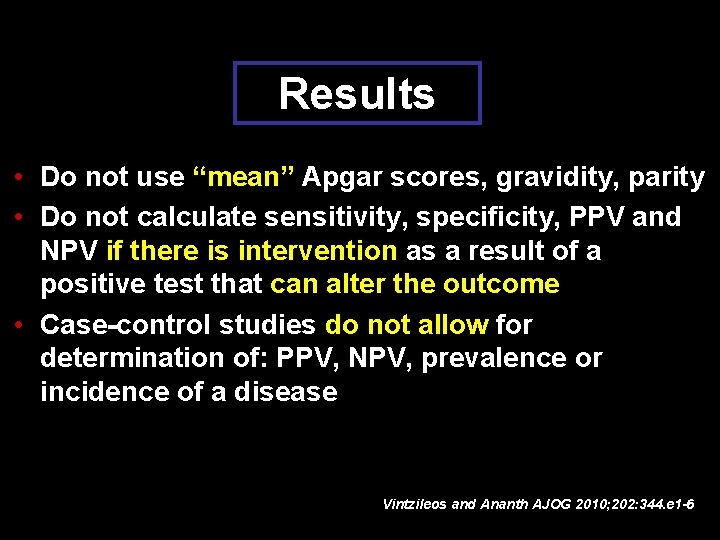
Results • Do not use “mean” Apgar scores, gravidity, parity • Do not calculate sensitivity, specificity, PPV and NPV if there is intervention as a result of a positive test that can alter the outcome • Case-control studies do not allow for determination of: PPV, NPV, prevalence or incidence of a disease Vintzileos and Ananth AJOG 2010; 202: 344. e 1 -6
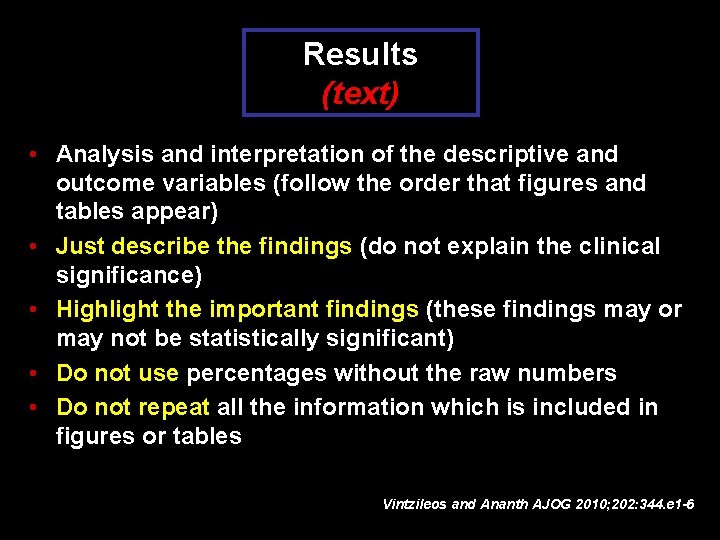
Results (text) • Analysis and interpretation of the descriptive and outcome variables (follow the order that figures and tables appear) • Just describe the findings (do not explain the clinical significance) • Highlight the important findings (these findings may or may not be statistically significant) • Do not use percentages without the raw numbers • Do not repeat all the information which is included in figures or tables Vintzileos and Ananth AJOG 2010; 202: 344. e 1 -6
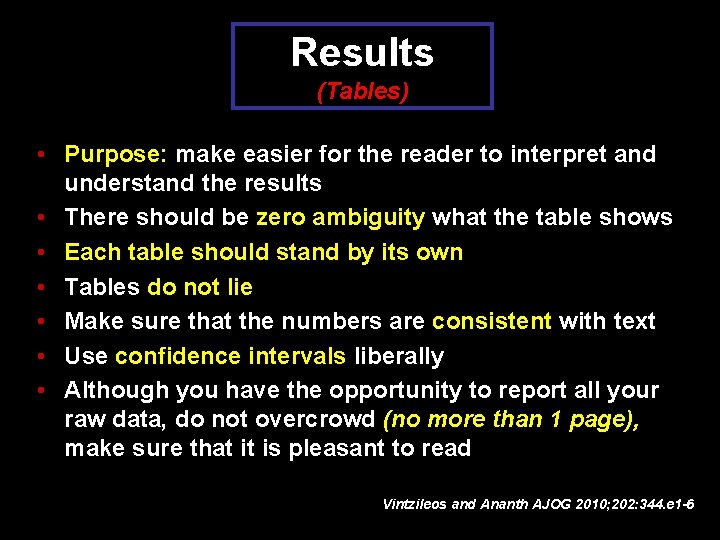
Results (Tables) • Purpose: make easier for the reader to interpret and understand the results • There should be zero ambiguity what the table shows • Each table should stand by its own • Tables do not lie • Make sure that the numbers are consistent with text • Use confidence intervals liberally • Although you have the opportunity to report all your raw data, do not overcrowd (no more than 1 page), make sure that it is pleasant to read Vintzileos and Ananth AJOG 2010; 202: 344. e 1 -6
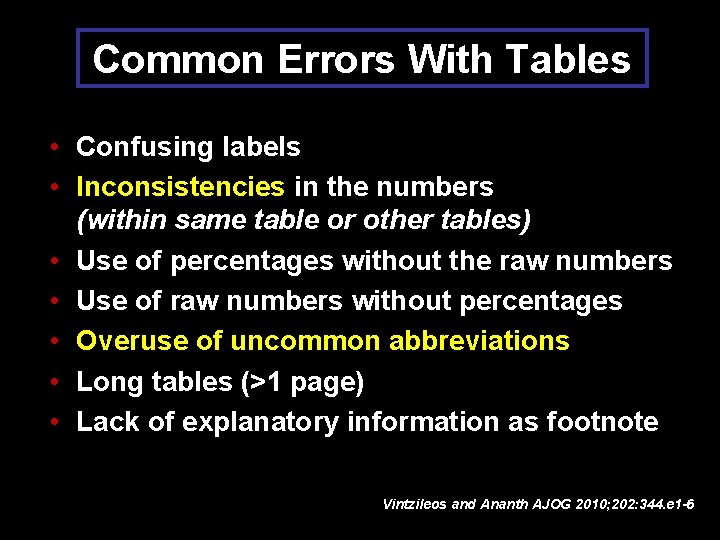
Common Errors With Tables • Confusing labels • Inconsistencies in the numbers (within same table or other tables) • Use of percentages without the raw numbers • Use of raw numbers without percentages • Overuse of uncommon abbreviations • Long tables (>1 page) • Lack of explanatory information as footnote Vintzileos and Ananth AJOG 2010; 202: 344. e 1 -6
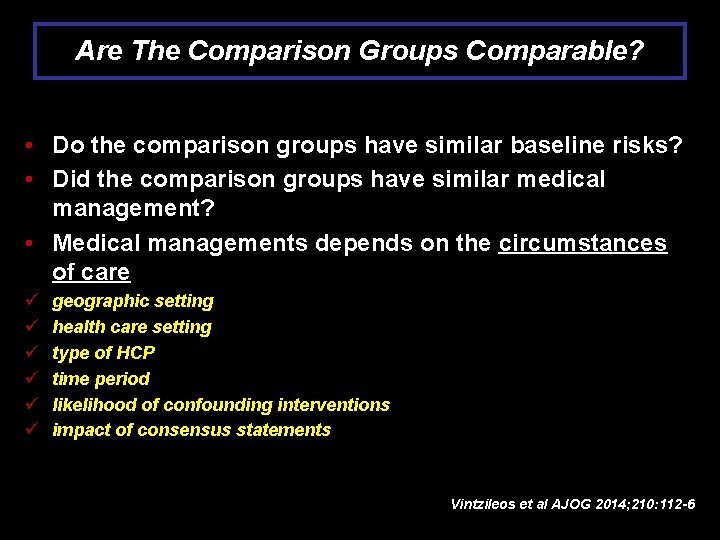
Are The Comparison Groups Comparable? • Do the comparison groups have similar baseline risks? • Did the comparison groups have similar medical management? • Medical managements depends on the circumstances of care ü ü ü geographic setting health care setting type of HCP time period likelihood of confounding interventions impact of consensus statements Vintzileos et al AJOG 2014; 210: 112 -6
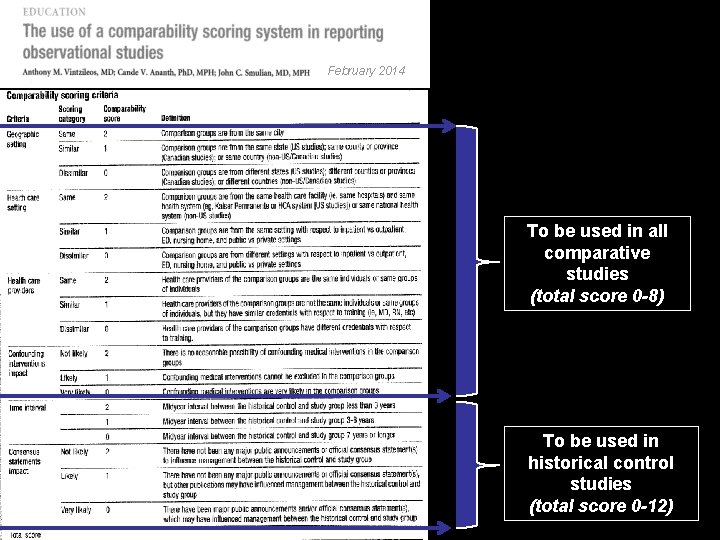
February 2014 To be used in all comparative studies (total score 0 -8) To be used in historical control studies (total score 0 -12)
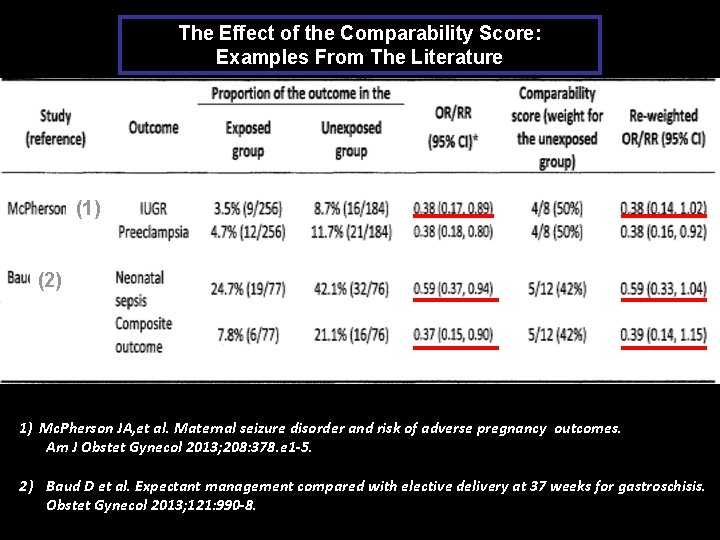
The Effect of the Comparability Score: Examples From The Literature (1) (2) 1) Mc. Pherson JA, et al. Maternal seizure disorder and risk of adverse pregnancy outcomes. Am J Obstet Gynecol 2013; 208: 378. e 1 -5. 2) Baud D et al. Expectant management compared with elective delivery at 37 weeks for gastroschisis. Obstet Gynecol 2013; 121: 990 -8.
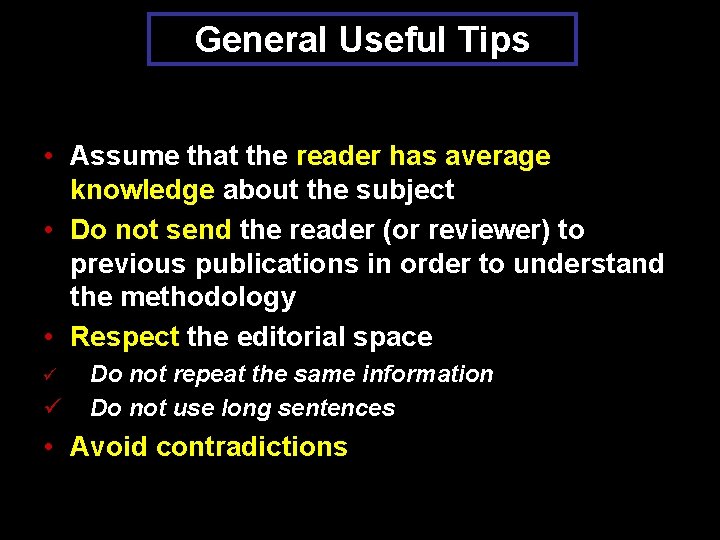
General Useful Tips • Assume that the reader has average knowledge about the subject • Do not send the reader (or reviewer) to previous publications in order to understand the methodology • Respect the editorial space ü ü Do not repeat the same information Do not use long sentences • Avoid contradictions
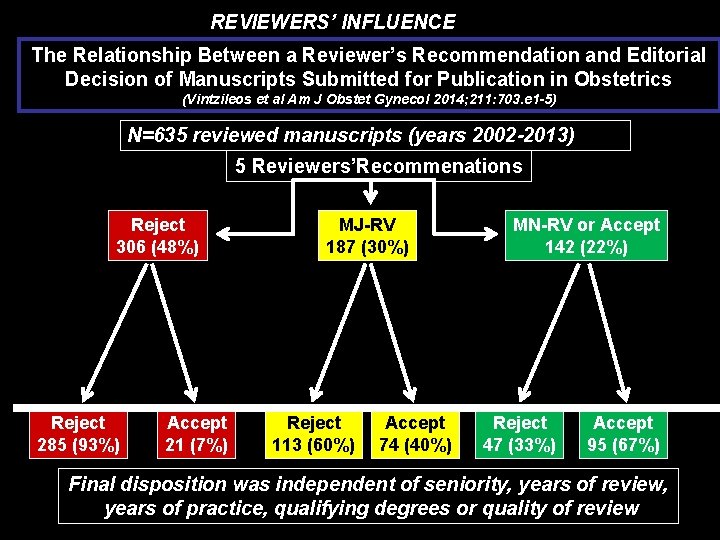
REVIEWERS’ INFLUENCE The Relationship Between a Reviewer’s Recommendation and Editorial Decision of Manuscripts Submitted for Publication in Obstetrics (Vintzileos et al Am J Obstet Gynecol 2014; 211: 703. e 1 -5) N=635 reviewed manuscripts (years 2002 -2013) 5 Reviewers’Recommenations Reject 306 (48%) Reject 285 (93%) Accept 21 (7%) MJ-RV 187 (30%) Reject 113 (60%) Accept 74 (40%) MN-RV or Accept 142 (22%) Reject 47 (33%) Accept 95 (67%) Final disposition was independent of seniority, years of review, years of practice, qualifying degrees or quality of review
If you can’t convince them, confuse them Harry S. Truman (http: //www. brainyquote. com/quotes/authors/h/harry_s_truman. html) Clarification Don’t follow Harry Truman’s advice in your manuscripts