
Statistical Mechanics in the Canonical Ensemble Outline of

Statistical Mechanics in the Canonical Ensemble: Outline of the Formalism and Some Examples (similar to parts of Chs. 6 & 7 in Reif’s book)

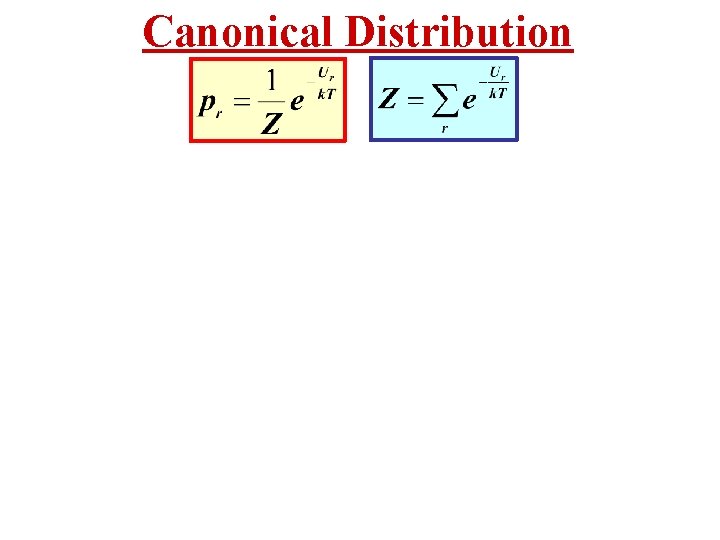
The Canonical Ensemble: Outline of the General Formalism • The Probability that the system is in quantum state r at temperature T is: Ur ε r = Energy of State r. Z “Partition Function” Function
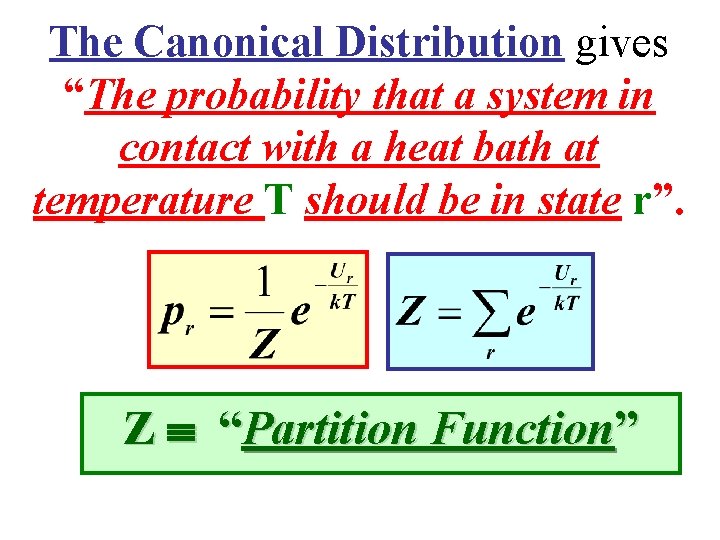
The Canonical Distribution gives “The probability that a system in contact with a heat bath at temperature T should be in state r”. Z “Partition Function”

Ur εr = energy of state r. -
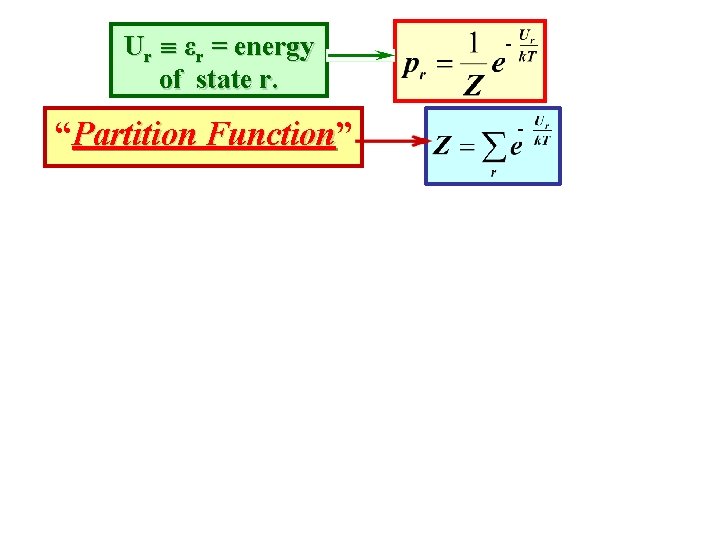
Ur εr = energy of state r. “Partition Function” Function - -

Ur εr = energy of state r. “Partition Function” Function - - pr Probability that a system in contact with a heat bath at temperature T is in state r.
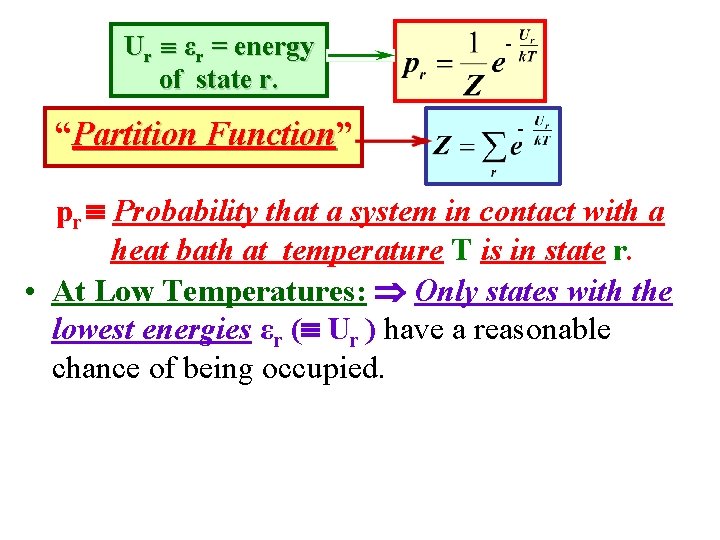
Ur εr = energy of state r. “Partition Function” Function - - pr Probability that a system in contact with a heat bath at temperature T is in state r. • At Low Temperatures: Only states with the lowest energies εr ( Ur ) have a reasonable chance of being occupied.
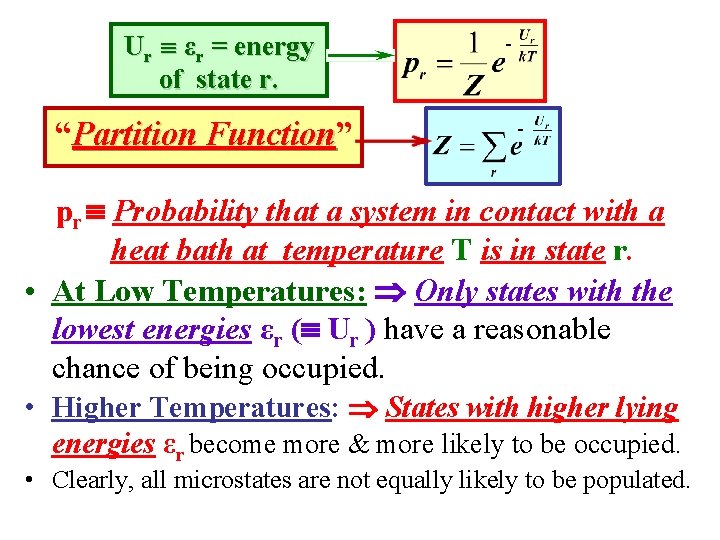
Ur εr = energy of state r. “Partition Function” Function - - pr Probability that a system in contact with a heat bath at temperature T is in state r. • At Low Temperatures: Only states with the lowest energies εr ( Ur ) have a reasonable chance of being occupied. • Higher Temperatures: States with higher lying energies εr become more & more likely to be occupied. • Clearly, all microstates are not equally likely to be populated.
Canonical Distribution
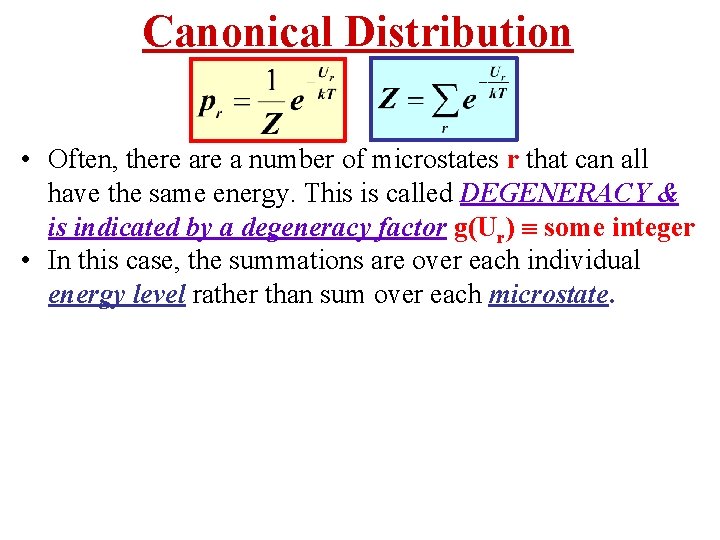
Canonical Distribution • Often, there a number of microstates r that can all have the same energy. This is called DEGENERACY & is indicated by a degeneracy factor g(Ur) some integer • In this case, the summations are over each individual energy level rather than sum over each microstate.

Canonical Distribution • Often, there a number of microstates r that can all have the same energy. This is called DEGENERACY & is indicated by a degeneracy factor g(Ur) some integer • In this case, the summations are over each individual energy level rather than sum over each microstate.
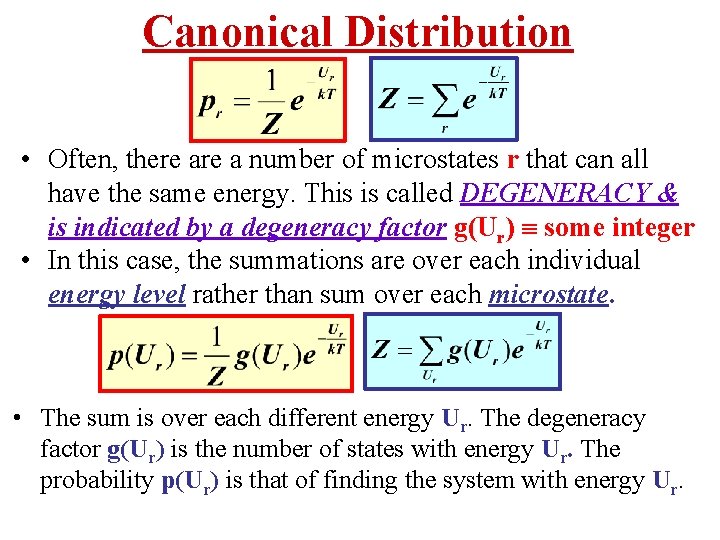
Canonical Distribution • Often, there a number of microstates r that can all have the same energy. This is called DEGENERACY & is indicated by a degeneracy factor g(Ur) some integer • In this case, the summations are over each individual energy level rather than sum over each microstate. • The sum is over each different energy Ur. The degeneracy factor g(Ur) is the number of states with energy Ur. The probability p(Ur) is that of finding the system with energy Ur.
Entropy in the Canonical Ensemble
Entropy in the Canonical Ensemble • The system of interest A is in equilibrium with a heat bath A' for which the energy fluctuates & the probability of finding it in any particular microstate is variable.
Entropy in the Canonical Ensemble • The system of interest A is in equilibrium with a heat bath A' for which the energy fluctuates & the probability of finding it in any particular microstate is variable. Goal: Calculate The Entropy S for system A. • If S is found, all thermodynamic variables can be calculated.
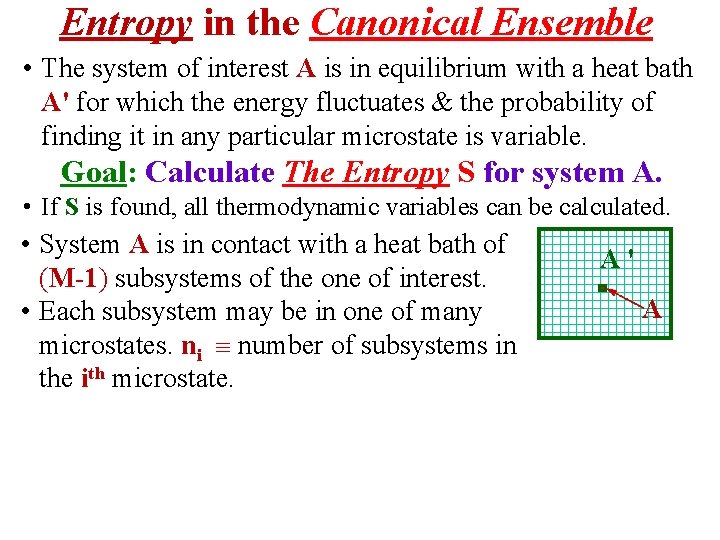
Entropy in the Canonical Ensemble • The system of interest A is in equilibrium with a heat bath A' for which the energy fluctuates & the probability of finding it in any particular microstate is variable. Goal: Calculate The Entropy S for system A. • If S is found, all thermodynamic variables can be calculated. • System A is in contact with a heat bath of (M-1) subsystems of the one of interest. • Each subsystem may be in one of many microstates. ni number of subsystems in the ith microstate. A' A
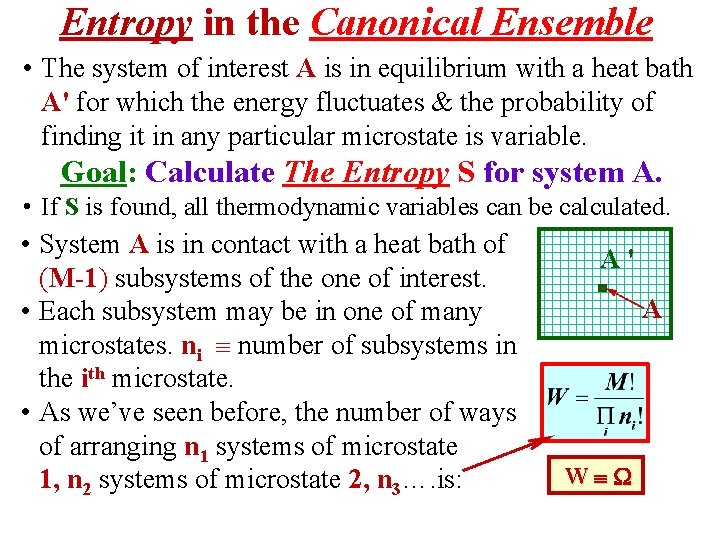
Entropy in the Canonical Ensemble • The system of interest A is in equilibrium with a heat bath A' for which the energy fluctuates & the probability of finding it in any particular microstate is variable. Goal: Calculate The Entropy S for system A. • If S is found, all thermodynamic variables can be calculated. • System A is in contact with a heat bath of (M-1) subsystems of the one of interest. • Each subsystem may be in one of many microstates. ni number of subsystems in the ith microstate. • As we’ve seen before, the number of ways of arranging n 1 systems of microstate 1, n 2 systems of microstate 2, n 3…. is: A' A W
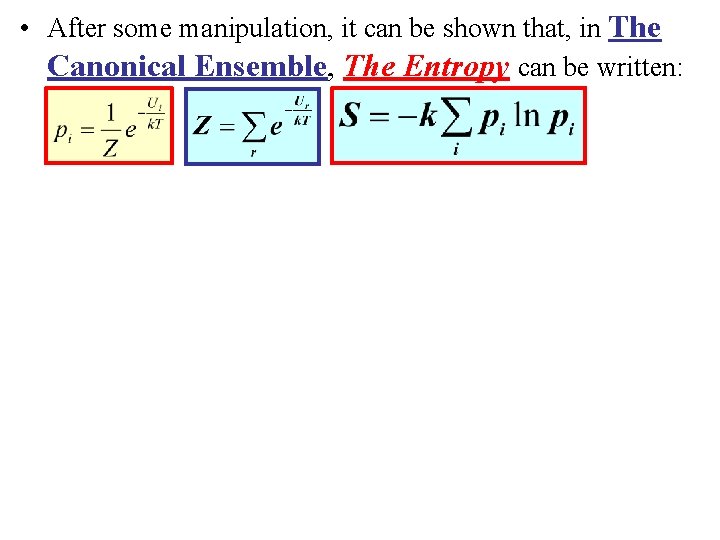
• After some manipulation, it can be shown that, in The Canonical Ensemble, The Entropy can be written:
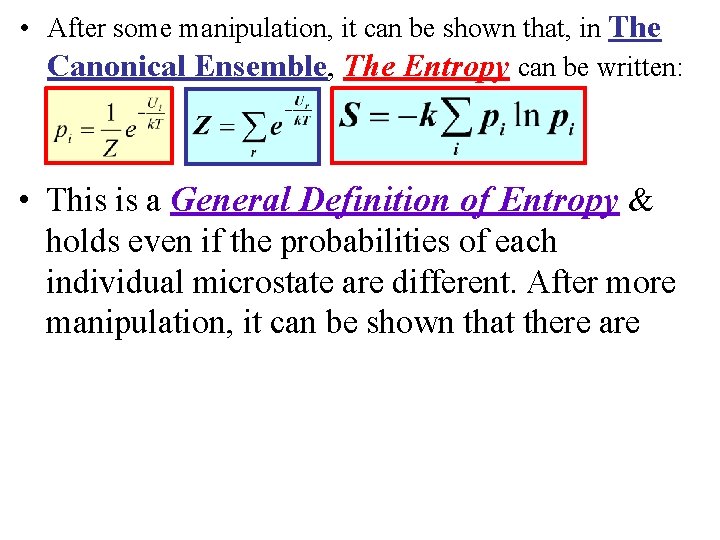
• After some manipulation, it can be shown that, in The Canonical Ensemble, The Entropy can be written: • This is a General Definition of Entropy & holds even if the probabilities of each individual microstate are different. After more manipulation, it can be shown that there are
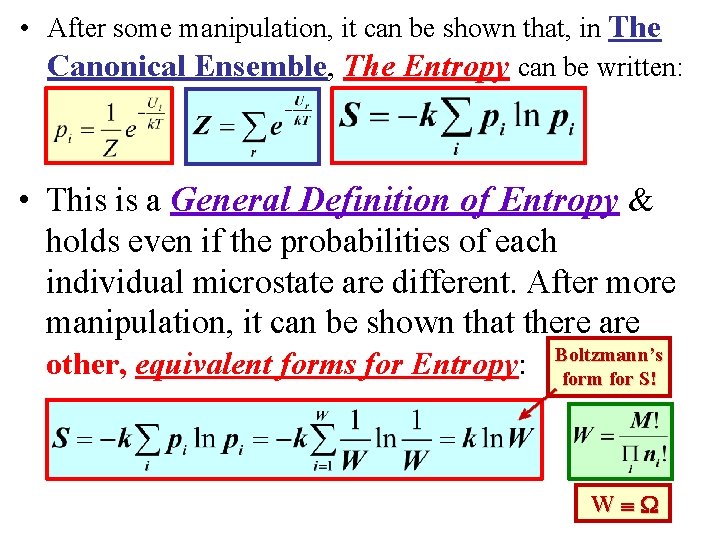
• After some manipulation, it can be shown that, in The Canonical Ensemble, The Entropy can be written: • This is a General Definition of Entropy & holds even if the probabilities of each individual microstate are different. After more manipulation, it can be shown that there are other, equivalent forms for Entropy: Boltzmann’s form for S! W
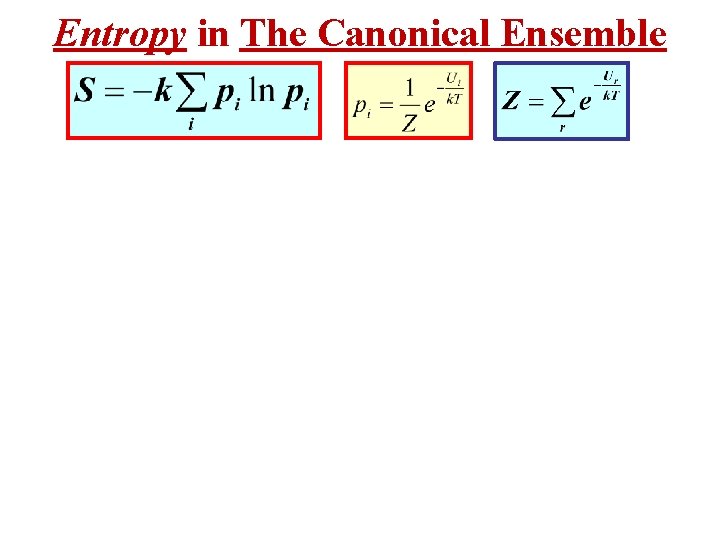
Entropy in The Canonical Ensemble
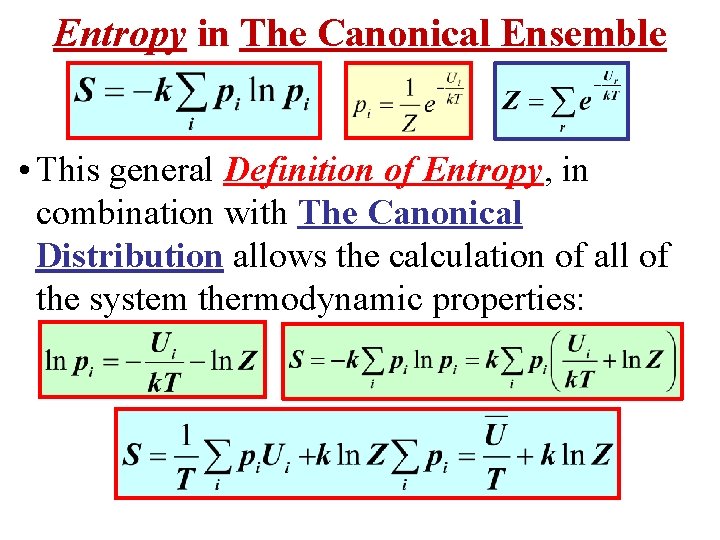
Entropy in The Canonical Ensemble • This general Definition of Entropy, in combination with The Canonical Distribution allows the calculation of all of the system thermodynamic properties:
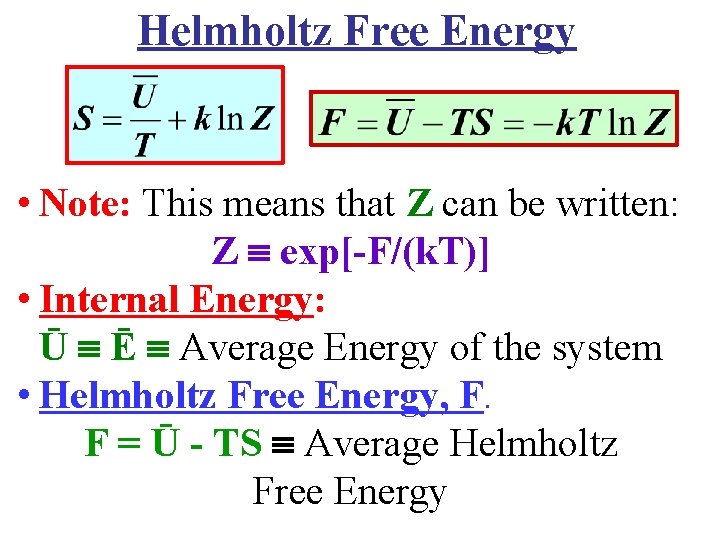
Helmholtz Free Energy • Note: This means that Z can be written: Z exp[-F/(k. T)] • Internal Energy: Ū Ē Average Energy of the system • Helmholtz Free Energy, F. F = Ū - TS Average Helmholtz Free Energy
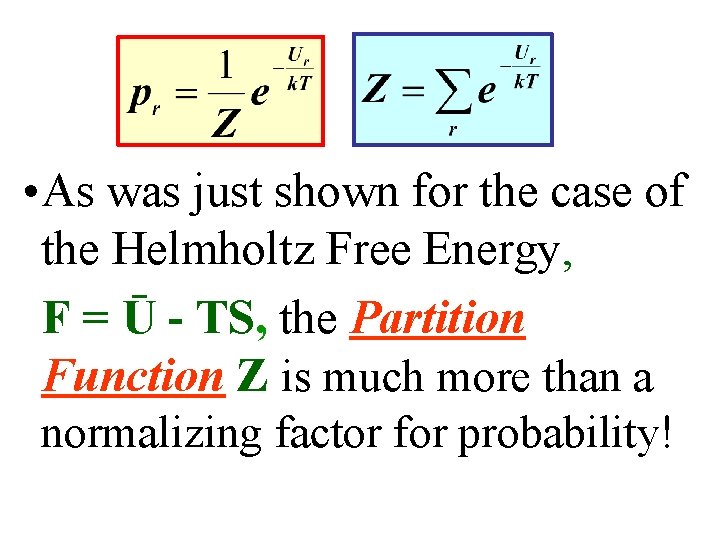
• As was just shown for the case of the Helmholtz Free Energy, F = Ū - TS, the Partition Function Z is much more than a normalizing factor for probability!
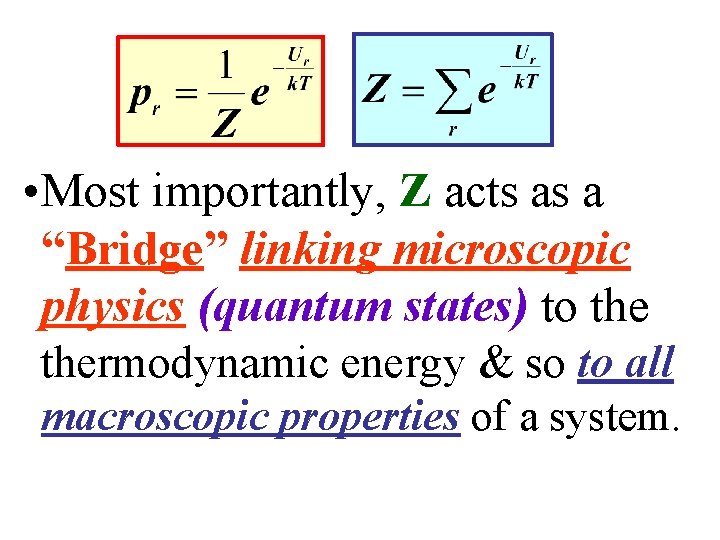
• Most importantly, Z acts as a “Bridge” linking microscopic physics (quantum states) to thermodynamic energy & so to all macroscopic properties of a system.
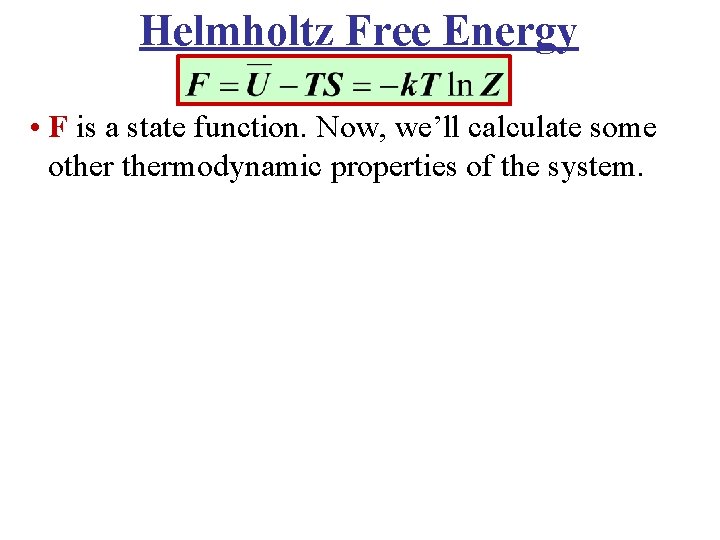
Helmholtz Free Energy • F is a state function. Now, we’ll calculate some othermodynamic properties of the system.
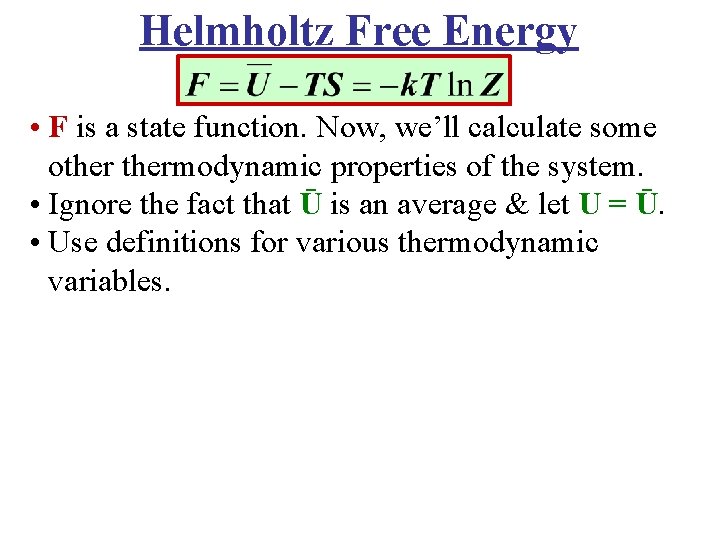
Helmholtz Free Energy • F is a state function. Now, we’ll calculate some othermodynamic properties of the system. • Ignore the fact that Ū is an average & let U = Ū. • Use definitions for various thermodynamic variables.
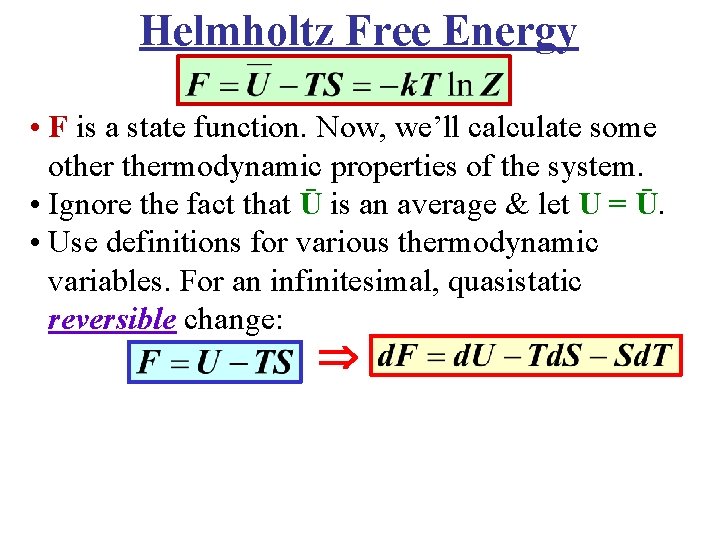
Helmholtz Free Energy • F is a state function. Now, we’ll calculate some othermodynamic properties of the system. • Ignore the fact that Ū is an average & let U = Ū. • Use definitions for various thermodynamic variables. For an infinitesimal, quasistatic reversible change:
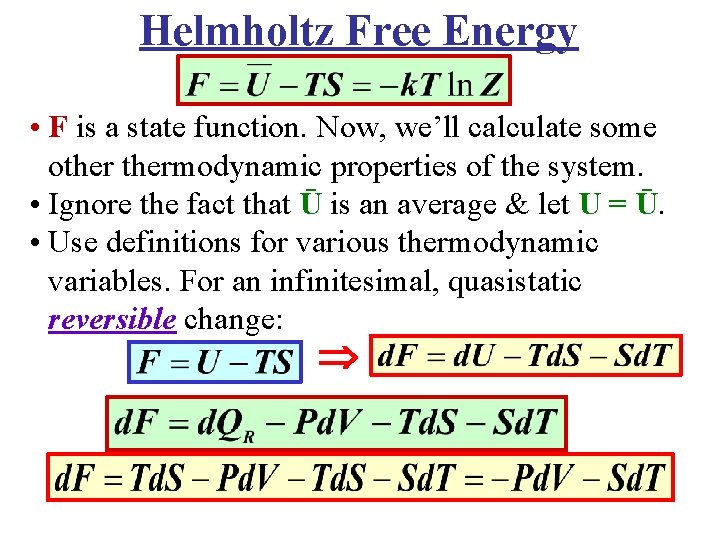
Helmholtz Free Energy • F is a state function. Now, we’ll calculate some othermodynamic properties of the system. • Ignore the fact that Ū is an average & let U = Ū. • Use definitions for various thermodynamic variables. For an infinitesimal, quasistatic reversible change:

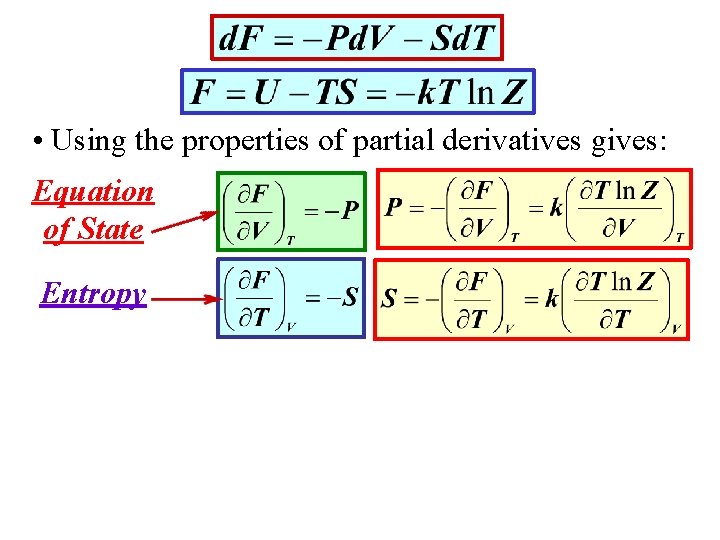
• Using the properties of partial derivatives gives: Equation of State Entropy
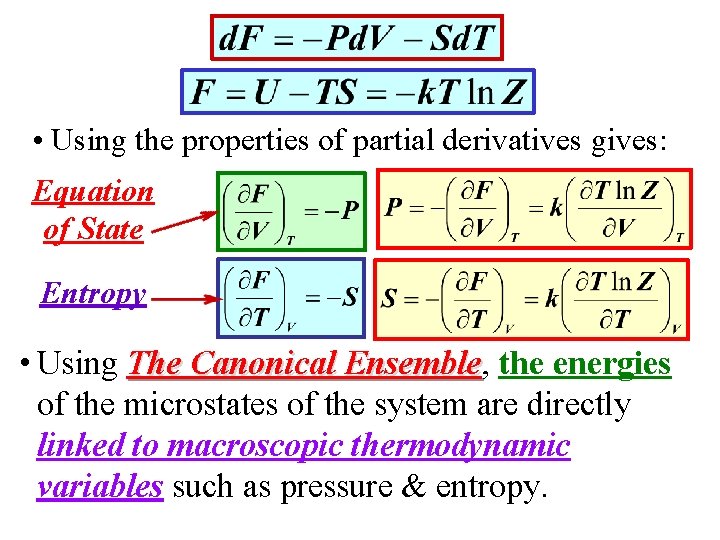
• Using the properties of partial derivatives gives: Equation of State Entropy • Using The Canonical Ensemble, Ensemble the energies of the microstates of the system are directly linked to macroscopic thermodynamic variables such as pressure & entropy.
Measurable Thermodynamic Variables: 2 nd Derivatives of Helmholtz Free Energy F
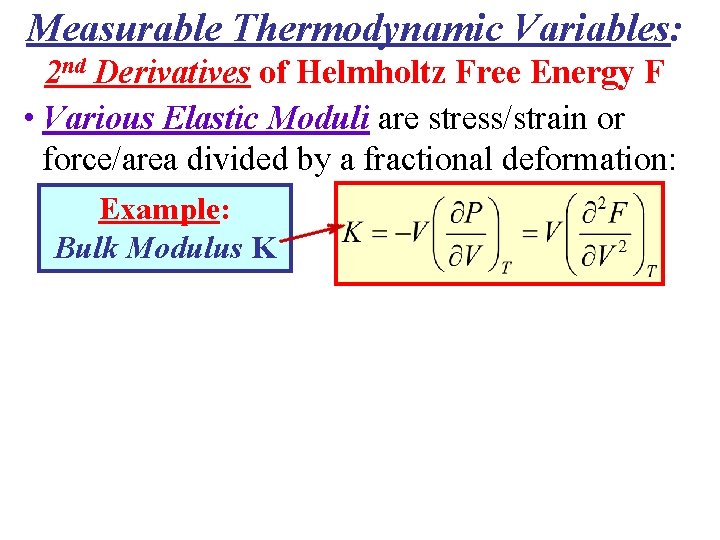
Measurable Thermodynamic Variables: 2 nd Derivatives of Helmholtz Free Energy F • Various Elastic Moduli are stress/strain or force/area divided by a fractional deformation: Example: Bulk Modulus K
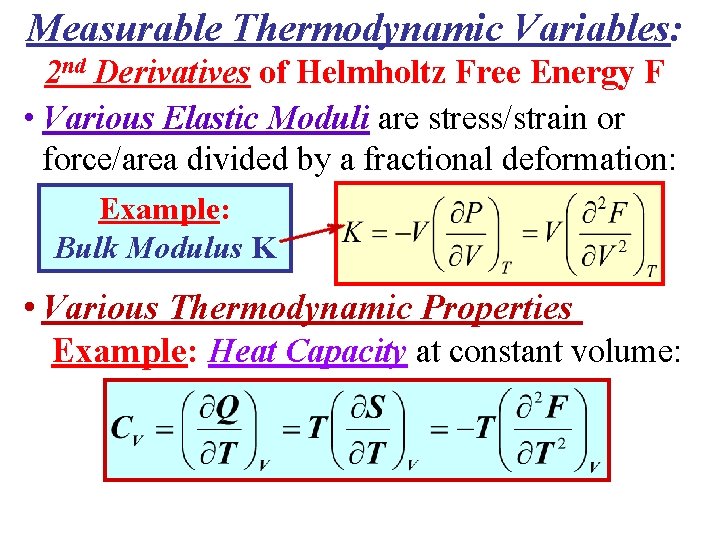
Measurable Thermodynamic Variables: 2 nd Derivatives of Helmholtz Free Energy F • Various Elastic Moduli are stress/strain or force/area divided by a fractional deformation: Example: Bulk Modulus K • Various Thermodynamic Properties Example: Heat Capacity at constant volume:
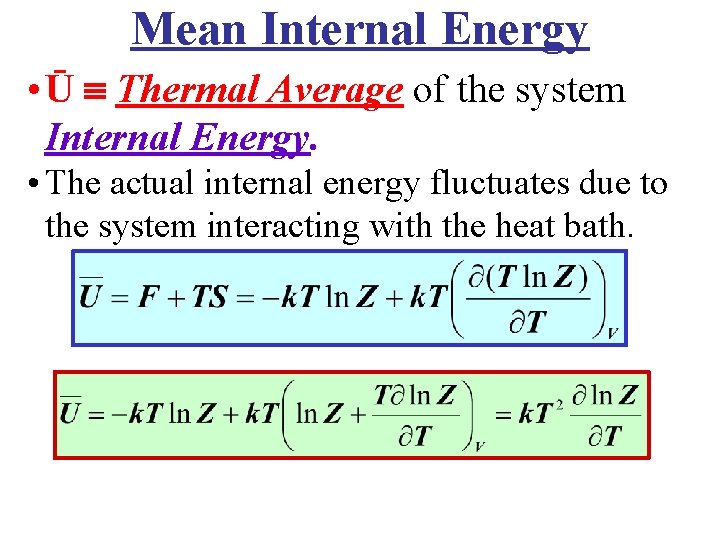
Mean Internal Energy • Ū Thermal Average of the system Internal Energy. • The actual internal energy fluctuates due to the system interacting with the heat bath.
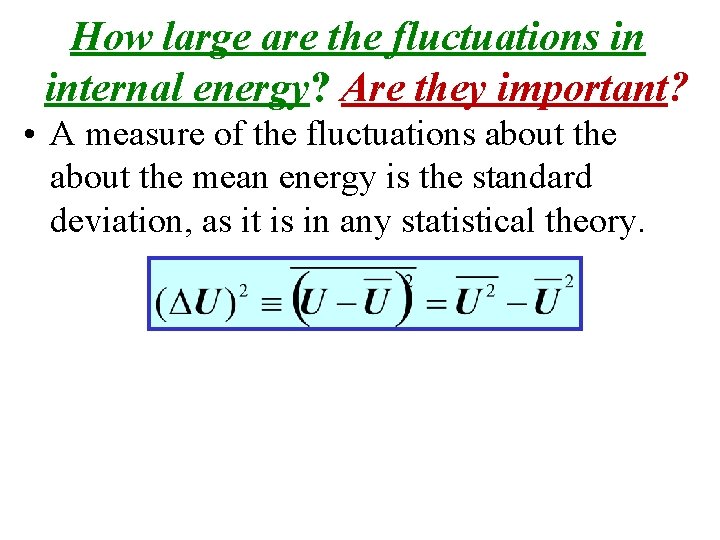
How large are the fluctuations in internal energy? Are they important? • A measure of the fluctuations about the mean energy is the standard deviation, as it is in any statistical theory.
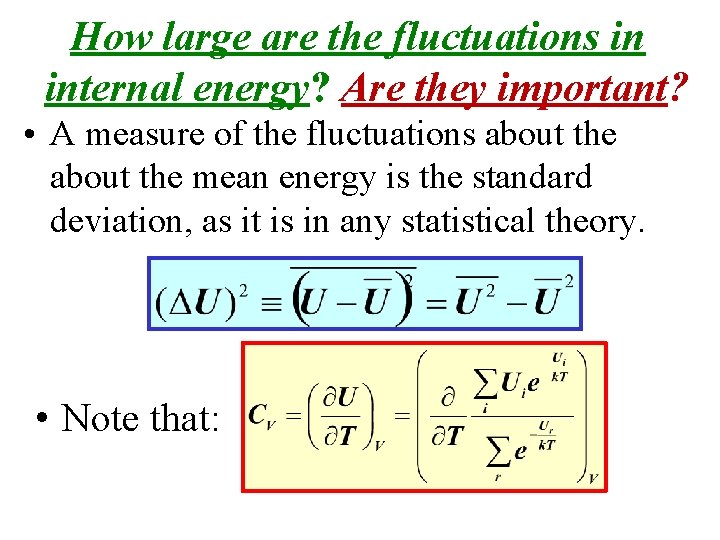
How large are the fluctuations in internal energy? Are they important? • A measure of the fluctuations about the mean energy is the standard deviation, as it is in any statistical theory. • Note that:
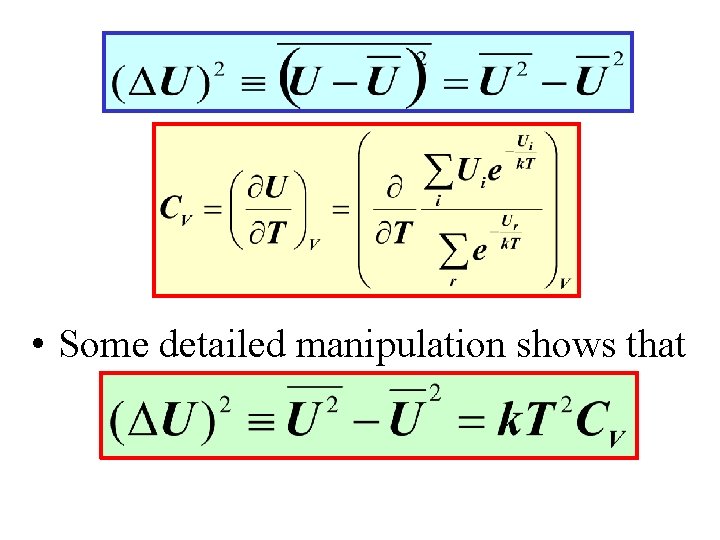
• Some detailed manipulation shows that
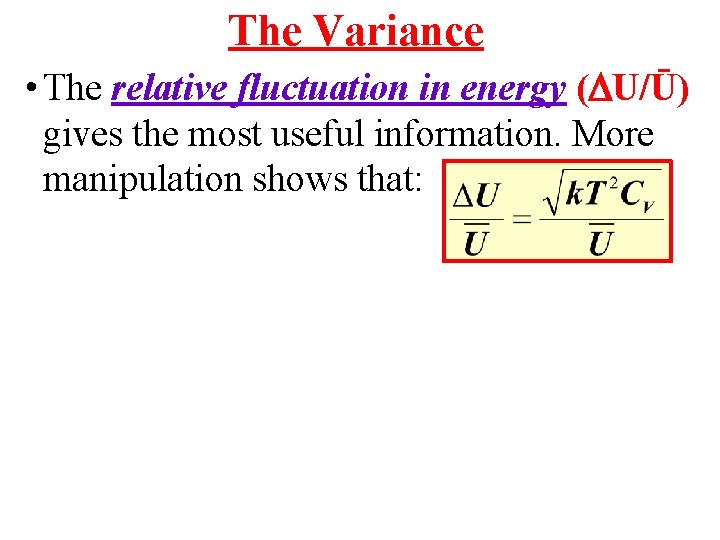
The Variance • The relative fluctuation in energy ( U/Ū) gives the most useful information. More manipulation shows that:
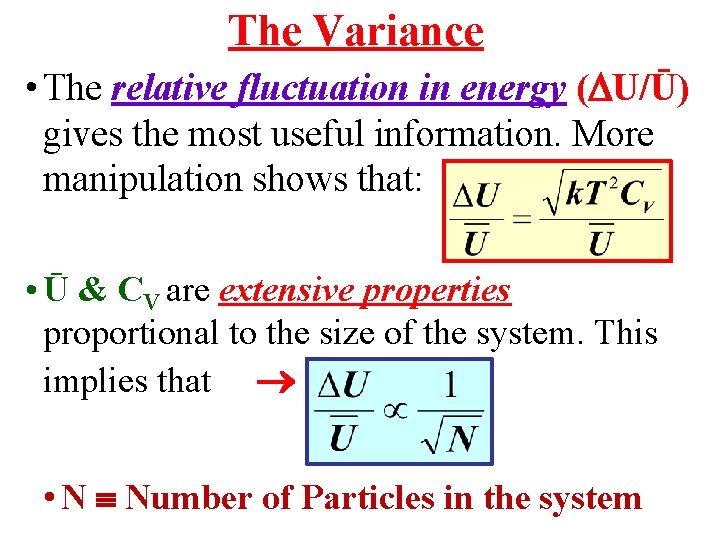
The Variance • The relative fluctuation in energy ( U/Ū) gives the most useful information. More manipulation shows that: • Ū & CV are extensive properties proportional to the size of the system. This implies that • N Number of Particles in the system
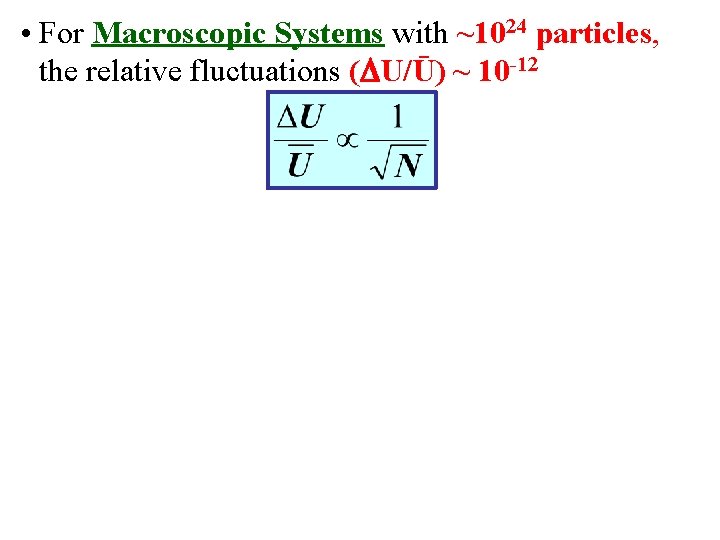
• For Macroscopic Systems with ~1024 particles, the relative fluctuations ( U/Ū) ~ 10 -12
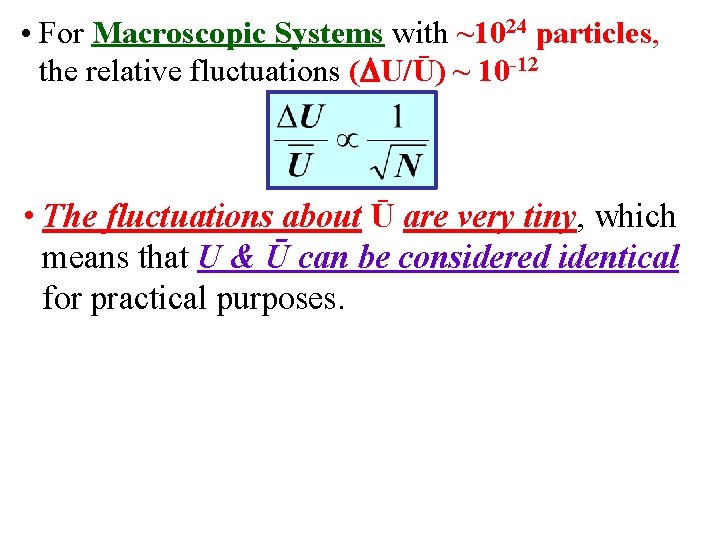
• For Macroscopic Systems with ~1024 particles, the relative fluctuations ( U/Ū) ~ 10 -12 • The fluctuations about Ū are very tiny, which means that U & Ū can be considered identical for practical purposes.
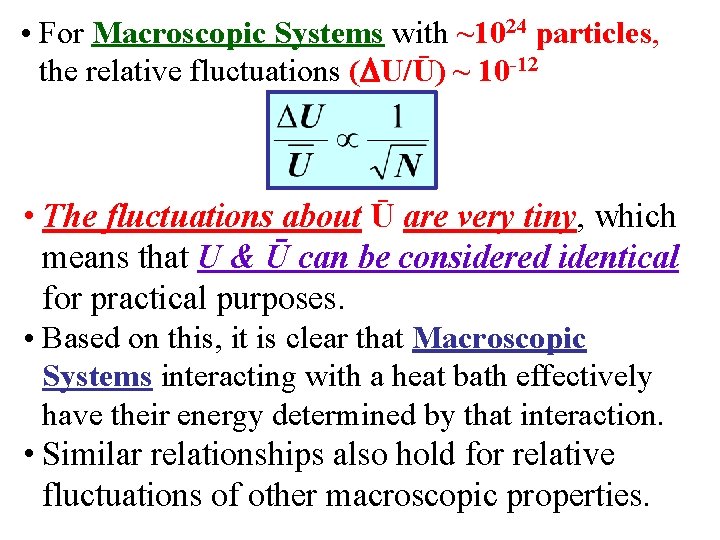
• For Macroscopic Systems with ~1024 particles, the relative fluctuations ( U/Ū) ~ 10 -12 • The fluctuations about Ū are very tiny, which means that U & Ū can be considered identical for practical purposes. • Based on this, it is clear that Macroscopic Systems interacting with a heat bath effectively have their energy determined by that interaction. • Similar relationships also hold for relative fluctuations of other macroscopic properties.
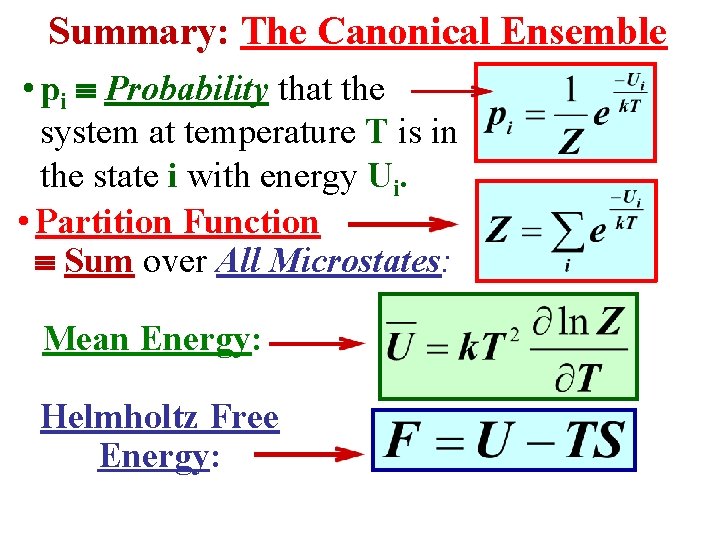
Summary: The Canonical Ensemble • pi Probability that the system at temperature T is in the state i with energy Ui. • Partition Function Sum over All Microstates: Mean Energy: Helmholtz Free Energy:
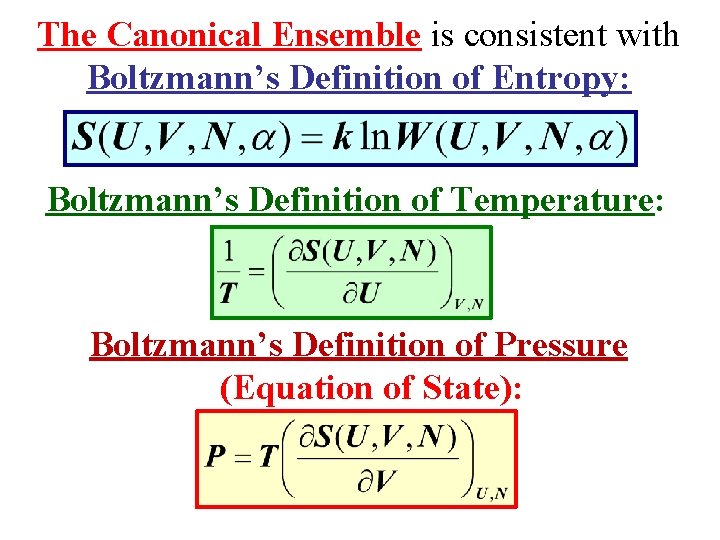
The Canonical Ensemble is consistent with Boltzmann’s Definition of Entropy: Boltzmann’s Definition of Temperature: Boltzmann’s Definition of Pressure (Equation of State):
- Slides: 46