
Statistical Machine Learning The Basic Approach and Current
Statistical Machine Learning. The Basic Approach and Current Research Challenges Shai Ben-David CS 497 February, 2007
A High Level Agenda “The purpose of science is to find meaningful simplicity in the midst of disorderly complexity” Herbert Simon
Representative learning tasks v Medical research. v Detection of fraudulent activity (credit card transactions, intrusion detection, stock market manipulation) v Analysis of genome functionality v Email spam detection. v Spatial prediction of landslide hazards.
Common to all such tasks v We wish to develop algorithms that detect meaningful regularities in large complex data sets. v We focus on data that is too complex for humans to figure out its meaningful regularities. v We consider the task of finding such regularities from random samples of the data population. v We should derive conclusions in timely manner. Computational efficiency is essential.
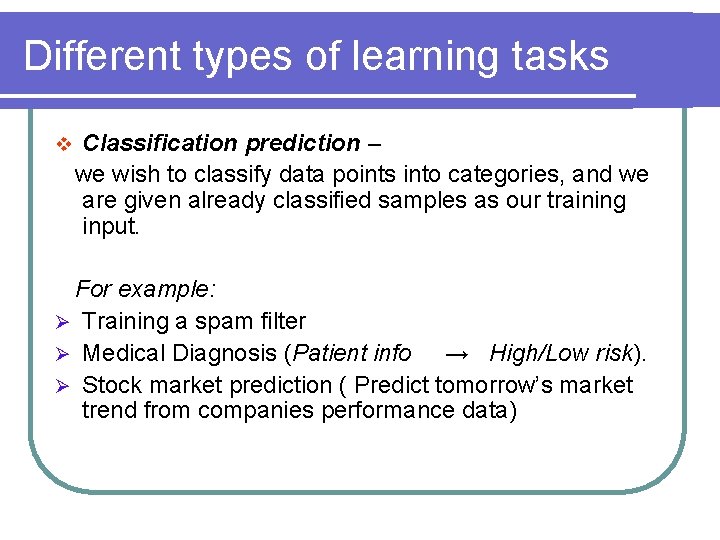
Different types of learning tasks v Classification prediction – we wish to classify data points into categories, and we are given already classified samples as our training input. For example: Ø Training a spam filter Ø Medical Diagnosis (Patient info → High/Low risk). Ø Stock market prediction ( Predict tomorrow’s market trend from companies performance data)
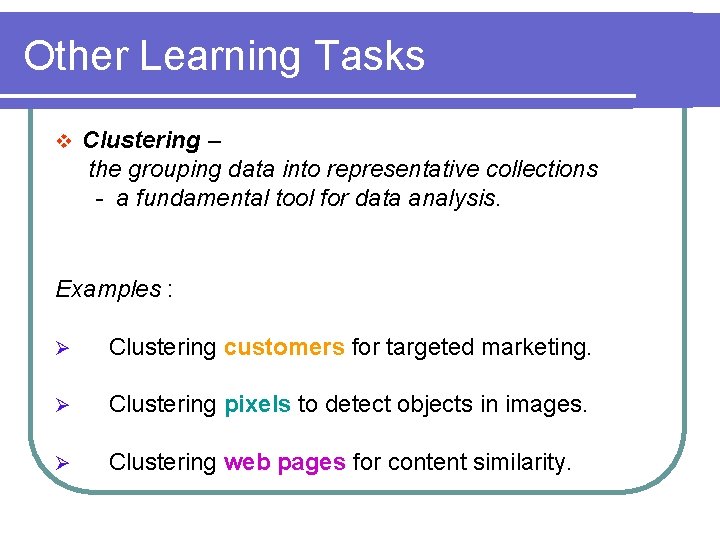
Other Learning Tasks v Clustering – the grouping data into representative collections - a fundamental tool for data analysis. Examples : Ø Clustering customers for targeted marketing. Ø Clustering pixels to detect objects in images. Ø Clustering web pages for content similarity.
Differences from Classical Statistics v We are interested in hypothesis generation rather than hypothesis testing. v We wish to make no prior assumptions about the structure of our data. v We develop algorithms for automated generation of hypotheses. v We are concerned with computational efficiency.
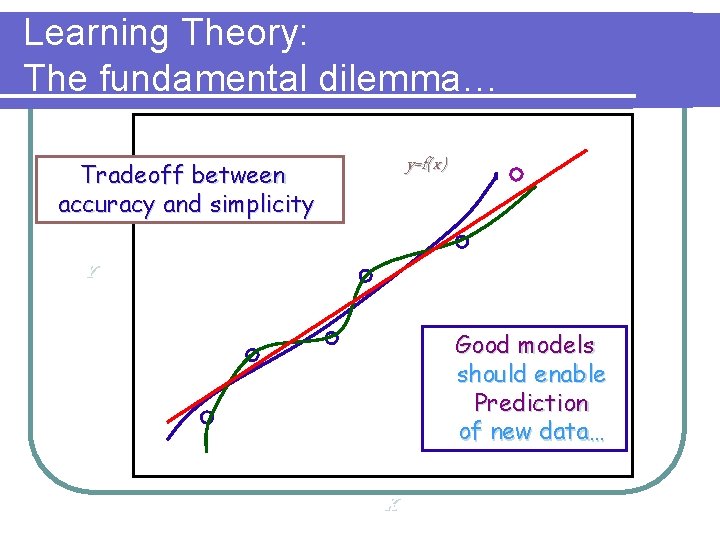
Learning Theory: The fundamental dilemma… y=f(x) Tradeoff between accuracy and simplicity Y Good models should enable Prediction of new data… X
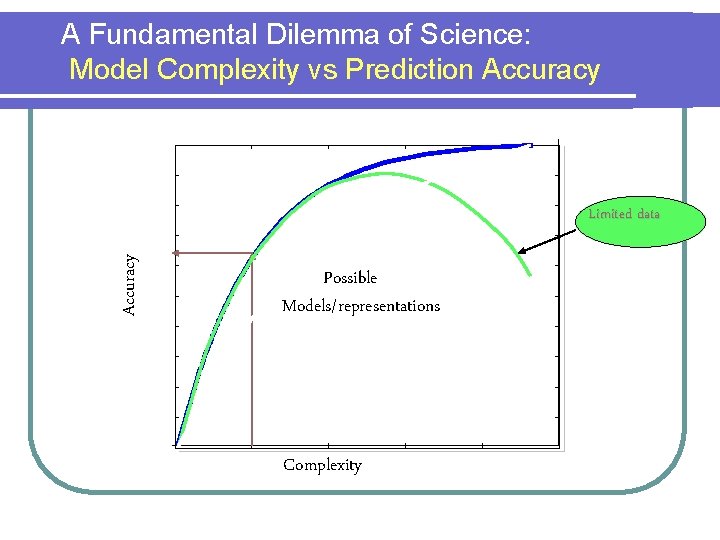
A Fundamental Dilemma of Science: Model Complexity vs Prediction Accuracy Limited data Possible Models/representations Complexity
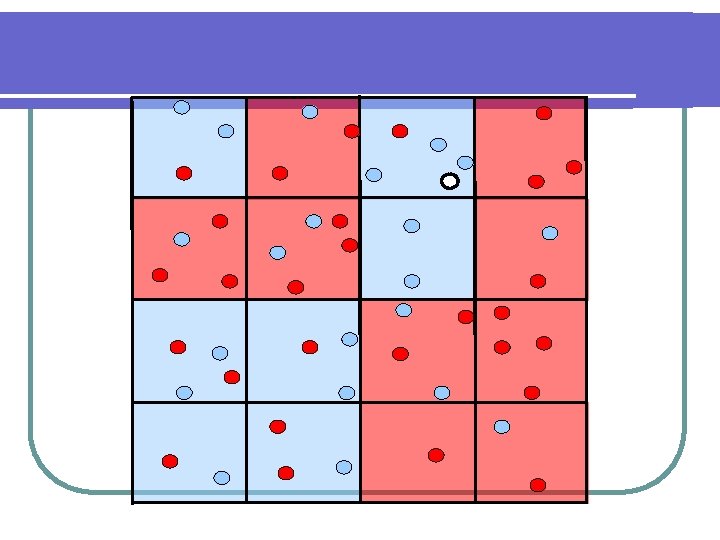
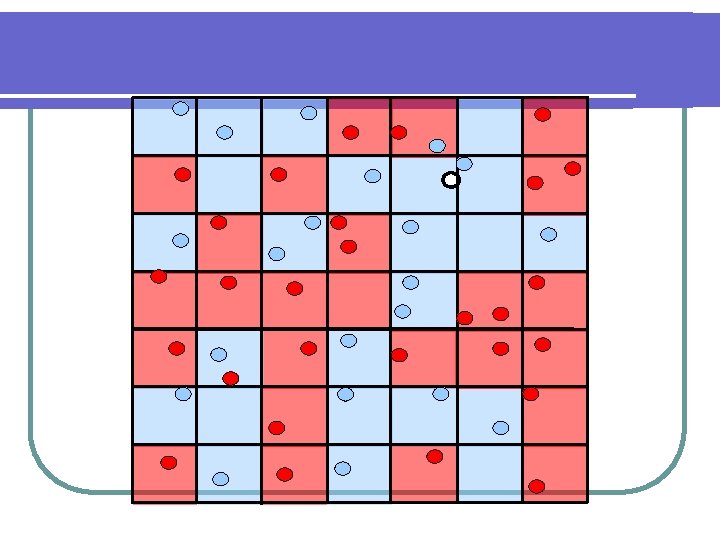
Problem Outline v We are interested in (automated) Hypothesis Generation, rather than traditional Hypothesis Testing v First obstacle: The danger of overfitting. v First solution: Consider only a limited set of candidate hypotheses.
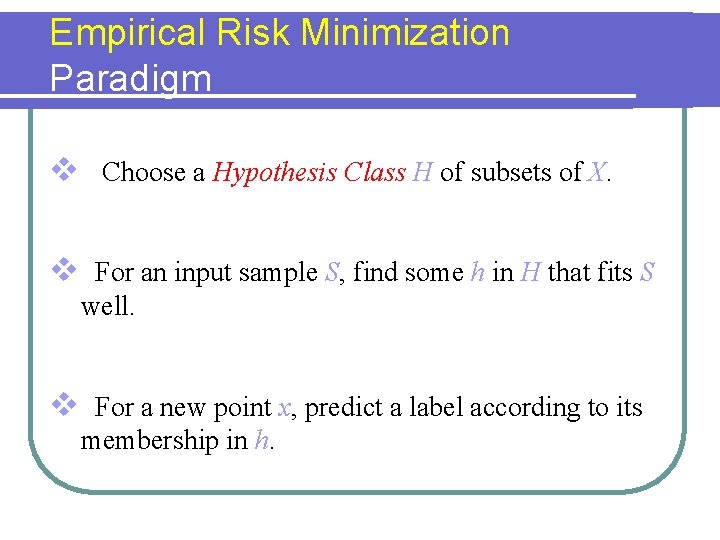
Empirical Risk Minimization Paradigm v Choose a Hypothesis Class H of subsets of X. v For an input sample S, find some h in H that fits S well. v For a new point x, predict a label according to its membership in h.
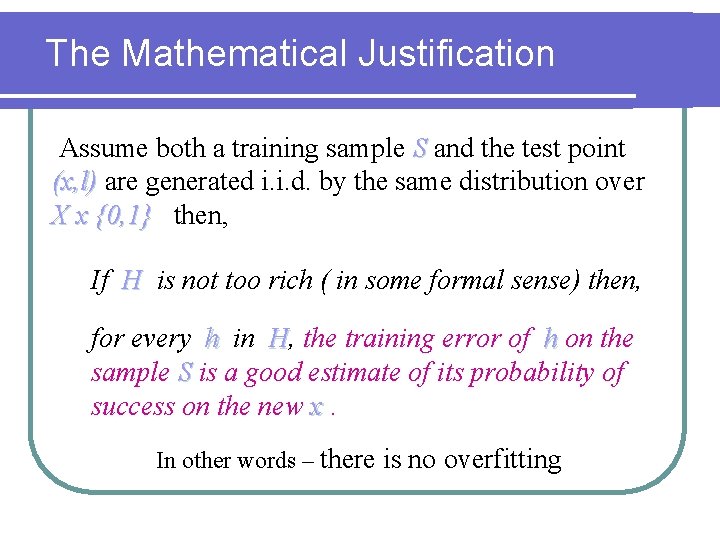
The Mathematical Justification Assume both a training sample S and the test point (x, l) are generated i. i. d. by the same distribution over X x {0, 1} then, If H is not too rich ( in some formal sense) then, for every h in H, the training error of h on the sample S is a good estimate of its probability of success on the new x. In other words – there is no overfitting
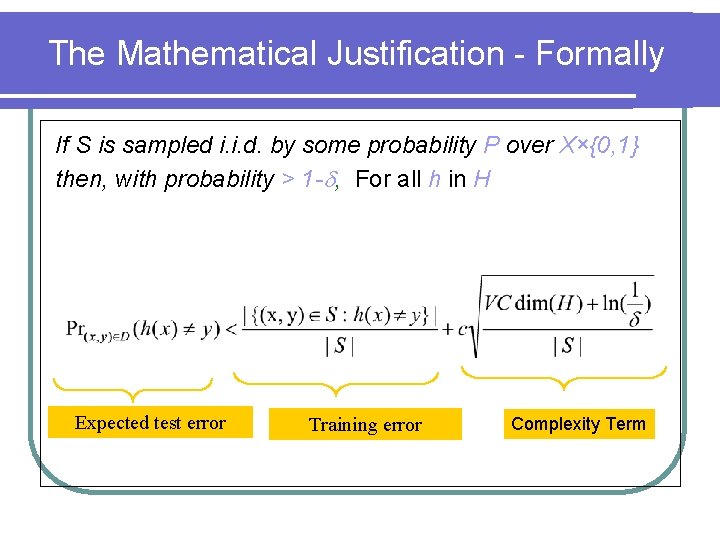
The Mathematical Justification - Formally If S is sampled i. i. d. by some probability P over X×{0, 1} then, with probability > 1 - , For all h in H Expected test error Training error Complexity Term

The Types of Errors to be Considered Training error minimizer Best regressor for P The Class H Total error Approximation Error Estimation Error Best h (in H) for P
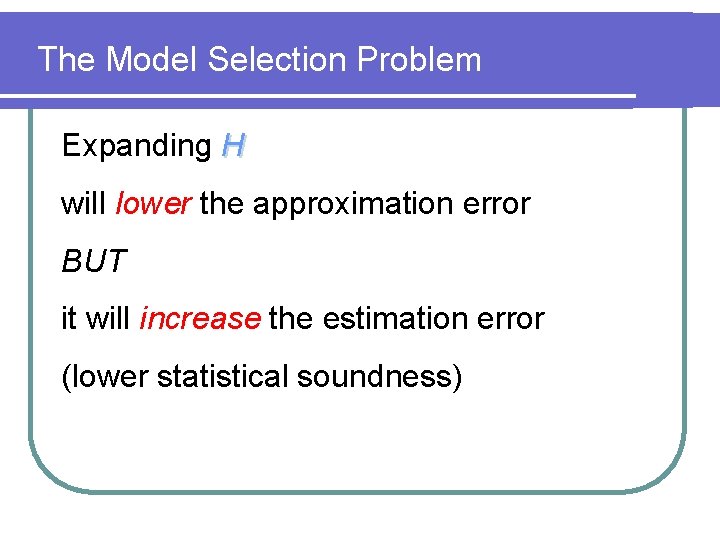
The Model Selection Problem Expanding H will lower the approximation error BUT it will increase the estimation error (lower statistical soundness)
Yet another problem – Computational Complexity Once we have a large enough training sample, how much computation is required to search for a good hypothesis? (That is, empirically good. )
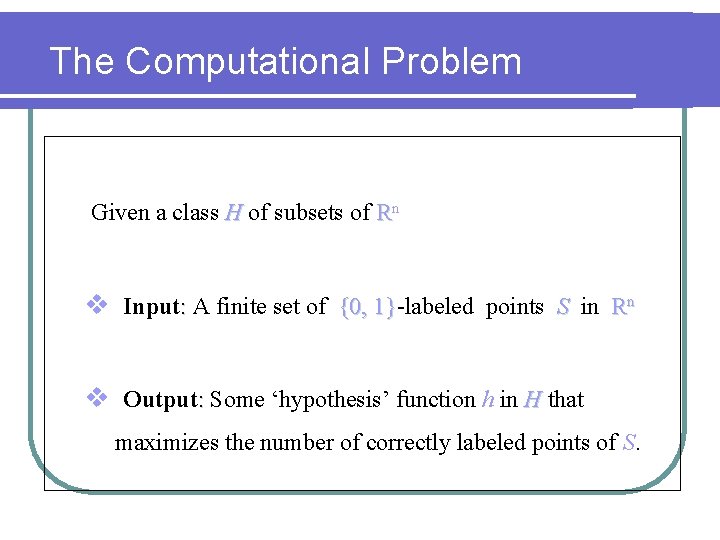
The Computational Problem Given a class H of subsets of Rn v Input: A finite set of {0, 1}-labeled points S in Rn 1} v Output: Some ‘hypothesis’ function h in H that maximizes the number of correctly labeled points of S.
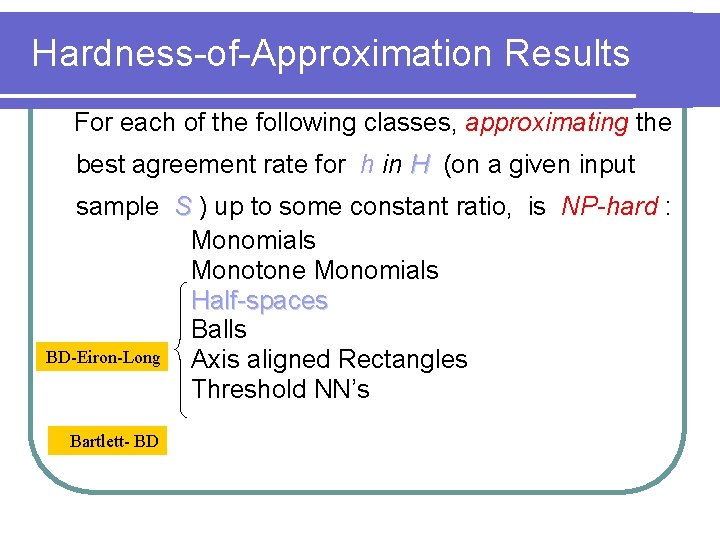
Hardness-of-Approximation Results For each of the following classes, approximating the best agreement rate for h in H (on a given input sample S ) up to some constant ratio, is NP-hard : Monomials Constant width Monotone Monomials Half-spaces Balls BD-Eiron-Long Axis aligned Rectangles Threshold NN’s Bartlett- BD
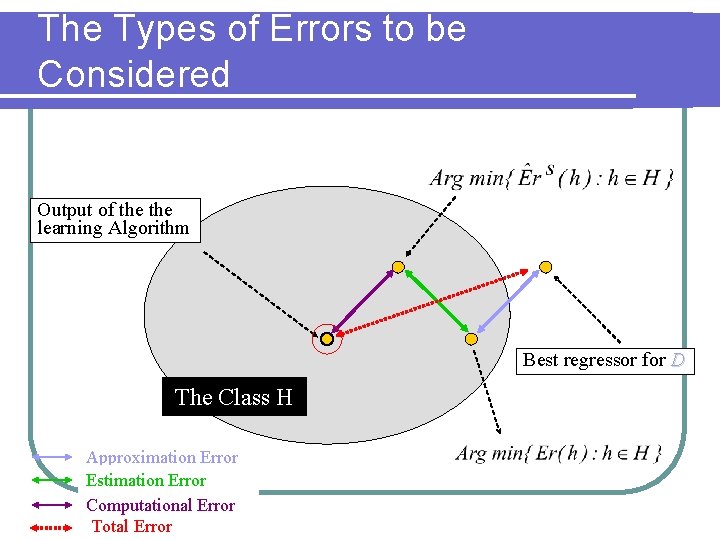
The Types of Errors to be Considered Output of the learning Algorithm Best regressor for D The Class H Approximation Error Estimation Error Computational Error Total Error
Our hypotheses set should balance several requirements: v Expressiveness – being able to capture the structure of our learning task. v Statistical ‘compactness’- having low combinatorial complexity. v Computational manageability – existence of efficient ERM algorithms.
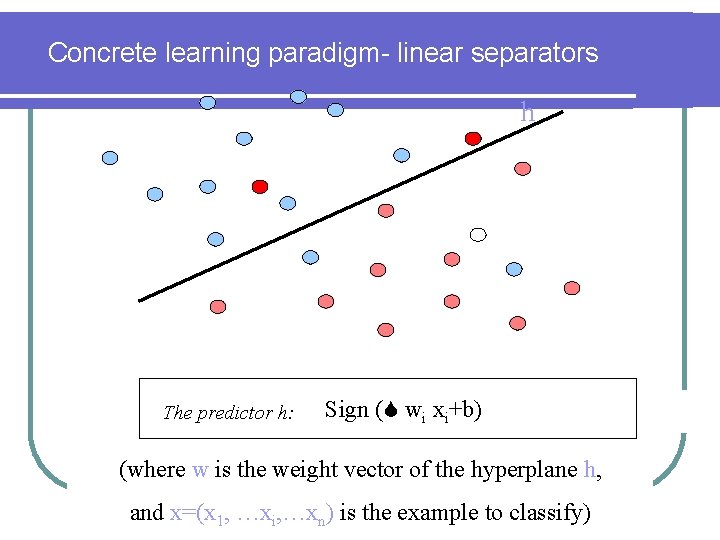
Concrete learning paradigm- linear separators h The predictor h: Sign ( wi xi+b) (where w is the weight vector of the hyperplane h, and x=(x 1, …xi, …xn) is the example to classify)
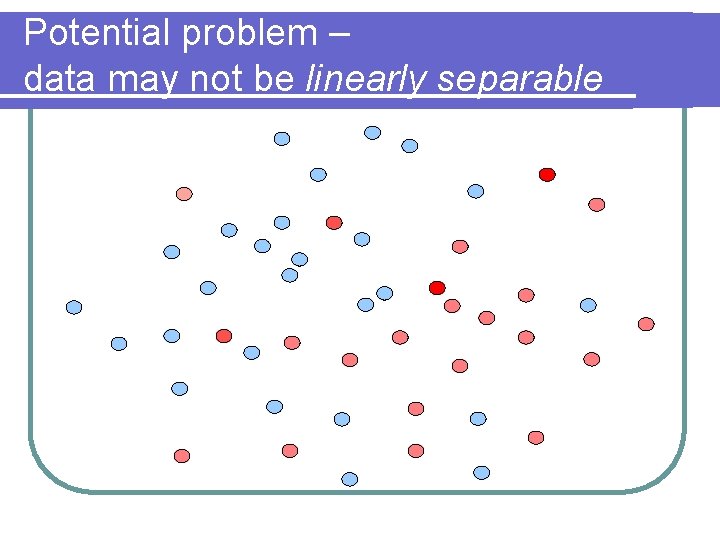
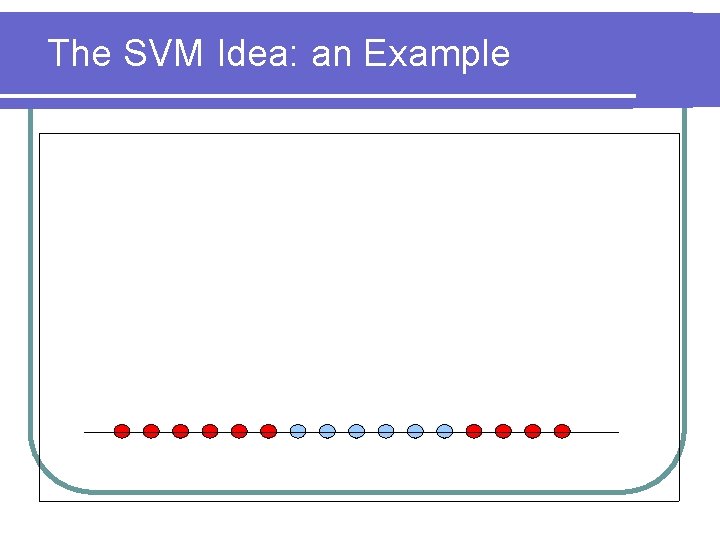
Potential problem – data may not be linearly separable
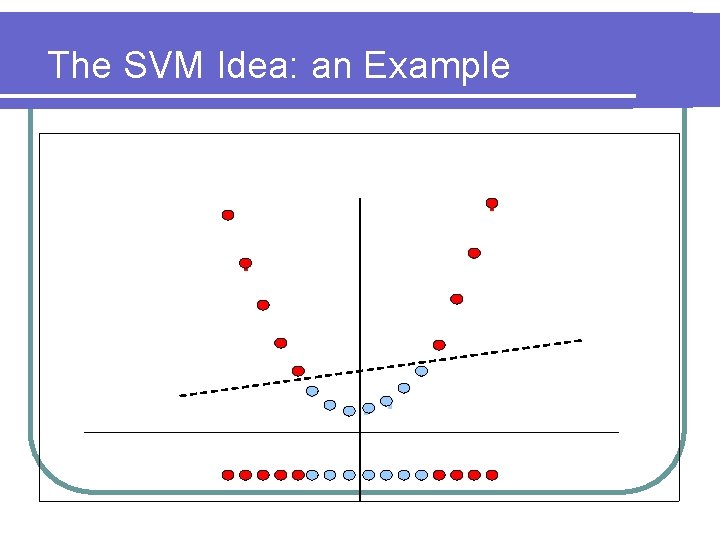
The SVM Paradigm v Choose an Embedding of the domain X into some high dimensional Euclidean space, so that the data sample becomes (almost) linearly separable. v Find a large-margin data-separating hyperplane in this image space, and use it for prediction. Important gain: When the data is separable, finding such a hyperplane is computationally feasible.
The SVM Idea: an Example
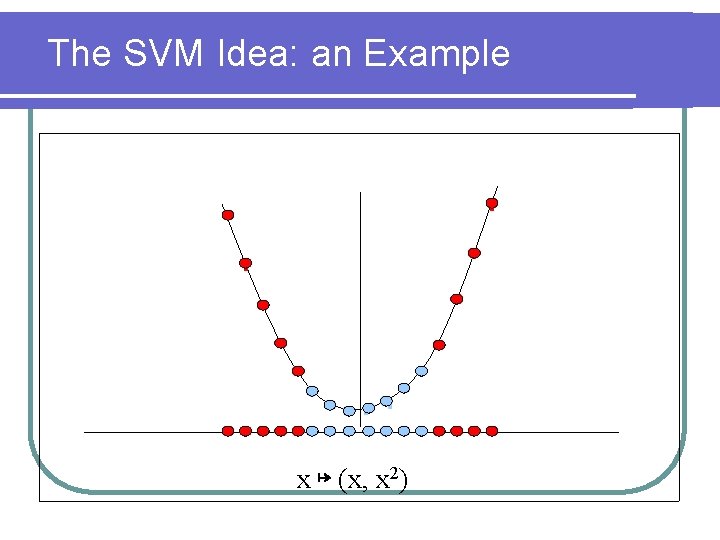
The SVM Idea: an Example x ↦ (x, x 2)
The SVM Idea: an Example
Controlling Computational Complexity Potentially the embeddings may require very high Euclidean dimension. How can we search for hyperplanes efficiently? The Kernel Trick: Use algorithms that depend only on the inner product of sample points.
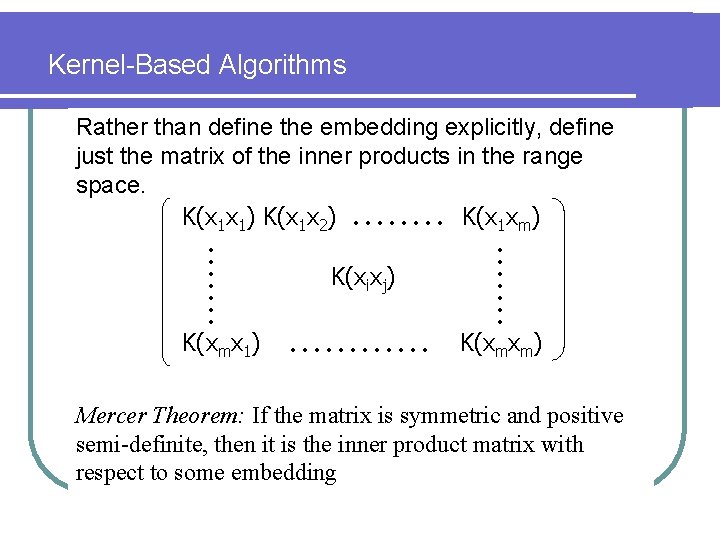
Kernel-Based Algorithms Rather than define the embedding explicitly, define just the matrix of the inner products in the range space. K(x 1 x 1) K(x 1 x 2) K(x 1 xm) K(xmx 1) K(xixj) . . . . K(xmxm) Mercer Theorem: If the matrix is symmetric and positive semi-definite, then it is the inner product matrix with respect to some embedding
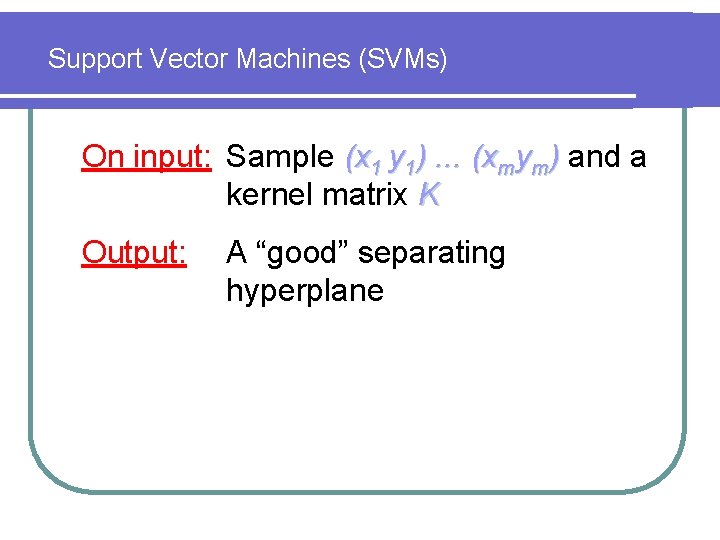
Support Vector Machines (SVMs) On input: Sample (x 1 y 1). . . (xmym) and a kernel matrix K Output: A “good” separating hyperplane
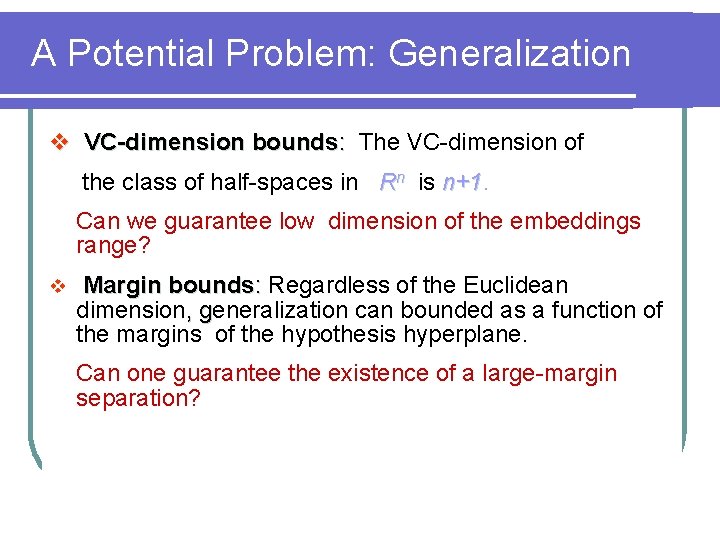
A Potential Problem: Generalization v VC-dimension bounds: The VC-dimension of the class of half-spaces in Rn is n+1 Can we guarantee low dimension of the embeddings range? v Margin bounds: Regardless of the Euclidean dimension, generalization can bounded as a function of g the margins of the hypothesis hyperplane. Can one guarantee the existence of a large-margin separation?
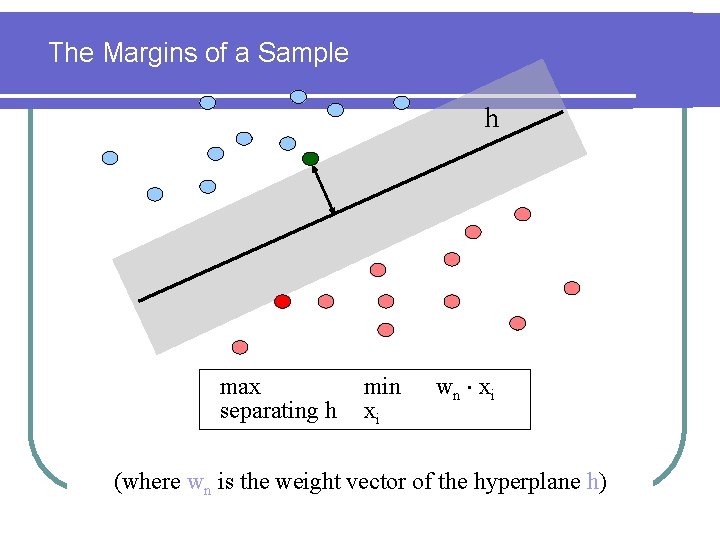
The Margins of a Sample h max separating h min xi wn xi (where wn is the weight vector of the hyperplane h)
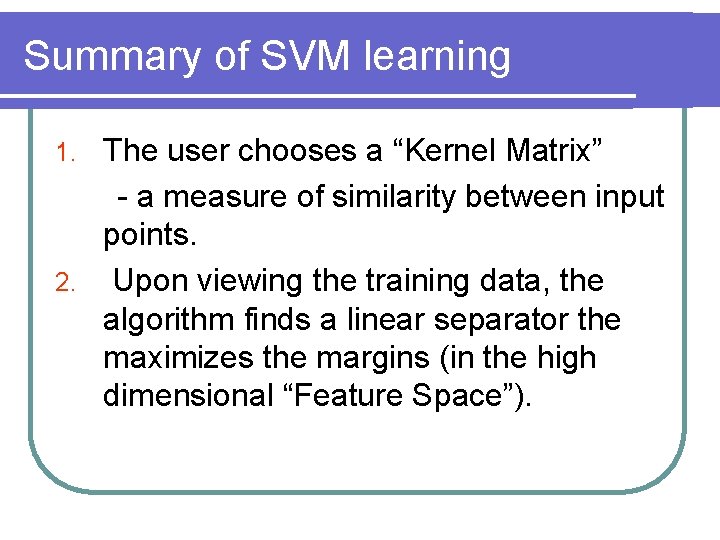
Summary of SVM learning The user chooses a “Kernel Matrix” - a measure of similarity between input points. 2. Upon viewing the training data, the algorithm finds a linear separator the maximizes the margins (in the high dimensional “Feature Space”). 1.
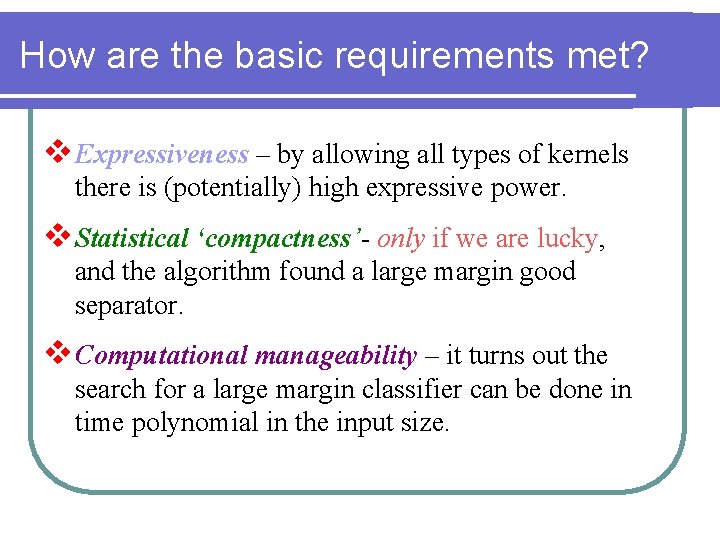
How are the basic requirements met? v Expressiveness – by allowing all types of kernels there is (potentially) high expressive power. v Statistical ‘compactness’- only if we are lucky, and the algorithm found a large margin good separator. v Computational manageability – it turns out the search for a large margin classifier can be done in time polynomial in the input size.
- Slides: 35