
Statistical Language Models Hongning Wang CSUVa CS 6501
![Source-Channel framework [Shannon 48] Source X Transmitter (encoder) P(X) Noisy Channel Y Receiver (decoder)](https://slidetodoc.com/presentation_image/1a6e448de3e52788de5f02bc277c4293/image-7.jpg "Source-Channel framework [Shannon 48] Source X Transmitter (encoder) P(X) Noisy Channel Y Receiver (decoder)")
- Slides: 49
Statistical Language Models Hongning Wang CS@UVa CS 6501: Text Mining 1
Today’s lecture 1. How to represent a document? – Make it computable 2. How to infer the relationship among documents or identify the structure within a document? – Knowledge discovery CS@UVa CS 6501: Text Mining 2
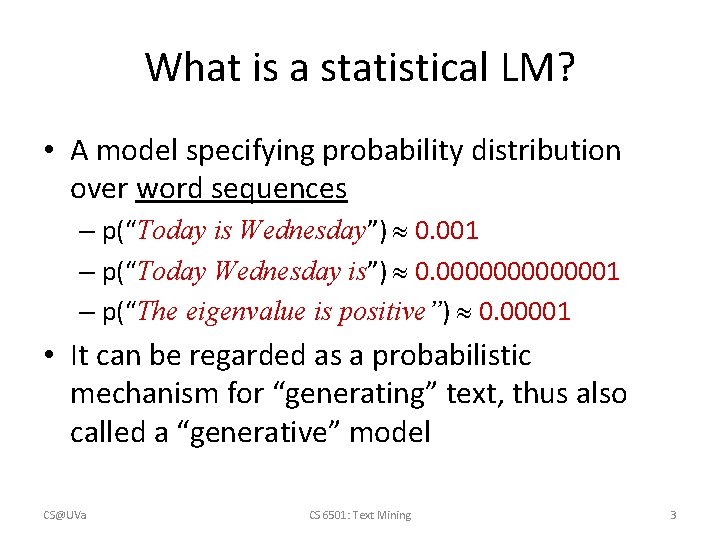
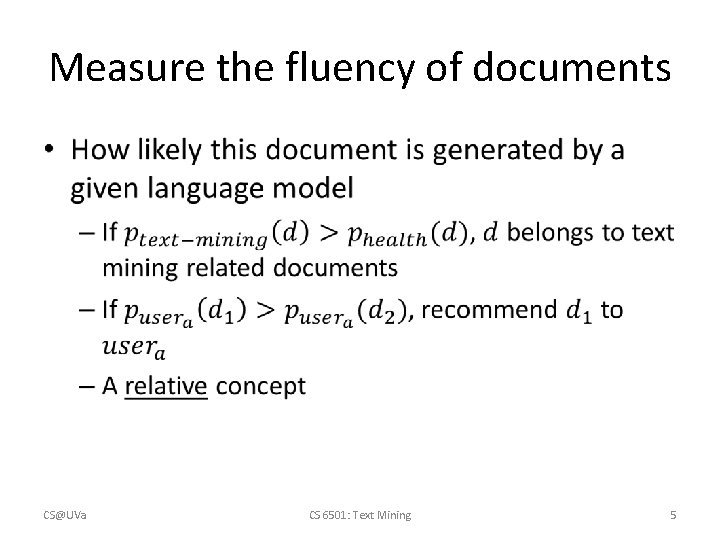
What is a statistical LM? • A model specifying probability distribution over word sequences – p(“Today is Wednesday”) 0. 001 – p(“Today Wednesday is”) 0. 0000001 – p(“The eigenvalue is positive”) 0. 00001 • It can be regarded as a probabilistic mechanism for “generating” text, thus also called a “generative” model CS@UVa CS 6501: Text Mining 3
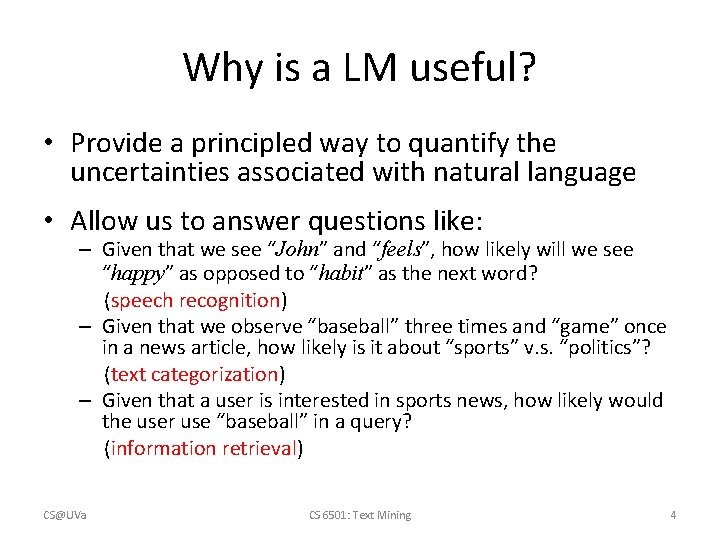
Why is a LM useful? • Provide a principled way to quantify the uncertainties associated with natural language • Allow us to answer questions like: – Given that we see “John” and “feels”, how likely will we see “happy” as opposed to “habit” as the next word? (speech recognition) – Given that we observe “baseball” three times and “game” once in a news article, how likely is it about “sports” v. s. “politics”? (text categorization) – Given that a user is interested in sports news, how likely would the user use “baseball” in a query? (information retrieval) CS@UVa CS 6501: Text Mining 4
Measure the fluency of documents • CS@UVa CS 6501: Text Mining 5
Recap: common misconceptions • Vector space model is bag-of-words • Bag-of-words is TF-IDF • Cosine similarity is superior to Euclidean distance CS@UVa CS 6501: Text Mining 6
Source-Channel framework [Shannon 48] Source X Transmitter (encoder) P(X) Noisy Channel Y Receiver (decoder) Destination X’ P(X|Y)=? P(Y|X) (Bayes Rule) When X is text, p(X) is a language model Many Examples: Speech recognition: Machine translation: OCR Error Correction: Information Retrieval: Summarization: CS@UVa X=Word sequence X=English sentence X=Correct word X=Document X=Summary CS 6501: Text Mining Y=Speech signal Y=Chinese sentence Y= Erroneous word Y=Query Y=Document 7
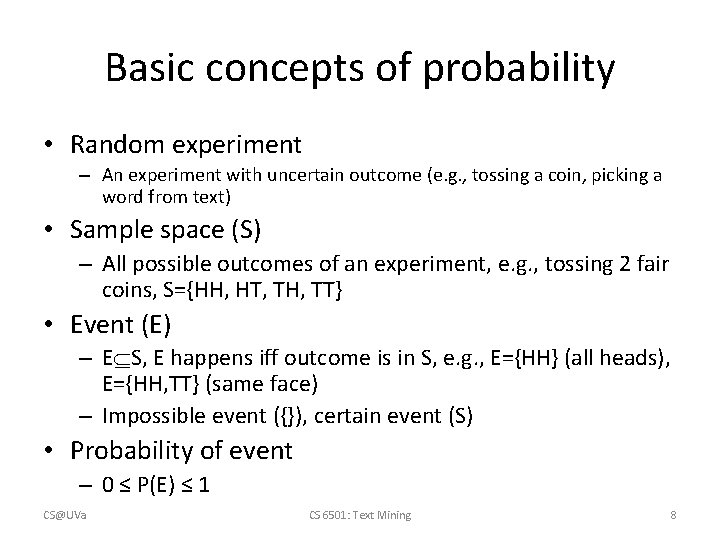
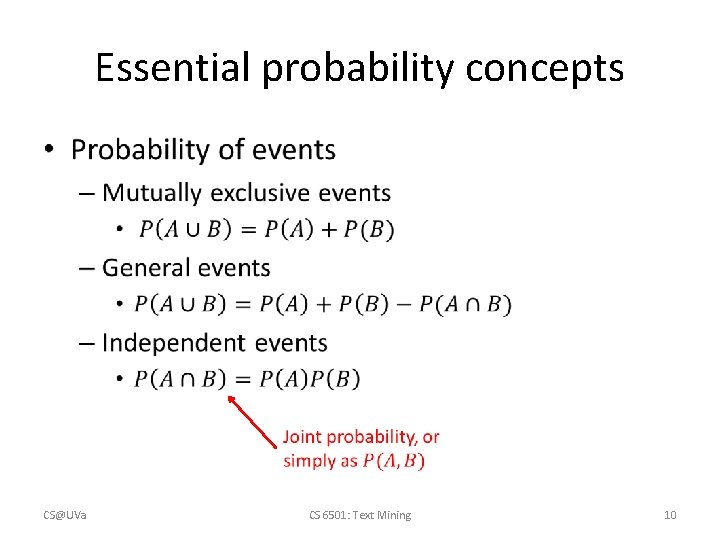
Basic concepts of probability • Random experiment – An experiment with uncertain outcome (e. g. , tossing a coin, picking a word from text) • Sample space (S) – All possible outcomes of an experiment, e. g. , tossing 2 fair coins, S={HH, HT, TH, TT} • Event (E) – E S, E happens iff outcome is in S, e. g. , E={HH} (all heads), E={HH, TT} (same face) – Impossible event ({}), certain event (S) • Probability of event – 0 ≤ P(E) ≤ 1 CS@UVa CS 6501: Text Mining 8
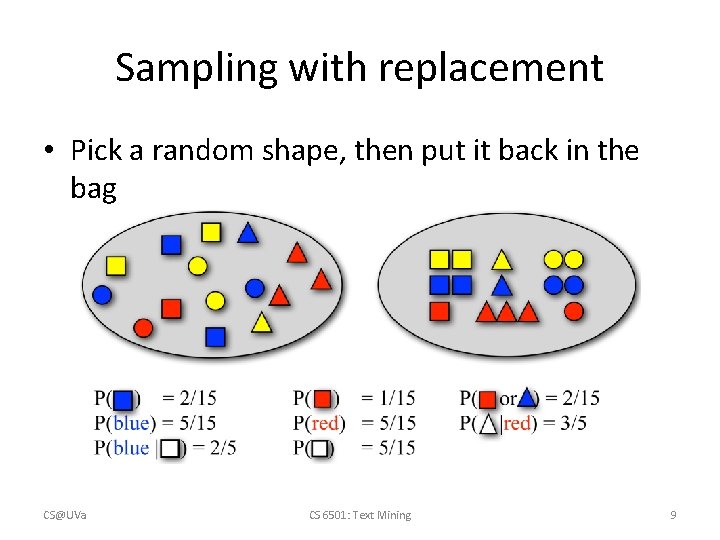
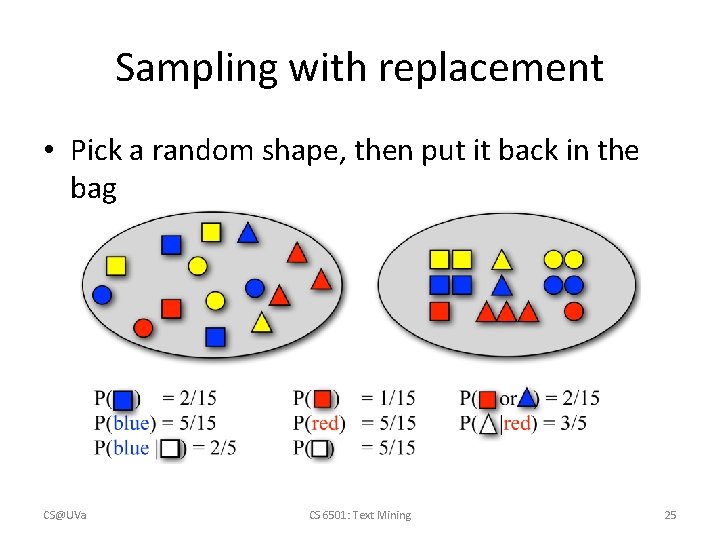
Sampling with replacement • Pick a random shape, then put it back in the bag CS@UVa CS 6501: Text Mining 9
Essential probability concepts • CS@UVa CS 6501: Text Mining 10
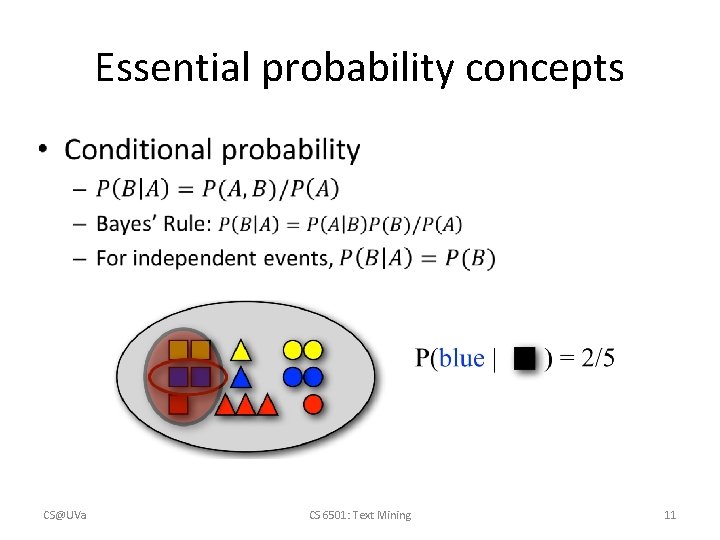
Essential probability concepts CS@UVa CS 6501: Text Mining 11
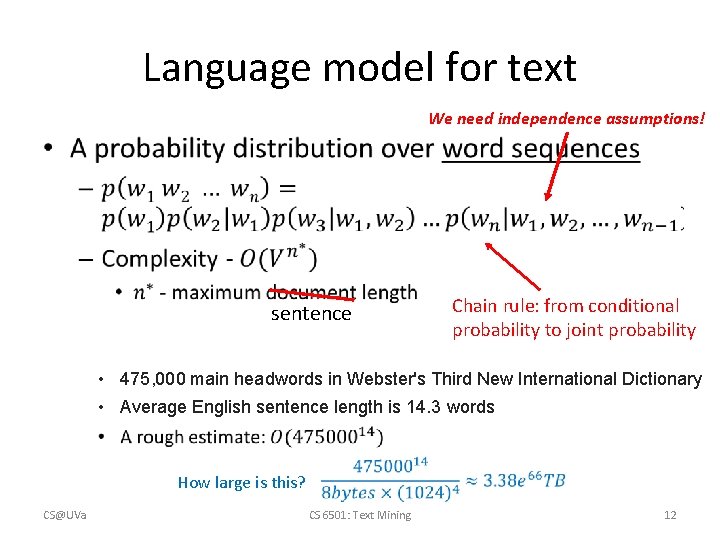
Language model for text We need independence assumptions! • sentence Chain rule: from conditional probability to joint probability • 475, 000 main headwords in Webster's Third New International Dictionary • Average English sentence length is 14. 3 words How large is this? CS@UVa CS 6501: Text Mining 12
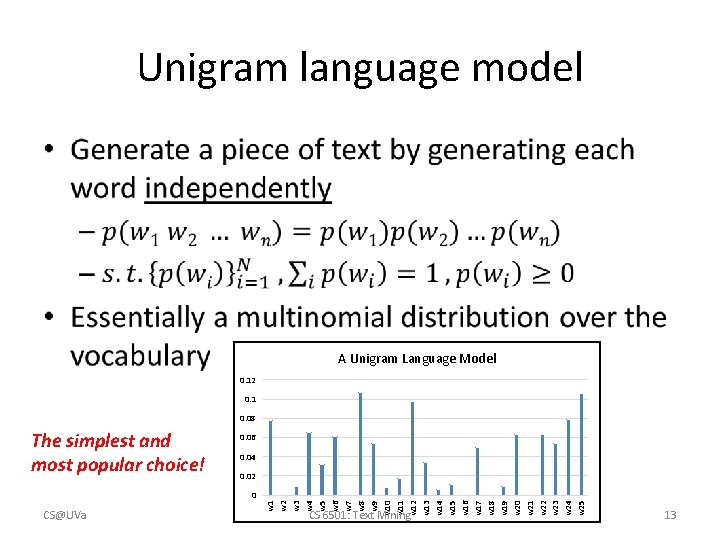
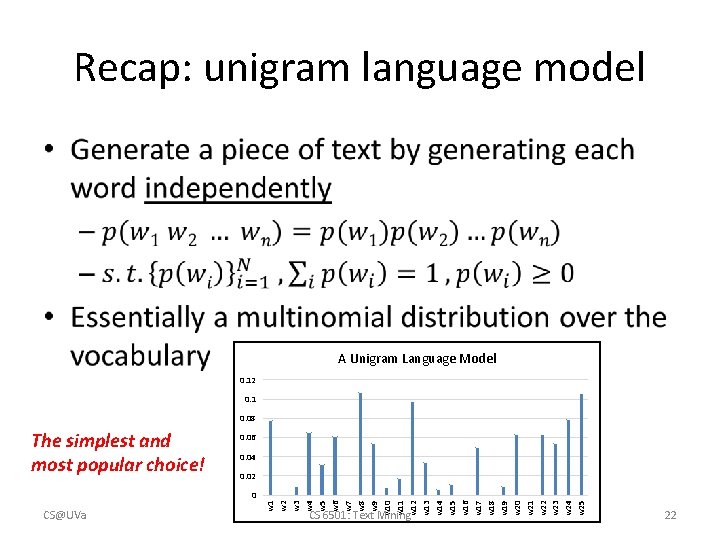
Unigram language model • A Unigram Language Model 0. 12 0. 1 0. 08 0. 06 0. 04 0. 02 0 CS@UVa w 1 w 2 w 3 w 4 w 5 w 6 w 7 w 8 w 9 w 10 w 11 w 12 w 13 w 14 w 15 w 16 w 17 w 18 w 19 w 20 w 21 w 22 w 23 w 24 w 25 The simplest and most popular choice! CS 6501: Text Mining 13
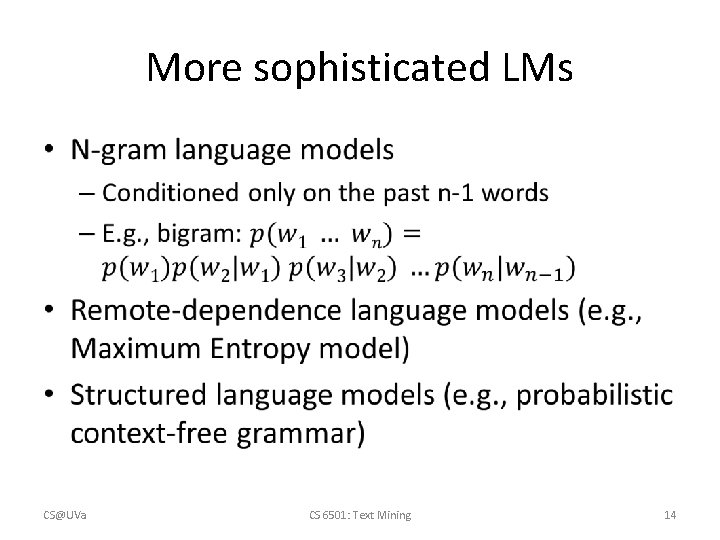
More sophisticated LMs • CS@UVa CS 6501: Text Mining 14
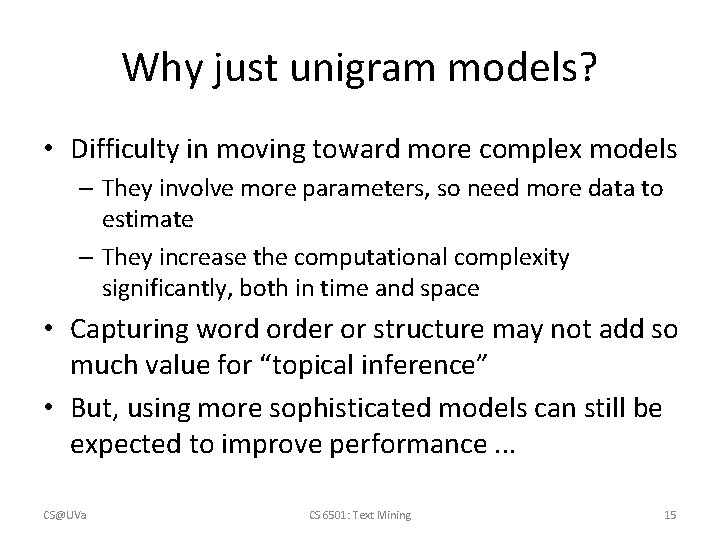
Why just unigram models? • Difficulty in moving toward more complex models – They involve more parameters, so need more data to estimate – They increase the computational complexity significantly, both in time and space • Capturing word order or structure may not add so much value for “topical inference” • But, using more sophisticated models can still be expected to improve performance. . . CS@UVa CS 6501: Text Mining 15
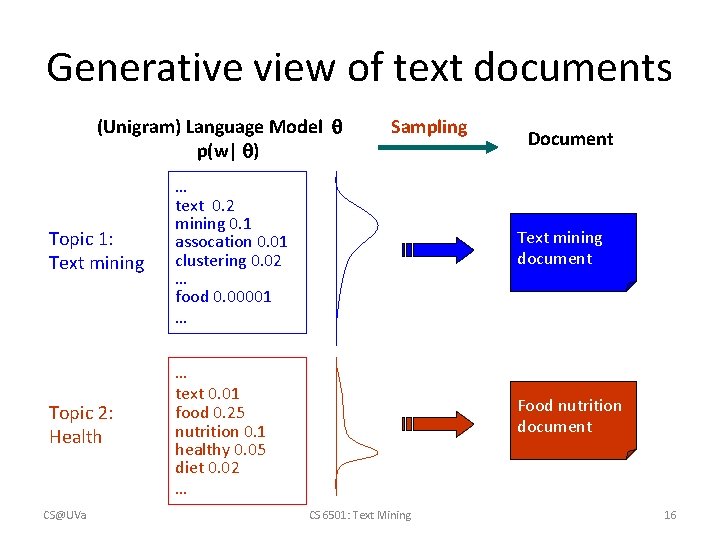
Generative view of text documents (Unigram) Language Model p(w| ) Topic 1: Text mining … text 0. 2 mining 0. 1 assocation 0. 01 clustering 0. 02 … food 0. 00001 … Topic 2: Health … text 0. 01 food 0. 25 nutrition 0. 1 healthy 0. 05 diet 0. 02 … CS@UVa Sampling Document Text mining document Food nutrition document CS 6501: Text Mining 16
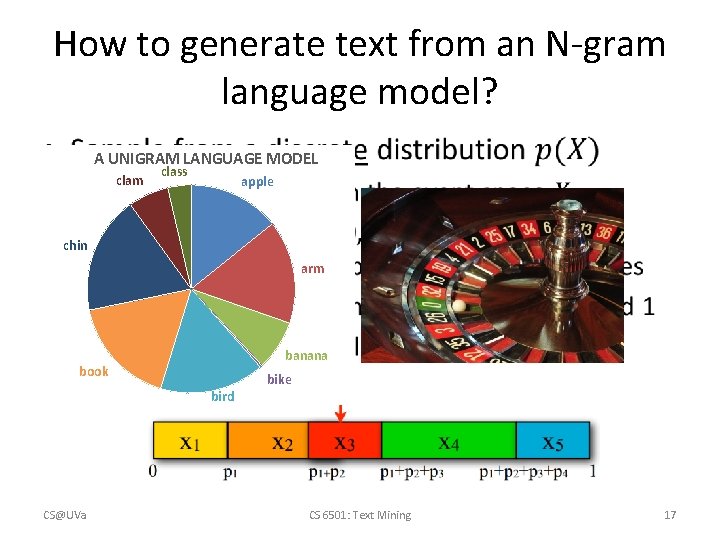
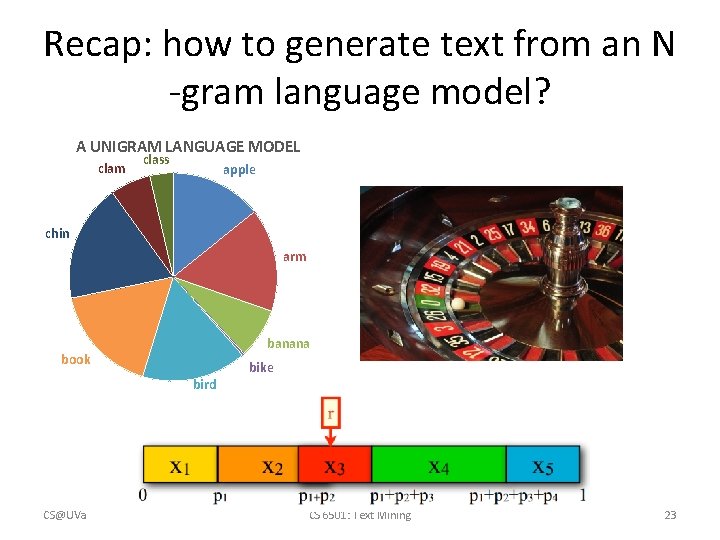
How to generate text from an N-gram language model? • A UNIGRAM LANGUAGE MODEL clam class apple chin arm banana book bird CS@UVa bike CS 6501: Text Mining 17
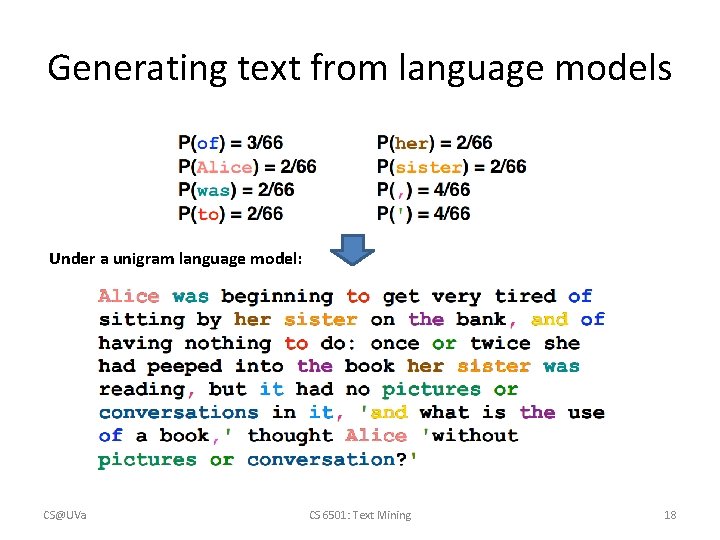
Generating text from language models Under a unigram language model: CS@UVa CS 6501: Text Mining 18
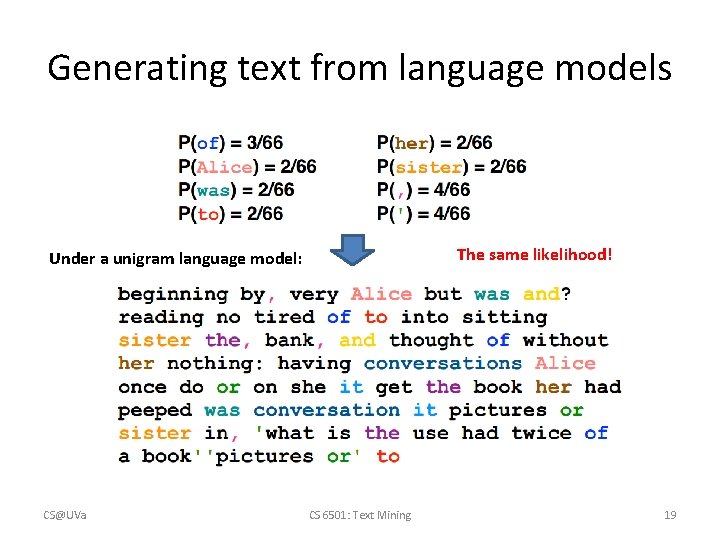
Generating text from language models The same likelihood! Under a unigram language model: CS@UVa CS 6501: Text Mining 19
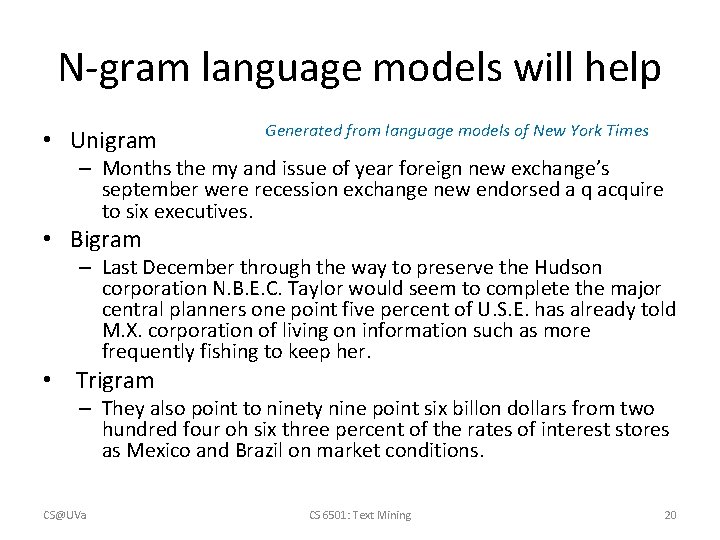
N-gram language models will help • Unigram Generated from language models of New York Times – Months the my and issue of year foreign new exchange’s september were recession exchange new endorsed a q acquire to six executives. • Bigram – Last December through the way to preserve the Hudson corporation N. B. E. C. Taylor would seem to complete the major central planners one point five percent of U. S. E. has already told M. X. corporation of living on information such as more frequently fishing to keep her. • Trigram – They also point to ninety nine point six billon dollars from two hundred four oh six three percent of the rates of interest stores as Mexico and Brazil on market conditions. CS@UVa CS 6501: Text Mining 20
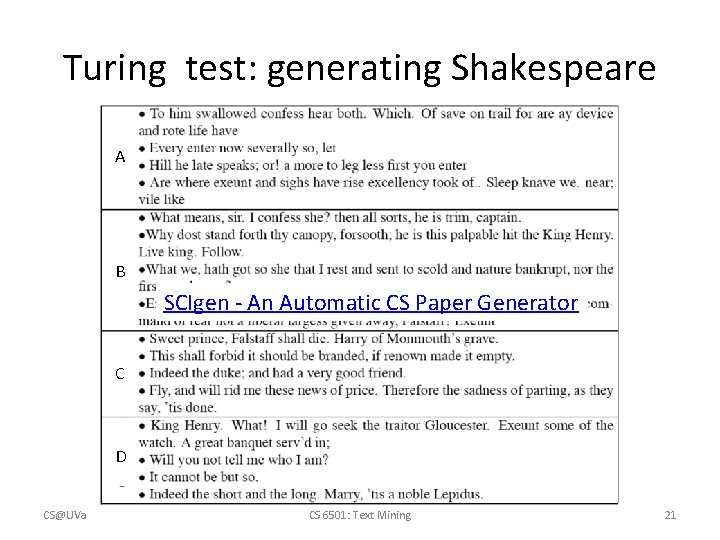
Turing test: generating Shakespeare A B SCIgen - An Automatic CS Paper Generator C D CS@UVa CS 6501: Text Mining 21
Recap: unigram language model • A Unigram Language Model 0. 12 0. 1 0. 08 0. 06 0. 04 0. 02 0 CS@UVa w 1 w 2 w 3 w 4 w 5 w 6 w 7 w 8 w 9 w 10 w 11 w 12 w 13 w 14 w 15 w 16 w 17 w 18 w 19 w 20 w 21 w 22 w 23 w 24 w 25 The simplest and most popular choice! CS 6501: Text Mining 22
Recap: how to generate text from an N -gram language model? A UNIGRAM LANGUAGE MODEL clam class apple chin arm banana book bird CS@UVa bike CS 6501: Text Mining 23
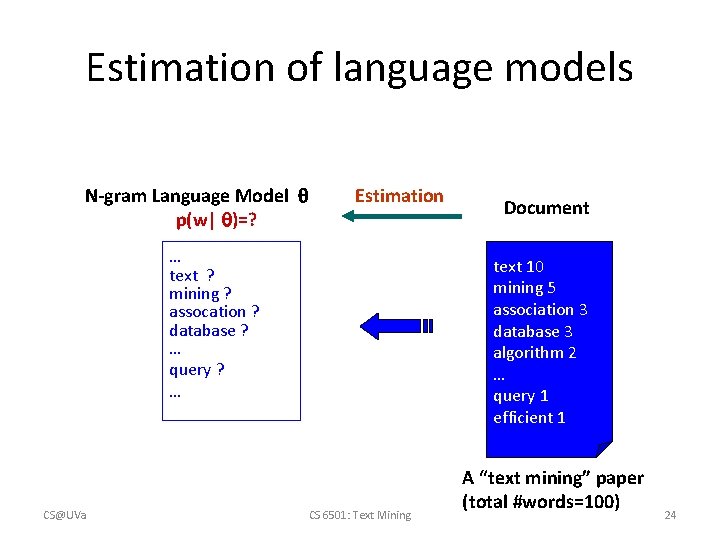
Estimation of language models N-gram Language Model p(w| )=? Estimation … text ? mining ? assocation ? database ? … query ? … CS@UVa Document text 10 mining 5 association 3 database 3 algorithm 2 … query 1 efficient 1 CS 6501: Text Mining A “text mining” paper (total #words=100) 24
Sampling with replacement • Pick a random shape, then put it back in the bag CS@UVa CS 6501: Text Mining 25
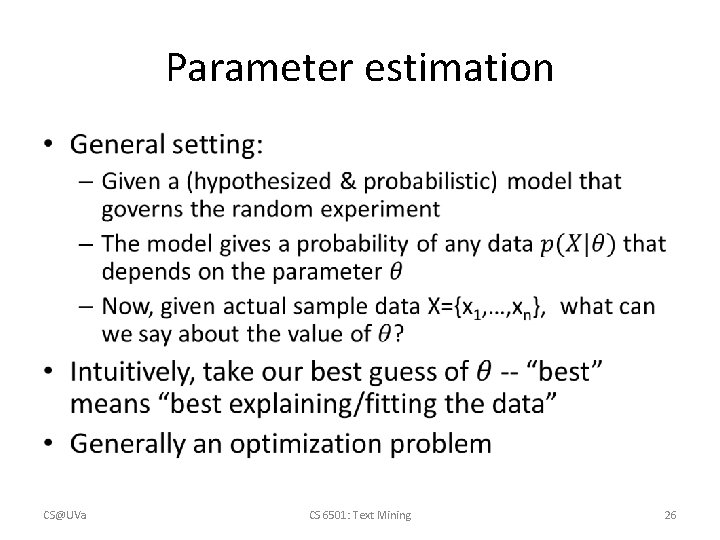
Parameter estimation • CS@UVa CS 6501: Text Mining 26
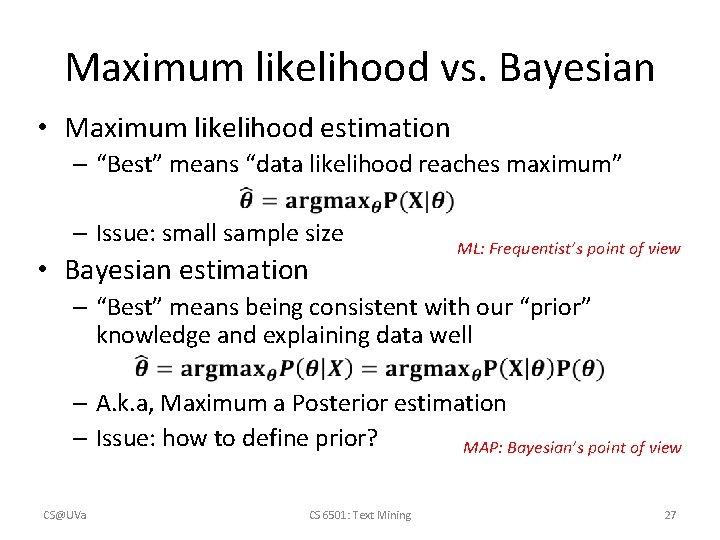
Maximum likelihood vs. Bayesian • Maximum likelihood estimation – “Best” means “data likelihood reaches maximum” – Issue: small sample size • Bayesian estimation ML: Frequentist’s point of view – “Best” means being consistent with our “prior” knowledge and explaining data well – A. k. a, Maximum a Posterior estimation – Issue: how to define prior? MAP: Bayesian’s point of view CS@UVa CS 6501: Text Mining 27
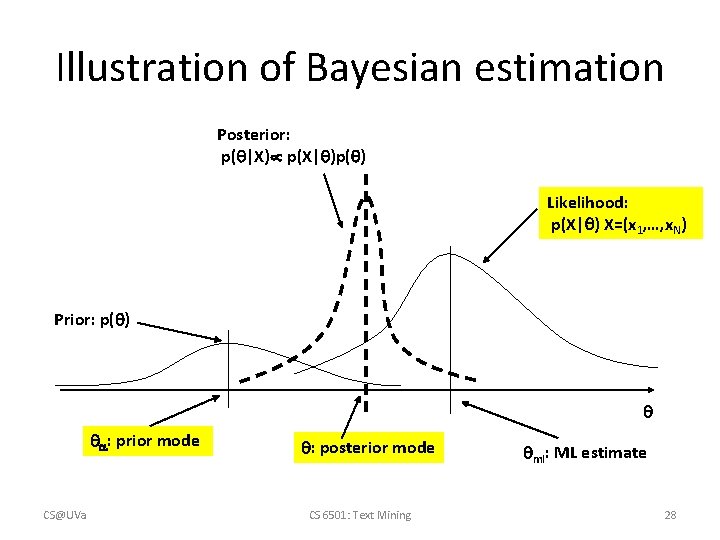
Illustration of Bayesian estimation Posterior: p( |X) p(X| )p( ) Likelihood: p(X| ) X=(x 1, …, x. N) Prior: p( ) : prior mode CS@UVa : posterior mode CS 6501: Text Mining ml: ML estimate 28
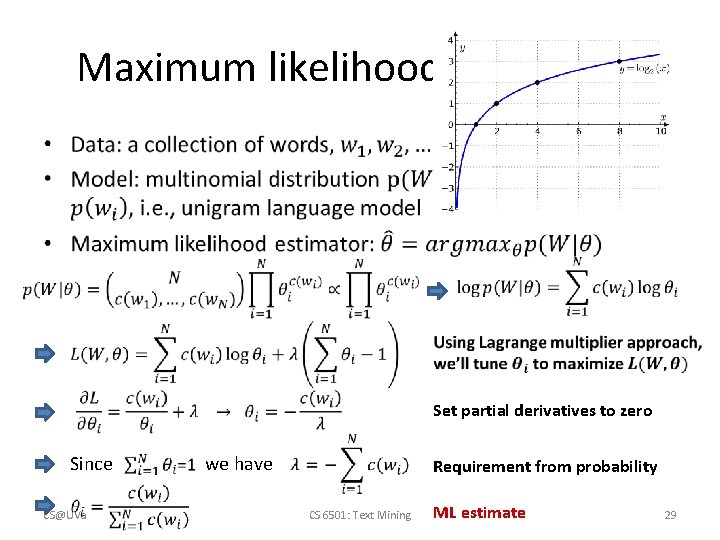
Maximum likelihood estimation • Since Set partial derivatives to zero we have Requirement from probability CS@UVa CS 6501: Text Mining ML estimate 29
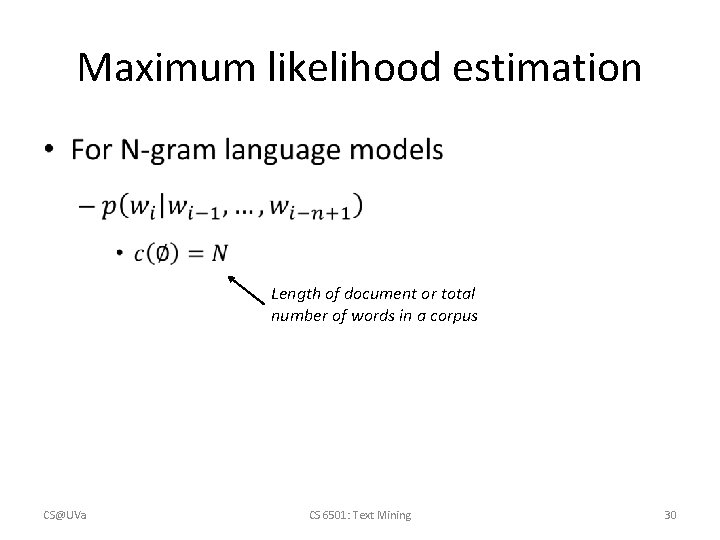
Maximum likelihood estimation • Length of document or total number of words in a corpus CS@UVa CS 6501: Text Mining 30
Pop-up Quiz • Prove the way we used to estimate the probability of getting a head with a given coin is correct. In what sense? CS@UVa CS 6501: Text Mining 31
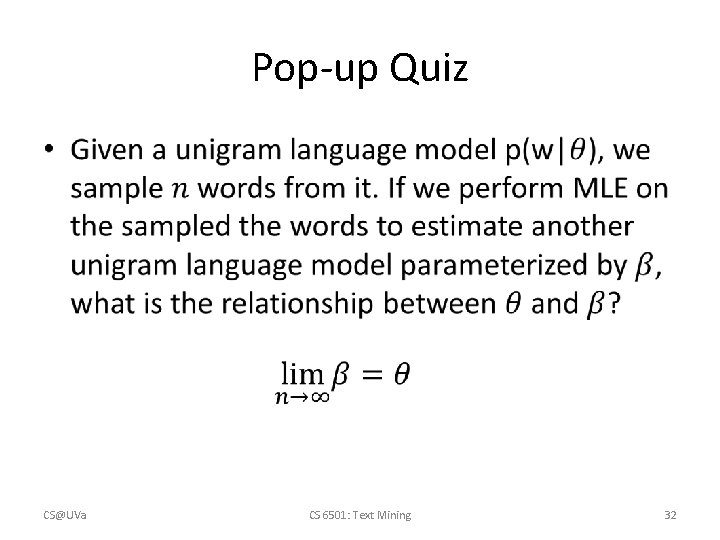
Pop-up Quiz • CS@UVa CS 6501: Text Mining 32
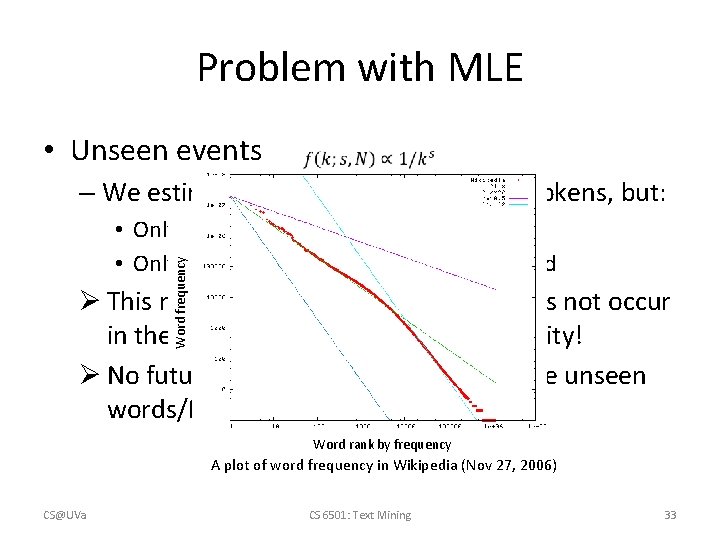
Problem with MLE • Unseen events – We estimated a model on 440 K word tokens, but: Word frequency • Only 30, 000 unique words occurred • Only 0. 04% of all possible bigrams occurred Ø This means any word/N-gram that does not occur in the training data has a zero probability! Ø No future documents can contain those unseen words/N-grams Word rank by frequency A plot of word frequency in Wikipedia (Nov 27, 2006) CS@UVa CS 6501: Text Mining 33
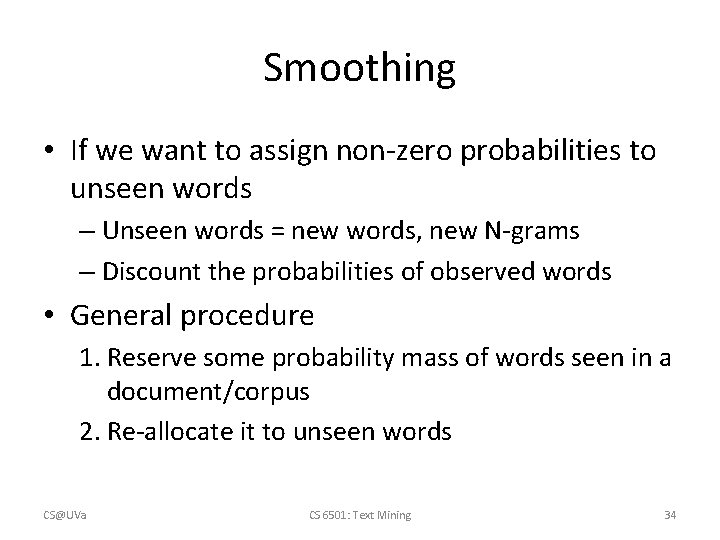
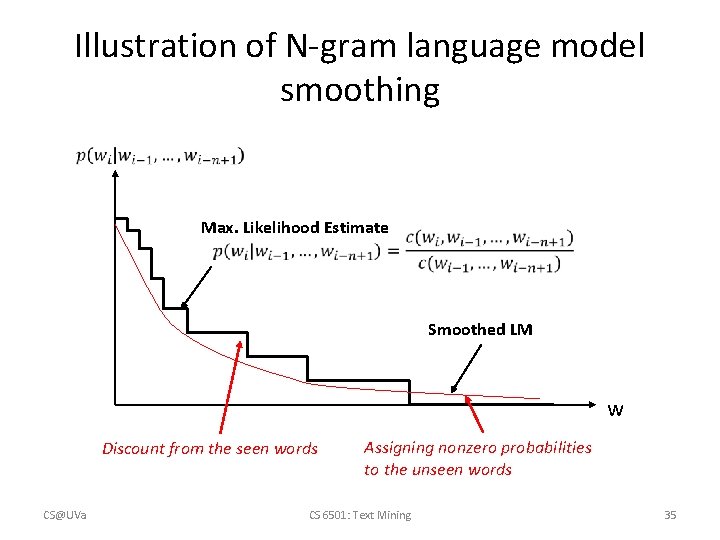
Smoothing • If we want to assign non-zero probabilities to unseen words – Unseen words = new words, new N-grams – Discount the probabilities of observed words • General procedure 1. Reserve some probability mass of words seen in a document/corpus 2. Re-allocate it to unseen words CS@UVa CS 6501: Text Mining 34
Illustration of N-gram language model smoothing Max. Likelihood Estimate Smoothed LM w Discount from the seen words CS@UVa Assigning nonzero probabilities to the unseen words CS 6501: Text Mining 35
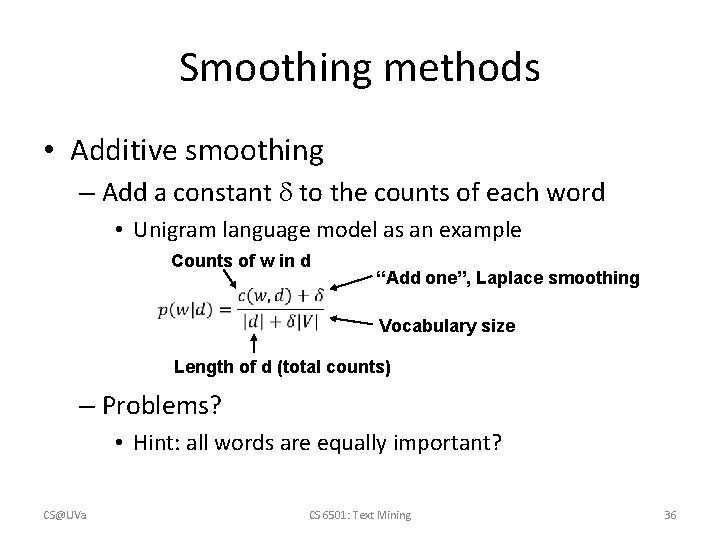
Smoothing methods • Additive smoothing – Add a constant to the counts of each word • Unigram language model as an example Counts of w in d “Add one”, Laplace smoothing Vocabulary size Length of d (total counts) – Problems? • Hint: all words are equally important? CS@UVa CS 6501: Text Mining 36
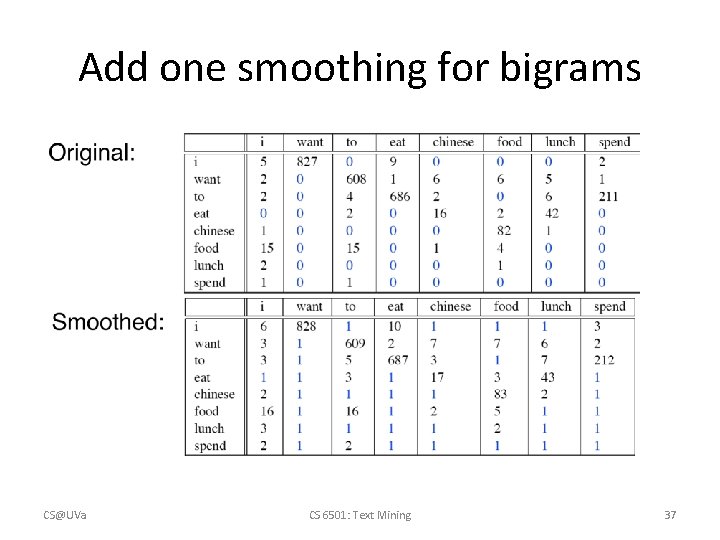
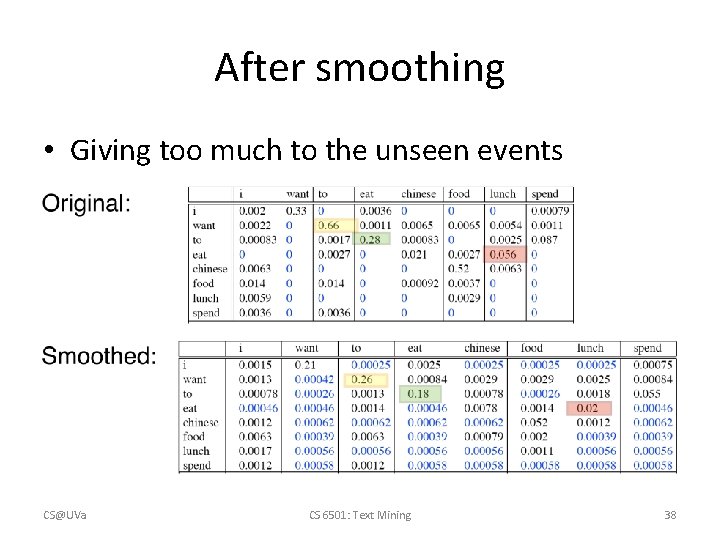
Add one smoothing for bigrams CS@UVa CS 6501: Text Mining 37
After smoothing • Giving too much to the unseen events CS@UVa CS 6501: Text Mining 38
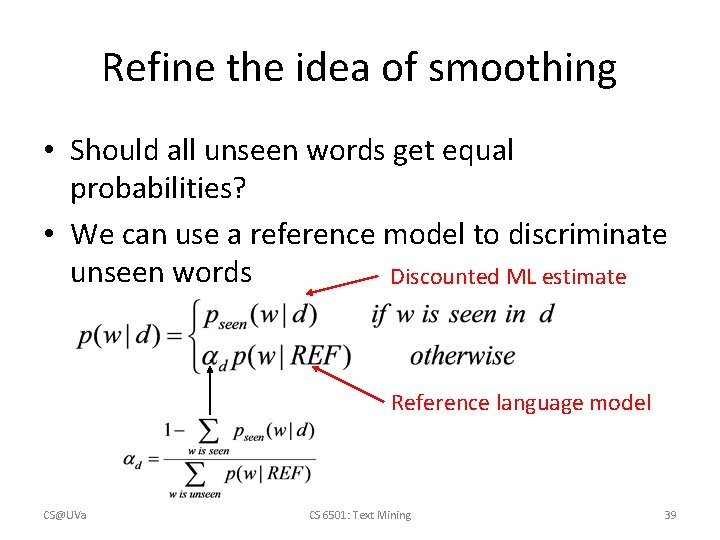
Refine the idea of smoothing • Should all unseen words get equal probabilities? • We can use a reference model to discriminate unseen words Discounted ML estimate Reference language model CS@UVa CS 6501: Text Mining 39
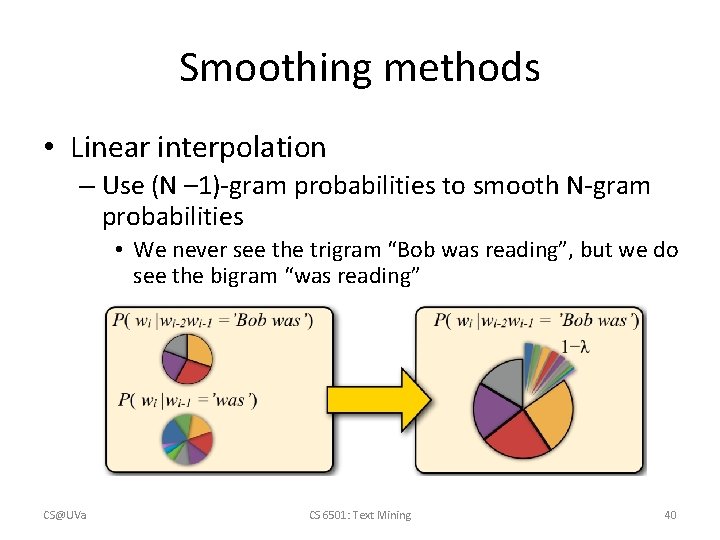
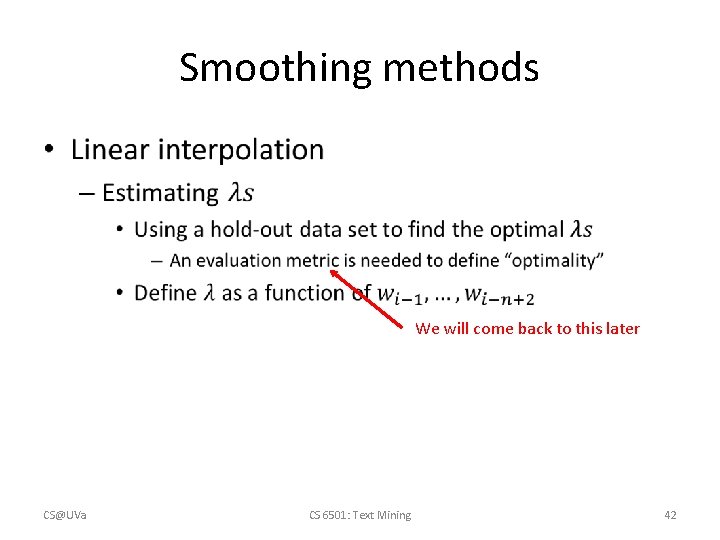
Smoothing methods • Linear interpolation – Use (N – 1)-gram probabilities to smooth N-gram probabilities • We never see the trigram “Bob was reading”, but we do see the bigram “was reading” CS@UVa CS 6501: Text Mining 40
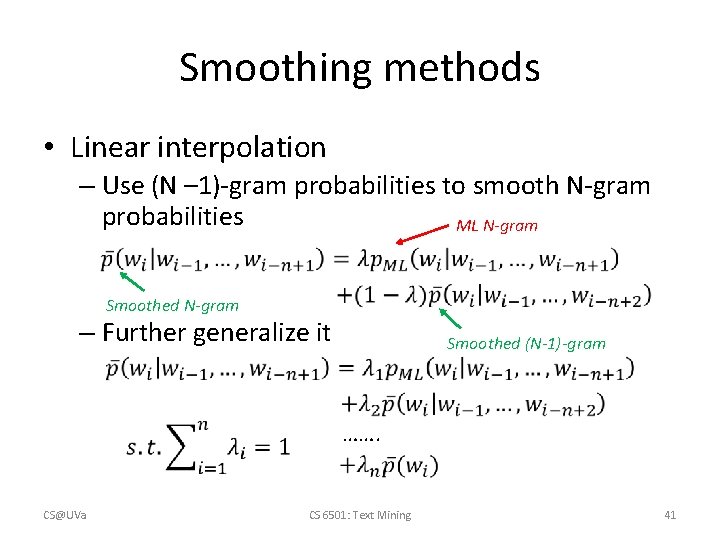
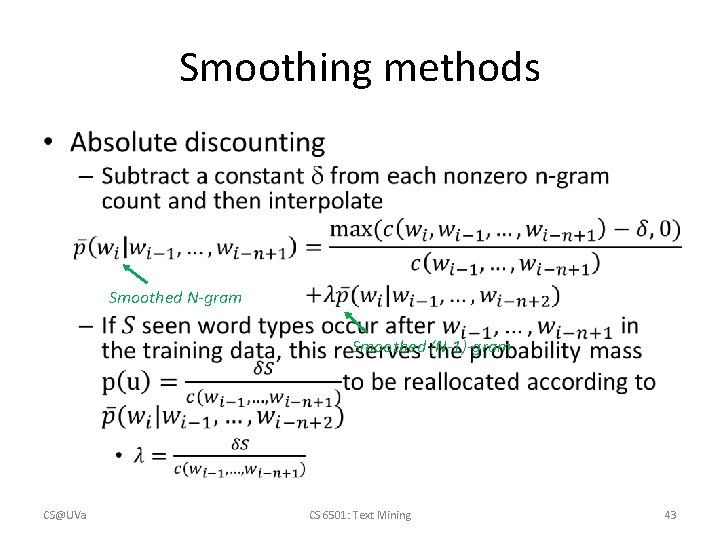
Smoothing methods • Linear interpolation – Use (N – 1)-gram probabilities to smooth N-gram probabilities ML N-gram Smoothed N-gram – Further generalize it Smoothed (N-1)-gram ……. CS@UVa CS 6501: Text Mining 41
Smoothing methods • We will come back to this later CS@UVa CS 6501: Text Mining 42
Smoothing methods • Smoothed N-gram Smoothed (N-1)-gram CS@UVa CS 6501: Text Mining 43
Language model evaluation • Train the models on the same training set – Parameter tuning can be done by holding off some training set for validation • Test the models on an unseen test set – This data set must be disjoint from training data • Language model A is better than model B – If A assigns higher probability to the test data than B CS@UVa CS 6501: Text Mining 44
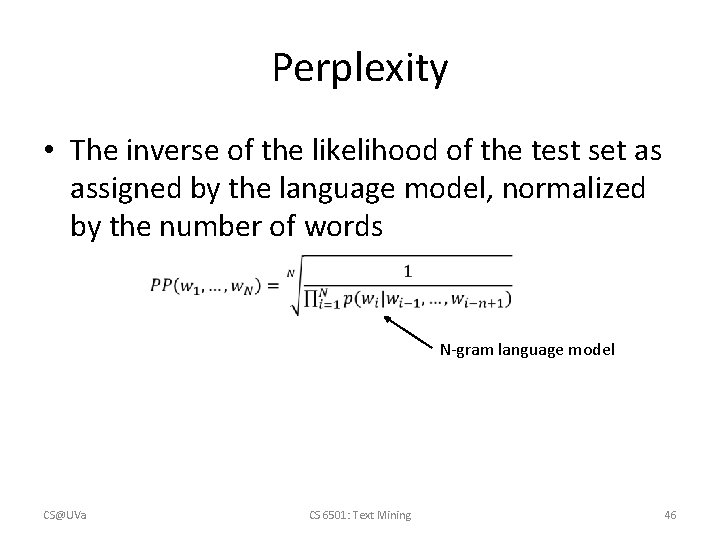
Perplexity • Standard evaluation metric for language models – A function of the probability that a language model assigns to a data set – Rooted in the notion of cross-entropy in information theory CS@UVa CS 6501: Text Mining 45
Perplexity • The inverse of the likelihood of the test set as assigned by the language model, normalized by the number of words N-gram language model CS@UVa CS 6501: Text Mining 46
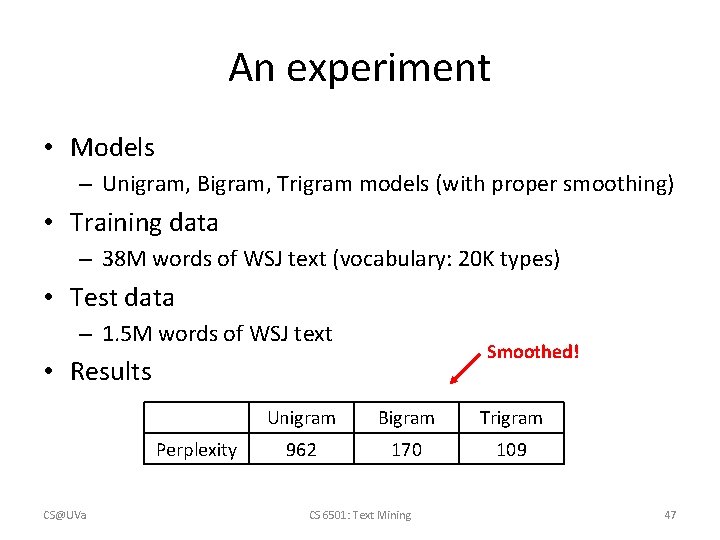
An experiment • Models – Unigram, Bigram, Trigram models (with proper smoothing) • Training data – 38 M words of WSJ text (vocabulary: 20 K types) • Test data – 1. 5 M words of WSJ text Smoothed! • Results Perplexity CS@UVa Unigram Bigram Trigram 962 170 109 CS 6501: Text Mining 47
What you should know • N-gram language models • How to generate text documents from a language model • How to estimate a language model • General idea and different ways of smoothing • Language model evaluation CS@UVa CS 6501: Text Mining 48
Today’s reading • Introduction to information retrieval – Chapter 12: Language models for information retrieval • Speech and Language Processing – Chapter 4: N-Grams CS@UVa CS 6501: Text Mining 49