
Statistical Inventory Models F Newsperson Model Single order

- Slides: 44
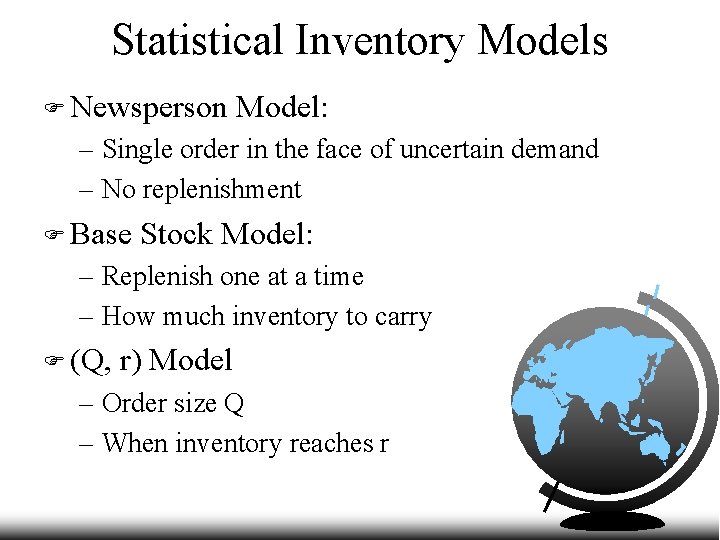
Statistical Inventory Models F Newsperson Model: – Single order in the face of uncertain demand – No replenishment F Base Stock Model: – Replenish one at a time – How much inventory to carry F (Q, r) Model – Order size Q – When inventory reaches r
Issues F How much to order – Newsperson problem F When to order – Variability in demand during lead-time – Variability in lead-time itself
Newsperson Problem F Ordering for a One-time market – Seasonal sales – Special Events F How much do we order? – Order more to increase revenue and reduce lost sales – Order less to avoid additional inventory and unsold goods.
Newsperson Problem Order up to the point that the expected costs and savings for the last item are equal F Costs: Co – cost of item less its salvage value – inventory holding cost (usually small) F Savings: Cs – revenue from the sale – good will gained by not turning away a customer
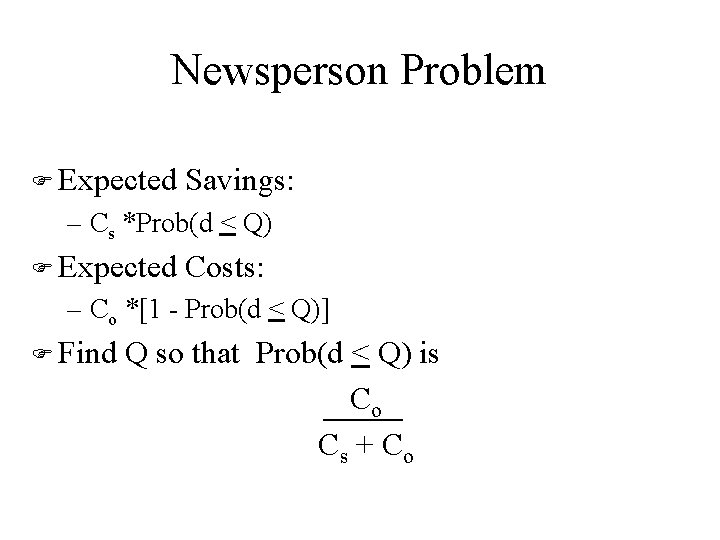
Newsperson Problem F Expected Savings: – Cs *Prob(d < Q) F Expected Costs: – Co *[1 - Prob(d < Q)] F Find Q so that Prob(d < Q) is Co Cs + C o
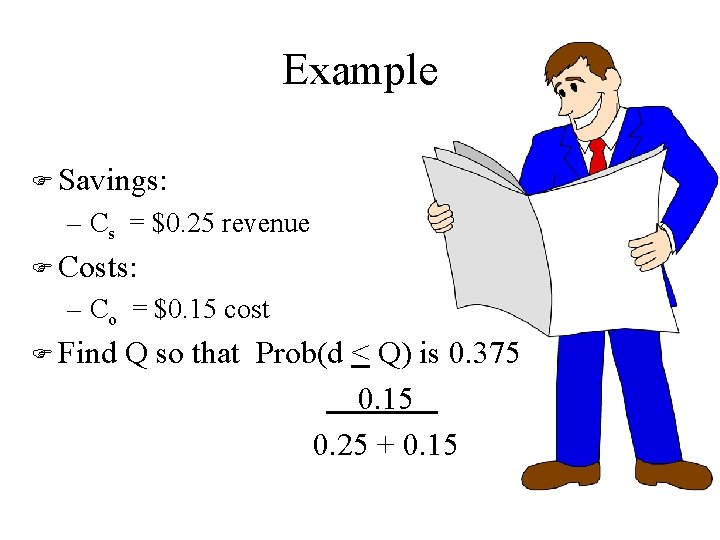
Example F Savings: – Cs = $0. 25 revenue F Costs: – Co = $0. 15 cost F Find Q so that Prob(d < Q) is 0. 375 0. 15 0. 25 + 0. 15
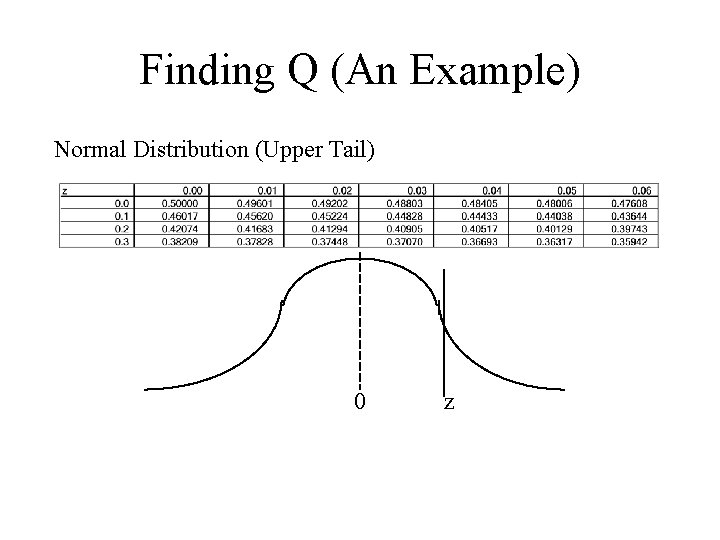
Finding Q (An Example) Normal Distribution (Upper Tail) 0 z
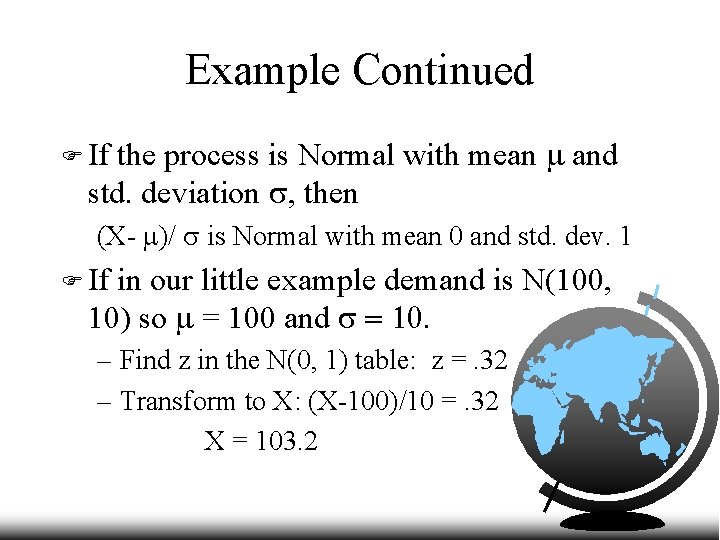
Example Continued the process is Normal with mean and std. deviation , then F If (X- )/ is Normal with mean 0 and std. dev. 1 F If in our little example demand is N(100, 10) so = 100 and . – Find z in the N(0, 1) table: z =. 32 – Transform to X: (X-100)/10 =. 32 X = 103. 2
Extensions F Independent, periodic demands F All unfilled orders are backordered F No setup costs Cs = Cost of one unit of backorder one period Co = Cost of one unit of inventory one period
Extensions F Independent, periodic demands F All unfilled orders are lost F No setup costs Cs = Cost of lost sale (unit profit) Co = Cost of one unit of inventory one period
Base Stock Model F Orders placed with each sale – Auto dealership F Sales occur one-at-a-time F Unfilled orders backordered F Known lead time l F No setup cost or limit on order frequency
Different Views F Base Stock Level: R – How much stock to carry F Re-order point: r = R-1 – When to place an order F Safety Stock Level: s – Inventory protection against variability in lead time demand – s = r - Expected Lead-time Demand
Different Tacks F Find the lowest base stock that supports a given customer service level F Find the customer service level a given base stock provides F Find the base stock that minimizes the costs of back-ordering and carrying inventory
Finding the Best Trade-off F As with the newsperson – Cost of carrying last item in inventory = – Savings that item realizes F Cost of carrying last item in inventory – h, the inventory carrying cost $/item/year F Cost of backordering – b, the backorder carrying cost $/item/year
Finding Balance F Cost the last item represents: – h*Fraction of time we carry inventory – h*Probability Lead-time demand is less than R – h*P(X < R) F Savings the last item represents: – b*Fraction of time we carry backorders – b*Probability Lead-time demand exceeds R – b*(1 -P(X < R)) F Choose R so that P(X < R) = b/(h + b)
Customer Service Level F What customer service level does base stock R provide? F What fraction of customer orders are filled from stock (not backordered)? F What fraction of our orders arrive before the demand for them? F What’s the probability that lead time demand is smaller than R? F P(X < R)
Smallest Base Stock F What’s the smallest base stock that provides desired customer service level? e. g. 99% fill rate. F What’s the smallest R so that P(X < R) >. 99?
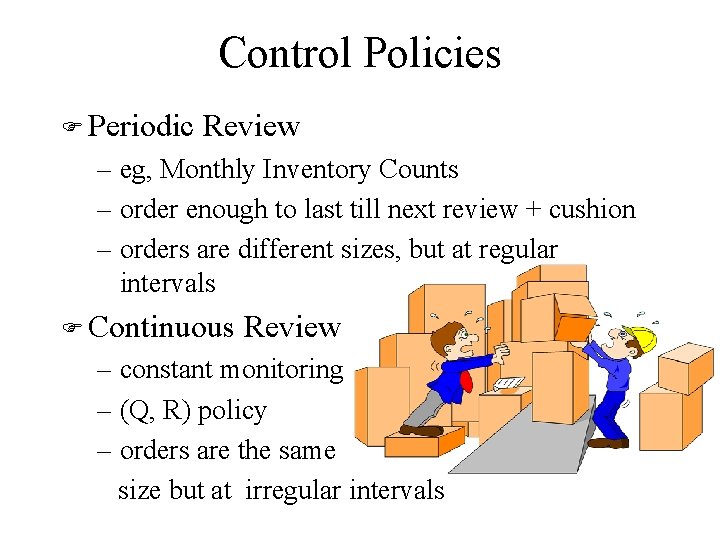
Control Policies F Periodic Review – eg, Monthly Inventory Counts – order enough to last till next review + cushion – orders are different sizes, but at regular intervals F Continuous Review – constant monitoring – (Q, R) policy – orders are the same size but at irregular intervals
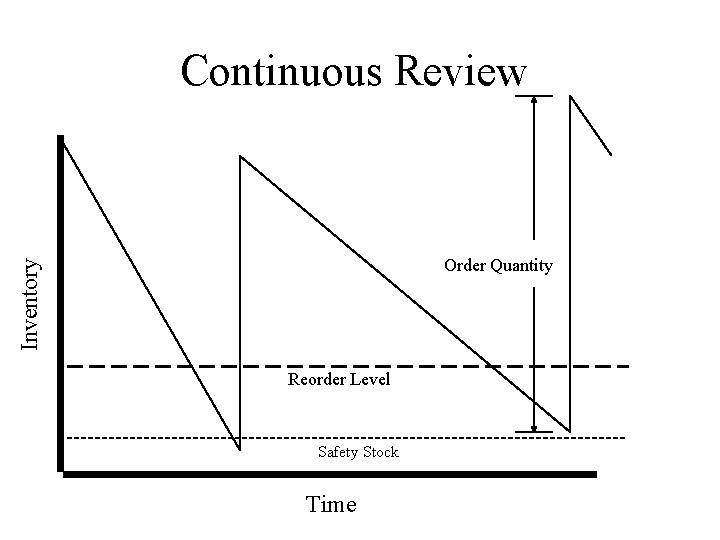
Continuous Review Inventory Order Quantity Reorder Level Safety Stock Time
Safety Stock F Inventory used to protect against variability in Lead-Time Demand: Demand between the time the order to restock is placed and the time it arrives Reorder Point is: R = Average Lead-Time Demand + Safety Stock
Order Quantity F Trade-off – fixed cost of placing/producing order, A – inventory carrying cost, h
A Model F Choose Q and r to minimize sum of – Setup costs – holding costs – backorder costs
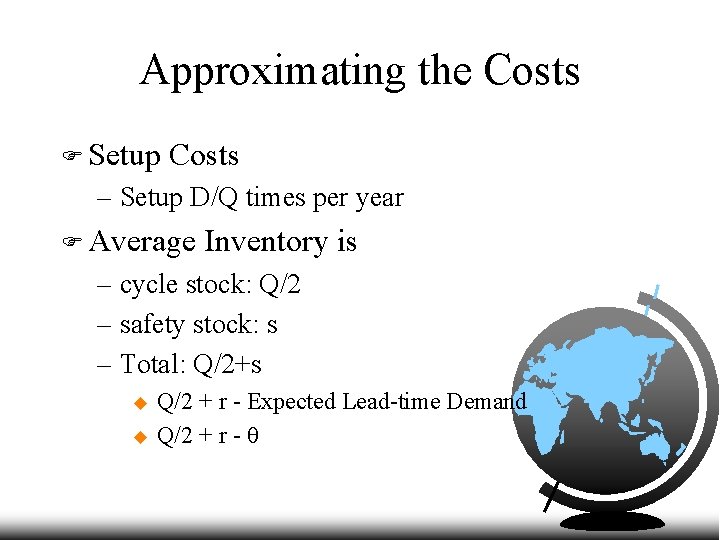
Approximating the Costs F Setup Costs – Setup D/Q times per year F Average Inventory is – cycle stock: Q/2 – safety stock: s – Total: Q/2+s u u Q/2 + r - Expected Lead-time Demand Q/2 + r -
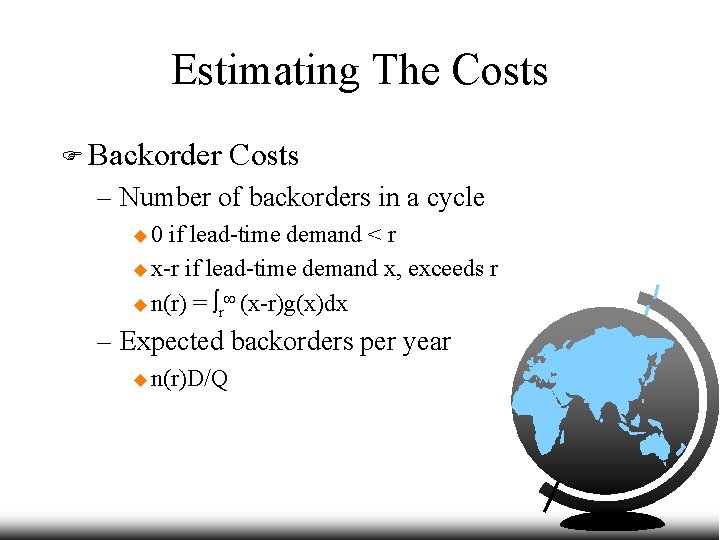
Estimating The Costs F Backorder Costs – Number of backorders in a cycle u 0 if lead-time demand < r u x-r if lead-time demand x, exceeds r u n(r) = r (x-r)g(x)dx – Expected backorders per year u n(r)D/Q
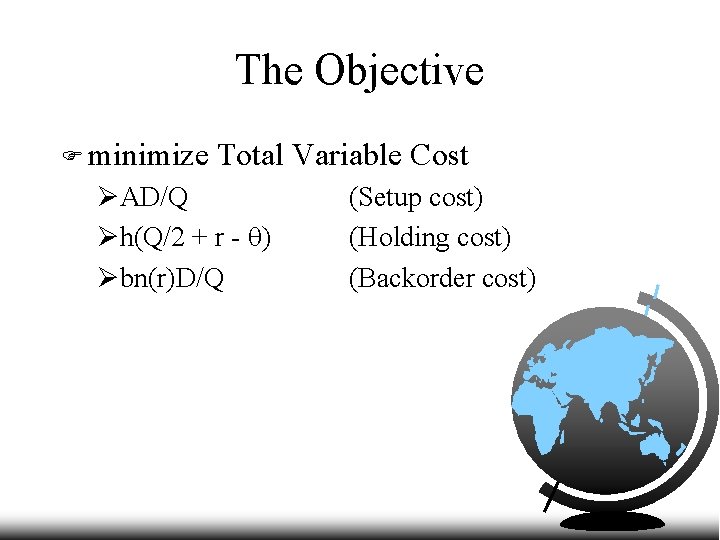
The Objective F minimize Total Variable Cost ØAD/Q Øh(Q/2 + r - ) Øbn(r)D/Q (Setup cost) (Holding cost) (Backorder cost)
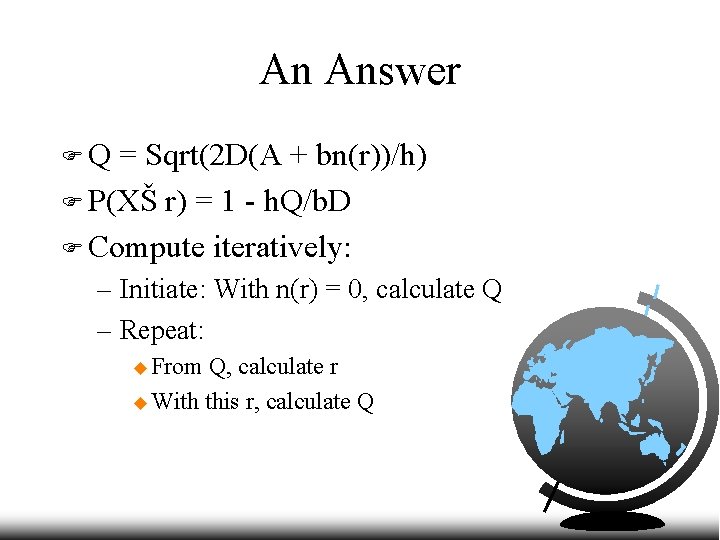
An Answer FQ = Sqrt(2 D(A + bn(r))/h) F P(XŠ r) = 1 - h. Q/b. D F Compute iteratively: – Initiate: With n(r) = 0, calculate Q – Repeat: u From Q, calculate r u With this r, calculate Q
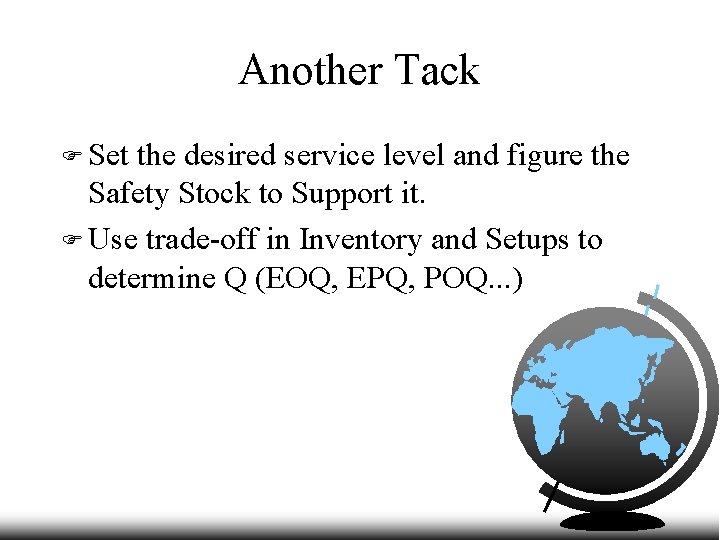
Another Tack F Set the desired service level and figure the Safety Stock to Support it. F Use trade-off in Inventory and Setups to determine Q (EOQ, EPQ, POQ. . . )
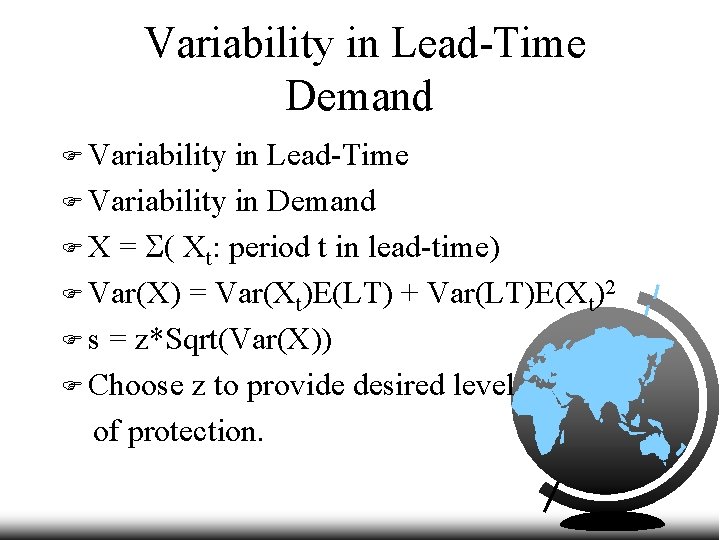
Variability in Lead-Time Demand F Variability in Lead-Time F Variability in Demand F X = Xt: period t in lead-time) F Var(X) = Var(Xt)E(LT) + Var(LT)E(Xt)2 F s = z*Sqrt(Var(X)) F Choose z to provide desired level of protection.
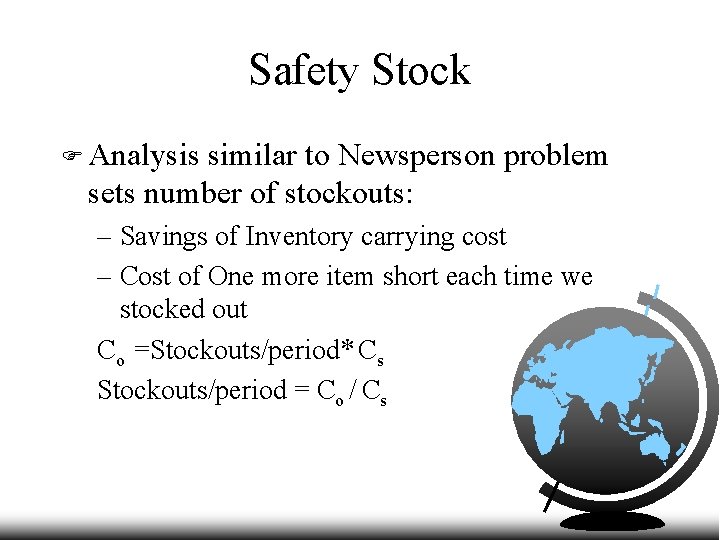
Safety Stock F Analysis similar to Newsperson problem sets number of stockouts: – Savings of Inventory carrying cost – Cost of One more item short each time we stocked out Co =Stockouts/period* Cs Stockouts/period = Co / Cs
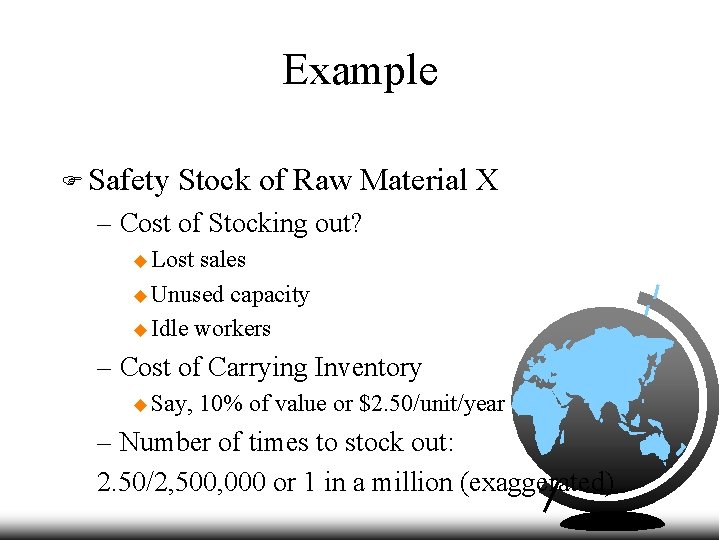
Example F Safety Stock of Raw Material X – Cost of Stocking out? u Lost sales u Unused capacity u Idle workers – Cost of Carrying Inventory u Say, 10% of value or $2. 50/unit/year – Number of times to stock out: 2. 50/2, 500, 000 or 1 in a million (exaggerated)
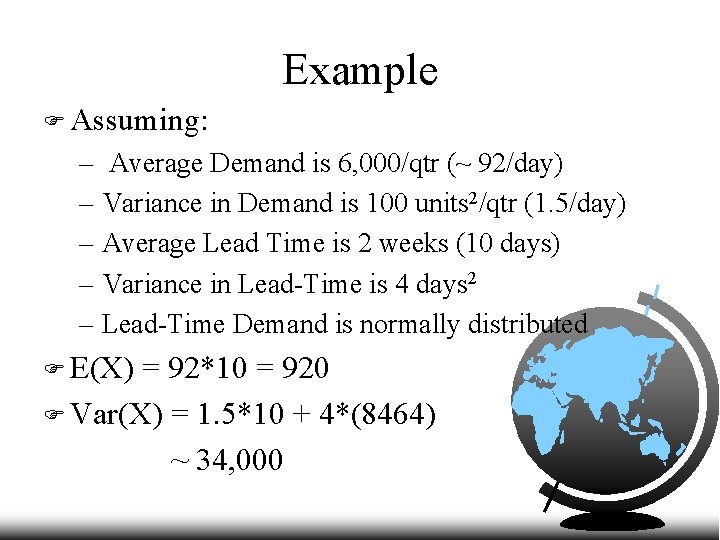
Example F Assuming: – Average Demand is 6, 000/qtr (~ 92/day) – Variance in Demand is 100 units 2/qtr (1. 5/day) – Average Lead Time is 2 weeks (10 days) – Variance in Lead-Time is 4 days 2 – Lead-Time Demand is normally distributed F E(X) = 92*10 = 920 F Var(X) = 1. 5*10 + 4*(8464) ~ 34, 000
Example F Look up 1 in a million on the Normal Upper Tail Chart – z ~ 4. 6 F Compute Safety Stock – s = 4. 6*Sqrt(34, 000) = 4. 6*184 = 846 F Compute Reorder Point – r = 920 + 846 = 1, 766
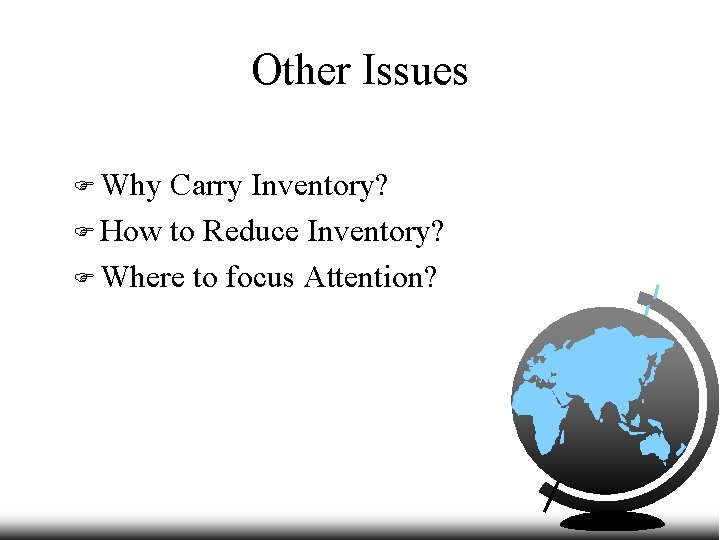
Other Issues F Why Carry Inventory? F How to Reduce Inventory? F Where to focus Attention?
Why Carry Inventory? F Buffer Production Rates From: – Seasonal Demand – Seasonal Supplies “Anticipation Inventory”
Other Types of Inventory “Decoupling Inventory” – Allows Processes to Operate Asynchronously – Examples: u u DC’s “decouple” our distribution from individual customer orders Holding tanks “decouple” 20 K gal. syrup mixes from 5 gal. bag-in-box units.
Other Types of Inventory F “Cycle Stock” – Consequence of Batch Production – Used to Reduce Change Overs: 8 hours and 400 tons of “red stripe” to change Pulp Mill from Hardwood to Pine Pulp u 4 hours to change part feeders on a Chip Shooter u Reduce Setup Time!
Other Types of Inventory “Pipeline Inventory” – Goods in Transit – Work in Process or WIP – Allows Processes to be in Different Places – Example: u Parts made in Mexico, Taurus Assembled in Atlanta
Other Types of Inventory “Safety Stock” – Buffer against Variability in u Demand u Production Process u Supplies – Avoid Stockouts or Shortages
Using Inventory Finished Goods or Raw Materials? F Inventory at Central Facility or at DCs? F Extremes: – High Demand, Low Cost Product – Low Demand, High Cost Product
Reducing Inventory F Reducing Anticipation Inventories – Manage Demand with Promotions, etc. – Reduce overall seasonality through product mix – Expand Markets
Reducing Inventory F Reducing Cycle Stock – Reduce the length of Setups u Redesign the Products u Redesign the Process – Move Setups Offline – Fixturing, etc. – Reduce the number of Setups u Narrow Product Mix u Consolidate Production
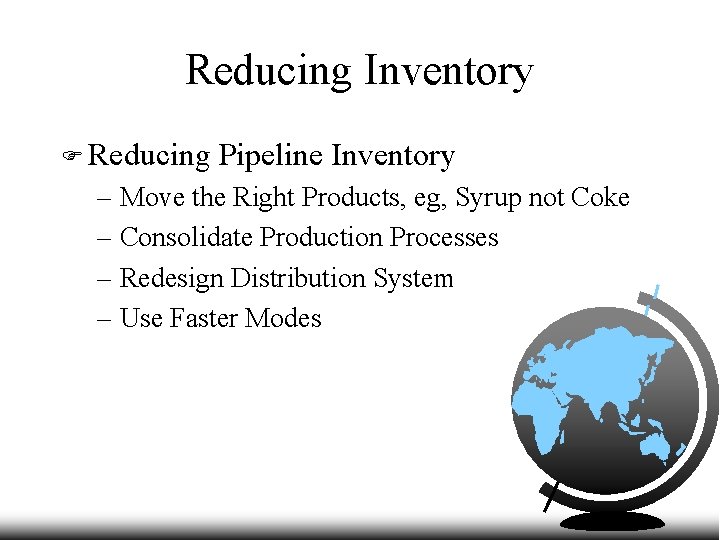
Reducing Inventory F Reducing Pipeline Inventory – Move the Right Products, eg, Syrup not Coke – Consolidate Production Processes – Redesign Distribution System – Use Faster Modes
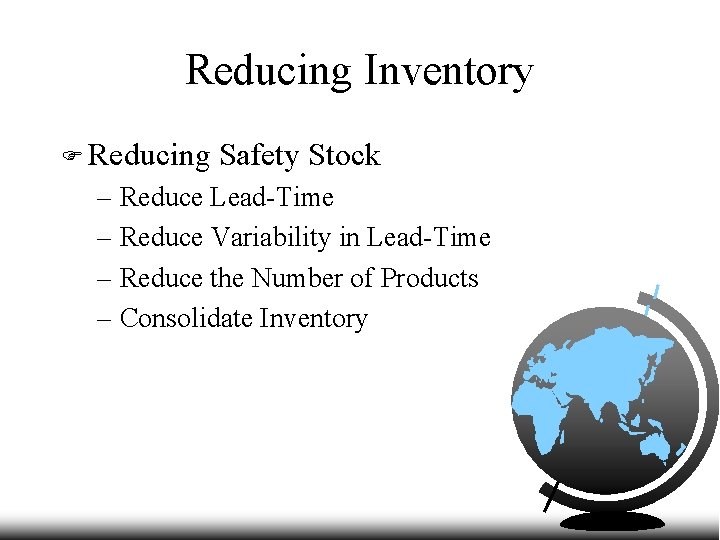
Reducing Inventory F Reducing Safety Stock – Reduce Lead-Time – Reduce Variability in Lead-Time – Reduce the Number of Products – Consolidate Inventory
ABC Analysis F Where to focus Attention: Dollar Volume = Unit Price * Annual Demand – Category A: 20% of the Stock Keeping Units (SKU’s) account for 80% of the Dollar Volume – Category C: 50% of the SKU’s with lowest Dollar Volume – Category B: Remaining 30% of the SKU’s