
STATISTICAL INFERENCE PART II SOME PROPERTIES OF ESTIMATORS
- Slides: 37
STATISTICAL INFERENCE PART II SOME PROPERTIES OF ESTIMATORS 1
SOME PROPERTIES OF ESTIMATORS • θ: a parameter of interest; unknown • Previously, we found good(? ) estimator(s) for θ or its function g(θ). • Goal: • Check how good are these estimator(s). Or are they good at all? • If more than one good estimator is available, which one is better? 2
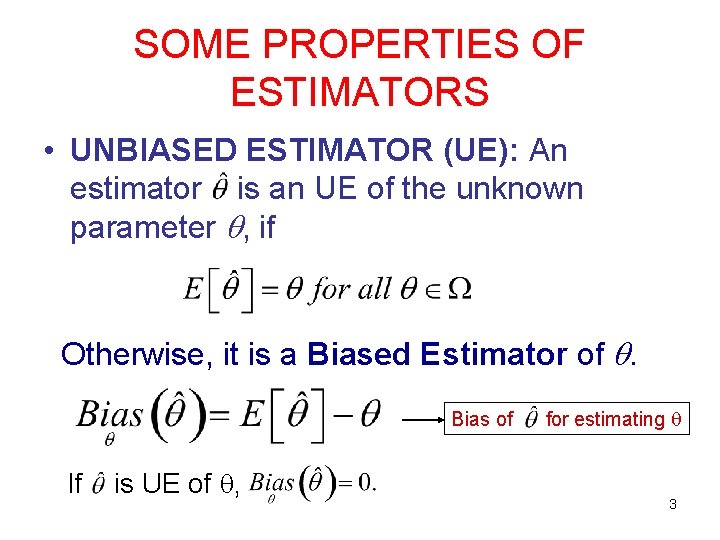
SOME PROPERTIES OF ESTIMATORS • UNBIASED ESTIMATOR (UE): An estimator is an UE of the unknown parameter , if Otherwise, it is a Biased Estimator of . Bias of If is UE of , for estimating 3
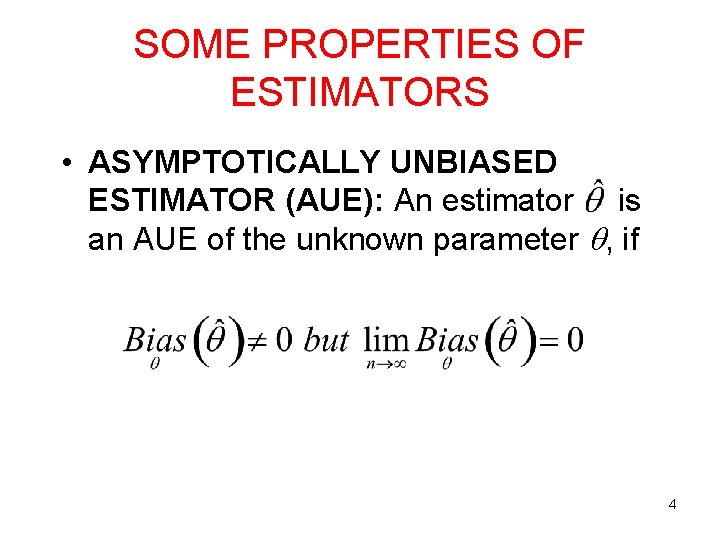
SOME PROPERTIES OF ESTIMATORS • ASYMPTOTICALLY UNBIASED ESTIMATOR (AUE): An estimator is an AUE of the unknown parameter , if 4
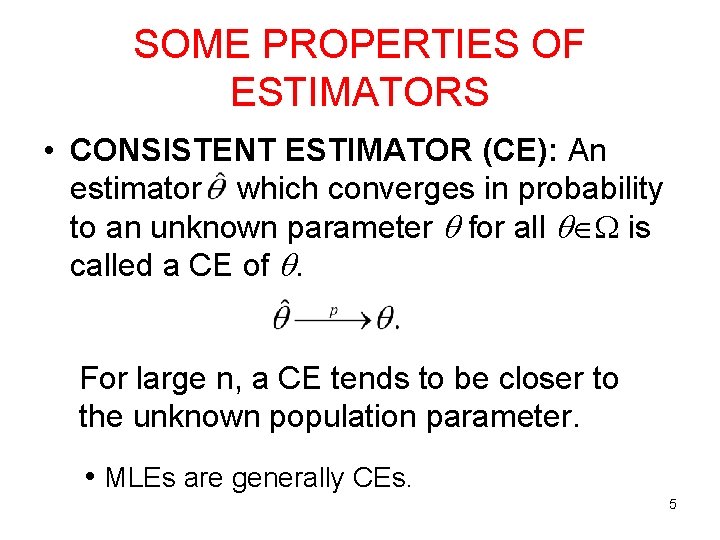
SOME PROPERTIES OF ESTIMATORS • CONSISTENT ESTIMATOR (CE): An estimator which converges in probability to an unknown parameter for all is called a CE of . For large n, a CE tends to be closer to the unknown population parameter. • MLEs are generally CEs. 5
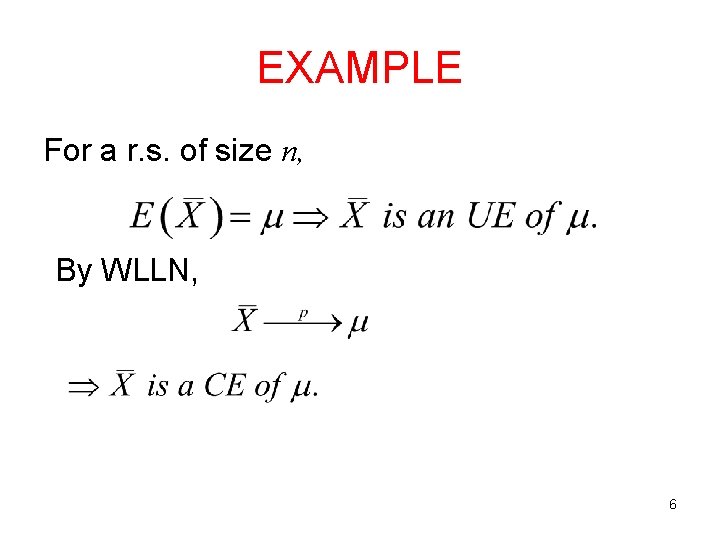
EXAMPLE For a r. s. of size n, By WLLN, 6
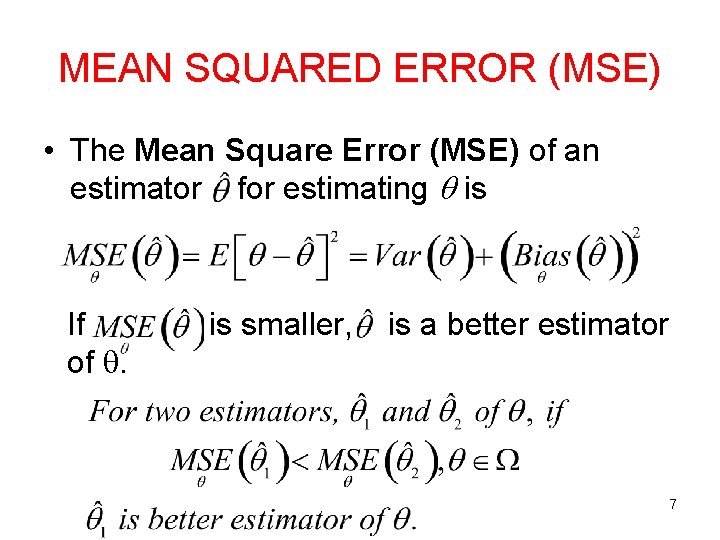
MEAN SQUARED ERROR (MSE) • The Mean Square Error (MSE) of an estimator for estimating is If of . is smaller, is a better estimator 7
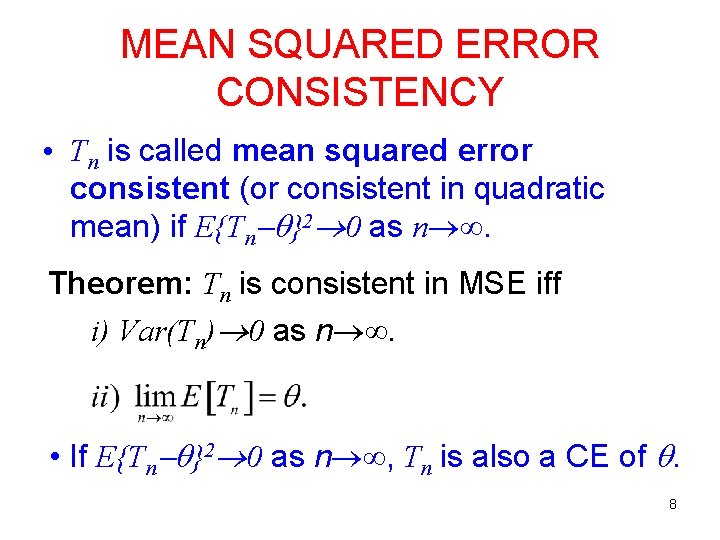
MEAN SQUARED ERROR CONSISTENCY • Tn is called mean squared error consistent (or consistent in quadratic mean) if E{Tn }2 0 as n . Theorem: Tn is consistent in MSE iff i) Var(Tn) 0 as n . • If E{Tn }2 0 as n , Tn is also a CE of . 8
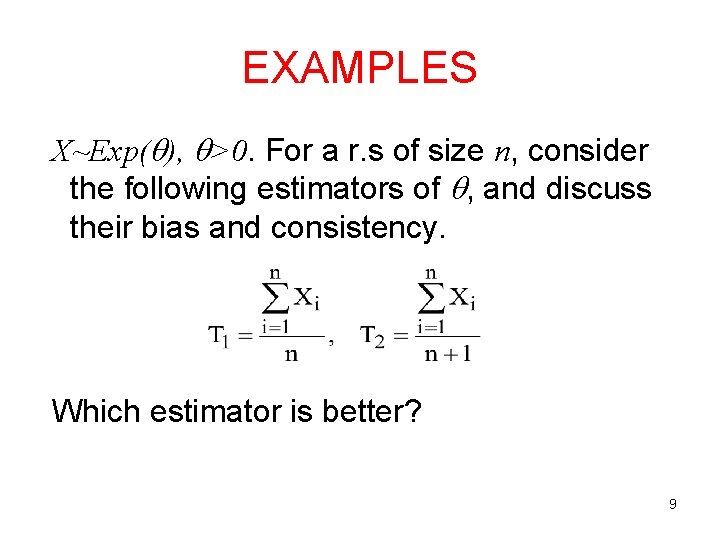
EXAMPLES X~Exp( ), >0. For a r. s of size n, consider the following estimators of , and discuss their bias and consistency. Which estimator is better? 9
SUFFICIENT STATISTICS • X, f(x; ), • X 1, X 2, …, Xn • Y=U(X 1, X 2, …, Xn ) is a statistic. • A sufficient statistic, Y, is a statistic which contains all the information for the estimation of . 10
SUFFICIENT STATISTICS • Given the value of Y, the sample contains no further information for the estimation of . • Y is a sufficient statistic (ss) for if the conditional distribution h(x 1, x 2, …, xn|y) does not depend on for every given Y=y. • A ss for is not unique: • If Y is a ss for , then any 1 -1 transformation of Y, say Y 1=fn(Y) is also a ss for . 11
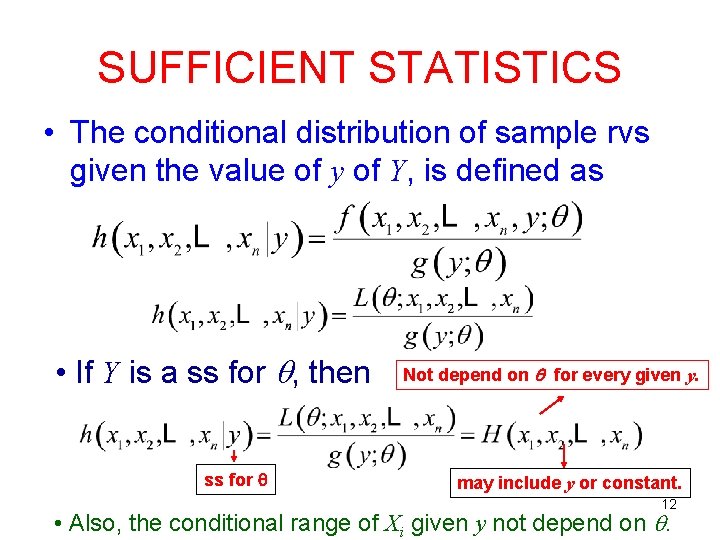
SUFFICIENT STATISTICS • The conditional distribution of sample rvs given the value of y of Y, is defined as • If Y is a ss for , then ss for Not depend on for every given y. may include y or constant. 12 • Also, the conditional range of Xi given y not depend on .
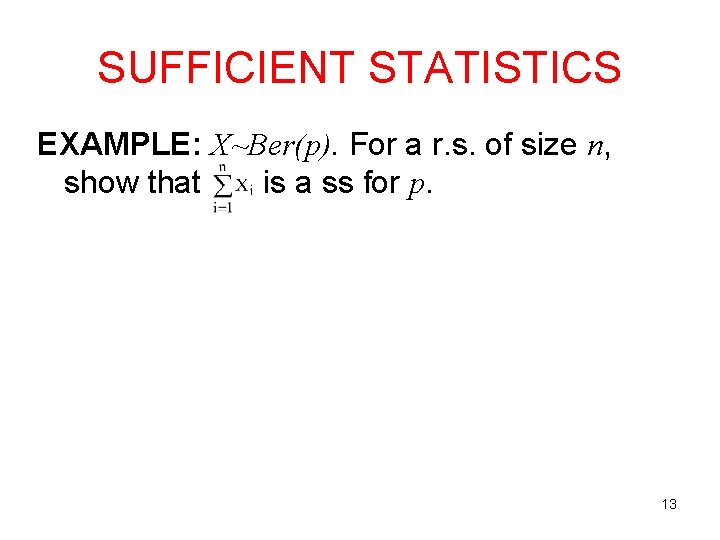
SUFFICIENT STATISTICS EXAMPLE: X~Ber(p). For a r. s. of size n, show that is a ss for p. 13
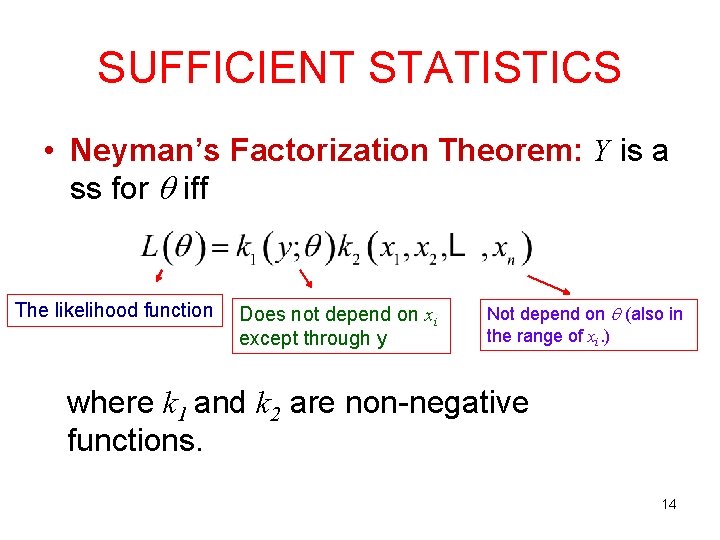
SUFFICIENT STATISTICS • Neyman’s Factorization Theorem: Y is a ss for iff The likelihood function Does not depend on xi except through y Not depend on (also in the range of xi. ) where k 1 and k 2 are non-negative functions. 14
EXAMPLES 1. X~Ber(p). For a r. s. of size n, find a ss for p if exists. 15
EXAMPLES 2. X~Beta(θ, 2). For a r. s. of size n, find a ss for θ. 16
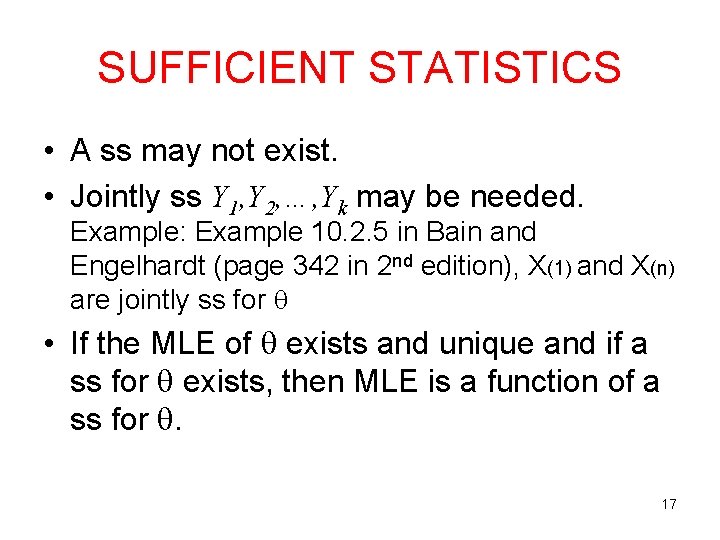
SUFFICIENT STATISTICS • A ss may not exist. • Jointly ss Y 1, Y 2, …, Yk may be needed. Example: Example 10. 2. 5 in Bain and Engelhardt (page 342 in 2 nd edition), X(1) and X(n) are jointly ss for • If the MLE of exists and unique and if a ss for exists, then MLE is a function of a ss for . 17
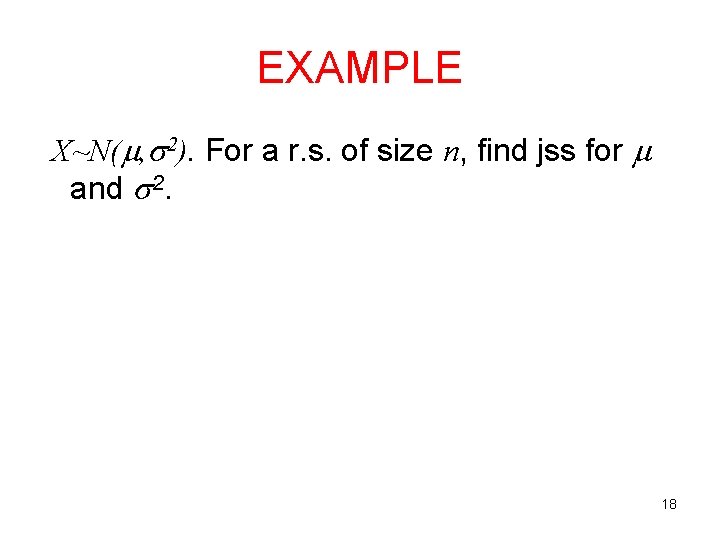
EXAMPLE X~N( , 2). For a r. s. of size n, find jss for and 2. 18
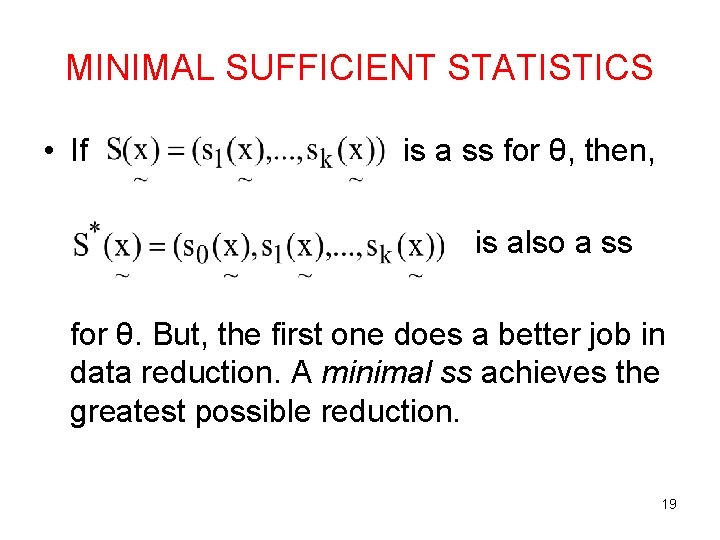
MINIMAL SUFFICIENT STATISTICS • If is a ss for θ, then, is also a ss for θ. But, the first one does a better job in data reduction. A minimal ss achieves the greatest possible reduction. 19
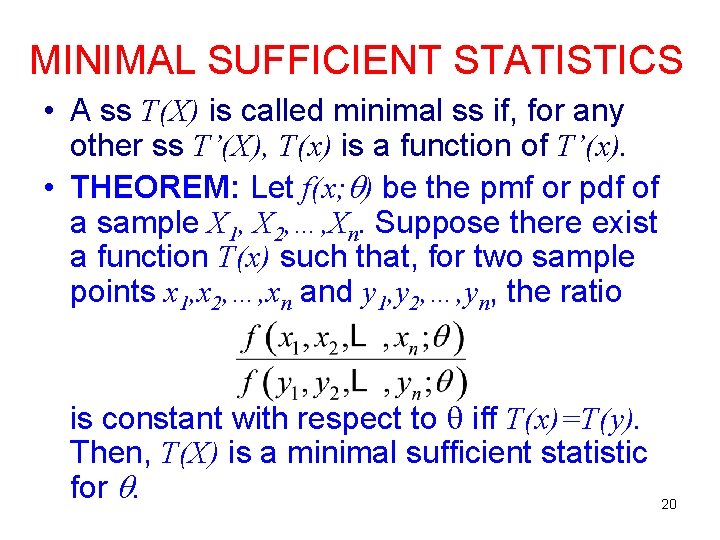
MINIMAL SUFFICIENT STATISTICS • A ss T(X) is called minimal ss if, for any other ss T’(X), T(x) is a function of T’(x). • THEOREM: Let f(x; ) be the pmf or pdf of a sample X 1, X 2, …, Xn. Suppose there exist a function T(x) such that, for two sample points x 1, x 2, …, xn and y 1, y 2, …, yn, the ratio is constant with respect to iff T(x)=T(y). Then, T(X) is a minimal sufficient statistic for . 20
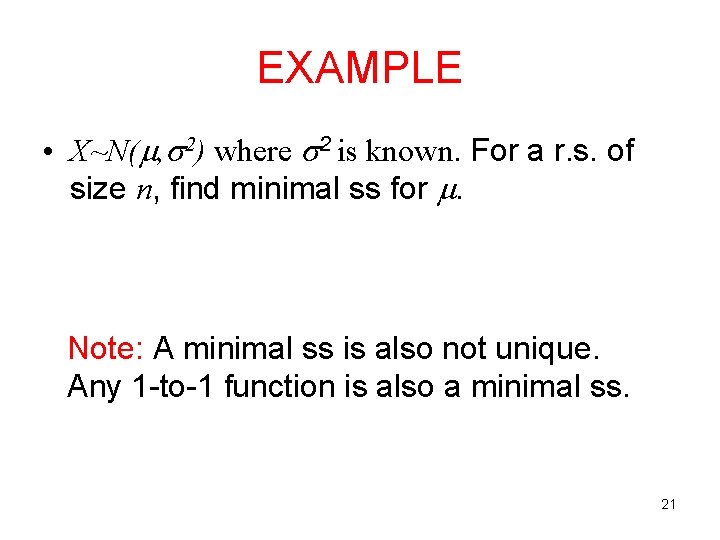
EXAMPLE • X~N( , 2) where 2 is known. For a r. s. of size n, find minimal ss for . Note: A minimal ss is also not unique. Any 1 -to-1 function is also a minimal ss. 21
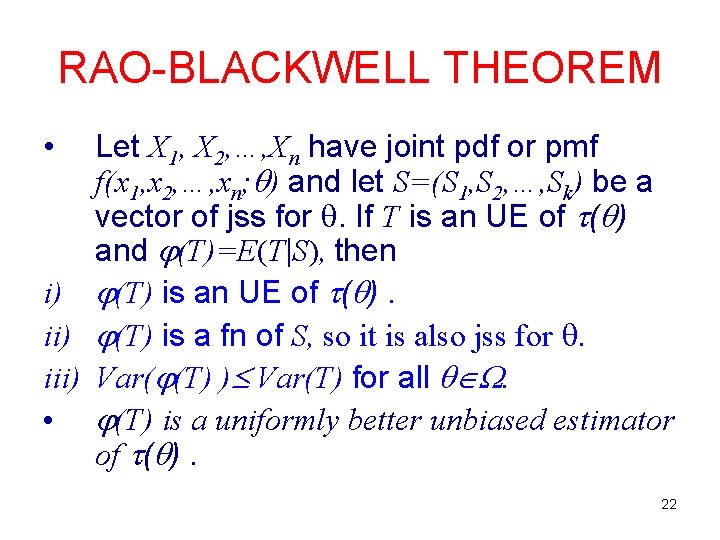
RAO-BLACKWELL THEOREM • Let X 1, X 2, …, Xn have joint pdf or pmf f(x 1, x 2, …, xn; ) and let S=(S 1, S 2, …, Sk) be a vector of jss for . If T is an UE of ( ) and (T)=E(T S), then i) (T) is an UE of ( ). ii) (T) is a fn of S, so it is also jss for . iii) Var( (T) ) Var(T) for all . • (T) is a uniformly better unbiased estimator of ( ). 22
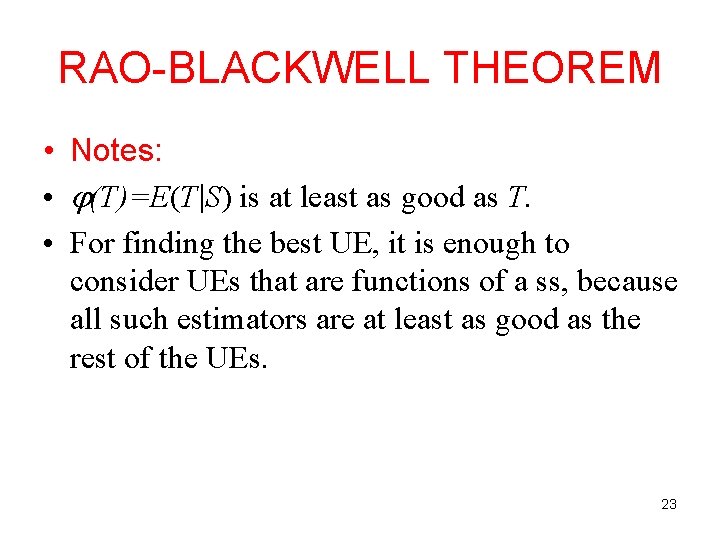
RAO-BLACKWELL THEOREM • Notes: • (T)=E(T S) is at least as good as T. • For finding the best UE, it is enough to consider UEs that are functions of a ss, because all such estimators are at least as good as the rest of the UEs. 23
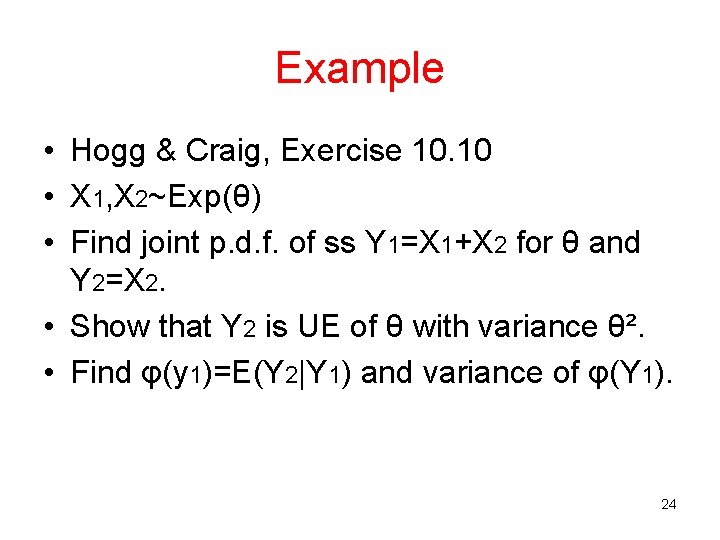
Example • Hogg & Craig, Exercise 10. 10 • X 1, X 2~Exp(θ) • Find joint p. d. f. of ss Y 1=X 1+X 2 for θ and Y 2=X 2. • Show that Y 2 is UE of θ with variance θ². • Find φ(y 1)=E(Y 2|Y 1) and variance of φ(Y 1). 24
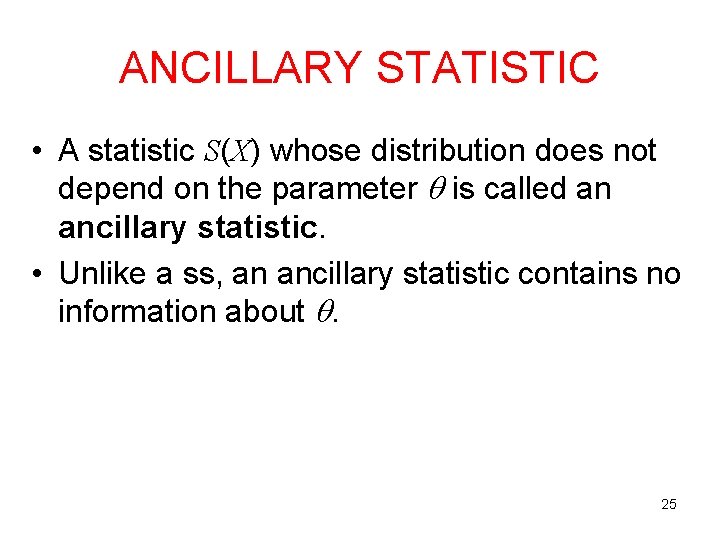
ANCILLARY STATISTIC • A statistic S(X) whose distribution does not depend on the parameter is called an ancillary statistic. • Unlike a ss, an ancillary statistic contains no information about . 25
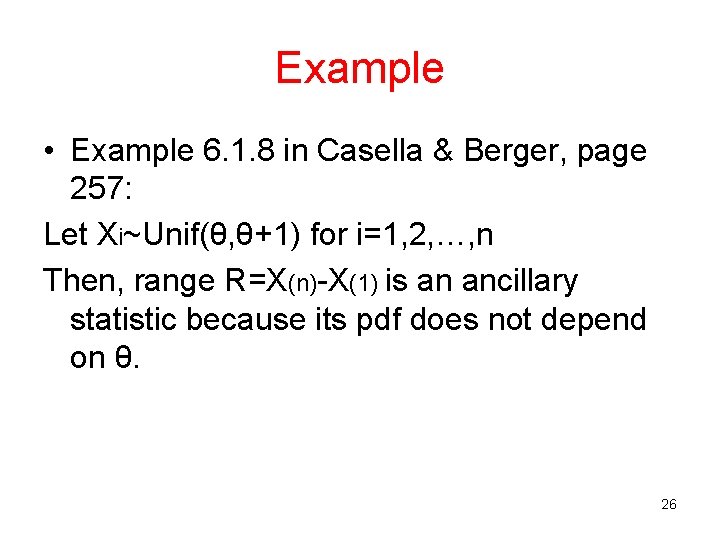
Example • Example 6. 1. 8 in Casella & Berger, page 257: Let Xi~Unif(θ, θ+1) for i=1, 2, …, n Then, range R=X(n)-X(1) is an ancillary statistic because its pdf does not depend on θ. 26
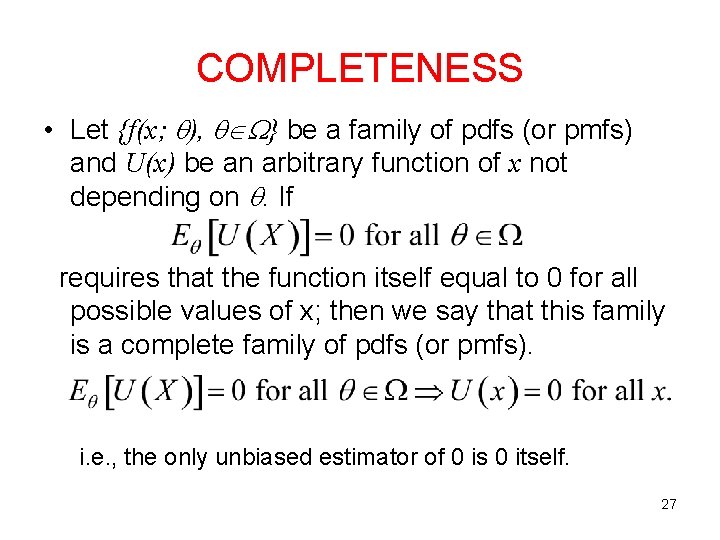
COMPLETENESS • Let {f(x; ), } be a family of pdfs (or pmfs) and U(x) be an arbitrary function of x not depending on . If requires that the function itself equal to 0 for all possible values of x; then we say that this family is a complete family of pdfs (or pmfs). i. e. , the only unbiased estimator of 0 is 0 itself. 27
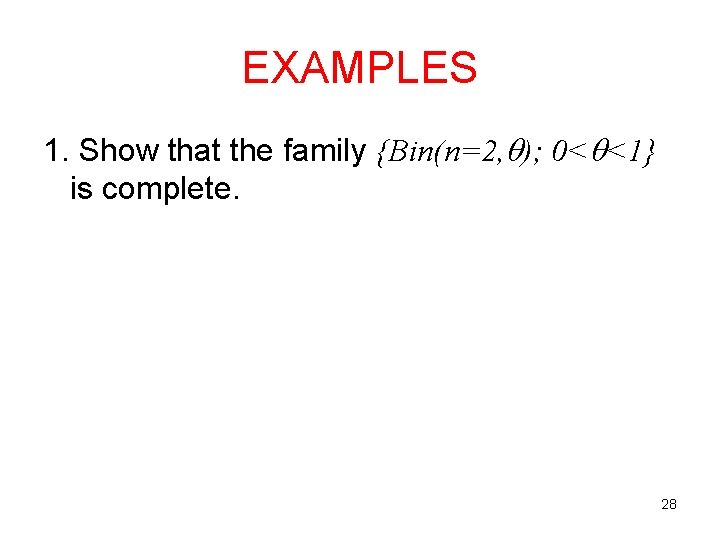
EXAMPLES 1. Show that the family {Bin(n=2, ); 0< <1} is complete. 28
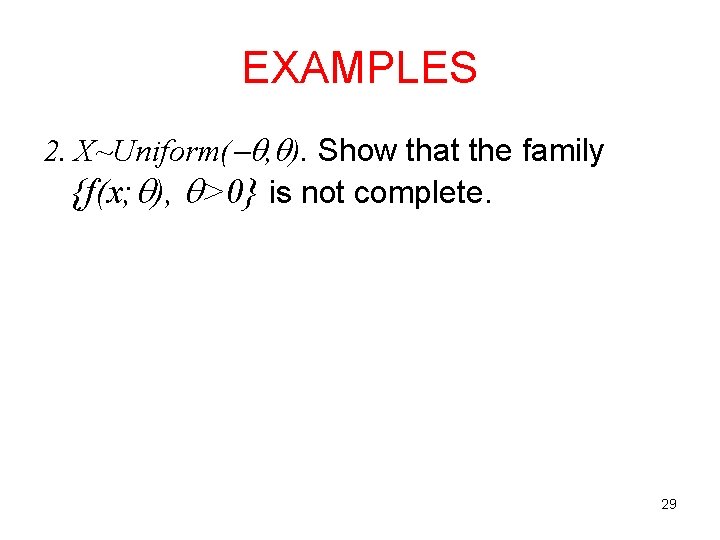
EXAMPLES 2. X~Uniform( , ). Show that the family {f(x; ), >0} is not complete. 29
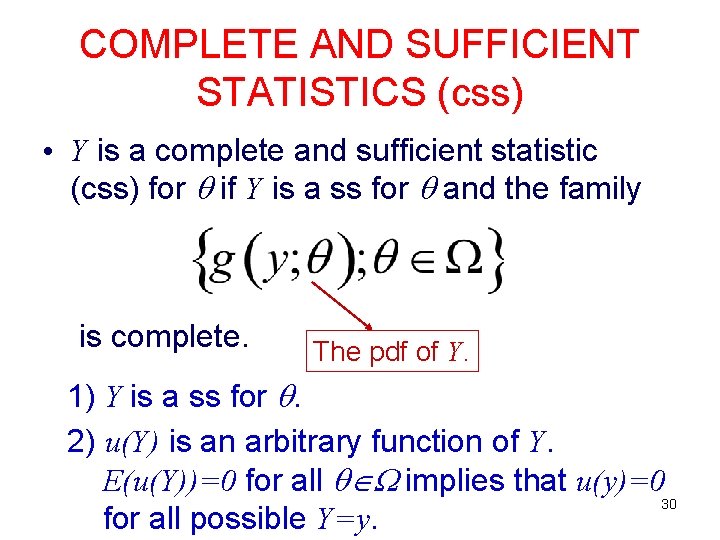
COMPLETE AND SUFFICIENT STATISTICS (css) • Y is a complete and sufficient statistic (css) for if Y is a ss for and the family is complete. The pdf of Y. 1) Y is a ss for . 2) u(Y) is an arbitrary function of Y. E(u(Y))=0 for all implies that u(y)=0 30 for all possible Y=y.
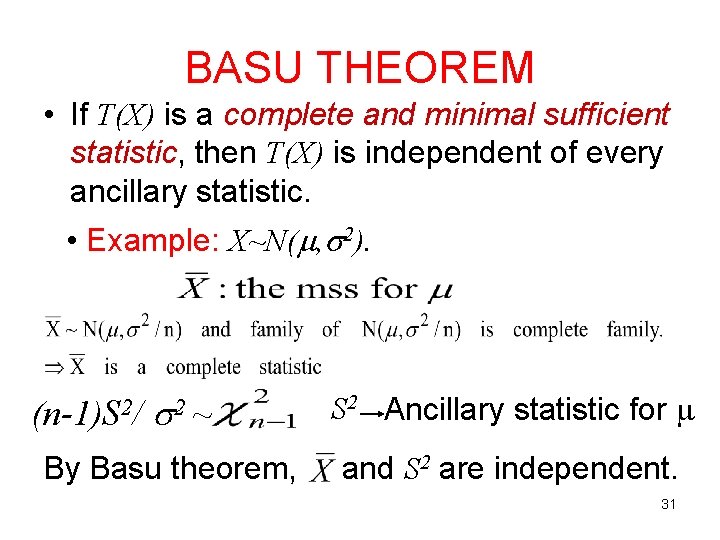
BASU THEOREM • If T(X) is a complete and minimal sufficient statistic, then T(X) is independent of every ancillary statistic. • Example: X~N( , 2). (n-1)S 2/ 2~ By Basu theorem, S 2 Ancillary statistic for and S 2 are independent. 31
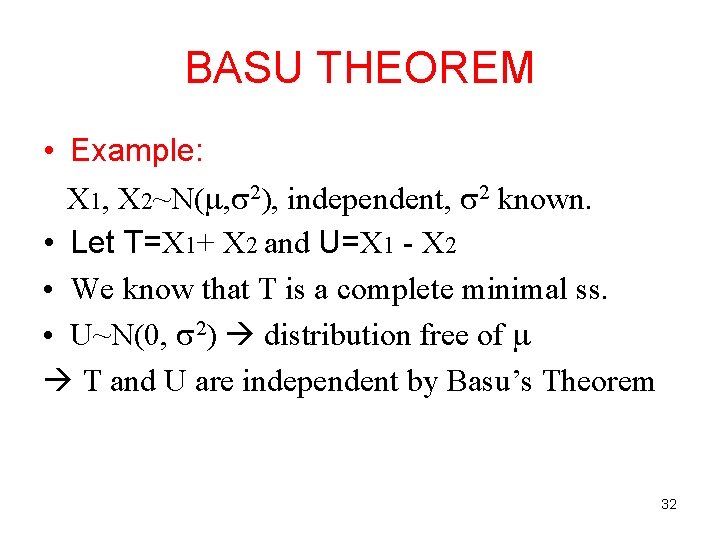
BASU THEOREM • Example: X 1, X 2~N( , 2), independent, 2 known. • Let T=X 1+ X 2 and U=X 1 - X 2 • We know that T is a complete minimal ss. • U~N(0, 2) distribution free of T and U are independent by Basu’s Theorem 32
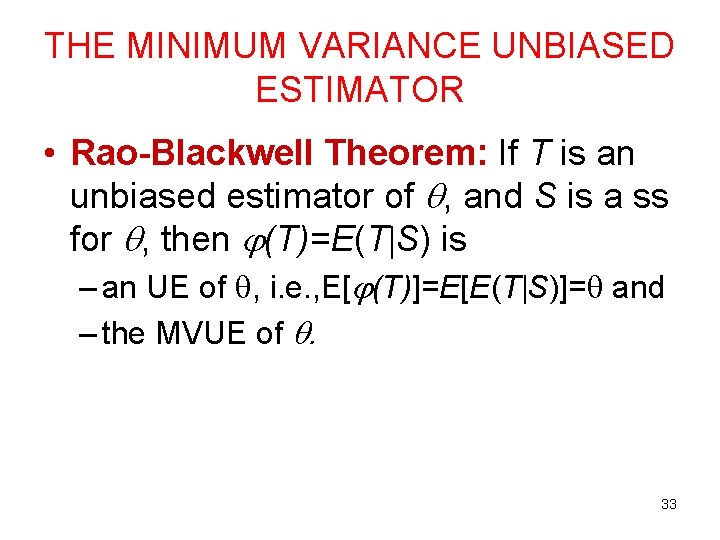
THE MINIMUM VARIANCE UNBIASED ESTIMATOR • Rao-Blackwell Theorem: If T is an unbiased estimator of , and S is a ss for , then (T)=E(T S) is – an UE of , i. e. , E[ (T)]=E[E(T S)]= and – the MVUE of . 33
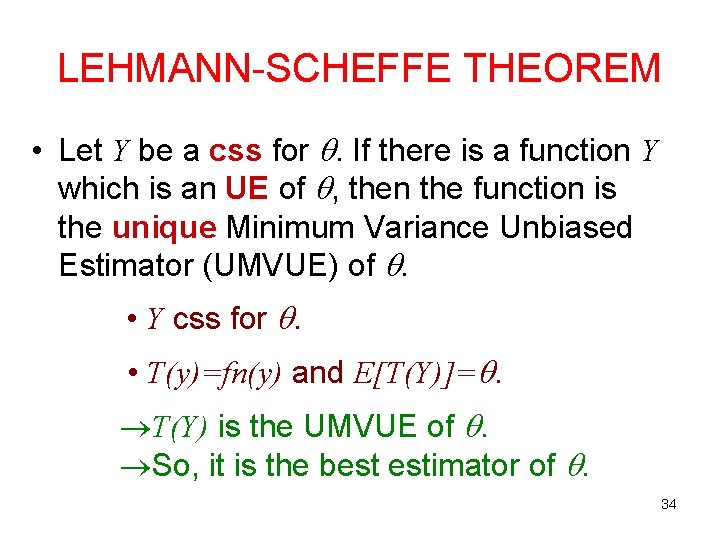
LEHMANN-SCHEFFE THEOREM • Let Y be a css for . If there is a function Y which is an UE of , then the function is the unique Minimum Variance Unbiased Estimator (UMVUE) of . • Y css for . • T(y)=fn(y) and E[T(Y)]=. T(Y) is the UMVUE of . So, it is the best estimator of . 34
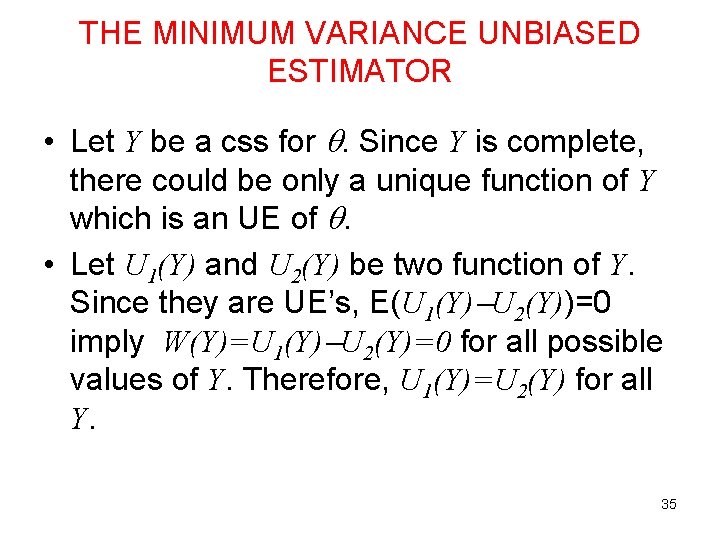
THE MINIMUM VARIANCE UNBIASED ESTIMATOR • Let Y be a css for . Since Y is complete, there could be only a unique function of Y which is an UE of . • Let U 1(Y) and U 2(Y) be two function of Y. Since they are UE’s, E(U 1(Y) U 2(Y))=0 imply W(Y)=U 1(Y) U 2(Y)=0 for all possible values of Y. Therefore, U 1(Y)=U 2(Y) for all Y. 35
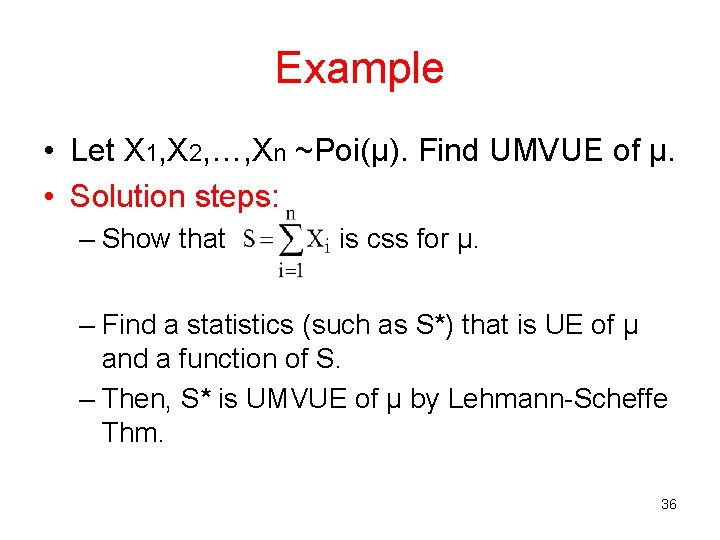
Example • Let X 1, X 2, …, Xn ~Poi(μ). Find UMVUE of μ. • Solution steps: – Show that is css for μ. – Find a statistics (such as S*) that is UE of μ and a function of S. – Then, S* is UMVUE of μ by Lehmann-Scheffe Thm. 36
Note • The estimator found by Rao-Blackwell Thm may not be unique. But, the estimator found by Lehmann-Scheffe Thm is unique. 37