
Statistical Genomics Lecture 10 GWAS by correlation Zhiwu
Statistical Genomics Lecture 10: GWAS by correlation Zhiwu Zhang Washington State University
Outline Correlation and t distribution GWAS by correlation Power and false positives Observed null distribution True positives False positives Type I error Cut off of P values
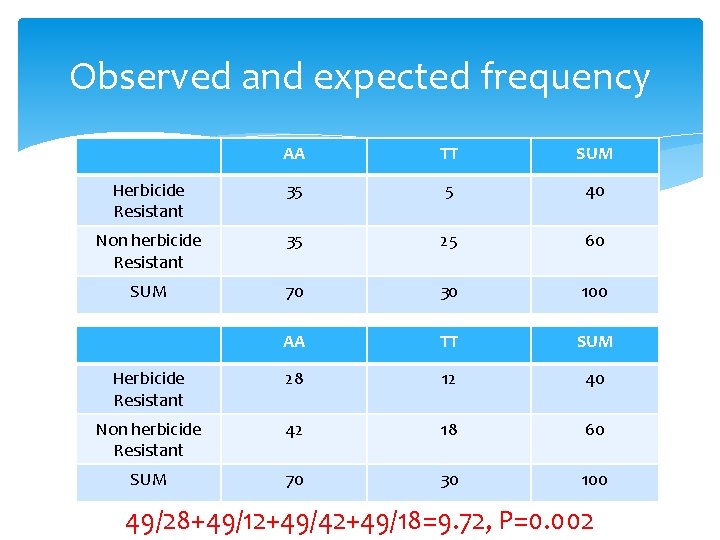
Observed and expected frequency AA TT SUM Herbicide Resistant 35 5 40 Non herbicide Resistant 35 25 60 SUM 70 30 100 AA TT SUM Herbicide Resistant 28 12 40 Non herbicide Resistant 42 18 60 SUM 70 30 100 49/28+49/12+49/42+49/18=9. 72, P=0. 002
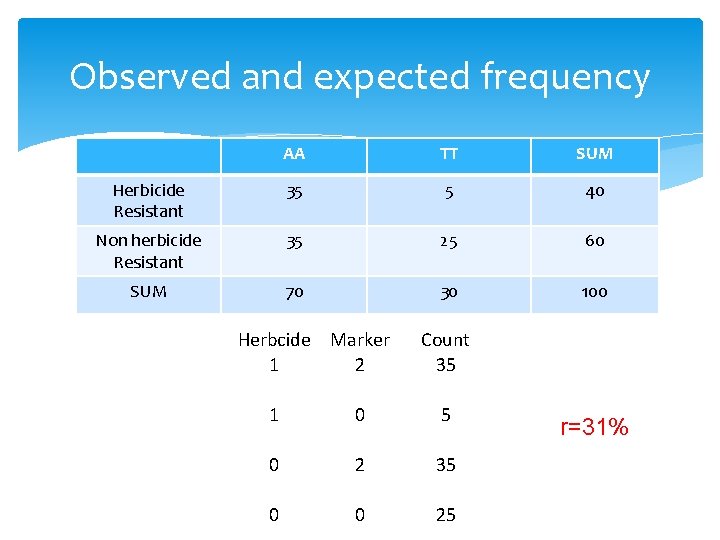
Observed and expected frequency AA TT SUM Herbicide Resistant 35 5 40 Non herbicide Resistant 35 25 60 SUM 70 30 100 Herbcide Marker 1 2 Count 35 1 0 5 0 2 35 0 0 25 r=31%

Pearson Correlation Suitable for continued variables r=Cov(x, y)/(Sx. Sy) Range from -1 to 1
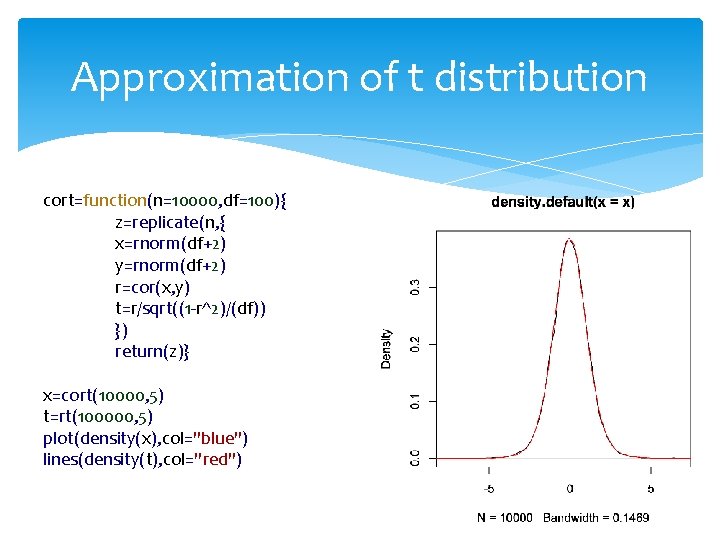
Approximation of t distribution cort=function(n=10000, df=100){ z=replicate(n, { x=rnorm(df+2) y=rnorm(df+2) r=cor(x, y) t=r/sqrt((1 -r^2)/(df)) }) return(z)} x=cort(10000, 5) t=rt(100000, 5) plot(density(x), col="blue") lines(density(t), col="red")
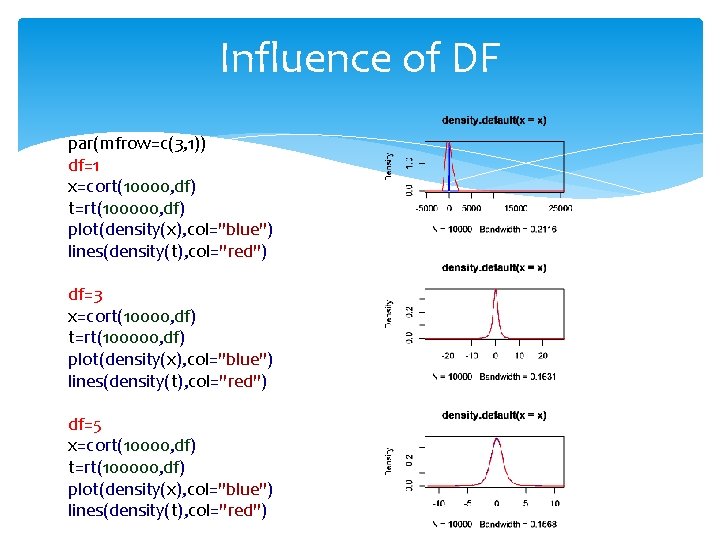
Influence of DF par(mfrow=c(3, 1)) df=1 x=cort(10000, df) t=rt(100000, df) plot(density(x), col="blue") lines(density(t), col="red") df=3 x=cort(10000, df) t=rt(100000, df) plot(density(x), col="blue") lines(density(t), col="red") df=5 x=cort(10000, df) t=rt(100000, df) plot(density(x), col="blue") lines(density(t), col="red")

Can we use correlation to map genes? Try it Sample ten SNPs as QTNs (mutations of genes) Assign gene effects and make total genetic effects Add residuals to make phenotypes with 75% heritability Test all the SNPs and see how many can be found among the top ten associations.
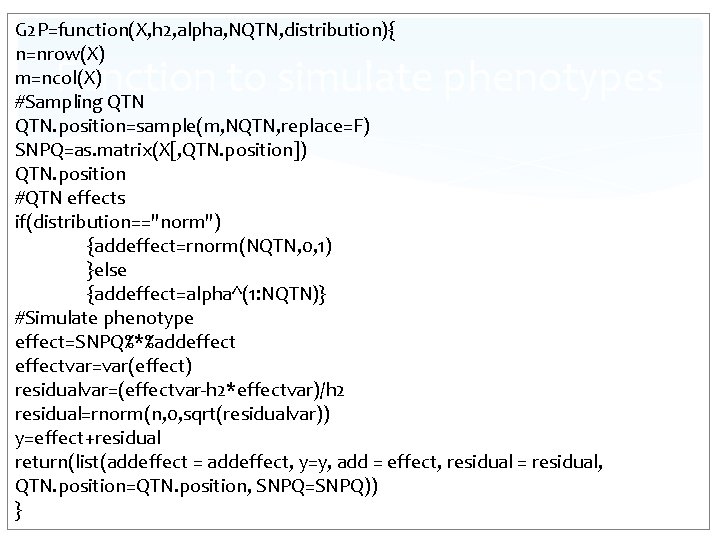
G 2 P=function(X, h 2, alpha, NQTN, distribution){ n=nrow(X) m=ncol(X) #Sampling QTN. position=sample(m, NQTN, replace=F) SNPQ=as. matrix(X[, QTN. position]) QTN. position #QTN effects if(distribution=="norm") {addeffect=rnorm(NQTN, 0, 1) }else {addeffect=alpha^(1: NQTN)} #Simulate phenotype effect=SNPQ%*%addeffectvar=var(effect) residualvar=(effectvar-h 2*effectvar)/h 2 residual=rnorm(n, 0, sqrt(residualvar)) y=effect+residual return(list(addeffect = addeffect, y=y, add = effect, residual = residual, QTN. position=QTN. position, SNPQ=SNPQ)) } Function to simulate phenotypes
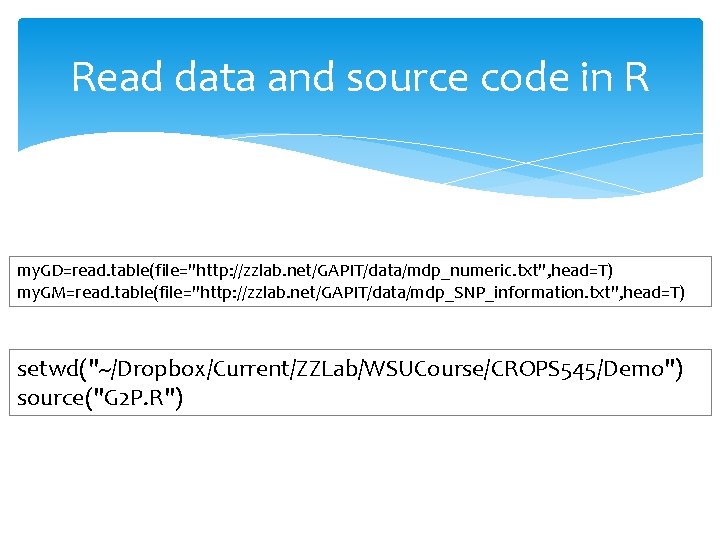
Read data and source code in R my. GD=read. table(file="http: //zzlab. net/GAPIT/data/mdp_numeric. txt", head=T) my. GM=read. table(file="http: //zzlab. net/GAPIT/data/mdp_SNP_information. txt", head=T) setwd("~/Dropbox/Current/ZZLab/WSUCourse/CROPS 545/Demo") source("G 2 P. R")
Let us have more fun! Have the ten genes on chromosome 1 -5 only, nothing on 6 to 10. Any associations on chromosome 6 -10 should be false positives X=my. GD[, -1] index 1 to 5=my. GM[, 2]<6 X 1 to 5 = X[, index 1 to 5]
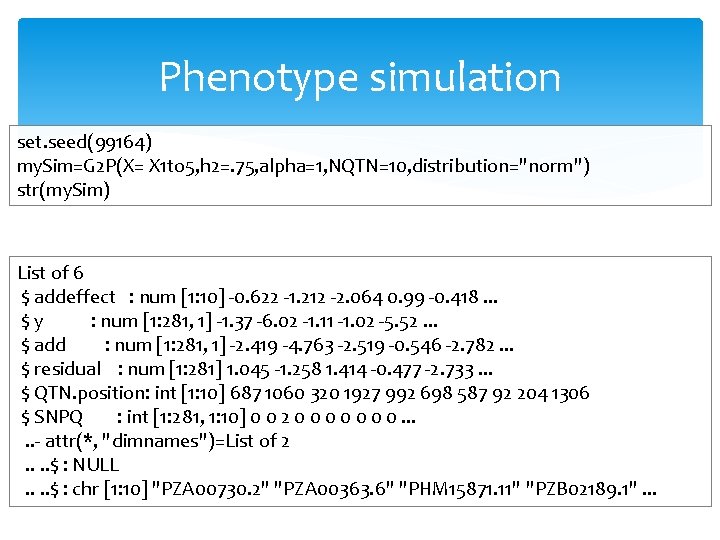
Phenotype simulation set. seed(99164) my. Sim=G 2 P(X= X 1 to 5, h 2=. 75, alpha=1, NQTN=10, distribution="norm") str(my. Sim) List of 6 $ addeffect : num [1: 10] -0. 622 -1. 212 -2. 064 0. 99 -0. 418. . . $y : num [1: 281, 1] -1. 37 -6. 02 -1. 11 -1. 02 -5. 52. . . $ add : num [1: 281, 1] -2. 419 -4. 763 -2. 519 -0. 546 -2. 782. . . $ residual : num [1: 281] 1. 045 -1. 258 1. 414 -0. 477 -2. 733. . . $ QTN. position: int [1: 10] 687 1060 320 1927 992 698 587 92 204 1306 $ SNPQ : int [1: 281, 1: 10] 0 0 2 0 0 0 0. . . - attr(*, "dimnames")=List of 2. . $ : NULL. . $ : chr [1: 10] "PZA 00730. 2" "PZA 00363. 6" "PHM 15871. 11" "PZB 02189. 1". . .
![QTN positions plot(my. GM[, c(2, 3)]) lines(my. GM[my. Sim$QTN. position, c(2, 3)], type="p", col="red")](http://slidetodoc.com/presentation_image_h/fb49a145b2f5ddf50dd8f8c578b6238f/image-13.jpg "QTN positions plot(my. GM[, c(2, 3)]) lines(my. GM[my. Sim$QTN. position, c(2, 3)], type=\"p\", col=\"red\")")
QTN positions plot(my. GM[, c(2, 3)]) lines(my. GM[my. Sim$QTN. position, c(2, 3)], type="p", col="red") points(my. GM[my. Sim$QTN. position, c(2, 3)], type="p", col="blue", cex = 5)
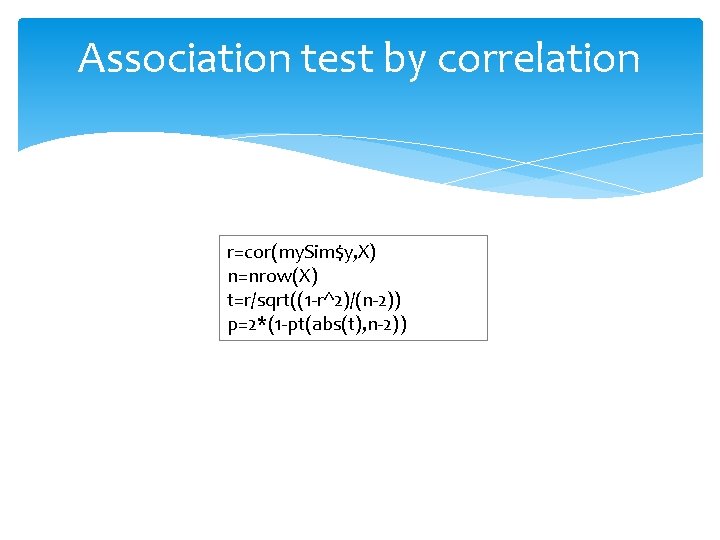
Association test by correlation r=cor(my. Sim$y, X) n=nrow(X) t=r/sqrt((1 -r^2)/(n-2)) p=2*(1 -pt(abs(t), n-2))
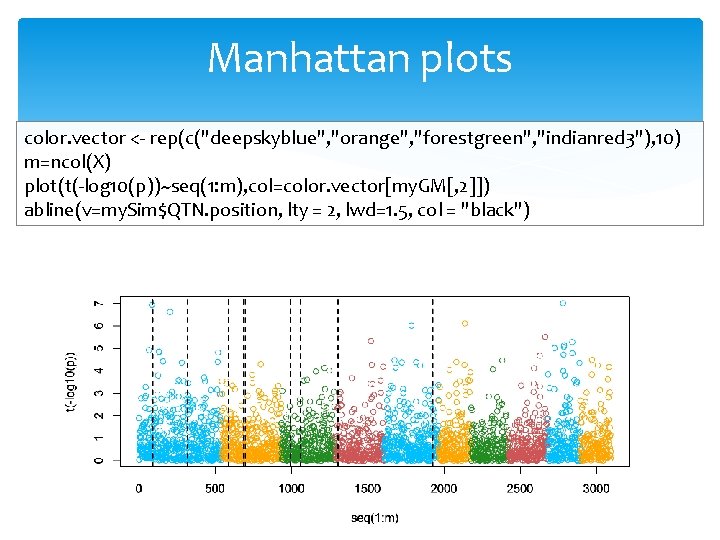
Manhattan plots color. vector <- rep(c("deepskyblue", "orange", "forestgreen", "indianred 3"), 10) m=ncol(X) plot(t(-log 10(p))~seq(1: m), col=color. vector[my. GM[, 2]]) abline(v=my. Sim$QTN. position, lty = 2, lwd=1. 5, col = "black")
![Two additional findings sort(p)[1: 5] zeros=p==0 p[zeros]=1 e-10 plot(t(-log 10(p))~seq(1: m), col=color. vector[my. GM[,](http://slidetodoc.com/presentation_image_h/fb49a145b2f5ddf50dd8f8c578b6238f/image-16.jpg "Two additional findings sort(p)[1: 5] zeros=p==0 p[zeros]=1 e-10 plot(t(-log 10(p))~seq(1: m), col=color. vector[my. GM[,")
Two additional findings sort(p)[1: 5] zeros=p==0 p[zeros]=1 e-10 plot(t(-log 10(p))~seq(1: m), col=color. vector[my. GM[, 2]]) abline(v=my. Sim$QTN. position, lty = 2, lwd=1. 5, col = "black")
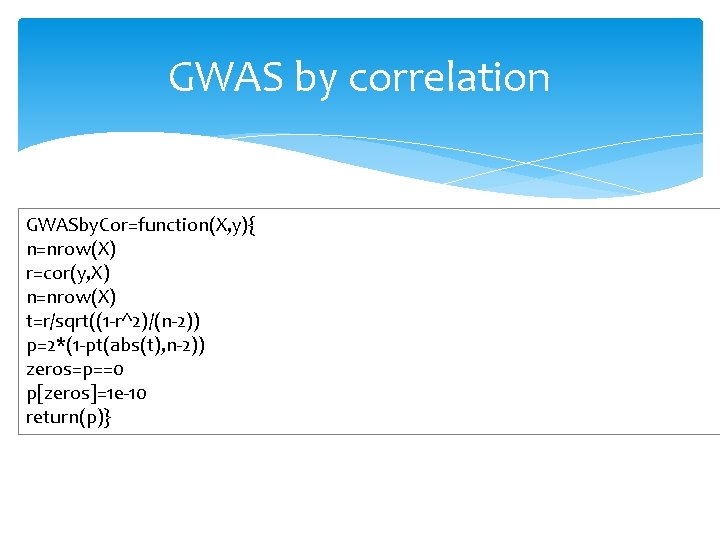
GWAS by correlation GWASby. Cor=function(X, y){ n=nrow(X) r=cor(y, X) n=nrow(X) t=r/sqrt((1 -r^2)/(n-2)) p=2*(1 -pt(abs(t), n-2)) zeros=p==0 p[zeros]=1 e-10 return(p)}
![The top ten associations index=order(p) top 10=index[1: 10] detected=intersect(top 10, my. Sim$QTN. position) false.](http://slidetodoc.com/presentation_image_h/fb49a145b2f5ddf50dd8f8c578b6238f/image-18.jpg "The top ten associations index=order(p) top 10=index[1: 10] detected=intersect(top 10, my. Sim$QTN. position) false.")
The top ten associations index=order(p) top 10=index[1: 10] detected=intersect(top 10, my. Sim$QTN. position) false. Positive=setdiff(top 10, my. Sim$QTN. position) top 10 my. Sim$QTN. position detected length(detected) false. Positive
![The top ten associations plot(t(-log 10(p))~seq(1: m), col=color. vector[my. GM[, 2]]) abline(v=my. Sim$QTN. position,](http://slidetodoc.com/presentation_image_h/fb49a145b2f5ddf50dd8f8c578b6238f/image-19.jpg "The top ten associations plot(t(-log 10(p))~seq(1: m), col=color. vector[my. GM[, 2]]) abline(v=my. Sim$QTN. position,")
The top ten associations plot(t(-log 10(p))~seq(1: m), col=color. vector[my. GM[, 2]]) abline(v=my. Sim$QTN. position, lty = 2, lwd=2, col = "black") abline(v= false. Positive, lty = 2, lwd=2, col = "red")
![Null distribution of P values hist(p[!index 1 to 5])](http://slidetodoc.com/presentation_image_h/fb49a145b2f5ddf50dd8f8c578b6238f/image-20.jpg "Null distribution of P values hist(p[!index 1 to 5])")
Null distribution of P values hist(p[!index 1 to 5])
![QQ plot p. obs=p[!index 1 to 5] m 2=length(p. obs) p. uni=runif(m 2, 0,](http://slidetodoc.com/presentation_image_h/fb49a145b2f5ddf50dd8f8c578b6238f/image-21.jpg "QQ plot p. obs=p[!index 1 to 5] m 2=length(p. obs) p. uni=runif(m 2, 0,")
QQ plot p. obs=p[!index 1 to 5] m 2=length(p. obs) p. uni=runif(m 2, 0, 1) order. obs=order(p. obs) order. uni=order(p. uni) plot(-log 10(p. uni[order. uni]), -log 10(p. obs[order. obs])) abline(a = 0, b = 1, col = "red")
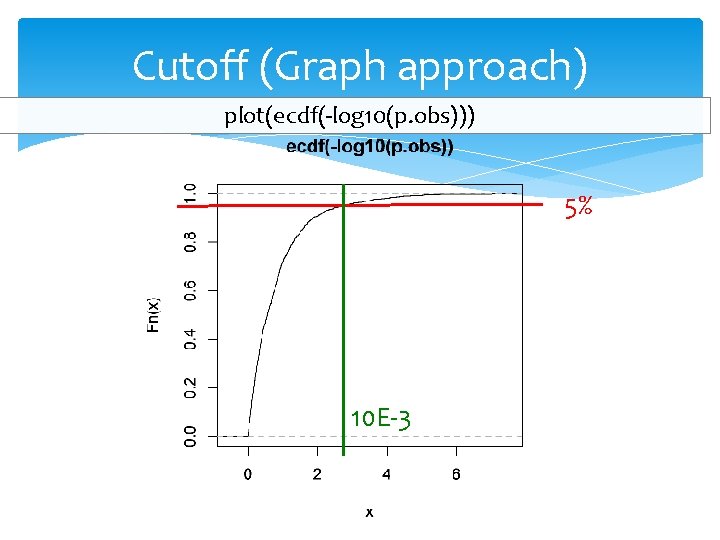
Cutoff (Graph approach) plot(ecdf(-log 10(p. obs))) 5% 10 E-3
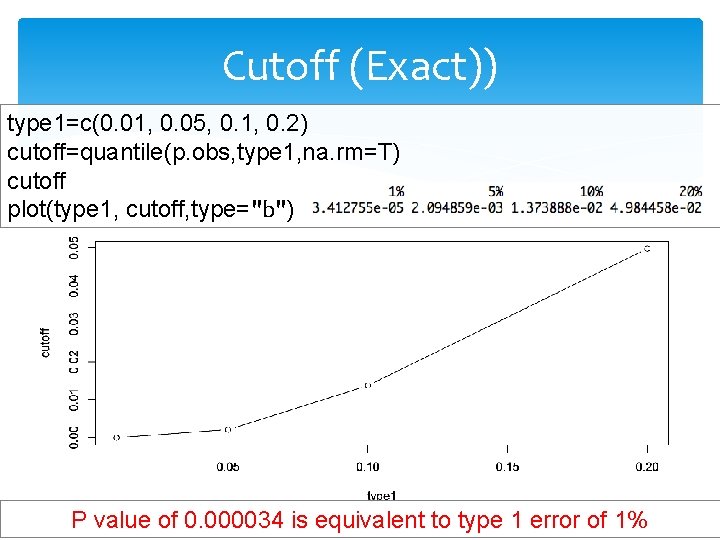
Cutoff (Exact)) type 1=c(0. 01, 0. 05, 0. 1, 0. 2) cutoff=quantile(p. obs, type 1, na. rm=T) cutoff plot(type 1, cutoff, type="b") P value of 0. 000034 is equivalent to type 1 error of 1%

Highlight Correlation and t distribution GWAS by correlation Power and false positives Observed null distribution True positives False positives Type I error Cut off of P values
- Slides: 24