
Statistical Evaluation of Random Errors Two important concepts
- Slides: 8
Statistical Evaluation of Random Errors
Two important concepts in the statistical evaluation of random errors are sample and population. A population is a collection of entities about which we want to gather information and is also called the universe. Examples of the population; a mining zone, a river, lakes, living tissues, cells, etc. The population can be finite in number and real or conceptual. Smaller subunits representing the population are called samples, and for chemists, the sample is the sample. Statistical laws are derived for populations. Significant changes should be made when the statistical laws derived for the population are to be applied to small-scale samples.
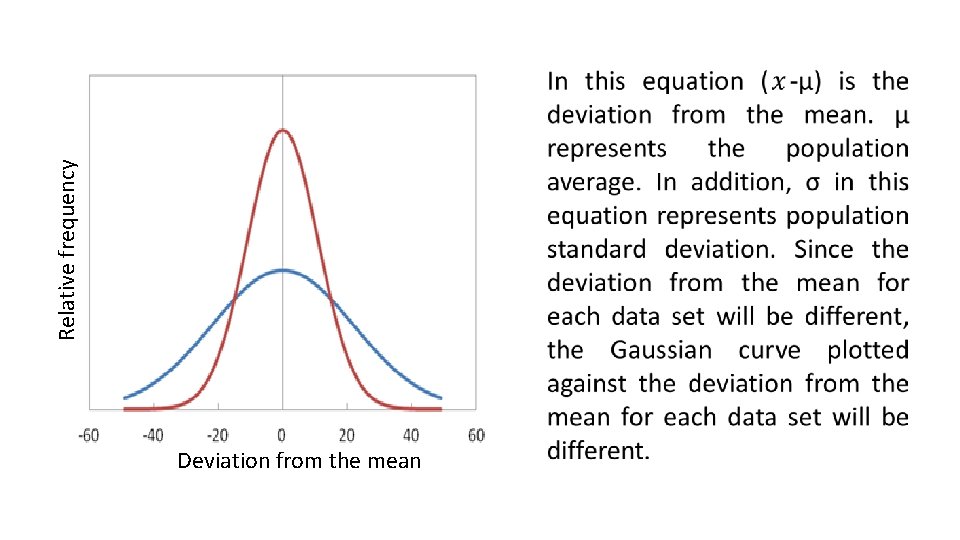
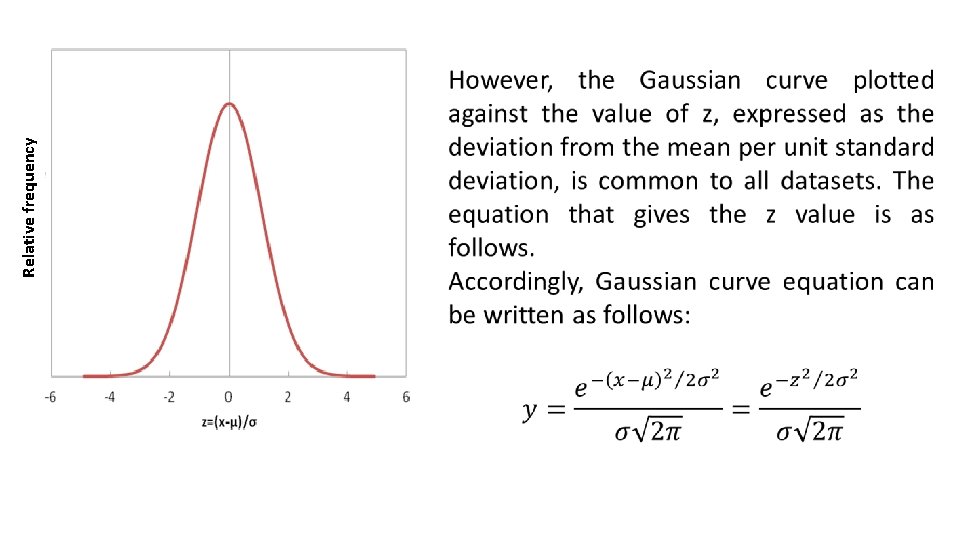
Relative frequency Deviation from the mean
Relative frequency
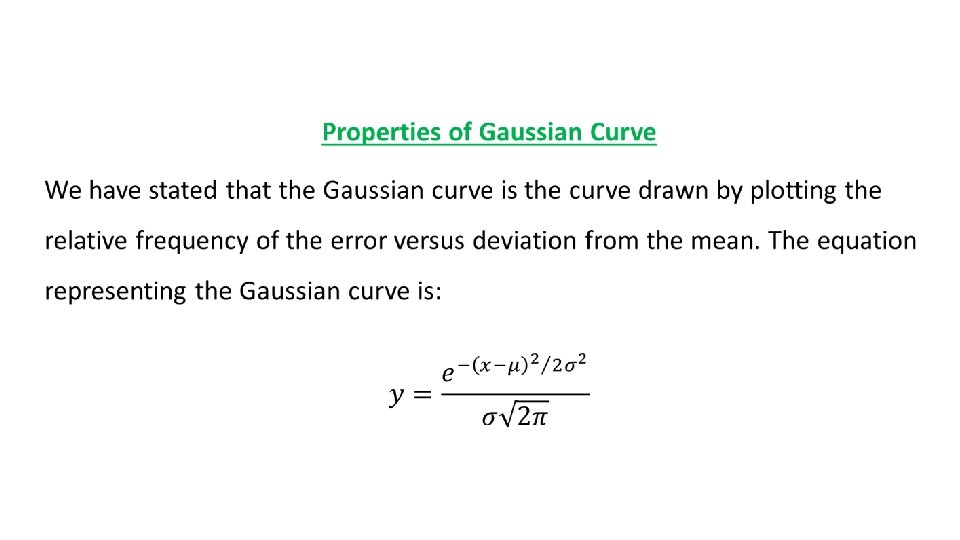
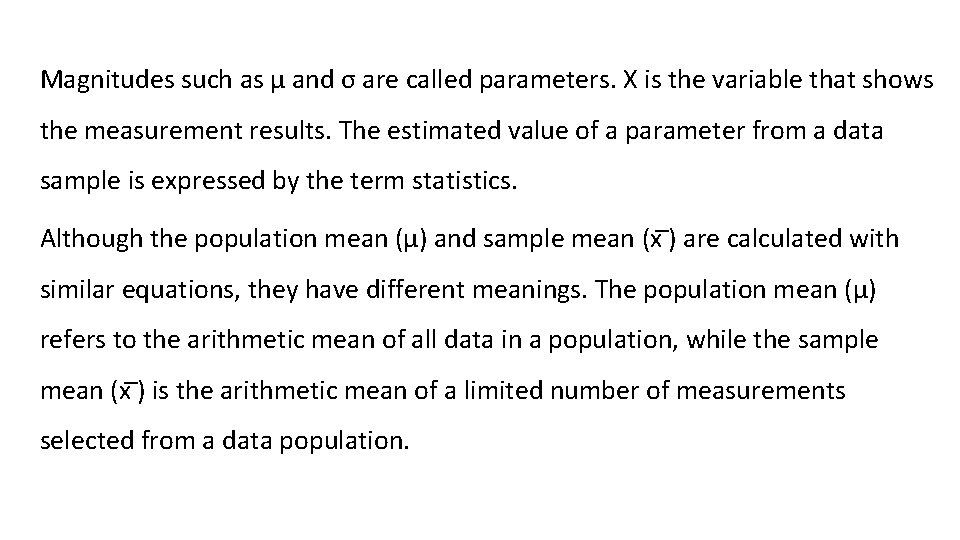
Magnitudes such as µ and σ are called parameters. X is the variable that shows the measurement results. The estimated value of a parameter from a data sample is expressed by the term statistics. Although the population mean (µ) and sample mean (x ) are calculated with similar equations, they have different meanings. The population mean (µ) refers to the arithmetic mean of all data in a population, while the sample mean (x ) is the arithmetic mean of a limited number of measurements selected from a data population.
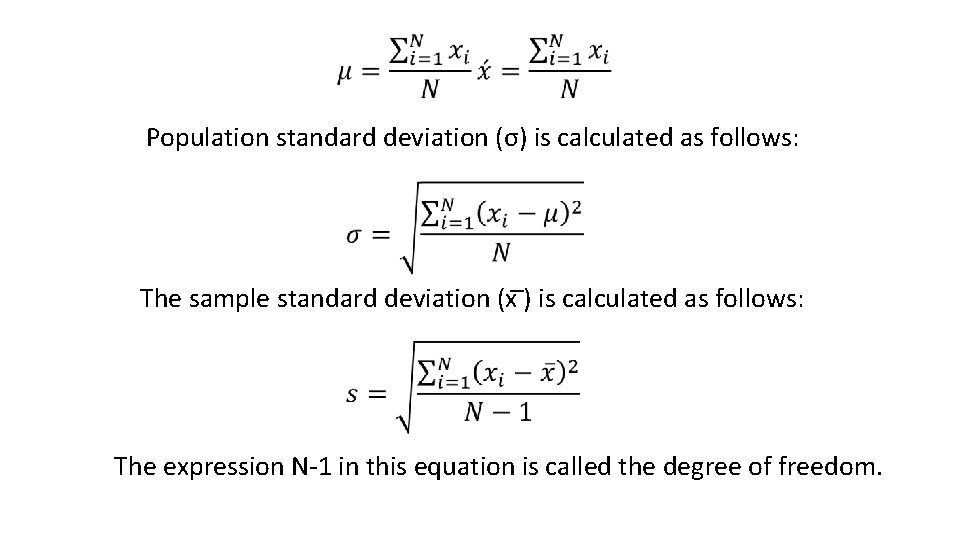
Population standard deviation (σ) is calculated as follows: The sample standard deviation (x ) is calculated as follows: The expression N-1 in this equation is called the degree of freedom.
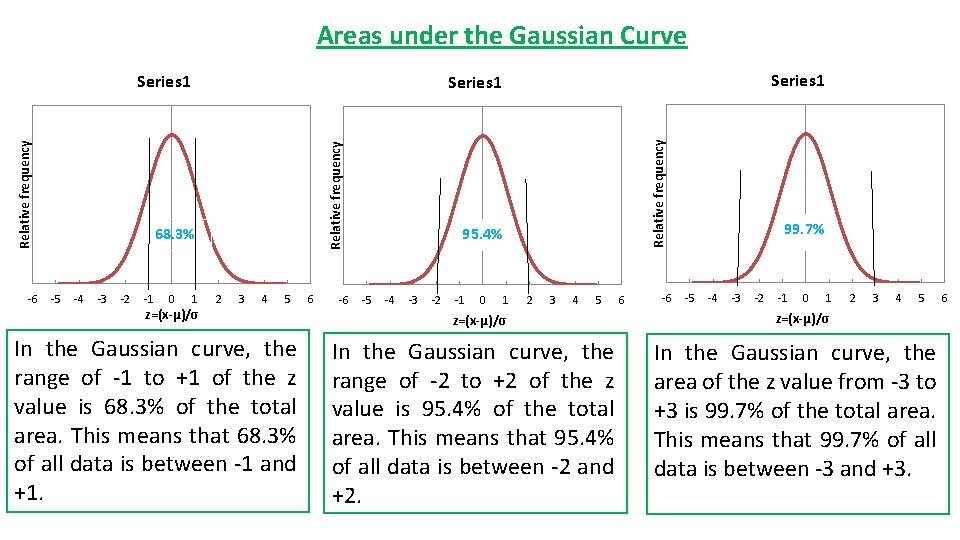
Areas under the Gaussian Curve -6 -4 -3 -2 -1 0 1 z=(x-µ)/σ 2 3 4 5 In the Gaussian curve, the range of -1 to +1 of the z value is 68. 3% of the total area. This means that 68. 3% of all data is between -1 and +1. 6 -6 Relative frequency 68. 3% -5 Series 1 Relative frequency Series 1 95. 4% -5 -4 -3 -2 -1 0 1 2 3 4 5 z=(x-µ)/σ In the Gaussian curve, the range of -2 to +2 of the z value is 95. 4% of the total area. This means that 95. 4% of all data is between -2 and +2. 6 -6 99. 7% -5 -4 -3 -2 -1 0 1 2 3 4 5 z=(x-µ)/σ In the Gaussian curve, the area of the z value from -3 to +3 is 99. 7% of the total area. This means that 99. 7% of all data is between -3 and +3. 6