
STATISTICAL AND THERMAL PHYSICS PHY 315 MACROSCOPIC MICROSCOPIC

- Slides: 19
STATISTICAL AND THERMAL PHYSICS (PHY 315) MACROSCOPIC & MICROSCOPIC DESCRIPTIONS LECTURE TWO Prof. Theodora. O. BELLO
LECTURE OVERVIEW ü ü ü ü Explanation of Examples of Open System Explanation of Examples of Closed System Explanation of Examples of Isolated System Description of Macroscopic System Description of Microscopic System Description of State of a System and Thermodynamic Variables Description of Thermodynamic Equilibrium
COURSE OBJECTIVES After going through the course, students should be able to: ü Explain Examples of Open System ü Explain Examples of Closed System ü Explain Examples of Isolated System ü Describe Macroscopic System ü Describe Microscopic System ü Describe State of a System and Thermodynamic Variables ü Describe Thermodynamic Equilibrium
OVERVIEW v. A system in thermodynamics is the collection of matter that is being studied. v. The boundary is the envelope that encloses a system or the imaginary outer edge of the system Surrounding: This is everything outside the system that can influence its boundary v. Isolated Boundary: This is the boundary that does not allow any exchange of matter and energy with the system and surroundings v. It is known as the A thermodynamic system is a quality of matter of fixed identity, around which we can draw boundary. v. The boundary may be fixed or moveable v. Work or heat can be transferred across the system boundary ü Ex: Refrigerator, air conditioner, washing machine, car engine e. t. c.
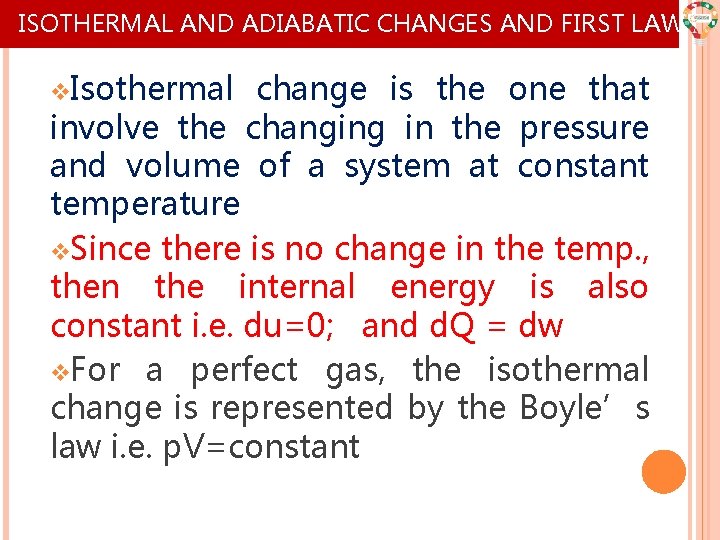
ISOTHERMAL AND ADIABATIC CHANGES AND FIRST LAW v. Isothermal change is the one that involve the changing in the pressure and volume of a system at constant temperature v. Since there is no change in the temp. , then the internal energy is also constant i. e. du=0; and d. Q = dw v. For a perfect gas, the isothermal change is represented by the Boyle’s law i. e. p. V=constant
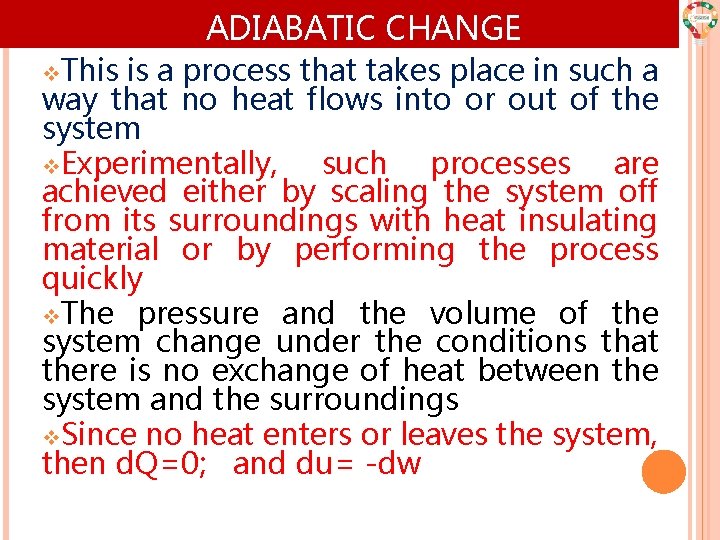
ADIABATIC CHANGE v. This is a process that takes place in such a way that no heat flows into or out of the system v. Experimentally, such processes are achieved either by scaling the system off from its surroundings with heat insulating material or by performing the process quickly v. The pressure and the volume of the system change under the conditions that there is no exchange of heat between the system and the surroundings v. Since no heat enters or leaves the system, then d. Q=0; and du= -dw
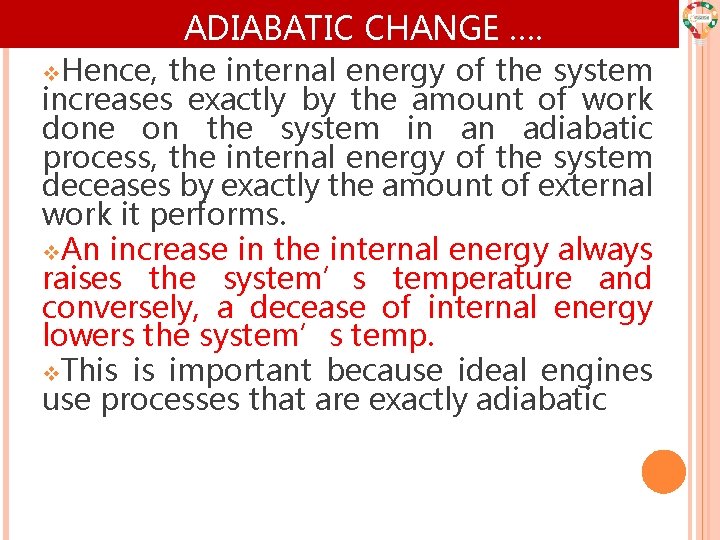
ADIABATIC CHANGE …. v. Hence, the internal energy of the system increases exactly by the amount of work done on the system in an adiabatic process, the internal energy of the system deceases by exactly the amount of external work it performs. v. An increase in the internal energy always raises the system’s temperature and conversely, a decease of internal energy lowers the system’s temp. v. This is important because ideal engines use processes that are exactly adiabatic
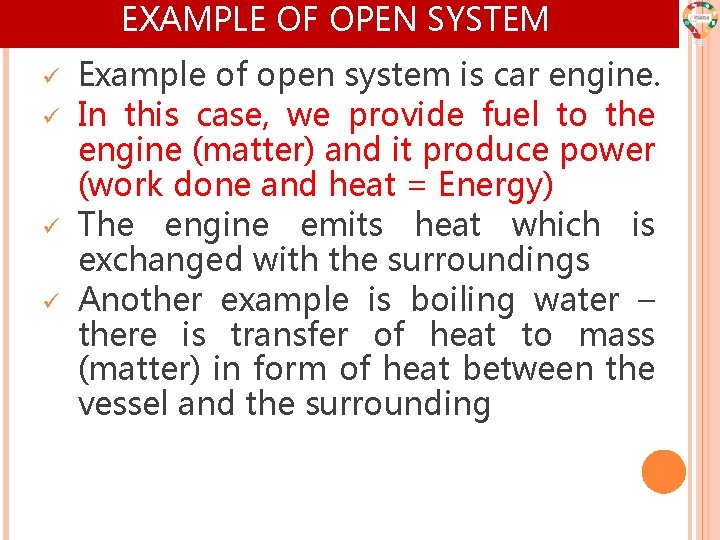
EXAMPLE OF OPEN SYSTEM ü ü Example of open system is car engine. In this case, we provide fuel to the engine (matter) and it produce power (work done and heat = Energy) The engine emits heat which is exchanged with the surroundings Another example is boiling water – there is transfer of heat to mass (matter) in form of heat between the vessel and the surrounding
EXAMPLE OF CLOSED SYSYTEM ü ü When fluid of gas is being compressed in the piston, where the mass of the gas remain constant but it can get heated or cooled Other example is the water being heated in the closed vessel, where water will get heated but its mass will remain the same
EXAMPLE OF ISOLATED SYSYTEM ü ü Piston and cylinder arrangement in which fluid or gas being compressed or expanded is insulated It becomes isolated system
MACROSCOPIC & MICROSCOPIC DESCRIPTIONS ü ü In analysing physical situations, we usually focus our attention on some portion of matter which we separate, in our minds from the environment external to it. We call such a portion the system. Everything outside the system which has a direct bearing on its behaviour is call the environment We then seek to determine the behaviour of the system by finding how it interacts with its environment
MACROSCOPIC AND MICROSCOPIC…. ü ü ü The behaviour of a system can be describe by suitable observable quantities to describe the system. We classify these quantities into macroscopic and microscopic. These quantities include: pressure, temperature, volume and entropy Macroscopic quantities are directly associated with our sense of perception We can also adopt microscopic point of view
MACROSCOPIC AND MICROSCOPIC…. ü ü ü Here, we consider quantities that describe the atoms and molecules that make up the system by their speeds, energies, masses, angular momenta, behaviour during collision These quantities or mathematical formulations based on their average behaviour which is the basis for the science of statistical mechanics The microscopic properties are not directly associated with our sense of perception
MACROSCOPIC AND MICROSCOPIC …. ü ü For any system, the macroscopic and microscopic quantities must be related. If the macroscopic quantities can be expressed in terms of microscopic quantities, we should be able to express the laws of thermodynamics quantitatively in the language of statistical mechanics
STATE OF A SYSTEM AND THERMODYNAMIC VARIABLES ü ü ü The state of a system at any instant is represented by its condition at that instant This condition is specified by a set of experimentally measurable quantities called thermodynamic variables or thermodynamic coordinates Equilibrium state is the simplest condition of a system – in which the variables specifying the state are timeindependent i. e. do not change with time and are reproducible
THERMODYNAMIC EQUILIBRIUM ü ü Mechanical Equilibrium: This is an absence of an unbalanced force or torque Chemical Equilibrium: This is the absence of any spontaneous change of internal structure (by diffusion or chemical reaction or both) in a system in mechanical equilb. Thermal Equilibrium: this is obtained when there is no spontaneous change in the coordinates of the system when separated from its surrounding Thermodynamic equilibrium: This is a condition when mechanical, chemical and thermal equilibria are fulfilled
TUTORIAL 1. Identify and describe processes that are i. Macroscopic ii. Microscopic 2. Give one example each of the processes that are at: i. Mechanical Equilibrium ii. Chemical Equilibrium iii. Thermal Equilibrium
REFERENCES 1. Blundell, S. J. & Blundell, K. M. (2010). Concepts in Thermal Physics. Oxford University Press, UK, 2 nd Edition, pp 140 -165 2. Halliday, D. & Resnicks, R. (2011). Fundamentals of Physics. John Willey & sons, Ma, USA. 9 th Edition, pp 78 -82
CONCLUSION