
STATISTICAL AND THERMAL PHYSICS PHY 315 EQUIPARTITION THEOREM

- Slides: 23
STATISTICAL AND THERMAL PHYSICS (PHY 315) EQUIPARTITION THEOREM LECTURE FIVE Prof. Theodora. O. BELLO
LECTURE OVERVIEW ü ü ü Description of Equipartition Theorem Explanation of Probability Description of Law of Equipartition Theorem Explanation of the Application of Law of Equipartition Theorem Calculation of Problems involving Equipartition Theorem
COURSE OBJECTIVES After going through the course, students should be able to: ü Describe Equipartition Theorem ü Explain Probability ü Describe Law of Equipartition Theorem ü Explain the Application of Law of Equipartition Theorem ü Calculate Problems involving Equipartition Theorem
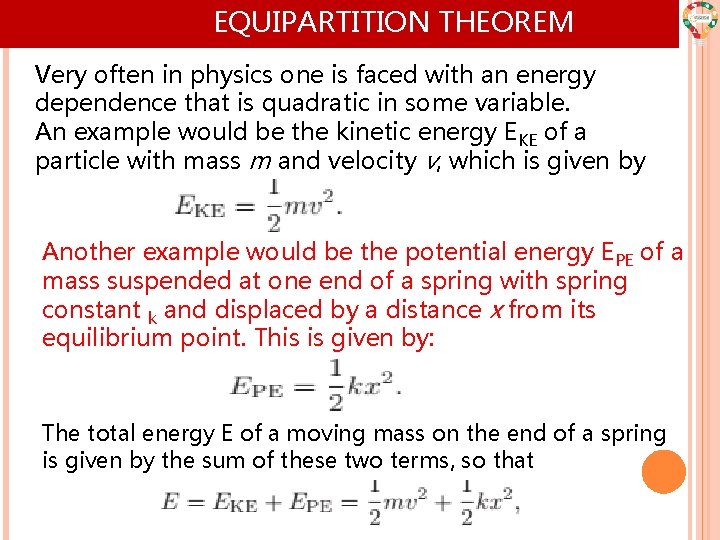
EQUIPARTITION THEOREM Very often in physics one is faced with an energy dependence that is quadratic in some variable. An example would be the kinetic energy EKE of a particle with mass m and velocity v, which is given by Another example would be the potential energy EPE of a mass suspended at one end of a spring with spring constant k and displaced by a distance x from its equilibrium point. This is given by: The total energy E of a moving mass on the end of a spring is given by the sum of these two terms, so that
EQUIPARTITION THEOREM…. . ü As the mass undergoes SHM, energy is exchanged between EKE and EPE, while the total energy remains fixed. ü Let us suppose that a system whose energy has a quadratic dependence on some variable is allowed to interact with a heat bath. ü It is then able to borrow energy occasionally from its environment, or even give it back into the environment. ü What mean thermal energy would it have?
EQUIPARTITION THEOREM…. . ü Thermal energy would be stored as kinetic or potential energy ü So if a mass on a spring is allowed to come into thermal equilibrium with its environment, one could in principle take a very big magnifying glass and see the mass on a spring jiggling around all by itself owing to such thermal vibrations. ü How big would such vibrations be? The calculation is quite straightforward ü The energy E of a system is E = αx 2 where α is some positive constant and x is some variable. Let us also assume that x could in principle take any value with equal probability.
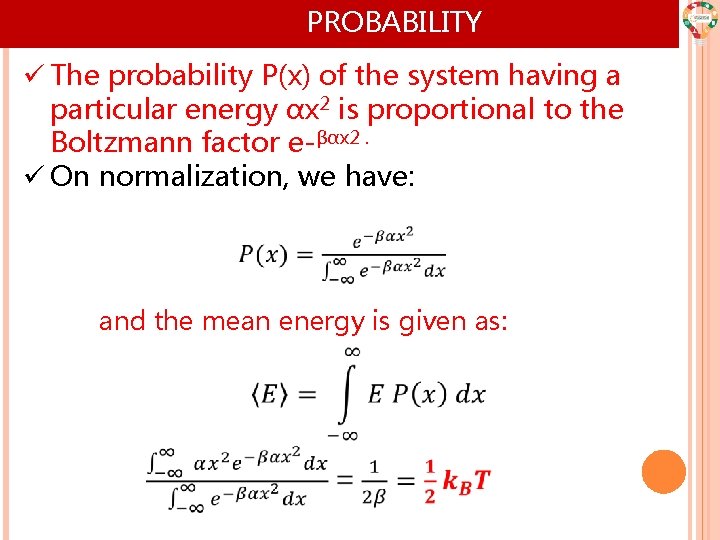
PROBABILITY ü The probability P(x) of the system having a particular energy αx 2 is proportional to the Boltzmann factor e-βαx 2. ü On normalization, we have: and the mean energy is given as:
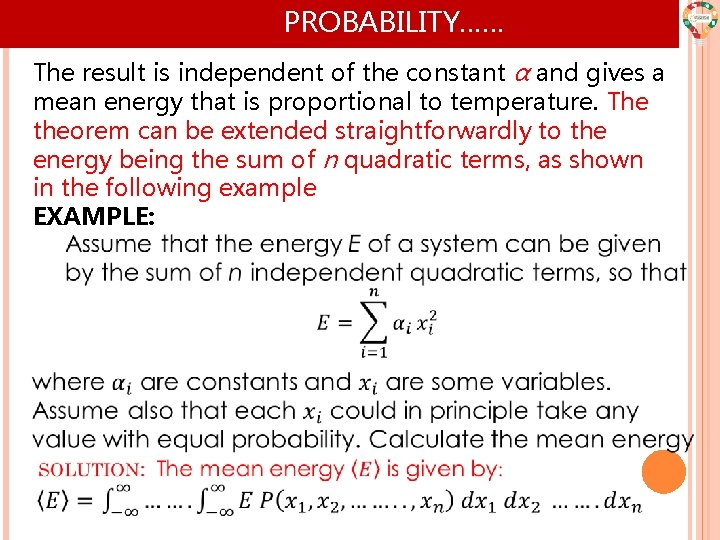
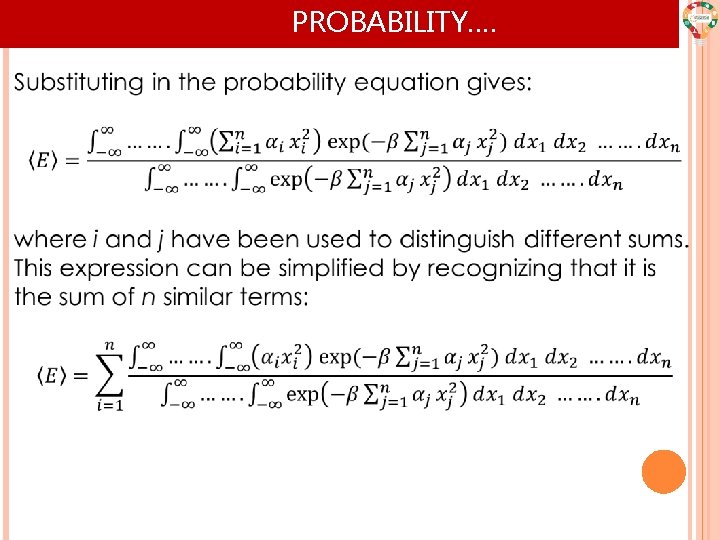
PROBABILITY…… The result is independent of the constant α and gives a mean energy that is proportional to temperature. The theorem can be extended straightforwardly to the energy being the sum of n quadratic terms, as shown in the following example EXAMPLE:
PROBABILITY….
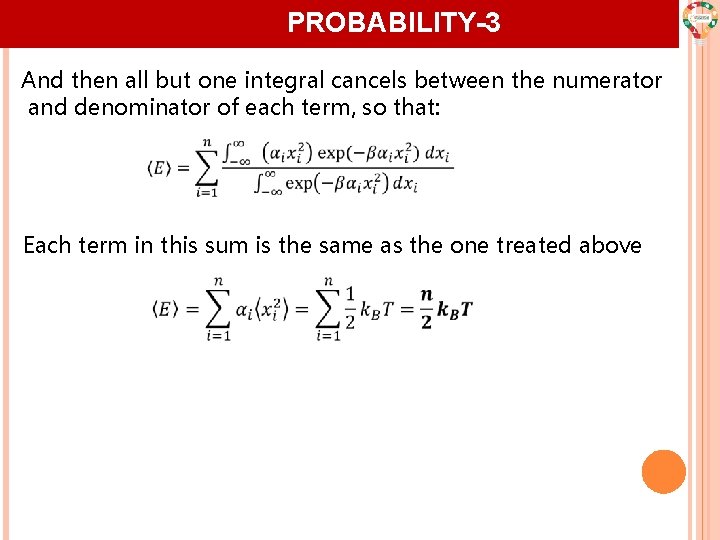
PROBABILITY-3 And then all but one integral cancels between the numerator and denominator of each term, so that: Each term in this sum is the same as the one treated above
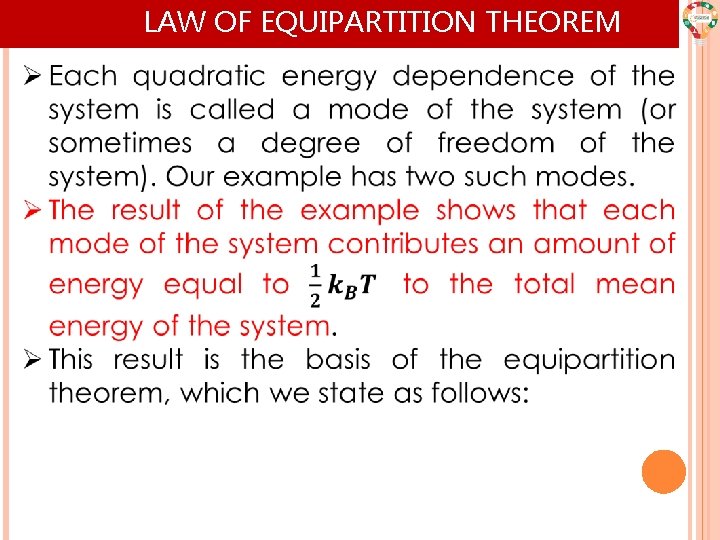
LAW OF EQUIPARTITION THEOREM
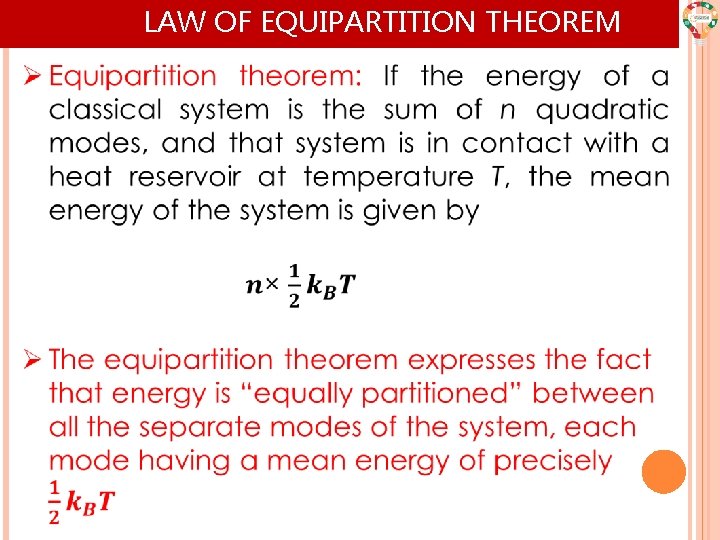
LAW OF EQUIPARTITION THEOREM
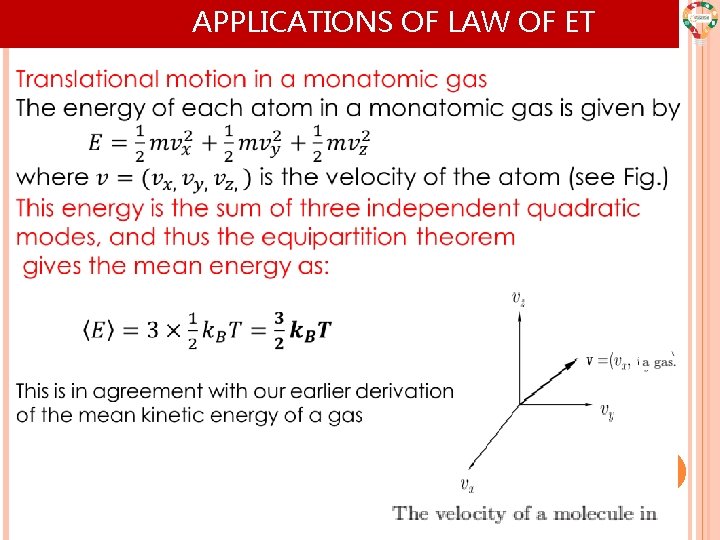
APPLICATIONS OF LAW OF ET
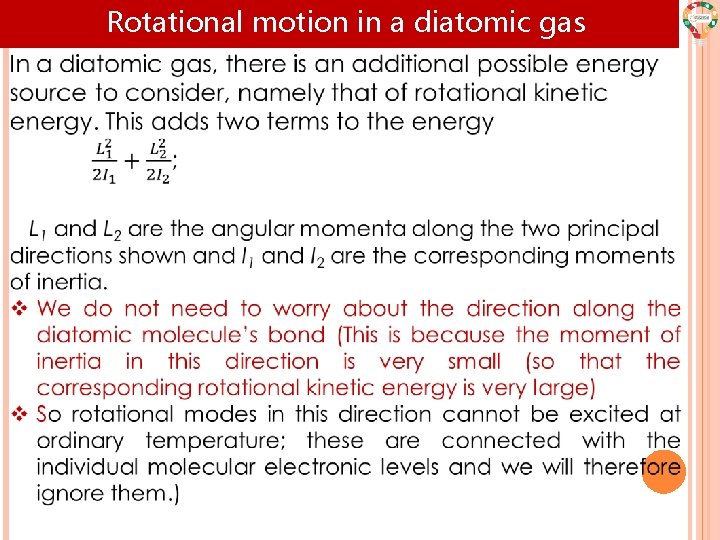
Rotational motion in a diatomic gas
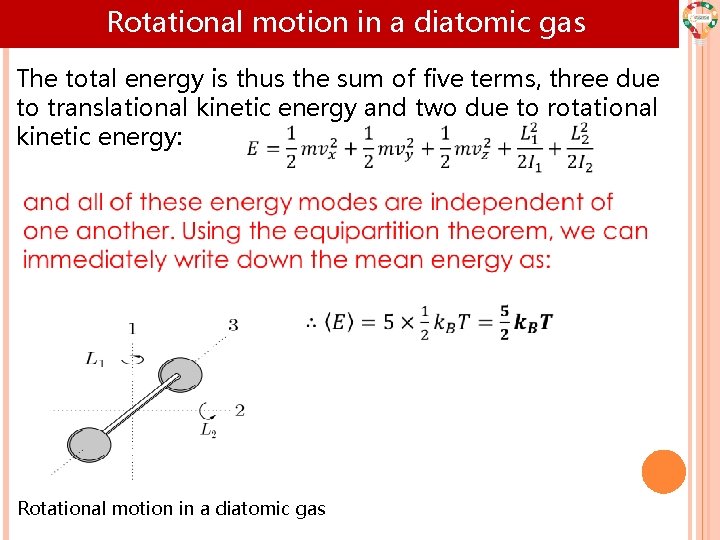
Rotational motion in a diatomic gas The total energy is thus the sum of five terms, three due to translational kinetic energy and two due to rotational kinetic energy: Rotational motion in a diatomic gas
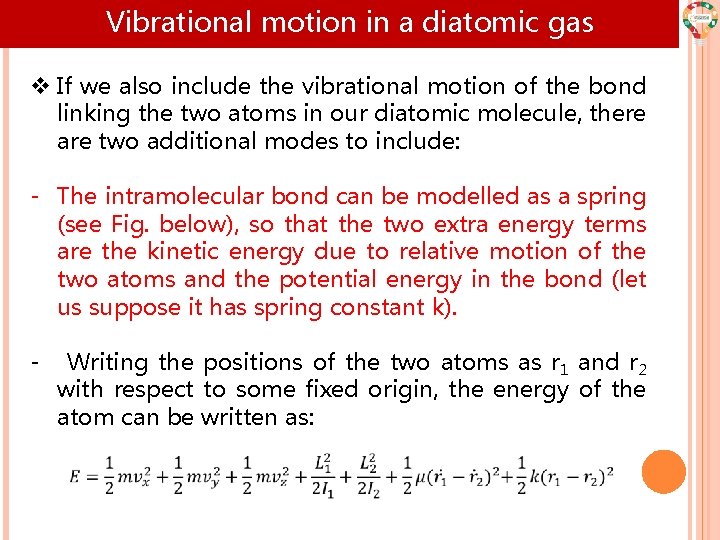
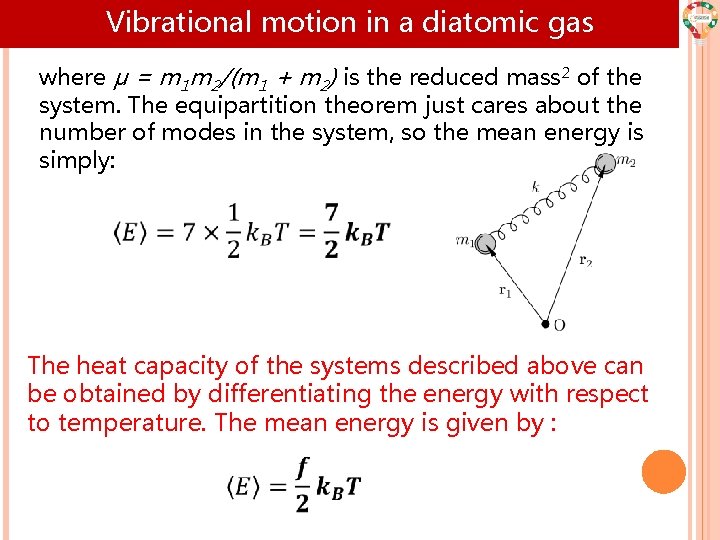
Vibrational motion in a diatomic gas v If we also include the vibrational motion of the bond linking the two atoms in our diatomic molecule, there are two additional modes to include: - The intramolecular bond can be modelled as a spring (see Fig. below), so that the two extra energy terms are the kinetic energy due to relative motion of the two atoms and the potential energy in the bond (let us suppose it has spring constant k). - Writing the positions of the two atoms as r 1 and r 2 with respect to some fixed origin, the energy of the atom can be written as:
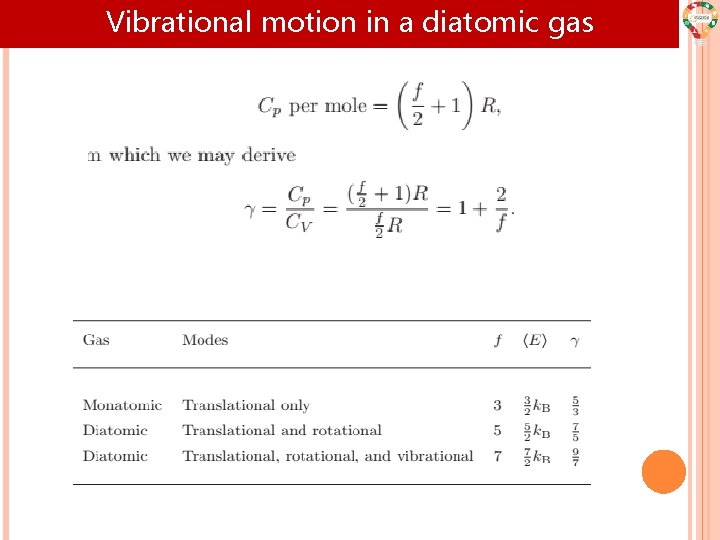
Vibrational motion in a diatomic gas where μ = m 1 m 2/(m 1 + m 2) is the reduced mass 2 of the system. The equipartition theorem just cares about the number of modes in the system, so the mean energy is simply: The heat capacity of the systems described above can be obtained by differentiating the energy with respect to temperature. The mean energy is given by :
Vibrational motion in a diatomic gas
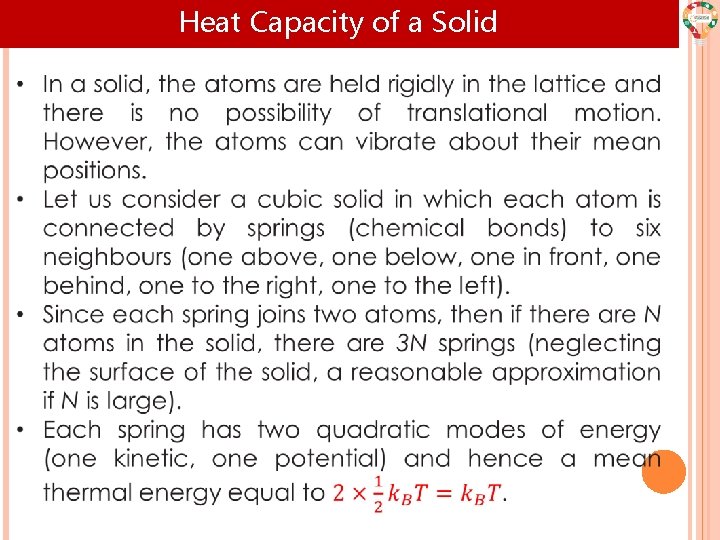
Heat Capacity of a Solid
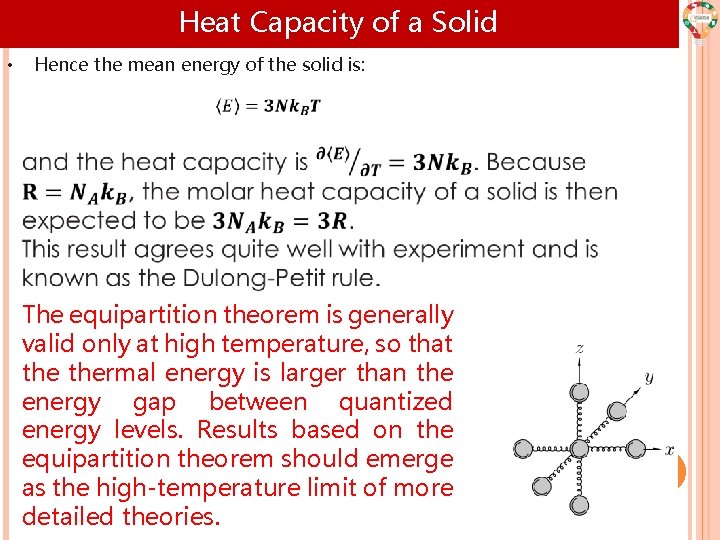
Heat Capacity of a Solid • Hence the mean energy of the solid is: The equipartition theorem is generally valid only at high temperature, so that thermal energy is larger than the energy gap between quantized energy levels. Results based on the equipartition theorem should emerge as the high-temperature limit of more detailed theories.
TUTORIAL What is the mean kinetic energy in e. V at room temperature of a gaseous (a) He atom, (b) Xe atom, (c) Ar atom, and (d) Kr atom. [Hint: calculate separately]
REFERENCES 1. Blundell, S. J. & Blundell, K. M. (2010). Concepts in Thermal Physics. Oxford University Press, UK, 2 nd Edition, pp 210 -218 2. Halliday, D. & Resnicks, R. (2011). Fundamentals of Physics. John Willey & sons, Ma, USA. 9 th Edition, pp 150 -172
CONCLUSION