
Statistical Analysis of Text Topic Modeling Yevgeniy Golovchenko
- Slides: 22
Statistical Analysis of Text: Topic Modeling Yevgeniy Golovchenko Ph. D fellow University of Copenhagen
13/12/2021 Background • • Visiting scholar at Waseda University Ph. D Fellow at Department of Polticial Science (UCPH) MA in Sociology Research topics: • Digital disinformation • Political participation on social media • Russian and Ukrainian politics Computational Social Science: • Social Network Analysis • NLP 2
13/12/2021 Goals for today: 1. A broader understanding of supervised and unsupervised models 2. The logic of topic models in social science 3. Applying Structural Topic Modeling in R 3
13/12/2021 Quantiative content analysis: Why? • Breadth • Variation over time • Causal hypothesis testing 4
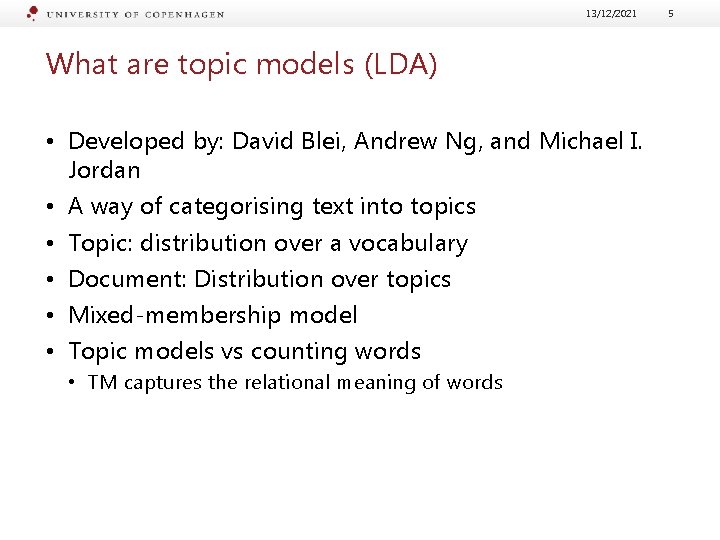
13/12/2021 What are topic models (LDA) • Developed by: David Blei, Andrew Ng, and Michael I. Jordan • A way of categorising text into topics • Topic: distribution over a vocabulary • Document: Distribution over topics • Mixed-membership model • Topic models vs counting words • TM captures the relational meaning of words 5
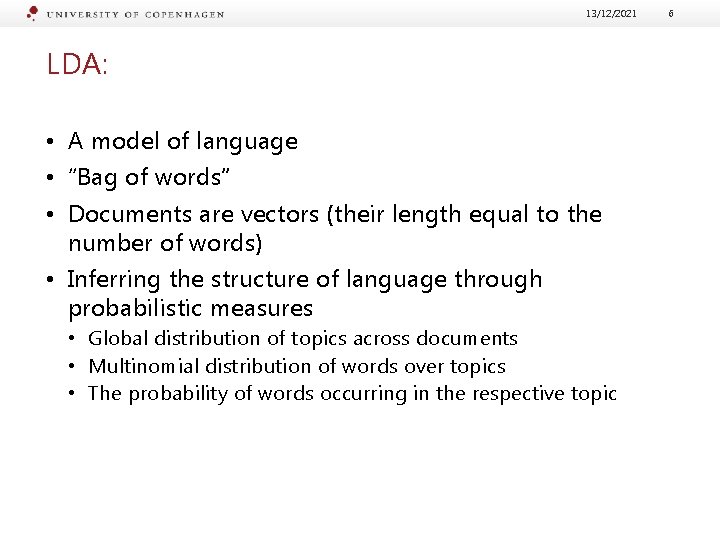
13/12/2021 LDA: • A model of language • “Bag of words” • Documents are vectors (their length equal to the number of words) • Inferring the structure of language through probabilistic measures • Global distribution of topics across documents • Multinomial distribution of words over topics • The probability of words occurring in the respective topic 6
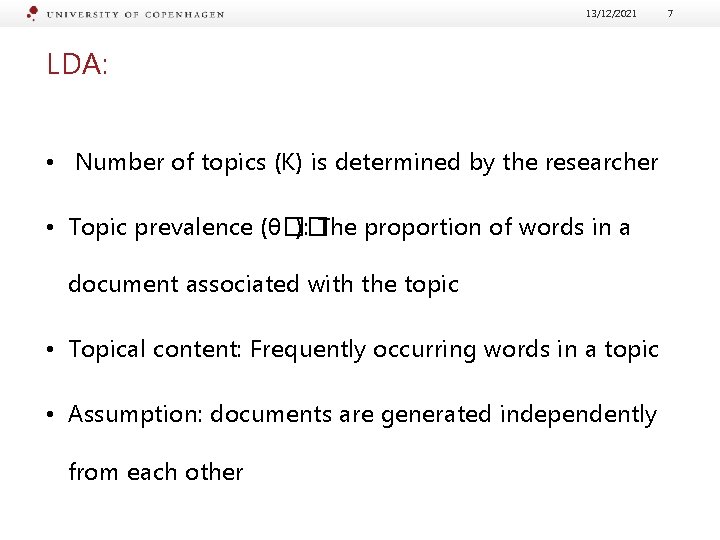
13/12/2021 LDA: • Number of topics (K) is determined by the researcher • Topic prevalence (θ�� ): The proportion of words in a document associated with the topic • Topical content: Frequently occurring words in a topic • Assumption: documents are generated independently from each other 7
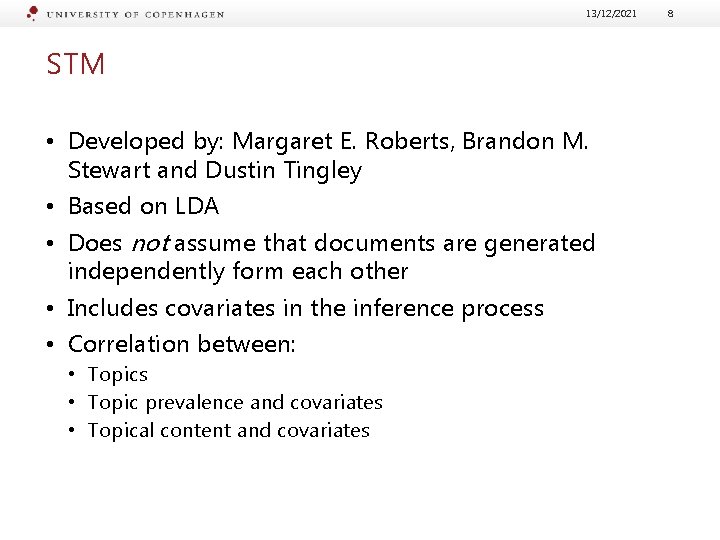
13/12/2021 STM • Developed by: Margaret E. Roberts, Brandon M. Stewart and Dustin Tingley • Based on LDA • Does not assume that documents are generated independently form each other • Includes covariates in the inference process • Correlation between: • Topics • Topic prevalence and covariates • Topical content and covariates 8
13/12/2021 Two Examples of topic modelling • Literature • Religious discourse 9
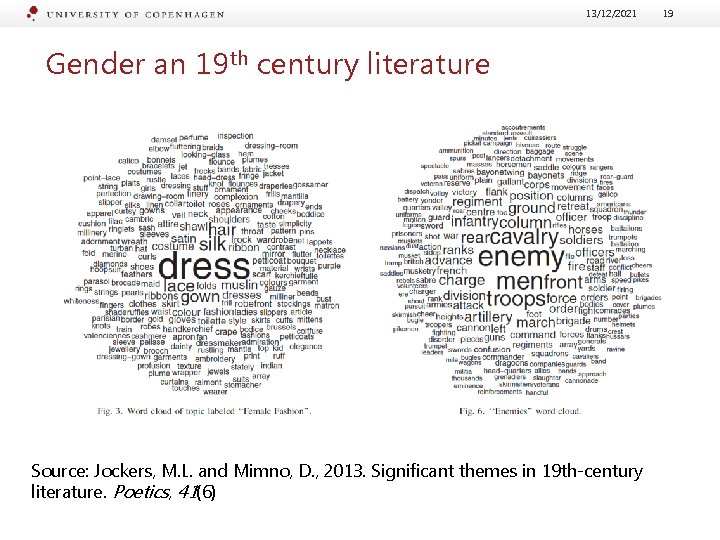
13/12/2021 10 Jockers, M. L. and Mimno, D. , 2013. Significant themes in 19 th-century literature • • • Analysis of literary works from 19 th century U. S. and Great Britain LDA Literary topics and gender N = 3279
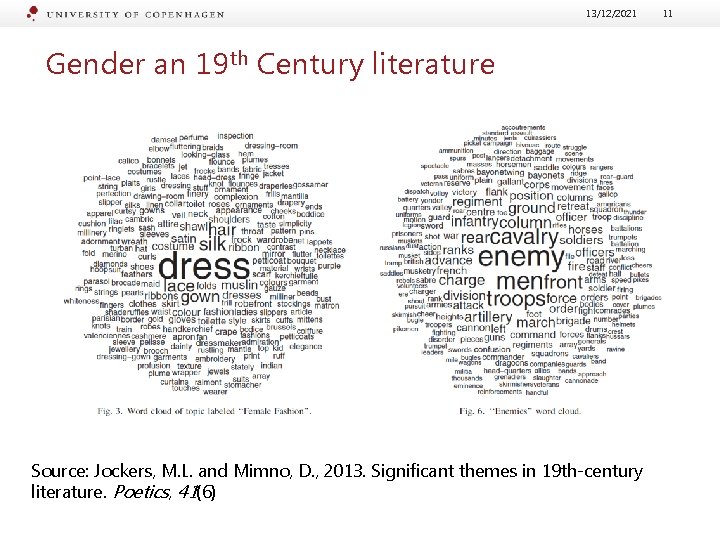
13/12/2021 Gender an 19 th Century literature Source: Jockers, M. L. and Mimno, D. , 2013. Significant themes in 19 th-century literature. Poetics, 41(6) 11
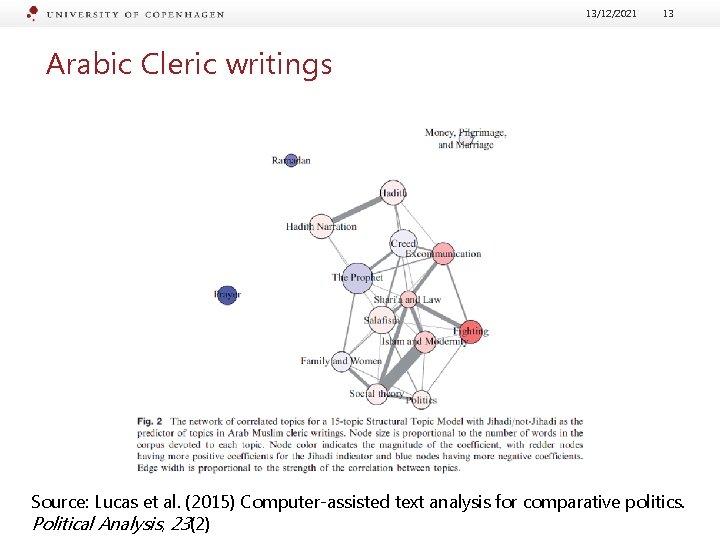
13/12/2021 12 Source: Lucas et al. (2015) Computer-assisted text analysis for comparative politics. • STM • 11, 045 texts religious texts from 33 clerics (20 jihadists, 13 non-jihadists”) • Is there a correlation between the source and topics?
13/12/2021 13 Arabic Cleric writings Source: Lucas et al. (2015) Computer-assisted text analysis for comparative politics. Political Analysis, 23(2)
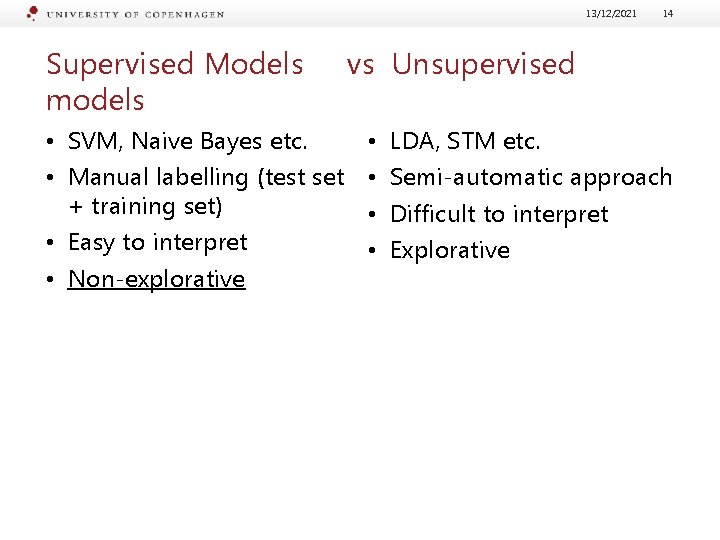
13/12/2021 Supervised Models models • SVM, Naive Bayes etc. • Manual labelling (test set + training set) • Easy to interpret • Non-explorative 14 vs Unsupervised • • LDA, STM etc. Semi-automatic approach Difficult to interpret Explorative
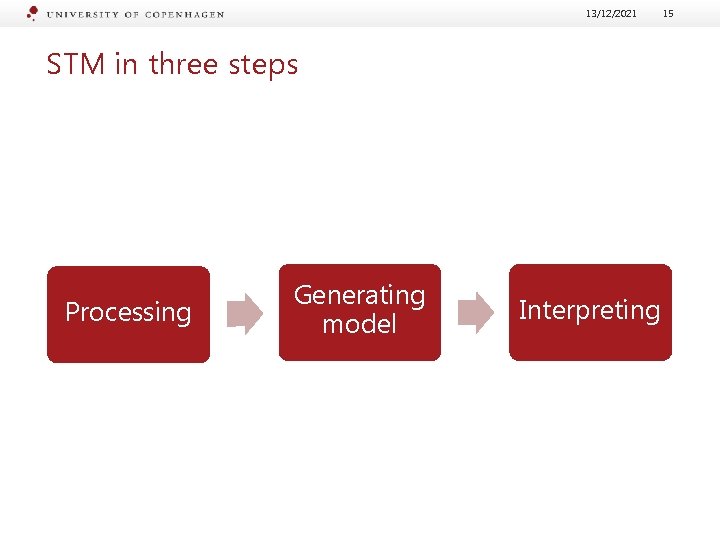
13/12/2021 STM in three steps Processing Generating model Interpreting 15
13/12/2021 16 Your turn! Download the script at: golovchenko. github. io/stm. R Dataset used in the Example: • Facebook posts written by Donald Trump and Hillary Clinton on their pages during 2016 • Collected using Facebook app called “Netvizz” • For details see: Rieder, B. , 2013, May. Studying Facebook via data extraction: the Netvizz application. In Proceedings of the 5 th annual ACM web science conference (pp. 346 -355). ACM. •
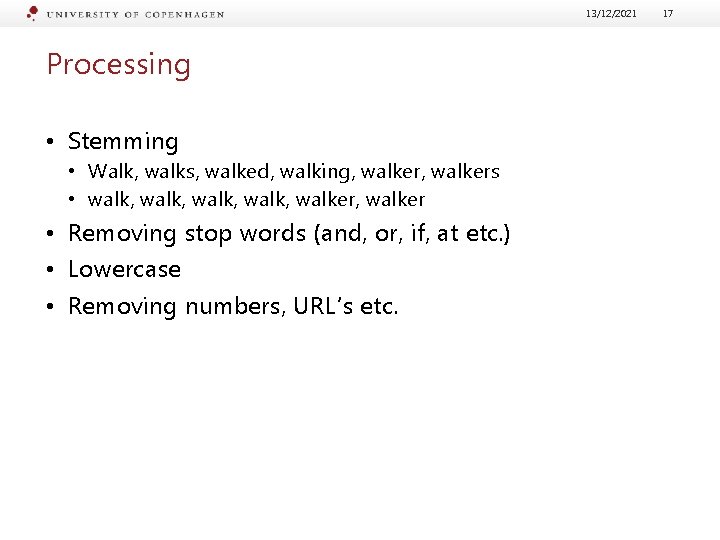
13/12/2021 Processing • Stemming • Walk, walks, walked, walking, walkers • walk, walker, walker • Removing stop words (and, or, if, at etc. ) • Lowercase • Removing numbers, URL’s etc. 17
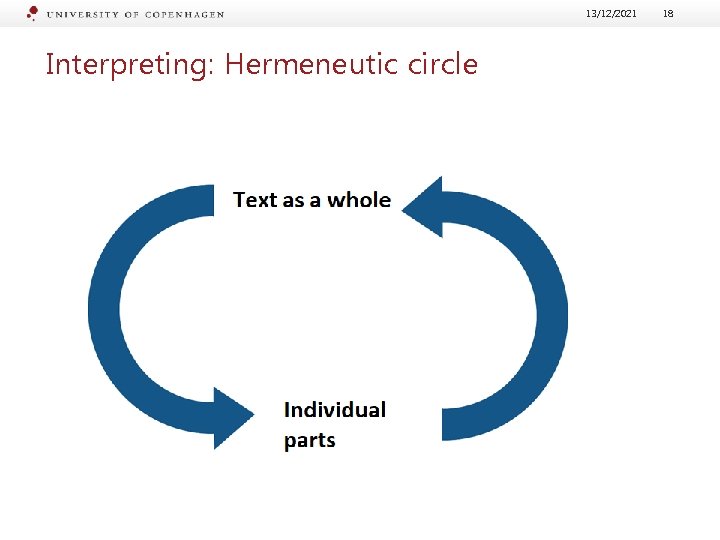
13/12/2021 Interpreting: Hermeneutic circle 18
13/12/2021 Gender an 19 th century literature Source: Jockers, M. L. and Mimno, D. , 2013. Significant themes in 19 th-century literature. Poetics, 41(6) 19
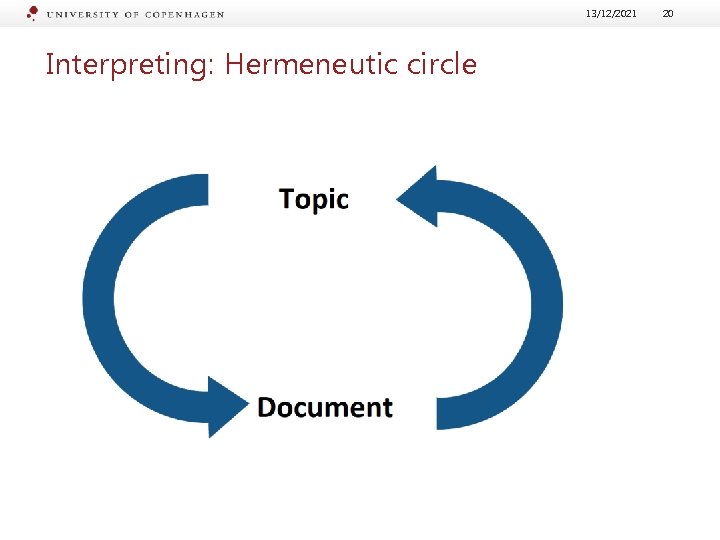
13/12/2021 Interpreting: Hermeneutic circle 20
13/12/2021 Visualizing topics Explore the corpus of Facebook posts in the interactive graph generated by using the package stm. Browser: http: //golovchenko. github. io/k 10/viz. html 21
13/12/2021 Contact yg@ifs. ku. dk 22