
Statistical analysis of hiss wave spectrum from the
- Slides: 14
Statistical analysis of hiss wave spectrum from the EMFISIS wave data Wen Li, R. M. Thorne, J. Bortnik, C. A. Kletzing, W. S. Kurth, and G. B. Hospodarsky Motivation + Objective Ø Previous statistical results are limited due to frequency coverage (> 100 Hz) and lack of polarization properties. Ø Unusually low frequency hiss (~20 Hz) is reported [Li et al. , 2013]. Ø Evaluate hiss wave frequency spectrum at various L and MLT using 2 -year of EMFISIS wave data.
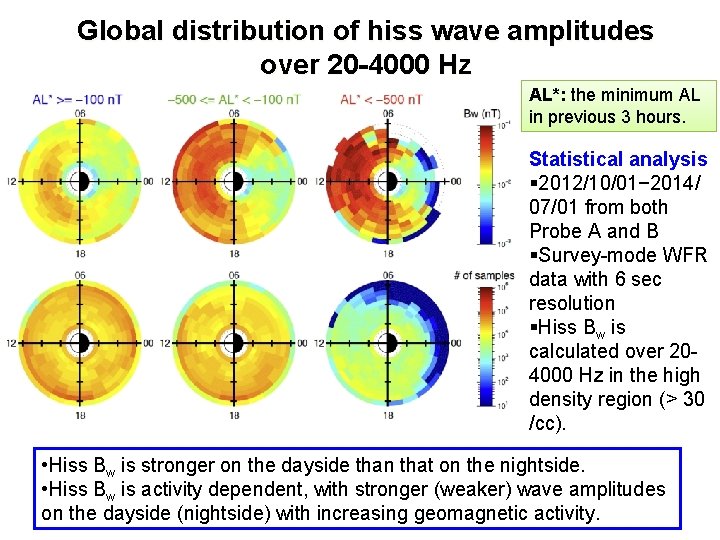
Global distribution of hiss wave amplitudes over 20 -4000 Hz AL*: the minimum AL in previous 3 hours. Statistical analysis § 2012/10/01− 2014/ 07/01 from both Probe A and B §Survey-mode WFR data with 6 sec resolution §Hiss Bw is calculated over 204000 Hz in the high density region (> 30 /cc). • Hiss Bw is stronger on the dayside than that on the nightside. • Hiss Bw is activity dependent, with stronger (weaker) wave amplitudes on the dayside (nightside) with increasing geomagnetic activity.
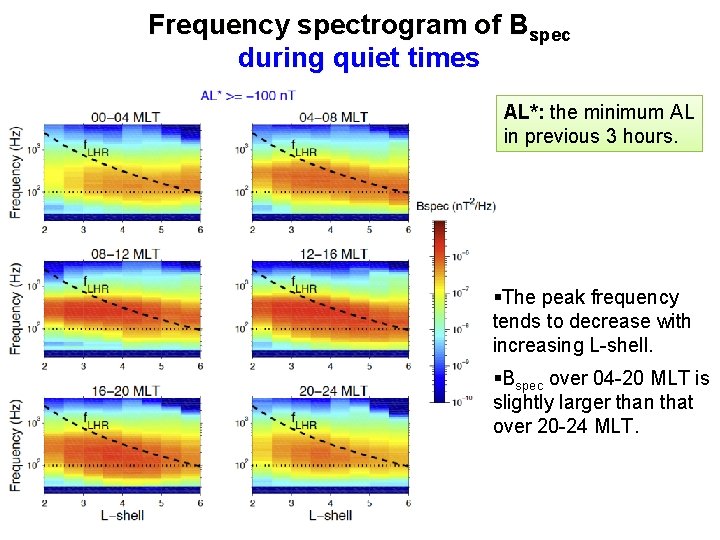
Frequency spectrogram of Bspec during quiet times AL*: the minimum AL in previous 3 hours. §The peak frequency tends to decrease with increasing L-shell. §Bspec over 04 -20 MLT is slightly larger than that over 20 -24 MLT.
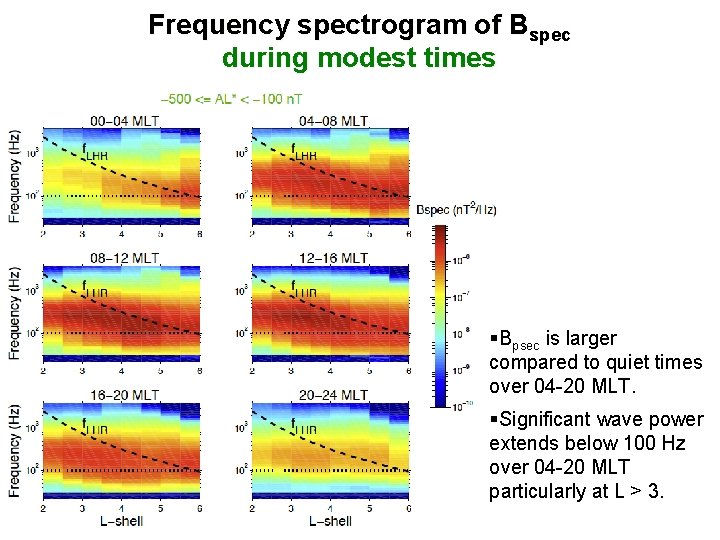
Frequency spectrogram of Bspec during modest times §Bpsec is larger compared to quiet times over 04 -20 MLT. §Significant wave power extends below 100 Hz over 04 -20 MLT particularly at L > 3.
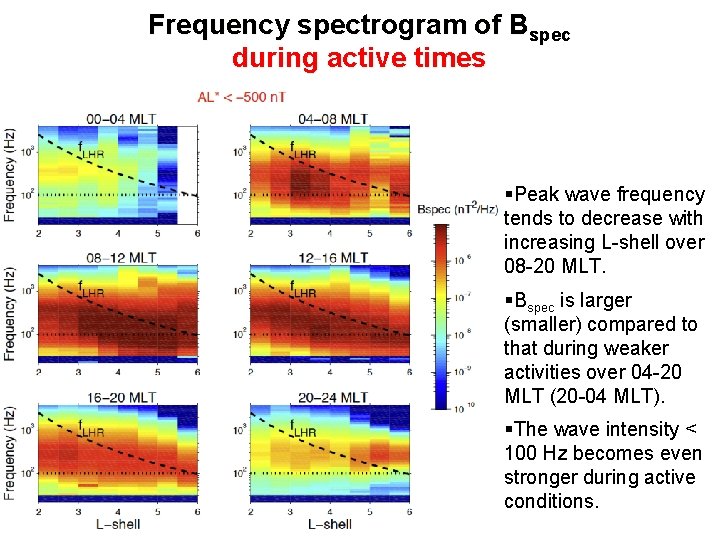
Frequency spectrogram of Bspec during active times §Peak wave frequency tends to decrease with increasing L-shell over 08 -20 MLT. §Bspec is larger (smaller) compared to that during weaker activities over 04 -20 MLT (20 -04 MLT). §The wave intensity < 100 Hz becomes even stronger during active conditions.
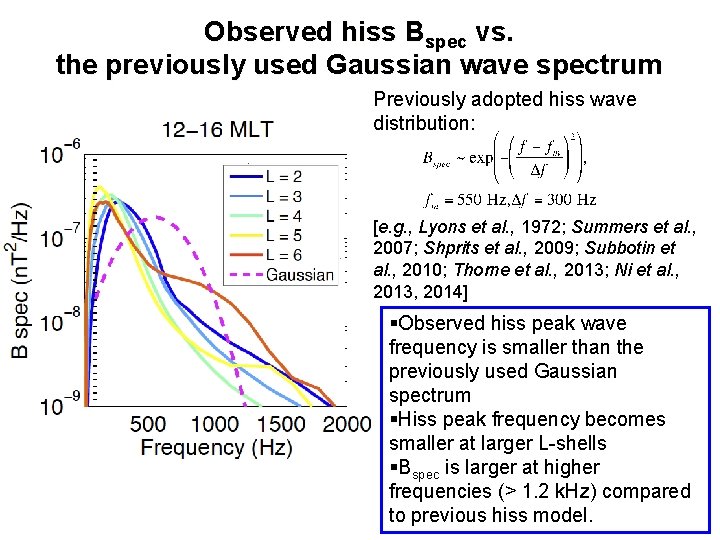
Observed hiss Bspec vs. the previously used Gaussian wave spectrum 12 -16 MLT Previously adopted hiss wave distribution: [e. g. , Lyons et al. , 1972; Summers et al. , 2007; Shprits et al. , 2009; Subbotin et al. , 2010; Thorne et al. , 2013; Ni et al. , 2013, 2014] §Observed hiss peak wave frequency is smaller than the previously used Gaussian spectrum §Hiss peak frequency becomes smaller at larger L-shells §Bspec is larger at higher frequencies (> 1. 2 k. Hz) compared to previous hiss model.
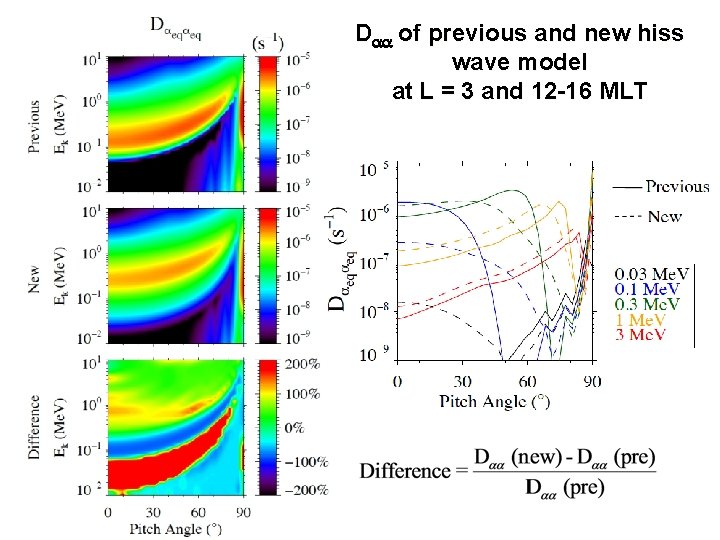
Daa of previous and new hiss wave model at L = 3 and 12 -16 MLT
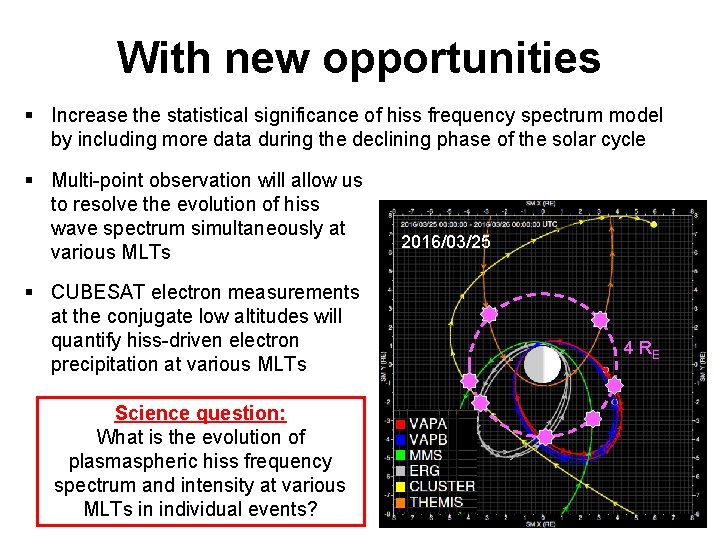
With new opportunities § Increase the statistical significance of hiss frequency spectrum model by including more data during the declining phase of the solar cycle § Multi-point observation will allow us to resolve the evolution of hiss wave spectrum simultaneously at various MLTs § CUBESAT electron measurements at the conjugate low altitudes will quantify hiss-driven electron precipitation at various MLTs Science question: What is the evolution of plasmaspheric hiss frequency spectrum and intensity at various MLTs in individual events? 2016/03/25 4 RE
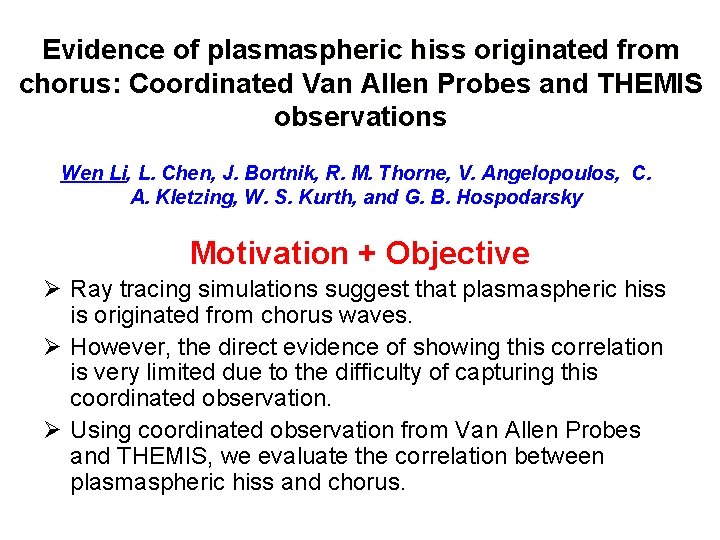
Evidence of plasmaspheric hiss originated from chorus: Coordinated Van Allen Probes and THEMIS observations Wen Li, L. Chen, J. Bortnik, R. M. Thorne, V. Angelopoulos, C. A. Kletzing, W. S. Kurth, and G. B. Hospodarsky Motivation + Objective Ø Ray tracing simulations suggest that plasmaspheric hiss is originated from chorus waves. Ø However, the direct evidence of showing this correlation is very limited due to the difficulty of capturing this coordinated observation. Ø Using coordinated observation from Van Allen Probes and THEMIS, we evaluate the correlation between plasmaspheric hiss and chorus.
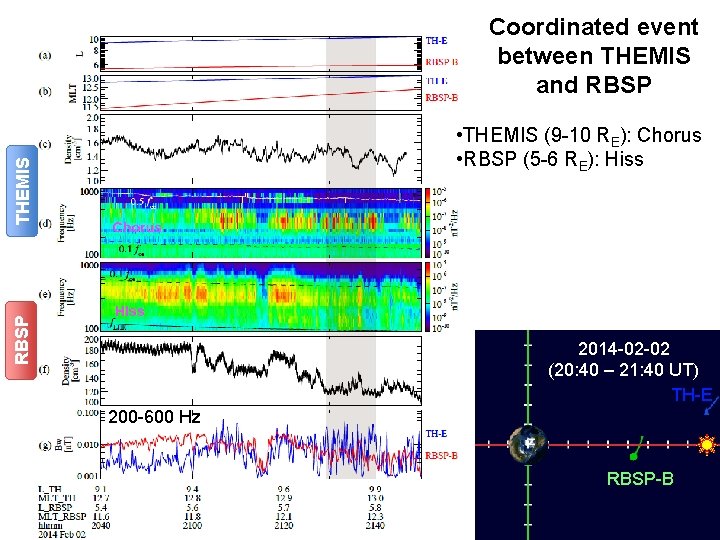
Coordinated event between THEMIS and RBSP THEMIS • THEMIS (9 -10 RE): Chorus • RBSP (5 -6 RE): Hiss 2014 -02 -02 (20: 40 – 21: 40 UT) TH-E 200 -600 Hz RBSP-B
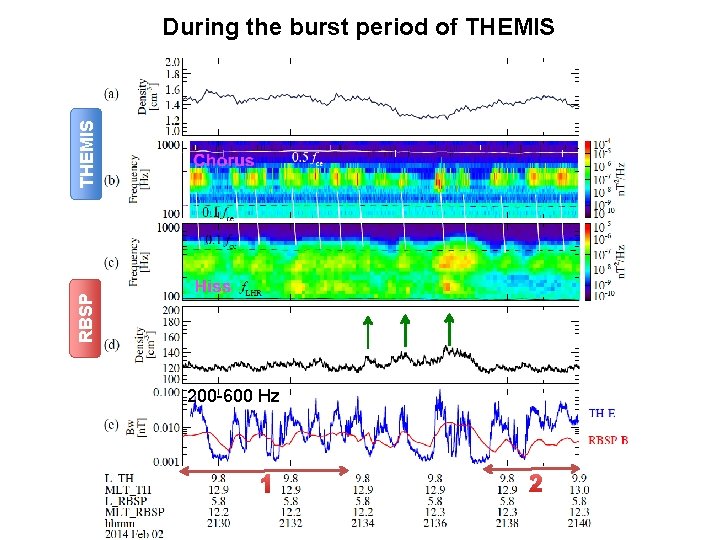
RBSP THEMIS During the burst period of THEMIS 200 -600 Hz 1 2
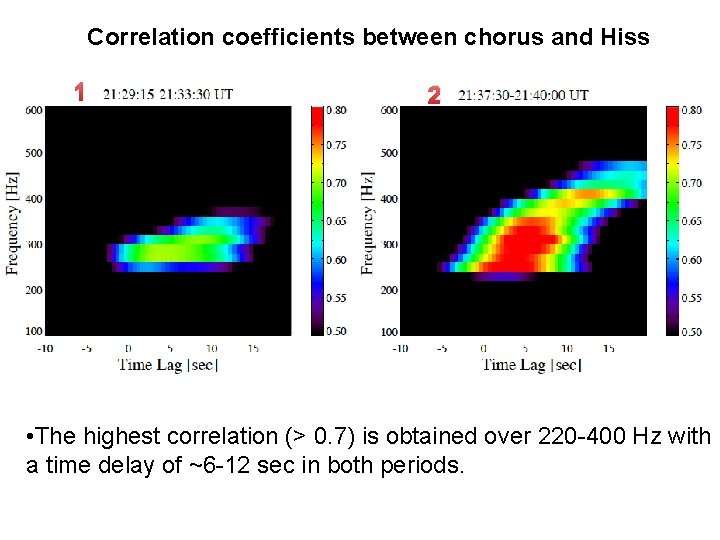
Correlation coefficients between chorus and Hiss 1 2 • The highest correlation (> 0. 7) is obtained over 220 -400 Hz with a time delay of ~6 -12 sec in both periods.
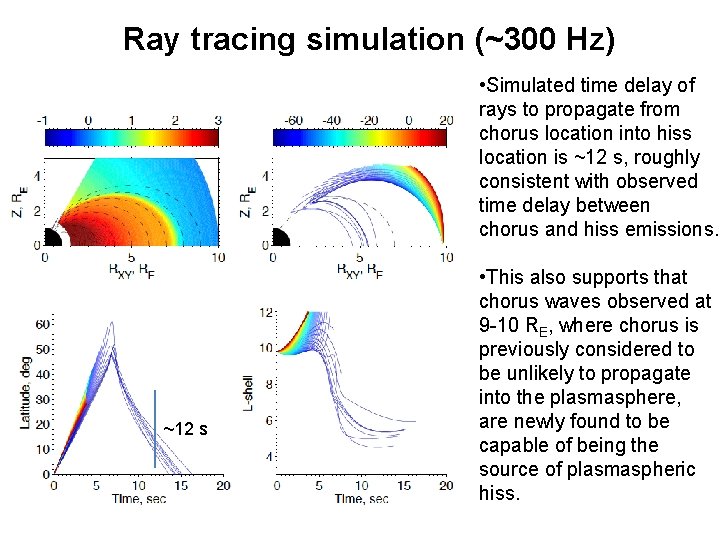
Ray tracing simulation (~300 Hz) • Simulated time delay of rays to propagate from chorus location into hiss location is ~12 s, roughly consistent with observed time delay between chorus and hiss emissions. ~12 s • This also supports that chorus waves observed at 9 -10 RE, where chorus is previously considered to be unlikely to propagate into the plasmasphere, are newly found to be capable of being the source of plasmaspheric hiss.
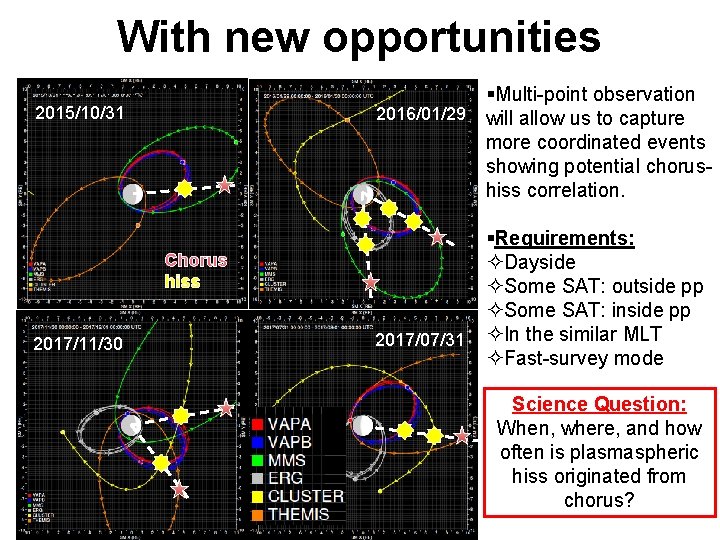
With new opportunities 2016/01/29 2015/10/31 §Multi-point observation 2016/01/29 will allow us to capture more coordinated events showing potential chorushiss correlation. Chorus hiss 2017/11/30 §Requirements: ²Dayside ²Some SAT: outside pp ²Some SAT: inside pp 2017/07/31 ²In the similar MLT ²Fast-survey mode Science Question: When, where, and how often is plasmaspheric hiss originated from chorus?