
Stationary Probability Vector of a Higherorder Markov Chain

Stationary Probability Vector of a Higher-order Markov Chain By Zhang Shixiao Supervisors: Prof. Chi-Kwong Li and Dr. Jor-Ting Chan
Content • 1. Introduction: Background • 2. Higher-order Markov Chain • 3. Conclusion
1. Introduction: Background • Matrices are widely used in both science and engineering. • In statistics Stochastic process: flow direction of a particular system or process. Stationary distribution: limiting behavior of a stochastic process.
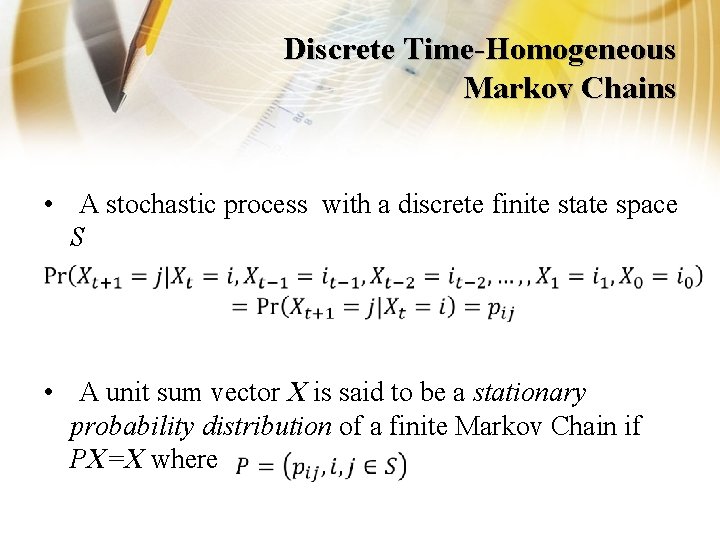
Discrete Time-Homogeneous Markov Chains • A stochastic process with a discrete finite state space S • A unit sum vector X is said to be a stationary probability distribution of a finite Markov Chain if PX=X where
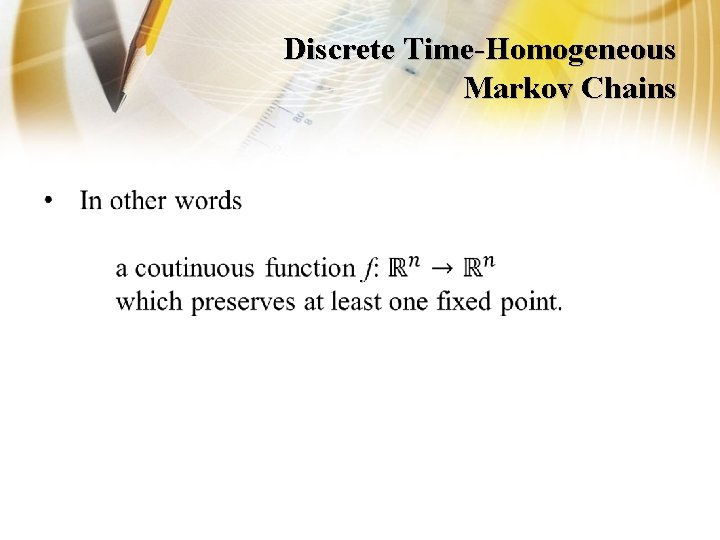
Discrete Time-Homogeneous Markov Chains •
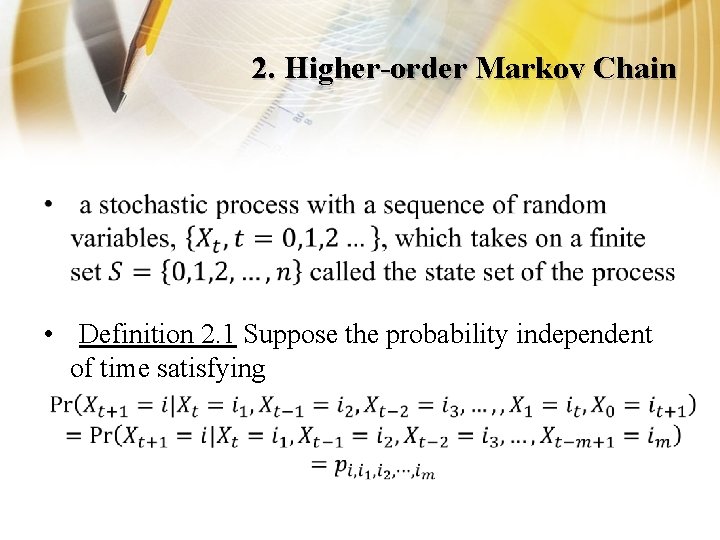
2. Higher-order Markov Chain • • Definition 2. 1 Suppose the probability independent of time satisfying
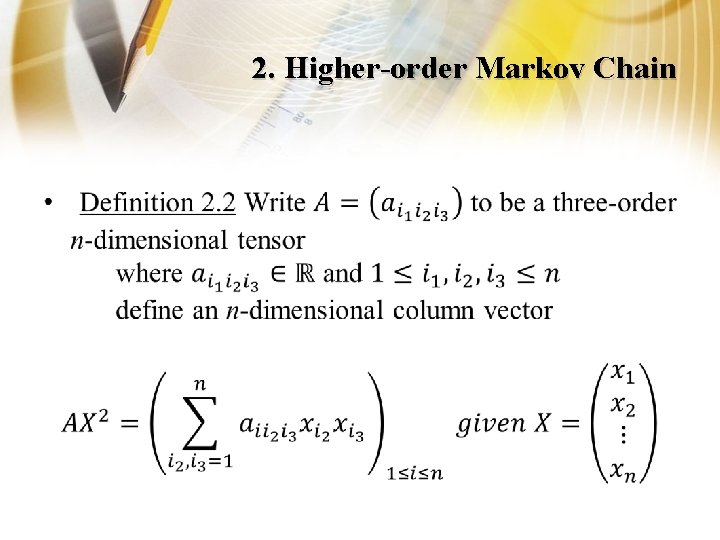
2. Higher-order Markov Chain •
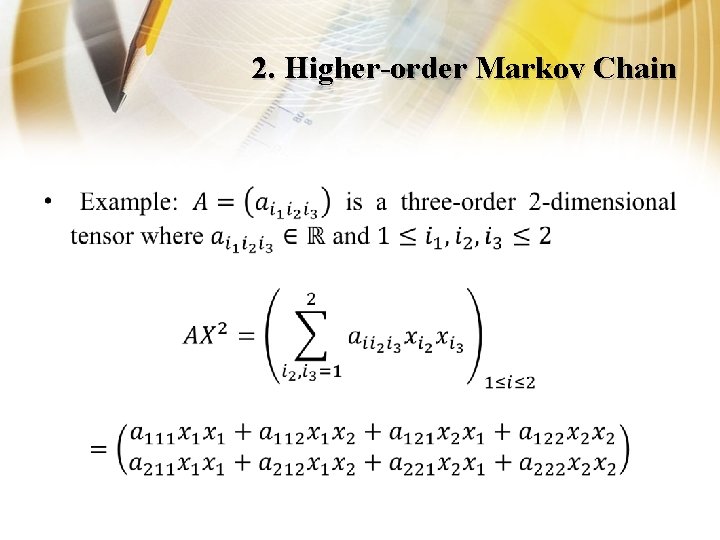
2. Higher-order Markov Chain •
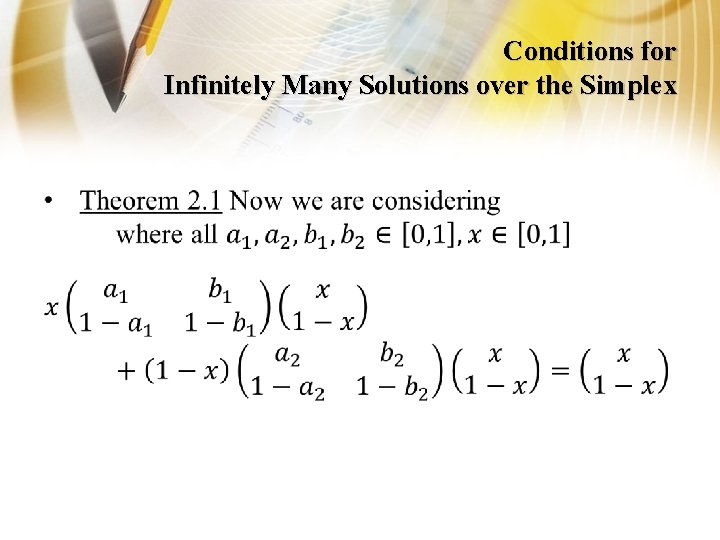
Conditions for Infinitely Many Solutions over the Simplex •
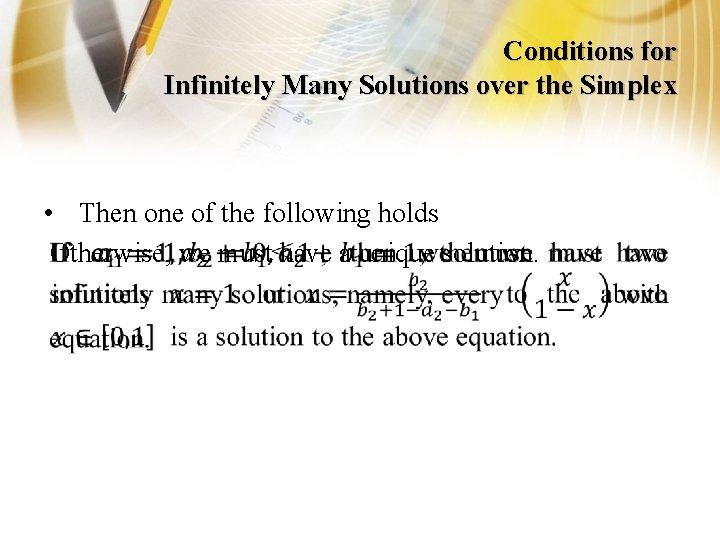
Conditions for Infinitely Many Solutions over the Simplex • Then one of the following holds Otherwise, we must have a unique solution.
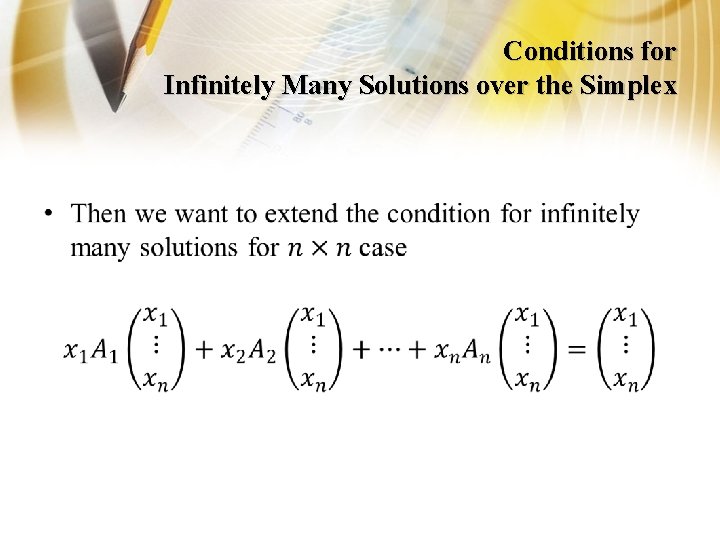
Conditions for Infinitely Many Solutions over the Simplex •
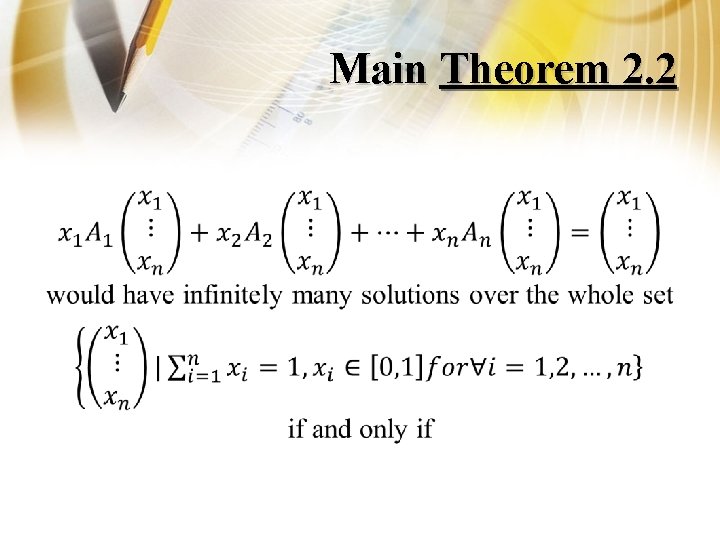
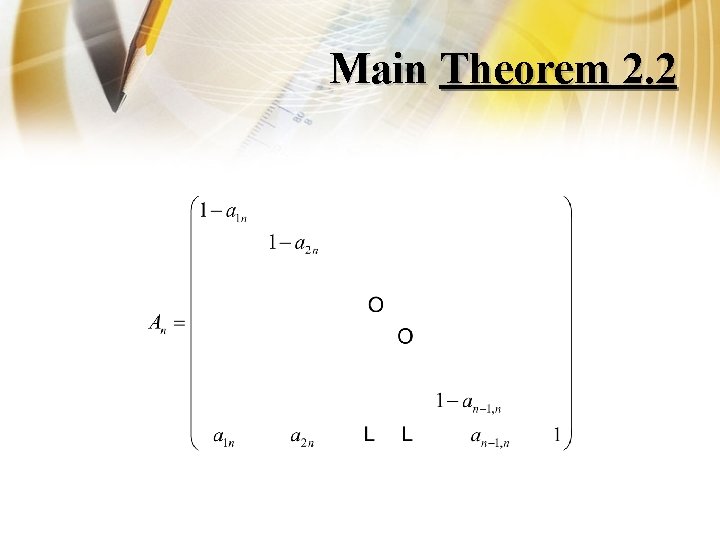
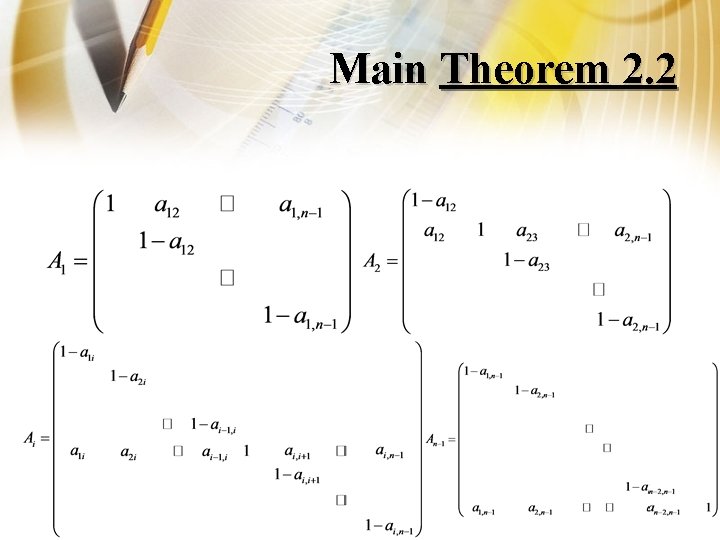
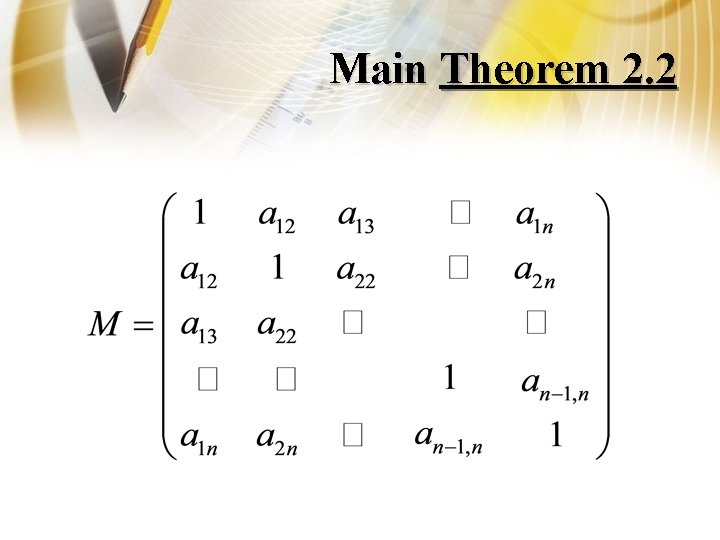
Main Theorem 2. 2 •
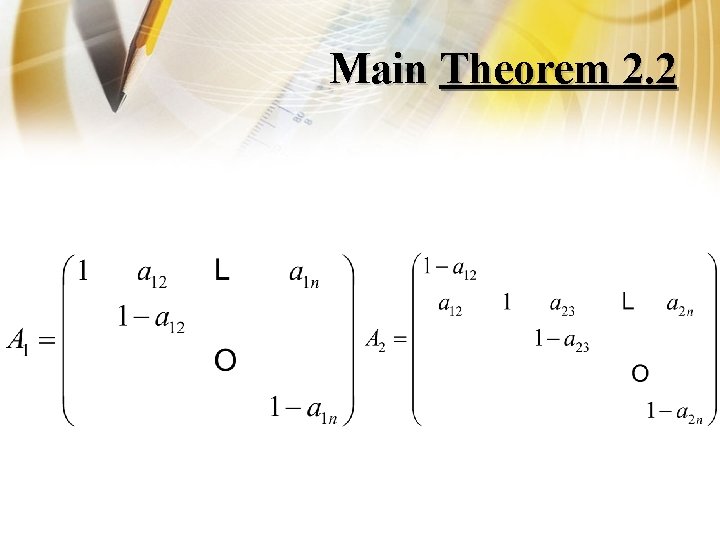
Main Theorem 2. 2
Main Theorem 2. 2
Main Theorem 2. 2
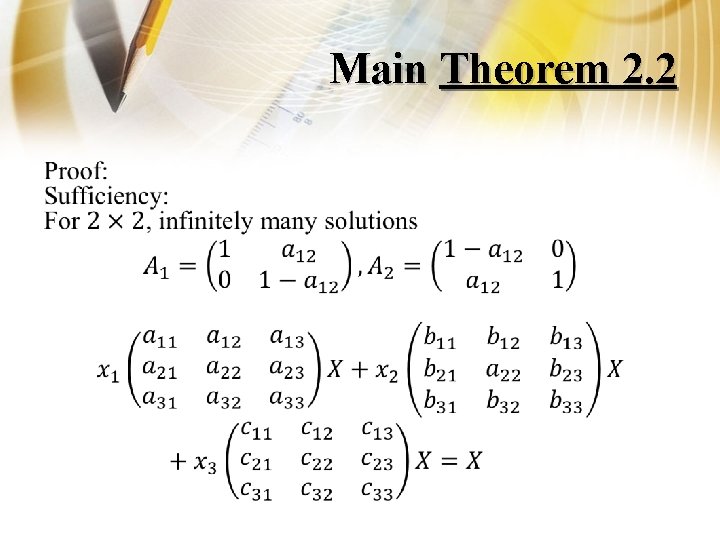
Main Theorem 2. 2 •
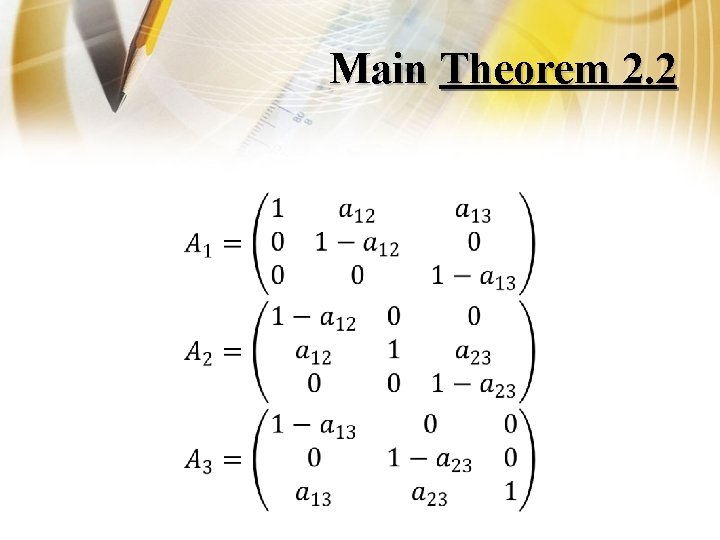
Main Theorem 2. 2 •
Main Theorem 2. 2
Main Theorem 2. 2
Other • Given any two solutions lying on the interior of 1 -dimensional face of the boundary of the simplex, then the whole 1 -dimensional face must be a set of collection of solutions to the above equation. • Conjecture: given any k+1 solutions lying in the interior of the k-dimensional face of the simplex, then any point lying in the whole k-dimensional face, including the vertexes and boundaries, will be a solution to the equation.
3. Conclusion

Thank you!
- Slides: 22