
Stationarity and Unit Root Testing Why do we
- Slides: 13
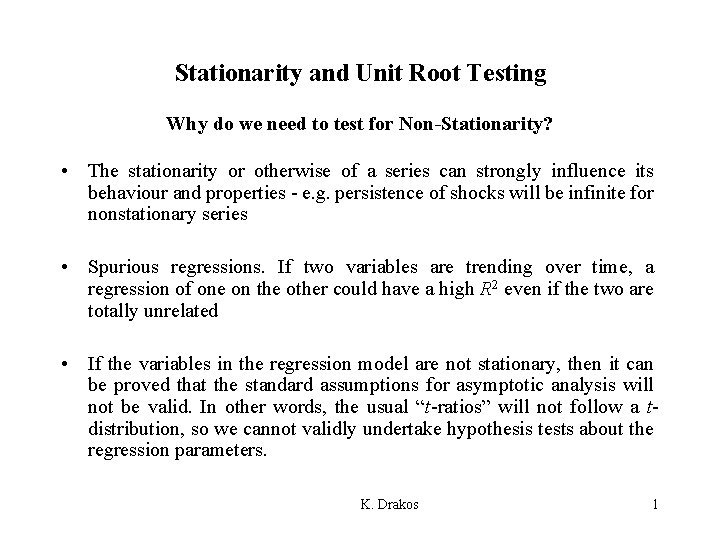
Stationarity and Unit Root Testing Why do we need to test for Non-Stationarity? • The stationarity or otherwise of a series can strongly influence its behaviour and properties - e. g. persistence of shocks will be infinite for nonstationary series • Spurious regressions. If two variables are trending over time, a regression of one on the other could have a high R 2 even if the two are totally unrelated • If the variables in the regression model are not stationary, then it can be proved that the standard assumptions for asymptotic analysis will not be valid. In other words, the usual “t-ratios” will not follow a tdistribution, so we cannot validly undertake hypothesis tests about the regression parameters. K. Drakos 1
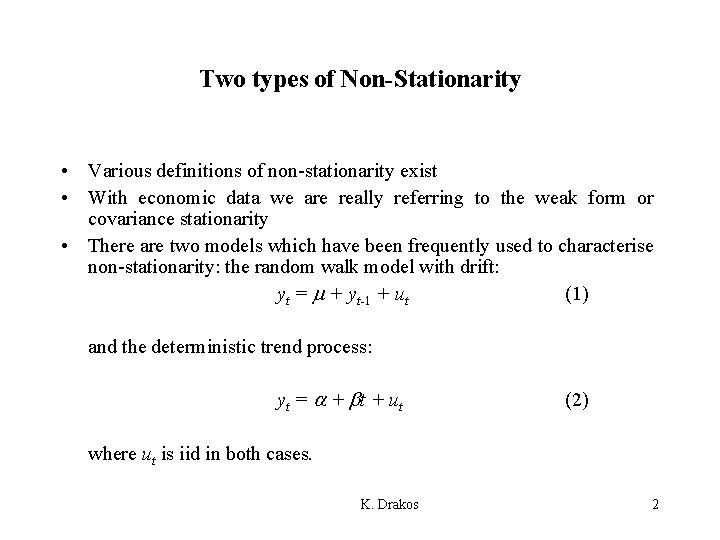
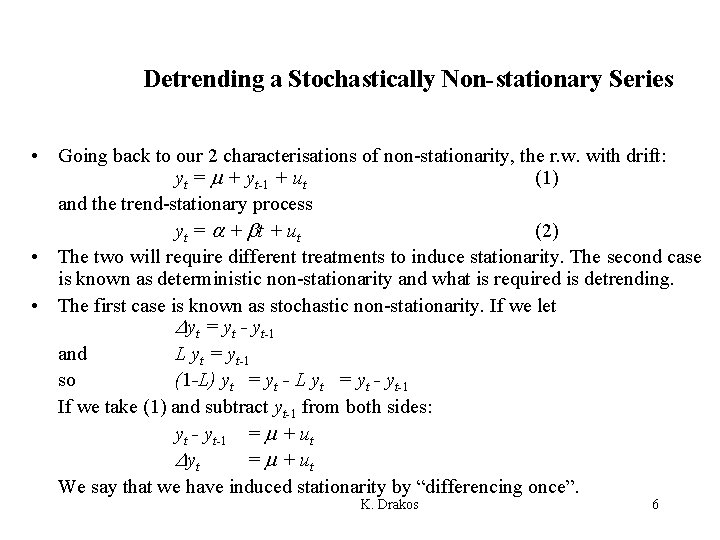
Two types of Non-Stationarity • Various definitions of non-stationarity exist • With economic data we are really referring to the weak form or covariance stationarity • There are two models which have been frequently used to characterise non-stationarity: the random walk model with drift: yt = + yt-1 + ut (1) and the deterministic trend process: yt = + t + u t (2) where ut is iid in both cases. K. Drakos 2
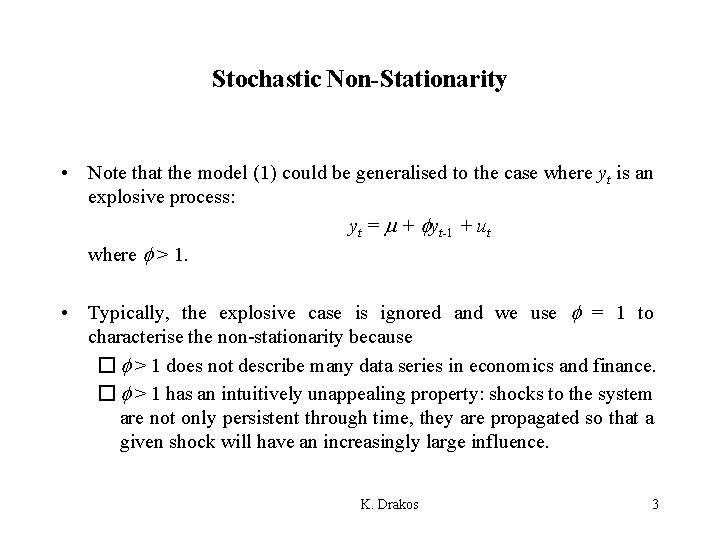
Stochastic Non-Stationarity • Note that the model (1) could be generalised to the case where yt is an explosive process: yt = + yt-1 + ut where > 1. • Typically, the explosive case is ignored and we use = 1 to characterise the non-stationarity because � > 1 does not describe many data series in economics and finance. � > 1 has an intuitively unappealing property: shocks to the system are not only persistent through time, they are propagated so that a given shock will have an increasingly large influence. K. Drakos 3
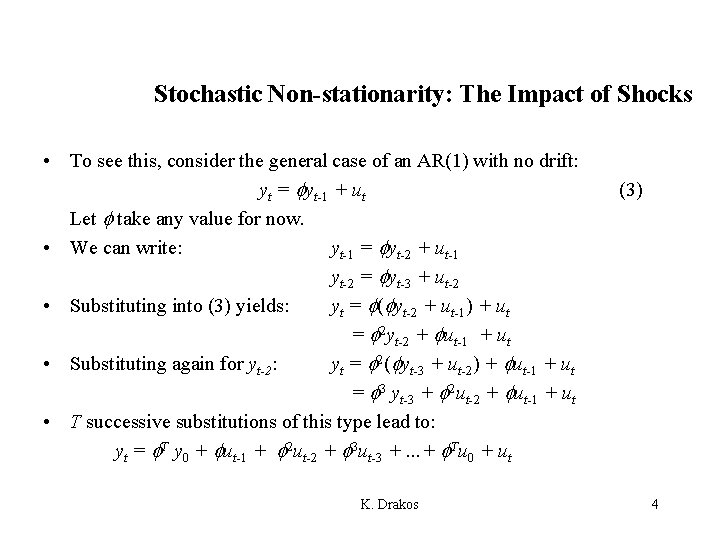
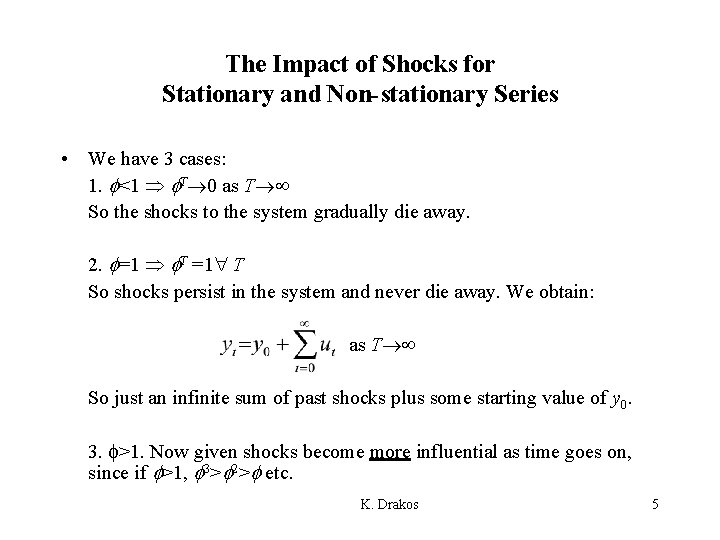
Stochastic Non-stationarity: The Impact of Shocks • To see this, consider the general case of an AR(1) with no drift: yt = yt-1 + ut Let take any value for now. • We can write: yt-1 = yt-2 + ut-1 yt-2 = yt-3 + ut-2 • Substituting into (3) yields: yt = ( yt-2 + ut-1) + ut = 2 yt-2 + ut-1 + ut • Substituting again for yt-2: yt = 2( yt-3 + ut-2) + ut-1 + ut = 3 yt-3 + 2 ut-2 + ut-1 + ut • T successive substitutions of this type lead to: yt = T y 0 + ut-1 + 2 ut-2 + 3 ut-3 +. . . + Tu 0 + ut K. Drakos (3) 4
The Impact of Shocks for Stationary and Non-stationary Series • We have 3 cases: 1. <1 T 0 as T So the shocks to the system gradually die away. 2. =1 T =1 T So shocks persist in the system and never die away. We obtain: as T So just an infinite sum of past shocks plus some starting value of y 0. 3. >1. Now given shocks become more influential as time goes on, since if >1, 3> 2> etc. K. Drakos 5
Detrending a Stochastically Non-stationary Series • Going back to our 2 characterisations of non-stationarity, the r. w. with drift: yt = + yt-1 + ut (1) and the trend-stationary process yt = + t + u t (2) • The two will require different treatments to induce stationarity. The second case is known as deterministic non-stationarity and what is required is detrending. • The first case is known as stochastic non-stationarity. If we let yt = yt - yt-1 and L yt = yt-1 so (1 -L) yt = yt - L yt = yt - yt-1 If we take (1) and subtract yt-1 from both sides: yt - yt-1 = + ut yt = + ut We say that we have induced stationarity by “differencing once”. K. Drakos 6
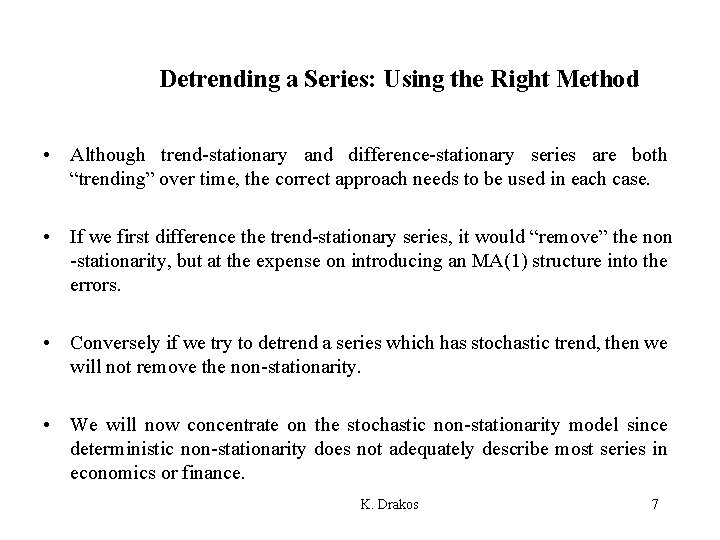
Detrending a Series: Using the Right Method • Although trend-stationary and difference-stationary series are both “trending” over time, the correct approach needs to be used in each case. • If we first difference the trend-stationary series, it would “remove” the non -stationarity, but at the expense on introducing an MA(1) structure into the errors. • Conversely if we try to detrend a series which has stochastic trend, then we will not remove the non-stationarity. • We will now concentrate on the stochastic non-stationarity model since deterministic non-stationarity does not adequately describe most series in economics or finance. K. Drakos 7
Sample Plots for various Stochastic Processes: A White Noise Process K. Drakos 8
Sample Plots for various Stochastic Processes: A Random Walk and a Random Walk with Drift K. Drakos 9
Sample Plots for various Stochastic Processes: A Deterministic Trend Process K. Drakos 10
Autoregressive Processes with differing values of (0, 0. 8, 1) K. Drakos 11
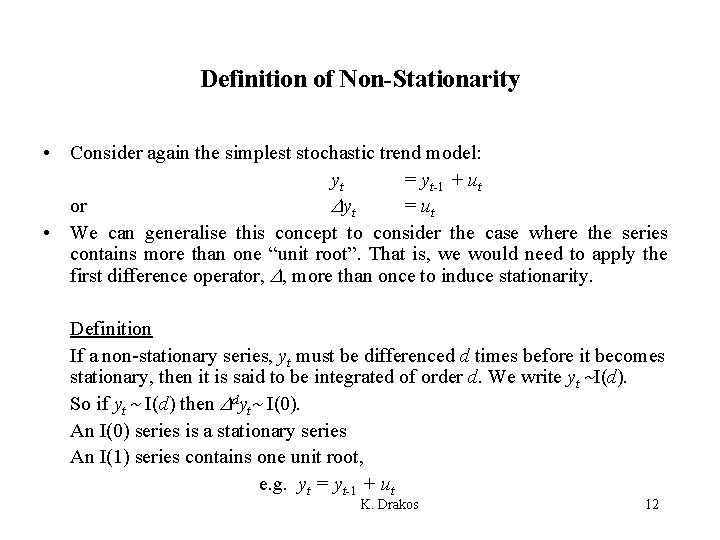
Definition of Non-Stationarity • Consider again the simplest stochastic trend model: yt = yt-1 + ut or yt = ut • We can generalise this concept to consider the case where the series contains more than one “unit root”. That is, we would need to apply the first difference operator, , more than once to induce stationarity. Definition If a non-stationary series, yt must be differenced d times before it becomes stationary, then it is said to be integrated of order d. We write yt I(d). So if yt I(d) then dyt I(0). An I(0) series is a stationary series An I(1) series contains one unit root, e. g. yt = yt-1 + ut K. Drakos 12
Characteristics of I(0), I(1) and I(2) Series • An I(2) series contains two unit roots and so would require differencing twice to induce stationarity. • I(1) and I(2) series can wander a long way from their mean value and cross this mean value rarely. • I(0) series should cross the mean frequently. • The majority of economic and financial series contain a single unit root, although some are stationary and consumer prices (and in some cases exchange rates) have been argued to have 2 unit roots. K. Drakos 13