
Station Cards Understanding Asthma Station 1 Build a


Station Cards Understanding Asthma
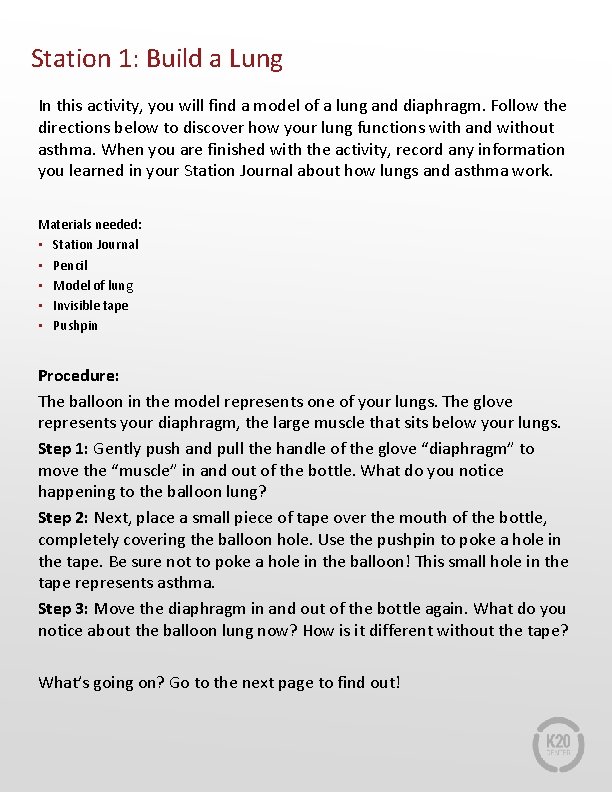
Station 1: Build a Lung In this activity, you will find a model of a lung and diaphragm. Follow the directions below to discover how your lung functions with and without asthma. When you are finished with the activity, record any information you learned in your Station Journal about how lungs and asthma work. Materials needed: • Station Journal • Pencil • Model of lung • Invisible tape • Pushpin Procedure: The balloon in the model represents one of your lungs. The glove represents your diaphragm, the large muscle that sits below your lungs. Step 1: Gently push and pull the handle of the glove “diaphragm” to move the “muscle” in and out of the bottle. What do you notice happening to the balloon lung? Step 2: Next, place a small piece of tape over the mouth of the bottle, completely covering the balloon hole. Use the pushpin to poke a hole in the tape. Be sure not to poke a hole in the balloon! This small hole in the tape represents asthma. Step 3: Move the diaphragm in and out of the bottle again. What do you notice about the balloon lung now? How is it different without the tape? What’s going on? Go to the next page to find out!
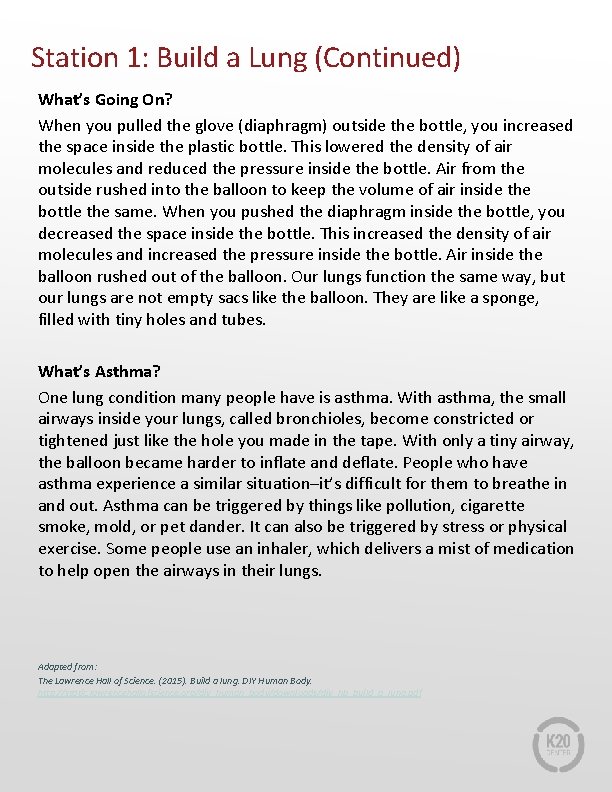
Station 1: Build a Lung (Continued) What’s Going On? When you pulled the glove (diaphragm) outside the bottle, you increased the space inside the plastic bottle. This lowered the density of air molecules and reduced the pressure inside the bottle. Air from the outside rushed into the balloon to keep the volume of air inside the bottle the same. When you pushed the diaphragm inside the bottle, you decreased the space inside the bottle. This increased the density of air molecules and increased the pressure inside the bottle. Air inside the balloon rushed out of the balloon. Our lungs function the same way, but our lungs are not empty sacs like the balloon. They are like a sponge, filled with tiny holes and tubes. What’s Asthma? One lung condition many people have is asthma. With asthma, the small airways inside your lungs, called bronchioles, become constricted or tightened just like the hole you made in the tape. With only a tiny airway, the balloon became harder to inflate and deflate. People who have asthma experience a similar situation–it’s difficult for them to breathe in and out. Asthma can be triggered by things like pollution, cigarette smoke, mold, or pet dander. It can also be triggered by stress or physical exercise. Some people use an inhaler, which delivers a mist of medication to help open the airways in their lungs. Adapted from: The Lawrence Hall of Science. (2015). Build a lung. DIY Human Body. http: //static. lawrencehallofscience. org/diy_human_body/downloads/diy_hb_build_a_lung. pdf

Station 2: Asthma Demonstration In this activity, you learn what it feels like to have asthma. Asthma is not contagious but can run in families. Some environmental asthma triggers include dust, mold, unvented gas stoves, and cleaning products (polish or dusting spray). During an asthma attack, the airways in your lungs (bronchi and bronchioles) become inflamed and constricted, which causes the size of the airways to decrease. The lining of the airways become larger and thicker mucus is formed. With less space in the airways, it is harder to breathe. Note: If you have asthma or another respiratory illness, do not participate in this activity. You could instead be the timer for your classmates. Materials needed: • Station Journal • One drinking straw • One coffee stirrer • Timer or watch • Pencil Step 1: Run in place for 30 seconds (no straws or stirrers; regular breathing). Step 2: On your Station Journal, write down how you feel in the left column of Station 2. You can use the right side of the journal to draw how you feel. Step 3: Put the regular straw in your mouth, pinch your nose, and breathe normally through your mouth. Run in place for 30 seconds. Step 4: Write down how you feel running in place while breathing through a straw on your Station Journal. You can use the right side of the journal to draw how you feel. Step 5: Put the coffee stirrer in your mouth, pinch your nose, and breathe normally through your mouth. Run in place for 30 seconds. Step 6: Write down how you feel running in place while breathing through a coffee stirrer on your Station Journal. You can use the right side of the journal to draw how you feel. Breathing through the straw and coffee stirrer represent what it’s like to have an asthma attack. Some attacks are more severe than others, but all require immediate action. Asthma symptoms can sometimes be prevented by reducing environmental triggers. Adapted from: The University of North Carolina at Chapel Hill. (n. d. ). Activity: Asthma Demonstration. Gillings School of Public Health. https: //sph. unc. edu/wp-content/uploads/sites/112/2014/07/Asthma-Demonstration 1. pdf
Station 3: How Does Asthma Work? In this activity, watch the video at the link below. Record any new information on your Station Journal. Materials needed: • Station Journal • Pencil • Computer with internet connection • Headphones (optional) To view the video, click HERE or visit https: //tinyurl. com/9 s 58 meww. You could also scan the QR code provided below. Gaw, C. (n. d. ). How does asthma work? [Video]. TED Ed. https: //ed. ted. com/lessons/how-does-asthma-work-christopher-egaw#watch
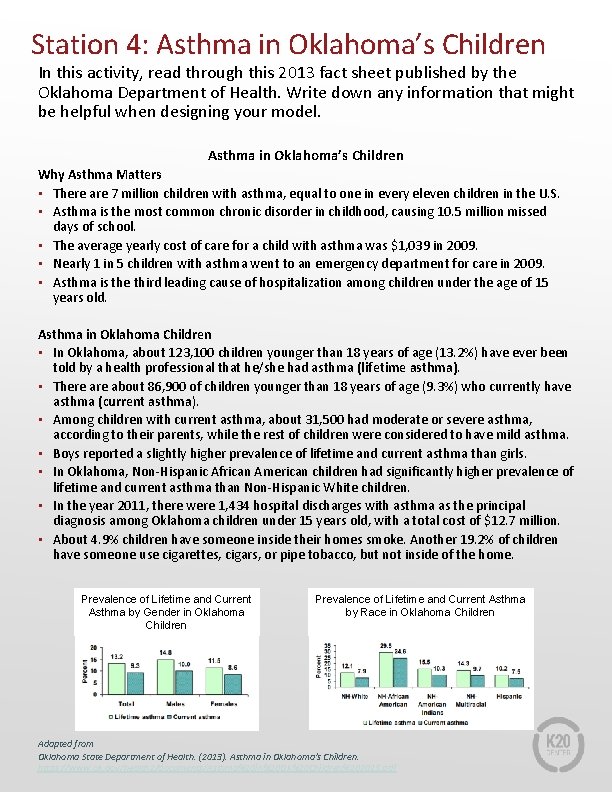
Station 4: Asthma in Oklahoma’s Children In this activity, read through this 2013 fact sheet published by the Oklahoma Department of Health. Write down any information that might be helpful when designing your model. Asthma in Oklahoma’s Children Why Asthma Matters • There are 7 million children with asthma, equal to one in every eleven children in the U. S. • Asthma is the most common chronic disorder in childhood, causing 10. 5 million missed days of school. • The average yearly cost of care for a child with asthma was $1, 039 in 2009. • Nearly 1 in 5 children with asthma went to an emergency department for care in 2009. • Asthma is the third leading cause of hospitalization among children under the age of 15 years old. Asthma in Oklahoma Children • In Oklahoma, about 123, 100 children younger than 18 years of age (13. 2%) have ever been told by a health professional that he/she had asthma (lifetime asthma). • There about 86, 900 of children younger than 18 years of age (9. 3%) who currently have asthma (current asthma). • Among children with current asthma, about 31, 500 had moderate or severe asthma, according to their parents, while the rest of children were considered to have mild asthma. • Boys reported a slightly higher prevalence of lifetime and current asthma than girls. • In Oklahoma, Non-Hispanic African American children had significantly higher prevalence of lifetime and current asthma than Non-Hispanic White children. • In the year 2011, there were 1, 434 hospital discharges with asthma as the principal diagnosis among Oklahoma children under 15 years old, with a total cost of $12. 7 million. • About 4. 9% children have someone inside their homes smoke. Another 19. 2% of children have someone use cigarettes, cigars, or pipe tobacco, but not inside of the home. Prevalence of Lifetime and Current Asthma by Gender in Oklahoma Children Prevalence of Lifetime and Current Asthma by Race in Oklahoma Children Adapted from Oklahoma State Department of Health. (2013). Asthma in Oklahoma’s Children. https: //www. ok. gov/health 2/documents/Asthma%20 in%20 OK%20 Children%202013. pdf
Station 5: How An Asthma Attack Occurs In this activity, watch the video at the link below. Record any new information on your Station Journal. Materials needed: • Station Journal • Pencil • Computer with internet connection • Headphones (optional) To view the video, click HERE or visit https: //tinyurl. com/52 evzxd 8. You could also scan the QR code provided below. Bupa Health UK. (2013, July 3). How an asthma attack occurs [Video]. You. Tube. https: //www. youtube. com/watch? v=Yp 5 ixu. Fi. Mm. M
Station 6: The Chemistry of Inhalers In this activity, study the two provided images and record any new information on your Station Journal. Materials needed: • Station Journal • Pencil • Bronchodilation and Bronchoconstriction image • The Chemistry of Asthma Inhalers image
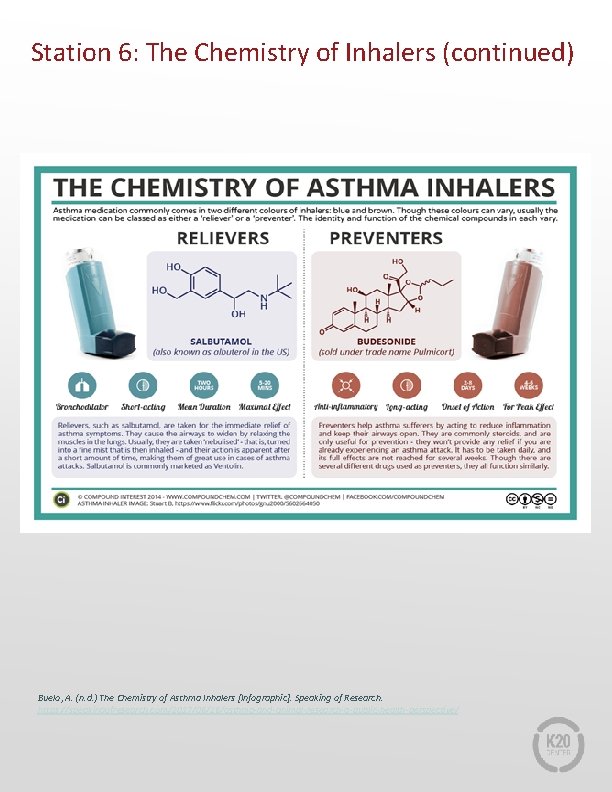
Station 6: The Chemistry of Inhalers (continued) Buelo, A. (n. d. ) The Chemistry of Asthma Inhalers [Infographic]. Speaking of Research. https: //speakingofresearch. com/2017/06/26/asthma-and-animal-research-a-public-health-perspective/

Station 6: The Chemistry of Inhalers (continued) Bronchodilation and Bronchoconstriction
- Slides: 11