
StatinAssociated Side Effects Purpose Describe incidence of statinassociated

Statin-Associated Side Effects
Purpose • Describe incidence of statin-associated side effects (SASE), particularly statin-associated muscle symptoms (SAMS) • Review the approach to addressing patients with potential SASE or SAMS 3
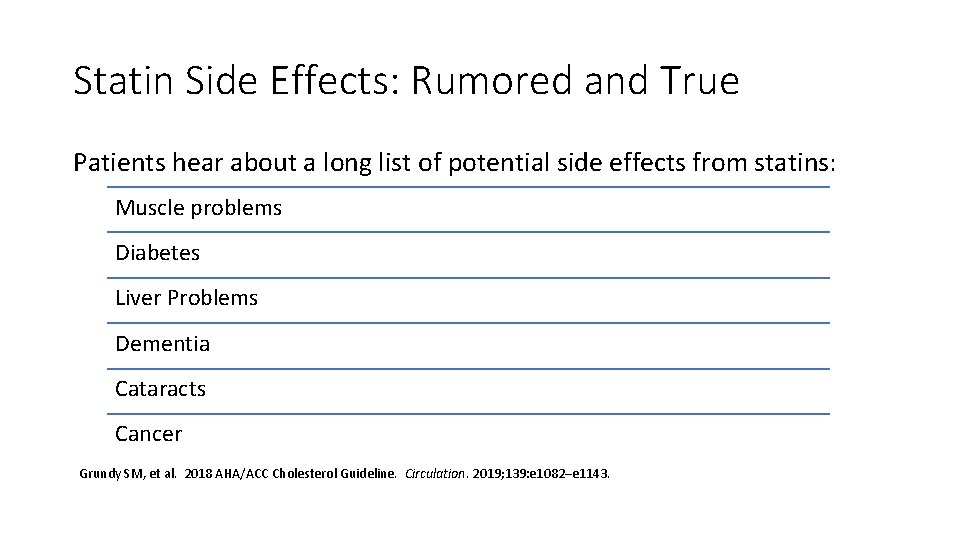
Statin Side Effects: Rumored and True Patients hear about a long list of potential side effects from statins: Muscle problems Diabetes Liver Problems Dementia Cataracts Cancer Grundy SM, et al. 2018 AHA/ACC Cholesterol Guideline. Circulation. 2019; 139: e 1082–e 1143.

Statin-Associated Muscle Symptoms (SAMS) Risk Management • Serious statin-induced muscle injury: <0. 1% • SAMS: 5 -20% • Tendonitis: no association • Assess and document aches and pains before initiating statins • Check CK for severe symptoms or objective weakness • ACC’s Statin Intolerance tool: http: //tools. acc. org/ldl/Statin. Intolerance/index. html#!/ • Sort out whether symptoms are statin-induced • What to do next Newman CB, Preiss D, Tobert JA. Statin Safety and Associated Adverse Events: A Scientific Statement from the American Heart Association. Arterioscl Throm Vas. 2019; 39: e 38–e 81. Grundy SM, et al. 2018 AHA/ACC Cholesterol Guideline. Circulation. 2019; 139: e 1082–e 1143.
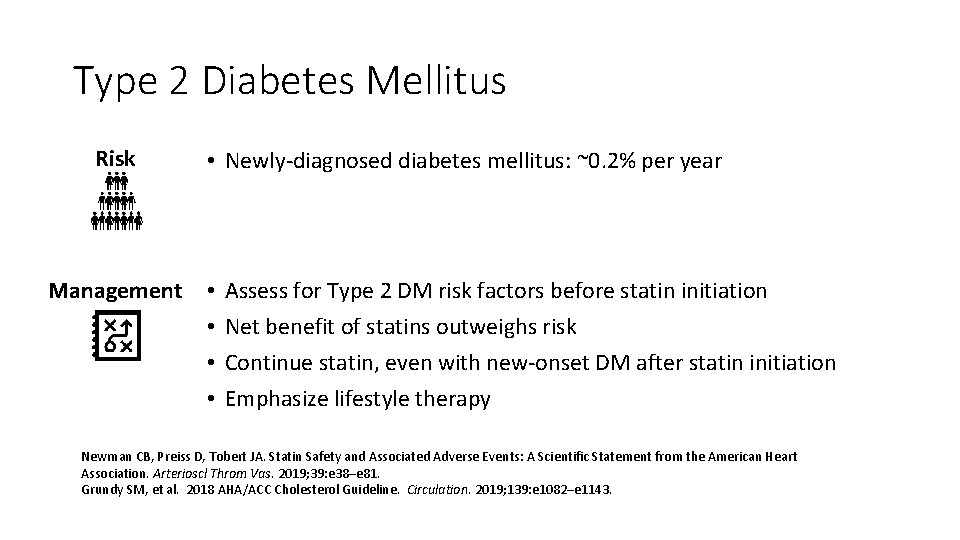
Type 2 Diabetes Mellitus Risk Management • Newly-diagnosed diabetes mellitus: ~0. 2% per year • • Assess for Type 2 DM risk factors before statin initiation Net benefit of statins outweighs risk Continue statin, even with new-onset DM after statin initiation Emphasize lifestyle therapy Newman CB, Preiss D, Tobert JA. Statin Safety and Associated Adverse Events: A Scientific Statement from the American Heart Association. Arterioscl Throm Vas. 2019; 39: e 38–e 81. Grundy SM, et al. 2018 AHA/ACC Cholesterol Guideline. Circulation. 2019; 139: e 1082–e 1143.
Liver Problems Risk Management • Serious hepatotoxicity: ~0. 001% • LFTs only need to be checked in patients exhibiting symptoms • No baseline needed (unless chronic stable liver disease) • No routine monitoring needed (unless chronic stable liver disease) Newman CB, Preiss D, Tobert JA. Statin Safety and Associated Adverse Events: A Scientific Statement from the American Heart Association. Arterioscl Throm Vas. 2019; 39: e 38–e 81. Grundy SM, et al. 2018 AHA/ACC Cholesterol Guideline. Circulation. 2019; 139: e 1082–e 1143.
Dementia Risk Management • Dementia: No increased risk • Cognitive function: No decline • Dialogue with patient emphasizing no evidence for risk Ott BR, Daiello LA, Dehabreh IJ, et al. Do Statins Impair Cognition? A Systematic Review and Meta-Analysis of Randomized Controlled Trials. J Gen Intern Med. 2015 Mar; 30: 348– 358. Grundy SM, et al. 2018 AHA/ACC Cholesterol Guideline. Circulation. 2019; 139: e 1082–e 1143.
Cataracts Risk Management • Cataracts: no convincing evidence • Dialogue with patient emphasizing no evidence for risk Newman CB, Preiss D, Tobert JA. Statin Safety and Associated Adverse Events: A Scientific Statement from the American Heart Association. Arterioscl Throm Vas. 2019; 39: e 38–e 81. Grundy SM, et al. 2018 AHA/ACC Cholesterol Guideline. Circulation. 2019; 139: e 1082–e 1143.
Cancer Risk Management • Cancer: no convincing evidence • Dialogue with patient emphasizing no evidence for risk Newman CB, Preiss D, Tobert JA. Statin Safety and Associated Adverse Events: A Scientific Statement from the American Heart Association. Arterioscl Throm Vas. 2019; 39: e 38–e 81. Grundy SM, et al. 2018 AHA/ACC Cholesterol Guideline. Circulation. 2019; 139: e 1082–e 1143.
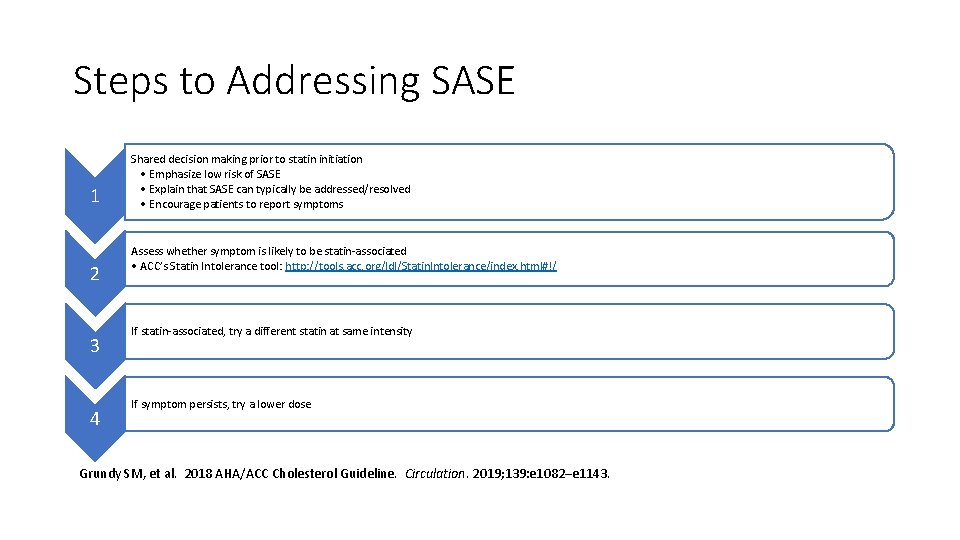
Steps to Addressing SASE 1 2 3 4 Shared decision making prior to statin initiation • Emphasize low risk of SASE • Explain that SASE can typically be addressed/resolved • Encourage patients to report symptoms Assess whether symptom is likely to be statin-associated • ACC’s Statin Intolerance tool: http: //tools. acc. org/ldl/Statin. Intolerance/index. html#!/ If statin-associated, try a different statin at same intensity If symptom persists, try a lower dose Grundy SM, et al. 2018 AHA/ACC Cholesterol Guideline. Circulation. 2019; 139: e 1082–e 1143.
<<Placeholder for center performance>> • How are we doing? • Insert site-specific data here • Review with team performance in each of the three high risk groups
<<Placeholder for next steps>> • Given our data, what are we doing to improve? • Insert plans for quality improvement and associated timeline
- Slides: 13