
Statics Force Equilibrium The condition of equilibrium How
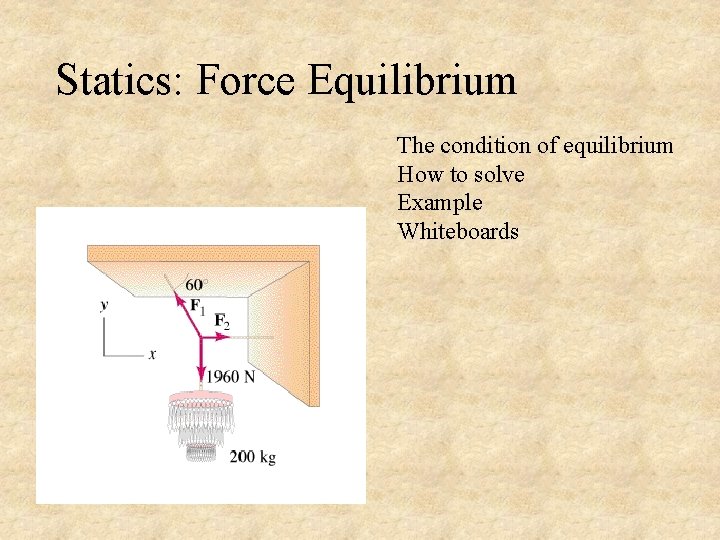
Statics: Force Equilibrium The condition of equilibrium How to solve Example Whiteboards
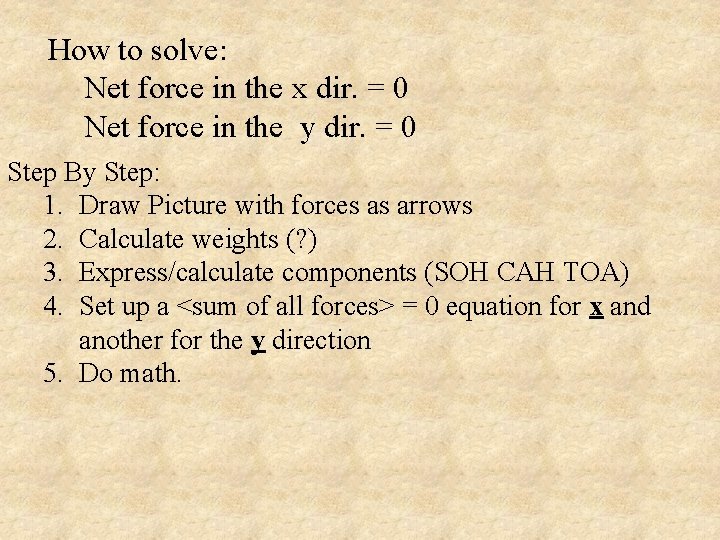
How to solve: Net force in the x dir. = 0 Net force in the y dir. = 0 Step By Step: 1. Draw Picture with forces as arrows 2. Calculate weights (? ) 3. Express/calculate components (SOH CAH TOA) 4. Set up a <sum of all forces> = 0 equation for x and another for the y direction 5. Do math.
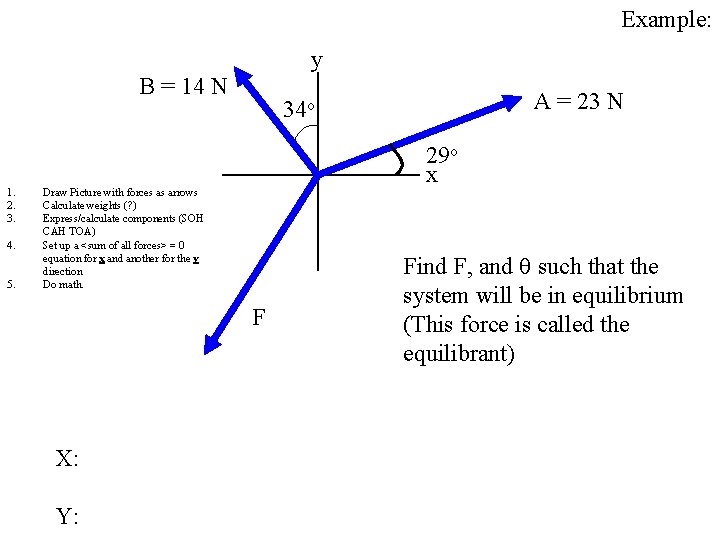
Example: y B = 14 N 1. 2. 3. 4. 5. 29 o x Draw Picture with forces as arrows Calculate weights (? ) Express/calculate components (SOH CAH TOA) Set up a <sum of all forces> = 0 equation for x and another for the y direction Do math. F X: Y: A = 23 N 34 o Find F, and such that the system will be in equilibrium (This force is called the equilibrant)
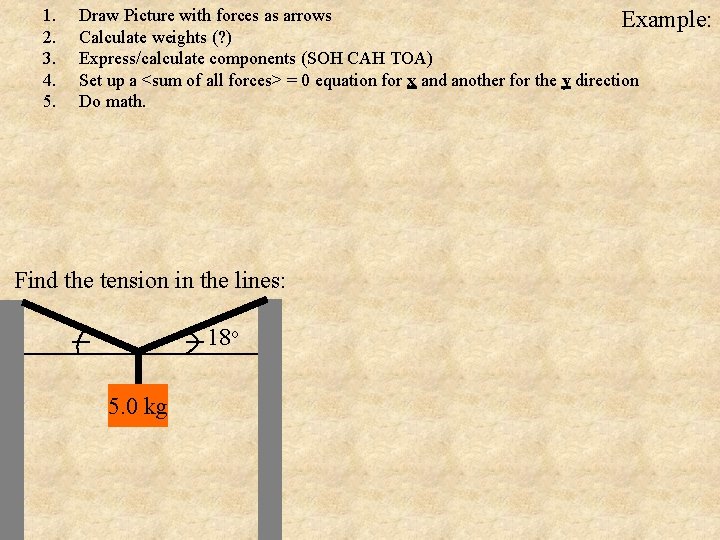
1. 2. 3. 4. 5. Draw Picture with forces as arrows Example: Calculate weights (? ) Express/calculate components (SOH CAH TOA) Set up a <sum of all forces> = 0 equation for x and another for the y direction Do math. Find the tension in the lines: 18 o 5. 0 kg
Whiteboards: Force Equilibrium 1 -3
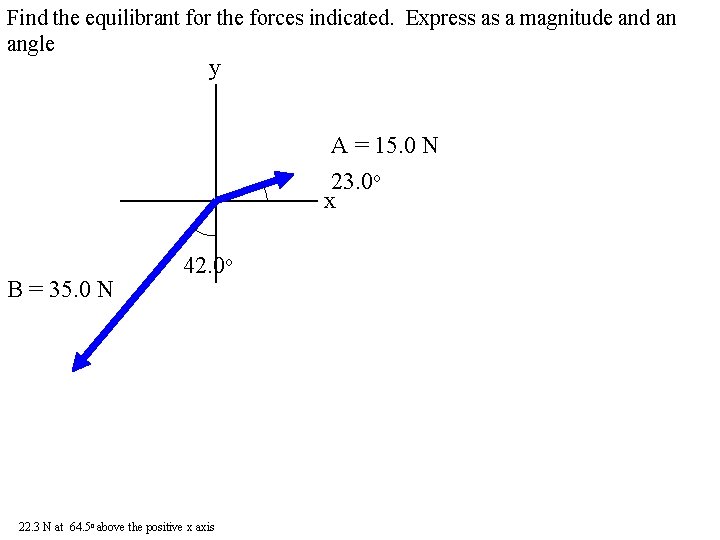
Find the equilibrant for the forces indicated. Express as a magnitude and an angle y A = 15. 0 N 23. 0 o x B = 35. 0 N 42. 0 o 22. 3 N at 64. 5 o above the positive x axis
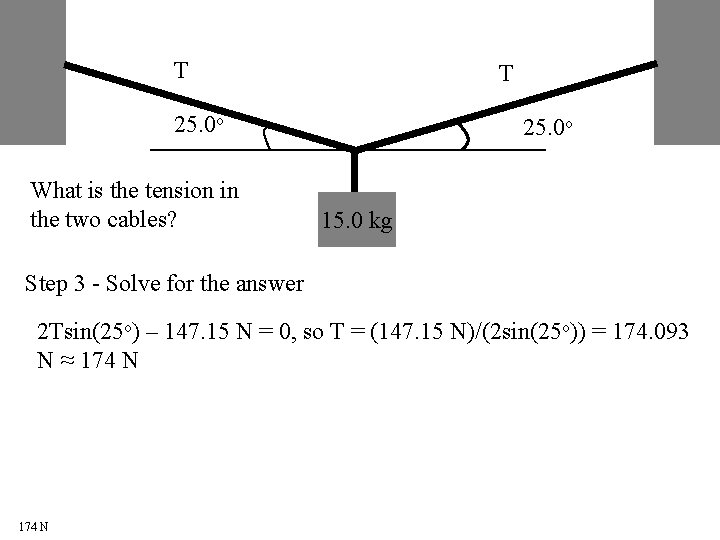
T T 25. 0 o What is the tension in the two cables? 25. 0 o 15. 0 kg Step 3 - Solve for the answer 2 Tsin(25 o) – 147. 15 N = 0, so T = (147. 15 N)/(2 sin(25 o)) = 174. 093 N ≈ 174 N
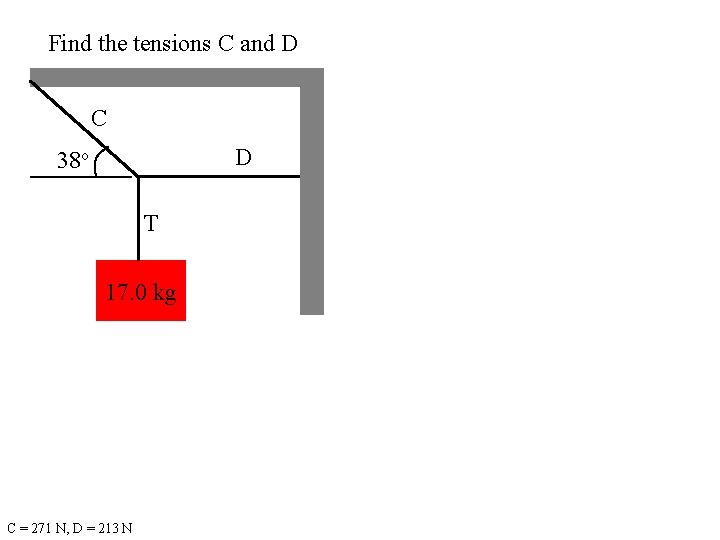
Find the tensions C and D C D 38 o T 17. 0 kg C = 271 N, D = 213 N
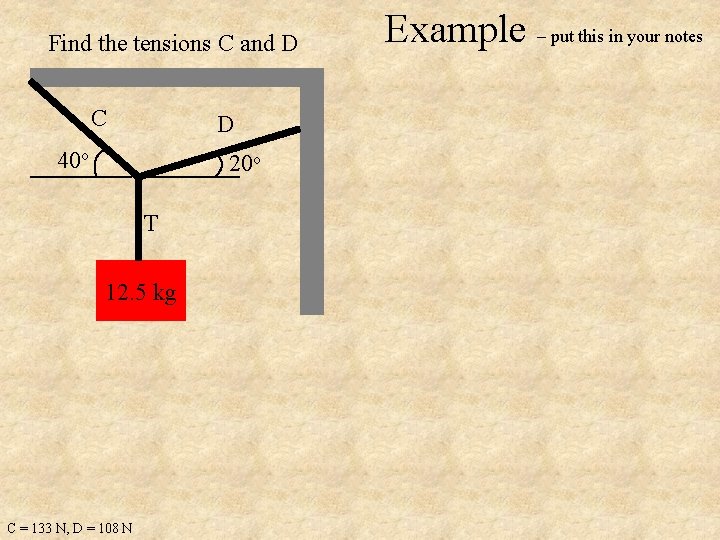
Find the tensions C and D C D 40 o 20 o T 12. 5 kg C = 133 N, D = 108 N Example – put this in your notes
Whiteboards: Two Unknowns 1|2
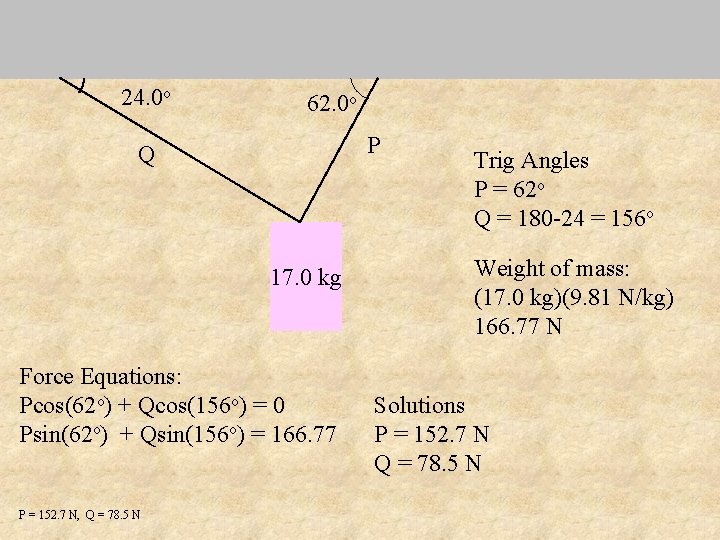
24. 0 o 62. 0 o P Q 17. 0 kg Force Equations: Pcos(62 o) + Qcos(156 o) = 0 Psin(62 o) + Qsin(156 o) = 166. 77 P = 152. 7 N, Q = 78. 5 N Trig Angles P = 62 o Q = 180 -24 = 156 o Weight of mass: (17. 0 kg)(9. 81 N/kg) 166. 77 N Solutions P = 152. 7 N Q = 78. 5 N
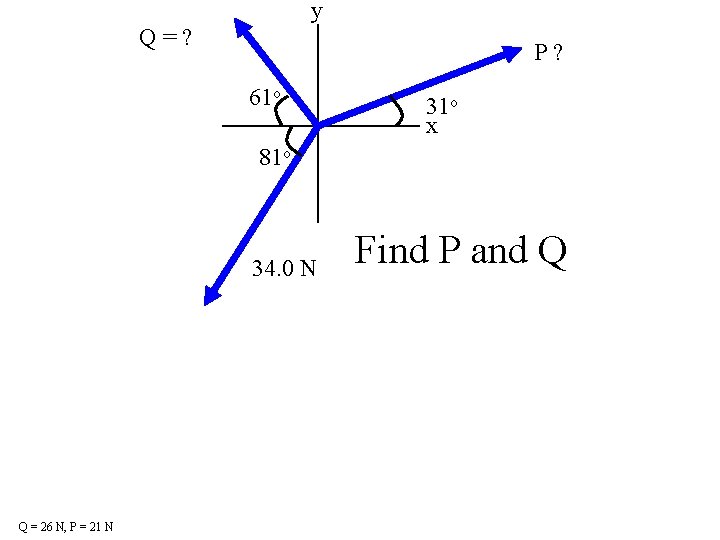
y Q=? P? 61 o 31 o x 81 o 34. 0 N Q = 26 N, P = 21 N Find P and Q


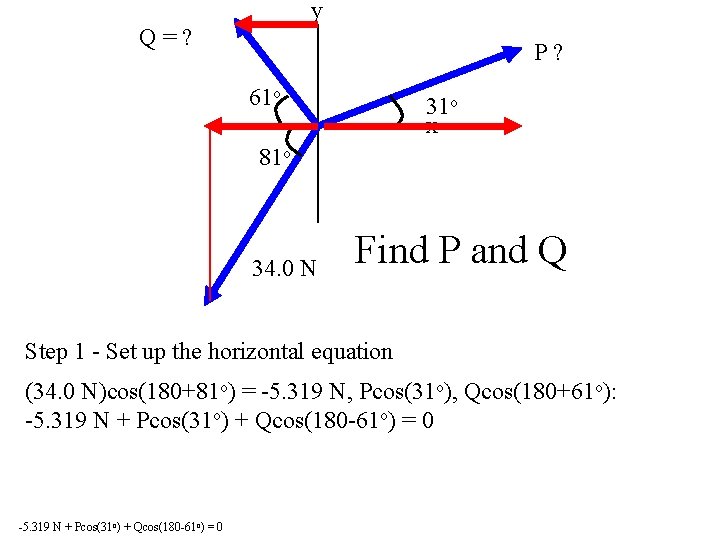
y Q=? P? 61 o 31 o x 81 o 34. 0 N Find P and Q Step 1 - Set up the horizontal equation (34. 0 N)cos(180+81 o) = -5. 319 N, Pcos(31 o), Qcos(180+61 o): -5. 319 N + Pcos(31 o) + Qcos(180 -61 o) = 0
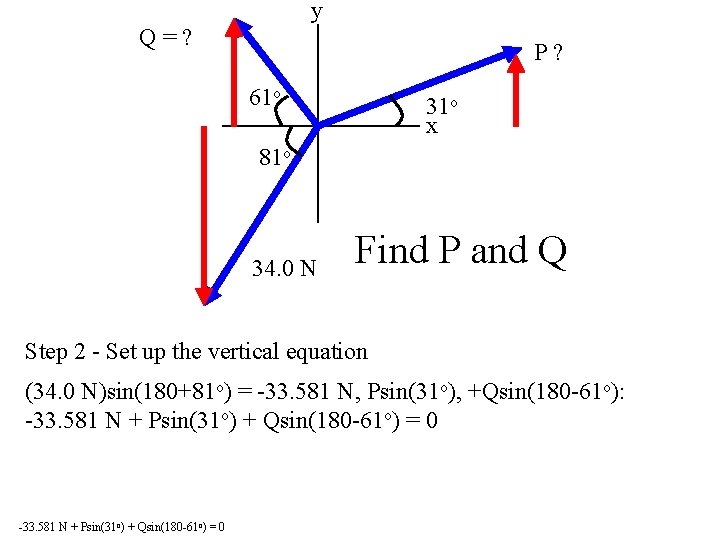
y Q=? P? 61 o 31 o x 81 o 34. 0 N Find P and Q Step 2 - Set up the vertical equation (34. 0 N)sin(180+81 o) = -33. 581 N, Psin(31 o), +Qsin(180 -61 o): -33. 581 N + Psin(31 o) + Qsin(180 -61 o) = 0
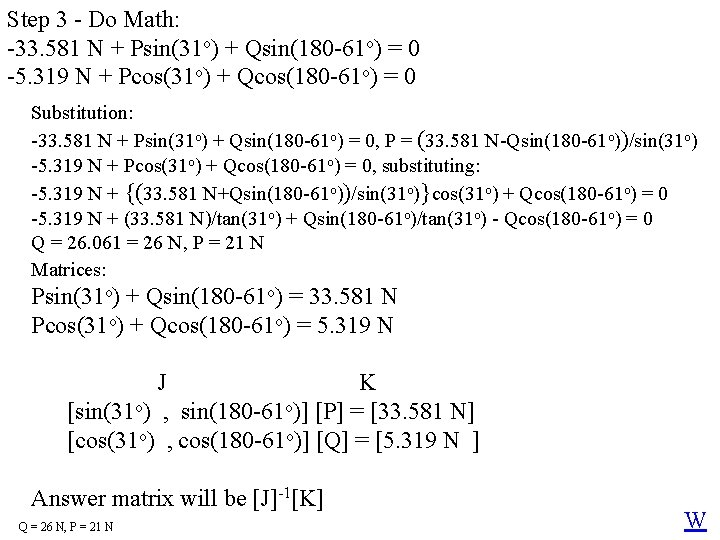
Step 3 - Do Math: -33. 581 N + Psin(31 o) + Qsin(180 -61 o) = 0 -5. 319 N + Pcos(31 o) + Qcos(180 -61 o) = 0 Substitution: -33. 581 N + Psin(31 o) + Qsin(180 -61 o) = 0, P = (33. 581 N-Qsin(180 -61 o))/sin(31 o) -5. 319 N + Pcos(31 o) + Qcos(180 -61 o) = 0, substituting: -5. 319 N + {(33. 581 N+Qsin(180 -61 o))/sin(31 o)}cos(31 o) + Qcos(180 -61 o) = 0 -5. 319 N + (33. 581 N)/tan(31 o) + Qsin(180 -61 o)/tan(31 o) - Qcos(180 -61 o) = 0 Q = 26. 061 = 26 N, P = 21 N Matrices: Psin(31 o) + Qsin(180 -61 o) = 33. 581 N Pcos(31 o) + Qcos(180 -61 o) = 5. 319 N J K [sin(31 o) , sin(180 -61 o)] [P] = [33. 581 N] [cos(31 o) , cos(180 -61 o)] [Q] = [5. 319 N ] Answer matrix will be [J]-1[K] Q = 26 N, P = 21 N W
- Slides: 17