
Statics Equilibrant The condition of equilibrium How to
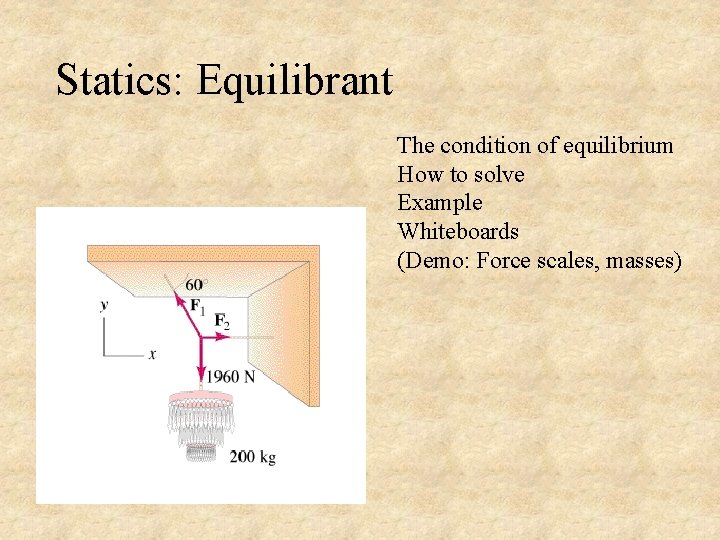
Statics: Equilibrant The condition of equilibrium How to solve Example Whiteboards (Demo: Force scales, masses)
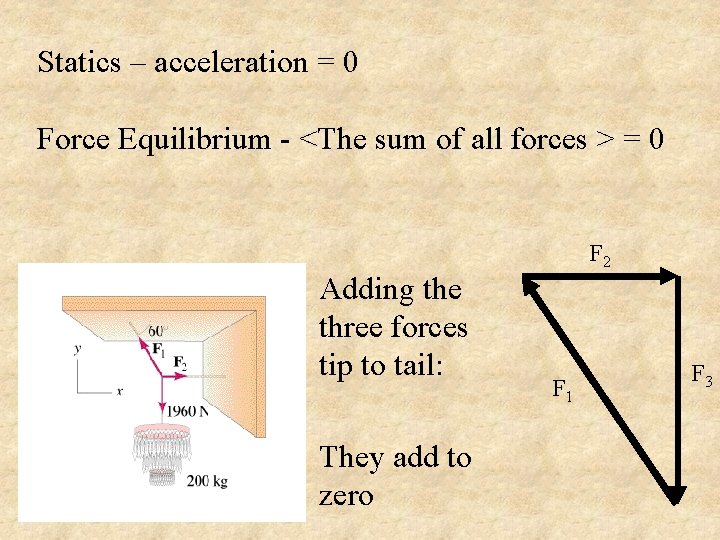
Statics – acceleration = 0 Force Equilibrium - <The sum of all forces > = 0 Adding the three forces tip to tail: They add to zero F 2 F 1 F 3
The Equilibrant is the opposite of the sum. 1. Add the given vectors 2. Negate the sum 3. Find its magnitude 4. Find some angle 5. Draw and label it
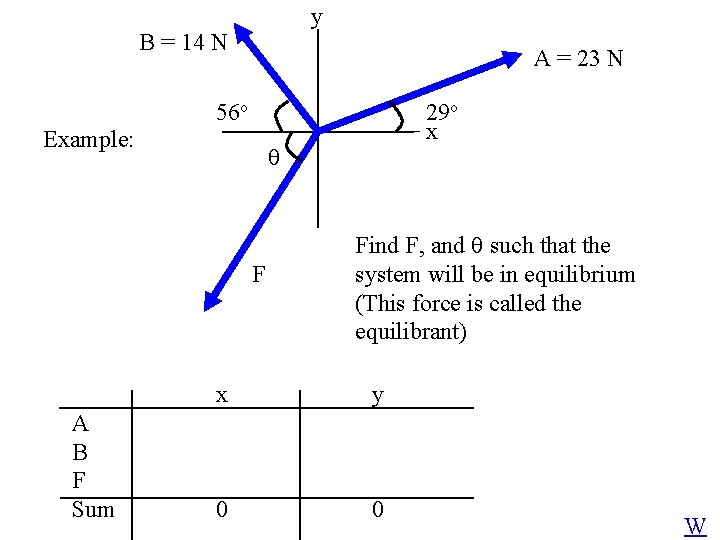
y B = 14 N A = 23 N 56 o Example: F A B F Sum 29 o x Find F, and such that the system will be in equilibrium (This force is called the equilibrant) x y 0 0 W
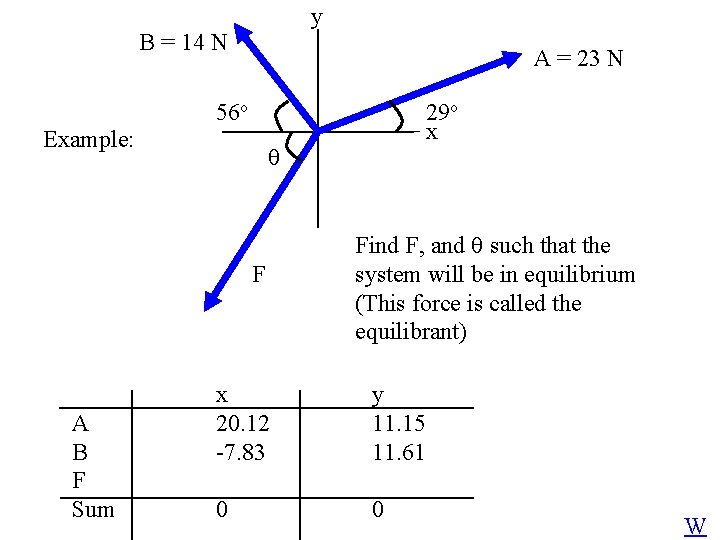
y B = 14 N A = 23 N 56 o Example: F A B F Sum 29 o x Find F, and such that the system will be in equilibrium (This force is called the equilibrant) x 20. 12 -7. 83 y 11. 15 11. 61 0 0 W
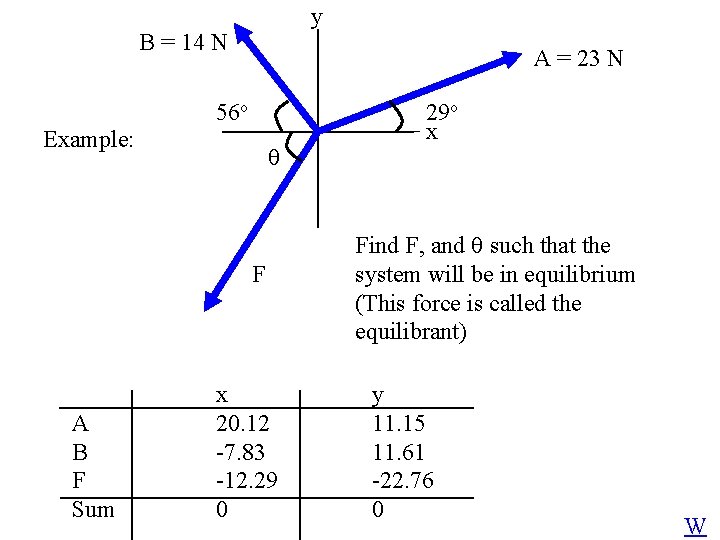
y B = 14 N A = 23 N 56 o Example: F A B F Sum x 20. 12 -7. 83 -12. 29 0 29 o x Find F, and such that the system will be in equilibrium (This force is called the equilibrant) y 11. 15 11. 61 -22. 76 0 W
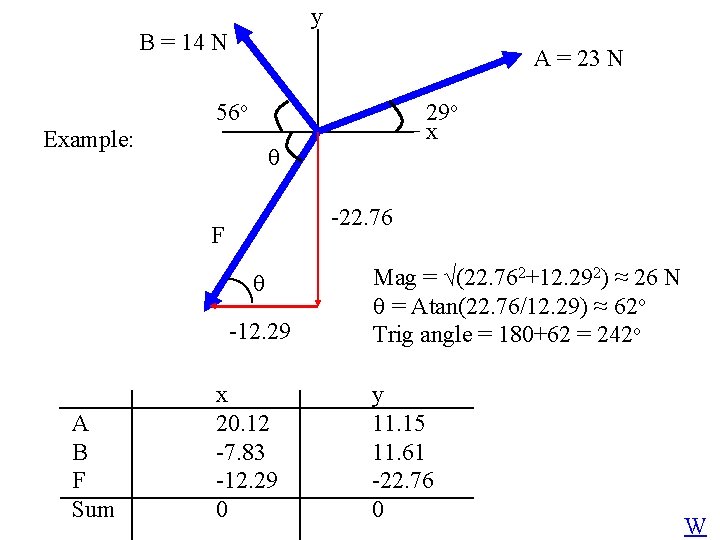
y B = 14 N A = 23 N 56 o Example: -22. 76 F -12. 29 A B F Sum 29 o x x 20. 12 -7. 83 -12. 29 0 Mag = √(22. 762+12. 292) ≈ 26 N = Atan(22. 76/12. 29) ≈ 62 o Trig angle = 180+62 = 242 o y 11. 15 11. 61 -22. 76 0 W
Whiteboards: Equilibrant 1|2 TOC
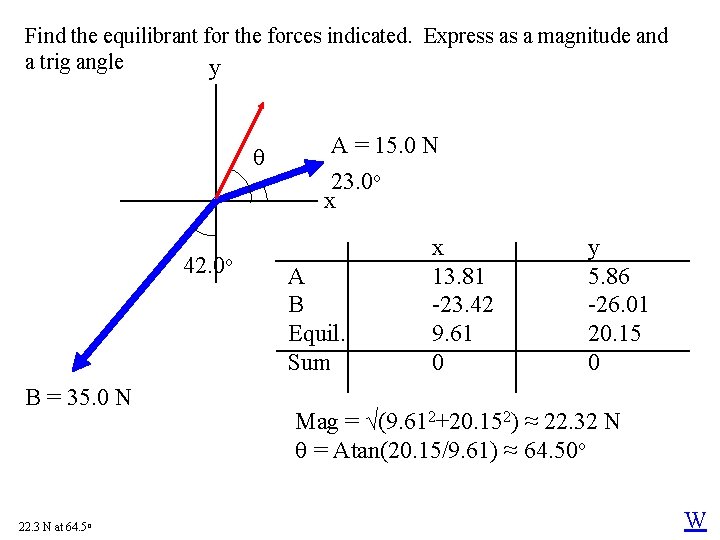
Find the equilibrant for the forces indicated. Express as a magnitude and a trig angle y 42. 0 o B = 35. 0 N 22. 3 N at 64. 5 o A = 15. 0 N 23. 0 o x A B Equil. Sum x 13. 81 -23. 42 9. 61 0 y 5. 86 -26. 01 20. 15 0 Mag = √(9. 612+20. 152) ≈ 22. 32 N = Atan(20. 15/9. 61) ≈ 64. 50 o W
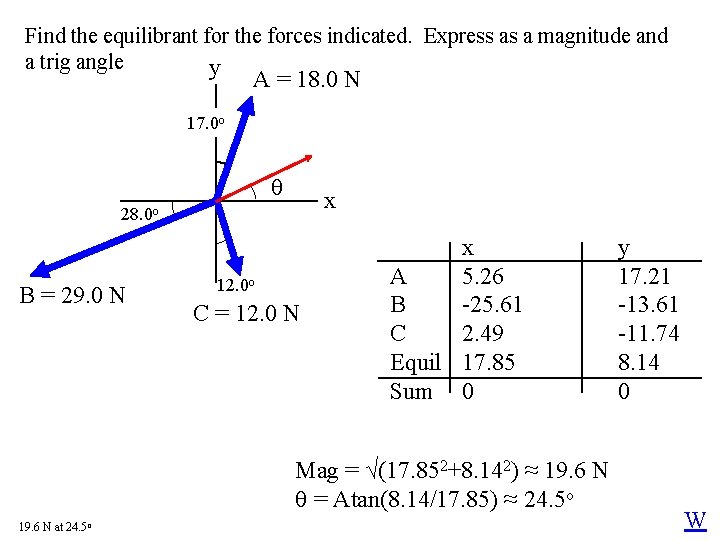
Find the equilibrant for the forces indicated. Express as a magnitude and a trig angle y A = 18. 0 N 17. 0 o x 28. 0 o B = 29. 0 N 12. 0 o C = 12. 0 N x A 5. 26 B -25. 61 C 2. 49 Equil 17. 85 Sum 0 Mag = √(17. 852+8. 142) ≈ 19. 6 N = Atan(8. 14/17. 85) ≈ 24. 5 o 19. 6 N at 24. 5 o y 17. 21 -13. 61 -11. 74 8. 14 0 W
- Slides: 10