
Statics Dynamics University of Ontario Institute of Technology


![Fundamentals Name Length Time Mass Force SI meter [m] second [s] kilogram [kg] newton](https://slidetodoc.com/presentation_image_h2/e837bcfaf6b47dd43f48a7ed6e69142e/image-16.jpg "Fundamentals Name Length Time Mass Force SI meter [m] second [s] kilogram [kg] newton")
- Slides: 27
Statics & Dynamics University of Ontario Institute of Technology ENGR 2020
Lecture Outline • Introductory details • Fundamentals • Definitions • Solution Style and Technique • Vectors
Contact Details • Dr. Jean-Claude (John) Stranart • • • 416 -738 -4403 (emergency or occasional evening) jcstranart@hotmail. com ? ? ? @uoit. ca Subject: UOIT: xxxxx Web site / Web CT fax: 416 -978 -5741
Dr. Jean-Claude (John) Stranart • Background • Ph. D. University of Toronto • M. A. Sc. University of Toronto • B. A. Sc. Waterloo • Research in mechanics, finite elements, fatigue/fracture, smart structures
Subject Matter/Overview • Statics • • • Equilibrium of a Particle Force System Resultants Equilibrium of a Rigid Body Structural Analysis Centre of Gravity/Centroid Friction
Subject Matter/Overview • Dynamics • Kinematics of a Particle • Kinetics of a Particle • Force, Acceleration • Work, Energy • Impulse, Momentum • Kinematics of a Rigid Body • Kinetics of a Rigid Body • Force, Acceleration • Work, Energy • Impulse, Momentum
Textbook • Engineering Mechanics: Statics and Dynamics • R. C. Hibbler, 10 th Edition • Work book/Study Pack
Lectures • 9: 10 – 11: 00 Wednesday & Friday • Room UA 1240 • 10 minute break ~ 10: 00 • Available for questions after class • If something is not clear, bring it up, don’t wait • Room change on May 13 (only) – UA 1120 or UA 1140
Tutorial • Wednesday • 12 – 2 pm • Room UA 2120 • Is everyone available ? (Midterms)
Office Hours • UA 3045 • To be determined
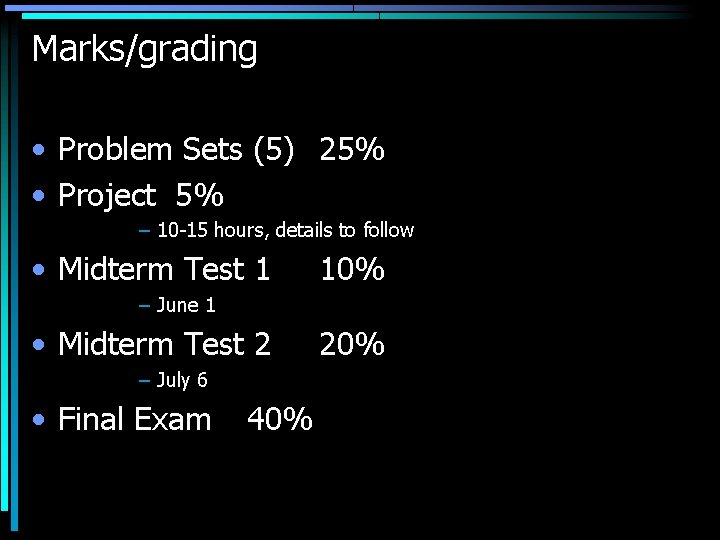
Marks/grading • Problem Sets (5) 25% • Project 5% – 10 -15 hours, details to follow • Midterm Test 1 10% – June 1 • Midterm Test 2 – July 6 • Final Exam 40% 20%
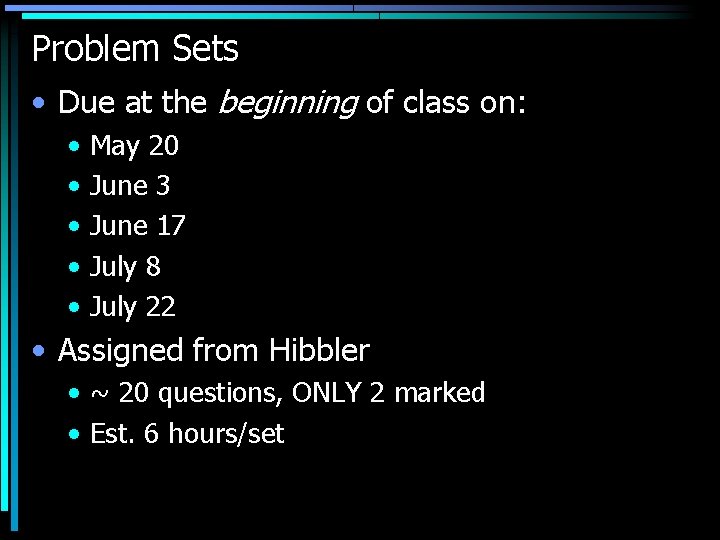
Problem Sets • Due at the beginning of class on: • • • May 20 June 3 June 17 July 8 July 22 • Assigned from Hibbler • ~ 20 questions, ONLY 2 marked • Est. 6 hours/set
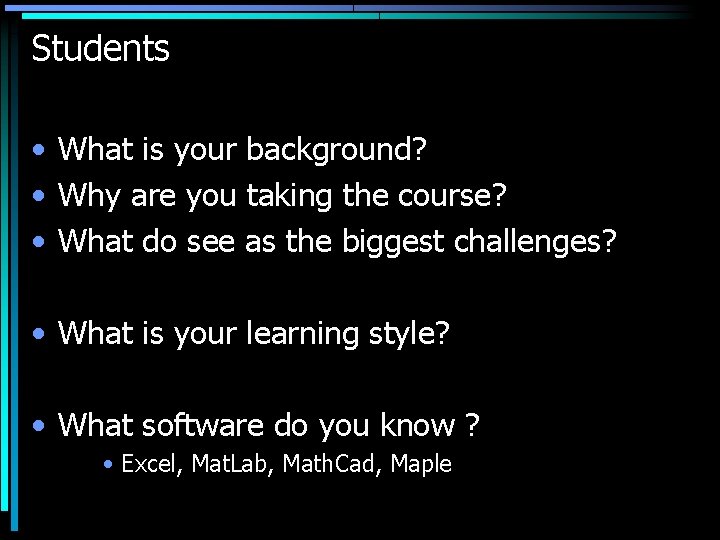
Students • What is your background? • Why are you taking the course? • What do see as the biggest challenges? • What is your learning style? • What software do you know ? • Excel, Mat. Lab, Math. Cad, Maple
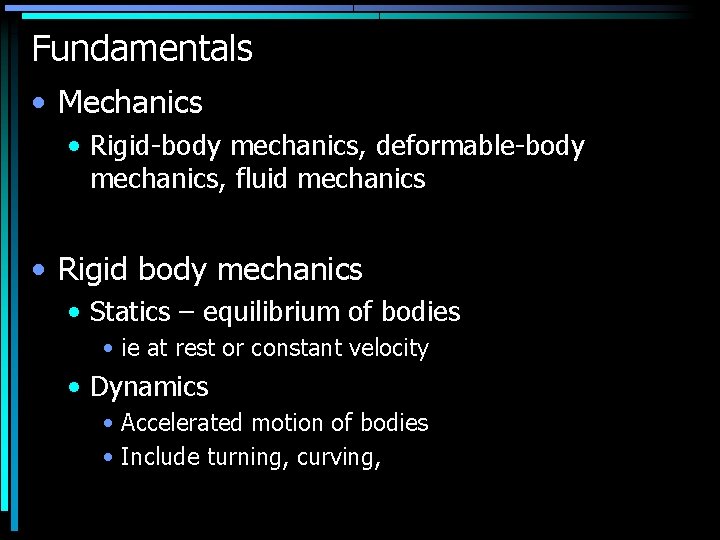
Fundamentals • Mechanics • Rigid-body mechanics, deformable-body mechanics, fluid mechanics • Rigid body mechanics • Statics – equilibrium of bodies • ie at rest or constant velocity • Dynamics • Accelerated motion of bodies • Include turning, curving,
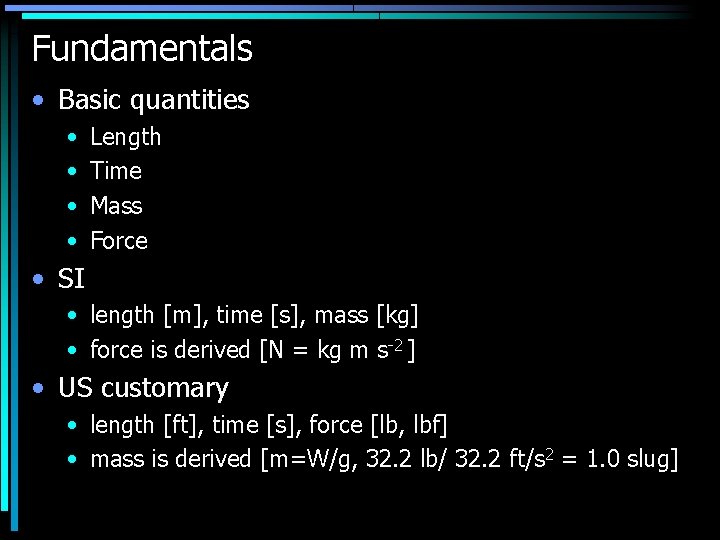
Fundamentals • Basic quantities • • Length Time Mass Force • SI • length [m], time [s], mass [kg] • force is derived [N = kg m s-2 ] • US customary • length [ft], time [s], force [lb, lbf] • mass is derived [m=W/g, 32. 2 lb/ 32. 2 ft/s 2 = 1. 0 slug]
Fundamentals Name Length Time Mass Force SI meter [m] second [s] kilogram [kg] newton [N] US foot [ft] second [s] slug pound [lb, lbf]
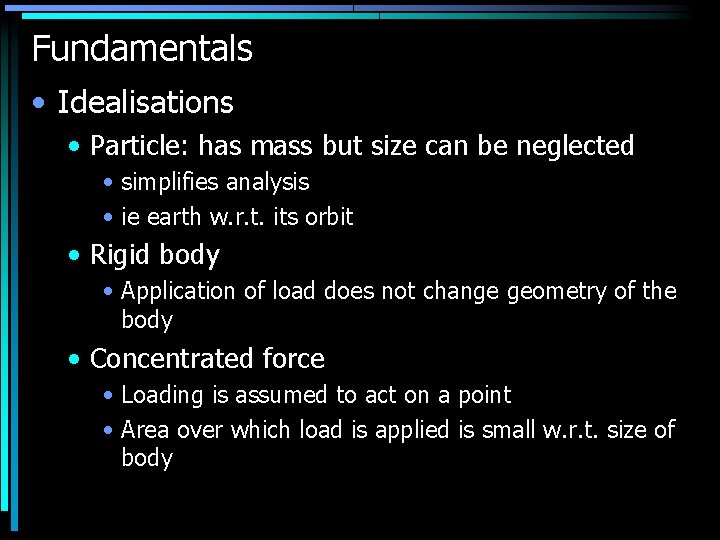
Fundamentals • Idealisations • Particle: has mass but size can be neglected • simplifies analysis • ie earth w. r. t. its orbit • Rigid body • Application of load does not change geometry of the body • Concentrated force • Loading is assumed to act on a point • Area over which load is applied is small w. r. t. size of body
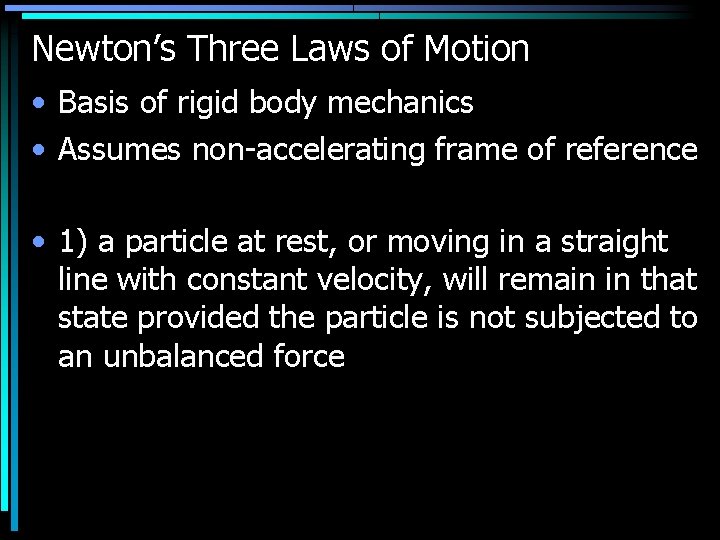
Newton’s Three Laws of Motion • Basis of rigid body mechanics • Assumes non-accelerating frame of reference • 1) a particle at rest, or moving in a straight line with constant velocity, will remain in that state provided the particle is not subjected to an unbalanced force
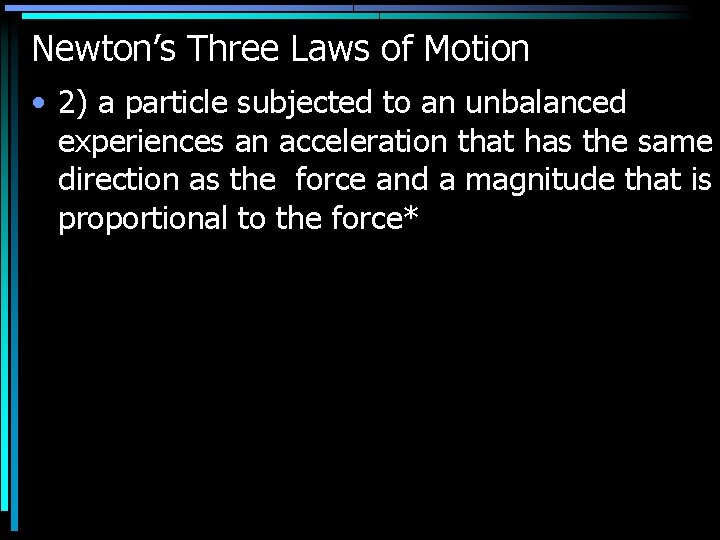
Newton’s Three Laws of Motion • 2) a particle subjected to an unbalanced experiences an acceleration that has the same direction as the force and a magnitude that is proportional to the force*
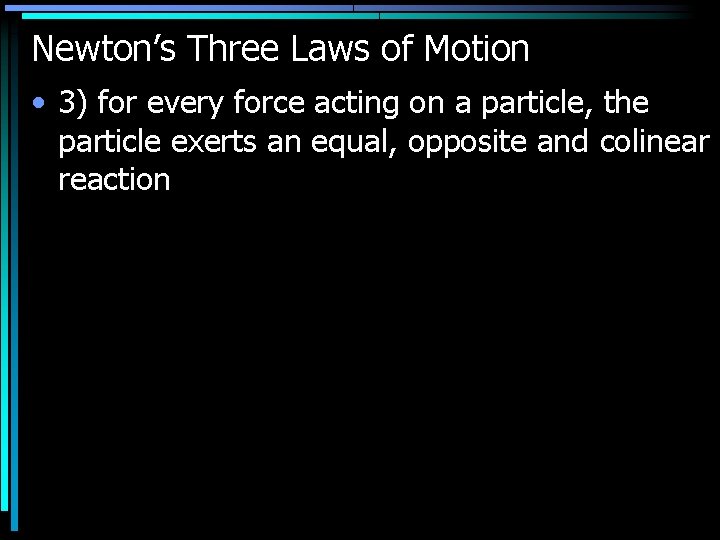
Newton’s Three Laws of Motion • 3) for every force acting on a particle, the particle exerts an equal, opposite and colinear reaction
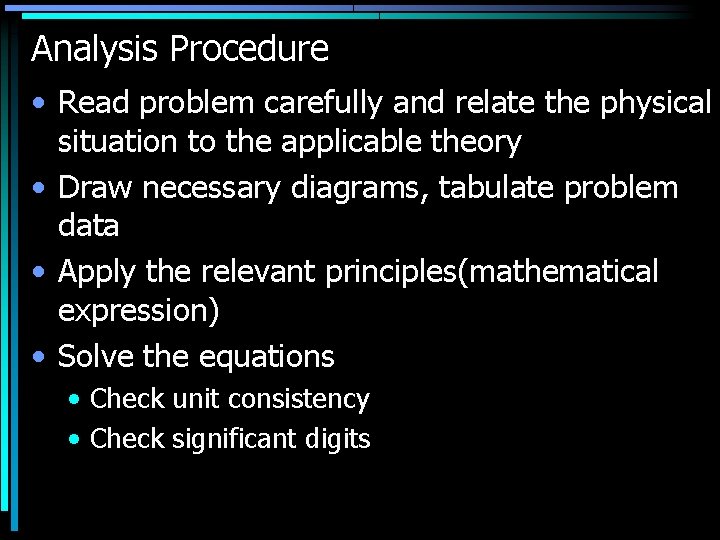
Analysis Procedure • Read problem carefully and relate the physical situation to the applicable theory • Draw necessary diagrams, tabulate problem data • Apply the relevant principles(mathematical expression) • Solve the equations • Check unit consistency • Check significant digits
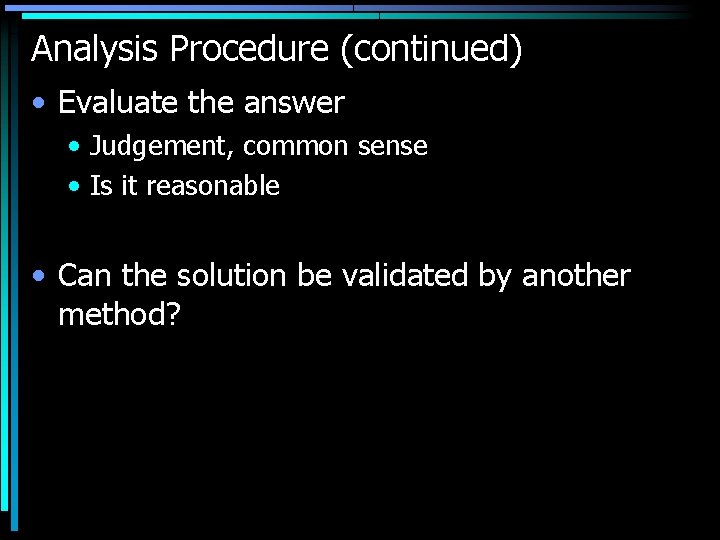
Analysis Procedure (continued) • Evaluate the answer • Judgement, common sense • Is it reasonable • Can the solution be validated by another method?
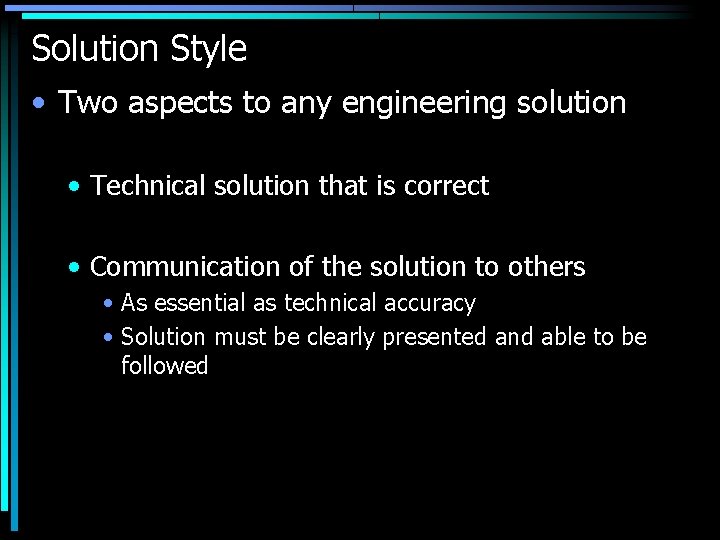
Solution Style • Two aspects to any engineering solution • Technical solution that is correct • Communication of the solution to others • As essential as technical accuracy • Solution must be clearly presented and able to be followed
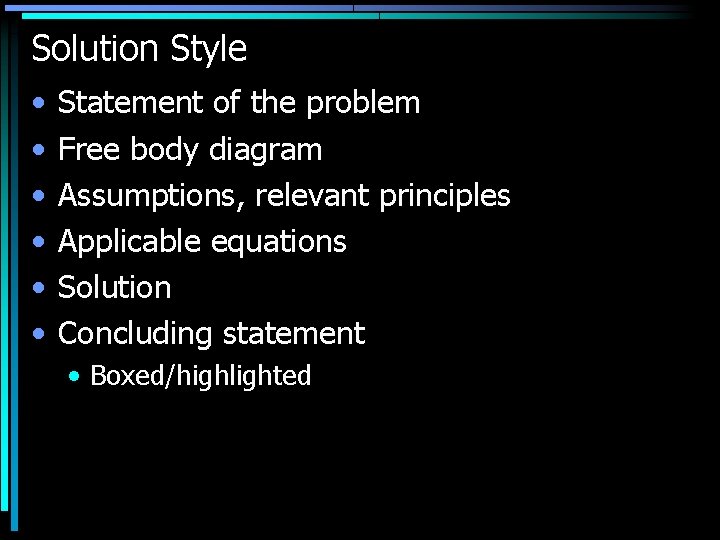
Solution Style • • • Statement of the problem Free body diagram Assumptions, relevant principles Applicable equations Solution Concluding statement • Boxed/highlighted
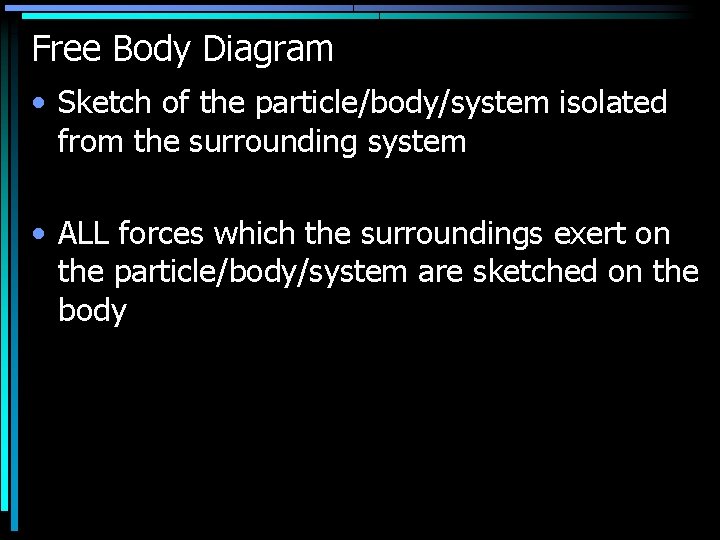
Free Body Diagram • Sketch of the particle/body/system isolated from the surrounding system • ALL forces which the surroundings exert on the particle/body/system are sketched on the body
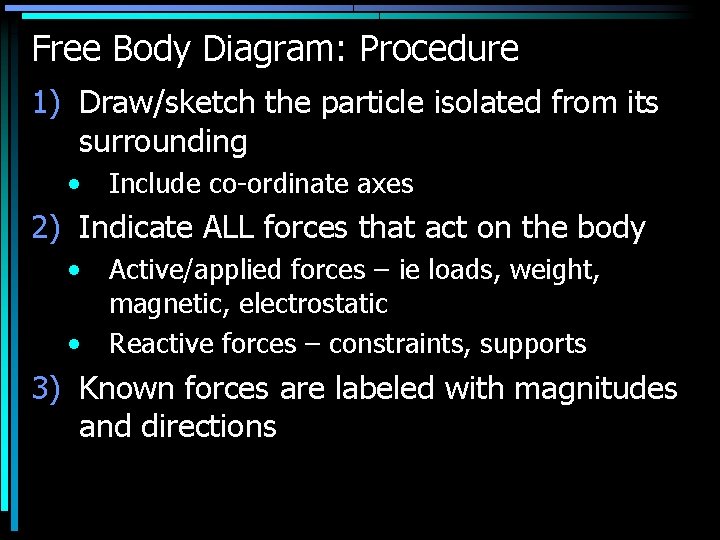
Free Body Diagram: Procedure 1) Draw/sketch the particle isolated from its surrounding • Include co-ordinate axes 2) Indicate ALL forces that act on the body • • Active/applied forces – ie loads, weight, magnetic, electrostatic Reactive forces – constraints, supports 3) Known forces are labeled with magnitudes and directions
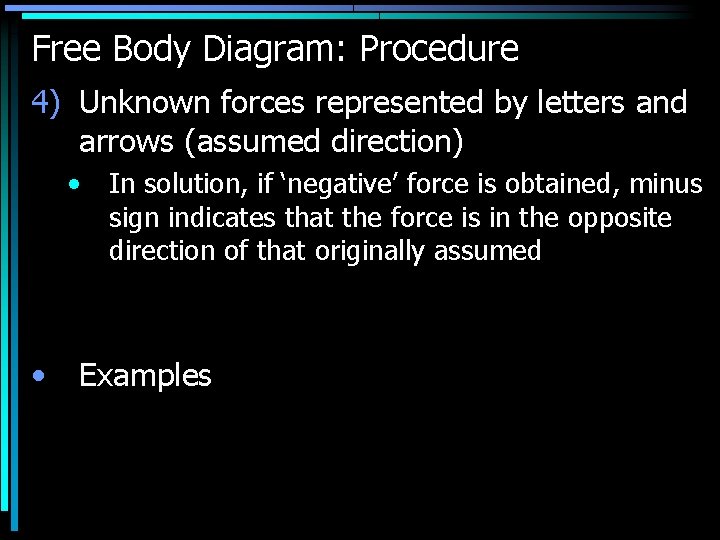
Free Body Diagram: Procedure 4) Unknown forces represented by letters and arrows (assumed direction) • • In solution, if ‘negative’ force is obtained, minus sign indicates that the force is in the opposite direction of that originally assumed Examples