
Static Program Analysis using Abstract Interpretation Arnaud Venet
Static Program Analysis using Abstract Interpretation Arnaud Venet Guillaume Brat venet@email. arc. nasa. gov brat@email. arc. nasa. gov Kestrel Technology NASA Ames Research Center Moffett Field, CA 94035
Introduction
Static Program Analysis Static program analysis consists of automatically discovering properties of a program that hold for all possible execution paths of the program. Static program analysis is not • Testing: manually checking a property for some execution paths • Model checking: automatically checking a property for all execution paths
Program Analysis for what? • Optimizing compilers • Program understanding • Semantic preprocessing: – Model checking – Automated test generation • Program verification
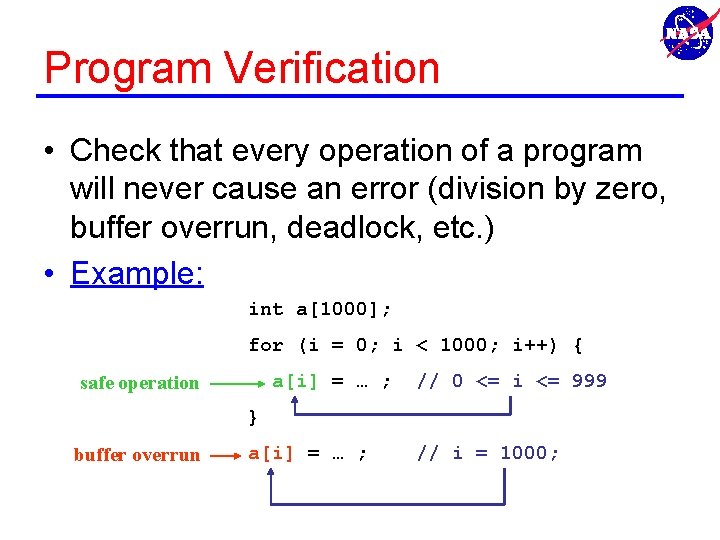
Program Verification • Check that every operation of a program will never cause an error (division by zero, buffer overrun, deadlock, etc. ) • Example: int a[1000]; for (i = 0; i < 1000; i++) { a[i] = … ; safe operation // 0 <= i <= 999 } buffer overrun a[i] = … ; // i = 1000;
Incompleteness of Program Analysis • Discovering a sufficient set of properties for checking every operation of a program is an undecidable problem! • False positives: operations that are safe in reality but which cannot be decided safe or unsafe from the properties inferred by static analysis.
Precision versus Efficiency Precision: number of program operations that can be decided safe or unsafe by an analyzer. • Precision and computational complexity are strongly related • Tradeoff precision/efficiency: limit in the average precision and scalability of a given analyzer • Greater precision and scalability is achieved through specialization
Specialization • Tailoring the program analyzer algorithms for a specific class of programs (flight control commands, digital signal processing, etc. ) • Precision and scalability is guaranteed for this class of programs only • Requires a lot of try-and-test to fine-tune the algorithms • Need for an open architecture
Soundness • What guarantees the soundness of the analyzer results? • In dataflow analysis and type inference the soundness proof of the resolution algorithm is independent from the analysis specification • An independent soundness proof precludes the use of test-and-try techniques • Need for analyzers correct by construction
Abstract Interpretation • A general methodology for designing static program analyzers that are: – Correct by construction – Generic – Easy to fine-tune • Scalability is difficult to achieve but the payoff is worth the effort!
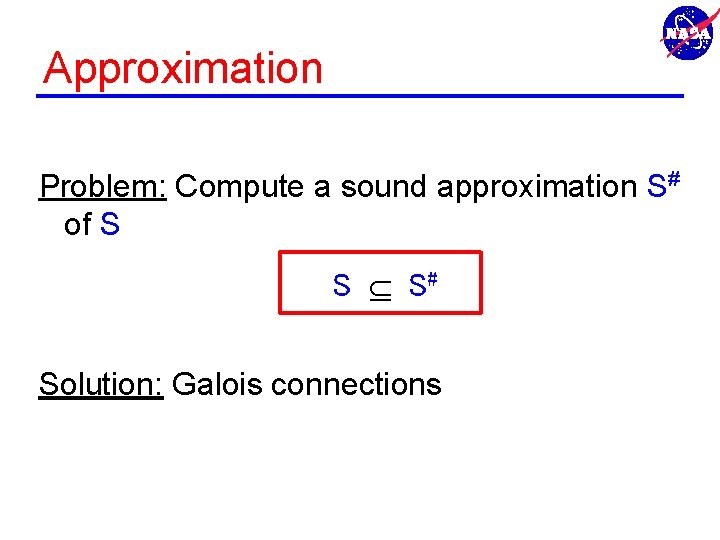
Approximation The core idea of Abstract Interpretation is the formalization of the notion of approximation • An approximation of memory configurations is first defined • Then the approximation of all atomic operations • The approximation is automatically lifted to the whole program structure • The approximation is generally a scheme that depends on some other parameter approximations
Overview of Abstract Interpretation • Start with a formal specification of the program semantics (the concrete semantics) • Construct abstract semantic equations w. r. t. a parametric approximation scheme • Use general algorithms to solve the abstract semantic equations • Try-and-test various instantiations of the approximation scheme in order to find the best fit
The Methodology of Abstract Interpretation
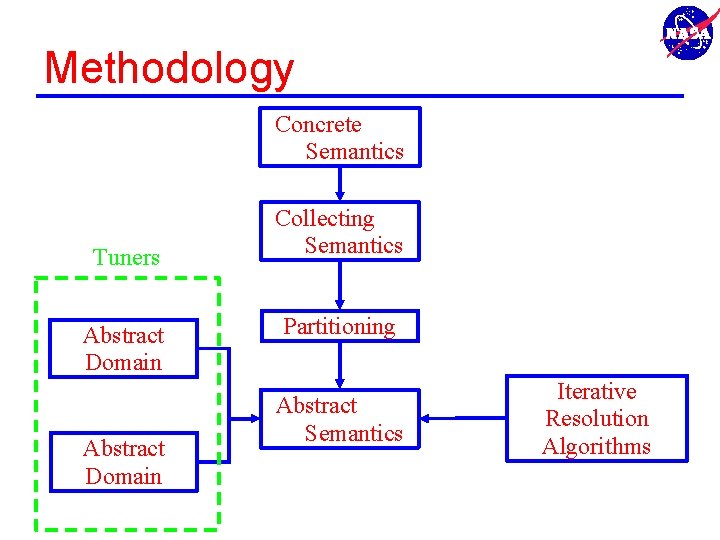
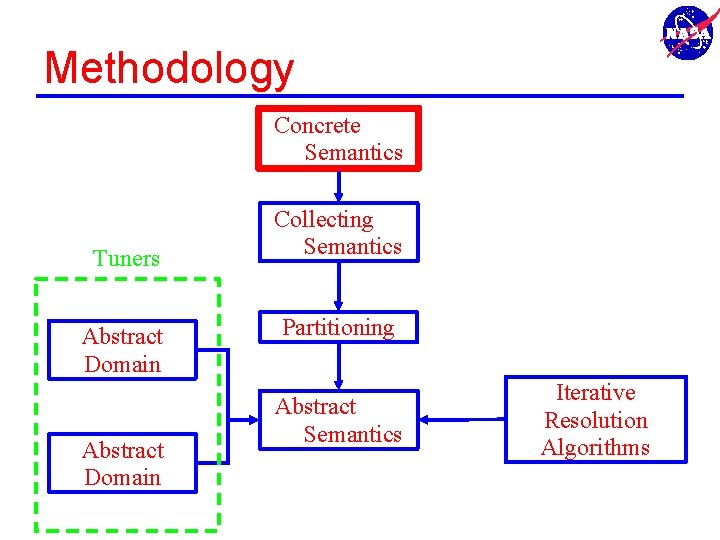
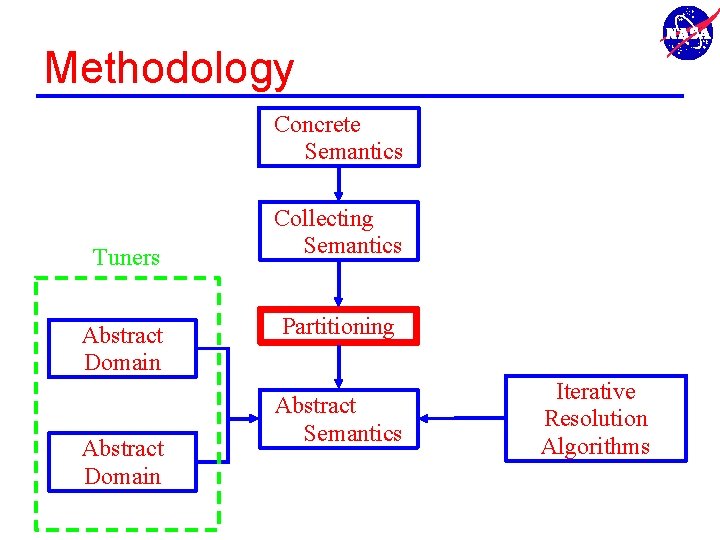
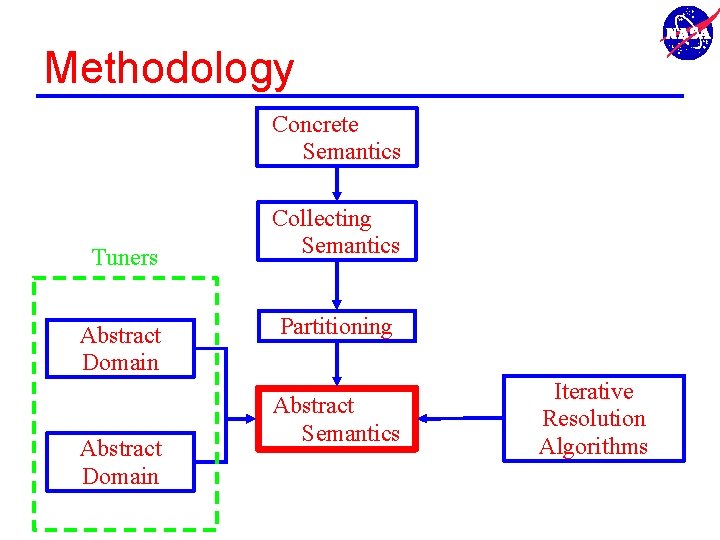
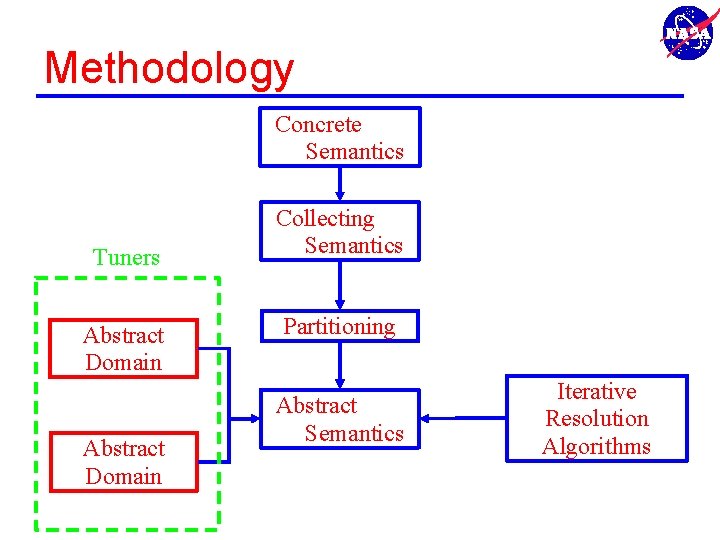
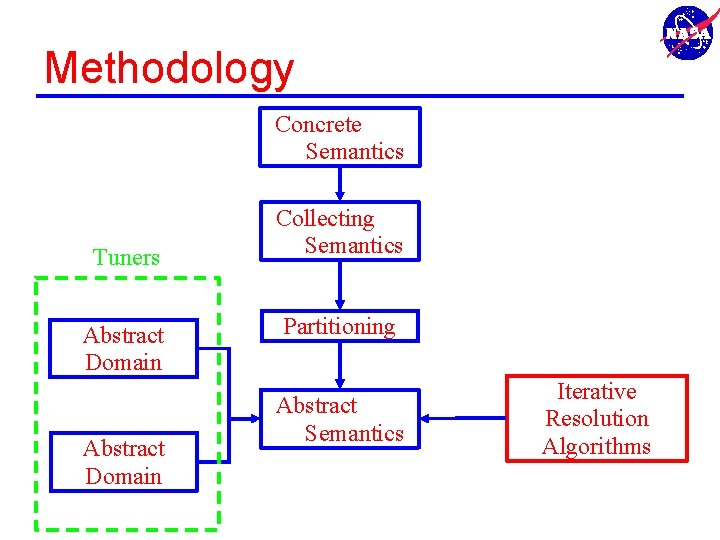
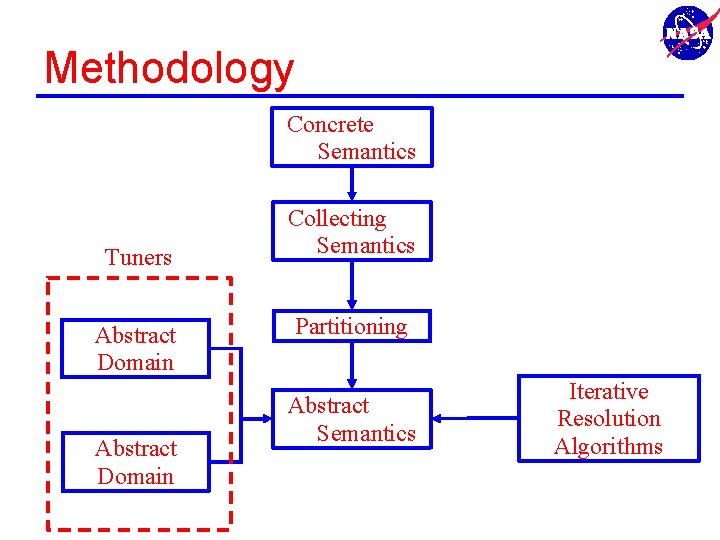
Methodology Concrete Semantics Tuners Abstract Domain Collecting Semantics Partitioning Abstract Semantics Iterative Resolution Algorithms
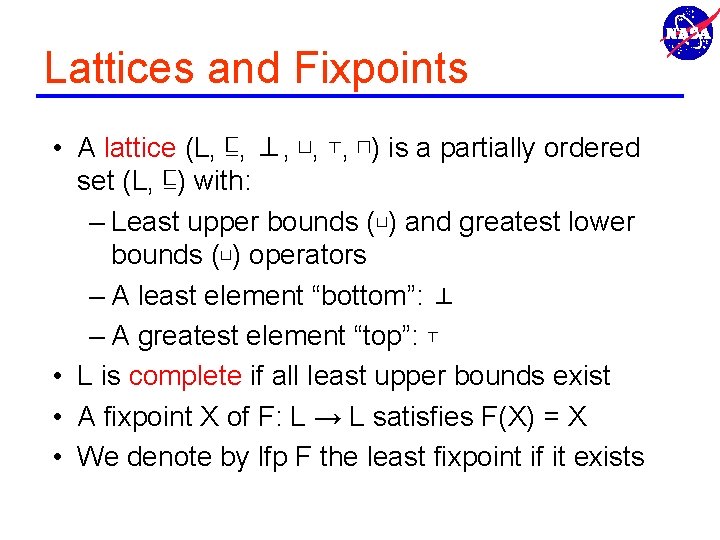
Lattices and Fixpoints • A lattice (L, ⊑, ⊥, ⊔, ⊤, ⊓) is a partially ordered set (L, ⊑) with: – Least upper bounds (⊔) and greatest lower bounds (⊔) operators – A least element “bottom”: ⊥ – A greatest element “top”: ⊤ • L is complete if all least upper bounds exist • A fixpoint X of F: L → L satisfies F(X) = X • We denote by lfp F the least fixpoint if it exists
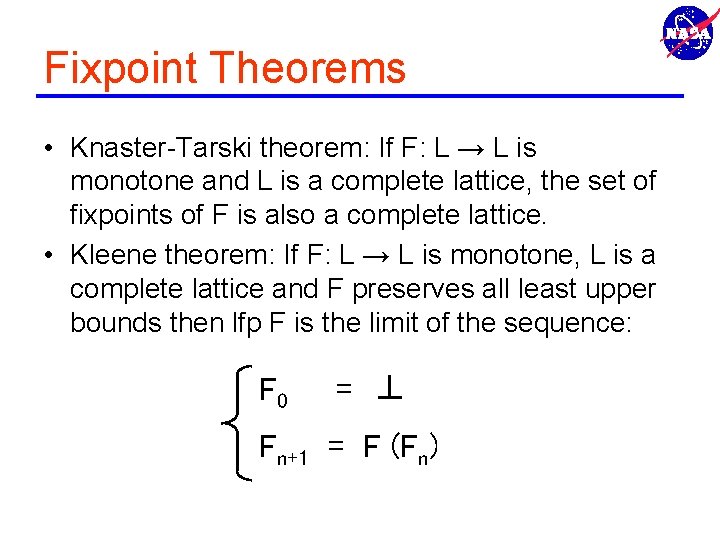
Fixpoint Theorems • Knaster-Tarski theorem: If F: L → L is monotone and L is a complete lattice, the set of fixpoints of F is also a complete lattice. • Kleene theorem: If F: L → L is monotone, L is a complete lattice and F preserves all least upper bounds then lfp F is the limit of the sequence: F 0 = ⊥ Fn+1 = F (Fn)
Methodology Concrete Semantics Tuners Abstract Domain Collecting Semantics Partitioning Abstract Semantics Iterative Resolution Algorithms
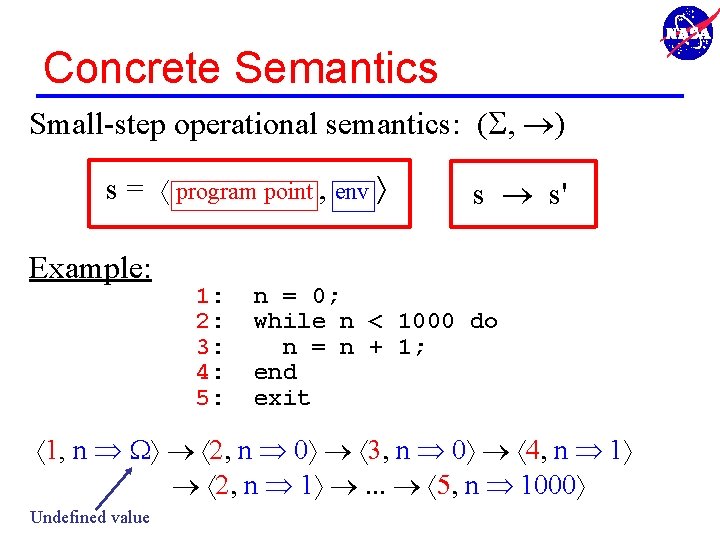
Concrete Semantics Small-step operational semantics: (S, ) s = program point , env Example: 1: 2: 3: 4: 5: s s' n = 0; while n < 1000 do n = n + 1; end exit 1, n 2, n 0 3, n 0 4, n 1 2, n 1 . . . 5, n 1000 Undefined value
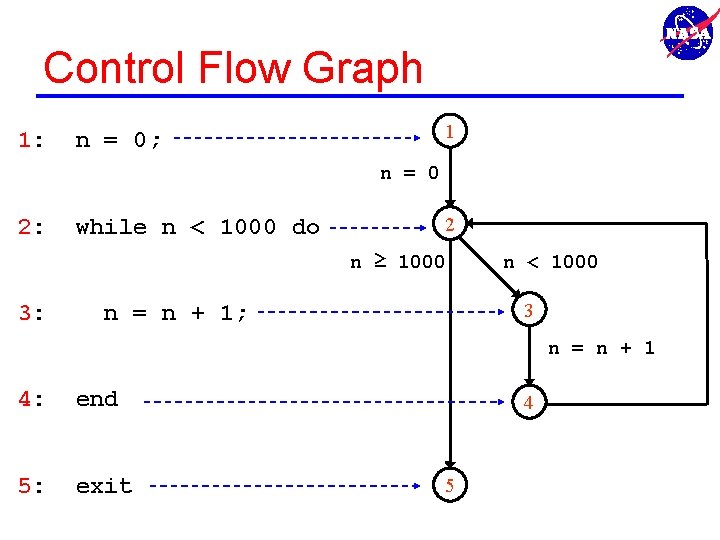
Control Flow Graph 1: 1 n = 0; n = 0 2: while n < 1000 do 2 n ≥ 1000 3: n < 1000 3 n = n + 1; n = n + 1 4: end 5: exit 4 5
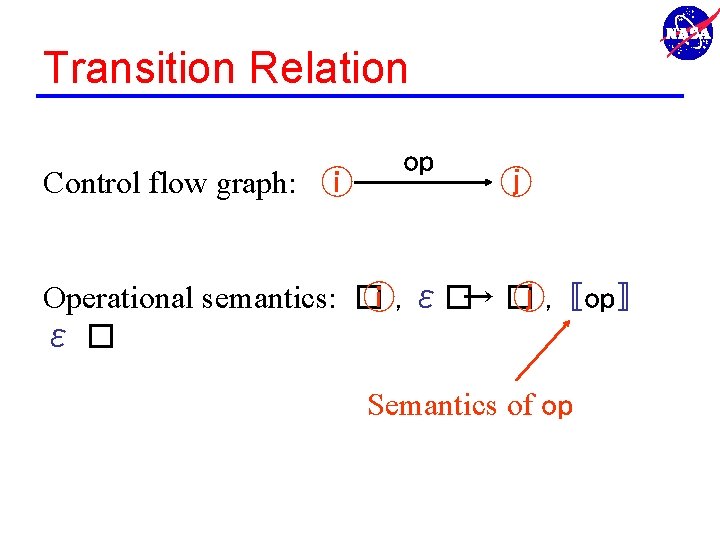
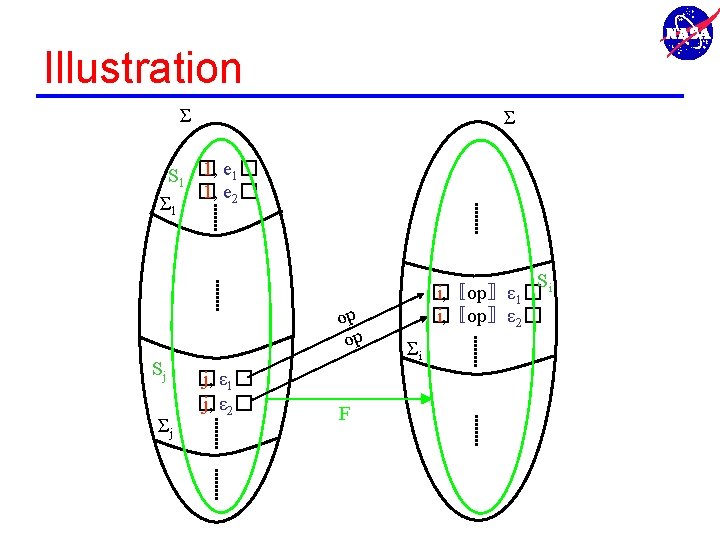
Transition Relation Control flow graph: ⓘ op ⓙ Operational semantics: � ⓘ, ε�→ � ⓙ, 〚op〛 ε� Semantics of op
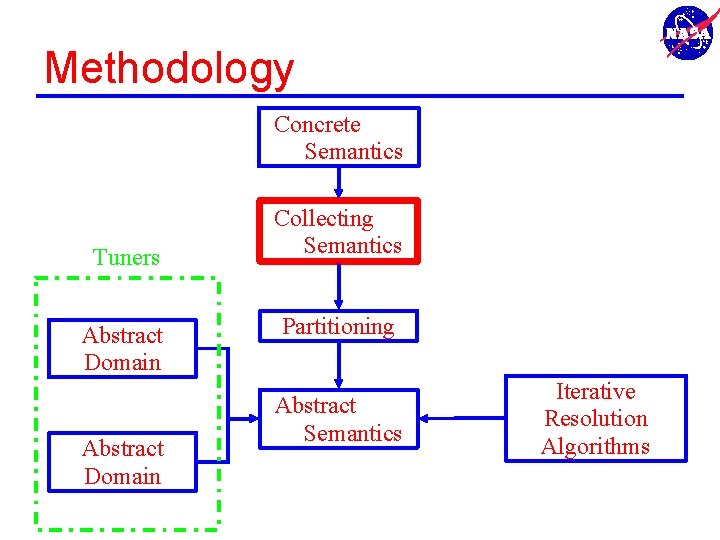
Methodology Concrete Semantics Tuners Abstract Domain Collecting Semantics Partitioning Abstract Semantics Iterative Resolution Algorithms
Collecting Semantics The collecting semantics is the set of observable behaviours in the operational semantics. It is the starting point of any analysis design. • The set of all descendants of the initial state that can reach a final state • The set of all finite traces from the initial state • The set of all finite and infinite traces from the initial state • etc.
Which Collecting Semantics? • Buffer overrun, division by zero, arithmetic overflows: state properties • Deadlocks, un-initialized variables: finite trace properties • Loop termination: finite and infinite trace properties
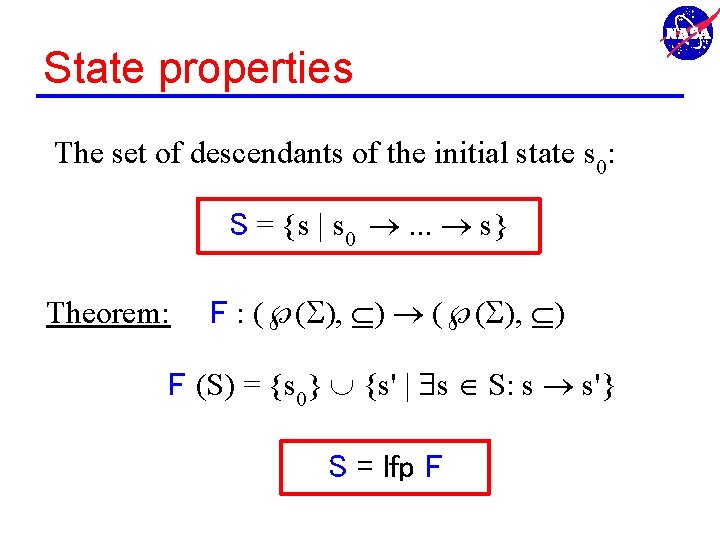
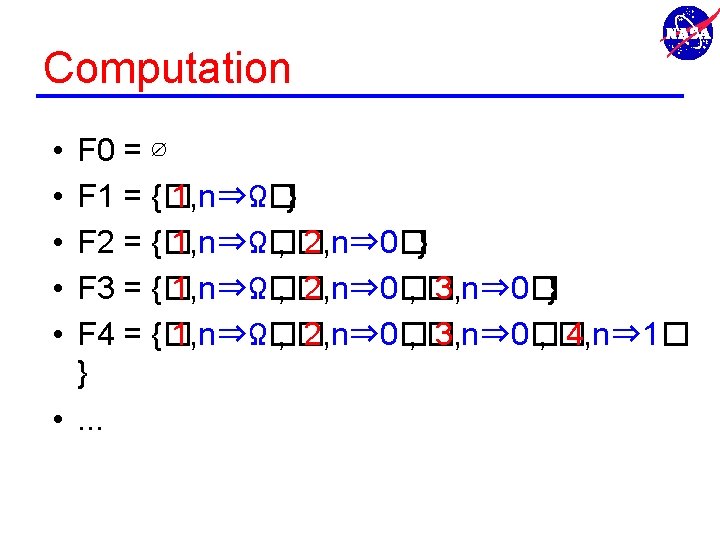
State properties The set of descendants of the initial state s 0: S = {s | s 0 . . . s} Theorem: F : ( (S), ) F (S) = {s 0} {s' | s S: s s'} S = lfp F
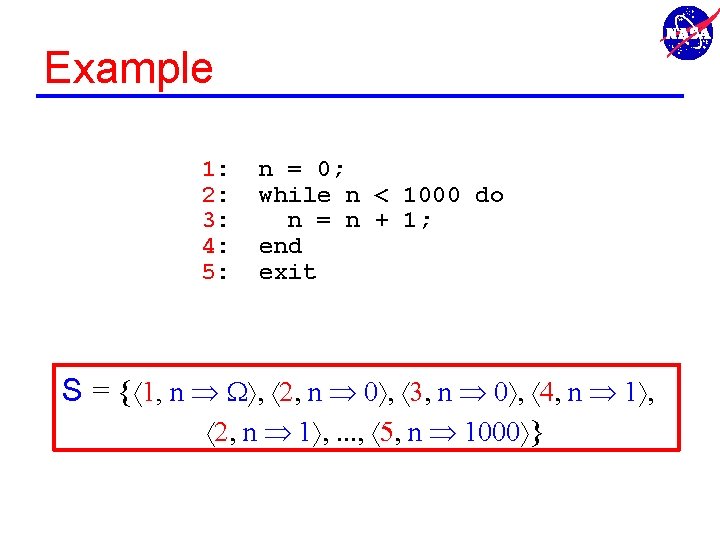
Example 1: 2: 3: 4: 5: n = 0; while n < 1000 do n = n + 1; end exit S = { 1, n , 2, n 0 , 3, n 0 , 4, n 1 , 2, n 1 , . . . , 5, n 1000 }
Methodology Concrete Semantics Tuners Abstract Domain Collecting Semantics Partitioning Abstract Semantics Iterative Resolution Algorithms
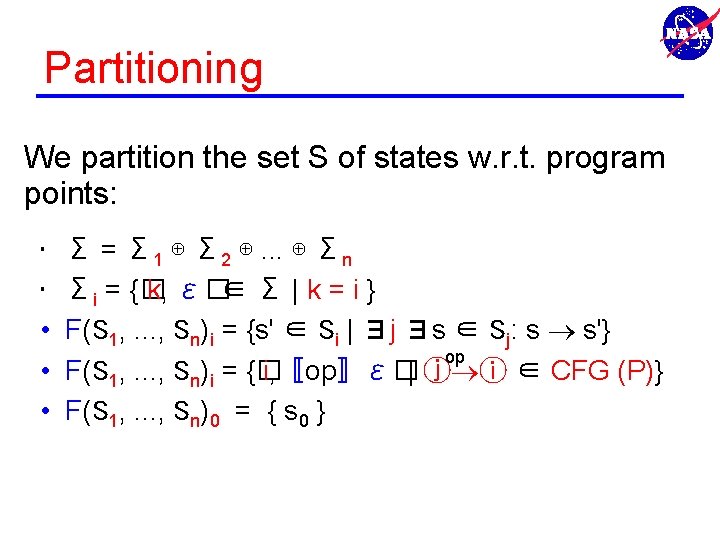
Partitioning We partition the set S of states w. r. t. program points: • • • Σ = Σ 1 ⊕ Σ 2 ⊕. . . ⊕ Σn Σi = {� k, ε�∈ Σ | k = i } F(S 1, . . . , Sn)i = {s' ∈ Si | ∃j ∃s ∈ Sj: s s'} op F(S 1, . . . , Sn)i = {� i, 〚op〛ε�| ⓙ ⓘ ∈ CFG (P)} F(S 1, . . . , Sn)0 = { s 0 }
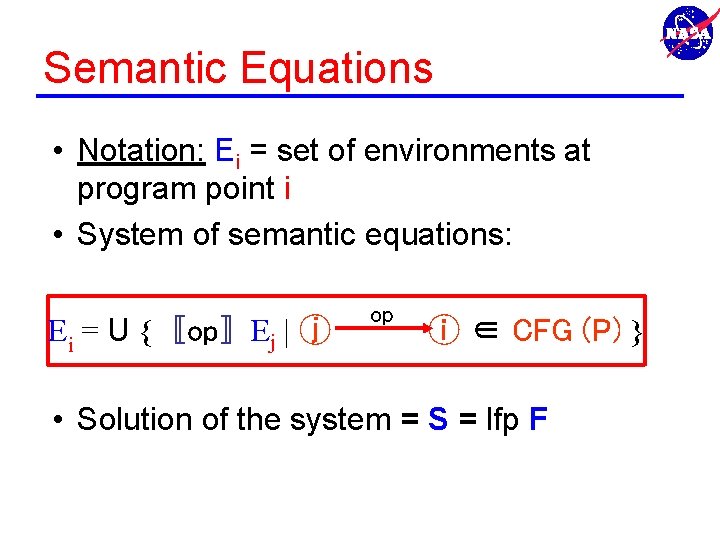
Semantic Equations • Notation: Ei = set of environments at program point i • System of semantic equations: Ei = U {〚op〛Ej | ⓙ op ⓘ ∈ CFG (P) } • Solution of the system = S = lfp F
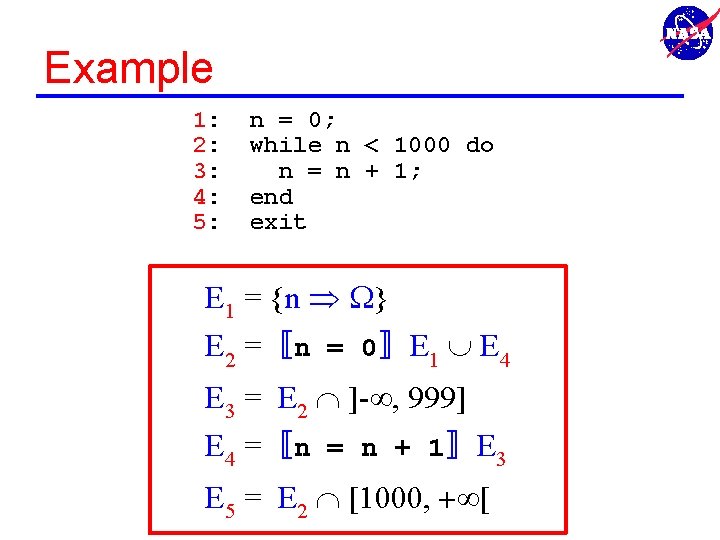
Example 1: 2: 3: 4: 5: n = 0; while n < 1000 do n = n + 1; end exit E 1 = {n } E 2 =〚n = 0〛E 1 E 4 E 3 = E 2 ]- , 999] E 4 =〚n = n + 1〛E 3 E 5 = E 2 [1000, + [
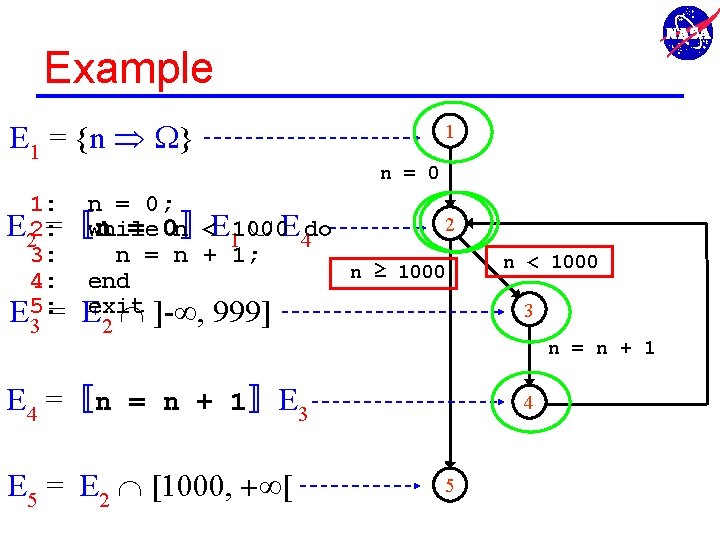
Example E 1 = {n } 1 n = 0 1: n = 0; 2 E 22: =〚while n = 0 n〛E E 4 do < 11000 3: n = n + 1; n ≥ 1000 4: end E 5: = Eexit ]- , 999] 3 2 n < 1000 3 n = n + 1 E 4 =〚n = n + 1〛E 3 E 5 = E 2 [1000, + [ 4 5
Other Kinds of Partitioning • In the case of collecting semantics of traces: – Partitioning w. r. t. procedure calls: context sensitivity – Partitioning w. r. t. executions paths in a procedure: path sensitivity – Dynamic partitioning (Bourdoncle)
Methodology Concrete Semantics Tuners Abstract Domain Collecting Semantics Partitioning Abstract Semantics Iterative Resolution Algorithms
Approximation Problem: Compute a sound approximation S# of S S S# Solution: Galois connections
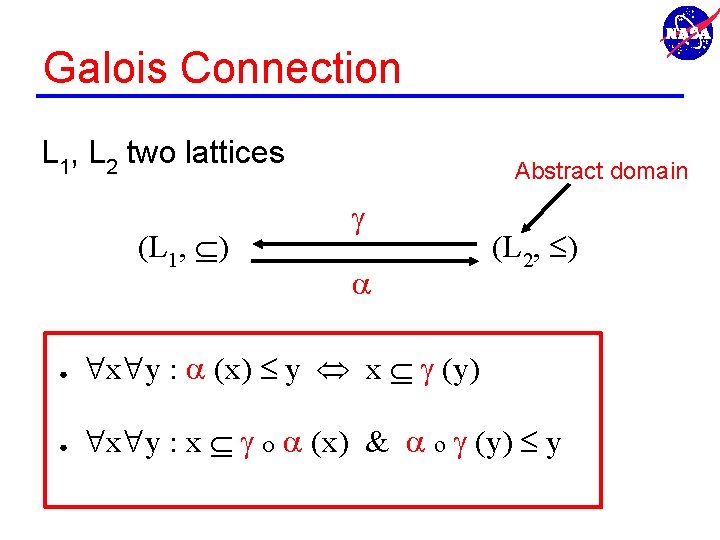
Galois Connection L 1, L 2 two lattices (L 1, ) Abstract domain g a (L 2, ) ● x y : a (x) y x g (y) ● x y : x g o a (x) & a o g (y) y
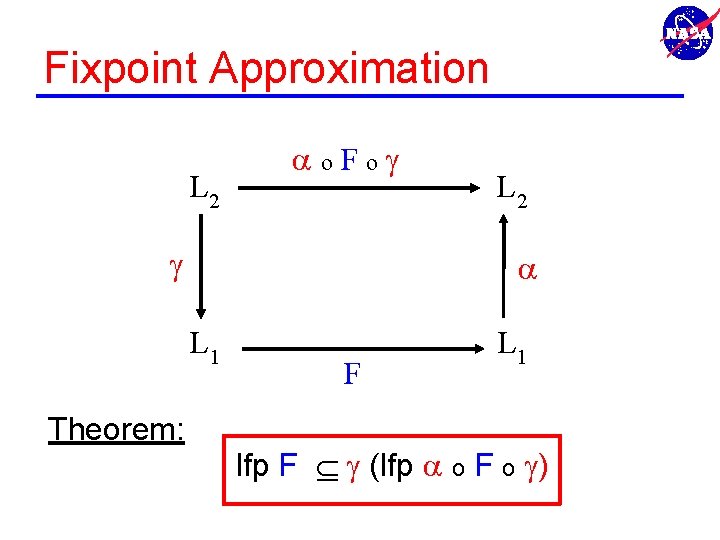
Fixpoint Approximation L 2 ao. Fog g a L 1 Theorem: L 2 F L 1 lfp F g (lfp a o F o g)
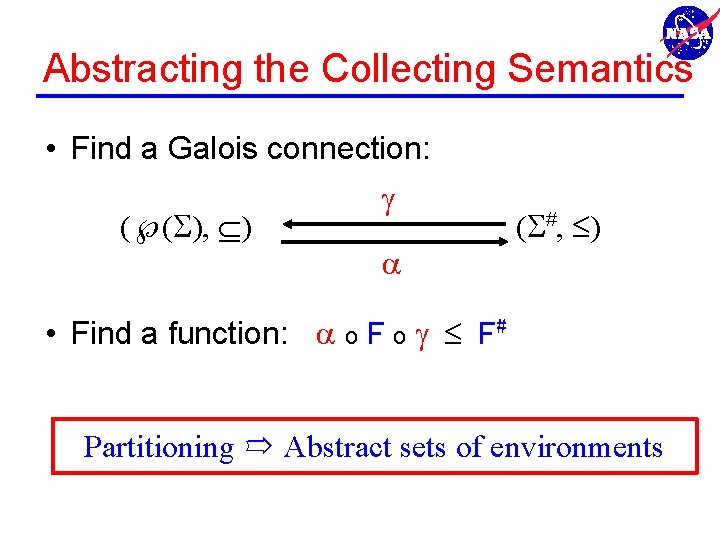
Abstracting the Collecting Semantics • Find a Galois connection: ( (S), ) g a (S#, ) • Find a function: a o F o g F# Partitioning ➱ Abstract sets of environments
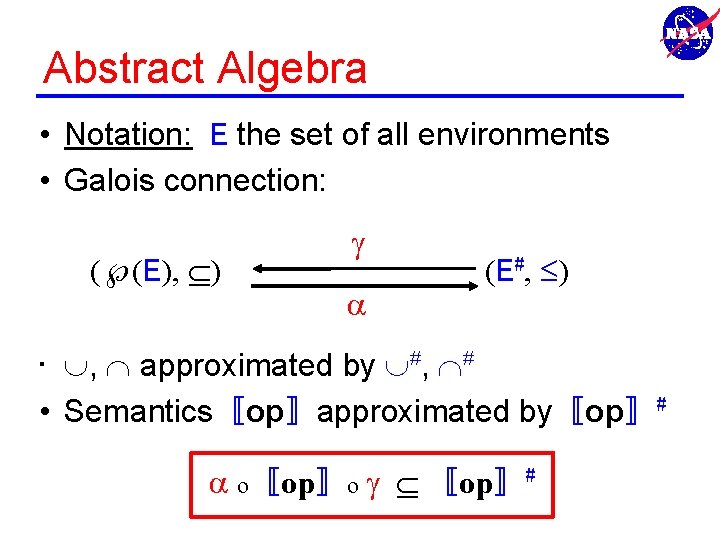
Abstract Algebra • Notation: E the set of all environments • Galois connection: ( (E), ) g a (E#, ) • , approximated by #, # • Semantics〚op〛approximated by〚op〛# a o〚op〛o g 〚op〛#
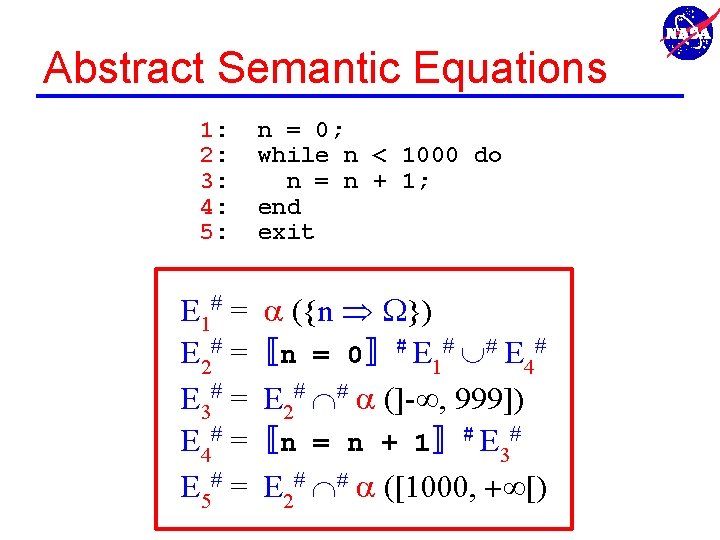
Abstract Semantic Equations 1: 2: 3: 4: 5: n = 0; while n < 1000 do n = n + 1; end exit E 1# = a ({n }) E 2# =〚n = 0〛# E 1# # E 4# E 3# = E 2# # a (]- , 999]) E 4# =〚n = n + 1〛# E 3# E 5# = E 2# # a ([1000, + [)
Methodology Concrete Semantics Tuners Abstract Domain Collecting Semantics Partitioning Abstract Semantics Iterative Resolution Algorithms
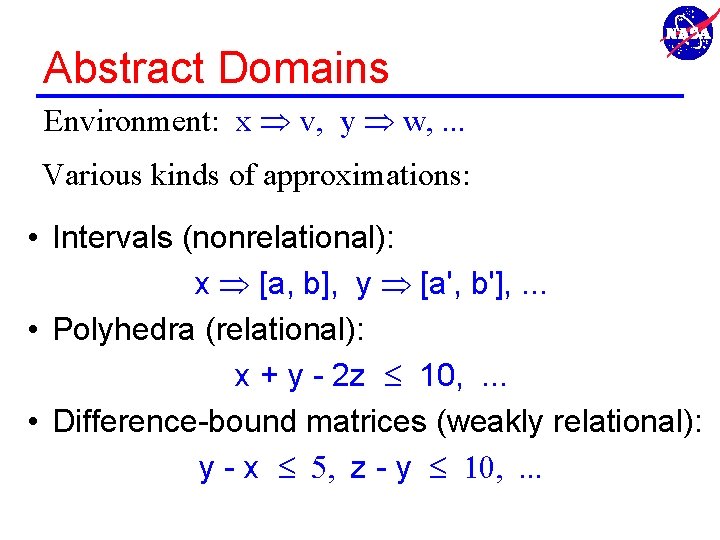
Abstract Domains Environment: x v, y w, . . . Various kinds of approximations: • Intervals (nonrelational): x [a, b], y [a', b'], . . . • Polyhedra (relational): x + y - 2 z 10, . . . • Difference-bound matrices (weakly relational): y - x 5, z - y 10, . . .
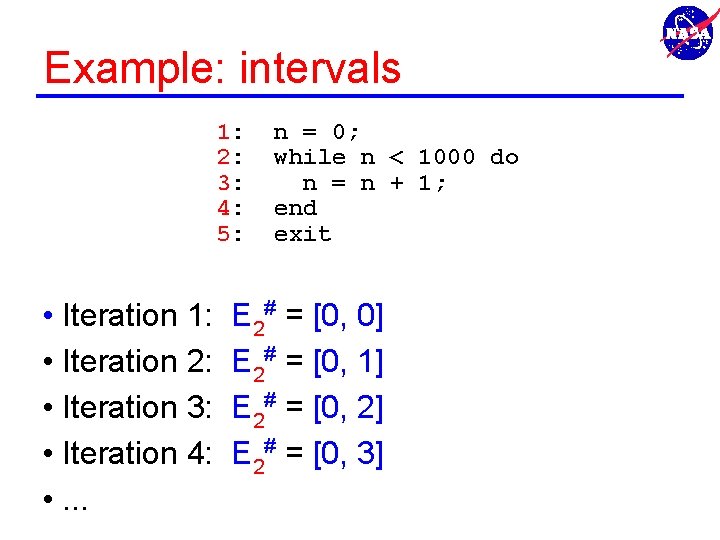
Example: intervals 1: 2: 3: 4: 5: • Iteration 1: • Iteration 2: • Iteration 3: • Iteration 4: • . . . n = 0; while n < 1000 do n = n + 1; end exit E 2# = [0, 0] E 2# = [0, 1] E 2# = [0, 2] E 2# = [0, 3]
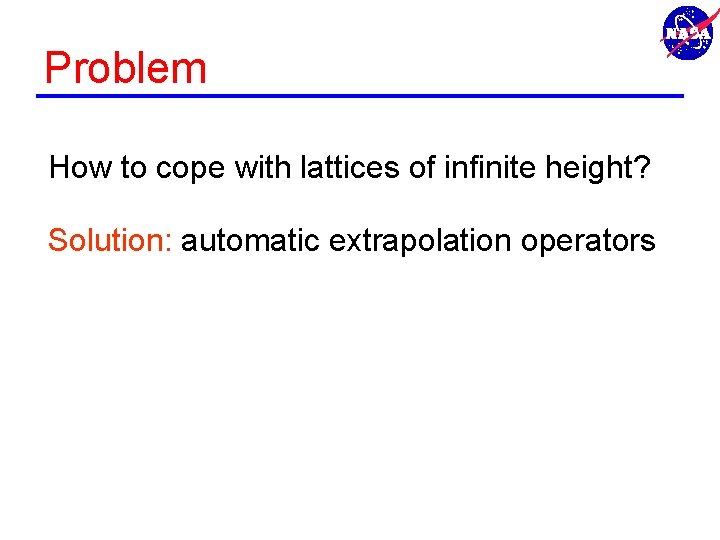
Problem How to cope with lattices of infinite height? Solution: automatic extrapolation operators
Methodology Concrete Semantics Tuners Abstract Domain Collecting Semantics Partitioning Abstract Semantics Iterative Resolution Algorithms
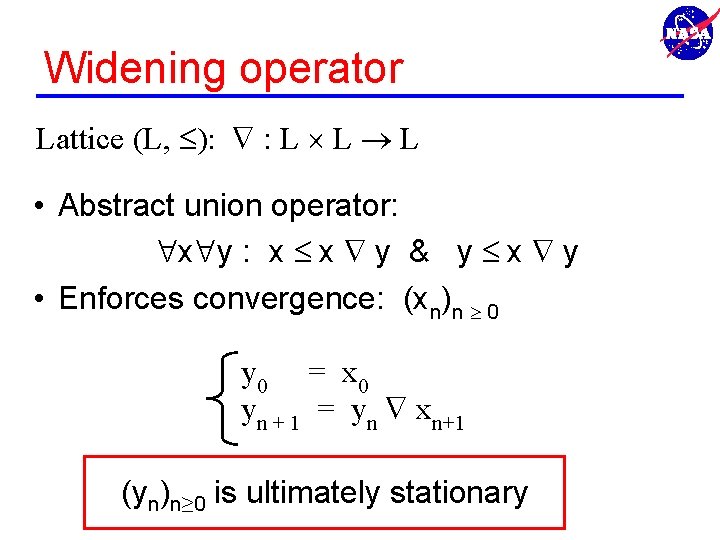
Widening operator Lattice (L, ): : L L L • Abstract union operator: x y : x x y & y x y • Enforces convergence: (xn)n 0 y 0 = x 0 yn + 1 = yn xn+1 (yn)n≥ 0 is ultimately stationary
![Widening of intervals [a, b] [a', b'] ● If a a' then a else](http://slidetodoc.com/presentation_image/4b228994e13079b54fac7b22b7b4775f/image-47.jpg "Widening of intervals [a, b] [a', b'] ● If a a' then a else")
Widening of intervals [a, b] [a', b'] ● If a a' then a else - ● If b' b then b else + ➥ Open unstable bounds (jump over the fixpoint)
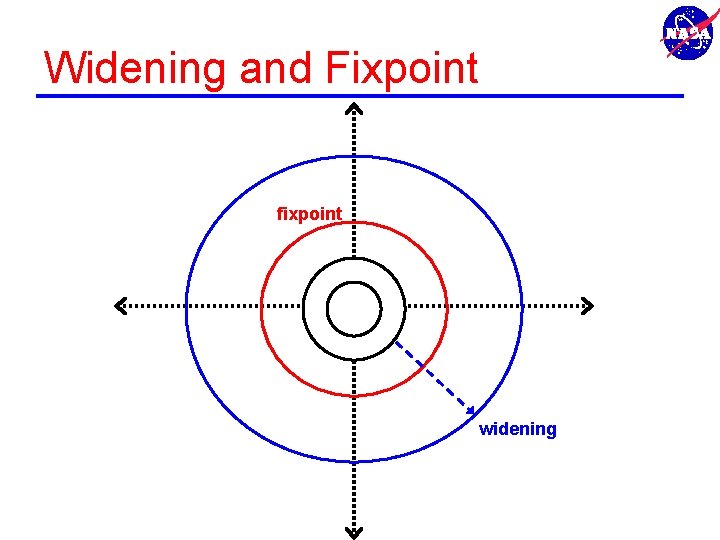
Widening and Fixpoint fixpoint widening
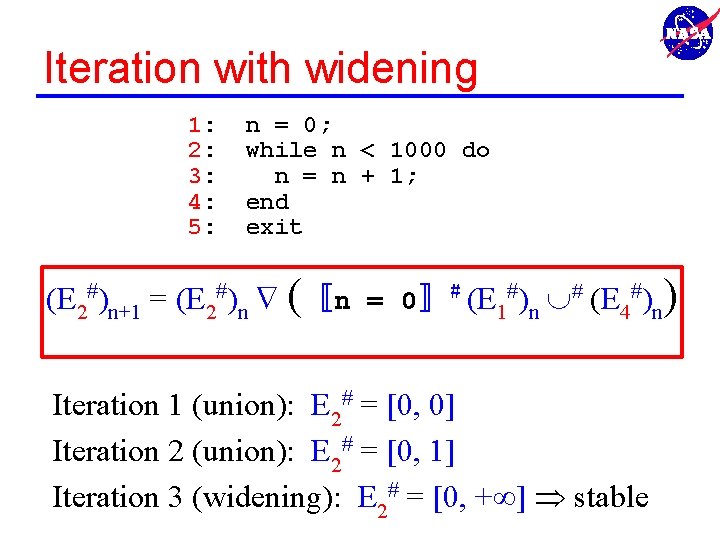
Iteration with widening 1: 2: 3: 4: 5: n = 0; while n < 1000 do n = n + 1; end exit (E 2#)n+1 = (E 2#)n (〚n = 0〛# (E 1#)n # (E 4#)n) Iteration 1 (union): E 2# = [0, 0] Iteration 2 (union): E 2# = [0, 1] Iteration 3 (widening): E 2# = [0, + ] stable
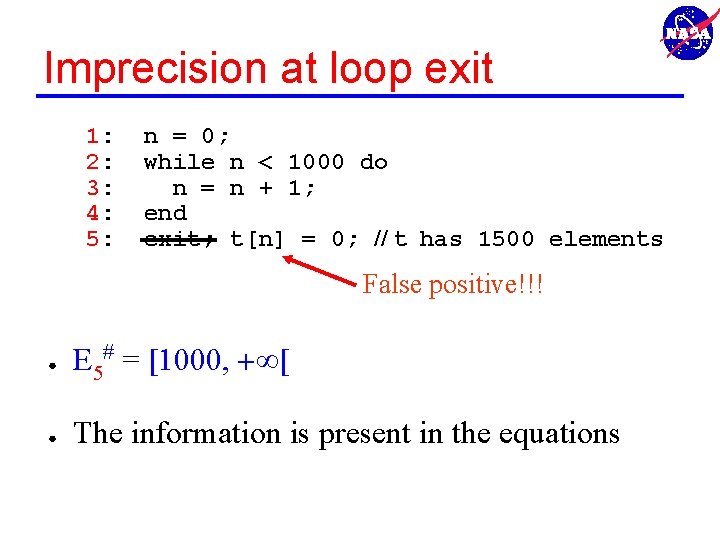
Imprecision at loop exit 1: 2: 3: 4: 5: n = 0; while n < 1000 do n = n + 1; end exit; t[n] = 0; // t has 1500 elements False positive!!! ● E 5# = [1000, + [ ● The information is present in the equations
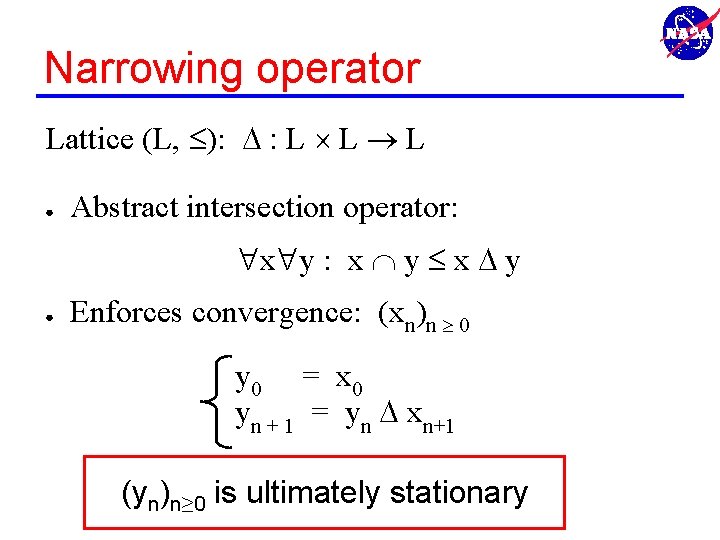
Narrowing operator Lattice (L, ): : L L L ● Abstract intersection operator: x y : x y ● Enforces convergence: (xn)n 0 y 0 = x 0 yn + 1 = yn xn+1 (yn)n≥ 0 is ultimately stationary
![Narrowing of intervals [a, b] [a', b'] ● If a = - then a'](http://slidetodoc.com/presentation_image/4b228994e13079b54fac7b22b7b4775f/image-52.jpg "Narrowing of intervals [a, b] [a', b'] ● If a = - then a'")
Narrowing of intervals [a, b] [a', b'] ● If a = - then a' else a ● If b = + then b' else b ➥ Refine open bounds
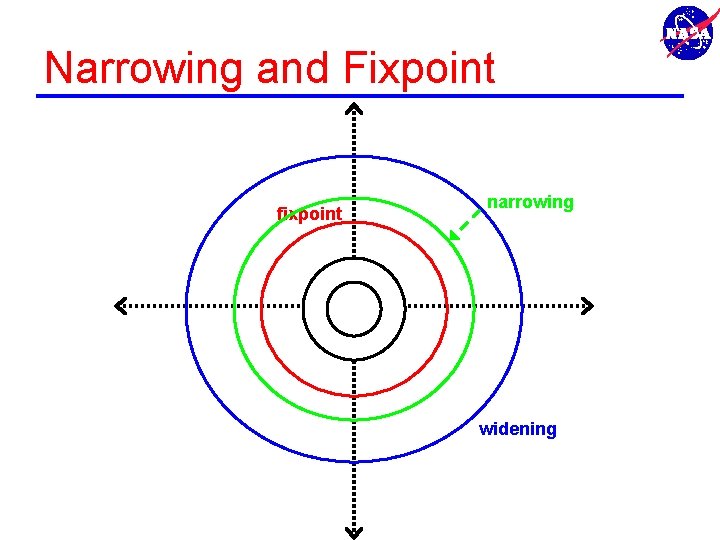
Narrowing and Fixpoint fixpoint narrowing widening
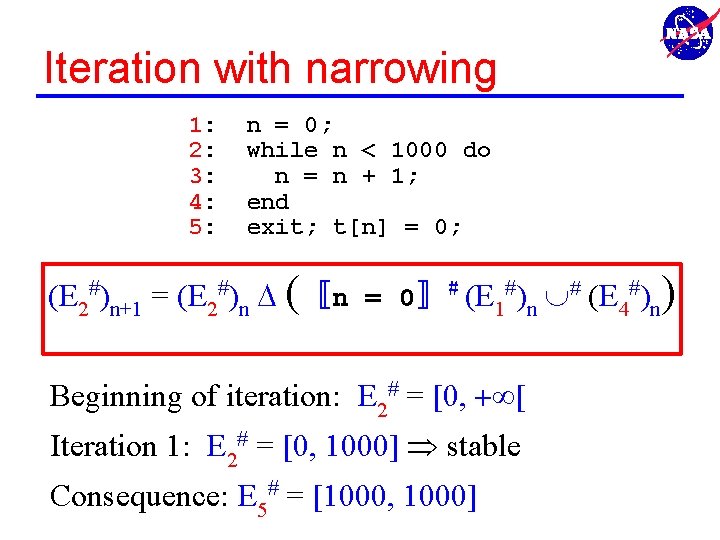
Iteration with narrowing 1: 2: 3: 4: 5: n = 0; while n < 1000 do n = n + 1; end exit; t[n] = 0; (E 2#)n+1 = (E 2#)n (〚n = 0〛# (E 1#)n # (E 4#)n) Beginning of iteration: E 2# = [0, + [ Iteration 1: E 2# = [0, 1000] stable Consequence: E 5# = [1000, 1000]
Methodology Concrete Semantics Tuners Abstract Domain Collecting Semantics Partitioning Abstract Semantics Iterative Resolution Algorithms
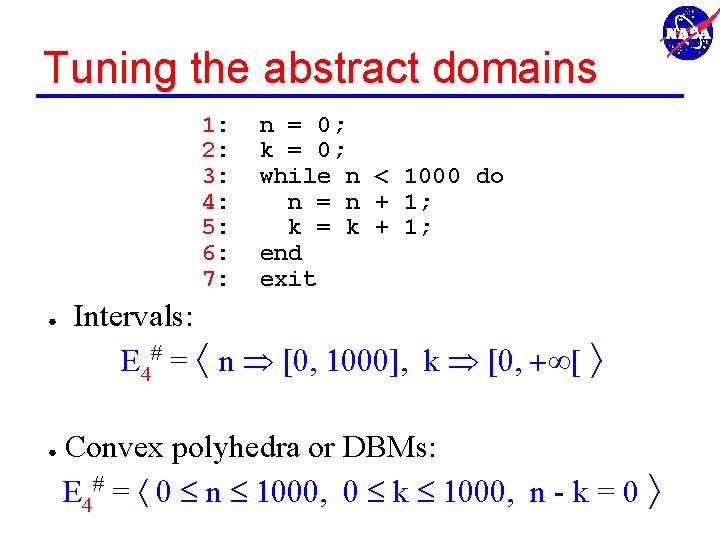
Tuning the abstract domains 1: 2: 3: 4: 5: 6: 7: ● ● n = 0; k = 0; while n < 1000 do n = n + 1; k = k + 1; end exit Intervals: E 4# = n [0, 1000], k [0, + [ Convex polyhedra or DBMs: E 4# = 0 n 1000, 0 k 1000, n - k = 0
Comparison with Data Flow Analysis
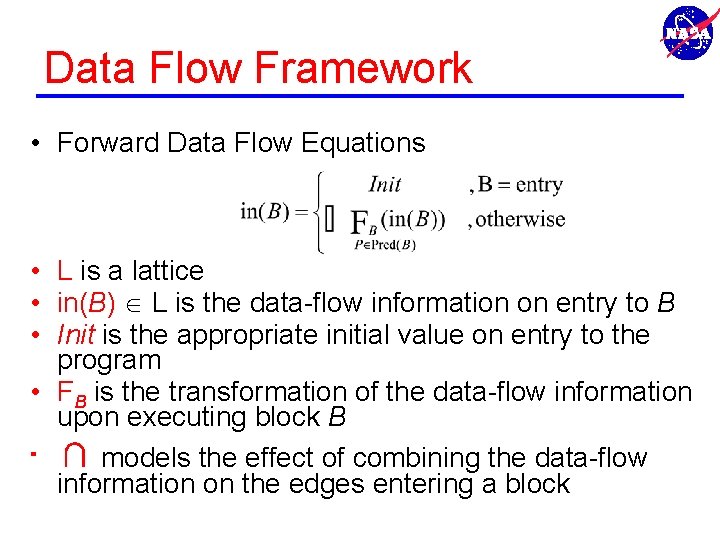
Data Flow Framework • Forward Data Flow Equations • L is a lattice • in(B) L is the data-flow information on entry to B • Init is the appropriate initial value on entry to the program • FB is the transformation of the data-flow information upon executing block B • ∩ models the effect of combining the data-flow information on the edges entering a block
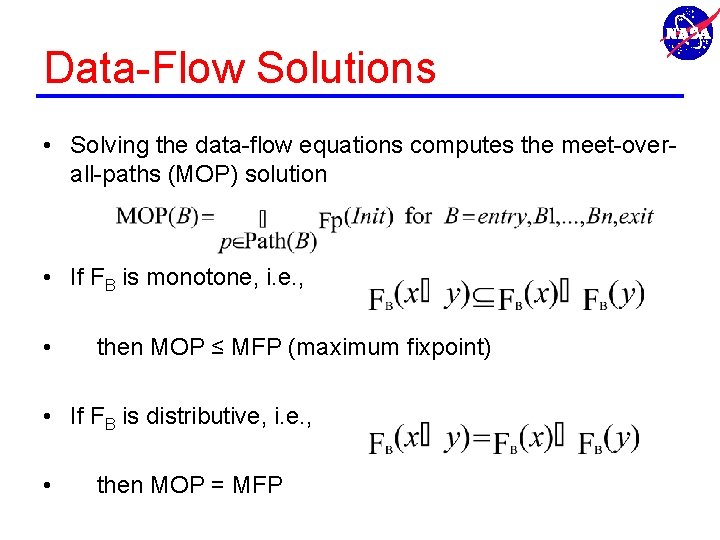
Data-Flow Solutions • Solving the data-flow equations computes the meet-overall-paths (MOP) solution • If FB is monotone, i. e. , • then MOP ≤ MFP (maximum fixpoint) • If FB is distributive, i. e. , • then MOP = MFP
Typical Data-Flow Analyses • • Reaching Definitions Available Expressions Live Variables Upwards-Exposed Uses Copy-Propagation Analysis Constant-Propagation Analysis Partial-redundancy Analysis
Reaching Definitions • Data-flow equations: i: RCHin(i) = U (GEN(j) (RCHin(j) PRSV(j))) where – PRSV are the definitions preserved by the block – GEN are the definitions generated by the blocks • This is an iterative forward bit-vector problem – Iterative: it is solved by iteration from a set of initial values – Forward: information flows in direction of execution – Bit-vector: each definition is represented as a 1 (may reach given point) or a 0 (it does not reach this point)
AI versus classical DFA • Classical DFA is stated in terms of properties whereas AI is usually stated in terms of models, whence the duality in the formulation. • In classical DFA the proof of soundness must be made separately whereas it comes from the construction of the analysis in AI. • Added benefits of AI: – Approximation of fixpoints in AI • Widening operators • Narrowing operators – Abstraction is explicit in AI • Galois connections • Can build a complex analysis as combination of basic, already-proved-correct, analyses

Annotated Bibliography
References • The historic paper: – Patrick Cousot & Radhia Cousot. Abstract interpretation: a unified lattice model for static analysis of programs by construction or approximation of fixpoints. In Conference Record of the Fourth Annual ACM SIGPLAN-SIGACT Symposium on Principles of Programming Languages, pages 238— 252, Los Angeles, California, 1977. ACM Press, New York, NY, USA. • Accessible introductions to theory: – Patrick Cousot. Semantic foundations of program analysis. In S. S. Muchnick and N. D. Jones, editors, Program Flow Analysis: Theory and Applications, Ch. 10, pages 303— 342, Prentice-Hall, Inc. , Englewood Cliffs, New Jersey, U. S. A. , 1981. – Patrick Cousot & Radhia Cousot. Abstract interpretation and application to logic programs. Journal of Logic Programming, 13(2— 3): 103— 179, 1992. • Beyond Galois connections, a presentation of relaxed frameworks: – Patrick Cousot & Radhia Cousot. Abstract interpretation frameworks. Journal of Logic and Computation, 2(4): 511— 547, August 1992. • A thorough description of a static analyzer with all the proofs (difficult to read): – Patrick Cousot. The Calculational Design of a Generic Abstract Interpreter. Course notes for the NATO International Summer School 1998 on Calculational System Design. Marktoberdorf, Germany, 28 July— 9 august 1998, organized by F. L. Bauer, M. Broy, E. W. Dijkstra, D. Gries and C. A. R. Hoare.
References • The abstract domain of intervals: – Patrick Cousot & Radhia Cousot. Static Determination of Dynamic Properties of Programs. In B. Robinet, editor, Proceedings of the second international symposium on Programming, Paris, France, pages 106— 130, april 13 -15 1976, Dunod, Paris. • The abstract domain of convex polyhedra: – Patrick Cousot & Nicolas Halbwachs. Automatic discovery of linear restraints among variables of a program. In Conference R ecord of the Fifth Annual ACM SIGPLANSIGACT Symposium on Principles of Program ming Languages, pages 84— 97, Tucson, Arizona, 1978. ACM Press, New York, NY, USA. • Weakly relational abstract domains: – Antoine Miné. The Octagon Abstract Domain. In Analysis, Slicing and Transformation (part of Working Conference on Reverse Engineering), October 2001, IEEE, pages 310 -319. – Antoine Miné. A New Numerical Abstract Domain Based on Difference-Bound Matrices. In Program As Data Objects II, May 2001, LNCS 2053, pages 155 -172. • Classical data flow analysis: – Steven Muchnick. Advanced Compiler Design and Implementation. Morgan Kaufmann, 1997.
- Slides: 65