
STATIC EQUILIBRIUM Ex A 20 0 kg object
STATIC EQUILIBRIUM
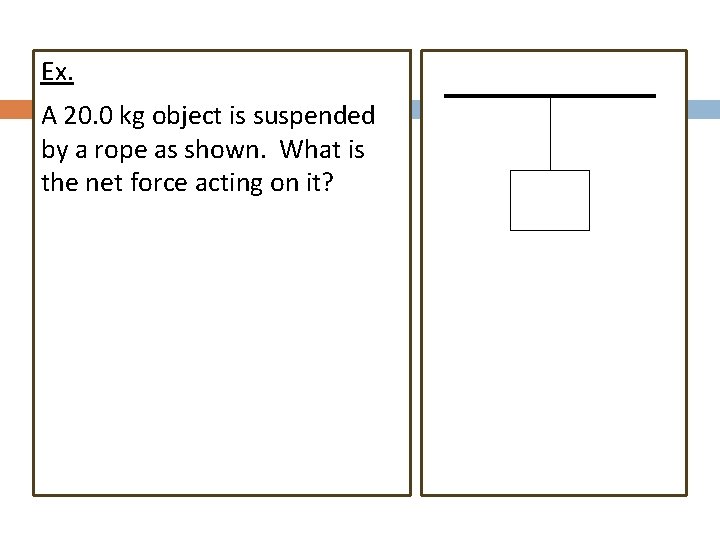
Ex. A 20. 0 kg object is suspended by a rope as shown. What is the net force acting on it?
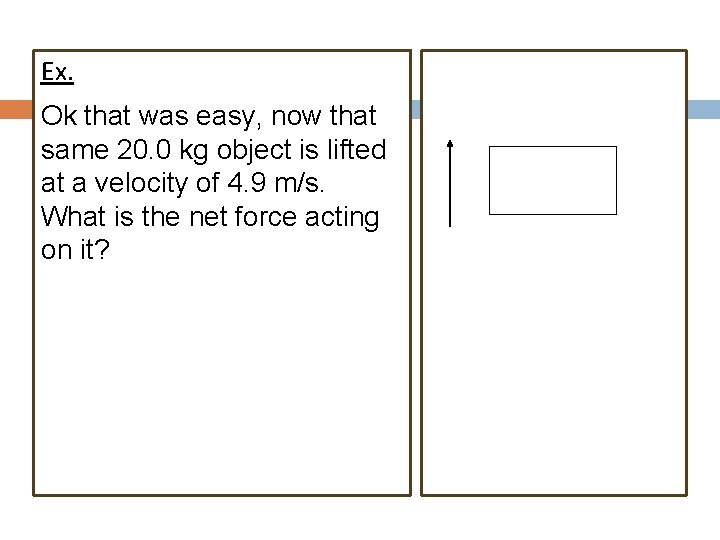
Ex. Ok that was easy, now that same 20. 0 kg object is lifted at a velocity of 4. 9 m/s. What is the net force acting on it?
Because in both cases the net force on the objects is zero they are said to be in equilibrium. If the object is stationary it is said to be in static equilibrium while an object moving at a constant velocity is in dynamic equilibrium. These are both cases where the object is in translational equilibrium. In these cases the sum of all forces is zero.

Translational motion refers to motion along a straight line. The condition for translational equilibrium becomes the: The First Condition for Equilibrium: ΣF = 0 And so, ΣFx = 0 ΣFy = 0
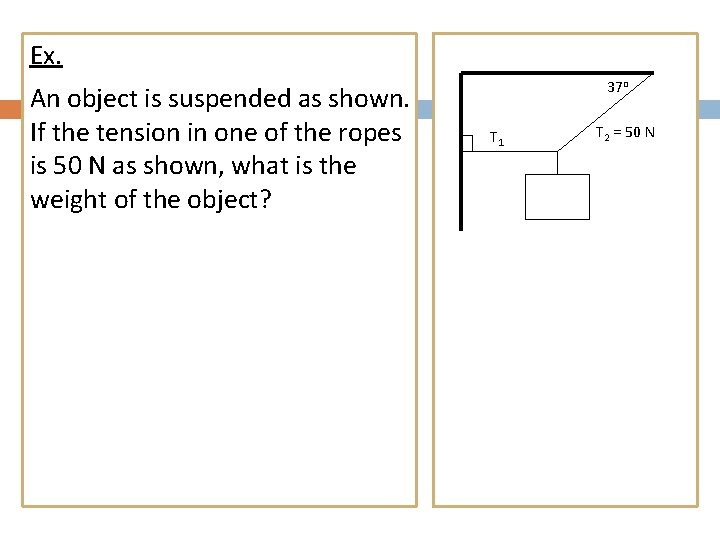
Ex. An object is suspended as shown. If the tension in one of the ropes is 50 N as shown, what is the weight of the object? 37 o T 1 T 2 = 50 N
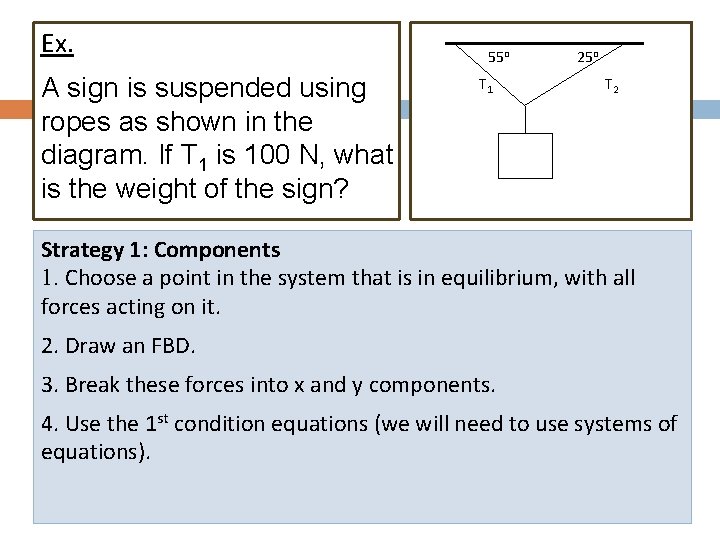
Ex. A sign is suspended using ropes as shown in the diagram. If T 1 is 100 N, what is the weight of the sign? 55 o T 1 25 o T 2 Strategy 1: Components 1. Choose a point in the system that is in equilibrium, with all forces acting on it. 2. Draw an FBD. 3. Break these forces into x and y components. 4. Use the 1 st condition equations (we will need to use systems of equations).
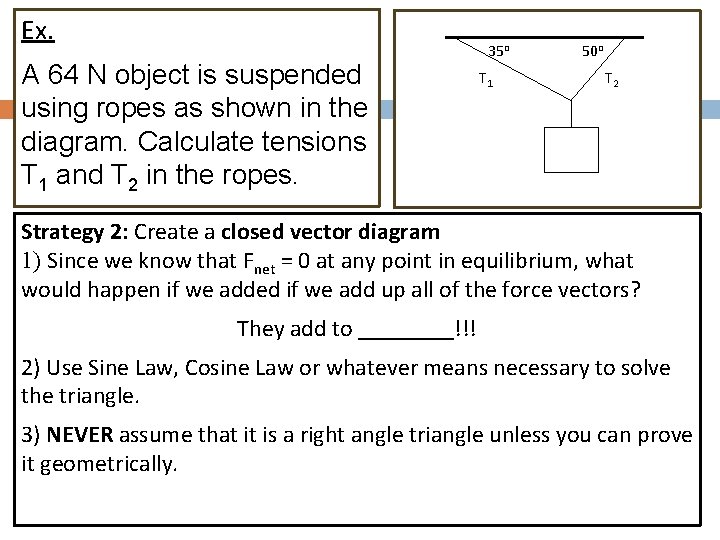
Ex. A 64 N object is suspended using ropes as shown in the diagram. Calculate tensions T 1 and T 2 in the ropes. 35 o T 1 50 o T 2 Strategy 2: Create a closed vector diagram 1) Since we know that Fnet = 0 at any point in equilibrium, what would happen if we added if we add up all of the force vectors? They add to ____!!! 2) Use Sine Law, Cosine Law or whatever means necessary to solve the triangle. 3) NEVER assume that it is a right angle triangle unless you can prove it geometrically.
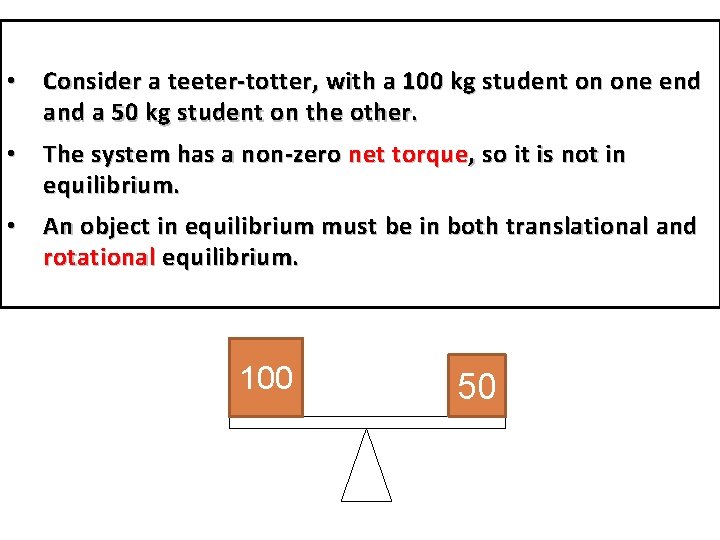
• Consider a teeter-totter, with a 100 kg student on one end a 50 kg student on the other. • The system has a non-zero net torque, so it is not in equilibrium. • An object in equilibrium must be in both translational and rotational equilibrium. 100 50
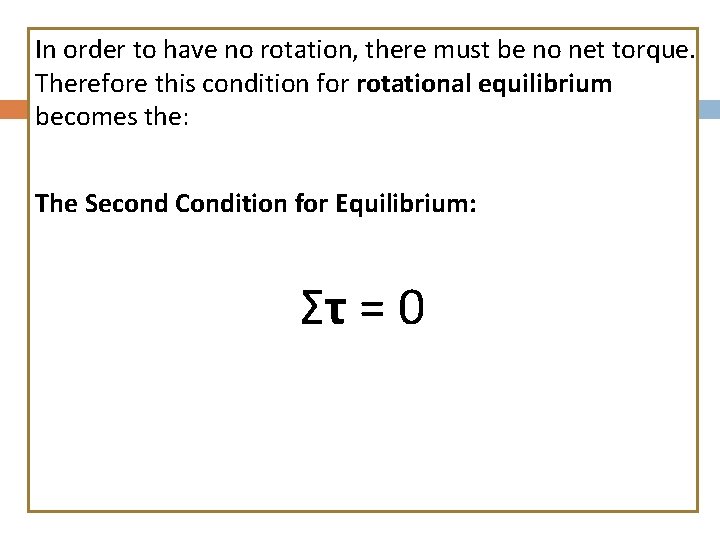
In order to have no rotation, there must be no net torque. Therefore this condition for rotational equilibrium becomes the: The Second Condition for Equilibrium: Στ = 0
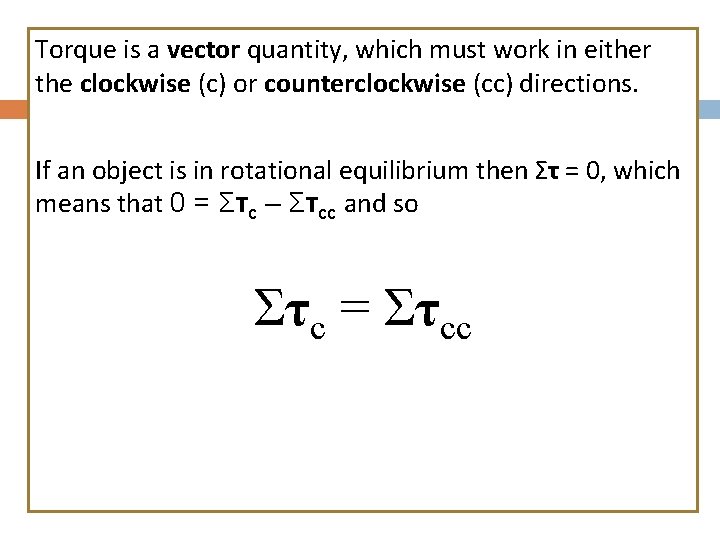
Torque is a vector quantity, which must work in either the clockwise (c) or counterclockwise (cc) directions. If an object is in rotational equilibrium then Στ = 0, which means that 0 = Στc – Στcc and so Στc = Στcc
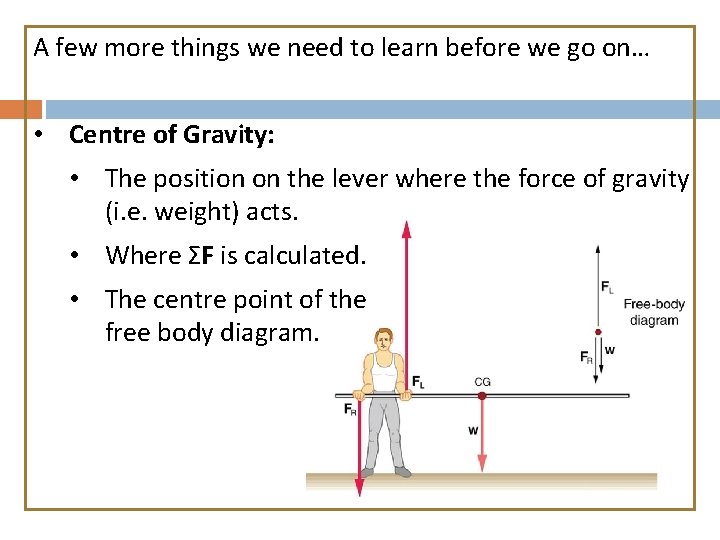
A few more things we need to learn before we go on… • Centre of Gravity: • The position on the lever where the force of gravity (i. e. weight) acts. • Where ΣF is calculated. • The centre point of the free body diagram.
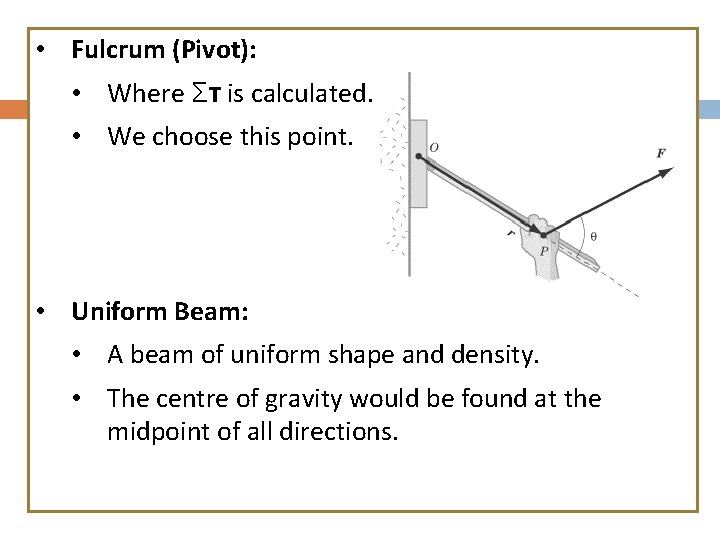
• Fulcrum (Pivot): • Where Στ is calculated. • We choose this point. • Uniform Beam: • A beam of uniform shape and density. • The centre of gravity would be found at the midpoint of all directions.
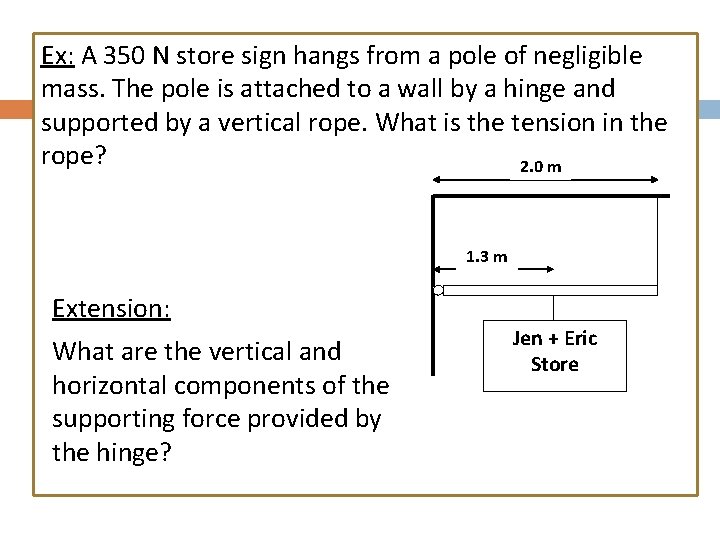
Ex: A 350 N store sign hangs from a pole of negligible mass. The pole is attached to a wall by a hinge and supported by a vertical rope. What is the tension in the rope? 2. 0 m 1. 3 m Extension: What are the vertical and horizontal components of the supporting force provided by the hinge? Jen + Eric Store
Problem Solving Strategy 1. 2. 3. 4. 5. Identify all forces and draw a free-body diagram. Choose an appropriate positive direction. Choose a convenient coordinate system for the components and find them. Write out the translational equilibrium equations for the centre of gravity. ΣF = 0 Write out the rotational equilibrium equations for an axis of choice. Try to pick one that makes the calculations easier. Choose an appropriate positive direction for clockwise/counterclockwise. Στ = 0 Solve. Remember n equations can solve for n
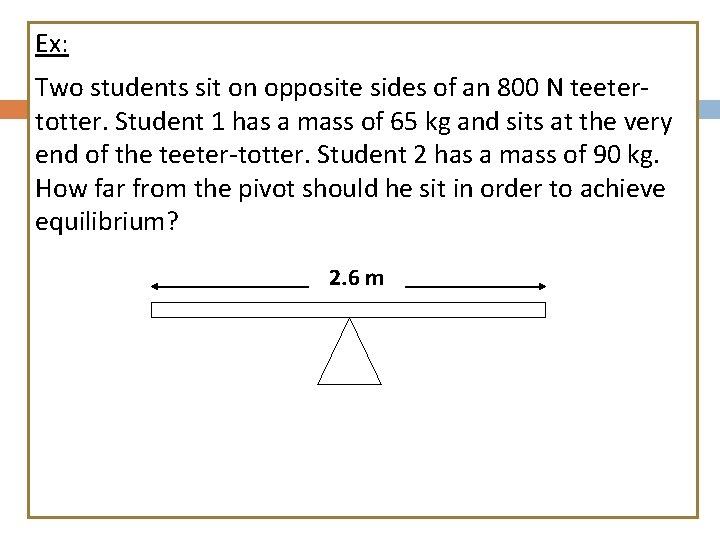
Ex: Two students sit on opposite sides of an 800 N teetertotter. Student 1 has a mass of 65 kg and sits at the very end of the teeter-totter. Student 2 has a mass of 90 kg. How far from the pivot should he sit in order to achieve equilibrium? 2. 6 m
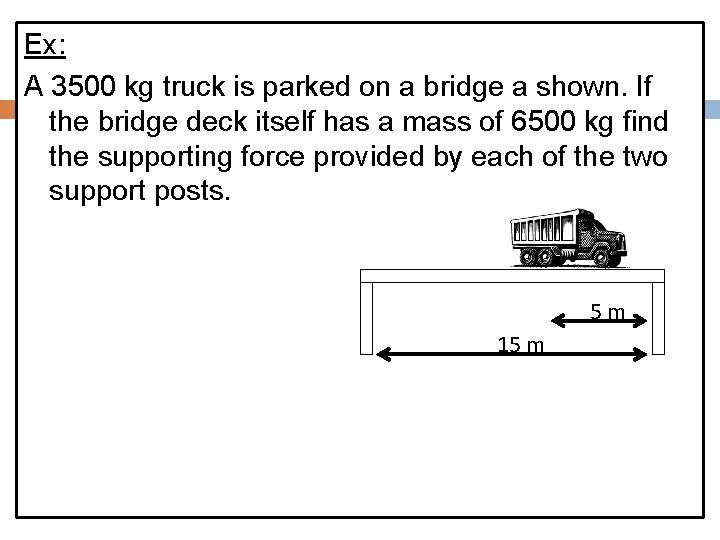
Ex: A 3500 kg truck is parked on a bridge a shown. If the bridge deck itself has a mass of 6500 kg find the supporting force provided by each of the two support posts. 5 m 15 m
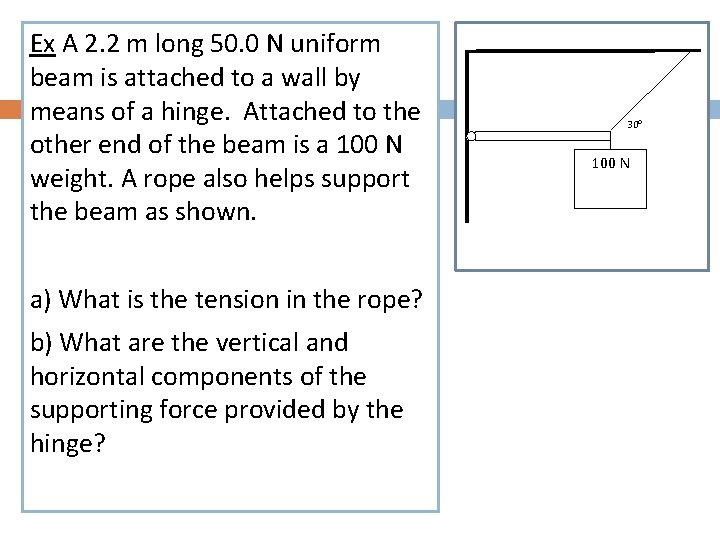
Ex A 2. 2 m long 50. 0 N uniform beam is attached to a wall by means of a hinge. Attached to the other end of the beam is a 100 N weight. A rope also helps support the beam as shown. a) What is the tension in the rope? b) What are the vertical and horizontal components of the supporting force provided by the hinge? 30 o 100 N
First we redraw the beam with the forces acting on it and their distances from the pivot. Notice that if we break the tension in the rope into component forces, the parallel component does not contribute to the torque in either the clockwise or counterclockwise direction. So, whenever we are calculating the torque on a body we must ALWAYS use the perpendicular component of any force.
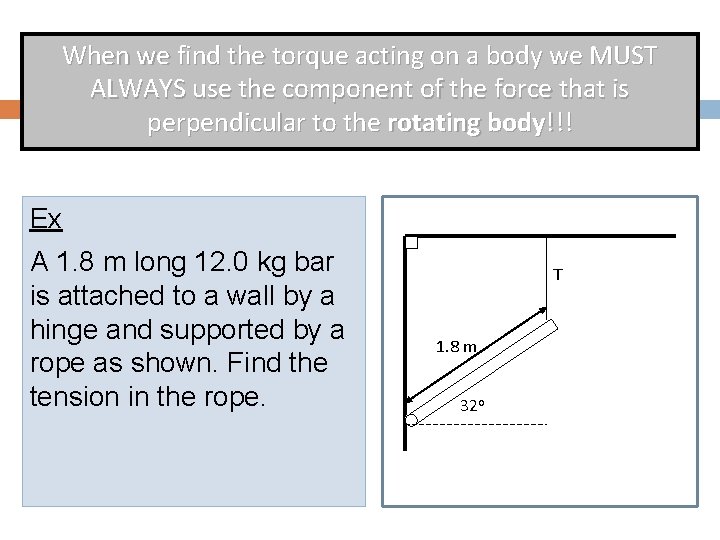
When we find the torque acting on a body we MUST ALWAYS use the component of the force that is perpendicular to the rotating body!!! Ex A 1. 8 m long 12. 0 kg bar is attached to a wall by a hinge and supported by a rope as shown. Find the tension in the rope. T 1. 8 m 32 o
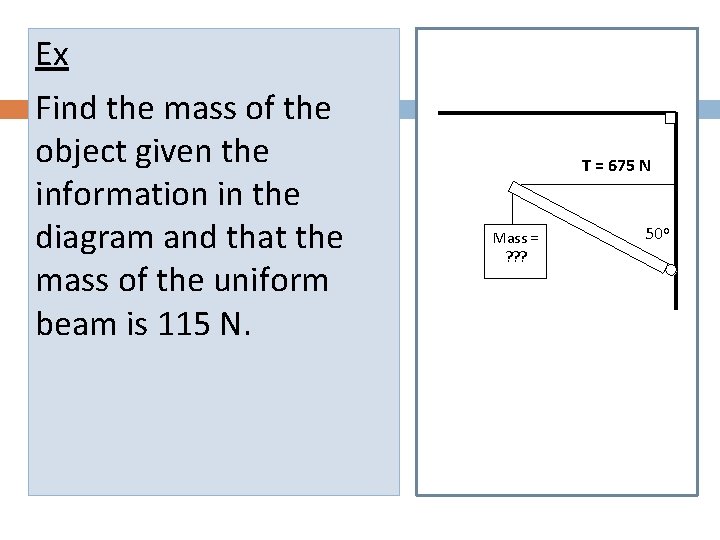
Ex Find the mass of the object given the information in the diagram and that the mass of the uniform beam is 115 N. T = 675 N Mass = ? ? ? 50 o
Ex (extra practice) A 5. 0 m long 12 kg uniform ladder leans against a frictionless wall 4. 0 m above the ground. Determine the forces exerted by the floor and by the wall on the ladder. Hint: Ffloor = FN + Ff while Fwall = FN.
- Slides: 22