
Static Electromagnetics 2007 Spring Prof ChangWook Baek Chapter
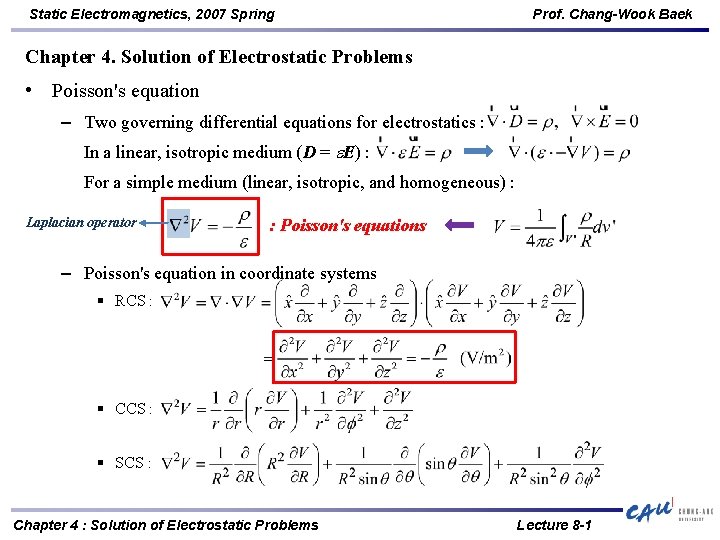
Static Electromagnetics, 2007 Spring Prof. Chang-Wook Baek Chapter 4. Solution of Electrostatic Problems • Poisson's equation – Two governing differential equations for electrostatics : In a linear, isotropic medium (D = E) : For a simple medium (linear, isotropic, and homogeneous) : Laplacian operator : Poisson's equations – Poisson's equation in coordinate systems § RCS : § CCS : § SCS : Chapter 4 : Solution of Electrostatic Problems Lecture 8 -1
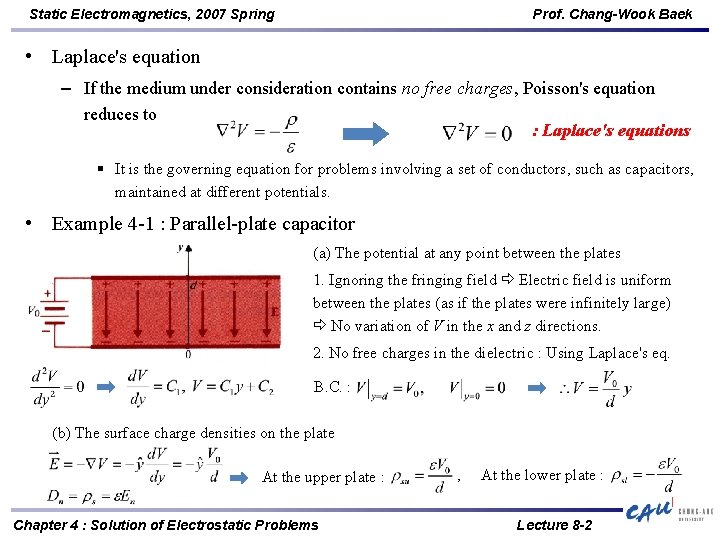
Static Electromagnetics, 2007 Spring Prof. Chang-Wook Baek • Laplace's equation – If the medium under consideration contains no free charges, Poisson's equation reduces to : Laplace's equations § It is the governing equation for problems involving a set of conductors, such as capacitors, maintained at different potentials. • Example 4 -1 : Parallel-plate capacitor (a) The potential at any point between the plates 1. Ignoring the fringing field Electric field is uniform between the plates (as if the plates were infinitely large) No variation of V in the x and z directions. 2. No free charges in the dielectric : Using Laplace's eq. B. C. : (b) The surface charge densities on the plate At the upper plate : Chapter 4 : Solution of Electrostatic Problems , At the lower plate : Lecture 8 -2
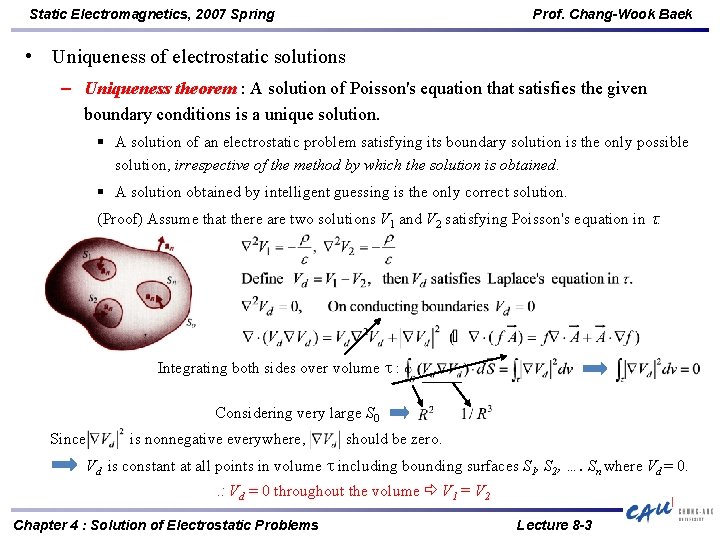
Static Electromagnetics, 2007 Spring Prof. Chang-Wook Baek • Uniqueness of electrostatic solutions – Uniqueness theorem : A solution of Poisson's equation that satisfies the given boundary conditions is a unique solution. § A solution of an electrostatic problem satisfying its boundary solution is the only possible solution, irrespective of the method by which the solution is obtained. § A solution obtained by intelligent guessing is the only correct solution. (Proof) Assume that there are two solutions V 1 and V 2 satisfying Poisson's equation in . Integrating both sides over volume : Considering very large S 0 Since is nonnegative everywhere, should be zero. Vd is constant at all points in volume including bounding surfaces S 1, S 2, …. Sn where Vd = 0 throughout the volume V 1 = V 2 Chapter 4 : Solution of Electrostatic Problems Lecture 8 -3
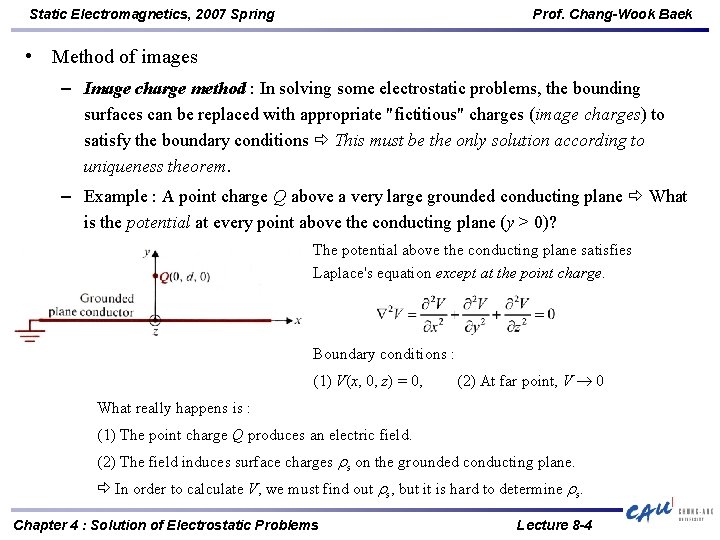
Static Electromagnetics, 2007 Spring Prof. Chang-Wook Baek • Method of images – Image charge method : In solving some electrostatic problems, the bounding surfaces can be replaced with appropriate "fictitious" charges (image charges) to satisfy the boundary conditions This must be the only solution according to uniqueness theorem. – Example : A point charge Q above a very large grounded conducting plane What is the potential at every point above the conducting plane (y > 0)? The potential above the conducting plane satisfies Laplace's equation except at the point charge. Boundary conditions : (1) V(x, 0, z) = 0, (2) At far point, V 0 What really happens is : (1) The point charge Q produces an electric field. (2) The field induces surface charges s on the grounded conducting plane. In order to calculate V, we must find out s, but it is hard to determine s. Chapter 4 : Solution of Electrostatic Problems Lecture 8 -4

Static Electromagnetics, 2007 Spring Prof. Chang-Wook Baek (Cont'd) (1) Potential above the conducting plate (y > 0) (0, d, 0) [HW] Image charges must be located outside the region in which the filed is to be determined. Explain why. Another point charge –Q (image charge) is located at y = – d and the conducting plate is removed. This situation satisfies the original boundary conditions. (0, -d, 0) This potential is the only solution of the original problem by uniqueness theorem. (2) Surface charge density on the conducting plate Chapter 4 : Solution of Electrostatic Problems Lecture 8 -5
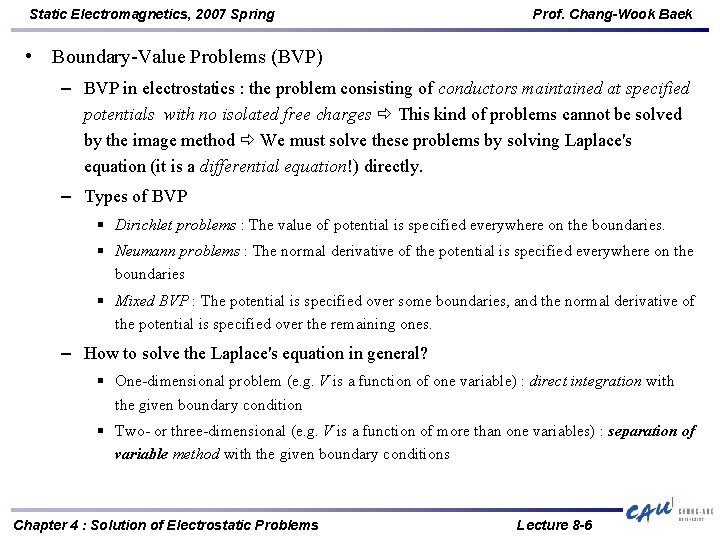
Static Electromagnetics, 2007 Spring Prof. Chang-Wook Baek • Boundary-Value Problems (BVP) – BVP in electrostatics : the problem consisting of conductors maintained at specified potentials with no isolated free charges This kind of problems cannot be solved by the image method We must solve these problems by solving Laplace's equation (it is a differential equation!) directly. – Types of BVP § Dirichlet problems : The value of potential is specified everywhere on the boundaries. § Neumann problems : The normal derivative of the potential is specified everywhere on the boundaries § Mixed BVP : The potential is specified over some boundaries, and the normal derivative of the potential is specified over the remaining ones. – How to solve the Laplace's equation in general? § One-dimensional problem (e. g. V is a function of one variable) : direct integration with the given boundary condition § Two- or three-dimensional (e. g. V is a function of more than one variables) : separation of variable method with the given boundary conditions Chapter 4 : Solution of Electrostatic Problems Lecture 8 -6
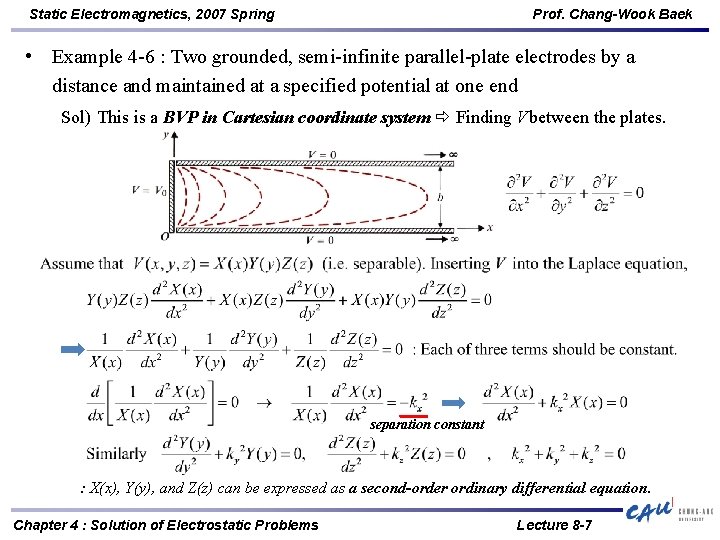
Static Electromagnetics, 2007 Spring Prof. Chang-Wook Baek • Example 4 -6 : Two grounded, semi-infinite parallel-plate electrodes by a distance and maintained at a specified potential at one end Sol) This is a BVP in Cartesian coordinate system Finding V between the plates. separation constant : X(x), Y(y), and Z(z) can be expressed as a second-order ordinary differential equation. Chapter 4 : Solution of Electrostatic Problems Lecture 8 -7
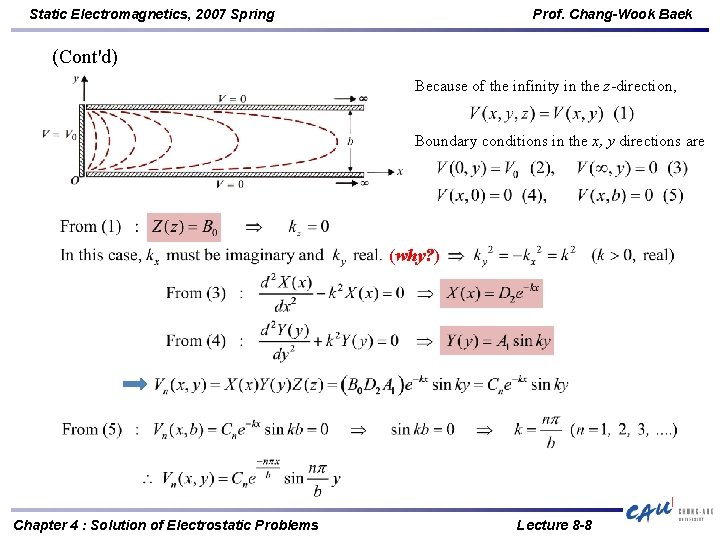
Static Electromagnetics, 2007 Spring Prof. Chang-Wook Baek (Cont'd) § Because of the infinity in the z-direction, Boundary conditions in the x, y directions are (why? ) Chapter 4 : Solution of Electrostatic Problems Lecture 8 -8
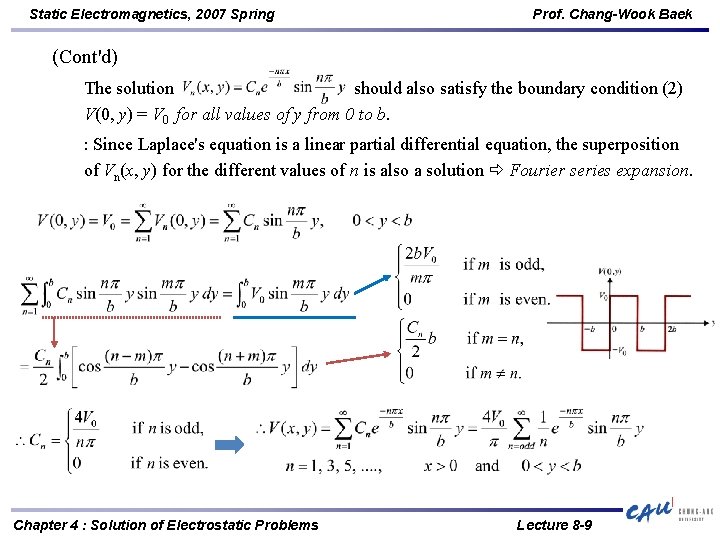
Static Electromagnetics, 2007 Spring Prof. Chang-Wook Baek (Cont'd) The solution should also satisfy the boundary condition (2) V(0, y) = V 0 for all values of y from 0 to b. : Since Laplace's equation is a linear partial differential equation, the superposition of Vn(x, y) for the different values of n is also a solution Fourier series expansion. Chapter 4 : Solution of Electrostatic Problems Lecture 8 -9
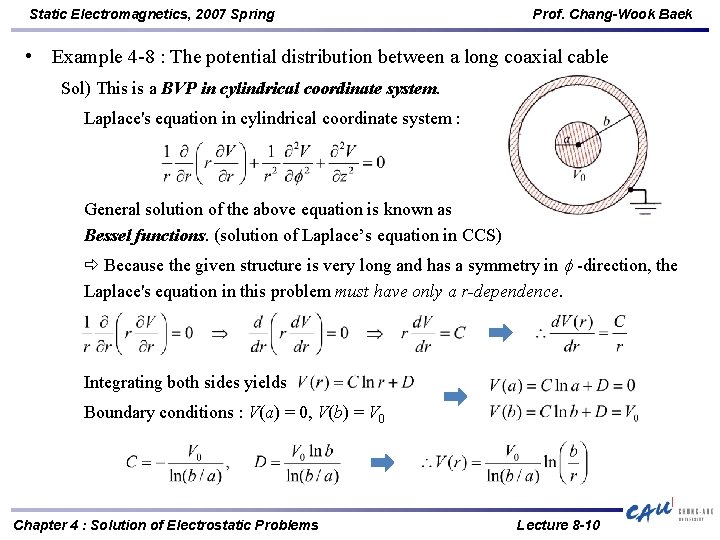
Static Electromagnetics, 2007 Spring Prof. Chang-Wook Baek • Example 4 -8 : The potential distribution between a long coaxial cable Sol) This is a BVP in cylindrical coordinate system. Laplace's equation in cylindrical coordinate system : General solution of the above equation is known as Bessel functions. (solution of Laplace’s equation in CCS) Because the given structure is very long and has a symmetry in -direction, the Laplace's equation in this problem must have only a r-dependence. Integrating both sides yields Boundary conditions : V(a) = 0, V(b) = V 0 Chapter 4 : Solution of Electrostatic Problems Lecture 8 -10
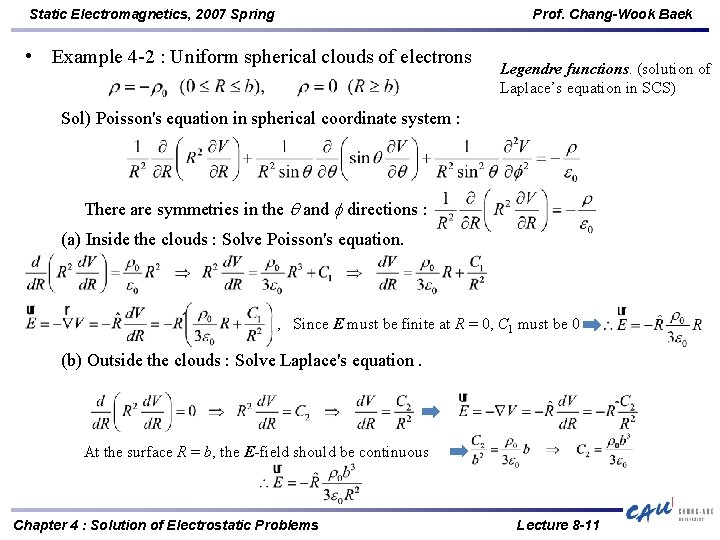
Static Electromagnetics, 2007 Spring Prof. Chang-Wook Baek • Example 4 -2 : Uniform spherical clouds of electrons Legendre functions. (solution of Laplace’s equation in SCS) Sol) Poisson's equation in spherical coordinate system : There are symmetries in the and directions : (a) Inside the clouds : Solve Poisson's equation. , Since E must be finite at R = 0, C 1 must be 0 (b) Outside the clouds : Solve Laplace's equation. At the surface R = b, the E-field should be continuous Chapter 4 : Solution of Electrostatic Problems Lecture 8 -11
- Slides: 11