
Static Electricity Recap On your whiteboard use the
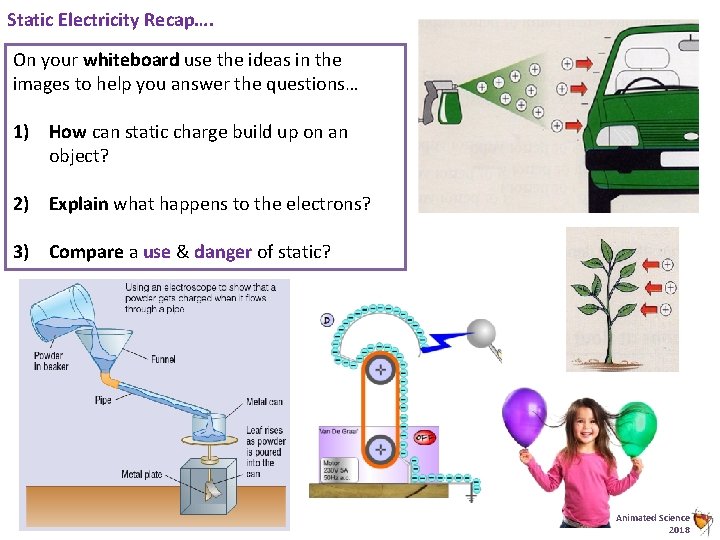
Static Electricity Recap…. On your whiteboard use the ideas in the images to help you answer the questions… 1) How can static charge build up on an object? 2) Explain what happens to the electrons? 3) Compare a use & danger of static? Animated Science 2018
Electricity – Household Electricity i. GCSE Edexcel 1 -9 2. 2 understand how the use of insulation, double insulation, earthing, fuses and circuit breakers protects the device or user in a range of domestic appliances In the context of a range of domestic appliances; 3 Pin Plug: Know the basic features of a 3 pin plug, understand why certain materials are used to make it. Fuses: Know what they are, how does it work and explain why a fuse must be connected to the live wire. Earthing: Know what is earthing, what can we do with unwanted charges and how does it make an appliance safe. Double insulation: Know why plastic classed as an insulator, what the term means and what are the changes to the circuit. Circuit Breakers (Harder): Know what does a circuit breaker do, what key Physics makes it work, and the sequence of events when they operate. Animated Science 2018
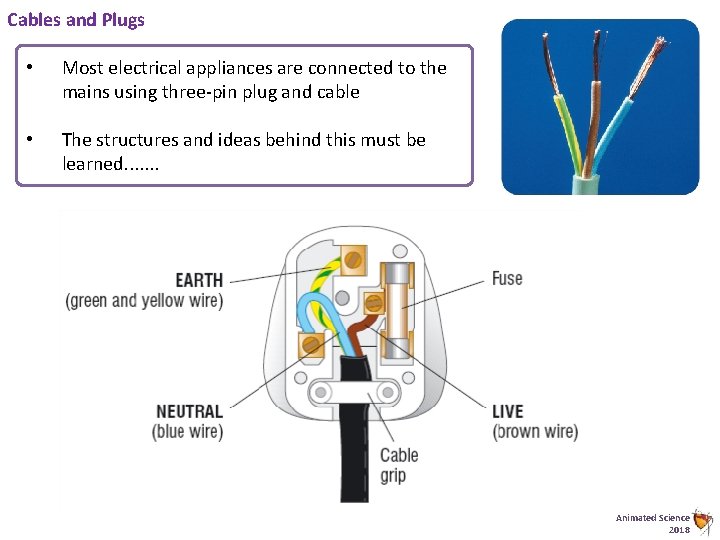
Cables and Plugs • Most electrical appliances are connected to the mains using three-pin plug and cable • The structures and ideas behind this must be learned. . . . Animated Science 2018
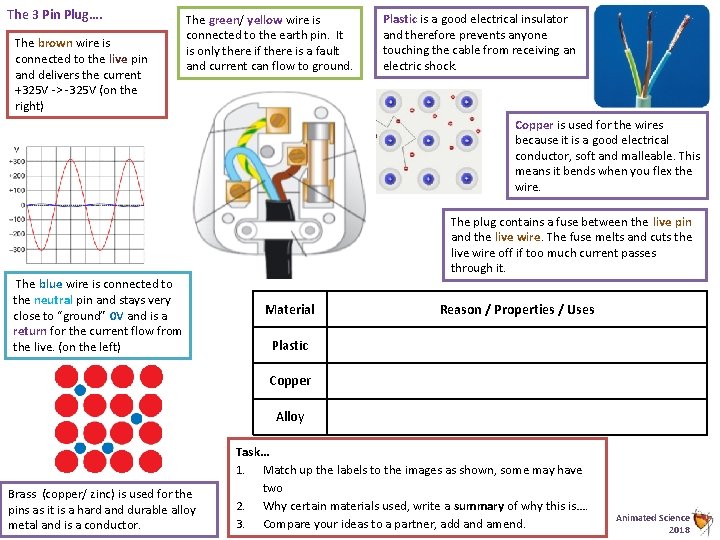
The 3 Pin Plug…. The brown wire is connected to the live pin and delivers the current +325 V -> -325 V (on the right) The green/ yellow wire is connected to the earth pin. It is only there if there is a fault and current can flow to ground. Plastic is a good electrical insulator and therefore prevents anyone touching the cable from receiving an electric shock. Copper is used for the wires because it is a good electrical conductor, soft and malleable. This means it bends when you flex the wire. The plug contains a fuse between the live pin and the live wire. The fuse melts and cuts the live wire off if too much current passes through it. The blue wire is connected to the neutral pin and stays very close to “ground” 0 V and is a return for the current flow from the live. (on the left) Material Reason / Properties / Uses Plastic Copper Alloy Brass (copper/ zinc) is used for the pins as it is a hard and durable alloy metal and is a conductor. Task… 1. Match up the labels to the images as shown, some may have two 2. Why certain materials used, write a summary of why this is…. 3. Compare your ideas to a partner, add and amend. Animated Science 2018
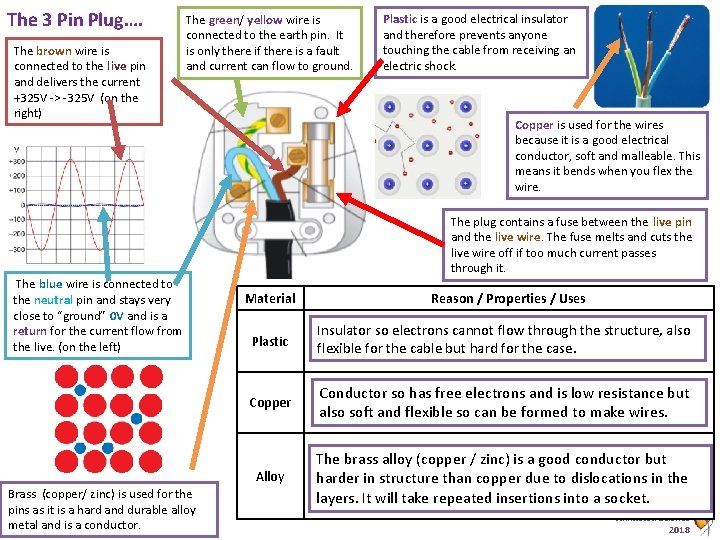
The 3 Pin Plug…. The brown wire is connected to the live pin and delivers the current +325 V -> -325 V (on the right) The green/ yellow wire is connected to the earth pin. It is only there if there is a fault and current can flow to ground. Plastic is a good electrical insulator and therefore prevents anyone touching the cable from receiving an electric shock. Copper is used for the wires because it is a good electrical conductor, soft and malleable. This means it bends when you flex the wire. The plug contains a fuse between the live pin and the live wire. The fuse melts and cuts the live wire off if too much current passes through it. The blue wire is connected to the neutral pin and stays very close to “ground” 0 V and is a return for the current flow from the live. (on the left) Brass (copper/ zinc) is used for the pins as it is a hard and durable alloy metal and is a conductor. Material Reason / Properties / Uses Plastic Insulator so electrons cannot flow through the structure, also flexible for the cable but hard for the case. Copper Conductor so has free electrons and is low resistance but also soft and flexible so can be formed to make wires. Alloy The brass alloy (copper / zinc) is a good conductor but harder in structure than copper due to dislocations in the layers. It will take repeated insertions into a socket. Animated Science 2018
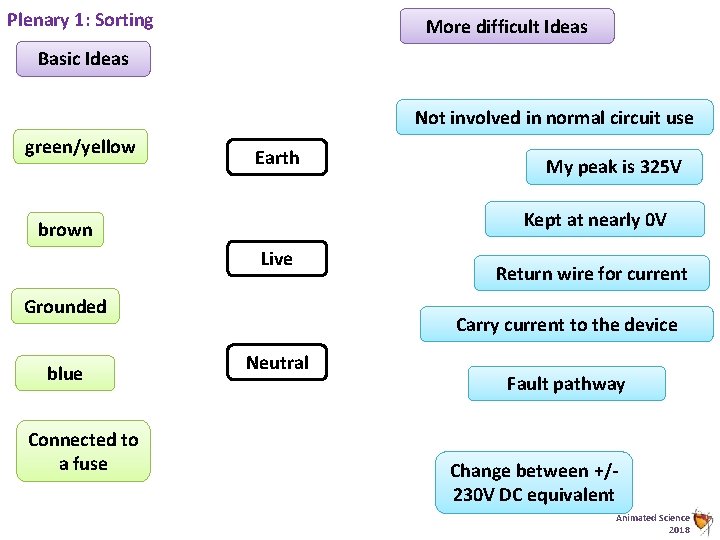
Plenary 1: Sorting More difficult Ideas Basic Ideas Not involved in normal circuit use green/yellow Earth Kept at nearly 0 V brown Live Grounded blue Connected to a fuse My peak is 325 V Return wire for current Carry current to the device Neutral Fault pathway Change between +/230 V DC equivalent Animated Science 2018
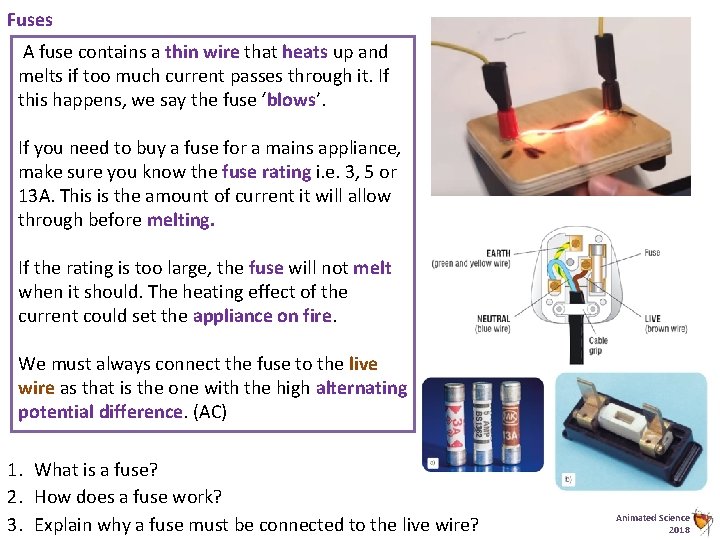
Fuses A fuse contains a thin wire that heats up and melts if too much current passes through it. If this happens, we say the fuse ‘blows’. If you need to buy a fuse for a mains appliance, make sure you know the fuse rating i. e. 3, 5 or 13 A. This is the amount of current it will allow through before melting. If the rating is too large, the fuse will not melt when it should. The heating effect of the current could set the appliance on fire. We must always connect the fuse to the live wire as that is the one with the high alternating potential difference. (AC) 1. What is a fuse? 2. How does a fuse work? 3. Explain why a fuse must be connected to the live wire? Animated Science 2018
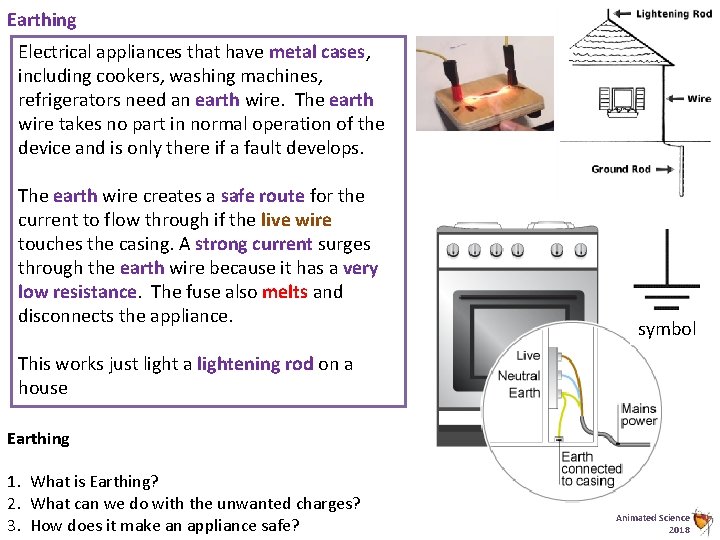
Earthing Electrical appliances that have metal cases, including cookers, washing machines, refrigerators need an earth wire. The earth wire takes no part in normal operation of the device and is only there if a fault develops. The earth wire creates a safe route for the current to flow through if the live wire touches the casing. A strong current surges through the earth wire because it has a very low resistance. The fuse also melts and disconnects the appliance. symbol This works just light a lightening rod on a house Earthing 1. What is Earthing? 2. What can we do with the unwanted charges? 3. How does it make an appliance safe? Animated Science 2018
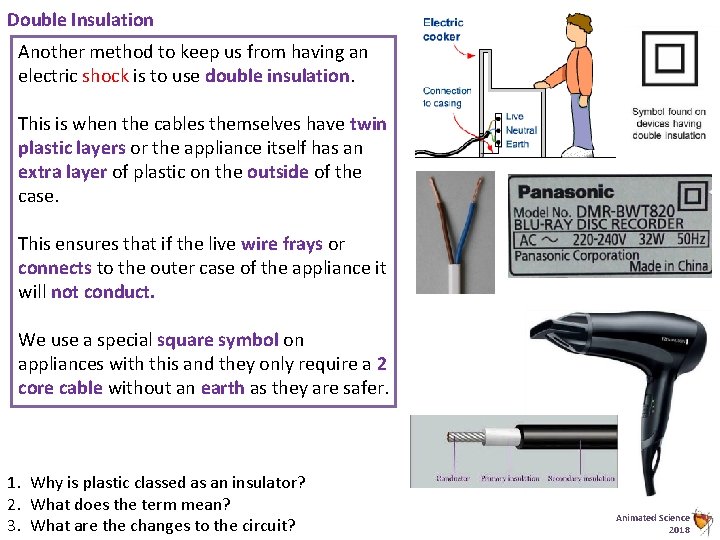
Double Insulation Another method to keep us from having an electric shock is to use double insulation. This is when the cables themselves have twin plastic layers or the appliance itself has an extra layer of plastic on the outside of the case. This ensures that if the live wire frays or connects to the outer case of the appliance it will not conduct. We use a special square symbol on appliances with this and they only require a 2 core cable without an earth as they are safer. 1. Why is plastic classed as an insulator? 2. What does the term mean? 3. What are the changes to the circuit? Animated Science 2018
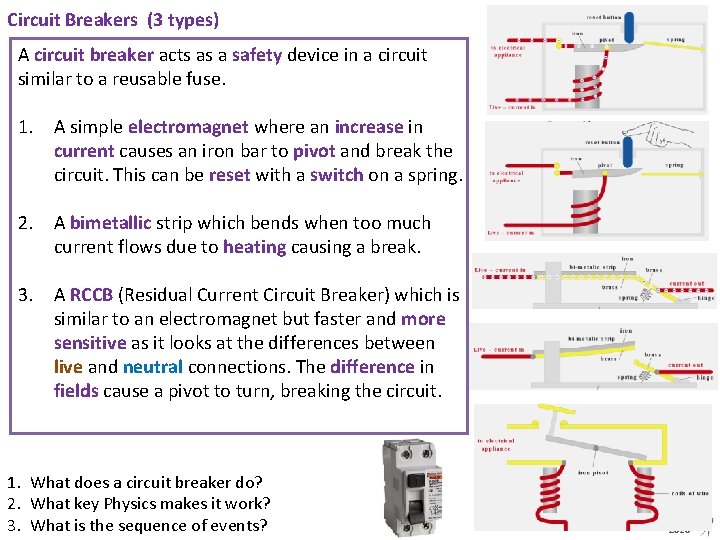
Circuit Breakers (3 types) A circuit breaker acts as a safety device in a circuit similar to a reusable fuse. 1. A simple electromagnet where an increase in current causes an iron bar to pivot and break the circuit. This can be reset with a switch on a spring. 2. A bimetallic strip which bends when too much current flows due to heating causing a break. 3. A RCCB (Residual Current Circuit Breaker) which is similar to an electromagnet but faster and more sensitive as it looks at the differences between live and neutral connections. The difference in fields cause a pivot to turn, breaking the circuit. 1. What does a circuit breaker do? 2. What key Physics makes it work? 3. What is the sequence of events? Animated Science 2018
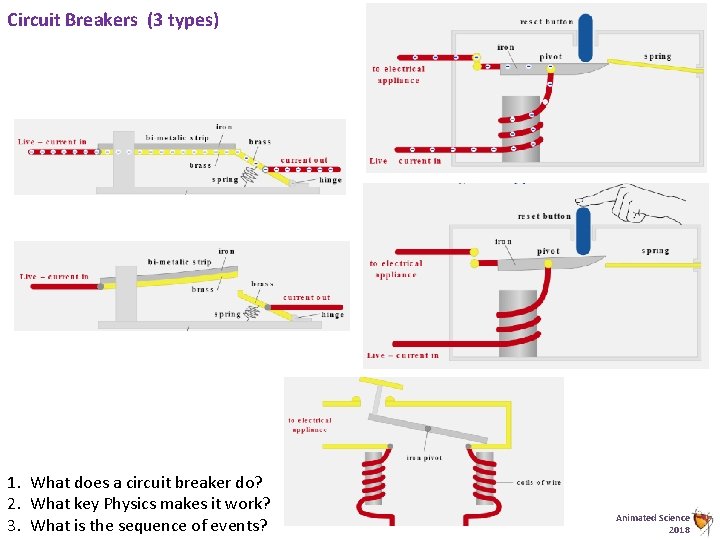
Circuit Breakers (3 types) 1. What does a circuit breaker do? 2. What key Physics makes it work? 3. What is the sequence of events? Animated Science 2018
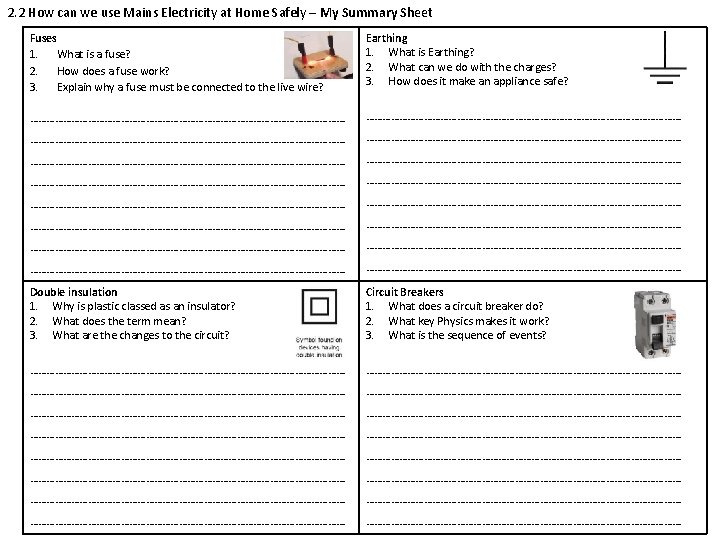
2. 2 How can we use Mains Electricity at Home Safely – My Summary Sheet Fuses 1. What is a fuse? 2. How does a fuse work? 3. Explain why a fuse must be connected to the live wire? Earthing 1. What is Earthing? 2. What can we do with the charges? 3. How does it make an appliance safe? ……………………………………………………………………………………………………. Double insulation 1. Why is plastic classed as an insulator? 2. What does the term mean? 3. What are the changes to the circuit? Circuit Breakers 1. What does a circuit breaker do? 2. What key Physics makes it work? 3. What is the sequence of events? …………………………………………………………………………………………………….
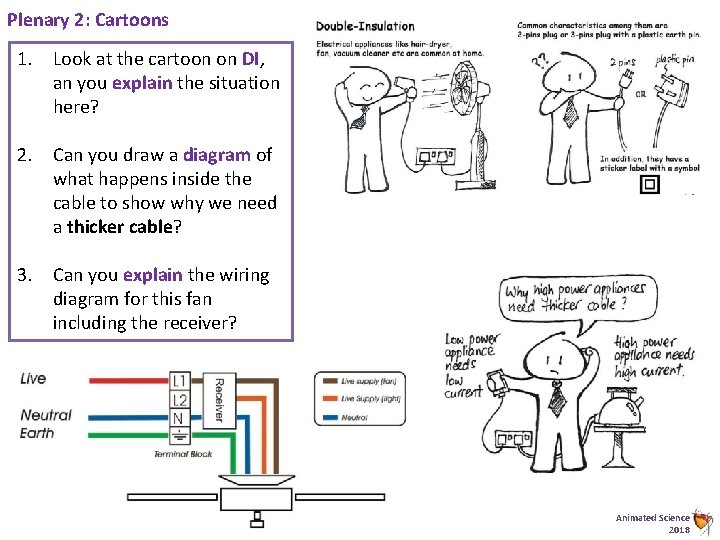
Plenary 2: Cartoons 1. Look at the cartoon on DI, an you explain the situation here? 2. Can you draw a diagram of what happens inside the cable to show why we need a thicker cable? 3. Can you explain the wiring diagram for this fan including the receiver? Animated Science 2018
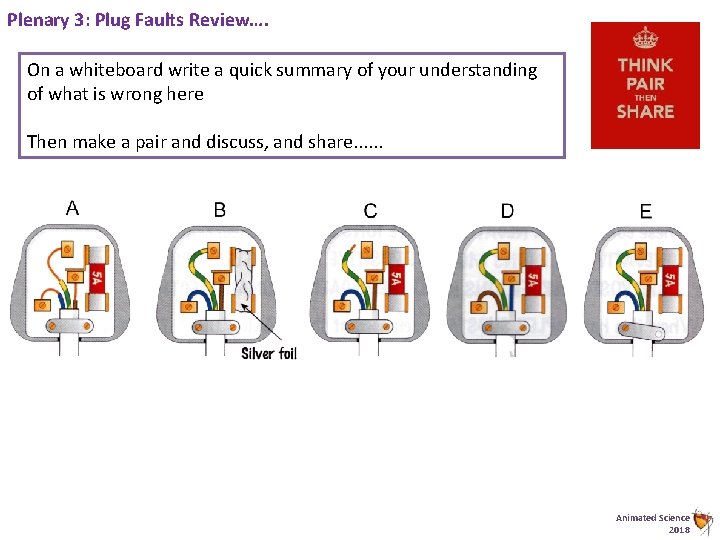
Plenary 3: Plug Faults Review…. On a whiteboard write a quick summary of your understanding of what is wrong here Then make a pair and discuss, and share. . . Animated Science 2018
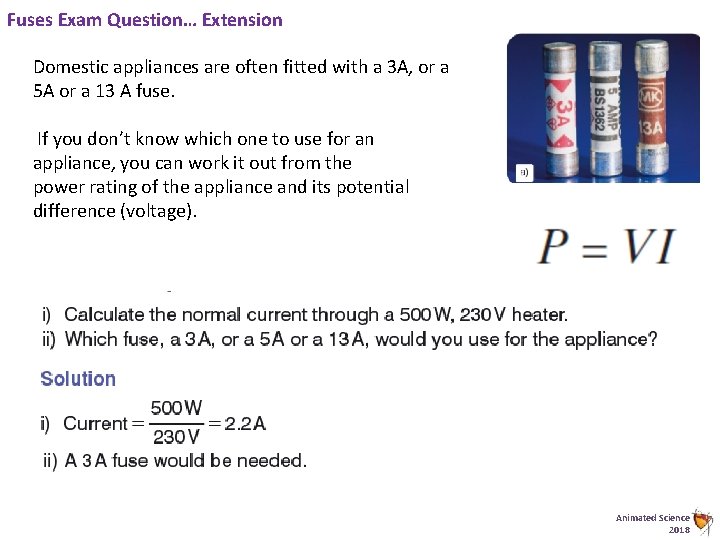
Fuses Exam Question… Extension Domestic appliances are often fitted with a 3 A, or a 5 A or a 13 A fuse. If you don’t know which one to use for an appliance, you can work it out from the power rating of the appliance and its potential difference (voltage). Animated Science 2018
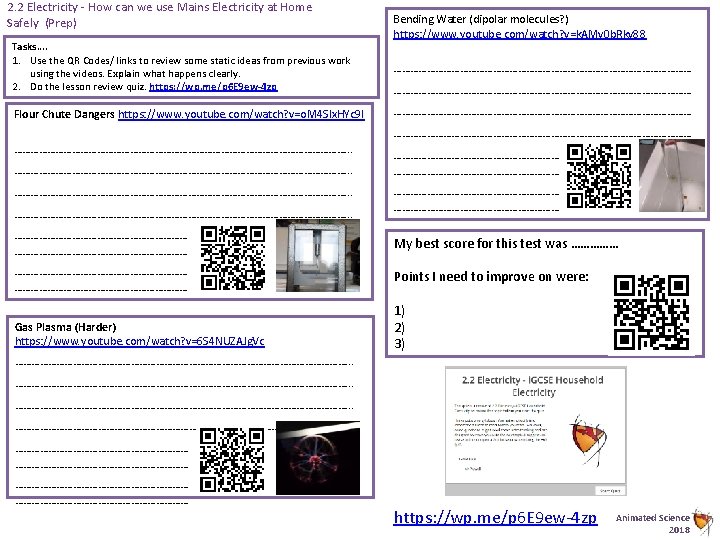
2. 2 Electricity - How can we use Mains Electricity at Home Safely (Prep) Tasks…. 1. Use the QR Codes/ links to review some static ideas from previous work using the videos. Explain what happens clearly. 2. Do the lesson review quiz. https: //wp. me/p 6 E 9 ew-4 zp Flour Chute Dangers https: //www. youtube. com/watch? v=o. M 4 SIx. HYc 9 I Bending Water (dipolar molecules? ) https: //www. youtube. com/watch? v=k. AMv 0 b. Rkv 88 ……………………………………………………………………………………………… …………………………………………………………………………………………………………. . . …………………………………………………… ……………………………………………………… My best score for this test was ………………………………… Points I need to improve on were: Gas Plasma (Harder) https: //www. youtube. com/watch? v=6 S 4 NUZAJg. Vc 1) 2) 3) …………………………………………………………………………………………………………. . . ……………………………………………………… https: //wp. me/p 6 E 9 ew-4 zp Animated Science 2018
- Slides: 16