
Static Electricity Electrostatics Where have you experienced this

- Slides: 60
Static Electricity / Electrostatics • Where have you experienced this? – Shocked a friend? (or yourself) – Clothes in the dryer stick together – Stroke a cat and see the hair standing up on end. – Rub a rubber balloon in somebody’s hair – Bolt of lightning
Electrons are migrants. They are attracted to the protons in the nucleus, but they can be persuaded to become attracted to protons in a different nucleus and join another electron shell if energy is added.
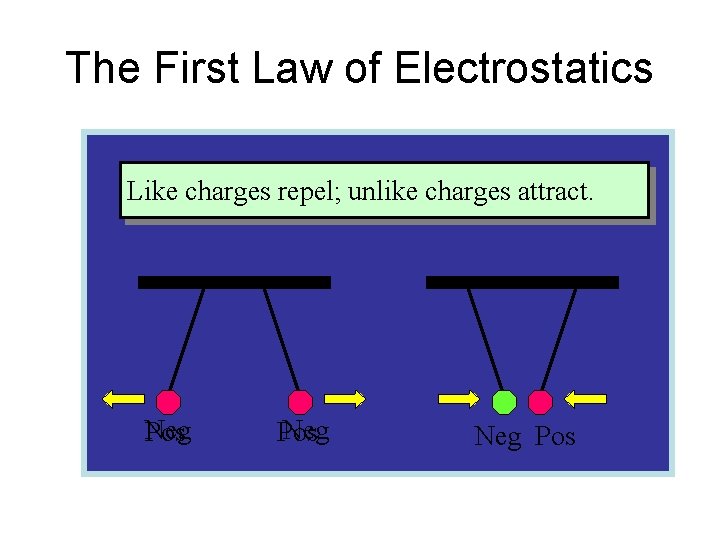
The First Law of Electrostatics Like charges repel; unlike charges attract. Neg Pos
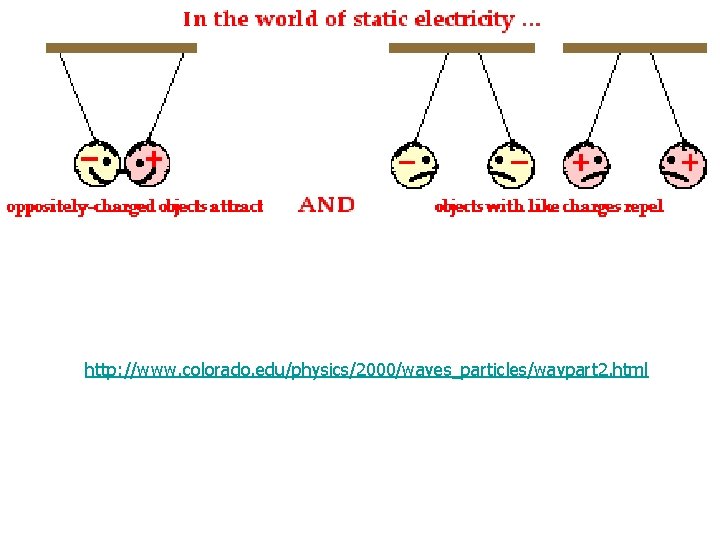
http: //www. colorado. edu/physics/2000/waves_particles/wavpart 2. html
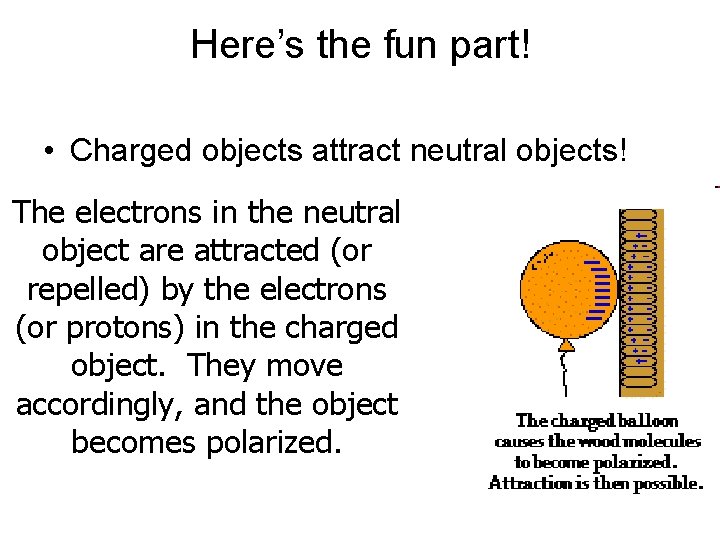
Here’s the fun part! • Charged objects attract neutral objects! The electrons in the neutral object are attracted (or repelled) by the electrons (or protons) in the charged object. They move accordingly, and the object becomes polarized.
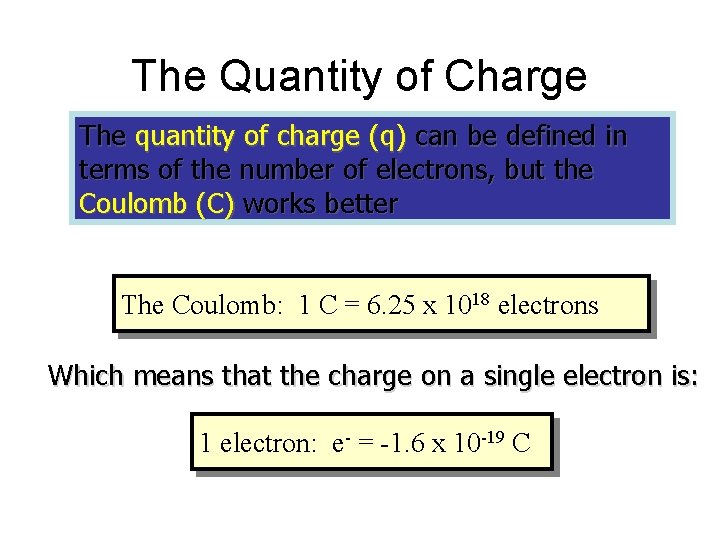
The Quantity of Charge The quantity of charge (q) can be defined in terms of the number of electrons, but the Coulomb (C) works better The Coulomb: 1 C = 6. 25 x 1018 electrons Which means that the charge on a single electron is: 1 electron: e- = -1. 6 x 10 -19 C
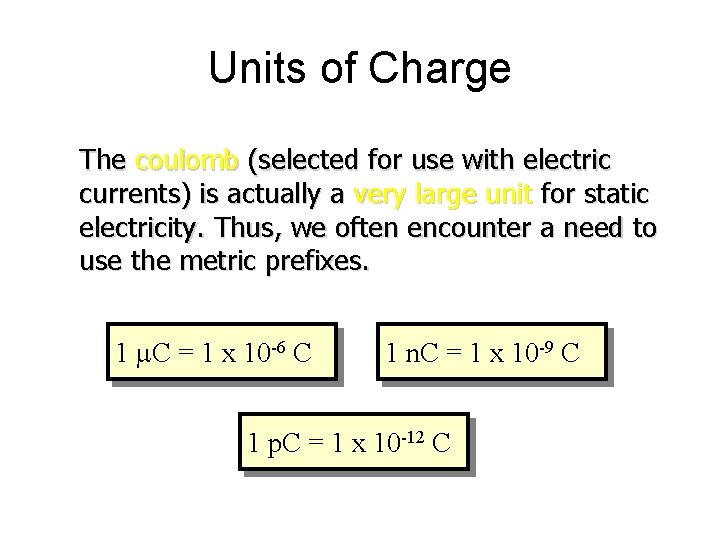
Units of Charge The coulomb (selected for use with electric currents) is actually a very large unit for static electricity. Thus, we often encounter a need to use the metric prefixes. 1 m. C = 1 x 10 -6 C 1 n. C = 1 x 10 -9 C 1 p. C = 1 x 10 -12 C
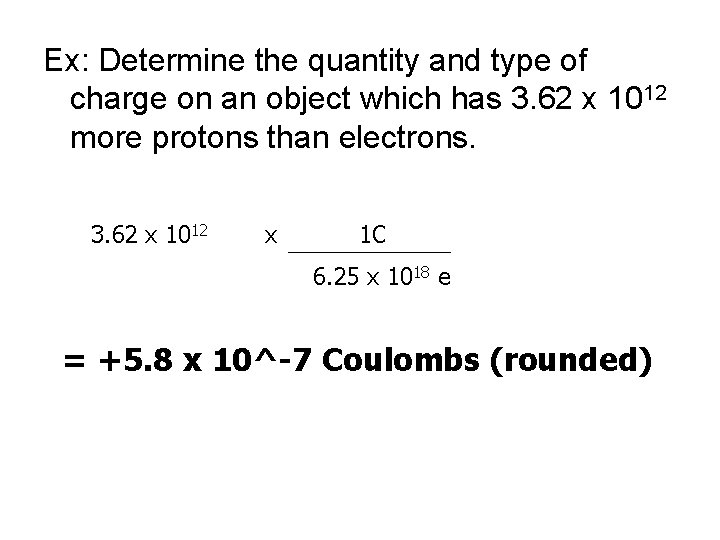
Ex: Determine the quantity and type of charge on an object which has 3. 62 x 1012 more protons than electrons. 3. 62 x 1012 x 1 C 6. 25 x 1018 e = +5. 8 x 10^-7 Coulombs (rounded)
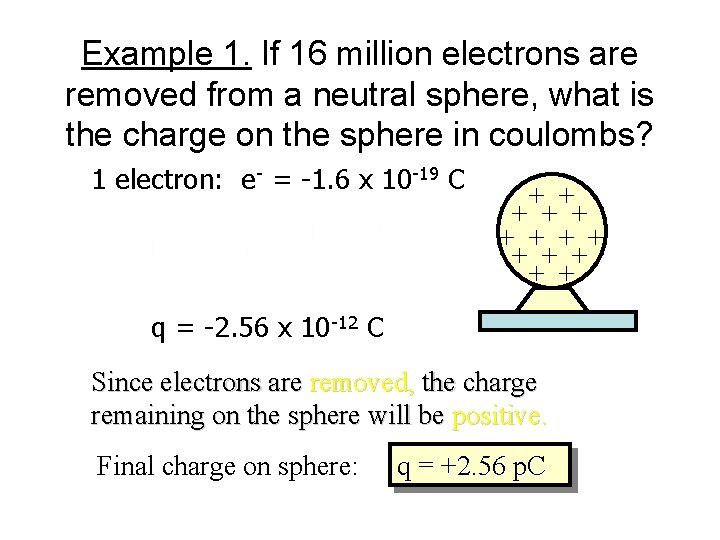
Example 1. If 16 million electrons are removed from a neutral sphere, what is the charge on the sphere in coulombs? 1 electron: e- = -1. 6 x 10 -19 C + + + + q = -2. 56 x 10 -12 C Since electrons are removed, the charge remaining on the sphere will be positive. Final charge on sphere: q = +2. 56 p. C
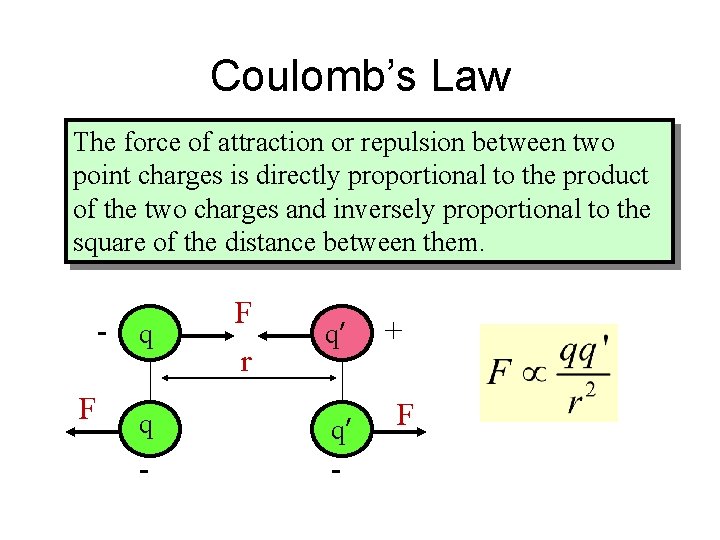
Coulomb’s Law The force of attraction or repulsion between two point charges is directly proportional to the product of the two charges and inversely proportional to the square of the distance between them. - q F F r q’ q q’ - - + F
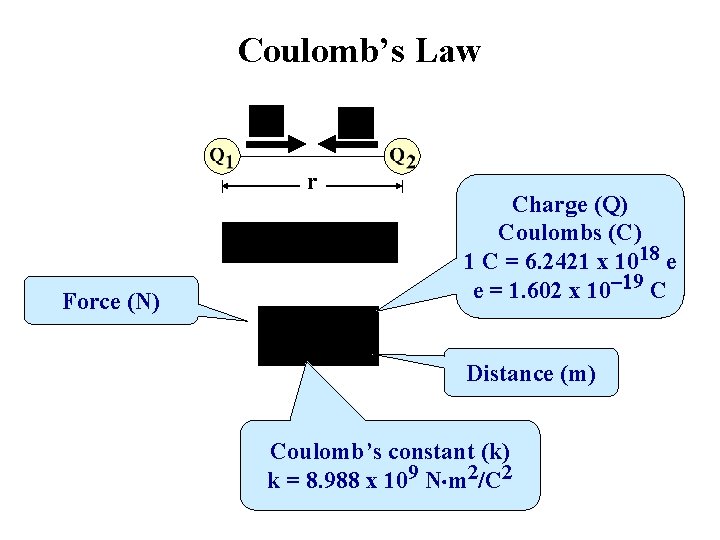
Coulomb’s Law r Force (N) Charge (Q) Coulombs (C) 1 C = 6. 2421 x 1018 e e = 1. 602 x 10 -19 C Distance (m) Coulomb’s constant (k) k = 8. 988 x 109 N m 2/C 2
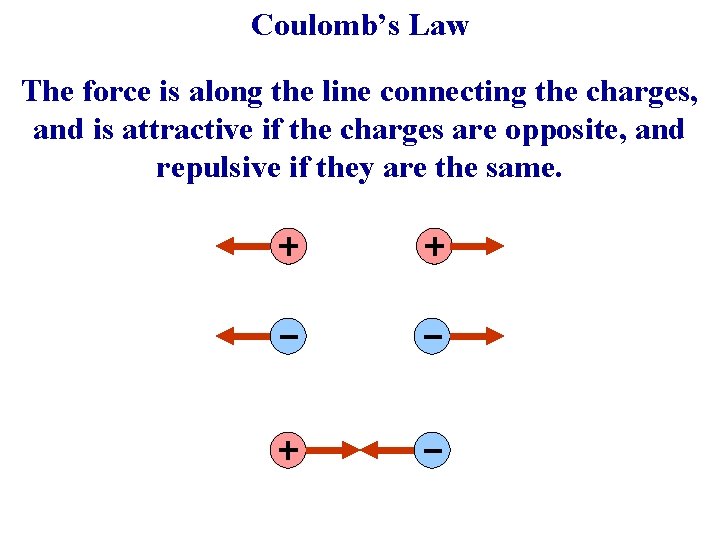
Coulomb’s Law The force is along the line connecting the charges, and is attractive if the charges are opposite, and repulsive if they are the same.
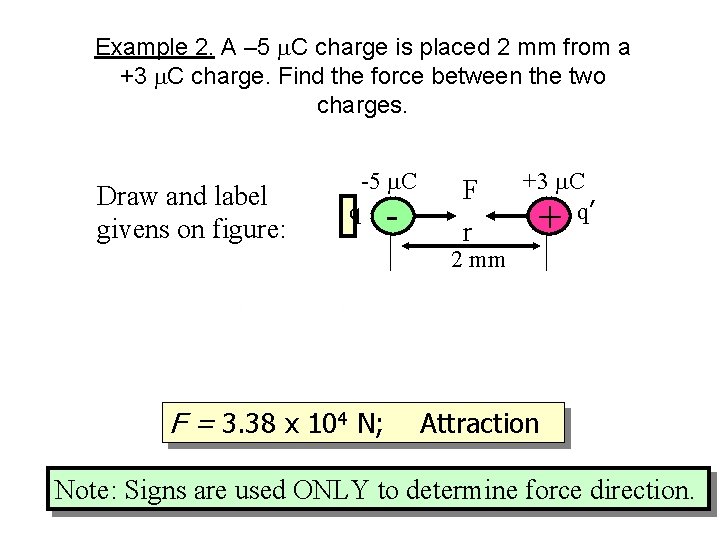
Example 2. A – 5 m. C charge is placed 2 mm from a +3 m. C charge. Find the force between the two charges. Draw and label givens on figure: -5 m. C q - F r +3 m. C q’ + 2 mm F = 3. 38 x 104 N; Attraction Note: Signs are used ONLY to determine force direction.
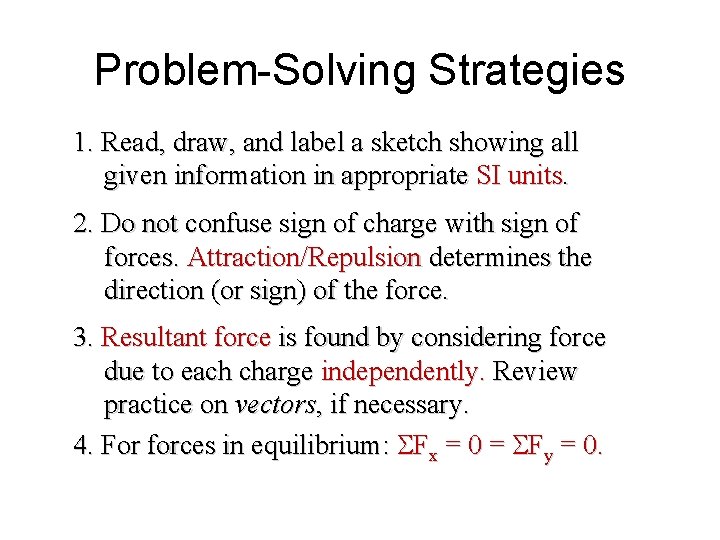
Problem-Solving Strategies 1. Read, draw, and label a sketch showing all given information in appropriate SI units. 2. Do not confuse sign of charge with sign of forces. Attraction/Repulsion determines the direction (or sign) of the force. 3. Resultant force is found by considering force due to each charge independently. Review practice on vectors, if necessary. 4. For forces in equilibrium: SFx = 0 = SFy = 0.
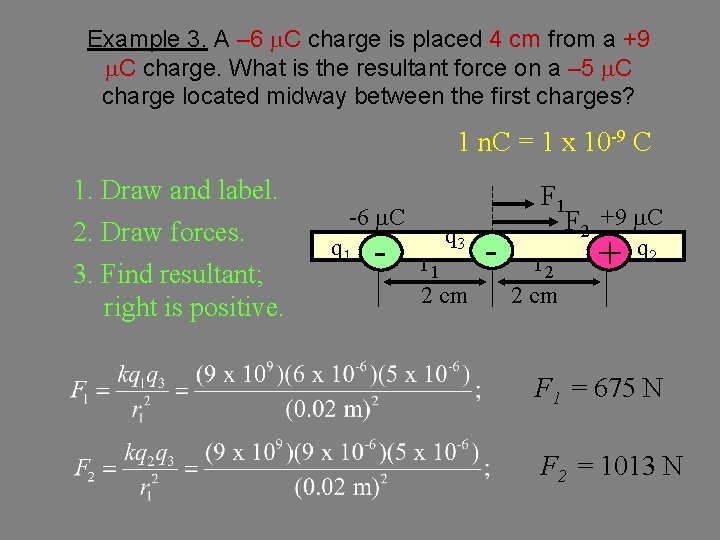
Example 3. A – 6 m. C charge is placed 4 cm from a +9 m. C charge. What is the resultant force on a – 5 m. C charge located midway between the first charges? 1 n. C = 1 x 10 -9 C 1. Draw and label. 2. Draw forces. 3. Find resultant; right is positive. -6 m. C q 1 - r 1 q 3 2 cm - F 1 F 2 +9 m. C q 2 + r 2 2 cm F 1 = 675 N F 2 = 1013 N
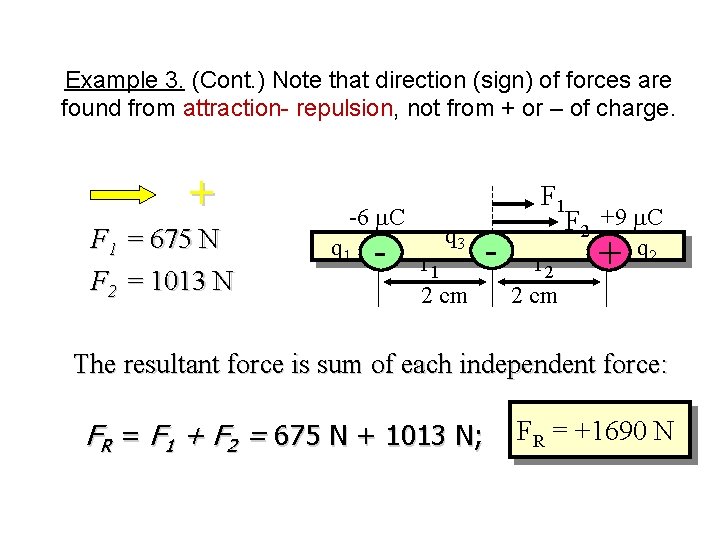
Example 3. (Cont. ) Note that direction (sign) of forces are found from attraction- repulsion, not from + or – of charge. + F 1 = 675 N F 2 = 1013 N -6 m. C q 1 - r 1 q 3 - 2 cm F 1 F 2 +9 m. C q 2 + r 2 2 cm The resultant force is sum of each independent force: FR = F 1 + F 2 = 675 N + 1013 N; FR = +1690 N
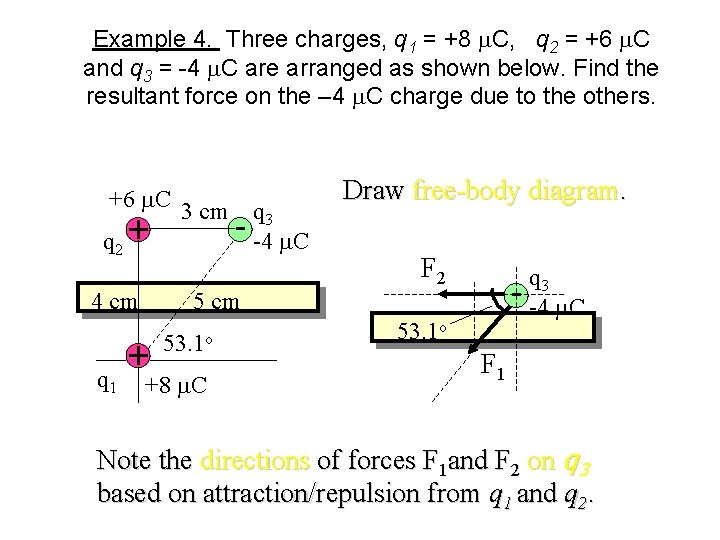
Example 4. Three charges, q 1 = +8 m. C, q 2 = +6 m. C and q 3 = -4 m. C are arranged as shown below. Find the resultant force on the – 4 m. C charge due to the others. +6 m. C 3 cm q 3 + q 2 -4 m. C 4 cm q 1 5 cm + 53. 1 o +8 m. C Draw free-body diagram. F 2 q 3 - -4 m. C 53. 1 o F 1 Note the directions of forces F 1 and F 2 on q 3 based on attraction/repulsion from q 1 and q 2.
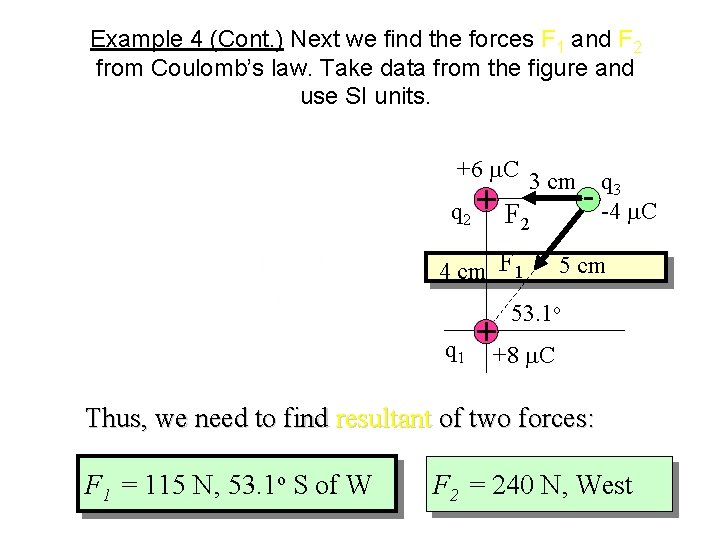
Example 4 (Cont. ) Next we find the forces F 1 and F 2 from Coulomb’s law. Take data from the figure and use SI units. +6 m. C 3 cm q 3 - -4 m. C q 2 + F 2 4 cm F 1 q 1 + 5 cm 53. 1 o +8 m. C Thus, we need to find resultant of two forces: F 1 = 115 N, 53. 1 o S of W F 2 = 240 N, West
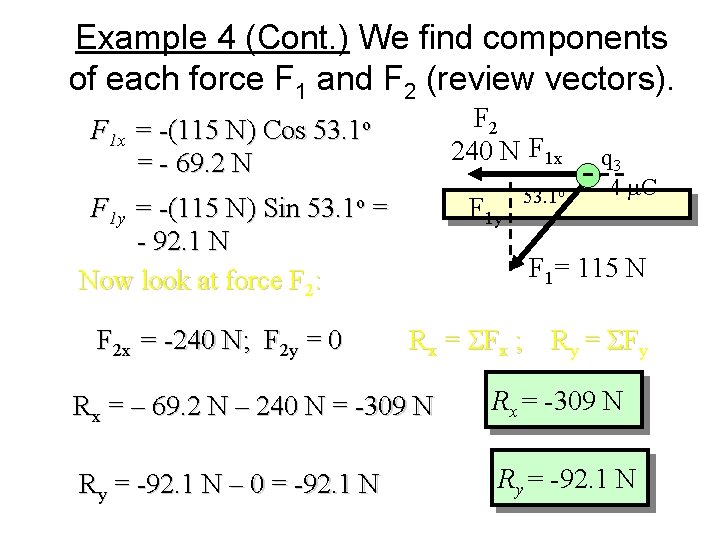
Example 4 (Cont. ) We find components of each force F 1 and F 2 (review vectors). F 2 240 N F 1 x = -(115 N) Cos 53. 1 o = - 69. 2 N 53. 1 o F 1 y = -(115 N) Sin - 92. 1 N Now look at force F 2: = F 2 x = -240 N; F 2 y = 0 F 1 y 53. 1 o q 3 - -4 m. C F 1= 115 N R x = S Fx ; R y = S Fy Rx = – 69. 2 N – 240 N = -309 N Rx= -309 N Ry = -92. 1 N – 0 = -92. 1 N Ry= -92. 1 N
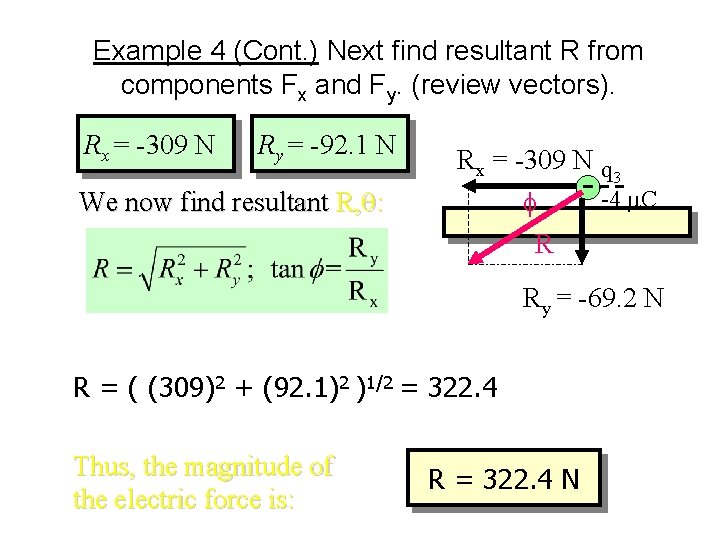
Example 4 (Cont. ) Next find resultant R from components Fx and Fy. (review vectors). Rx= -309 N Ry= -92. 1 N Rx = -309 N q We now find resultant R, q: f R - -4 m. C 3 Ry = -69. 2 N R = ( (309)2 + (92. 1)2 )1/2 = 322. 4 Thus, the magnitude of the electric force is: R = 322. 4 N
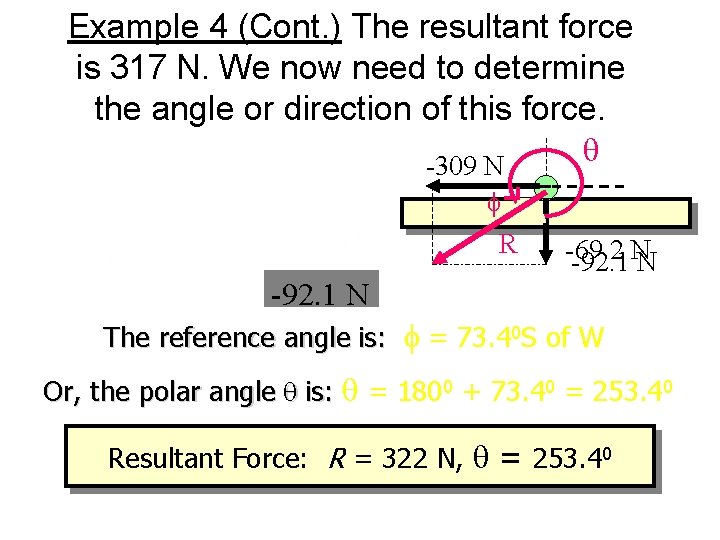
Example 4 (Cont. ) The resultant force is 317 N. We now need to determine the angle or direction of this force. -92. 1 N q -309 N f R -69. 2 -92. 1 N N The reference angle is: f = 73. 40 S of W Or, the polar angle q is: q = 1800 + 73. 40 = 253. 40 Resultant Force: R = 322 N, q = 253. 40
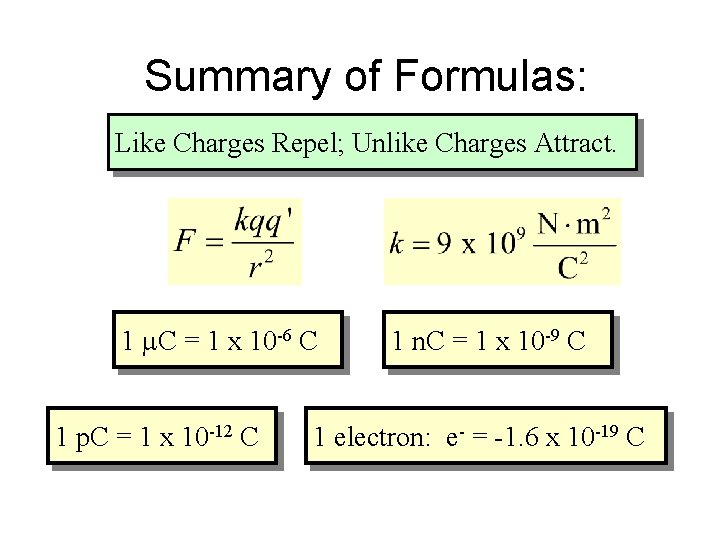
Summary of Formulas: Like Charges Repel; Unlike Charges Attract. 1 m. C = 1 x 10 -6 C 1 p. C = 1 x 10 -12 C 1 n. C = 1 x 10 -9 C 1 electron: e- = -1. 6 x 10 -19 C
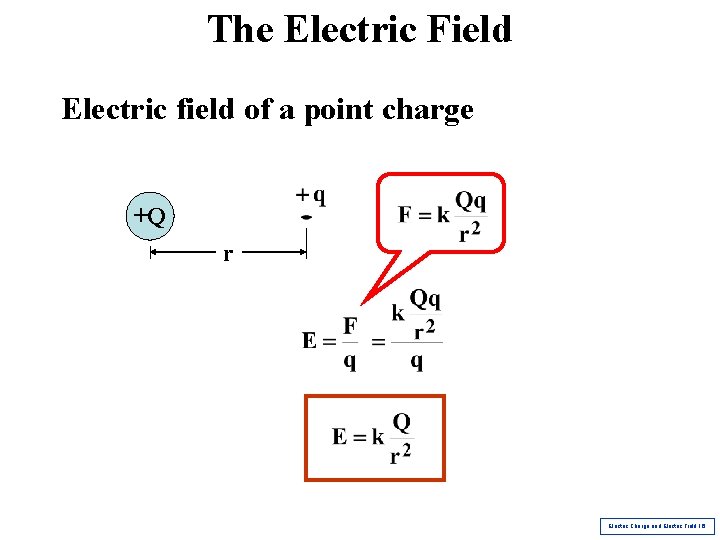
The Electric Field Electric field of a point charge +Q r Electric Charge and Electric Field 16
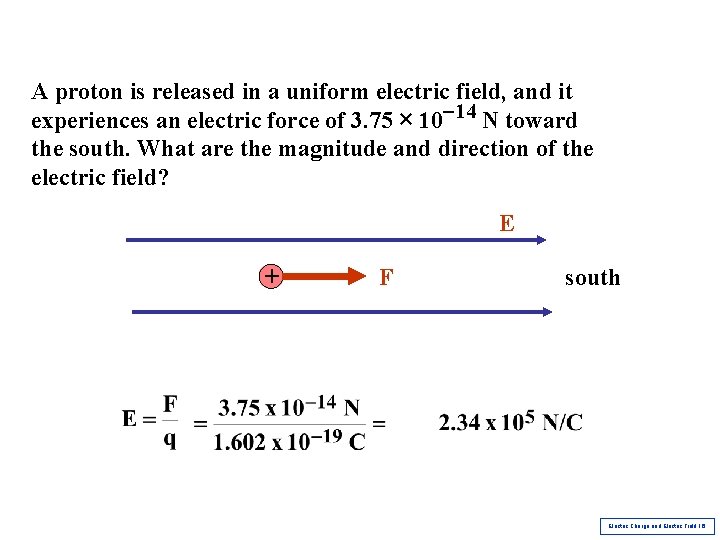
A proton is released in a uniform electric field, and it experiences an electric force of 3. 75 × 10 -14 N toward the south. What are the magnitude and direction of the electric field? E + F south Electric Charge and Electric Field 16
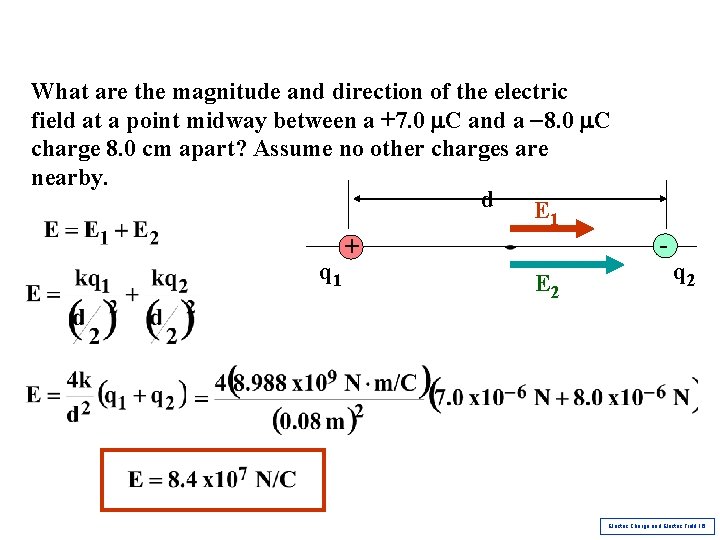
What are the magnitude and direction of the electric field at a point midway between a +7. 0 m. C and a -8. 0 m. C charge 8. 0 cm apart? Assume no other charges are nearby. d E 1 q 1 - + E 2 q 2 Electric Charge and Electric Field 16
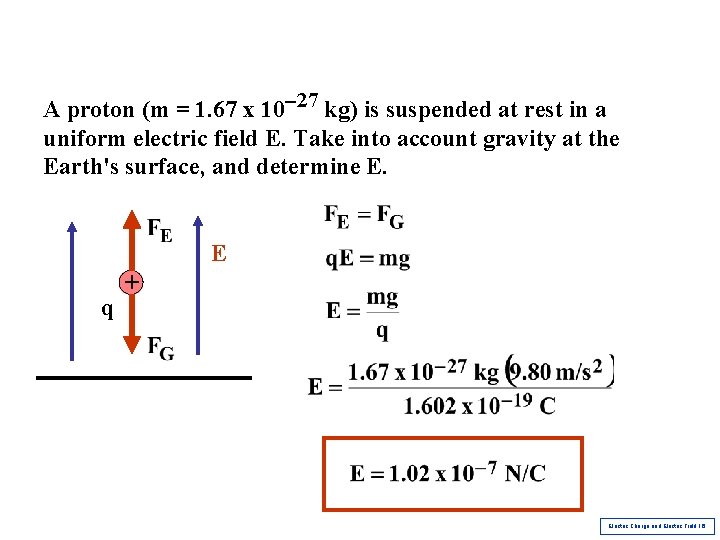
A proton (m = 1. 67 x 10 -27 kg) is suspended at rest in a uniform electric field E. Take into account gravity at the Earth's surface, and determine E. E q + Electric Charge and Electric Field 16
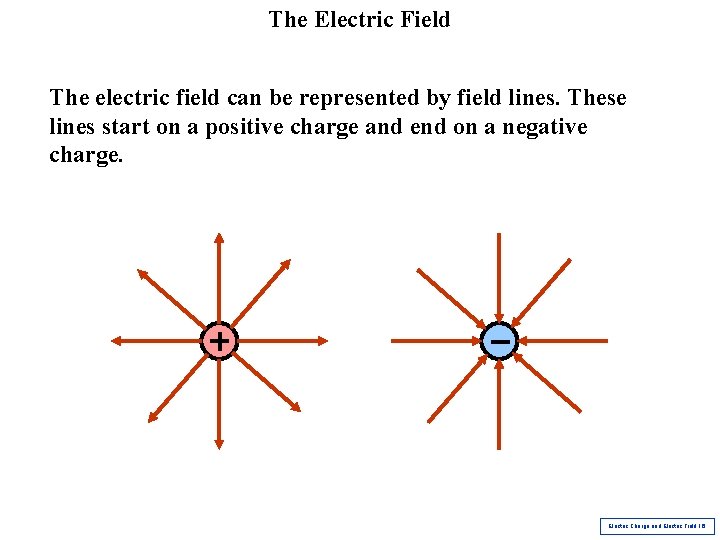
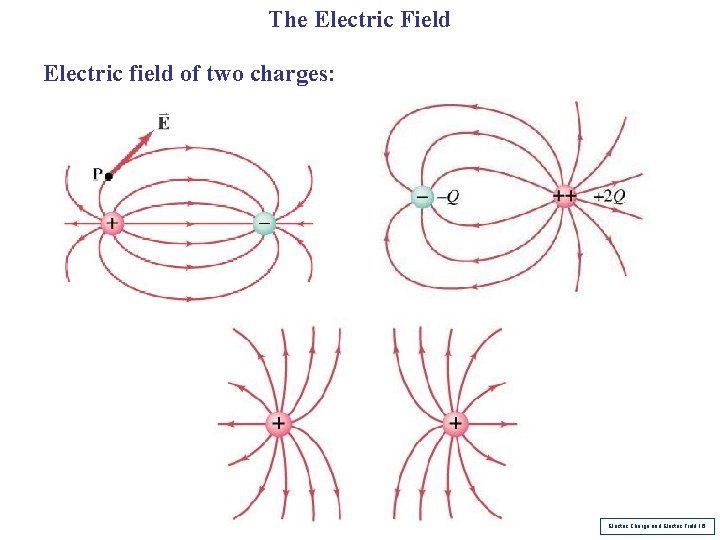
The Electric Field The electric field can be represented by field lines. These lines start on a positive charge and end on a negative charge. Electric Charge and Electric Field 16
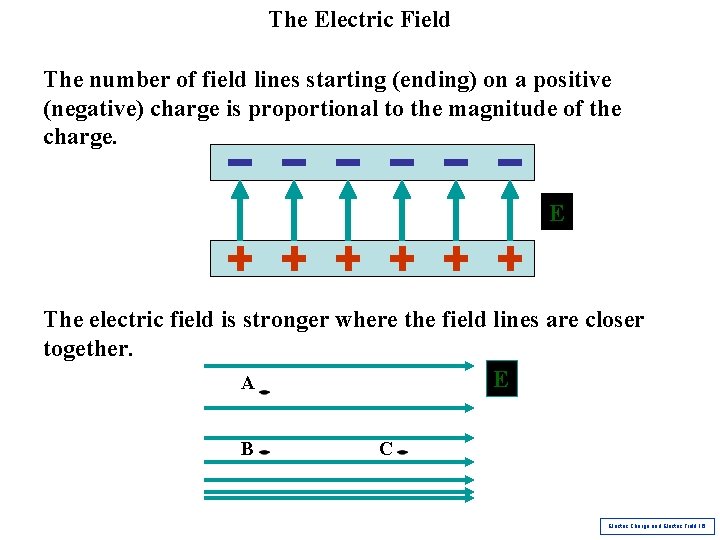
The Electric Field The number of field lines starting (ending) on a positive (negative) charge is proportional to the magnitude of the charge. E The electric field is stronger where the field lines are closer together. E A B C Electric Charge and Electric Field 16
The Electric Field Electric field of two charges: Electric Charge and Electric Field 16
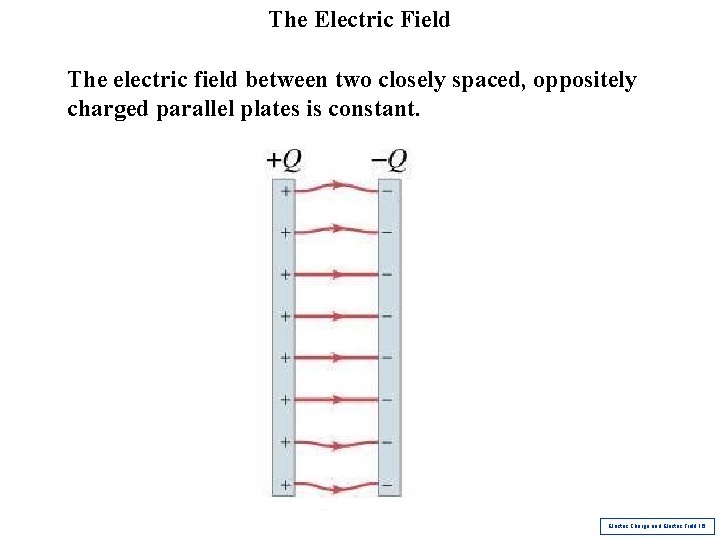
The Electric Field The electric field between two closely spaced, oppositely charged parallel plates is constant. Electric Charge and Electric Field 16
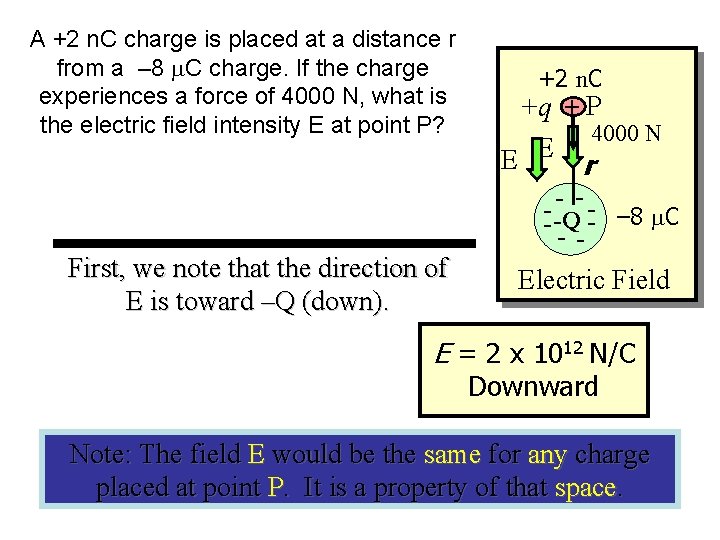
A +2 n. C charge is placed at a distance r from a – 8 m. C charge. If the charge experiences a force of 4000 N, what is the electric field intensity E at point P? +2 n. C +q +. P 4000 N E E r First, we note that the direction of E is toward –Q (down). - --- -Q - – 8 m. C -Electric Field E = 2 x 10¹² N/C Downward Note: The field E would be the same for any charge placed at point P. It is a property of that space.
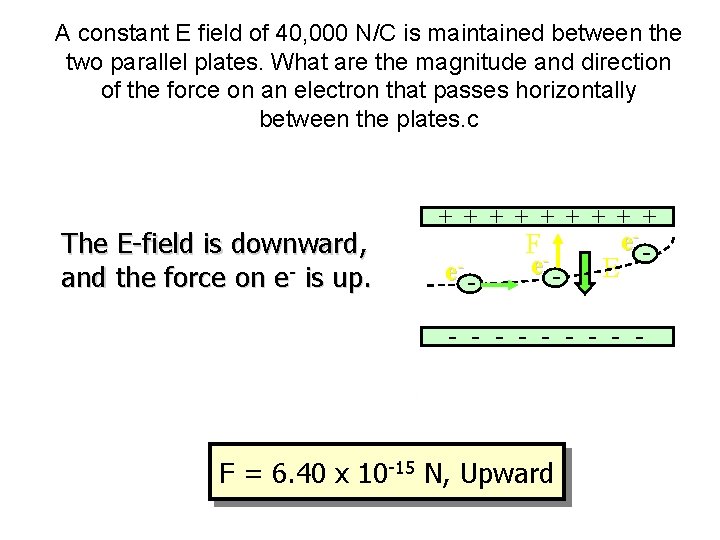
A constant E field of 40, 000 N/C is maintained between the two parallel plates. What are the magnitude and direction of the force on an electron that passes horizontally between the plates. c The E-field is downward, and the force on e- is up. + + + + + e- - Fe -. E e- - - F = 6. 40 x 10 -15 N, Upward
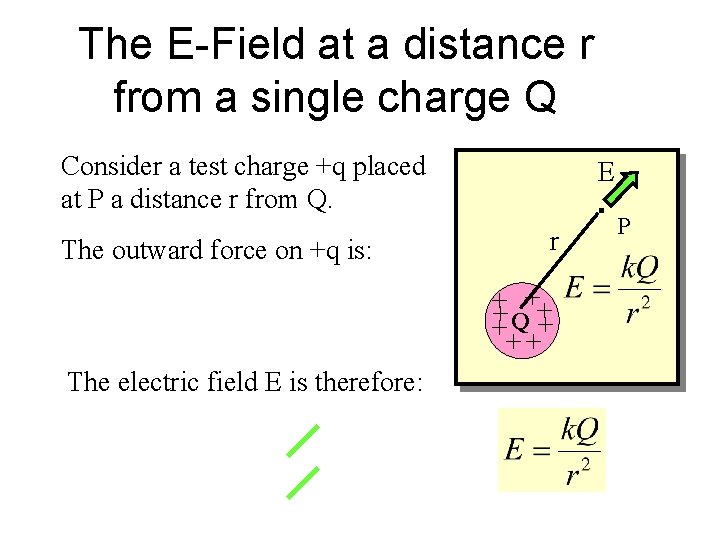
The E-Field at a distance r from a single charge Q Consider a test charge +q placed at P a distance r from Q. The outward force on +q is: FE +q +. . P P r ++ + + +Q + + ++ The electric field E is therefore:
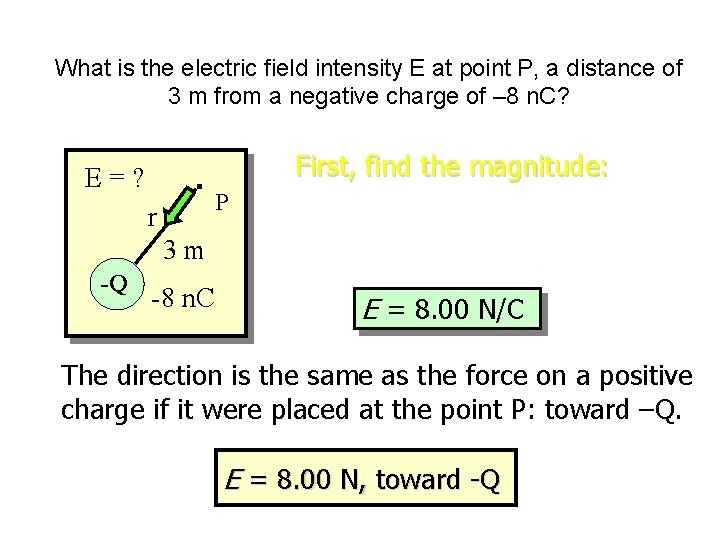
What is the electric field intensity E at point P, a distance of 3 m from a negative charge of – 8 n. C? . E=? r First, find the magnitude: P 3 m -Q -8 n. C E = 8. 00 N/C The direction is the same as the force on a positive charge if it were placed at the point P: toward –Q. E = 8. 00 N, toward -Q
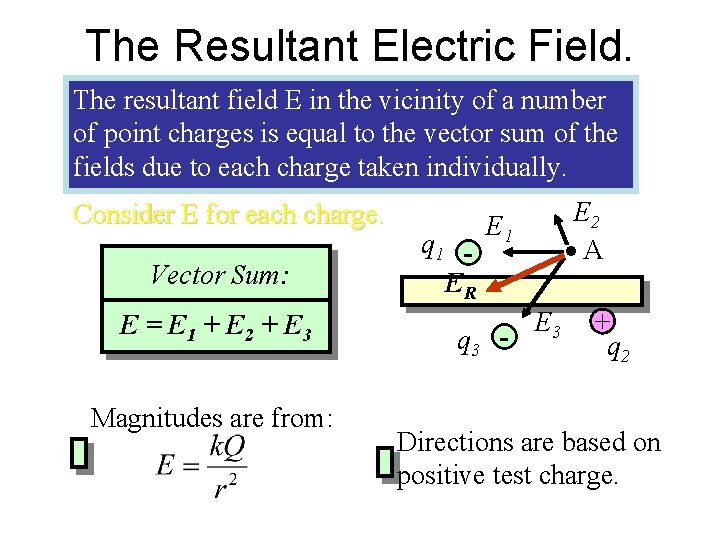
The Resultant Electric Field. The resultant field E in the vicinity of a number of point charges is equal to the vector sum of the fields due to each charge taken individually. Consider E for each charge. Vector Sum: E = E 1 + E 2 + E 3 Magnitudes are from: q 1 ER E 2 ·A E 1 q 3 - E 3 + q 2 Directions are based on positive test charge.
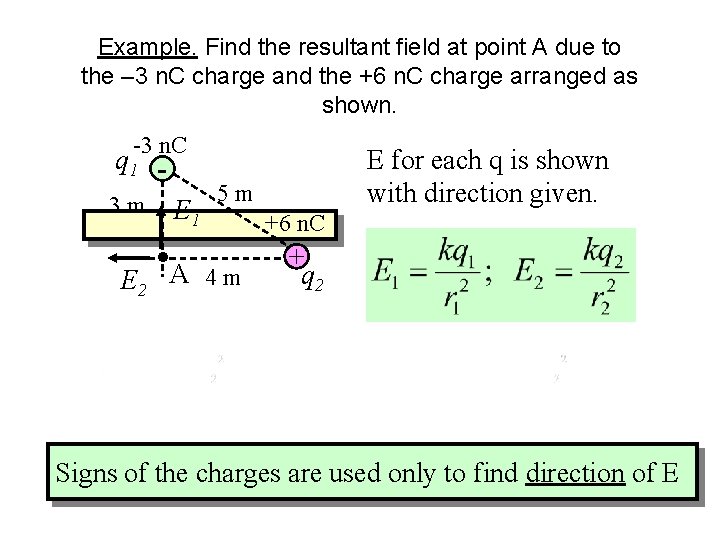
Example. Find the resultant field at point A due to the – 3 n. C charge and the +6 n. C charge arranged as shown. -3 n. C q 1 3 m E 1 E for each q is shown with direction given. 5 m · E 2 A 4 m +6 n. C + q 2 Signs of the charges are used only to find direction of E
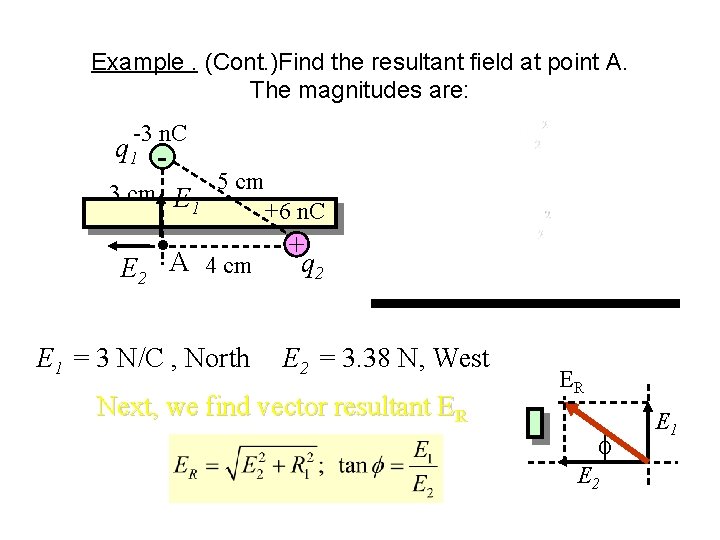
Example. (Cont. )Find the resultant field at point A. The magnitudes are: -3 n. C q 1 - 3 cm E 1 5 cm · E 2 A 4 cm E 1 = 3 N/C , North +6 n. C + q 2 E 2 = 3. 38 N, West Next, we find vector resultant ER ER f E 2 E 1
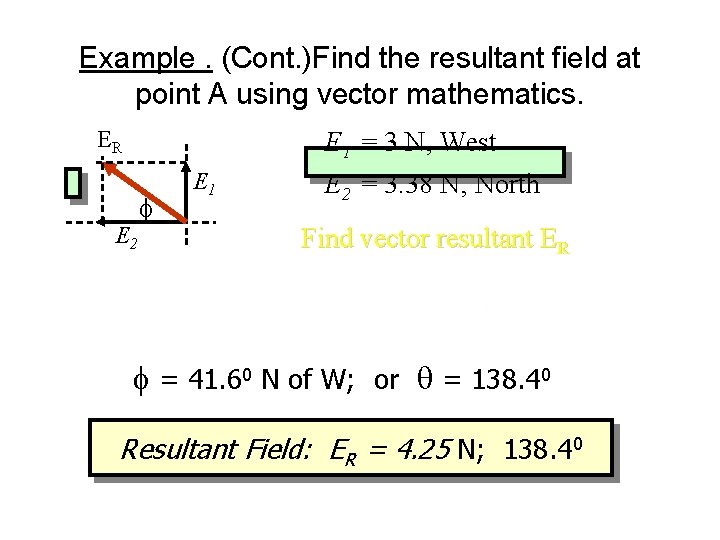
Example. (Cont. )Find the resultant field at point A using vector mathematics. ER E 1 = 3 N, West E 2 f E 1 E 2 = 3. 38 N, North Find vector resultant ER 3. 00 N 3. 38 N f = 41. 60 N of W; or q = 138. 40 Resultant Field: ER = 4. 25 N; 138. 40
Electric Potential & Electric Potential Energy
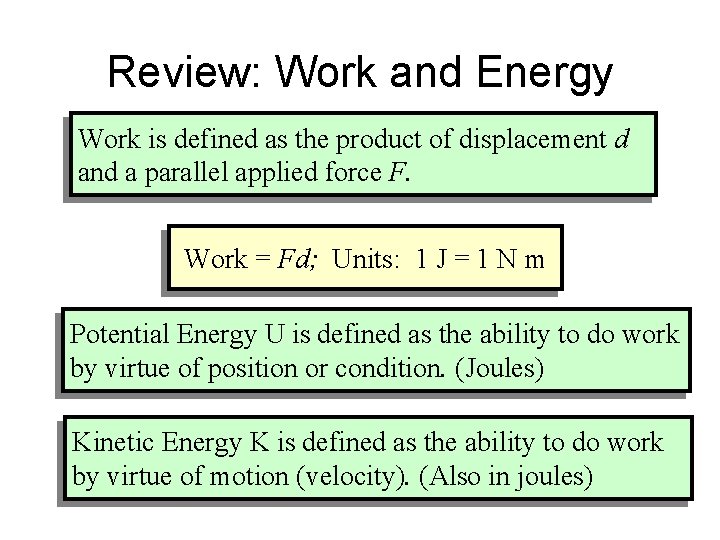
Review: Work and Energy Work is defined as the product of displacement d and a parallel applied force F. Work = Fd; Units: 1 J = 1 N m Potential Energy U is defined as the ability to do work by virtue of position or condition. (Joules) Kinetic Energy K is defined as the ability to do work by virtue of motion (velocity). (Also in joules)
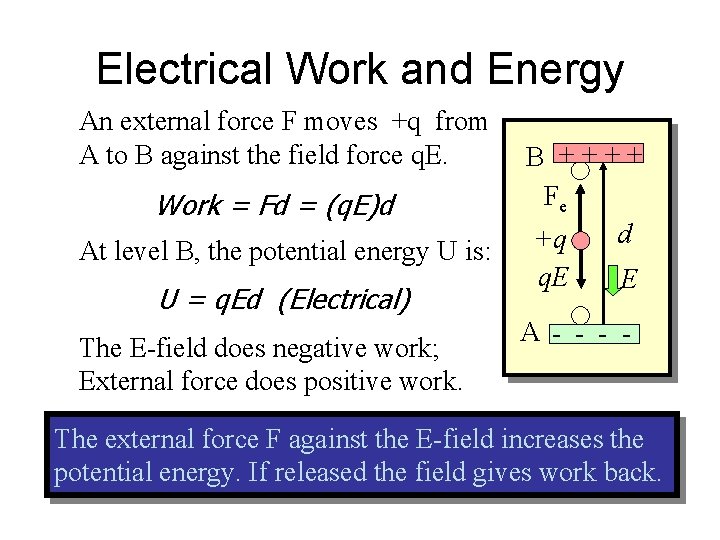
Electrical Work and Energy An external force F moves +q from A to B against the field force q. E. Work = Fd = (q. E)d At level B, the potential energy U is: U = q. Ed (Electrical) The E-field does negative work; External force does positive work. B ++++ Fe +q + d q. E E A - - The external force F against the E-field increases the potential energy. If released the field gives work back.
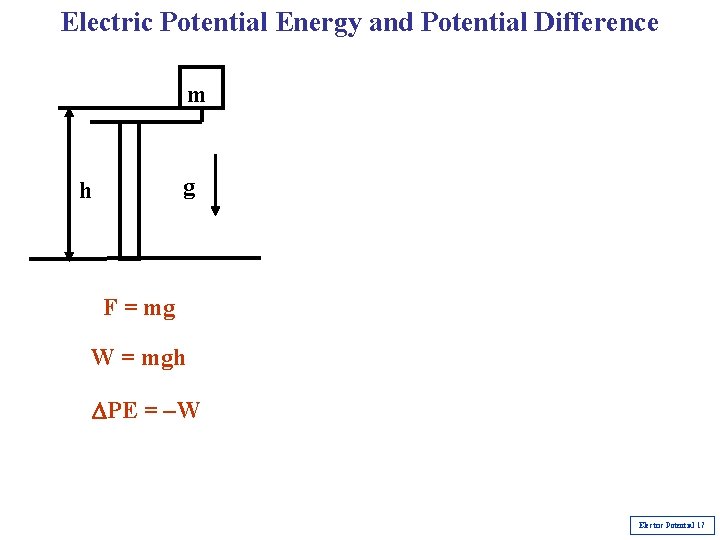
Electric Potential Energy and Potential Difference m g h F = mg W = mgh DPE = -W Electric Potential 17
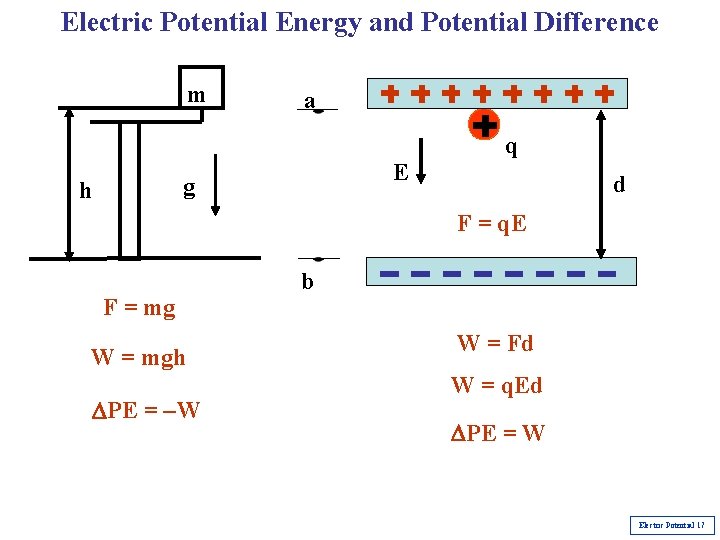
Electric Potential Energy and Potential Difference m a E g h q d F = q. E F = mg W = mgh DPE = -W b W = Fd W = q. Ed DPE = W Electric Potential 17
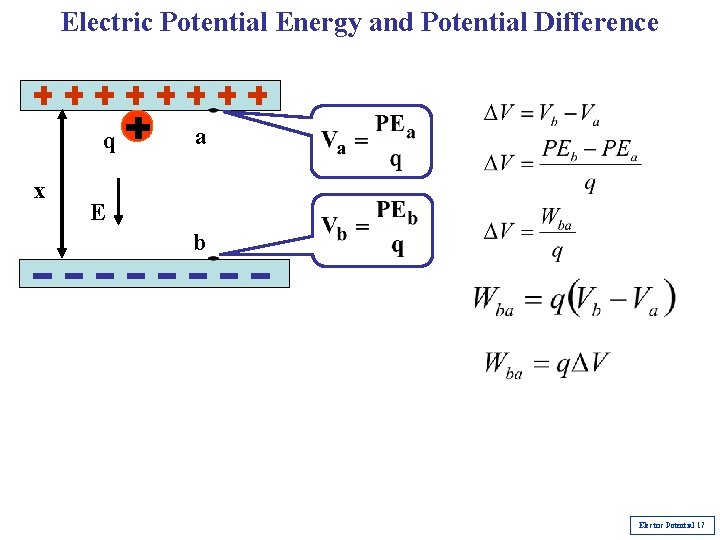
Electric Potential Energy and Potential Difference q x a E b Electric Potential 17
Electric Potential Electric potential is another property of space allowing us to predict the P. E. of any charge q at a point. Electric Potential: P. r + ++Q++ The units are: joules per coulomb (J/C) Potential For example, if the potential is 400 J/C at point P, a – 2 n. C charge at that point would have P. E. : U = q. V = (-2 x 10 -9 C)(400 J/C); U = -800 n. J
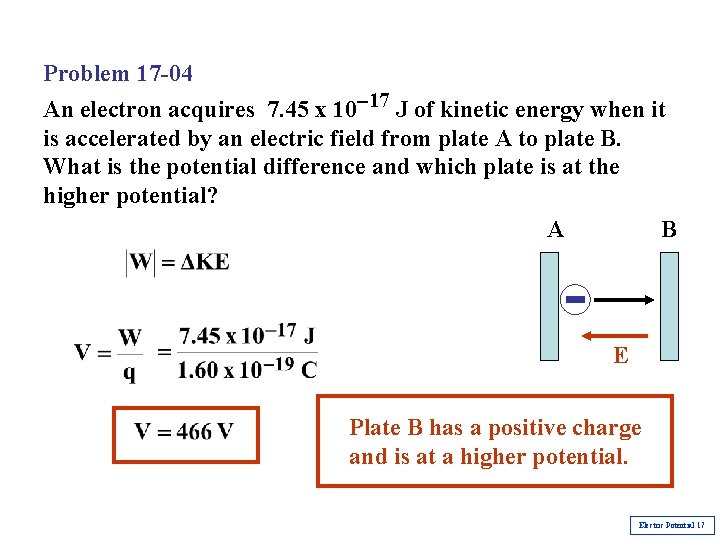
Problem 17 -04 An electron acquires 7. 45 x 10 -17 J of kinetic energy when it is accelerated by an electric field from plate A to plate B. What is the potential difference and which plate is at the higher potential? A B E Plate B has a positive charge and is at a higher potential. Electric Potential 17
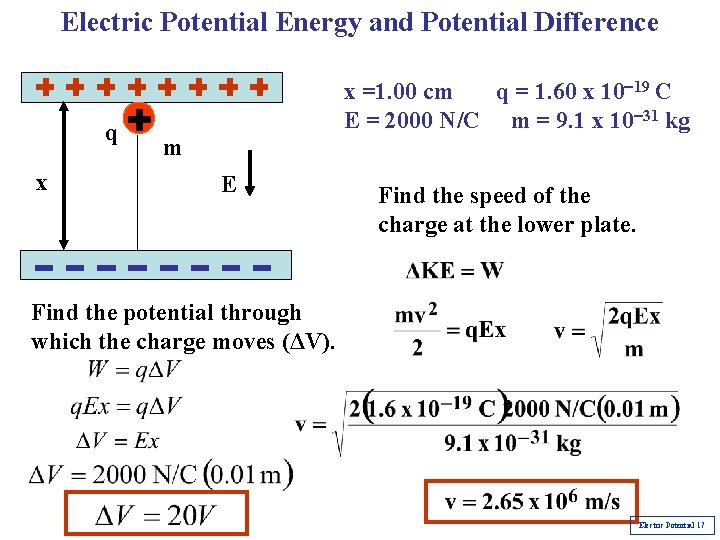
Electric Potential Energy and Potential Difference q x x =1. 00 cm q = 1. 60 x 10 -19 C E = 2000 N/C m = 9. 1 x 10 -31 kg m E Find the speed of the charge at the lower plate. Find the potential through which the charge moves (ΔV). Electric Potential 17
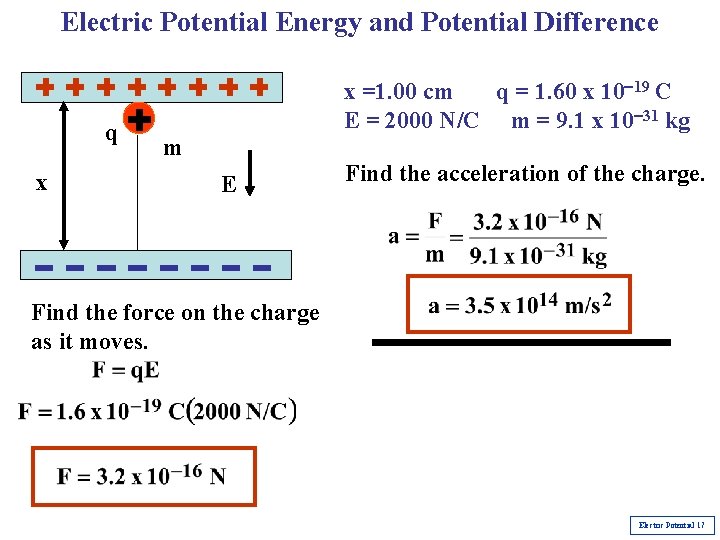
Electric Potential Energy and Potential Difference q x x =1. 00 cm q = 1. 60 x 10 -19 C E = 2000 N/C m = 9. 1 x 10 -31 kg m E Find the acceleration of the charge. Find the force on the charge as it moves. Electric Potential 17
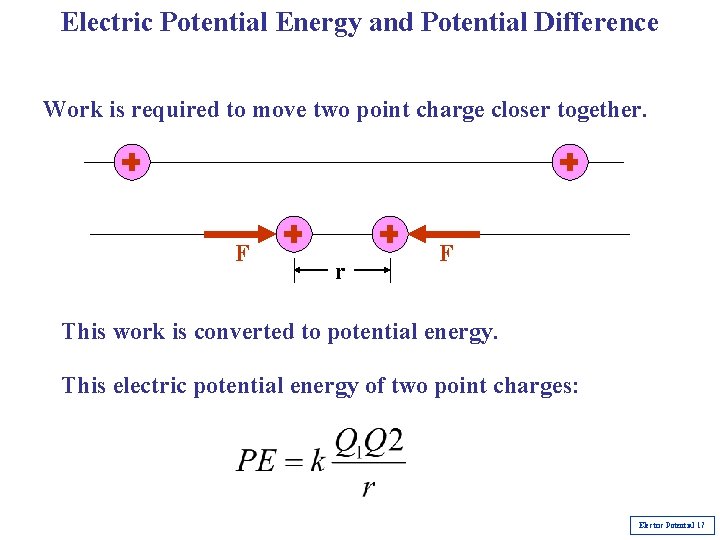
Electric Potential Energy and Potential Difference Work is required to move two point charge closer together. F r F This work is converted to potential energy. This electric potential energy of two point charges: Electric Potential 17
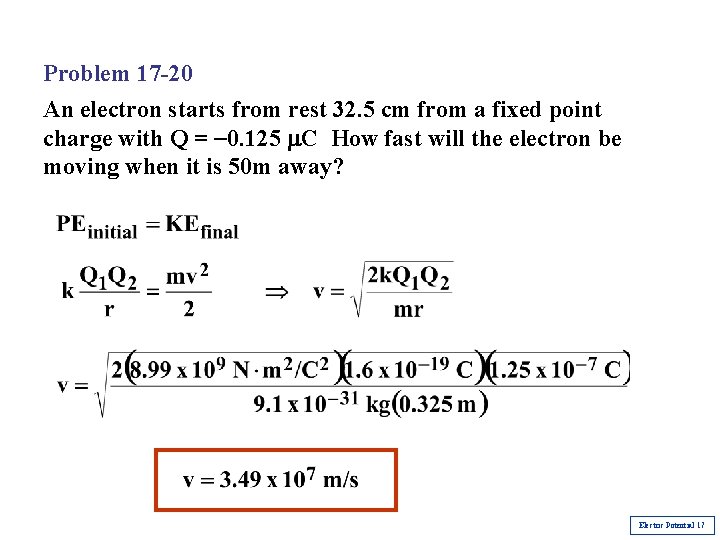
Problem 17 -20 An electron starts from rest 32. 5 cm from a fixed point charge with Q = -0. 125 m. C How fast will the electron be moving when it is 50 m away? Electric Potential 17
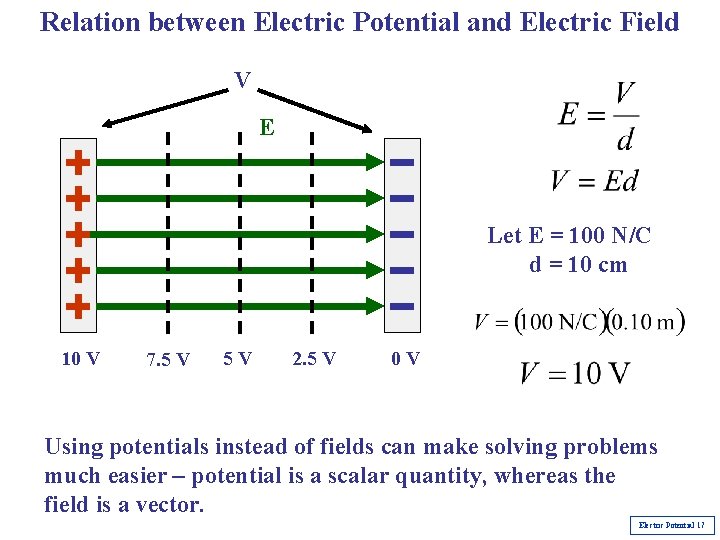
Relation between Electric Potential and Electric Field V E Let E = 100 N/C d = 10 cm 10 V 7. 5 V 5 d V 2. 5 V 0 V Using potentials instead of fields can make solving problems much easier – potential is a scalar quantity, whereas the field is a vector. Electric Potential 17
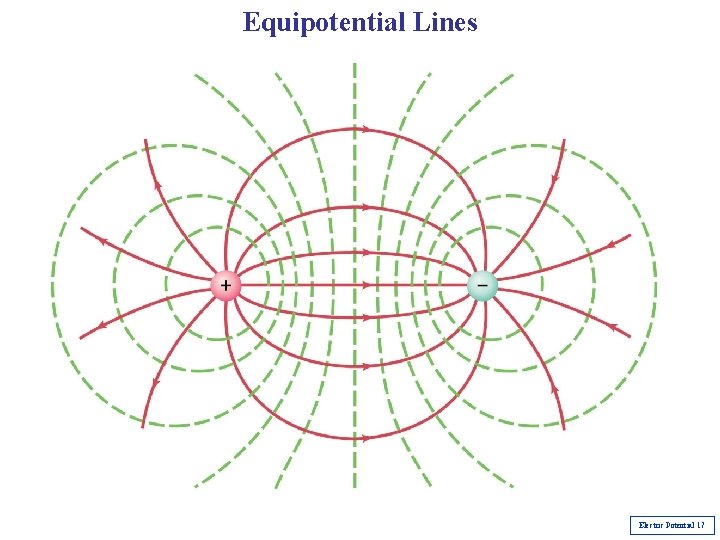
Equipotential Lines Electric Potential 17
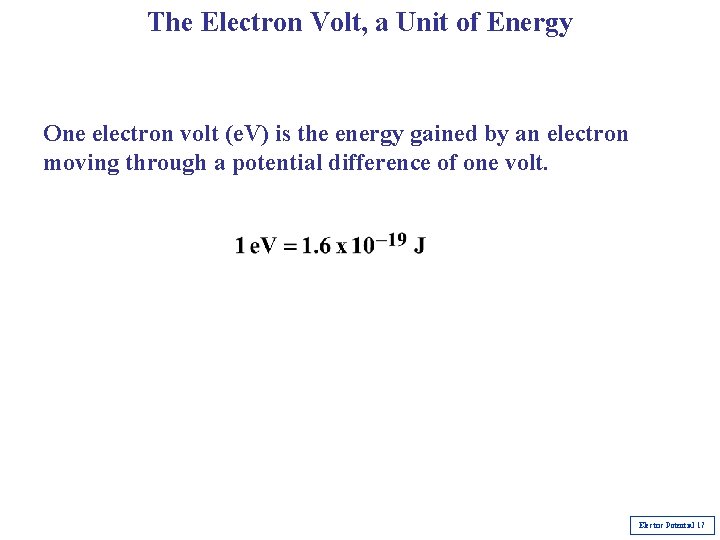
The Electron Volt, a Unit of Energy One electron volt (e. V) is the energy gained by an electron moving through a potential difference of one volt. Electric Potential 17
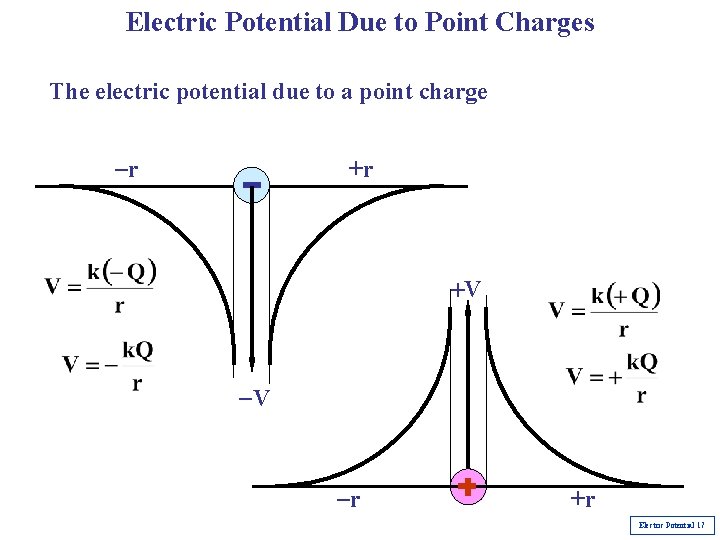
Electric Potential Due to Point Charges The electric potential due to a point charge -r +r +V -V -r +r Electric Potential 17
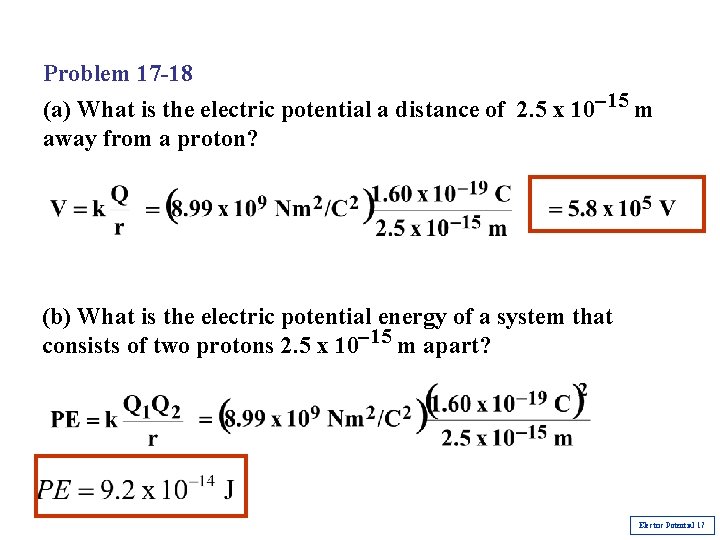
Problem 17 -18 (a) What is the electric potential a distance of 2. 5 x 10 -15 m away from a proton? (b) What is the electric potential energy of a system that consists of two protons 2. 5 x 10 -15 m apart? Electric Potential 17
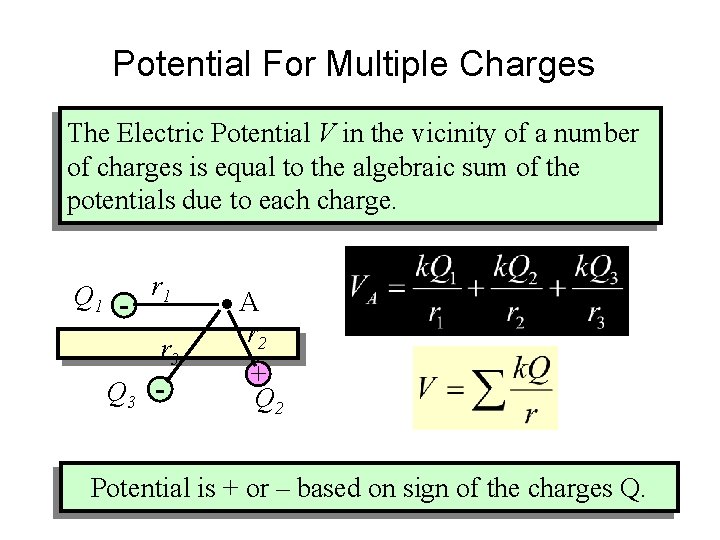
Potential For Multiple Charges The Electric Potential V in the vicinity of a number of charges is equal to the algebraic sum of the potentials due to each charge. Q 1 - r 1 r 3 Q 3 - ·A r 2 + Q 2 Potential is + or – based on sign of the charges Q.
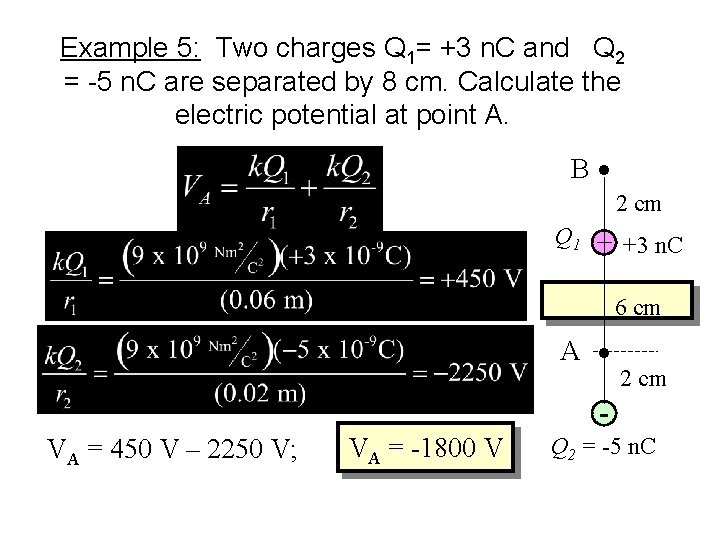
Example 5: Two charges Q 1= +3 n. C and Q 2 = -5 n. C are separated by 8 cm. Calculate the electric potential at point A. B· 2 cm Q 1 + +3 n. C 6 cm A · 2 cm VA = 450 V – 2250 V; VA = -1800 V Q 2 = -5 n. C
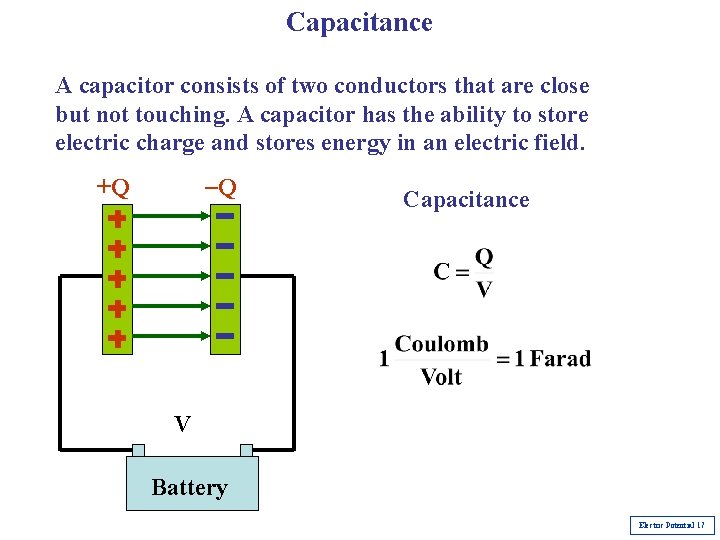
Capacitance A capacitor consists of two conductors that are close but not touching. A capacitor has the ability to store electric charge and stores energy in an electric field. -Q +Q Capacitance V Battery Electric Potential 17
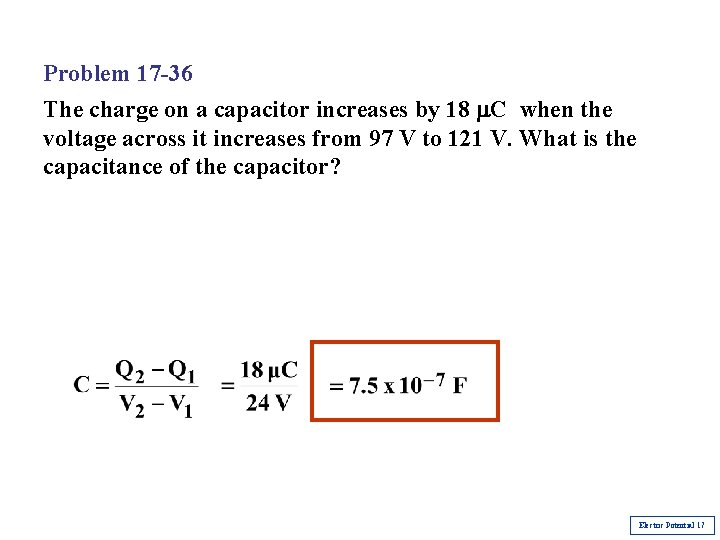
Problem 17 -36 The charge on a capacitor increases by 18 m. C when the voltage across it increases from 97 V to 121 V. What is the capacitance of the capacitor? Electric Potential 17
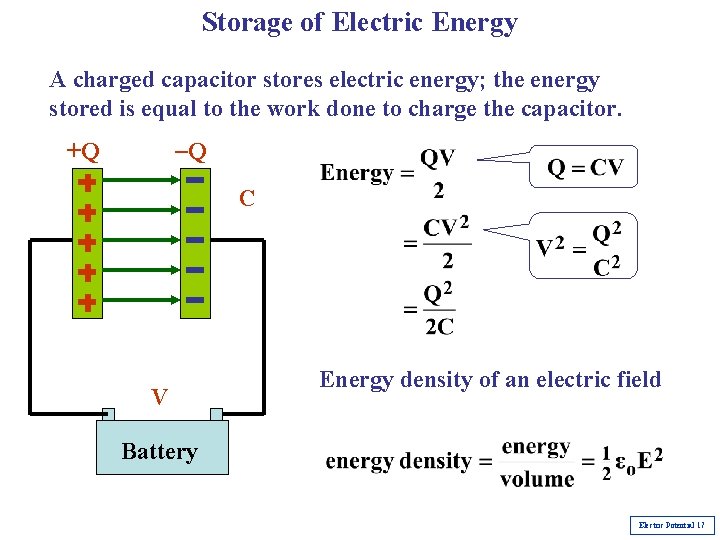
Storage of Electric Energy A charged capacitor stores electric energy; the energy stored is equal to the work done to charge the capacitor. -Q +Q C V Energy density of an electric field Battery Electric Potential 17