
Static electricity A Static Electricity is caused when
- Slides: 2
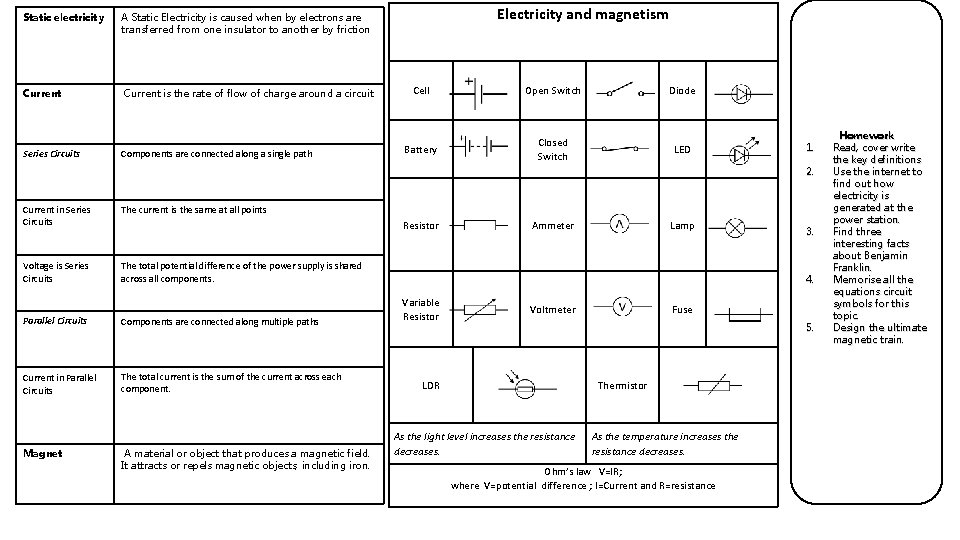
Static electricity A Static Electricity is caused when by electrons are transferred from one insulator to another by friction Current is the rate of flow of charge around a circuit. Series Circuits Components are connected along a single path Electricity and magnetism Cell Open Switch Battery Closed Switch Diode LED 1. 2. Current in Series Circuits The current is the same at all points Voltage is Series Circuits The total potential difference of the power supply is shared across all components. Resistor Parallel Circuits Components are connected along multiple paths Current in Parallel Circuits The total current is the sum of the current across each component. Magnet A material or object that produces a magnetic field. It attracts or repels magnetic objects, including iron. Ammeter Lamp 3. 4. Variable Resistor Voltmeter Fuse 5. LDR Thermistor As the light level increases the resistance decreases. As the temperature increases the resistance decreases. Ohm’s law V=IR; where V=potential difference ; I=Current and R=resistance Homework Read, cover write the key definitions Use the internet to find out how electricity is generated at the power station. Find three interesting facts about Benjamin Franklin. Memorise all the equations circuit symbols for this topic. Design the ultimate magnetic train.
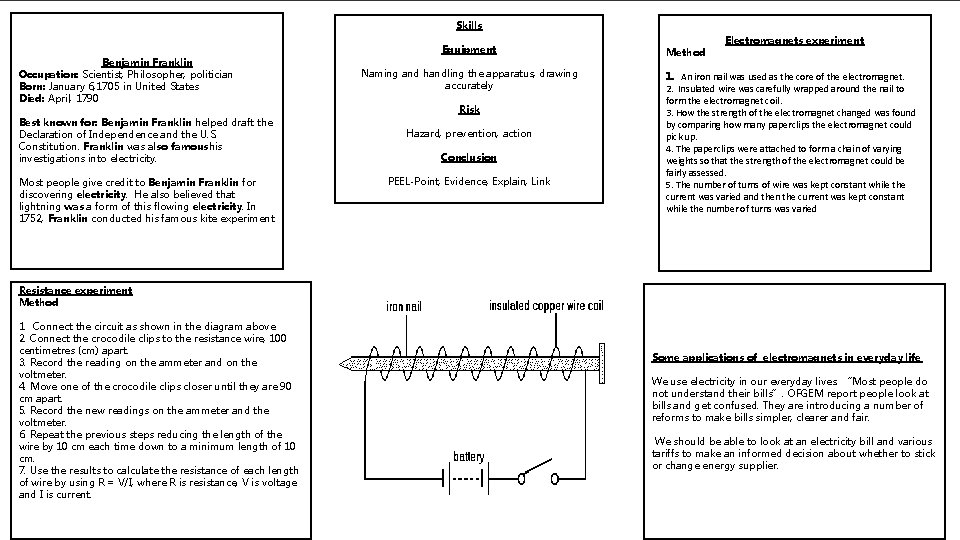
Skills Equipment Benjamin Franklin Occupation: Scientist, Philosopher, politician Born: January 6, 1705 in United States Died: April, 1790 Best known for: Benjamin Franklin helped draft the Declaration of Independence and the U. S. Constitution. Franklin was also famoushis investigations into electricity. Most people give credit to Benjamin Franklin for discovering electricity. He also believed that lightning was a form of this flowing electricity. In 1752, Franklin conducted his famous kite experiment. Naming and handling the apparatus, drawing accurately Risk Hazard, prevention, action Conclusion PEEL-Point, Evidence, Explain, Link Method Electromagnets experiment 1. An iron nail was used as the core of the electromagnet. 2. Insulated wire was carefully wrapped around the nail to form the electromagnet coil. 3. How the strength of the electromagnet changed was found by comparing how many paperclips the electromagnet could pick up. 4. The paperclips were attached to form a chain of varying weights so that the strength of the electromagnet could be fairly assessed. 5. The number of turns of wire was kept constant while the current was varied and then the current was kept constant while the number of turns was varied Resistance experiment Method 1. Connect the circuit as shown in the diagram above. 2. Connect the crocodile clips to the resistance wire, 100 centimetres (cm) apart. 3. Record the reading on the ammeter and on the voltmeter. 4. Move one of the crocodile clips closer until they are 90 cm apart. 5. Record the new readings on the ammeter and the voltmeter. 6. Repeat the previous steps reducing the length of the wire by 10 cm each time down to a minimum length of 10 cm. 7. Use the results to calculate the resistance of each length of wire by using R = V/I, where R is resistance, V is voltage and I is current. Some applications of electromagnets in everyday life We use electricity in our everyday lives. “Most people do not understand their bills”. OFGEM report people look at bills and get confused. They are introducing a number of reforms to make bills simpler, clearer and fair. We should be able to look at an electricity bill and various tariffs to make an informed decision about whether to stick or change energy supplier.