
Static Channel Assignment and Routing in MultiRadio Wireless

- Slides: 28
Static Channel Assignment and Routing in Multi-Radio Wireless Mesh Networks Neil Tang 3/9/2009 CS 541 Advanced Networking 1
Outline Ø References Ø End-to-End Bandwidth Ø Problem Definition Ø Channel Assignment Algorithm Ø Bandwidth Aware Routing Algorithms Ø Simulation Results Ø Conclusions CS 541 Advanced Networking 2
References Tang-Mobi. Hoc’ 2005: J. Tang, G. Xue and W. Zhang, Interferenceaware topology control and Qo. S routing in multi-channel wireless mesh networks, ACM International Symposium on Mobile Ad Hoc Networking and Computing (Mobi. Hoc), 2005 (Acceptance Ratio: 14%, Cited by 105 according to Google Scholar), pp. 68 -77. CS 541 Advanced Networking 3
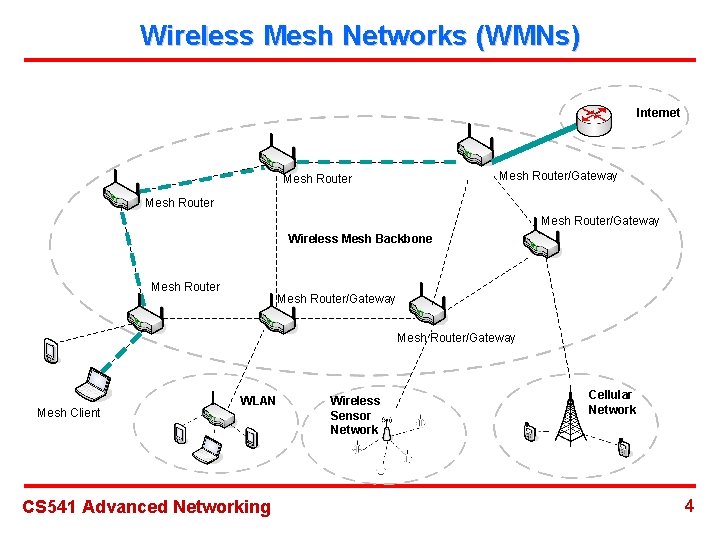
Wireless Mesh Networks (WMNs) Internet Mesh Router/Gateway Mesh Router/Gateway Wireless Mesh Backbone Mesh Router/Gateway Mesh Client WLAN CS 541 Advanced Networking Wireless Sensor Network Cellular Network 4
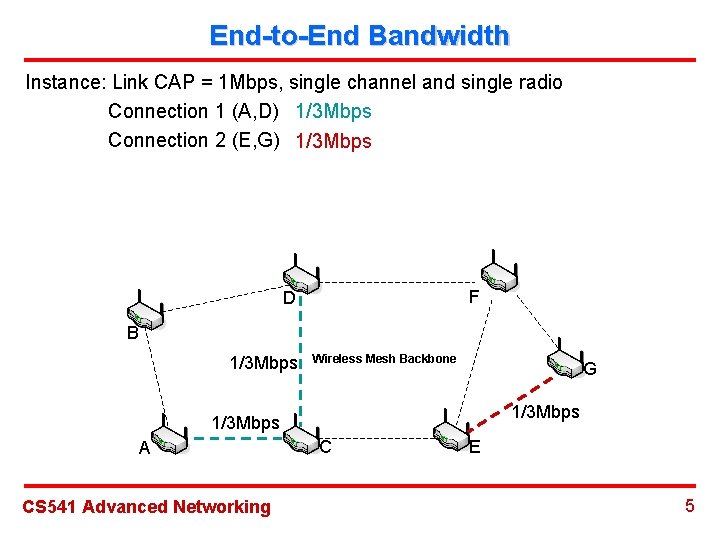
End-to-End Bandwidth Instance: Link CAP = 1 Mbps, single channel and single radio Connection 1 (A, D) 1/3 Mbps Connection 2 (E, G) 1/3 Mbps F D B 1/3 Mbps Wireless Mesh Backbone G 1/3 Mbps A CS 541 Advanced Networking C E 5
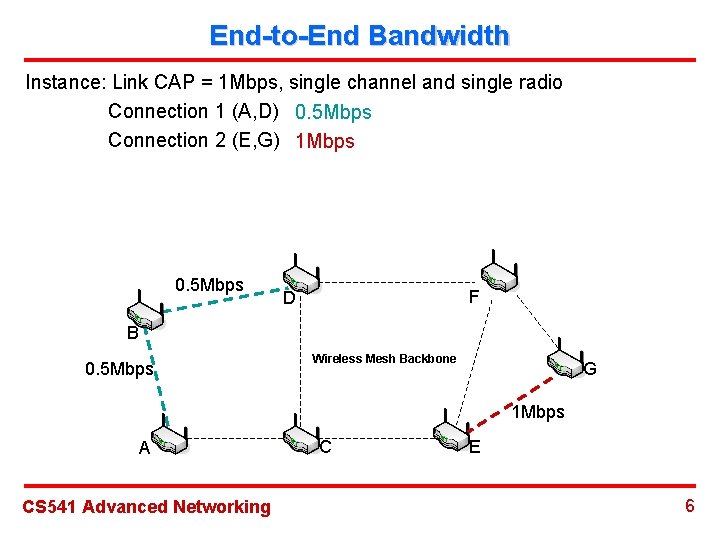
End-to-End Bandwidth Instance: Link CAP = 1 Mbps, single channel and single radio Connection 1 (A, D) 0. 5 Mbps Connection 2 (E, G) 1 Mbps 0. 5 Mbps F D B 0. 5 Mbps Wireless Mesh Backbone G 1 Mbps A CS 541 Advanced Networking C E 6
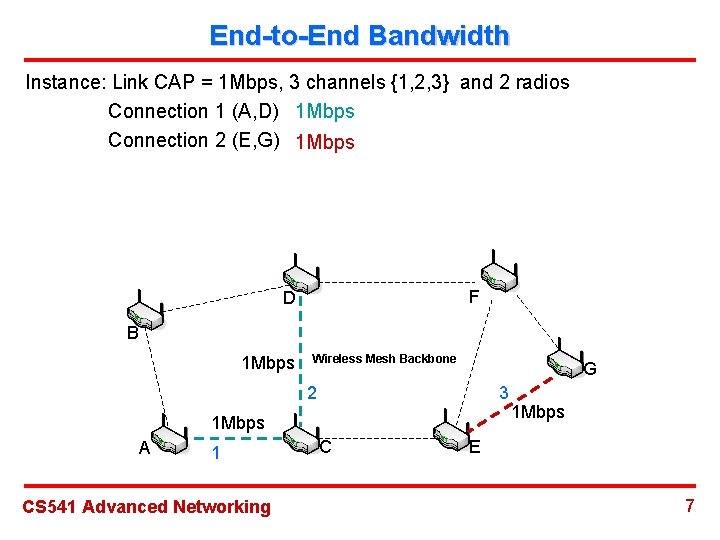
End-to-End Bandwidth Instance: Link CAP = 1 Mbps, 3 channels {1, 2, 3} and 2 radios Connection 1 (A, D) 1 Mbps Connection 2 (E, G) 1 Mbps F D B 1 Mbps Wireless Mesh Backbone G 2 3 1 Mbps A 1 CS 541 Advanced Networking C 1 Mbps E 7
Assumptions Ø A stationary wireless mesh backbone network Ø Multiple radios in each node and multiple channels Ø The same fixed transmission power Ø Half-duplex and unicast communications Ø Static channel assignment Ø MAC layer: 802. 11 DCF and scheduling-based CS 541 Advanced Networking 8
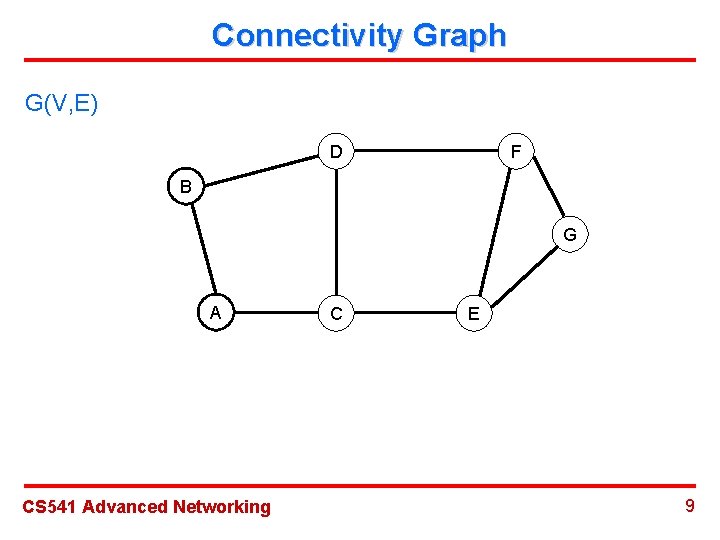
Connectivity Graph G(V, E) D F B G A CS 541 Advanced Networking C E 9
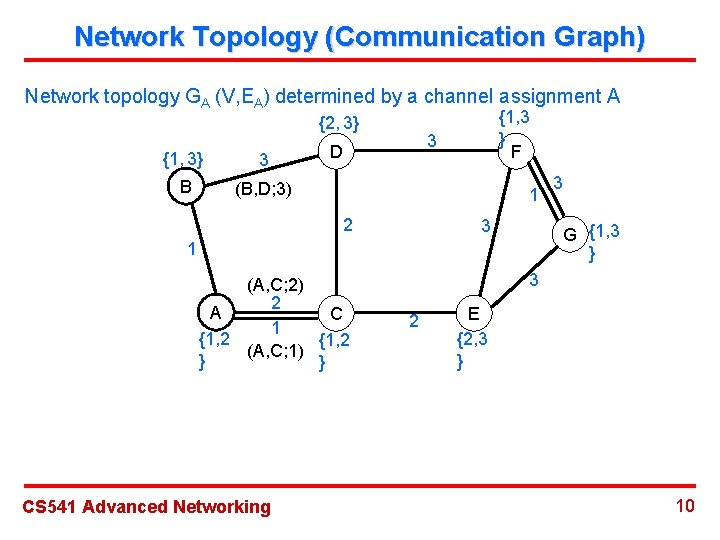
Network Topology (Communication Graph) Network topology GA (V, EA) determined by a channel assignment A {2, 3} {1, 3} 3 B (B, D; 3) {1, 3 } F 3 D 1 2 3 G {1, 3 } 1 (A, C; 2) 2 A C 1 {1, 2 (A, C; 1) } } CS 541 Advanced Networking 3 3 2 E {2, 3 } 10
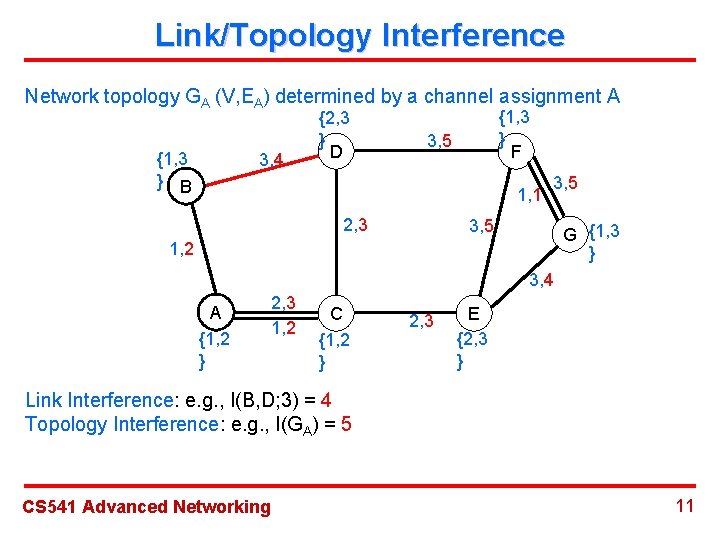
Link/Topology Interference Network topology GA (V, EA) determined by a channel assignment A {1, 3 } B 3, 4 {2, 3 } D {1, 3 } F 3, 5 1, 1 2, 3 3, 5 G {1, 3 } 1, 2 3, 4 A {1, 2 } 2, 3 1, 2 C {1, 2 } 2, 3 E {2, 3 } Link Interference: e. g. , I(B, D; 3) = 4 Topology Interference: e. g. , I(GA) = 5 CS 541 Advanced Networking 11
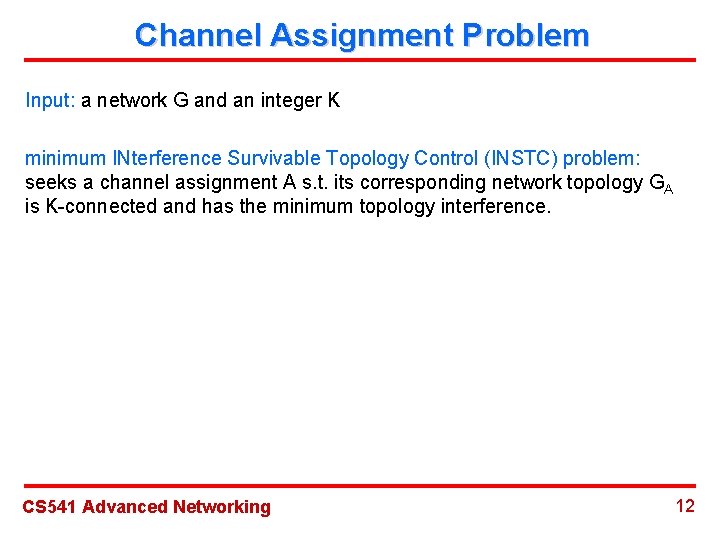
Channel Assignment Problem Input: a network G and an integer K minimum INterference Survivable Topology Control (INSTC) problem: seeks a channel assignment A s. t. its corresponding network topology GA is K-connected and has the minimum topology interference. CS 541 Advanced Networking 12
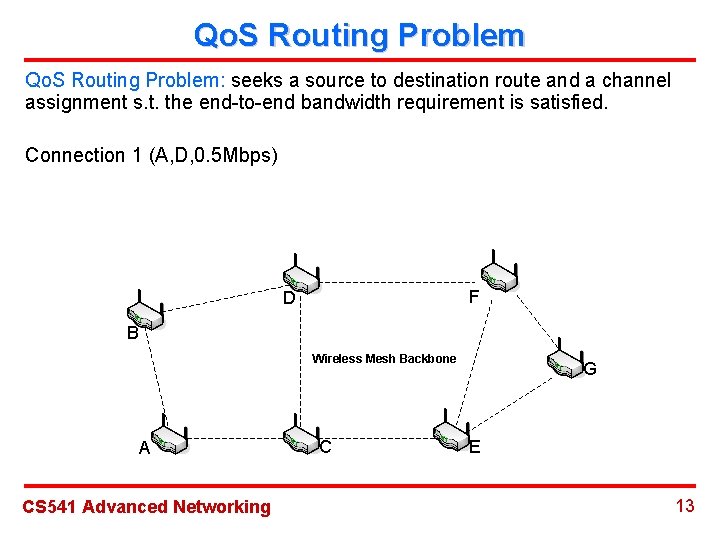
Qo. S Routing Problem: seeks a source to destination route and a channel assignment s. t. the end-to-end bandwidth requirement is satisfied. Connection 1 (A, D, 0. 5 Mbps) F D B Wireless Mesh Backbone A CS 541 Advanced Networking C G E 13
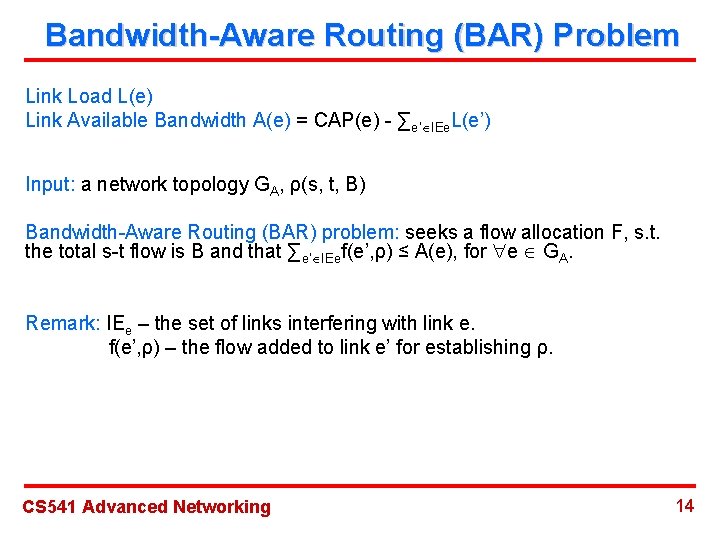
Bandwidth-Aware Routing (BAR) Problem Link Load L(e) Link Available Bandwidth A(e) = CAP(e) - ∑e’ IEe. L(e’) Input: a network topology GA, ρ(s, t, B) Bandwidth-Aware Routing (BAR) problem: seeks a flow allocation F, s. t. the total s-t flow is B and that ∑e’ IEef(e’, ρ) ≤ A(e), for e GA. Remark: IEe – the set of links interfering with link e. f(e’, ρ) – the flow added to link e’ for establishing ρ. CS 541 Advanced Networking 14
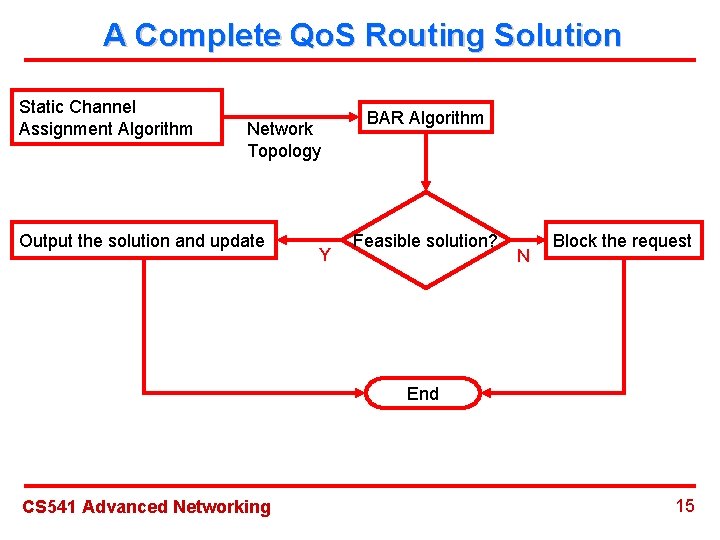
A Complete Qo. S Routing Solution Static Channel Assignment Algorithm Network Topology Output the solution and update Y BAR Algorithm Feasible solution? N Block the request End CS 541 Advanced Networking 15
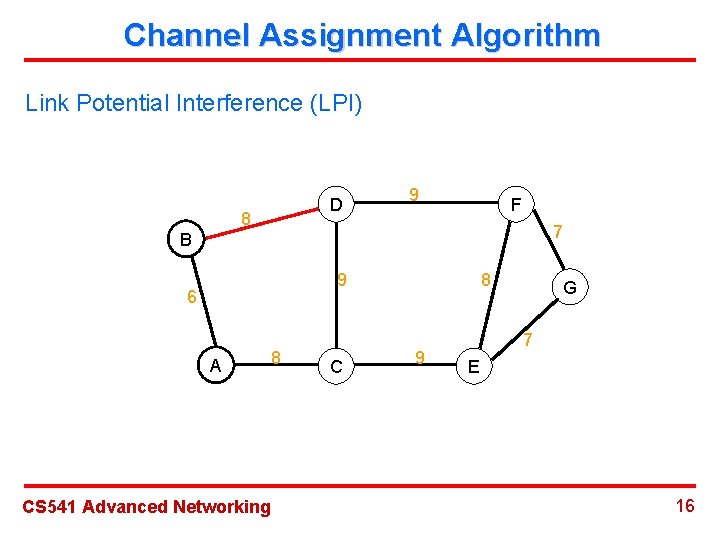
Channel Assignment Algorithm Link Potential Interference (LPI) D 8 9 F 7 B 9 6 A 8 CS 541 Advanced Networking C 8 9 G 7 E 16
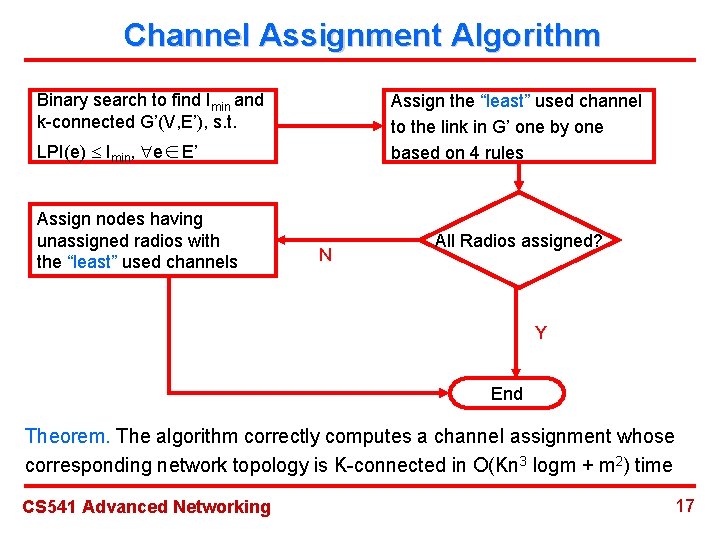
Channel Assignment Algorithm Binary search to find Imin and k-connected G’(V, E’), s. t. Assign the “least” used channel to the link in G’ one by one based on 4 rules LPI(e) Imin, e E’ Assign nodes having unassigned radios with the “least” used channels N All Radios assigned? Y End Theorem. The algorithm correctly computes a channel assignment whose corresponding network topology is K-connected in O(Kn 3 logm + m 2) time CS 541 Advanced Networking 17
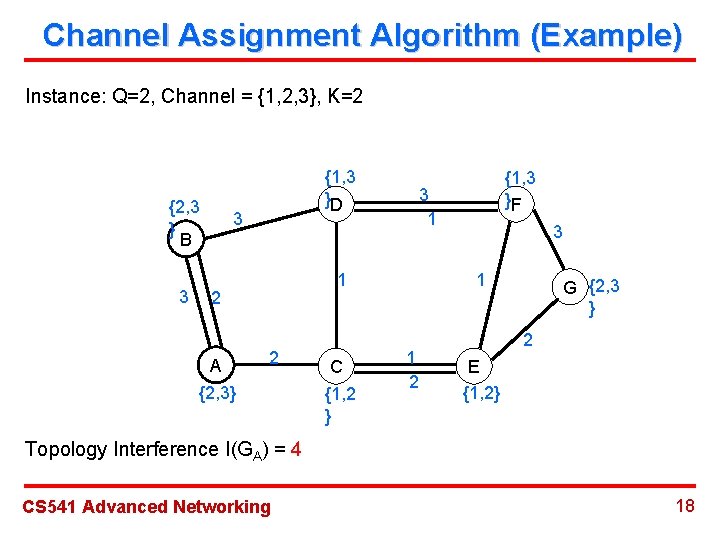
Channel Assignment Algorithm (Example) Instance: Q=2, Channel = {1, 2, 3}, K=2 {2, 3 } B 3 {1, 3 }D 3 A 3 1 1 2 2 {2, 3} C {1, 2 } {1, 3 }F 3 1 1 2 G {2, 3 } 2 E {1, 2} Topology Interference I(GA) = 4 CS 541 Advanced Networking 18
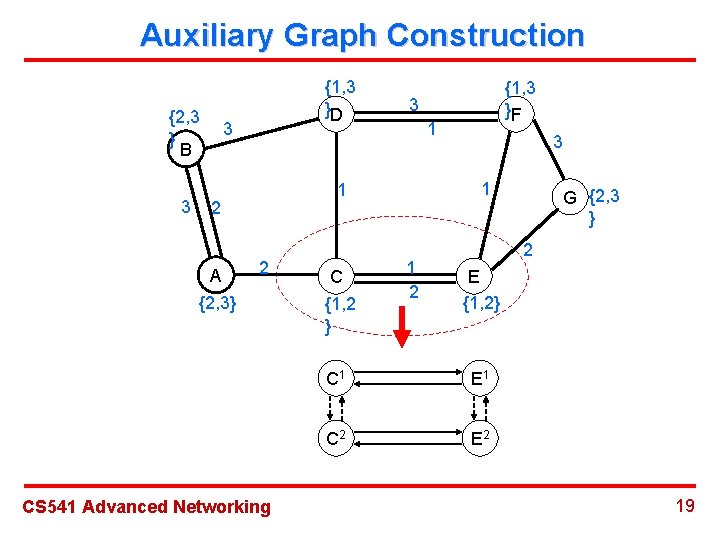
Auxiliary Graph Construction {2, 3 } B 3 {1, 3 }D 3 A 3 1 2 {2, 3} CS 541 Advanced Networking C {1, 2 } 3 1 1 2 {1, 3 }F 1 2 G {2, 3 } 2 E {1, 2} C 1 E 1 C 2 E 2 19
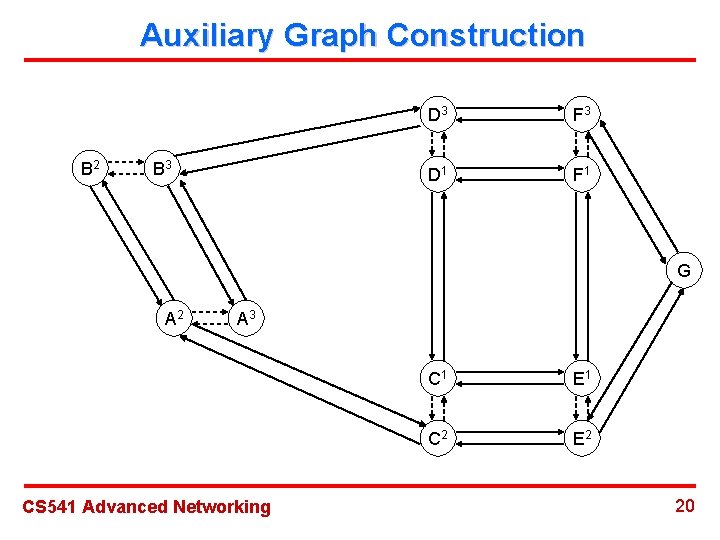
Auxiliary Graph Construction B 2 B 3 D 3 F 3 D 1 F 1 G A 2 A 3 CS 541 Advanced Networking C 1 E 1 C 2 E 2 20
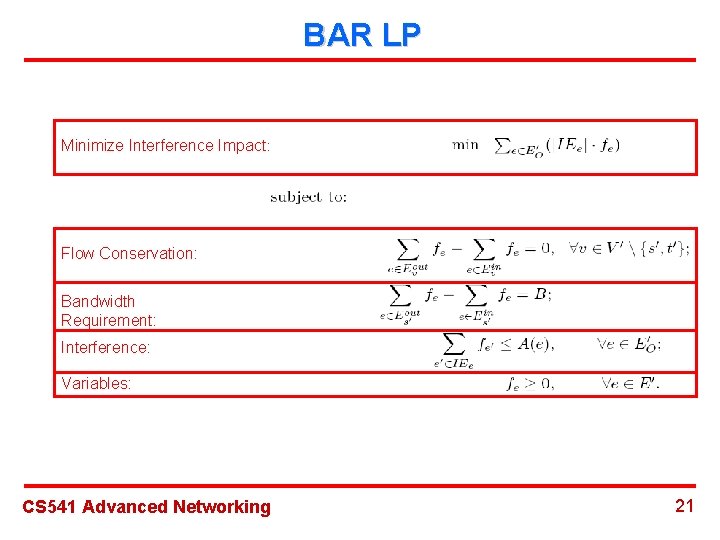
BAR LP Minimize Interference Impact: Flow Conservation: Bandwidth Requirement: Interference: Variables: CS 541 Advanced Networking 21
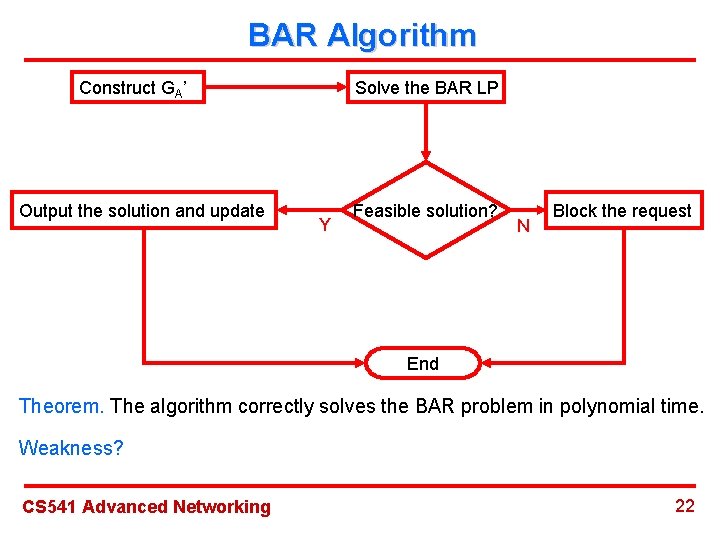
BAR Algorithm Construct GA’ Output the solution and update Solve the BAR LP Y Feasible solution? N Block the request End Theorem. The algorithm correctly solves the BAR problem in polynomial time. Weakness? CS 541 Advanced Networking 22
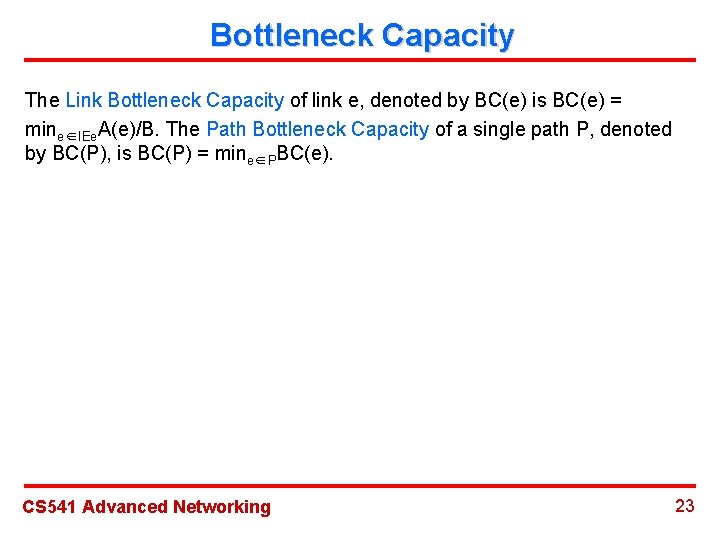
Bottleneck Capacity The Link Bottleneck Capacity of link e, denoted by BC(e) is BC(e) = mine∈IEe. A(e)/B. The Path Bottleneck Capacity of a single path P, denoted by BC(P), is BC(P) = mine∈PBC(e). CS 541 Advanced Networking 23
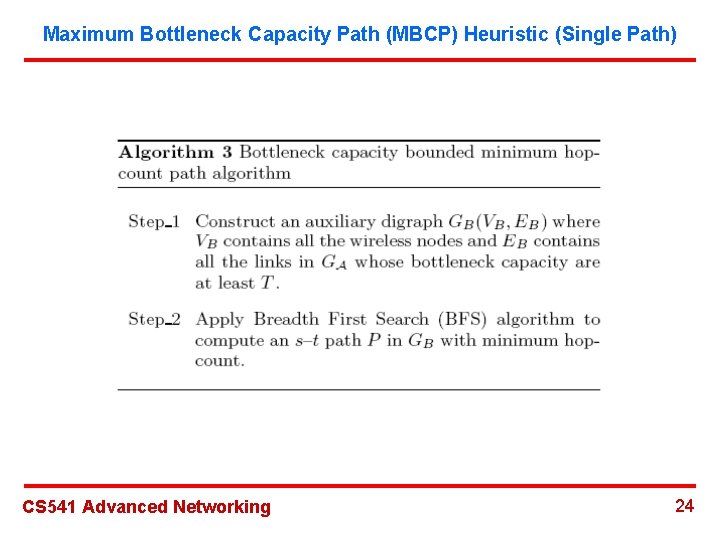
Maximum Bottleneck Capacity Path (MBCP) Heuristic (Single Path) CS 541 Advanced Networking 24
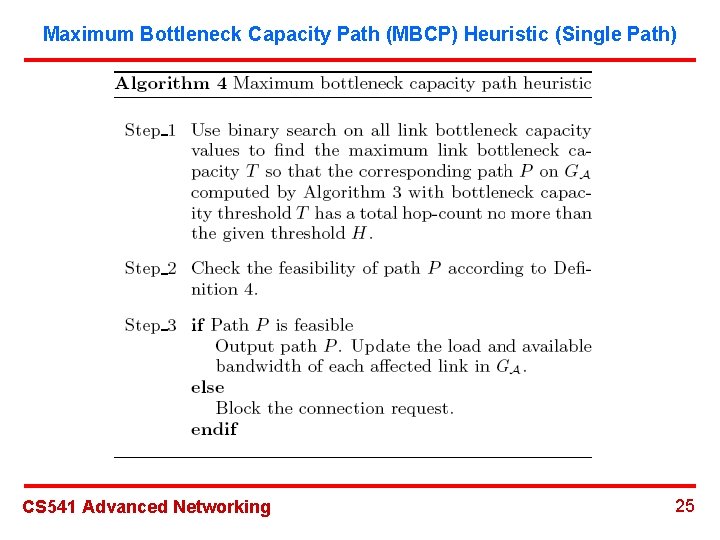
Maximum Bottleneck Capacity Path (MBCP) Heuristic (Single Path) CS 541 Advanced Networking 25
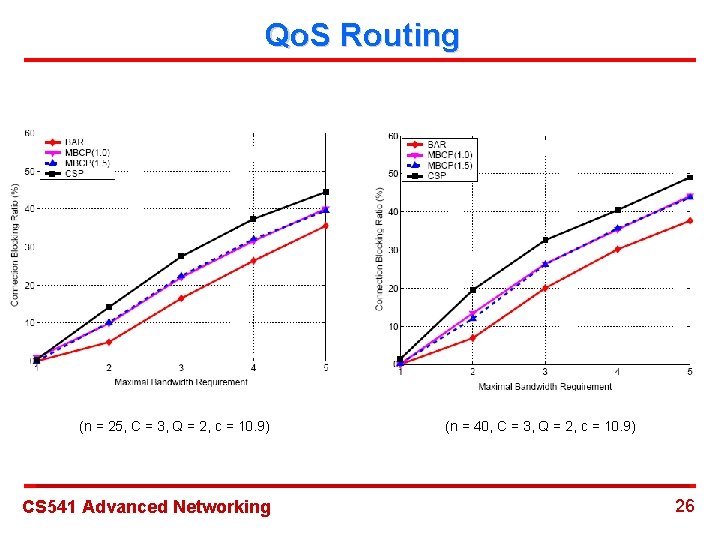
Qo. S Routing (n = 25, C = 3, Q = 2, c = 10. 9) CS 541 Advanced Networking (n = 40, C = 3, Q = 2, c = 10. 9) 26
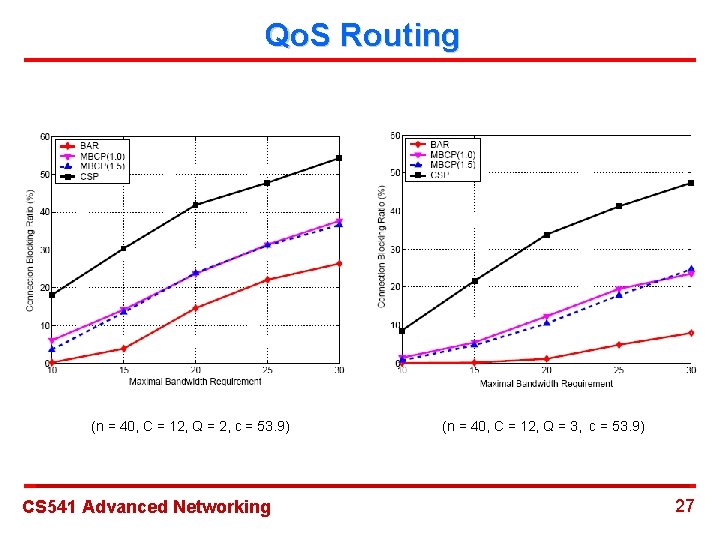
Qo. S Routing (n = 40, C = 12, Q = 2, c = 53. 9) CS 541 Advanced Networking (n = 40, C = 12, Q = 3, c = 53. 9) 27
Conclusions Ø Simulation results show that compared with the CSP scheme, the BAR scheme improves the system performance by 57% on average. CS 541 Advanced Networking 28