
States of Matter steam water ice States of
- Slides: 8
States of Matter steam water ice
States of Matter • The four most familiar states of matter are solid, liquid, gas, and plasma. • The speed of the particles and the strength of the attraction between them determine the state of matter of the substance.
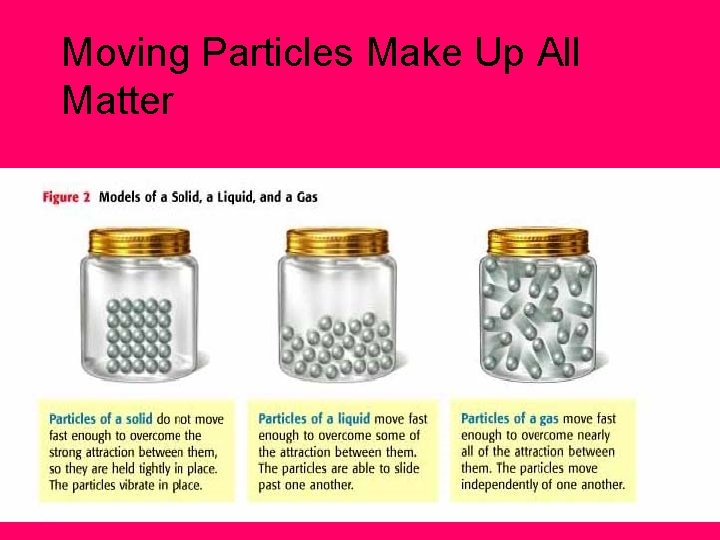
Moving Particles Make Up All Matter • Matter consists of tiny particles called molecules and atoms • Atoms and molecules are always in motion and bumping into one another • The state is determined by how fast the particles move and how strongly the particles are attracted to one another
Moving Particles Make Up All Matter
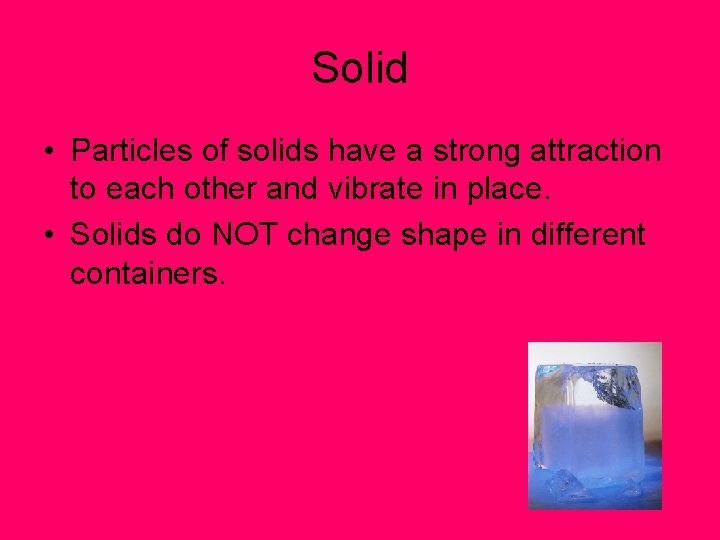
Solid • Particles of solids have a strong attraction to each other and vibrate in place. • Solids do NOT change shape in different containers.
Liquid • Liquid particles are able to slide past one another but do not move independently of each other. • Liquids form spherical drops as a result of surface tension. The meniscus of a liquid in a graduated cylinder is caused by surface tension. • A substance that pours very slowly has a high viscosity. Honey, tar, and lava are all very viscous substances.
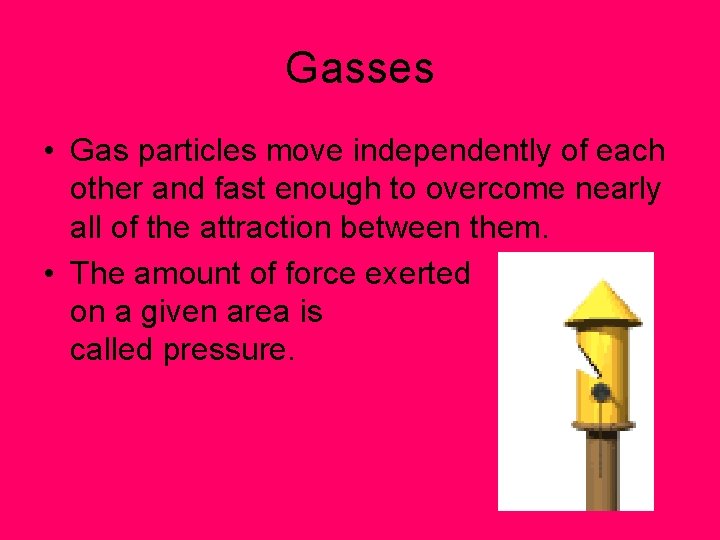
Gasses • Gas particles move independently of each other and fast enough to overcome nearly all of the attraction between them. • The amount of force exerted on a given area is called pressure.
Let’s summarize 3 -2 -1! • 3 states of matter • 2 properties of liquids • 1 way of determining state