
States of matter Solid Crystalline Amorphous Fluid Liquid
- Slides: 20
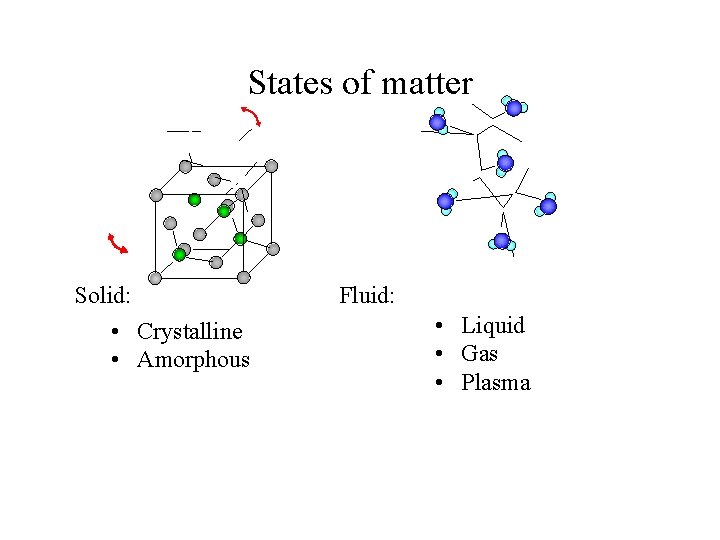
States of matter Solid: • Crystalline • Amorphous Fluid: • Liquid • Gas • Plasma
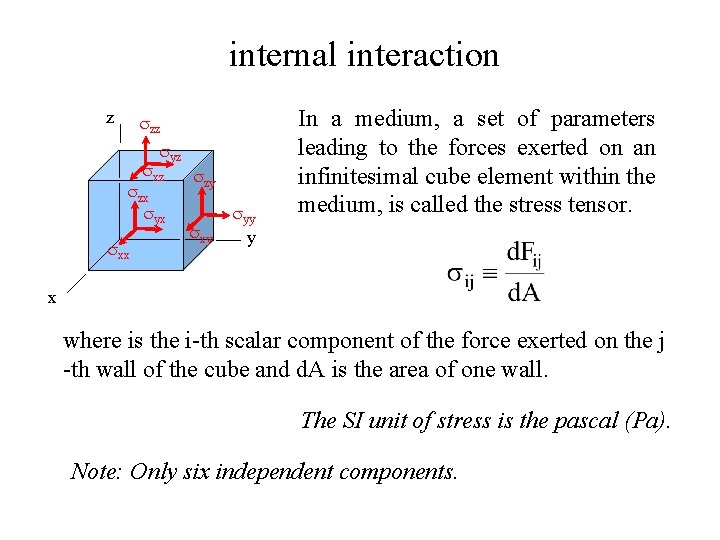
internal interaction z zz yz xz zx yx xx zy xy yy y In a medium, a set of parameters leading to the forces exerted on an infinitesimal cube element within the medium, is called the stress tensor. x where is the i-th scalar component of the force exerted on the j -th wall of the cube and d. A is the area of one wall. The SI unit of stress is the pascal (Pa). Note: Only six independent components.
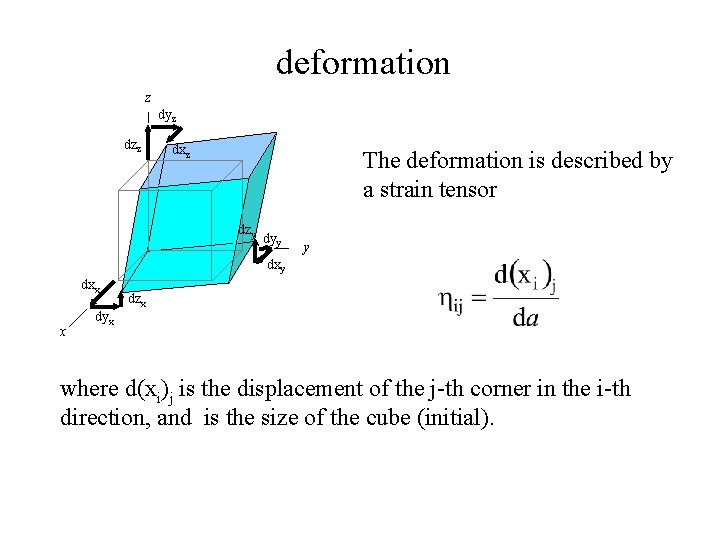
deformation z dyz dzz dxz The deformation is described by a strain tensor dzy dyy y dxx x dzx dyx where d(xi)j is the displacement of the j-th corner in the i-th direction, and is the size of the cube (initial).
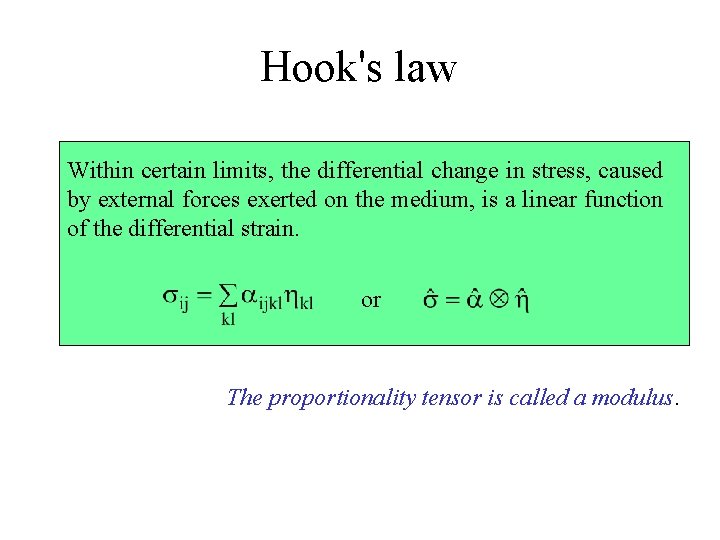
Hook's law Within certain limits, the differential change in stress, caused by external forces exerted on the medium, is a linear function of the differential strain. or The proportionality tensor is called a modulus.
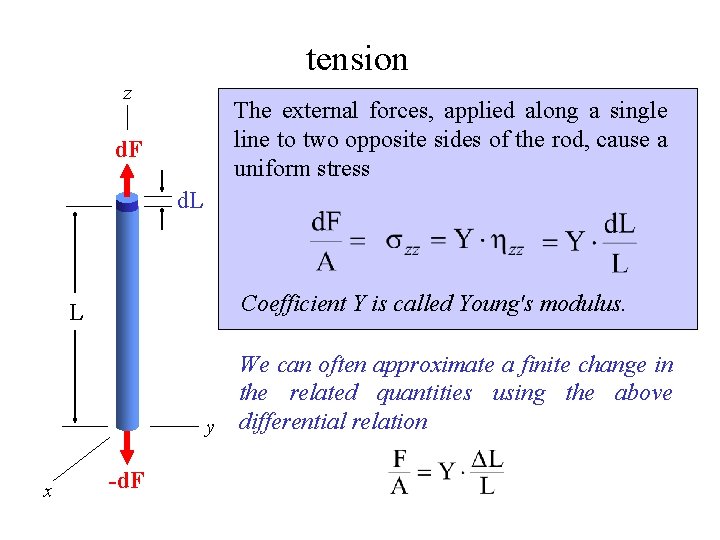
tension z The external forces, applied along a single line to two opposite sides of the rod, cause a uniform stress d. F d. L Coefficient Y is called Young's modulus. L We can often approximate a finite change in the related quantities using the above y differential relation x -d. F
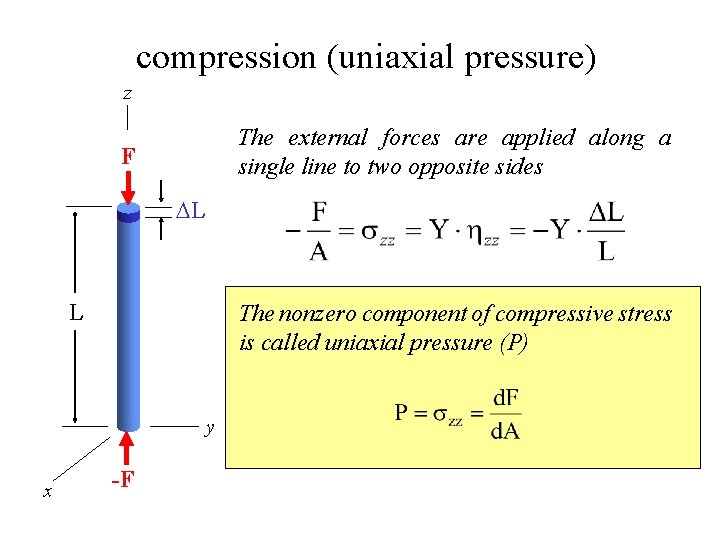
compression (uniaxial pressure) z The external forces are applied along a single line to two opposite sides F L L The nonzero component of compressive stress is called uniaxial pressure (P) y x -F
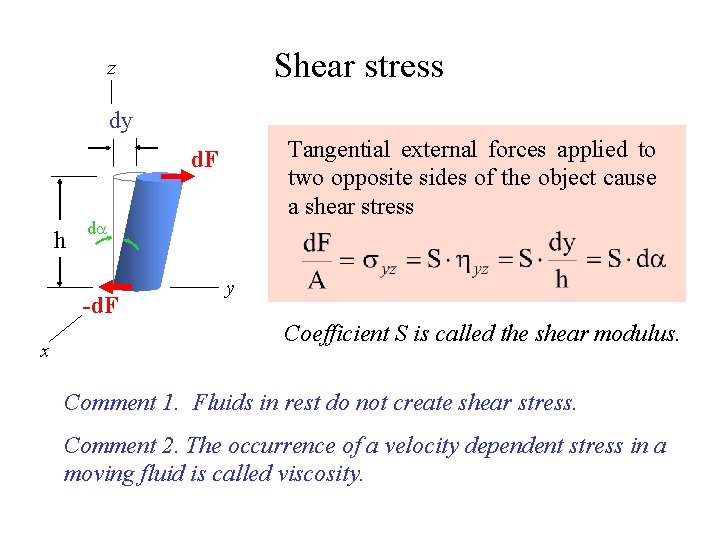
Shear stress z dy Tangential external forces applied to two opposite sides of the object cause a shear stress d. F h d -d. F x y Coefficient S is called the shear modulus. Comment 1. Fluids in rest do not create shear stress. Comment 2. The occurrence of a velocity dependent stress in a moving fluid is called viscosity.
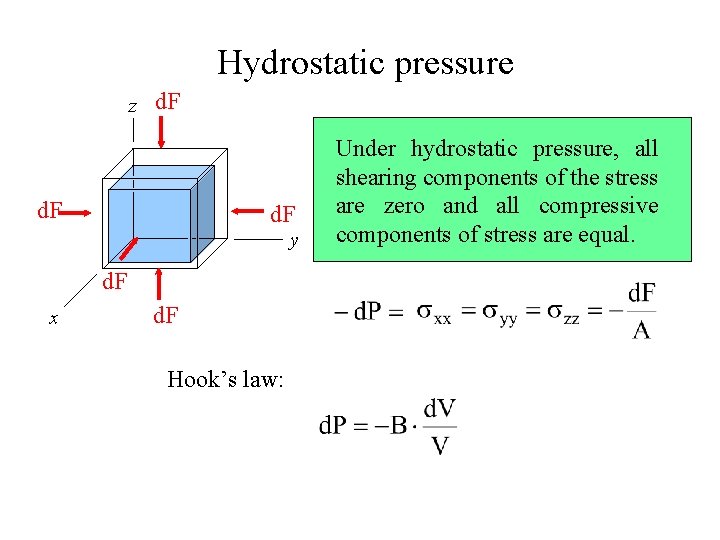
Hydrostatic pressure z d. F y d. F x d. F Hook’s law: Under hydrostatic pressure, all shearing components of the stress are zero and all compressive components of stress are equal.
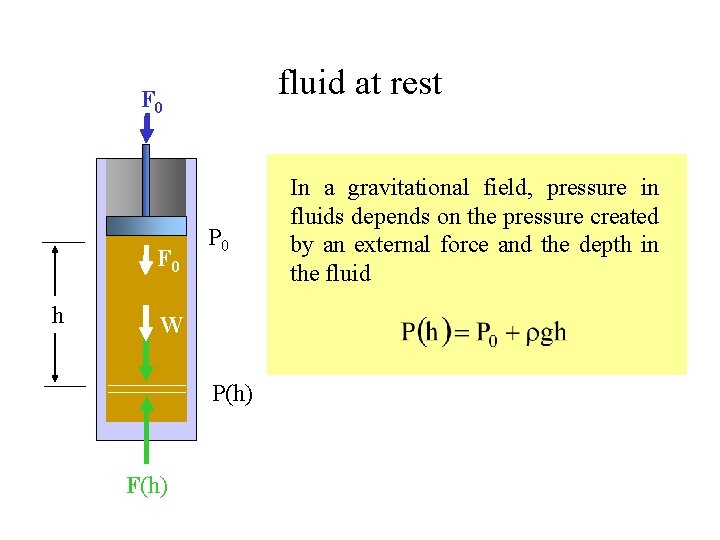
fluid at rest F 0 h P 0 W for uniform density: P(h) F(h) In a gravitational field, pressure in fluids depends on the pressure created by an external force and the depth in the fluid
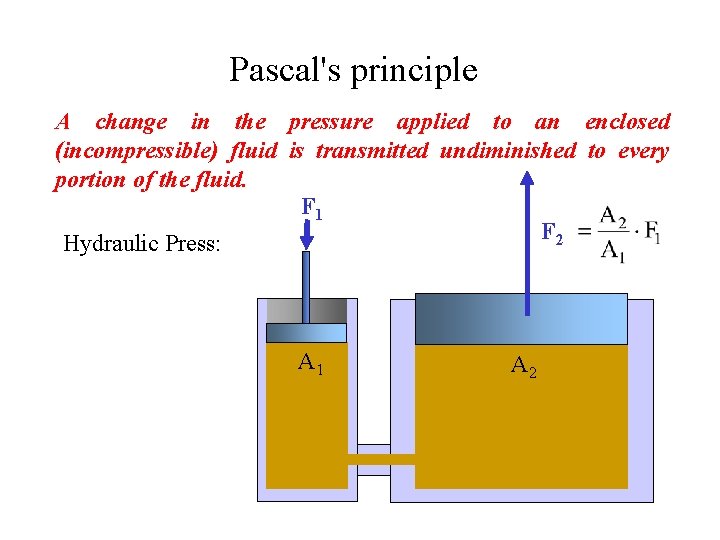
Pascal's principle A change in the pressure applied to an enclosed (incompressible) fluid is transmitted undiminished to every portion of the fluid. F 1 F 2 Hydraulic Press: A 1 A 2
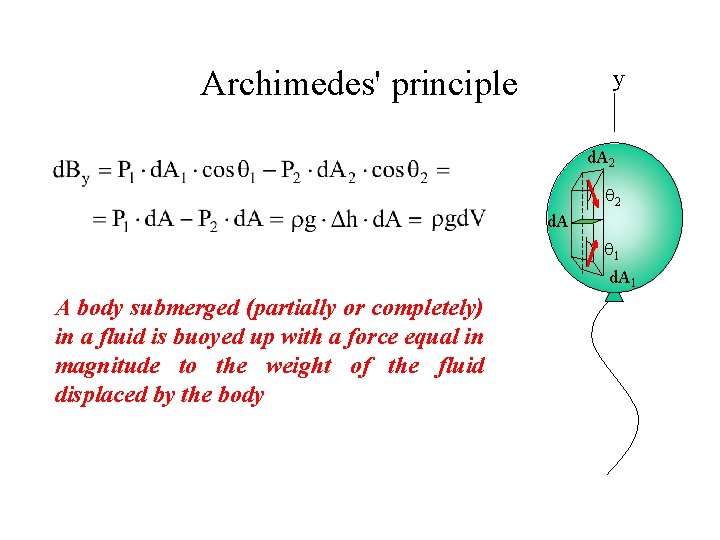
Archimedes' principle y d. A 2 2 d. A 1 A body submerged (partially or completely) in a fluid is buoyed up with a force equal in magnitude to the weight of the fluid displaced by the body
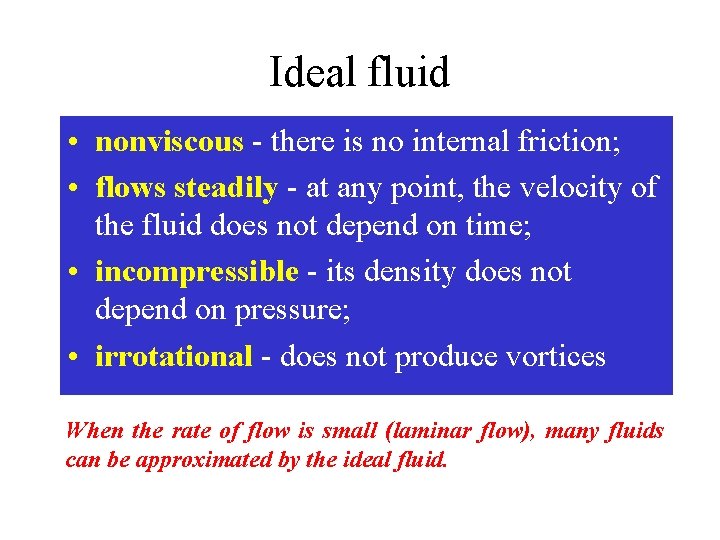
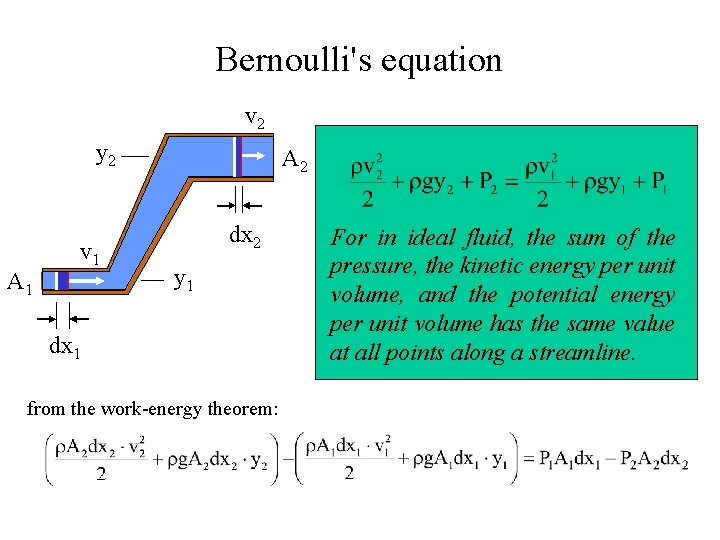
Ideal fluid • nonviscous - there is no internal friction; • flows steadily - at any point, the velocity of the fluid does not depend on time; • incompressible - its density does not depend on pressure; • irrotational - does not produce vortices When the rate of flow is small (laminar flow), many fluids can be approximated by the ideal fluid.
Bernoulli's equation v 2 y 2 A 1 v 1 A 2 dx 2 y 1 dx 1 from the work-energy theorem: For in ideal fluid, the sum of the pressure, the kinetic energy per unit volume, and the potential energy per unit volume has the same value at all points along a streamline.
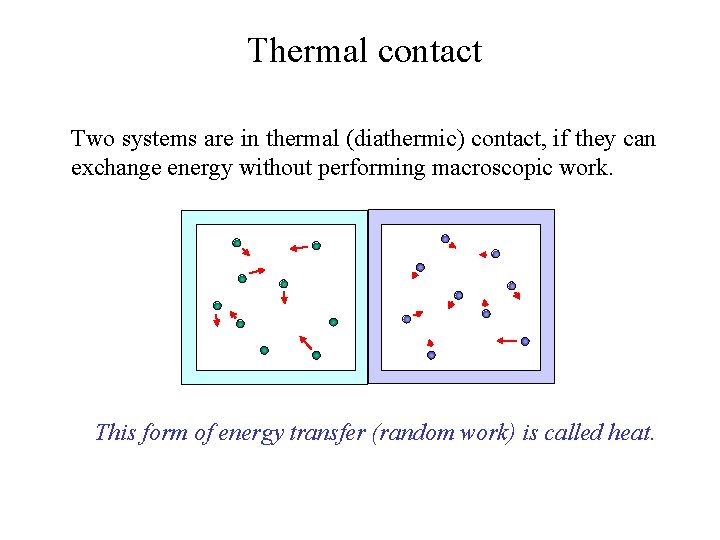
Thermal contact Two systems are in thermal (diathermic) contact, if they can exchange energy without performing macroscopic work. This form of energy transfer (random work) is called heat.
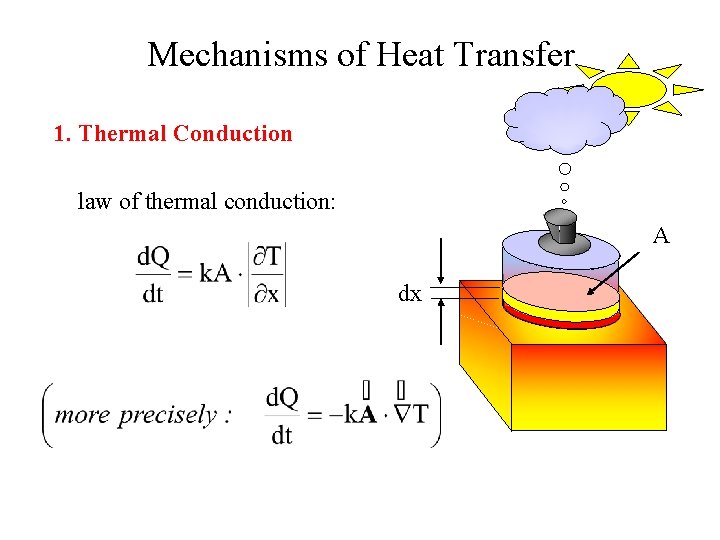
Mechanisms of Heat Transfer 1. Thermal Conduction law of thermal conduction: A dx
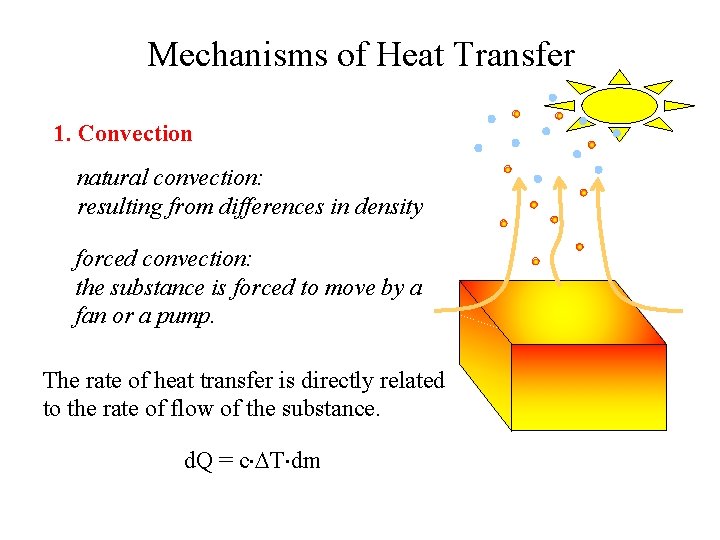
Mechanisms of Heat Transfer 1. Convection natural convection: resulting from differences in density forced convection: the substance is forced to move by a fan or a pump. The rate of heat transfer is directly related to the rate of flow of the substance. d. Q = c T dm
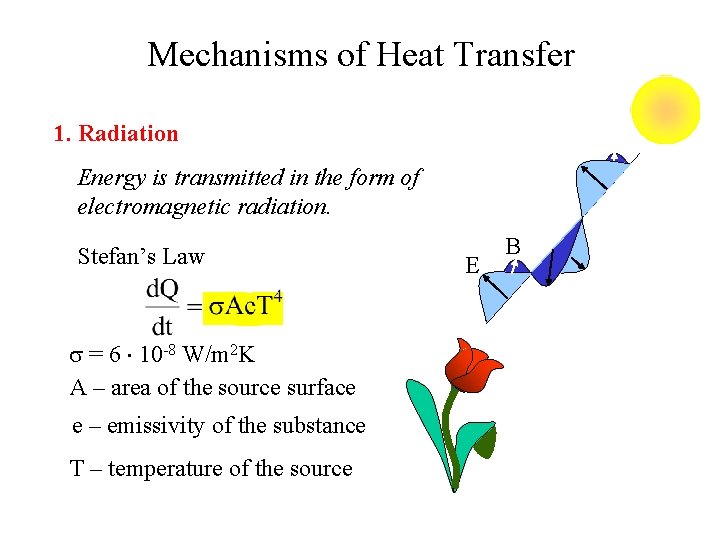
Mechanisms of Heat Transfer 1. Radiation Energy is transmitted in the form of electromagnetic radiation. Stefan’s Law = 6 10 -8 W/m 2 K A – area of the source surface e – emissivity of the substance T – temperature of the source E B
Zeroth law of thermodynamics Thermal Equilibrium: If the systems in diathermic contact do not exchange energy (on the average), we say that they are in thermal equilibrium. If both systems, A and B, are in thermal equilibrium with a third system, C, then A and B are in thermal equilibrium with each other.
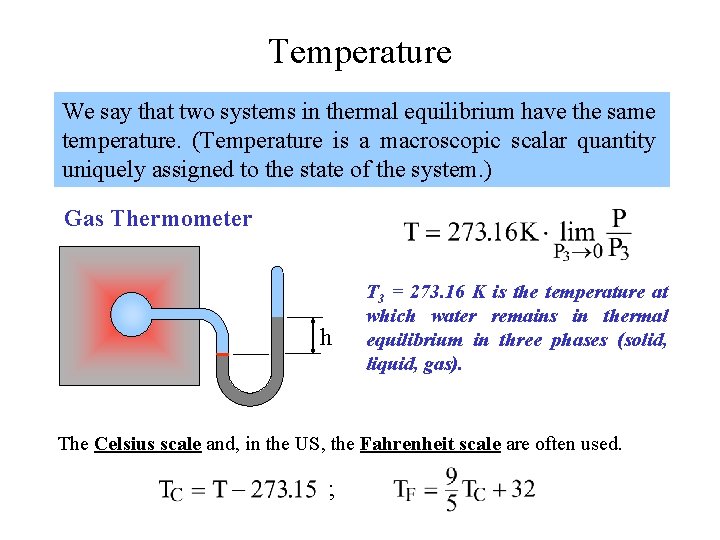
Temperature We say that two systems in thermal equilibrium have the same temperature. (Temperature is a macroscopic scalar quantity uniquely assigned to the state of the system. ) Gas Thermometer h T 3 = 273. 16 K is the temperature at which water remains in thermal equilibrium in three phases (solid, liquid, gas). The Celsius scale and, in the US, the Fahrenheit scale are often used. ;
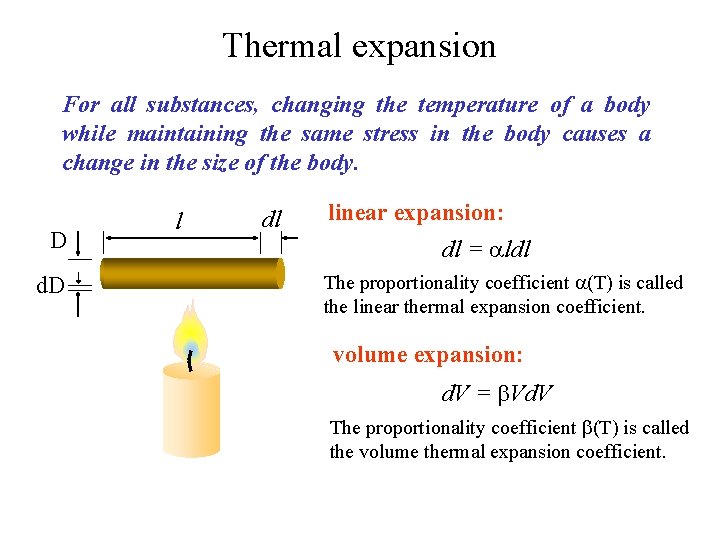
Thermal expansion For all substances, changing the temperature of a body while maintaining the same stress in the body causes a change in the size of the body. D d. D l dl linear expansion: dl = ldl The proportionality coefficient (T) is called the linear thermal expansion coefficient. volume expansion: d. V = Vd. V The proportionality coefficient (T) is called the volume thermal expansion coefficient.