
States of Matter Section 16 1 http www
- Slides: 13
States of Matter Section 16. 1 http: //www. harcourtschool. com/activity/states _of_matter/
Kinetic Theory All matter is composed of small particles Particles are in constant random motion Particles collide with each other and the walls of their containers constantly When particles collide- small amounts of energy are lost Solids- definite shape and volume- particles have strong attraction for each other, preventing motion
Solids Thermal energy causes the particles to vibrate – KE PE also causes some vibration- (energy due to the forces that act within or between particles) Higher temperatures- more vibration Temperature- the average KE of particles in a substance
Particle Motion No particle motion- absolute zero- 0 K Geometric arrangement of particles in a solid- determines chemical & physical properties of a solid Solids- particles are closely packed
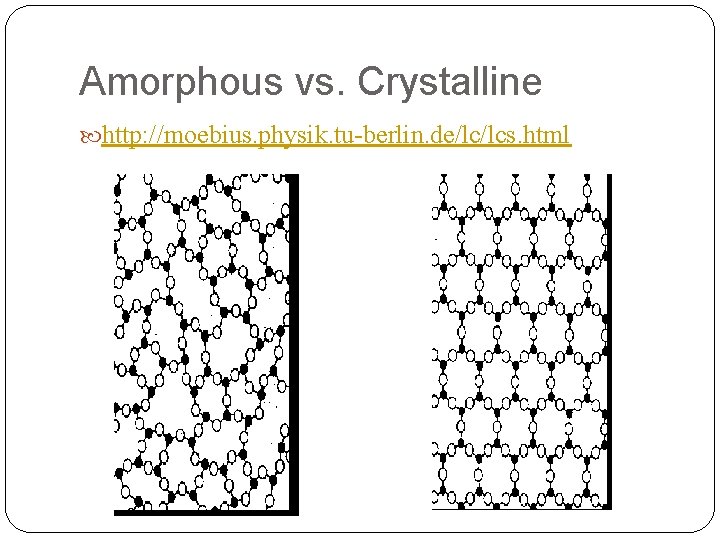
Particle Motion Different solids melt in different ways: Amorphous -solid that softens and gradually turns into a liquid over a large temperature range – don’t form crystals Crystalline solids- have set geometric structure-may melt normally or form liquid crystals Liquid crystals start to flow during the melting phase but do not lose their ordered arrangement completely From solid to liquid- in solids, particles move slowly Heat is added-particles move faster Eventually solid particles are moving fast enough- have enough KE- to overcome the attractive forces between the particles and escape the solid
Melting Point- temperature at which a solid begins to liquefy. Heat of fusion- the amount of energy required to change a substance from the solid phase to the liquid phase at its melting point Particles of a liquid have more KE than particles of a solid There is enough energy for particles to move past each other
Amorphous vs. Crystalline http: //moebius. physik. tu-berlin. de/lc/lcs. html
Particle Motion Particles of a gas-have enough KE to overcome the attractions between them completely Spread and fill the containers Diffusion-spreading of particles throughout a container until they are uniformly distributed Liquid to gas- some particles of a liquid move faster than others and escape the attractive forces of other particles- allows them to enter the gas phase Evaporation & Boiling- liquid into gas Evaporation-particles must have enough KE to escape the attractive forces of the liquid
Particle Motion Boiling- the T at which the P of a vapor in the liquid is equal to the external P acting on the surface of the liquid Lower external pressure like on a mountain means lower boiling point Higher external pressure like at sea level means higher boiling point Heat of vaporization- amount of energy required to overcome the pressure at the surface of the liquid (E needed to boil) Plasma-gas consisting of positive and negative particles- most common state of matter in universe
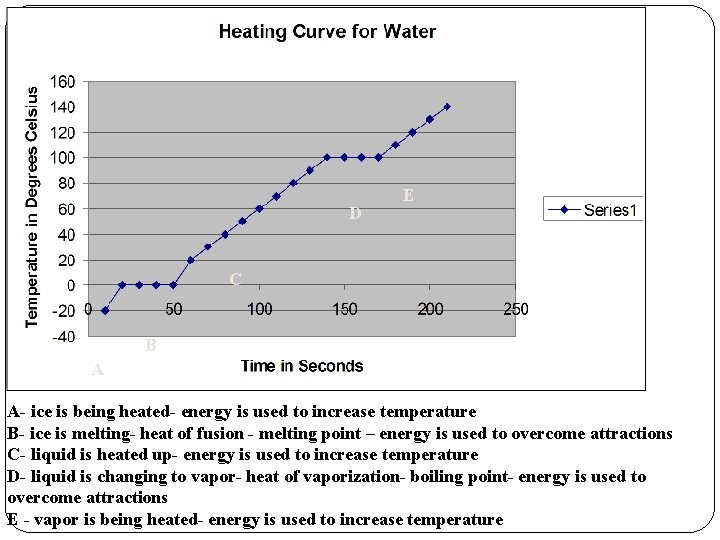
Heating Curve D E C B A A- ice is being heated- energy is used to increase temperature B- ice is melting- heat of fusion - melting point – energy is used to overcome attractions C- liquid is heated up- energy is used to increase temperature D- liquid is changing to vapor- heat of vaporization- boiling point- energy is used to overcome attractions E - vapor is being heated- energy is used to increase temperature
Temperature & Matter When temperature increases- substances expand- thermal expansion Gases expand the MOST because particles have no attractions!! When temperature decreases-substances contract Thermometers-energy is added- particles of the liquid move faster & farther apart-forces fluid upward through thermometer
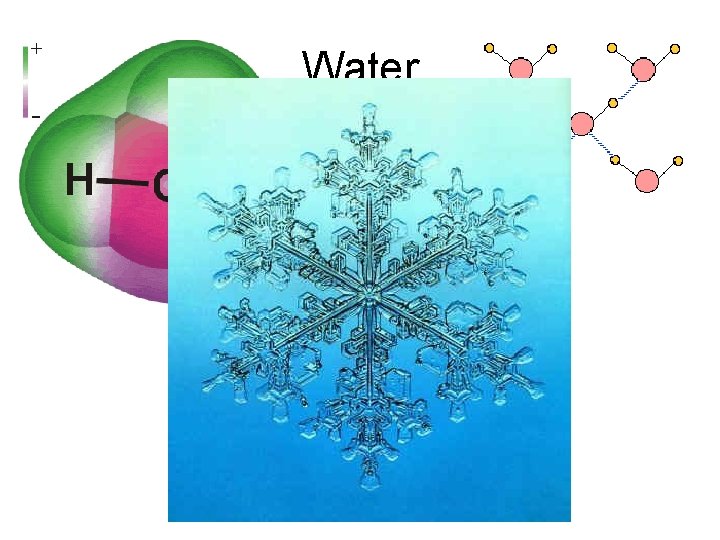
Temperature & Matter Water Hot air balloons rise- higher temperature= expansion = lower density = rises Water Has + and – regions Decrease in temperature-particles get closer together - from one particle attracts to + of other molecule Empty spaces in ice are greater than those in water- ice is less dense than water Water expands from liquid to solid- different from all other substances!
Water