
States of matter Exploring the properties of gases
- Slides: 8
States of matter Exploring the properties of gases
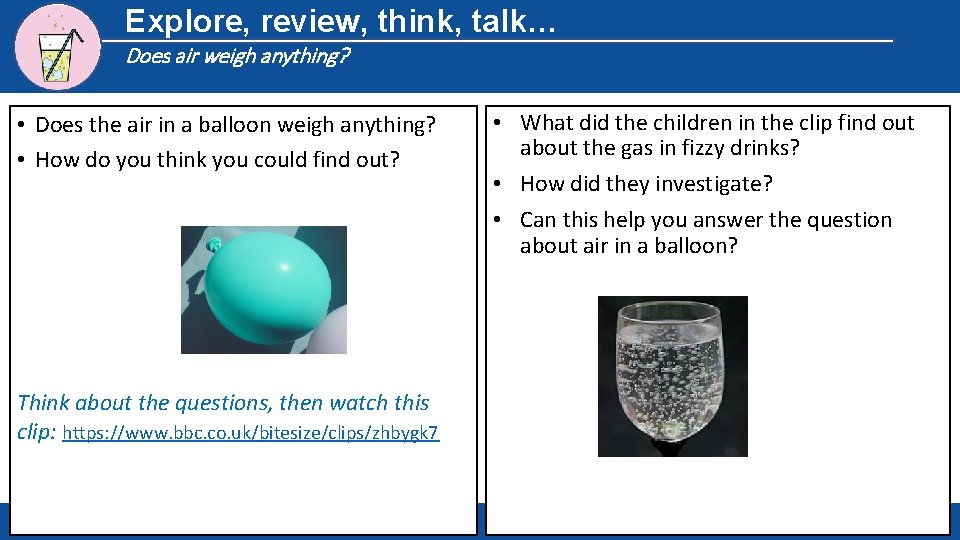
Explore, review, think, talk… Does air weigh anything? • Does the air in a balloon weigh anything? • How do you think you could find out? Think about the questions, then watch this clip: https: //www. bbc. co. uk/bitesize/clips/zhbygk 7 • What did the children in the clip find out about the gas in fizzy drinks? • How did they investigate? • Can this help you answer the question about air in a balloon?
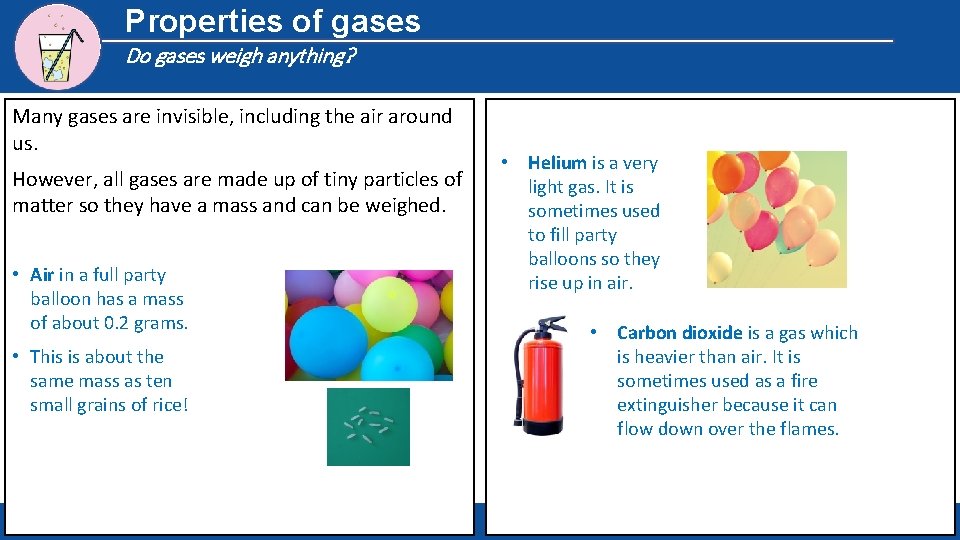
Properties of gases Do gases weigh anything? Many gases are invisible, including the air around us. However, all gases are made up of tiny particles of matter so they have a mass and can be weighed. • Air in a full party balloon has a mass of about 0. 2 grams. • This is about the same mass as ten small grains of rice! • Helium is a very light gas. It is sometimes used to fill party balloons so they rise up in air. • Carbon dioxide is a gas which is heavier than air. It is sometimes used as a fire extinguisher because it can flow down over the flames.
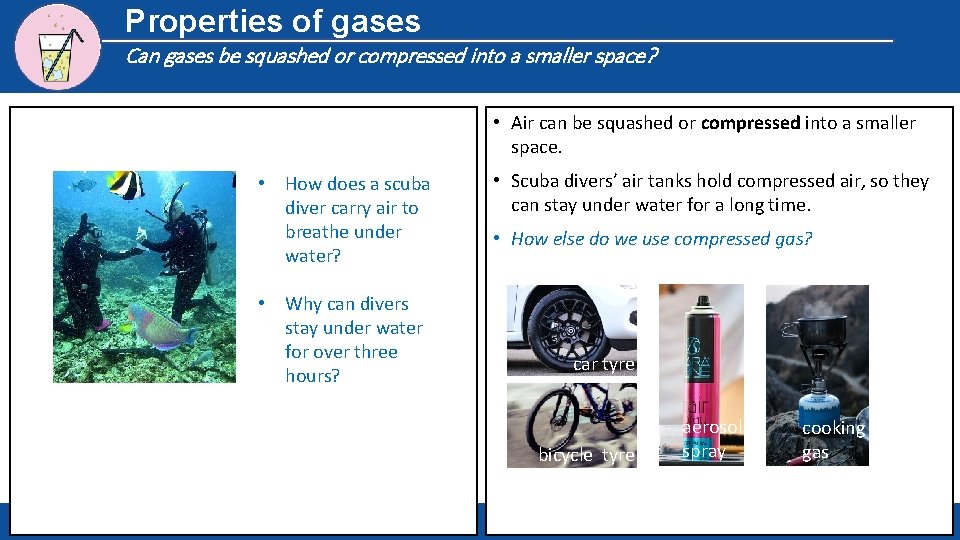
Properties of gases Can gases be squashed or compressed into a smaller space? • Air can be squashed or compressed into a smaller space. • How does a scuba diver carry air to breathe under water? • Why can divers stay under water for over three hours? • Scuba divers’ air tanks hold compressed air, so they can stay under water for a long time. • How else do we use compressed gas? car tyre bicycle tyre aerosol spray cooking gas
Make a poster or mind map to describe some everyday uses of gases. Use what you have learnt and the word bank to help you. You may like to draw pictures or use photographs. Word bank: gas, compressed, air, helium, carbon dioxide, cooking gas, aerosol gas. bicycle tyre, car tyre, balloon, fizzy drink, scuba diving tank, aerosol can, fire extinguisher, gas bottle, cooker. I can describe some everyday uses of gases.
Find out more… Find out more about carbon dioxide gas Ask an adult if you can investigate more about carbon dioxide gas with them: • Use the link to the PSTT Science Fun at Home ‘What a gas!’ activity to investigate making carbon dioxide gas at home: • https: //pstt. org. uk/application/files/8615/8814/8781/Sci ence_Fun_at_Home_6_Gases. pdf • Use the link to the RSC’s Chemistry in your Cupboard ‘Building a rocket’ activity to find out how to make a gas propelled rocket by compressing carbon dioxide. (This is an outside activity only!) • https: //bit. ly/3 avocm 1
Key Learning • A gas fills all available space; it has no fixed shape or volume. • Many gases are invisible. • A gas has a mass, so its weight can be measured. • A gas can be squashed or compressed into a smaller space. So… Thinking back to our big question for this topic Does air weigh anything?
Glossary of terms States of matter: There are three states of matter: solid, liquid and gas. Gas: A gas is a material which fills all available space; it has no fixed shape or volume. Invisible: Many gases are invisible so you cannot see them. Compressed: A gas can be compressed or squashed into a smaller space or volume. For example, divers use compressed air tanks under water. Matter: A gas is made up of tiny particles of matter. This means gas has a mass and its weight can be measured. Volume: The volume is the amount of space taken up by a solid, liquid or gas.