
StatementLevel Control Structures Introduction Selection Statements Iterative Statements
![Iterative Statements • FORTRAN 90’s Other DO – Syntax: [name: ] DO variable =](https://slidetodoc.com/presentation_image_h2/f5d2b70548b31afe184037dc68d5ca47/image-25.jpg "Iterative Statements • FORTRAN 90’s Other DO – Syntax: [name: ] DO variable =")
![Iterative Statements 4. Ada • Syntax: for var in [reverse] discrete_range loop. . .](https://slidetodoc.com/presentation_image_h2/f5d2b70548b31afe184037dc68d5ca47/image-29.jpg "Iterative Statements 4. Ada • Syntax: for var in [reverse] discrete_range loop. . .")
![Iterative Statements 5. C • Syntax: for ([expr_1] ; [expr_2] ; [expr_3]) statement –](https://slidetodoc.com/presentation_image_h2/f5d2b70548b31afe184037dc68d5ca47/image-31.jpg "Iterative Statements 5. C • Syntax: for ([expr_1] ; [expr_2] ; [expr_3]) statement –")
![Guarded Commands 1. Selection: if <boolean> -> <statement> []<boolean> -> <statement>. . . []](https://slidetodoc.com/presentation_image_h2/f5d2b70548b31afe184037dc68d5ca47/image-46.jpg "Guarded Commands 1. Selection: if <boolean> -> <statement> []<boolean> -> <statement>. . . []")
![Guarded Commands 2. Loops do <boolean> -> <statement> [] <boolean> -> <statement>. . .](https://slidetodoc.com/presentation_image_h2/f5d2b70548b31afe184037dc68d5ca47/image-49.jpg "Guarded Commands 2. Loops do <boolean> -> <statement> [] <boolean> -> <statement>. . .")
- Slides: 53
Statement-Level Control Structures • • • Introduction Selection Statements Iterative Statements Unconditional Branching Guarded Commands Conclusions 1
Introduction • Levels of Control Flow: 1. Within expressions 2. Among program units 3. Among program statements 2
Introduction • Evolution: – FORTRAN I control statements were based directly on IBM 704 hardware – Much research and argument in the 1960 s about the issue – One important result: It was proven that all flowcharts can be coded with only two-way selection and pretest logical loops 3
Introduction • Def: A control structure is a control statement and the statements whose execution it controls • Overall Design Question: – What control statements should a language have, beyond selection and pretest logical loops? 4
Selection Statements • A selection statement provides the means of choosing between two or more paths of execution • Two general categories: – Two-way selectors – Multiple-way selectors 5
Two-Way Selection Statements • Design Issues: 1. What is the form and type of the control expression? 2. How are then and else clauses specified? 3. How should the meaning of nested selectors be specified? 6
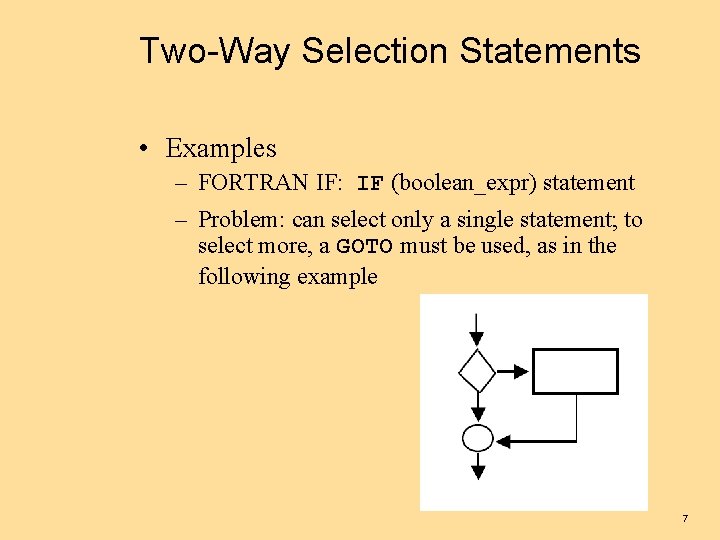
Two-Way Selection Statements • Examples – FORTRAN IF: IF (boolean_expr) statement – Problem: can select only a single statement; to select more, a GOTO must be used, as in the following example 7
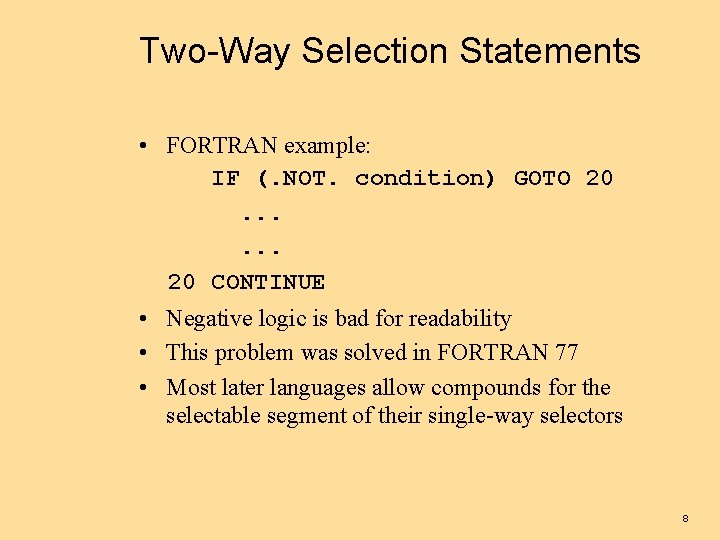
Two-Way Selection Statements • FORTRAN example: IF (. NOT. condition) GOTO 20. . . 20 CONTINUE • Negative logic is bad for readability • This problem was solved in FORTRAN 77 • Most later languages allow compounds for the selectable segment of their single-way selectors 8
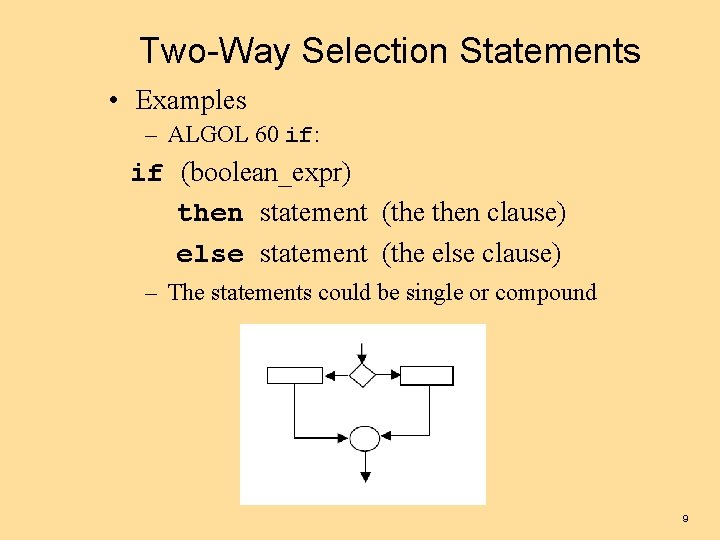
Two-Way Selection Statements • Examples – ALGOL 60 if: if (boolean_expr) then statement (the then clause) else statement (the else clause) – The statements could be single or compound 9
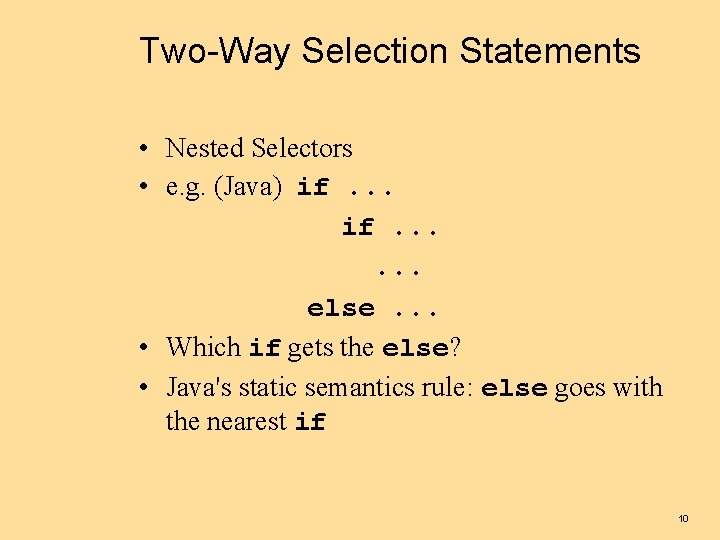
Two-Way Selection Statements • Nested Selectors • e. g. (Java) if. . . else. . . • Which if gets the else? • Java's static semantics rule: else goes with the nearest if 10
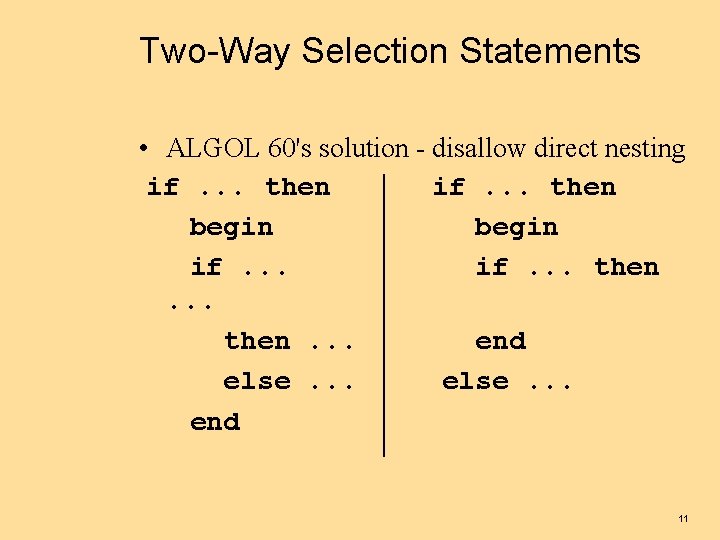
Two-Way Selection Statements • ALGOL 60's solution - disallow direct nesting if. . . then begin if. . . then. . . end else. . . end 11
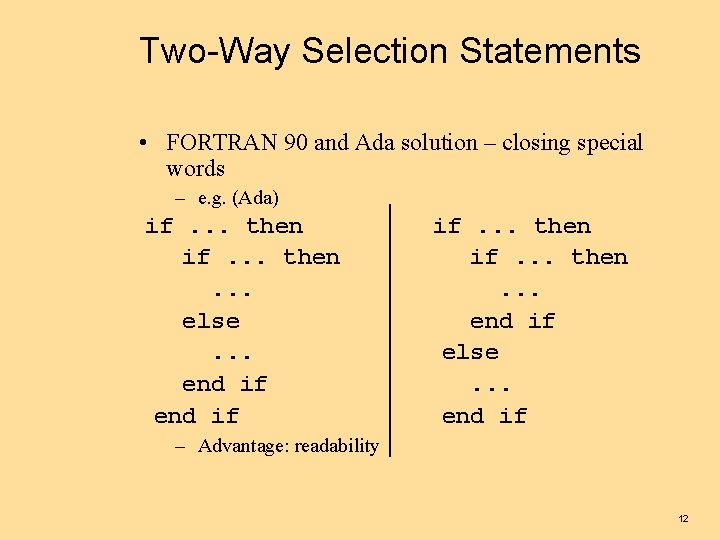
Two-Way Selection Statements • FORTRAN 90 and Ada solution – closing special words – e. g. (Ada) if. . . then. . . else. . . end if if. . . then. . . end if else. . . end if – Advantage: readability 12
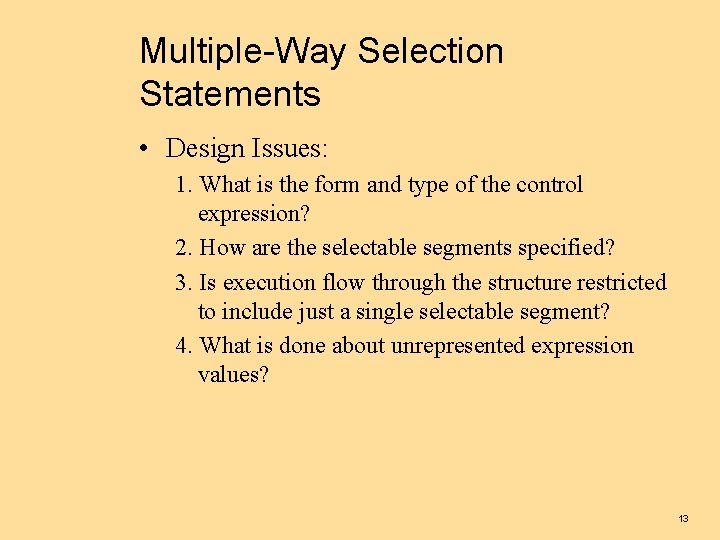
Multiple-Way Selection Statements • Design Issues: 1. What is the form and type of the control expression? 2. How are the selectable segments specified? 3. Is execution flow through the structure restricted to include just a single selectable segment? 4. What is done about unrepresented expression values? 13
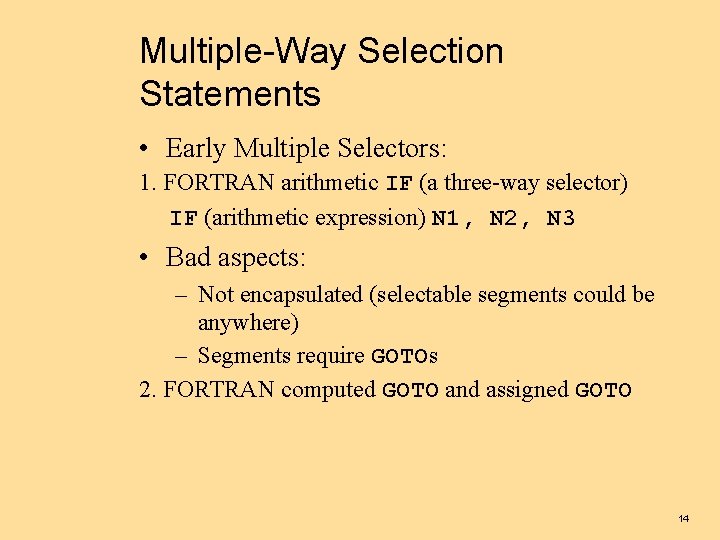
Multiple-Way Selection Statements • Early Multiple Selectors: 1. FORTRAN arithmetic IF (a three-way selector) IF (arithmetic expression) N 1, N 2, N 3 • Bad aspects: – Not encapsulated (selectable segments could be anywhere) – Segments require GOTOs 2. FORTRAN computed GOTO and assigned GOTO 14
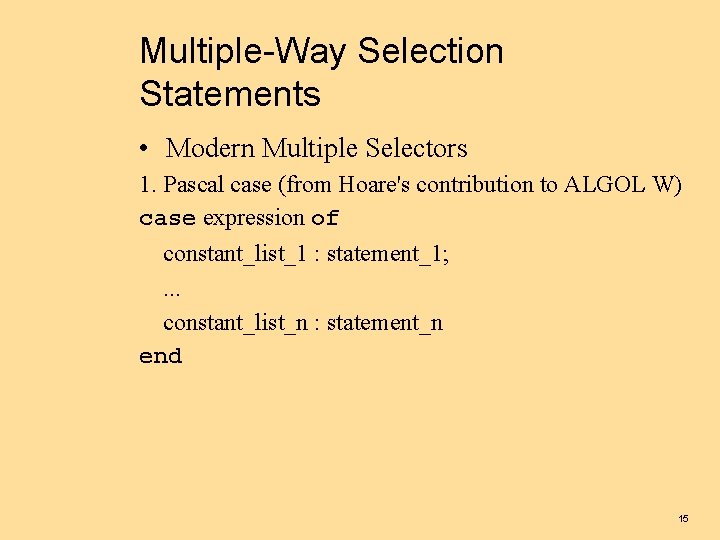
Multiple-Way Selection Statements • Modern Multiple Selectors 1. Pascal case (from Hoare's contribution to ALGOL W) case expression of constant_list_1 : statement_1; . . . constant_list_n : statement_n end 15
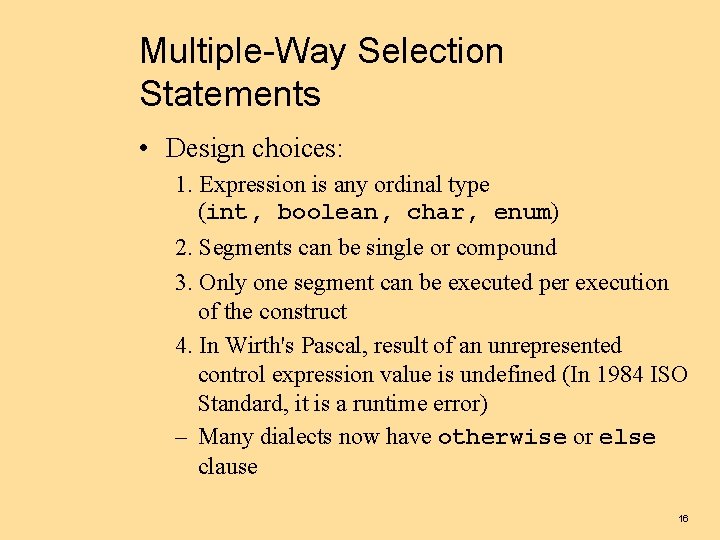
Multiple-Way Selection Statements • Design choices: 1. Expression is any ordinal type (int, boolean, char, enum) 2. Segments can be single or compound 3. Only one segment can be executed per execution of the construct 4. In Wirth's Pascal, result of an unrepresented control expression value is undefined (In 1984 ISO Standard, it is a runtime error) – Many dialects now have otherwise or else clause 16
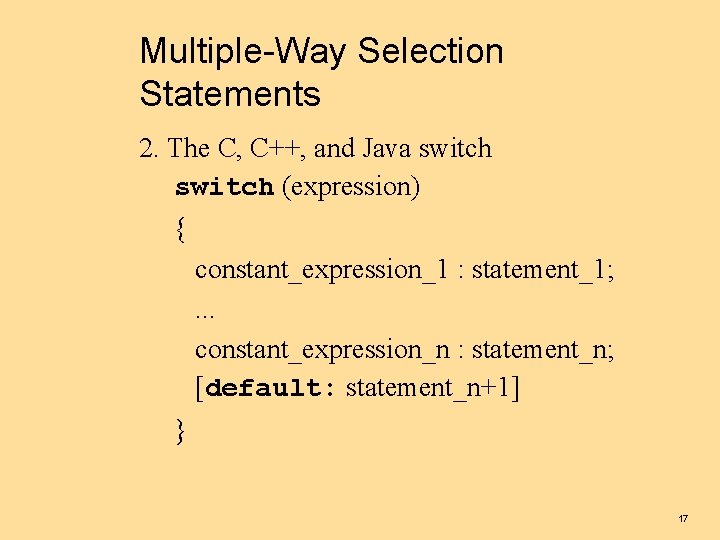
Multiple-Way Selection Statements 2. The C, C++, and Java switch (expression) { constant_expression_1 : statement_1; . . . constant_expression_n : statement_n; [default: statement_n+1] } 17
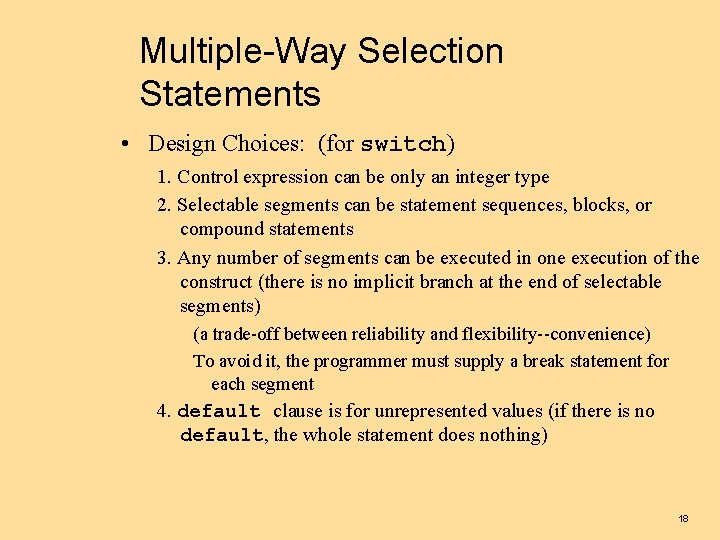
Multiple-Way Selection Statements • Design Choices: (for switch) 1. Control expression can be only an integer type 2. Selectable segments can be statement sequences, blocks, or compound statements 3. Any number of segments can be executed in one execution of the construct (there is no implicit branch at the end of selectable segments) (a trade-off between reliability and flexibility--convenience) To avoid it, the programmer must supply a break statement for each segment 4. default clause is for unrepresented values (if there is no default, the whole statement does nothing) 18
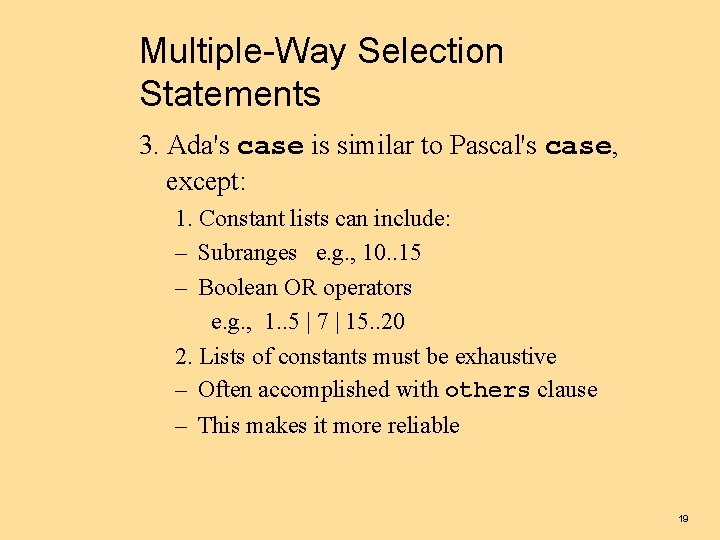
Multiple-Way Selection Statements 3. Ada's case is similar to Pascal's case, except: 1. Constant lists can include: – Subranges e. g. , 10. . 15 – Boolean OR operators e. g. , 1. . 5 | 7 | 15. . 20 2. Lists of constants must be exhaustive – Often accomplished with others clause – This makes it more reliable 19
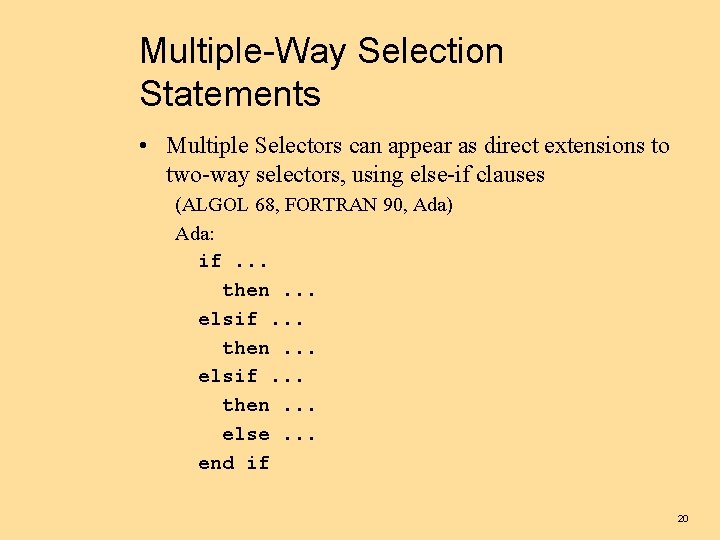
Multiple-Way Selection Statements • Multiple Selectors can appear as direct extensions to two-way selectors, using else-if clauses (ALGOL 68, FORTRAN 90, Ada) Ada: if. . . then. . . elsif. . . then. . . else. . . end if 20
Multiple-Way Selection Statements • Ada’s multiple selectors: – Far more readable than deeply nested if's – Allows a Boolean gate on every selectable group 21
Iterative Statements • The repeated execution of a statement or compound statement is accomplished either by iteration or recursion • Here we look at iteration, because recursion is unit-level control • General design issues for iteration control statements: 1. How is iteration controlled? 2. Where is the control mechanism in the loop? 22
Iterative Statements 1. Counter-Controlled Loops • Design Issues: 1. What are the type and scope of the loop variable? 2. What is the value of the loop variable at loop termination? 3. Should it be legal for the loop variable or loop parameters to be changed in the loop body, and if so, does the change affect loop control? 4. Should the loop parameters be evaluated only once, or once for every iteration? 23
Iterative Statements 1. FORTRAN 90 • Syntax: DO label var = start, finish [, stepsize] • Stepsize can be any value but zero • Parameters can be expressions • Design choices: 1. Loop variable must be INTEGER 2. Loop variable always has its last value 3. The loop variable cannot be changed in the loop, but the parameters can; because they are evaluated only once, it does not affect loop control 4. Loop parameters are evaluated only once 24
Iterative Statements • FORTRAN 90’s Other DO – Syntax: [name: ] DO variable = initial, terminal [, stepsize] … END DO [name] – Loop variable must be an INTEGER 25
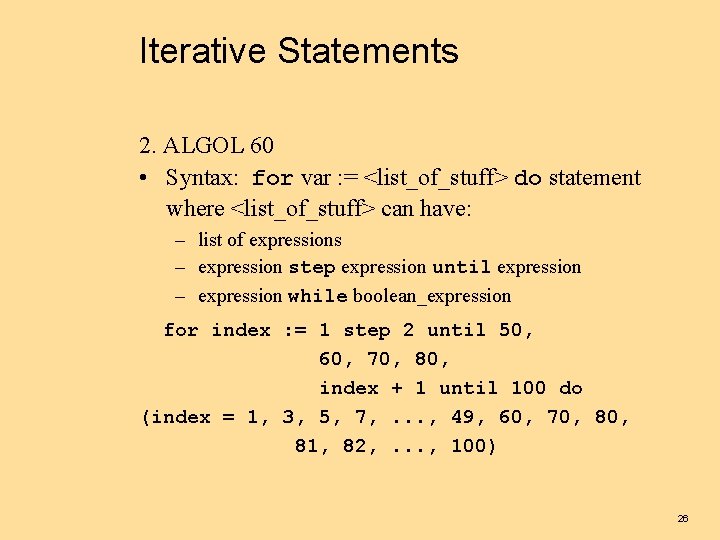
Iterative Statements 2. ALGOL 60 • Syntax: for var : = <list_of_stuff> do statement where <list_of_stuff> can have: – list of expressions – expression step expression until expression – expression while boolean_expression for index : = 1 step 2 until 50, 60, 70, 80, index + 1 until 100 do (index = 1, 3, 5, 7, . . . , 49, 60, 70, 81, 82, . . . , 100) 26
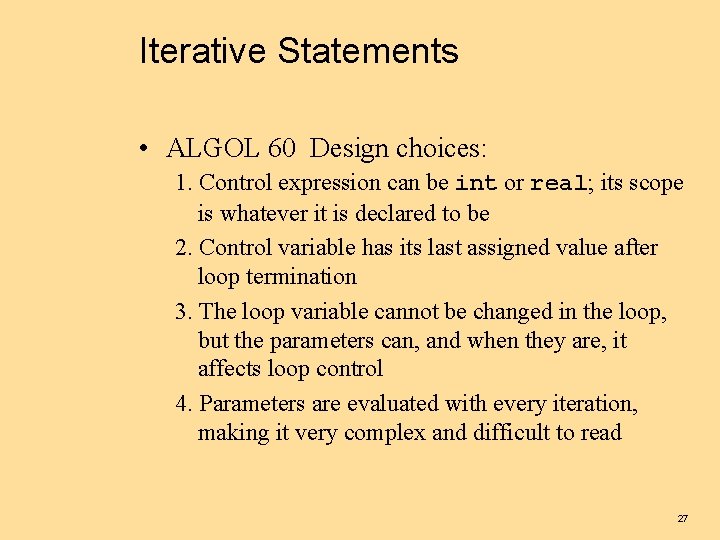
Iterative Statements • ALGOL 60 Design choices: 1. Control expression can be int or real; its scope is whatever it is declared to be 2. Control variable has its last assigned value after loop termination 3. The loop variable cannot be changed in the loop, but the parameters can, and when they are, it affects loop control 4. Parameters are evaluated with every iteration, making it very complex and difficult to read 27
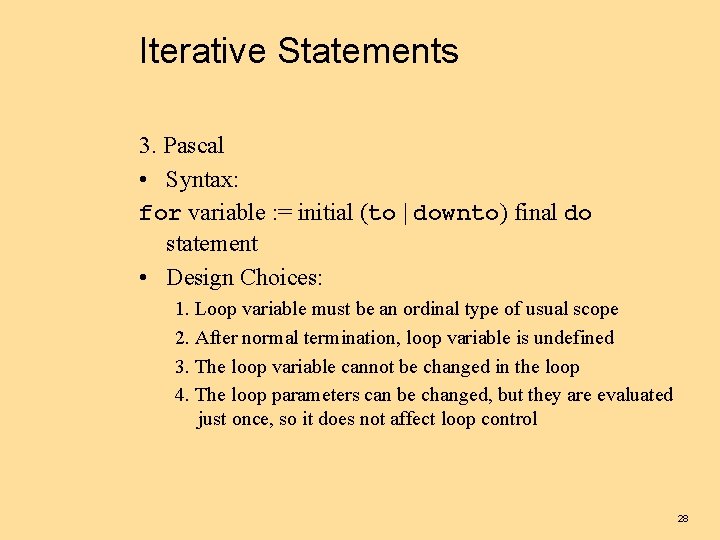
Iterative Statements 3. Pascal • Syntax: for variable : = initial (to | downto) final do statement • Design Choices: 1. Loop variable must be an ordinal type of usual scope 2. After normal termination, loop variable is undefined 3. The loop variable cannot be changed in the loop 4. The loop parameters can be changed, but they are evaluated just once, so it does not affect loop control 28
Iterative Statements 4. Ada • Syntax: for var in [reverse] discrete_range loop. . . end loop 29
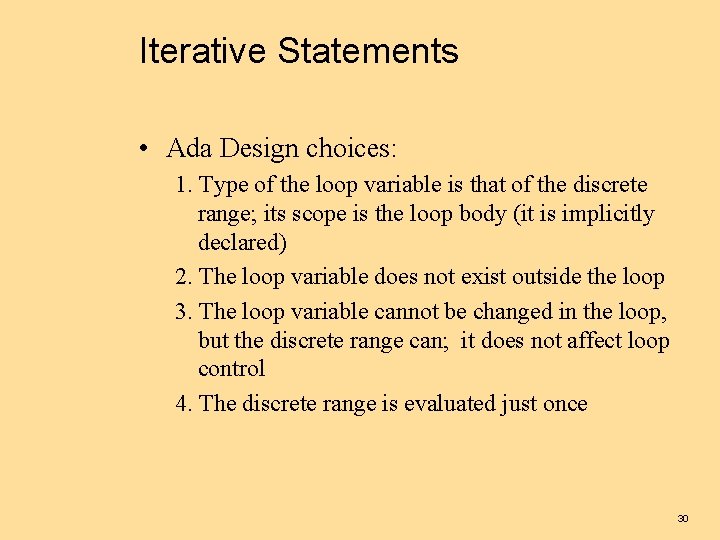
Iterative Statements • Ada Design choices: 1. Type of the loop variable is that of the discrete range; its scope is the loop body (it is implicitly declared) 2. The loop variable does not exist outside the loop 3. The loop variable cannot be changed in the loop, but the discrete range can; it does not affect loop control 4. The discrete range is evaluated just once 30
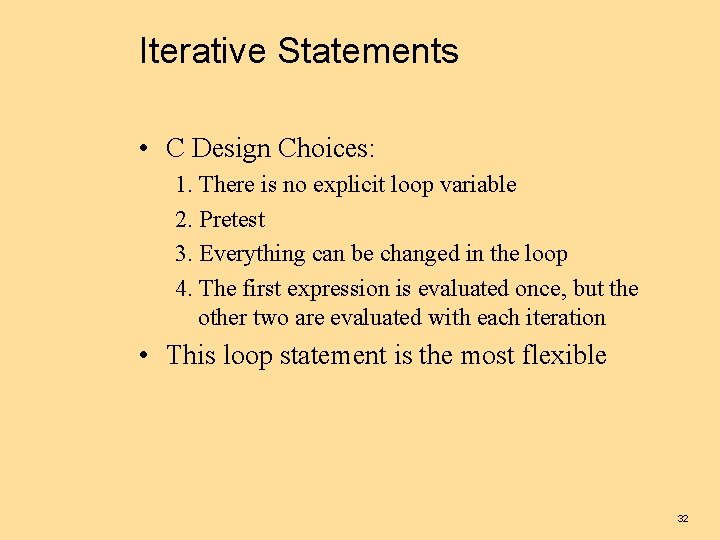
Iterative Statements 5. C • Syntax: for ([expr_1] ; [expr_2] ; [expr_3]) statement – The expressions can be whole statements, or even statement sequences, with the statements separated by commas – The value of a multiple-statement expression is the value of the last statement in the expression e. g. , for (i = 0, j = 10; j == i; i++) … – If the second expression is absent, it is an infinite loop 31
Iterative Statements • C Design Choices: 1. There is no explicit loop variable 2. Pretest 3. Everything can be changed in the loop 4. The first expression is evaluated once, but the other two are evaluated with each iteration • This loop statement is the most flexible 32
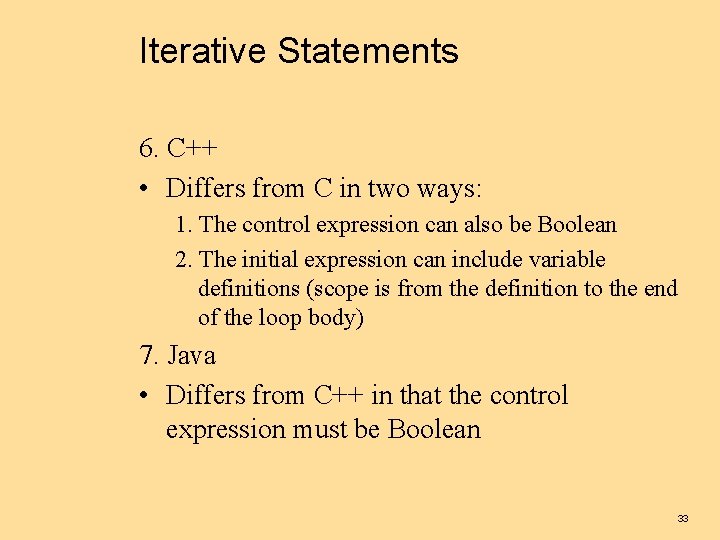
Iterative Statements 6. C++ • Differs from C in two ways: 1. The control expression can also be Boolean 2. The initial expression can include variable definitions (scope is from the definition to the end of the loop body) 7. Java • Differs from C++ in that the control expression must be Boolean 33
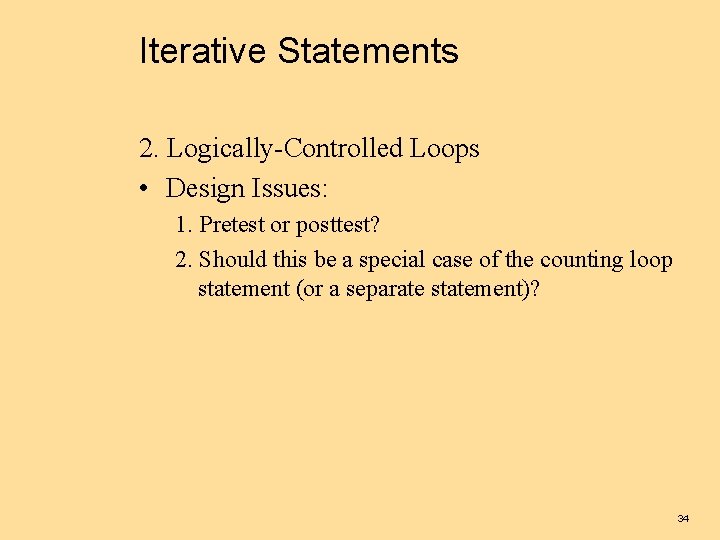
Iterative Statements 2. Logically-Controlled Loops • Design Issues: 1. Pretest or posttest? 2. Should this be a special case of the counting loop statement (or a separate statement)? 34
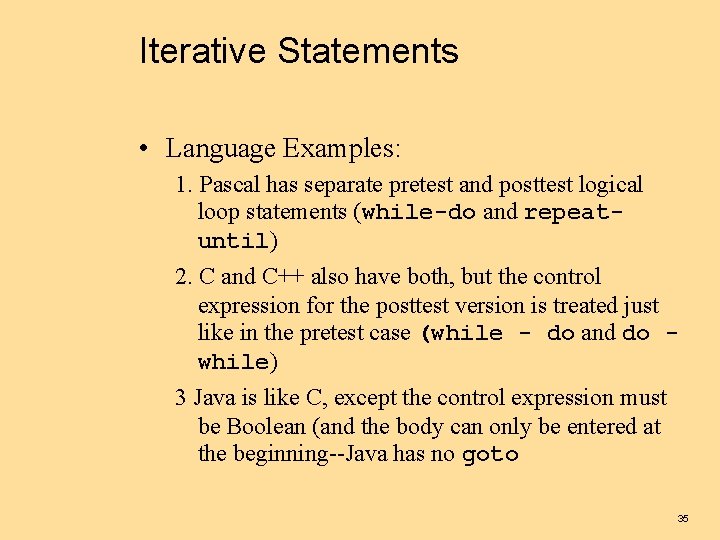
Iterative Statements • Language Examples: 1. Pascal has separate pretest and posttest logical loop statements (while-do and repeatuntil) 2. C and C++ also have both, but the control expression for the posttest version is treated just like in the pretest case (while - do and do while) 3 Java is like C, except the control expression must be Boolean (and the body can only be entered at the beginning--Java has no goto 35
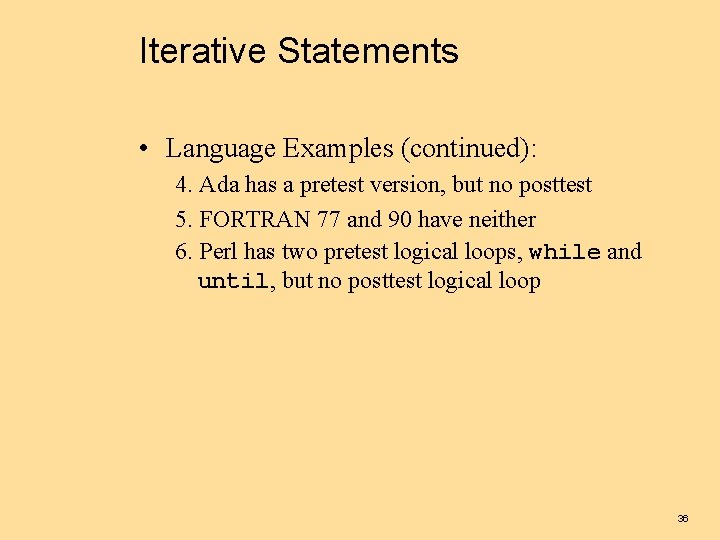
Iterative Statements • Language Examples (continued): 4. Ada has a pretest version, but no posttest 5. FORTRAN 77 and 90 have neither 6. Perl has two pretest logical loops, while and until, but no posttest logical loop 36
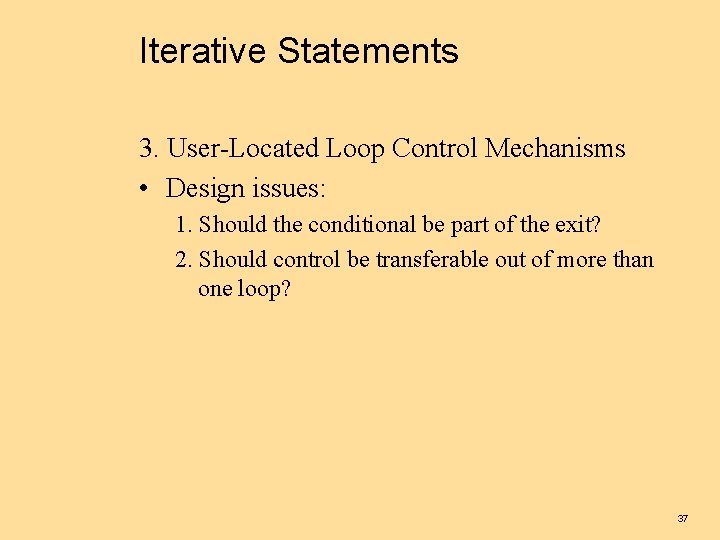
Iterative Statements 3. User-Located Loop Control Mechanisms • Design issues: 1. Should the conditional be part of the exit? 2. Should control be transferable out of more than one loop? 37
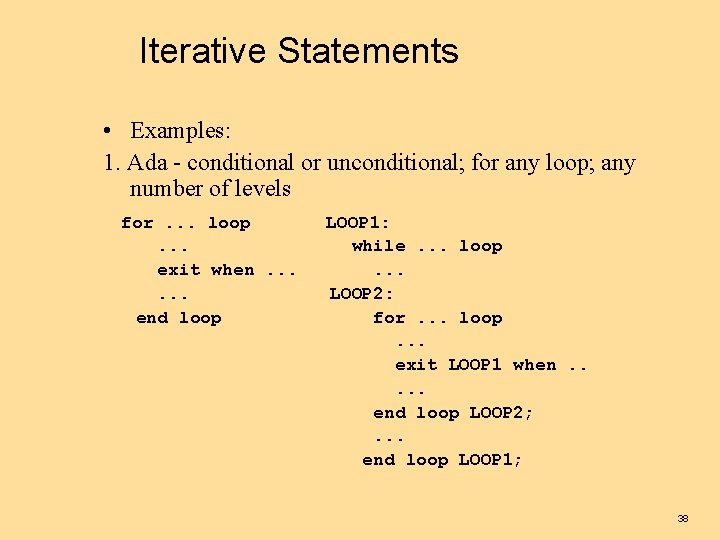
Iterative Statements • Examples: 1. Ada - conditional or unconditional; for any loop; any number of levels for. . . loop. . . exit when. . . end loop LOOP 1: while. . . loop. . . LOOP 2: for. . . loop. . . exit LOOP 1 when. . . end loop LOOP 2; . . . end loop LOOP 1; 38
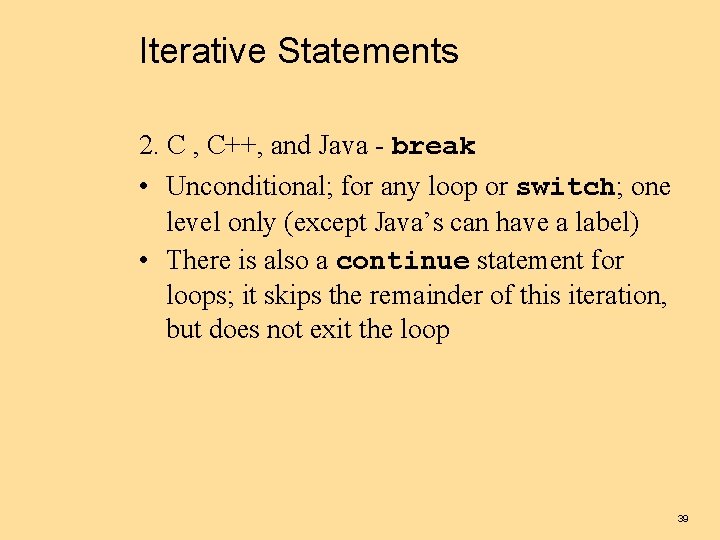
Iterative Statements 2. C , C++, and Java - break • Unconditional; for any loop or switch; one level only (except Java’s can have a label) • There is also a continue statement for loops; it skips the remainder of this iteration, but does not exit the loop 39
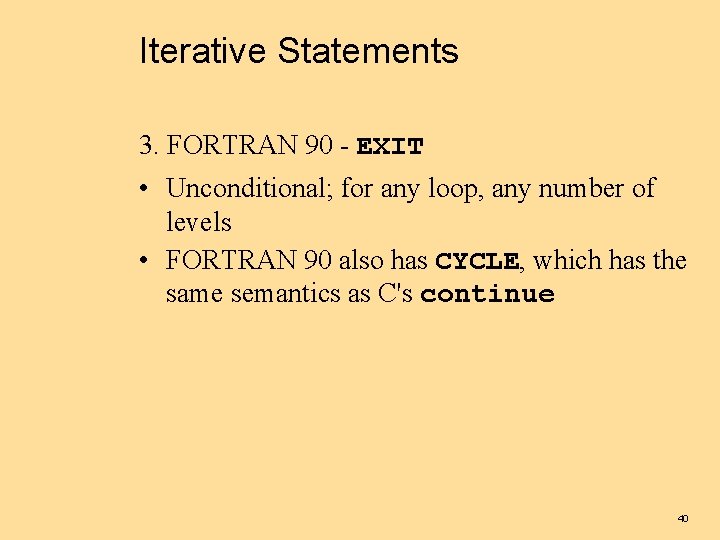
Iterative Statements 3. FORTRAN 90 - EXIT • Unconditional; for any loop, any number of levels • FORTRAN 90 also has CYCLE, which has the same semantics as C's continue 40
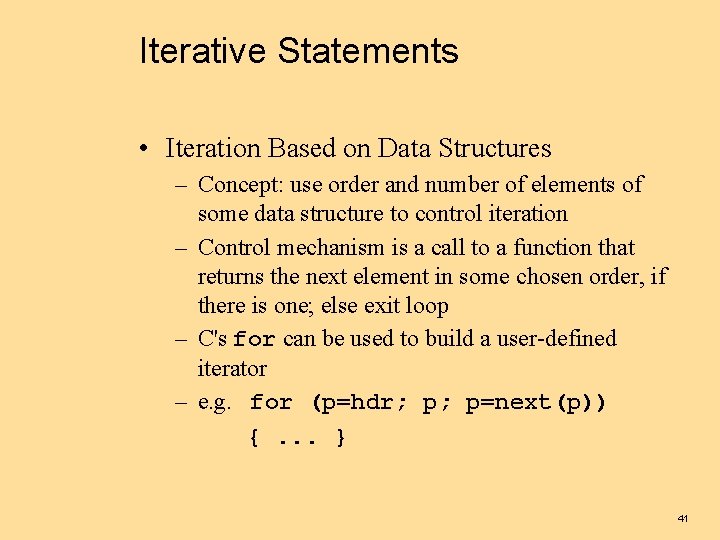
Iterative Statements • Iteration Based on Data Structures – Concept: use order and number of elements of some data structure to control iteration – Control mechanism is a call to a function that returns the next element in some chosen order, if there is one; else exit loop – C's for can be used to build a user-defined iterator – e. g. for (p=hdr; p; p=next(p)) {. . . } 41
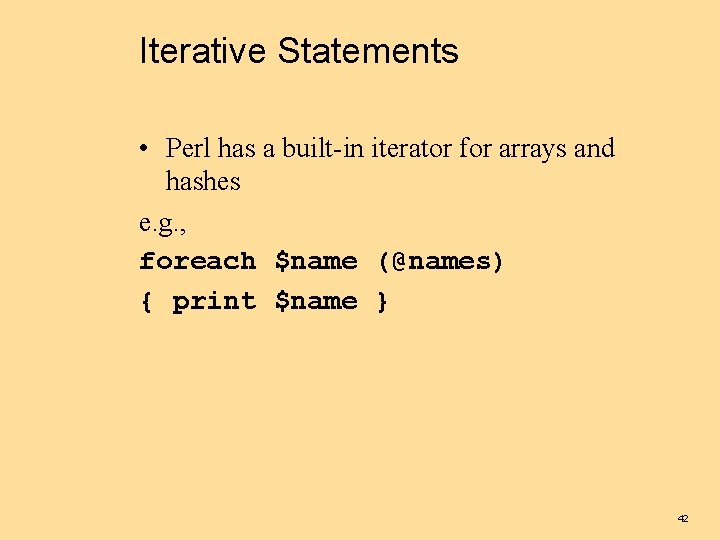
Iterative Statements • Perl has a built-in iterator for arrays and hashes e. g. , foreach $name (@names) { print $name } 42
Unconditional Branching • Problem: readability • Some languages do not have them: e. g. , Java • Loop exit statements are restricted and somewhat camouflaged goto’s 43
Unconditional Branching • Label forms: 1. Unsigned int constants: Pascal (with colon) FORTRAN (no colon) 2. Identifiers with colons: ALGOL 60, C 3. Identifiers in <<. . . >>: Ada 4. Variables as labels: PL/I – Can be assigned values and passed as parameters – Highly flexible, but make programs impossible to read and difficult to implement 44
Guarded Commands • Dijkstra, 1975 • Purpose: to support a new programming methodology (verification during program development) 45
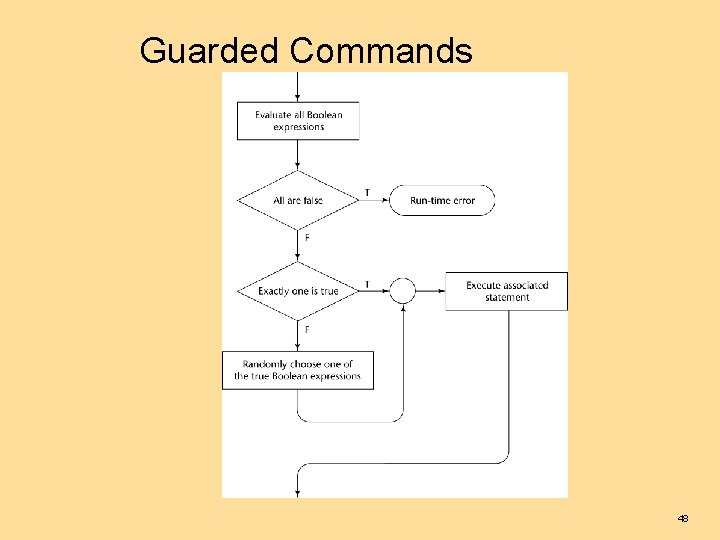
Guarded Commands 1. Selection: if <boolean> -> <statement> []<boolean> -> <statement>. . . [] <boolean> -> <statement> fi • Semantics: when this construct is reached, – Evaluate all boolean expressions – If more than one are true, choose one nondeterministically – If none are true, it is a runtime error 46
Guarded Commands • Idea: if the order of evaluation is not important, the program should not specify one 47
Guarded Commands 48
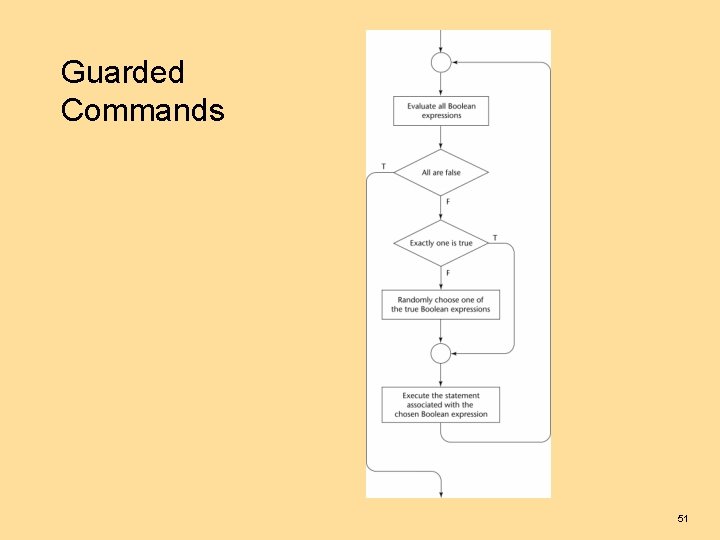
Guarded Commands 2. Loops do <boolean> -> <statement> [] <boolean> -> <statement>. . . [] <boolean> -> <statement> od 49
Guarded Commands • Semantics: For each iteration: – Evaluate all boolean expressions – If more than one are true, choose one nondeterministically; then start loop again – If none are true, exit loop 50
Guarded Commands 51
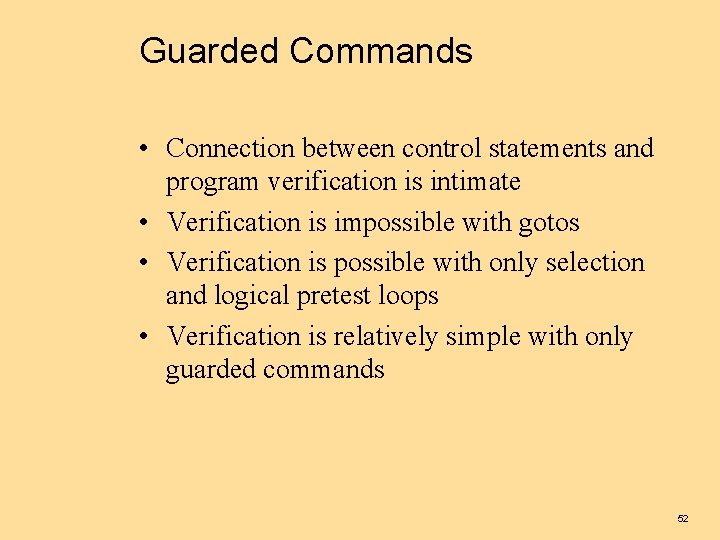
Guarded Commands • Connection between control statements and program verification is intimate • Verification is impossible with gotos • Verification is possible with only selection and logical pretest loops • Verification is relatively simple with only guarded commands 52
Conclusion • Choice of control statements beyond selection and logical pretest loops is a trade-off between language size and writability 53