
Statement Validity Assessment Vrij Chapter 8 What is
- Slides: 50
Statement Validity Assessment Vrij: Chapter 8
What is Statement Validity Assesment? l l l A “verbal veracity assessment tool” Originated in Sweden (1963) as a method to determine the credibility of child witnesses in sexual abuse cases Credibility of children in sexual abuse cases is critical, especially when there are no corroborating witnesses or physical evidence
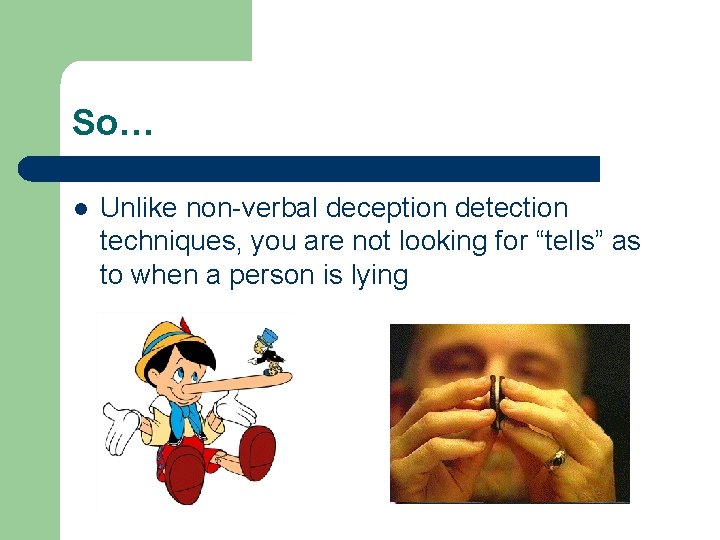
So… l Unlike non-verbal deception detection techniques, you are not looking for “tells” as to when a person is lying
Problems with child witness testimonies l Vrij cites Craig, 1995, stating estimates range between 6% to 60% that child witness statements about sexual abuse are inaccurate – l Due to parental influence, outside pressure, simple misidentification, or complete lies Adults tend to mistrust statements made by children
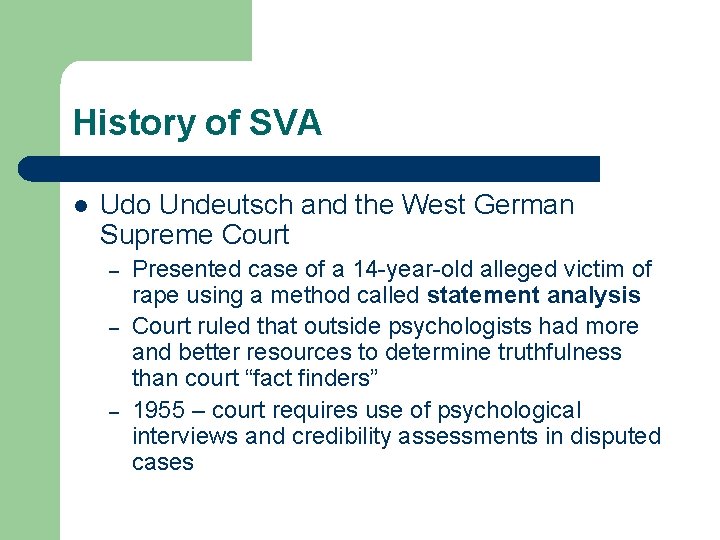
History of SVA l Udo Undeutsch and the West German Supreme Court – – – Presented case of a 14 -year-old alleged victim of rape using a method called statement analysis Court ruled that outside psychologists had more and better resources to determine truthfulness than court “fact finders” 1955 – court requires use of psychological interviews and credibility assessments in disputed cases
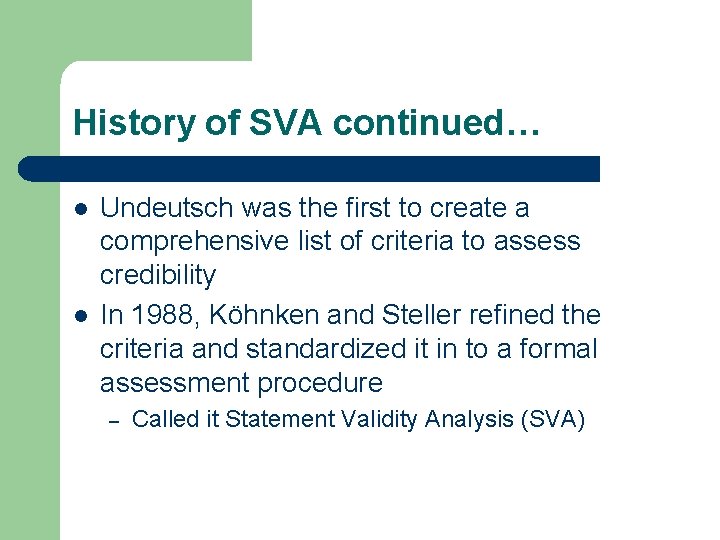
History of SVA continued… l l Undeutsch was the first to create a comprehensive list of criteria to assess credibility In 1988, Kӧhnken and Steller refined the criteria and standardized it in to a formal assessment procedure – Called it Statement Validity Analysis (SVA)
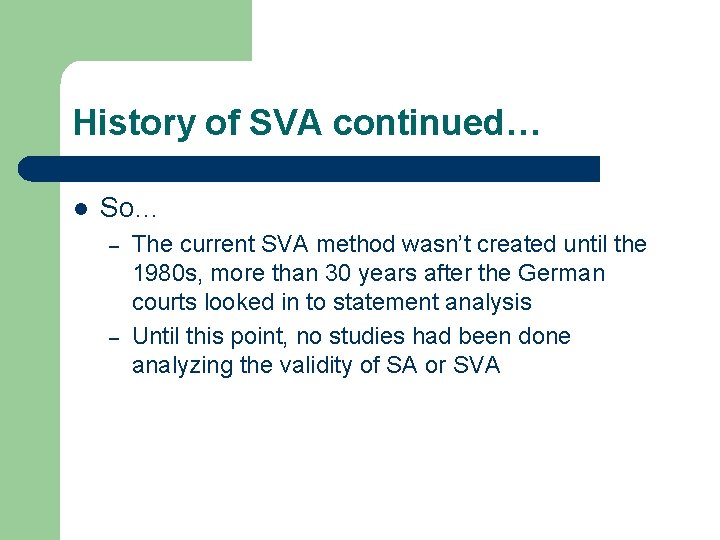
History of SVA continued… l So… – – The current SVA method wasn’t created until the 1980 s, more than 30 years after the German courts looked in to statement analysis Until this point, no studies had been done analyzing the validity of SA or SVA
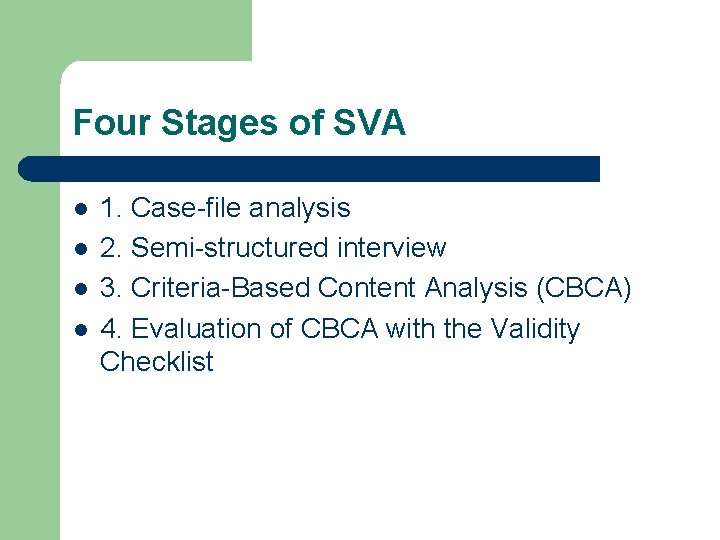
Four Stages of SVA l l 1. Case-file analysis 2. Semi-structured interview 3. Criteria-Based Content Analysis (CBCA) 4. Evaluation of CBCA with the Validity Checklist
Stage 1: Case-File Analysis l l Analysis of facts in a case Expert forms hypotheses about what happened. Details from the analysis will help the expert focus on critical details later in the interview.
Stage 2: Semi-Structured Interview l l l What the Criteria-Based Content Analysis (Stage 3) will analyze Child gives his/her account of the allegation Can be very difficult do to lack of verbal or cognitive skills in young children – l Also highly influenced by personality factors such as anxiety or simple embarrassment Skill and knowledge of interviewer is critical
Stage 2: Semi-Structured Interview continued… l l Interviewer must have a strategy for eliciting as much detailed information as possible Has to ask the right questions in the right way – – Must avoid leading, yes or no, questions Must get child (or adult for that matter) to tell story without interviewer influence
Stage 2: Semi-Structured Interview, continued… l Proper kinds of questions/techniques: – – Open-ended (e. g. “Tell me what happened. ”) Facilitative responses l – Focused questions l l “OK”, “mmhm”, head nods, etc Focus on specific details or aspects of the event Problematic questions: – – Leading (e. g. “Was it your dad? ” Option-posing (e. g. “Was the man white or black? ”)
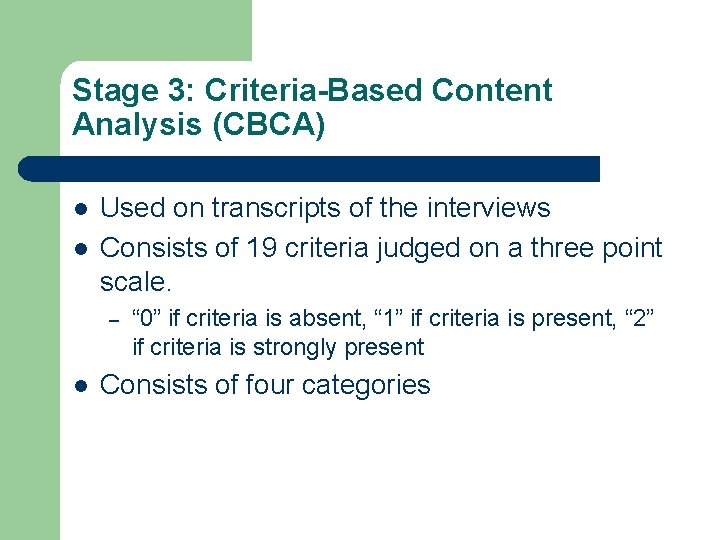
Stage 3: Criteria-Based Content Analysis (CBCA) l l Used on transcripts of the interviews Consists of 19 criteria judged on a three point scale. – l “ 0” if criteria is absent, “ 1” if criteria is present, “ 2” if criteria is strongly present Consists of four categories
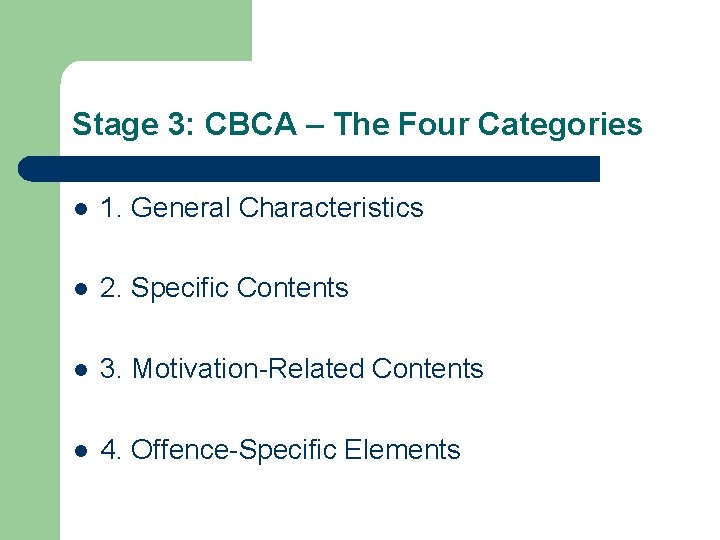
Stage 3: CBCA – The Four Categories l 1. General Characteristics l 2. Specific Contents l 3. Motivation-Related Contents l 4. Offence-Specific Elements
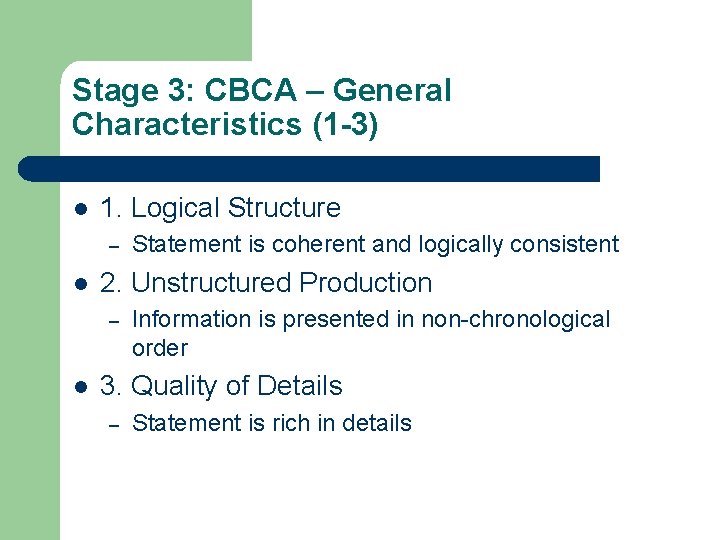
Stage 3: CBCA – General Characteristics (1 -3) l 1. Logical Structure – l 2. Unstructured Production – l Statement is coherent and logically consistent Information is presented in non-chronological order 3. Quality of Details – Statement is rich in details
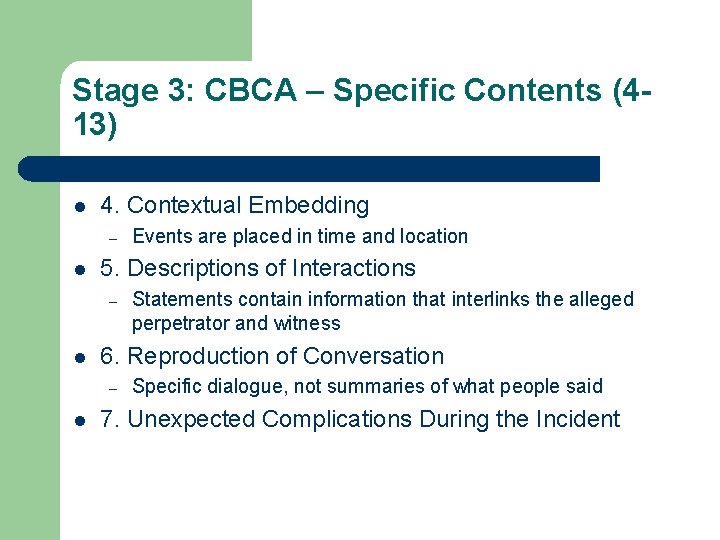
Stage 3: CBCA – Specific Contents (413) l 4. Contextual Embedding – l 5. Descriptions of Interactions – l Statements contain information that interlinks the alleged perpetrator and witness 6. Reproduction of Conversation – l Events are placed in time and location Specific dialogue, not summaries of what people said 7. Unexpected Complications During the Incident
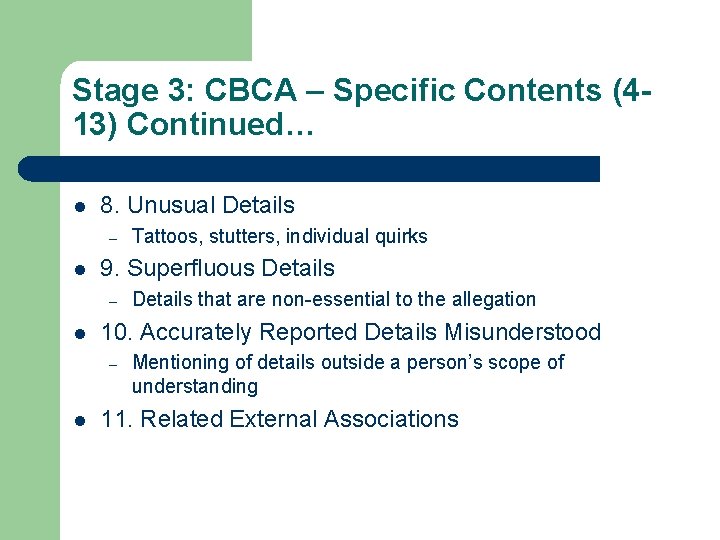
Stage 3: CBCA – Specific Contents (413) Continued… l 8. Unusual Details – l 9. Superfluous Details – l Details that are non-essential to the allegation 10. Accurately Reported Details Misunderstood – l Tattoos, stutters, individual quirks Mentioning of details outside a person’s scope of understanding 11. Related External Associations
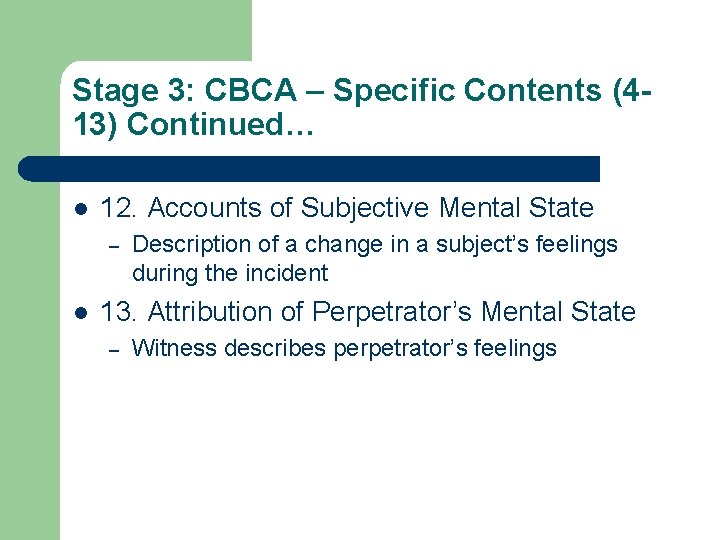
Stage 3: CBCA – Specific Contents (413) Continued… l 12. Accounts of Subjective Mental State – l Description of a change in a subject’s feelings during the incident 13. Attribution of Perpetrator’s Mental State – Witness describes perpetrator’s feelings
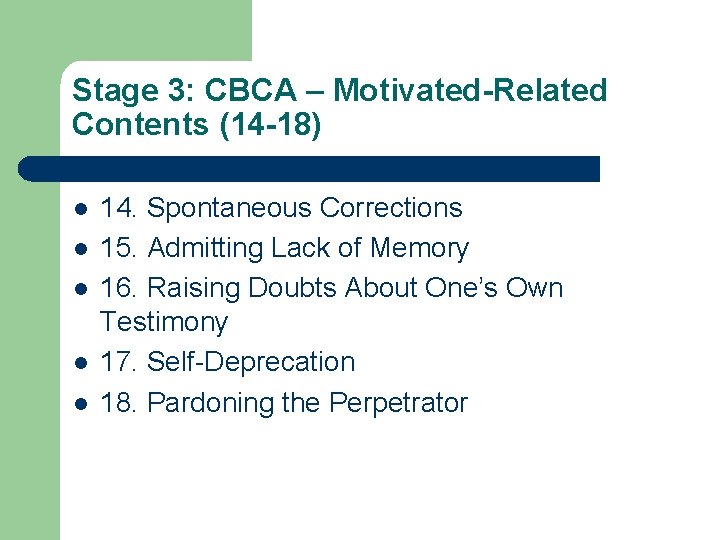
Stage 3: CBCA – Motivated-Related Contents (14 -18) l l l 14. Spontaneous Corrections 15. Admitting Lack of Memory 16. Raising Doubts About One’s Own Testimony 17. Self-Deprecation 18. Pardoning the Perpetrator
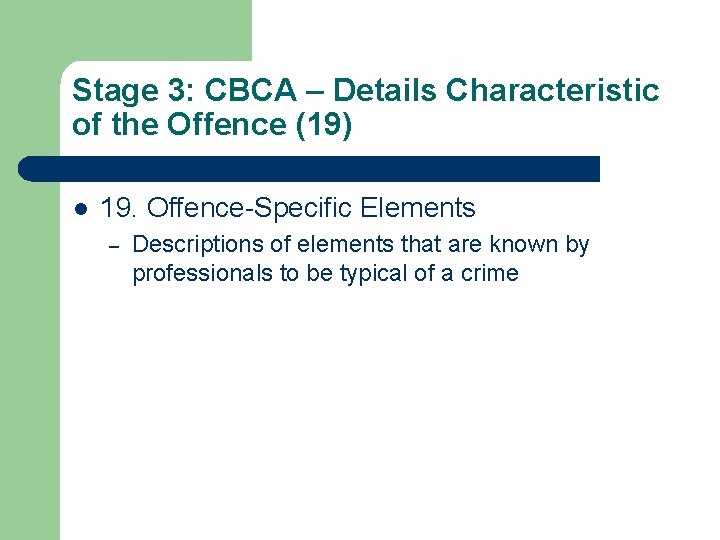
Stage 3: CBCA – Details Characteristic of the Offence (19) l 19. Offence-Specific Elements – Descriptions of elements that are known by professionals to be typical of a crime
Stage 4: Evaluation of CBCA with the Validity Checklist l l The CBCA score alone is not enough to determine if a person is being truthful The examiner must also take into account other factors that could have affected the outcome – l Leading by the interviewer, outside influences, witness’s cognitive abilities, etc… The CBCA is NOT a standardized test
Stage 4: Evaluation of CBCA with the Validity Checklist, continued… l l l Attempts to standardize the CBCA results through an 11 point checklist Allows the examiner to consider alternative reasons for CBCA outcomes As these alternative reasons are rejected, the CBCA results become stronger (in the assumption that the score represents the veracity of the statement)
Stage 4: Evaluation of CBCA with the Validity Checklist, continued… l The Four Stages: – – 1. Psychological Characteristics 2. Interview Characteristics 3. Motivation 4. Investigative Questions
Stage 4: Evaluation of CBCA with the Validity Checklist – Psych Characteristics l 1. Inappropriateness of Language and Knowledge l 2. Inappropriateness of Affect l 3. Susceptibility to Suggestion
Stage 4: Evaluation of CBCA with the Validity Checklist – Interview Characteristics l 4. Suggestive, Leading, or Coercive Interviewing l 5. Overall Inadequacy of the Interview
Stage 4: Evaluation of CBCA with the Validity Checklist – Motivation l 6. Questionable Motives to Report – Both for witness and other parties involved l 7. Questionable Context of the Original Disclosure or Report l 8. Pressures to Report Falsely
Stage 4: Evaluation of CBCA with the Validity Checklist – Investigative Questions l 9. Inconsistency with the Laws of Nature l 10. Inconsistency with Other Statements l 11. Inconsistency with Other Evidence
SVA – Issues l l l l Effectiveness of individual criteria in CBCA Effectiveness of Validity Checklist Differences between laboratory and field studies Detection rates and false-positives Countermeasures Applicability to adults? The Daubert Standard
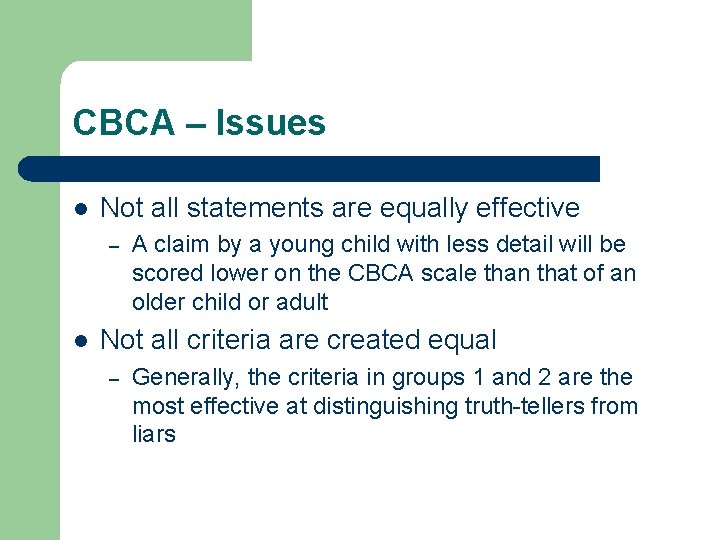
CBCA – Issues l Not all statements are equally effective – l A claim by a young child with less detail will be scored lower on the CBCA scale than that of an older child or adult Not all criteria are created equal – Generally, the criteria in groups 1 and 2 are the most effective at distinguishing truth-tellers from liars
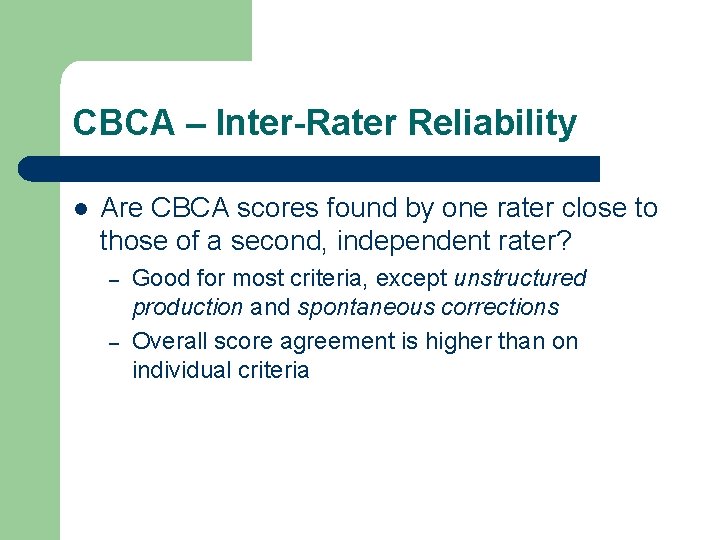
CBCA – Inter-Rater Reliability l Are CBCA scores found by one rater close to those of a second, independent rater? – – Good for most criteria, except unstructured production and spontaneous corrections Overall score agreement is higher than on individual criteria
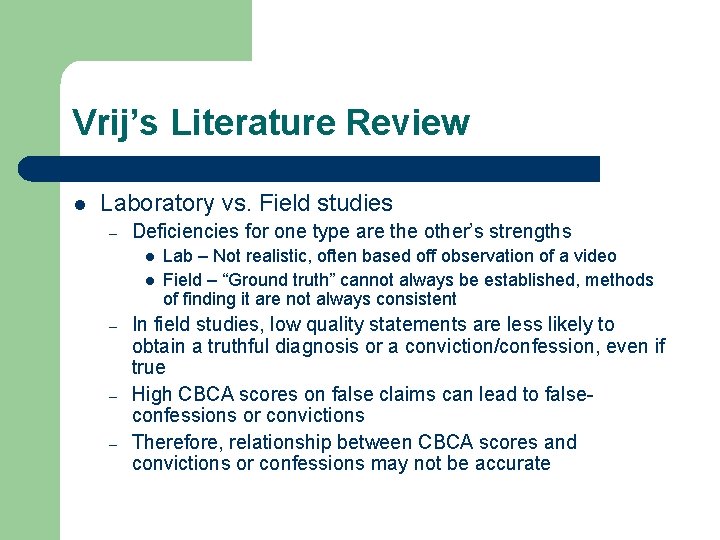
Vrij’s Literature Review l Laboratory vs. Field studies – Deficiencies for one type are the other’s strengths l l – – – Lab – Not realistic, often based off observation of a video Field – “Ground truth” cannot always be established, methods of finding it are not always consistent In field studies, low quality statements are less likely to obtain a truthful diagnosis or a conviction/confession, even if true High CBCA scores on false claims can lead to falseconfessions or convictions Therefore, relationship between CBCA scores and convictions or confessions may not be accurate
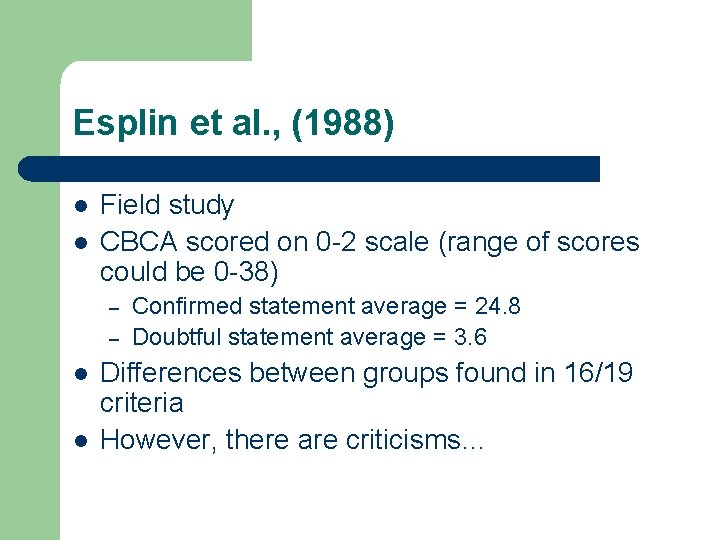
Esplin et al. , (1988) l l Field study CBCA scored on 0 -2 scale (range of scores could be 0 -38) – – l l Confirmed statement average = 24. 8 Doubtful statement average = 3. 6 Differences between groups found in 16/19 criteria However, there are criticisms…
CBCA results from other studies l l Boychuck (1991) – 13/19 Lamb et al. (1997 b)* – 5/14 – – l l l Plausible average = 6. 74 Implausible average = 4. 85 Parker & Brown (2000) – 6/18 Rassin & van der Sleen (2005) – 2/5 Craig et al. (1999)* – – Confirmed average = 7. 2 Doubtful average = 5. 7 l * used a 0 -1 pt scale on CBCA
Critical Difference to Non-verbal Studies: l All results found were in the expected direction, supporting the Undeutsch Hypothesis – – Results in non-verbal studies are highly erratic You may find non-verbal cues within individuals, but between groups these do not exist
CBCA – Lab Studies l l Difficult to create realistic situations Accuracy rates ranged from 54% to 90% – – – Average rates for truths = 70. 81% Average rates for lies = 71. 12% Rates did not differ between children, adults, witnesses, victims, or suspects
CBCA – Lab Studies, continued… l Serious methodological problems: – – Different situations used Different analysis methods used Different amounts of training for raters Some studies do not use the Validity Checklist and base diagnoses purely upon the CBCA
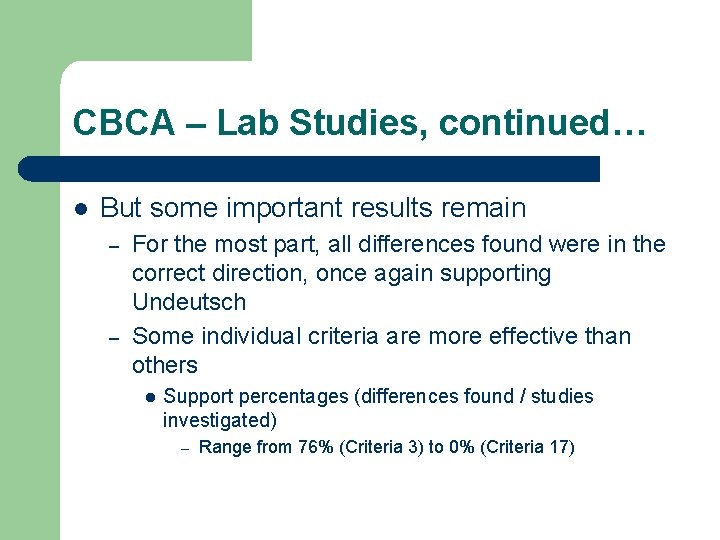
CBCA – Lab Studies, continued… l But some important results remain – – For the most part, all differences found were in the correct direction, once again supporting Undeutsch Some individual criteria are more effective than others l Support percentages (differences found / studies investigated) – Range from 76% (Criteria 3) to 0% (Criteria 17)
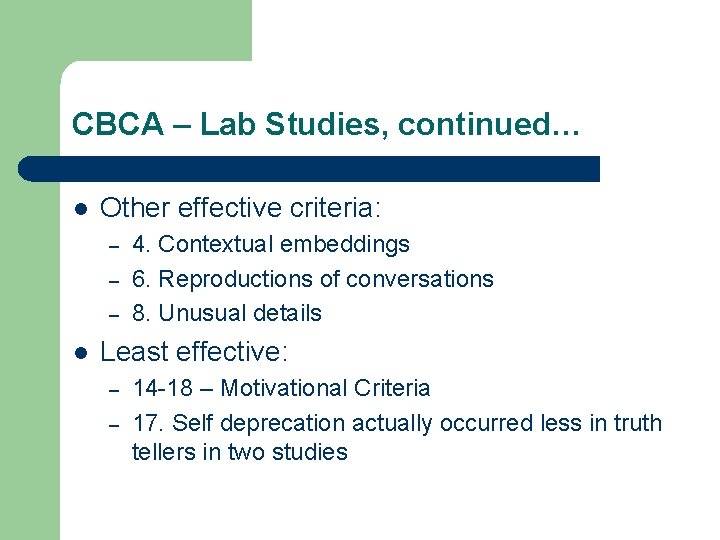
CBCA – Lab Studies, continued… l Other effective criteria: – – – l 4. Contextual embeddings 6. Reproductions of conversations 8. Unusual details Least effective: – – 14 -18 – Motivational Criteria 17. Self deprecation actually occurred less in truth tellers in two studies
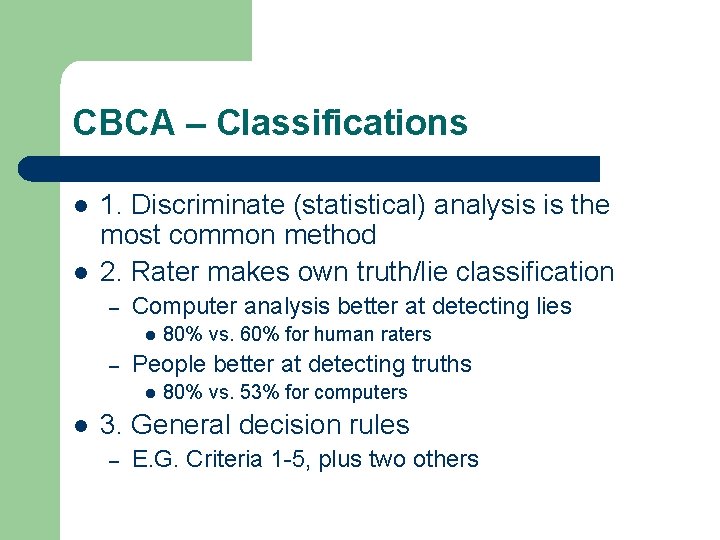
CBCA – Classifications l l 1. Discriminate (statistical) analysis is the most common method 2. Rater makes own truth/lie classification – Computer analysis better at detecting lies l – People better at detecting truths l l 80% vs. 60% for human raters 80% vs. 53% for computers 3. General decision rules – E. G. Criteria 1 -5, plus two others
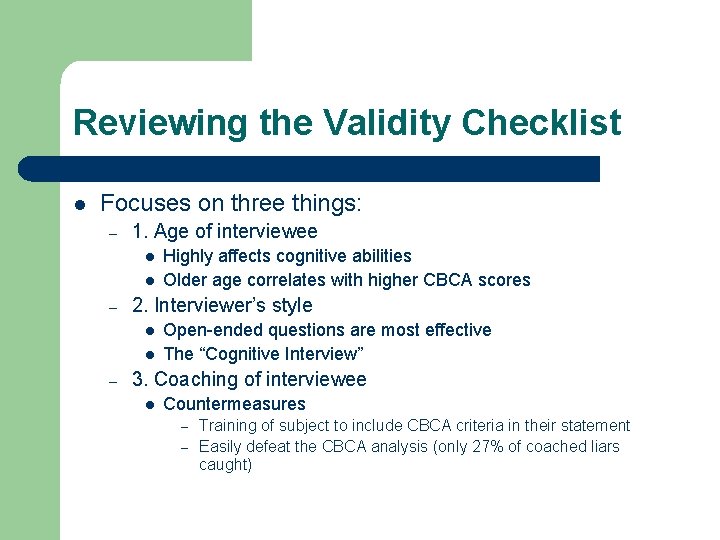
Reviewing the Validity Checklist l Focuses on three things: – 1. Age of interviewee l l – 2. Interviewer’s style l l – Highly affects cognitive abilities Older age correlates with higher CBCA scores Open-ended questions are most effective The “Cognitive Interview” 3. Coaching of interviewee l Countermeasures Training of subject to include CBCA criteria in their statement – Easily defeat the CBCA analysis (only 27% of coached liars caught) –
What the lay-person believes… l l l Generally correct about number of details (Criterion 3) and descriptions of interactions (5) Generally believe liars include more contextual embeddings (Criterion 4), unusual details (8), and superfluous details (9) in stories Overall, the lay-person’s view differs somewhat from the experts’ view – This, potentially, is a good thing
Problems with the Validity Checklist l Difficulty in identifying issues – l Difficulty in measuring issues – l Coaching by an adult is hard to discover E. g. susceptibility to suggestion Difficulty in determining impact of issues – – The validity checklist is much more subjective and less formalized than the CBCA It is therefore harder to study
Vrij’s specific problems with VC l Issue 2 – Inappropriateness of Affect – Cites research that suggests there are two main psychological reactions to a rape l l l Issue 10 – Inconsistencies between statements – – l 1. Expressed style 2. Numbed style Human memory is not perfect, details can be unintentional A practiced lie will not contain as many inconsistencies Issue 9 and 11 (Consistency with laws of nature, consistency with other evidence) – – Children’s scope of understanding often include fantasies and other things not in agreement with natural laws Sometimes, even in a true allegation, no other evidence can be found
Vrij’s specific problems with VC, continued… l l Embedded false statements are difficult to detect False memories
The Daubert Standard l Daubert vs. Merrel Dow Pharmaceuticals, Inc. (1993) – – Set standards for the inclusion of expert witness testimony in court cases in the United states Consists of 5 criteria that must be met for evidence to be admissible in court
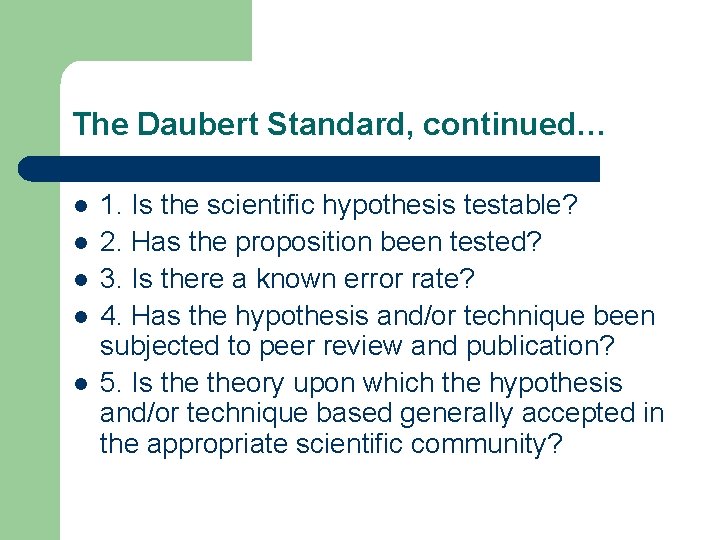
The Daubert Standard, continued… l l l 1. Is the scientific hypothesis testable? 2. Has the proposition been tested? 3. Is there a known error rate? 4. Has the hypothesis and/or technique been subjected to peer review and publication? 5. Is theory upon which the hypothesis and/or technique based generally accepted in the appropriate scientific community?
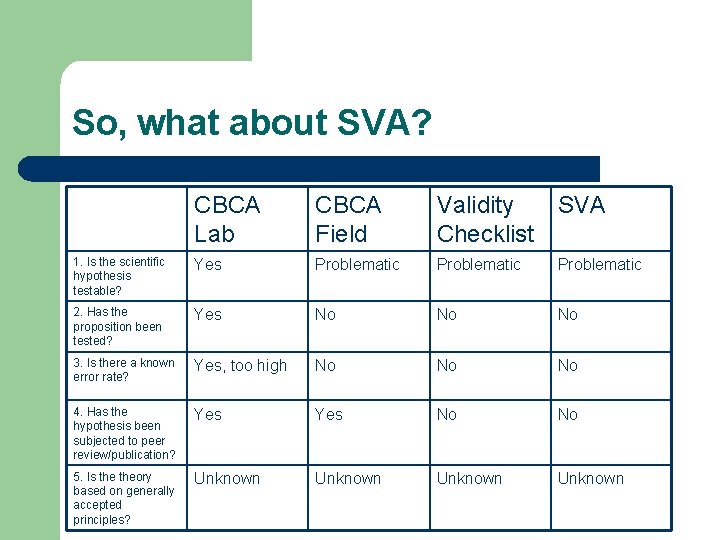
So, what about SVA? CBCA Lab CBCA Field Validity SVA Checklist 1. Is the scientific hypothesis testable? Yes Problematic 2. Has the proposition been tested? Yes No No No 3. Is there a known error rate? Yes, too high No No No 4. Has the hypothesis been subjected to peer review/publication? Yes No No 5. Is theory based on generally accepted principles? Unknown
Error rates l Refer to subjects that are classified incorrectly – l Truth tellers classified as liars, and vice-versa Error rate for CBCA judgments made in laboratory research is nearly 30% for both truths and lies – This is EXTREMELY high
Overall evaluation of SVA l l l While results from research on SVA strongly support the Undeutsch Hypothesis, SVA does not meet the requirements of the five criteria established by the Daubert Standard 70% correct classification is OK 30% error rate is much too high for a valid test Certain criteria in the CBCA appear to be highly effective at discriminating truth tellers from liars Other criteria are wholly ineffective
In the end… l l l CBCA and SVA would be an effective tool for use in the initial stages of investigations Results from these tests can guide police throughout investigations CBCA and SVA appears to be effective on adults also, not just useful in situations of child sexual abuse