
StateAuthorized Portable Orders SAPO Training for Health Care
State-Authorized Portable Orders (SAPO) Training for Health Care Professionals Created by the National Center for Ethics in Health Care INCLUDES UPDATES IN VHA DIRECTIVE 1004. 04, dated February 26, 2019 PPT last updated: 2/27/19 National Center for Ethics in Health Care 1
Outline • Background • What are SAPO? • VA policy on SAPO • Summary of major changes to VHA Directive 1004. 04, State-Authorized Portable Orders (SAPO), dated February 26, 2019 • Which SAPO are recognized in VA? • Offering SAPO • Writing SAPO • Veterans who lack decision-making capacity and do not have a surrogate • Documentation • References National Center for Ethics in Health Care 2
What Are SAPO? • Specialized forms or identifiers, for example, bracelets or necklaces, that translate a patient’s preferences regarding life-sustaining treatments – such as resuscitation, mechanical ventilation, or the provision of artificial nutrition and hydration – into portable medical orders • Used in the majority of the 50 states to help ensure that patients’ life-sustaining treatment (LST) decisions are known and honored in emergency situations • Designed to travel with the patient whenever the patient is transported to or from a health care facility and to be communicated to first responders, for example, ambulance personnel, and clinicians for use in a medical crisis National Center for Ethics in Health Care 3
VA Policy on SAPO • VA is committed to promoting Veteran-centered care, ensuring that Veterans’ values, goals, and treatment preferences are respected and reflected in the care they receive, therefore, VHA supports the use of SAPO • VHA Directive 1004. 04, State-Authorized Portable Orders (SAPO), dated February 26, 2019 – Defines policy for the use and execution of SAPO – Replaced VHA Handbook 1004. 04, published October 25, 2012 National Center for Ethics in Health Care 4
VHA Directive 1004. 04: Major Changes • Aligns with VHA Handbook 1004. 03, Life-Sustaining Treatment Decisions: Eliciting, Documenting and Honoring Patients’ Values, Goals and Preferences • Expands the definition of SAPO that are recognized in VA to include those authorized by state law or the state medical board or association • To ensure fairness, now requires that each facility accept any valid SAPO from any state. Facilities continue to have discretion in determining the SAPO that will be offered at the facility. • Changes the name of the required electronic health record progress note title for associating SAPO from “Out-of-Hospital Orders” to “State-Authorized Portable Orders, ” and allows facilities flexibility in adding a suffix to this title to reflect local needs National Center for Ethics in Health Care 5
VHA Directive 1004. 04: Major Changes (continued) • Removes the requirement for practitioners to write a separate progress note specifying the date, jurisdiction, and description of the substance of the SAPO • Clarifies that SAPO are not required to be offered prior to discharge to Veterans who are admitted only under observation status • Explains that facilities must develop document management processes for rescinding/removing SAPO from Crisis, Warnings, Allergies/Adverse Reactions, and Directives (CWAD) postings, when SAPO are no longer current • Establishes requirements for policy implementation no later than 6 months after publication (August 26, 2019). National Center for Ethics in Health Care 6
Which SAPO are Recognized in VA? • SAPO forms or identifiers authorized by state law and the state medical board or association • Each VA medical facility must accept/honor a patient’s valid SAPO from any state • Consult with your District Counsel if you have questions about the validity of SAPO National Center for Ethics in Health Care 7
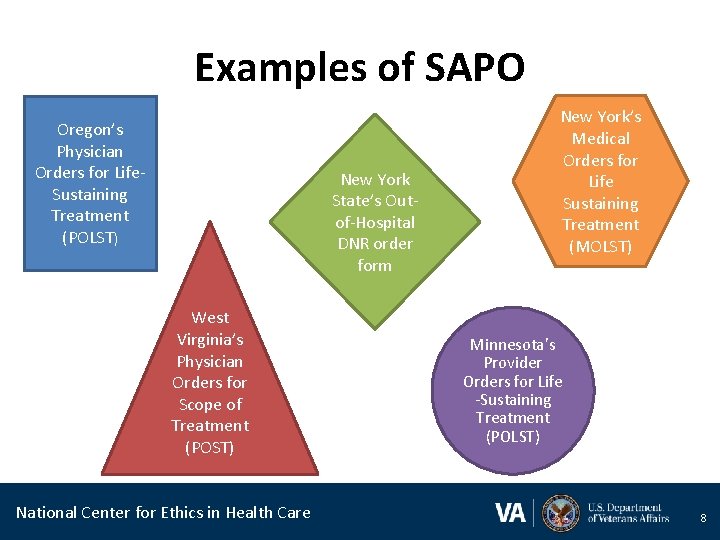
Examples of SAPO Oregon’s Physician Orders for Life. Sustaining Treatment (POLST) New York State’s Outof-Hospital DNR order form West Virginia’s Physician Orders for Scope of Treatment (POST) National Center for Ethics in Health Care New York’s Medical Orders for Life Sustaining Treatment (MOLST) Minnesota’s Provider Orders for Life -Sustaining Treatment (POLST) 8
Offering SAPO • VA practitioners must offer SAPO in the following circumstances: – When SAPO are requested by a Veteran (or surrogate, if the Veteran lacks decision-making capacity) – Prior to discharge, or upon completion of outpatient encounters with Veterans for whom VA LST orders have been written * Prior to discharge for Veterans who already have SAPO, the practitioner must ask whether the SAPO will remain as-is or whether revisions are needed and, if necessary, provide a new SAPO National Center for Ethics in Health Care 9
Writing SAPO • Within VA, SAPO may only be written by VA practitioners who are authorized under state law or the state medical board or association to write SAPO, and who are authorized by VHA Handbook 1004. 03, Life-Sustaining Treatment Decisions: Eliciting, Documenting, and Honoring Patients' Values, Goals, and Preferences, to write DNAR/DNR and other life-sustaining treatment orders • Consult with District Counsel to determine who is authorized to complete SAPO within the state National Center for Ethics in Health Care 10
Writing SAPO In VA, a goals of care conversation (Go. CC) is required (per VHA Handbook 1004. 03) prior to writing orders, including SAPO, related to LST, and for ensuring consistency between the patient’s VA LST orders and SAPO. National Center for Ethics in Health Care 11
Veteran Presents With SAPO in a Medical Emergency If a Veteran presents with SAPO in a medical emergency, VA practitioners must act in accordance with the Veteran’s SAPO, unless: • There are VA LST notes and orders in the Veteran’s electronic health record more recent than the SAPO. In such circumstances, the more recent VA LST notes and orders have priority • There is a reason to doubt the validity of the SAPO • The Veteran indicates by unambiguous verbal or nonverbal instructions that the SAPO are to be rescinded National Center for Ethics in Health Care 12
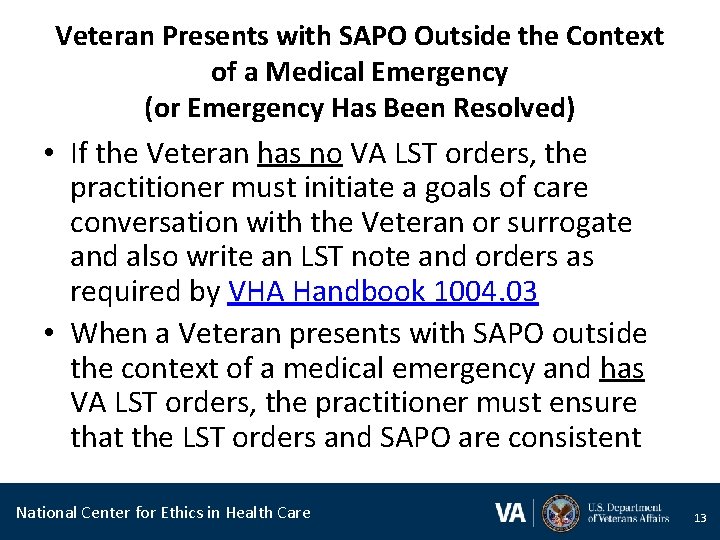
Veteran Presents with SAPO Outside the Context of a Medical Emergency (or Emergency Has Been Resolved) • If the Veteran has no VA LST orders, the practitioner must initiate a goals of care conversation with the Veteran or surrogate and also write an LST note and orders as required by VHA Handbook 1004. 03 • When a Veteran presents with SAPO outside the context of a medical emergency and has VA LST orders, the practitioner must ensure that the LST orders and SAPO are consistent National Center for Ethics in Health Care 13
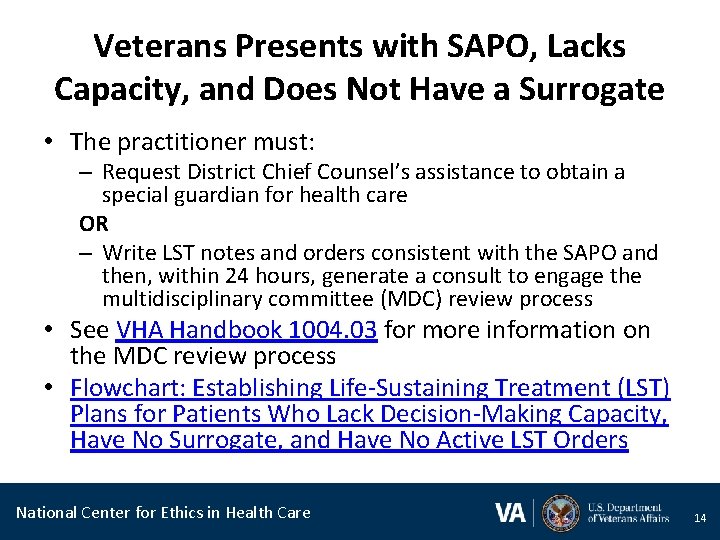
Veterans Presents with SAPO, Lacks Capacity, and Does Not Have a Surrogate • The practitioner must: – Request District Chief Counsel’s assistance to obtain a special guardian for health care OR – Write LST notes and orders consistent with the SAPO and then, within 24 hours, generate a consult to engage the multidisciplinary committee (MDC) review process • See VHA Handbook 1004. 03 for more information on the MDC review process • Flowchart: Establishing Life-Sustaining Treatment (LST) Plans for Patients Who Lack Decision-Making Capacity, Have No Surrogate, and Have No Active LST Orders National Center for Ethics in Health Care 14
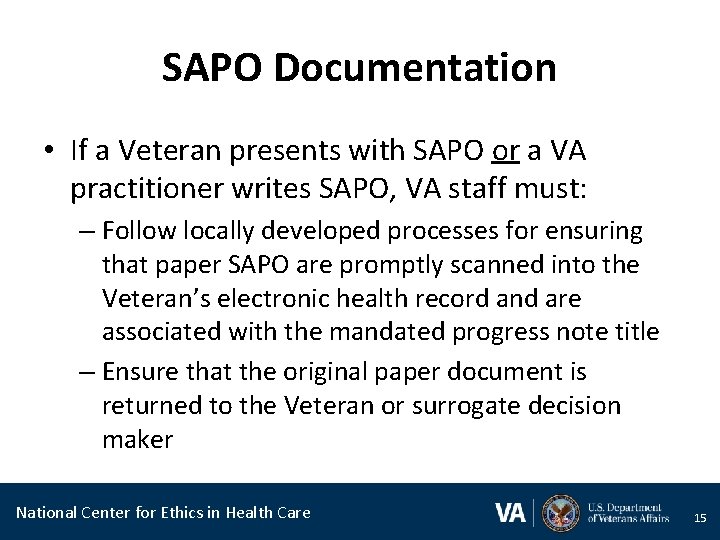
SAPO Documentation • If a Veteran presents with SAPO or a VA practitioner writes SAPO, VA staff must: – Follow locally developed processes for ensuring that paper SAPO are promptly scanned into the Veteran’s electronic health record and are associated with the mandated progress note title – Ensure that the original paper document is returned to the Veteran or surrogate decision maker National Center for Ethics in Health Care 15
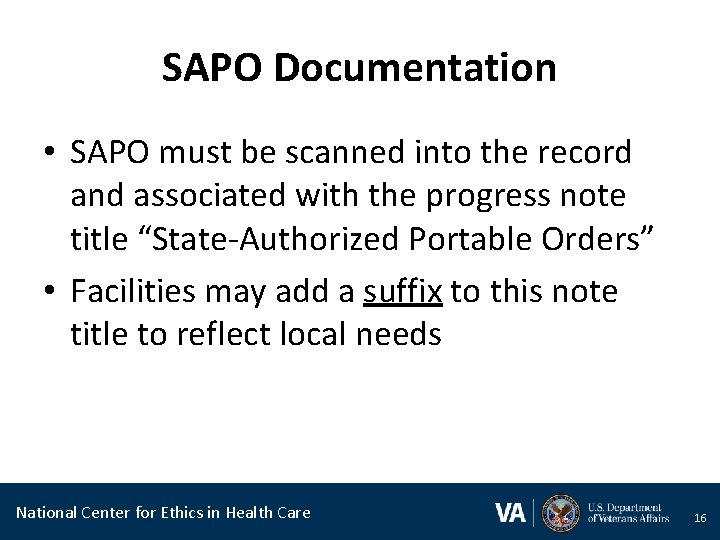
SAPO Documentation • SAPO must be scanned into the record and associated with the progress note title “State-Authorized Portable Orders” • Facilities may add a suffix to this note title to reflect local needs National Center for Ethics in Health Care 16
Examples of Note Titles with Local Suffix • E. g. , “State-Authorized Portable Orders – CA POLST” • E. g. , “State-Authorized Portable Orders – MOLST” * All note title must start with “State-Authorized Portable Orders” National Center for Ethics in Health Care 17
SAPO Documentation • VHA Directive 1004. 04 removed the earlier requirement for practitioners to write a separate progress note specifying the date, jurisdiction, and description of the substance of the SAPO • It is sufficient to scan the document into the Veteran’s record and associate it with the appropriate note title National Center for Ethics in Health Care 18
References • VHA Directive 1004. 04, State-Authorized Portable Orders (SAPO), dated February 26, 2019 • FAQ: VHA Directive 1004. 04, SAPO • VHA Handbook 1004. 03, Life-Sustaining Treatment Decisions Initiative: Eliciting, Documenting, and Honoring Patients’ Values, Goals, and Preferences, dated January 11, 2017 • Website: National Center for Ethics in Health Care 19
Questions? Email VHAEthics@va. gov National Center for Ethics in Health Care 20
- Slides: 20