
State space model of precipitation rate Tamre Cardoso
![Structure of model Data: [G|N(D), q. G] [Z|N(D), q. Z] Processes: [N|m. N, q.](https://slidetodoc.com/presentation_image_h2/766529c40a232bf7cfc51b4613ef3546/image-8.jpg "Structure of model Data: [G|N(D), q. G] [Z|N(D), q. Z] Processes: [N|m. N, q.")
- Slides: 24
State space model of precipitation rate (Tamre Cardoso, Ph. D UW 2004) Updating wave height forecasts using satellite data (Anders Malmberg, Ph. D U. Lund 2005) Model emulators (O’Hagan and coworkers )
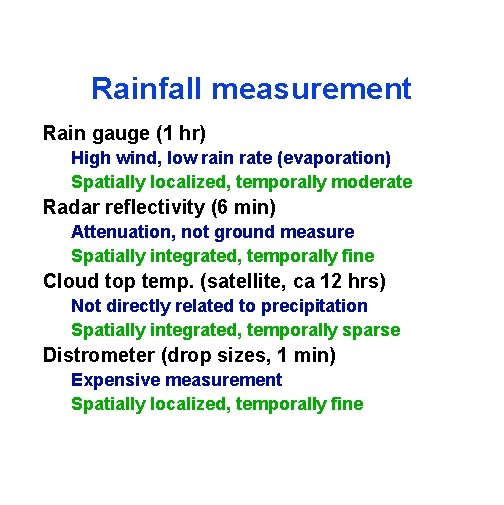
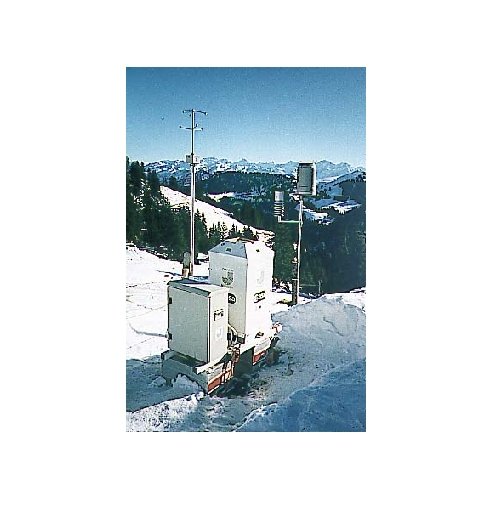
Rainfall measurement Rain gauge (1 hr) High wind, low rain rate (evaporation) Spatially localized, temporally moderate Radar reflectivity (6 min) Attenuation, not ground measure Spatially integrated, temporally fine Cloud top temp. (satellite, ca 12 hrs) Not directly related to precipitation Spatially integrated, temporally sparse Distrometer (drop sizes, 1 min) Expensive measurement Spatially localized, temporally fine
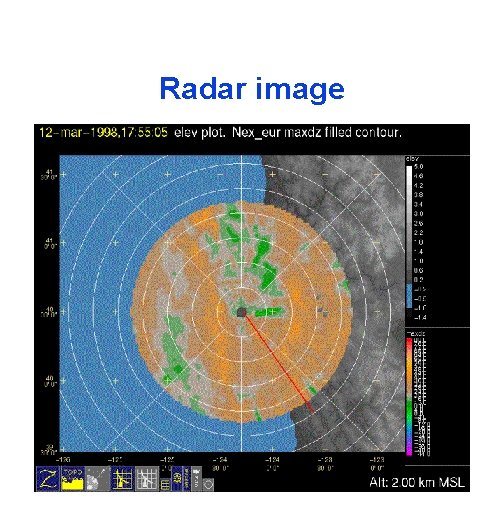
Radar image
Drop size distribution
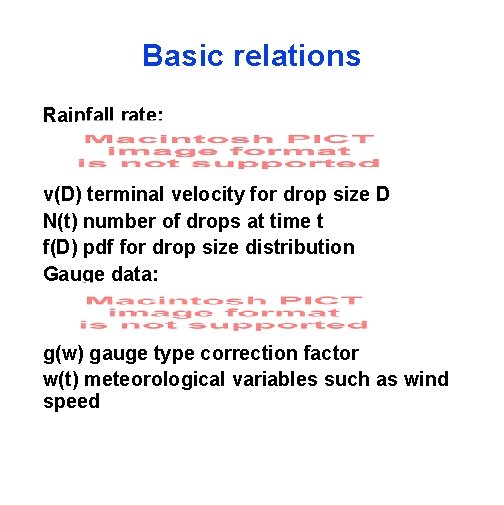
Basic relations Rainfall rate: v(D) terminal velocity for drop size D N(t) number of drops at time t f(D) pdf for drop size distribution Gauge data: g(w) gauge type correction factor w(t) meteorological variables such as wind speed
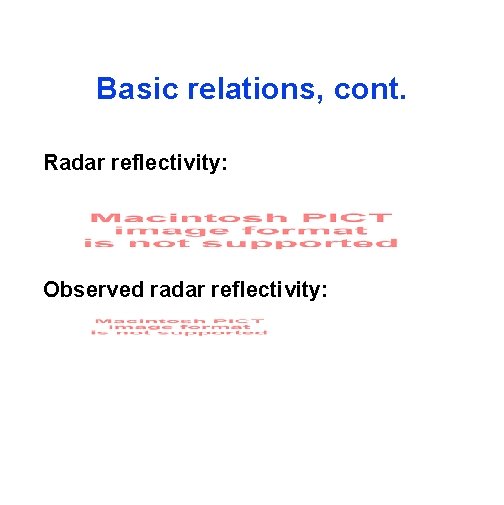
Basic relations, cont. Radar reflectivity: Observed radar reflectivity:
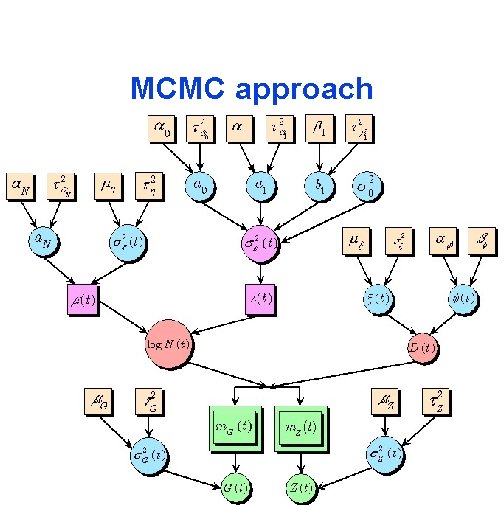
Structure of model Data: [G|N(D), q. G] [Z|N(D), q. Z] Processes: [N|m. N, q. N] [D|xt, q. D] log GARCH LN Temporal dynamics: [m. N(t)|qm] AR(1) Model parameters: [q. G, q. Z, q. N, qm, q. D|q. H] Hyperparameters: q. H
MCMC approach
Observed and predicted rain rate
Observed and calculated radar reflectivity
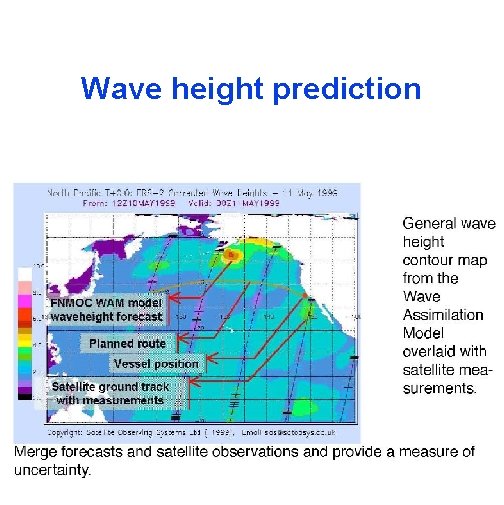
Wave height prediction
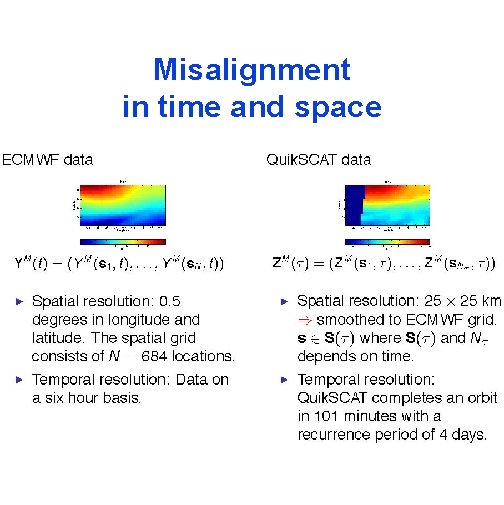
Misalignment in time and space
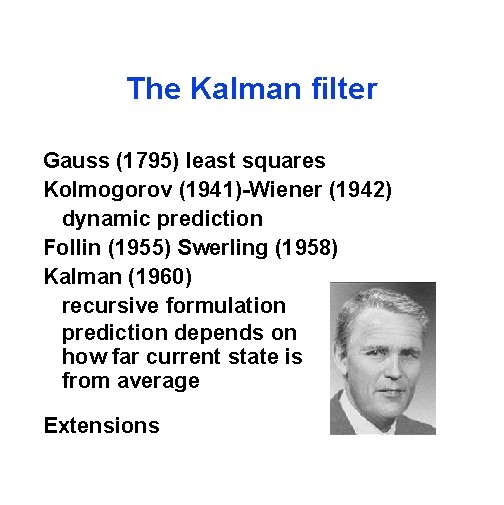
The Kalman filter Gauss (1795) least squares Kolmogorov (1941)-Wiener (1942) dynamic prediction Follin (1955) Swerling (1958) Kalman (1960) recursive formulation prediction depends on how far current state is from average Extensions
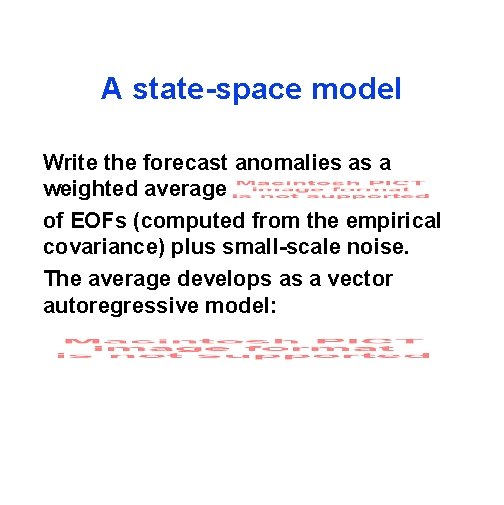
A state-space model Write the forecast anomalies as a weighted average of EOFs (computed from the empirical covariance) plus small-scale noise. The average develops as a vector autoregressive model:
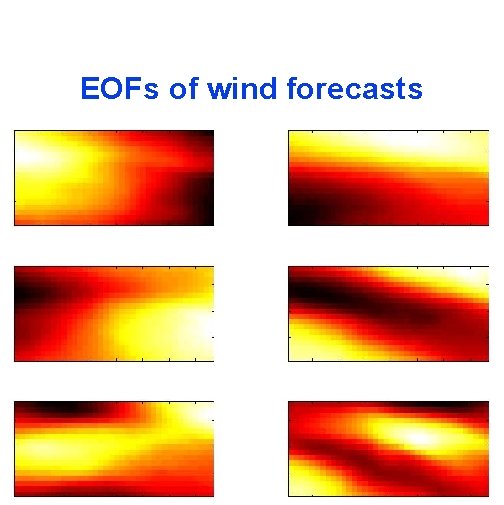
EOFs of wind forecasts
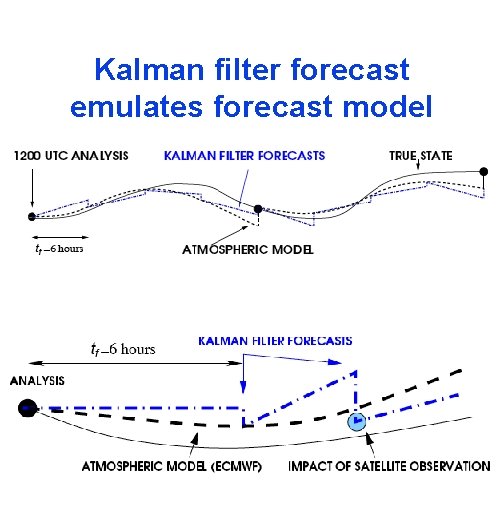
Kalman filter forecast emulates forecast model
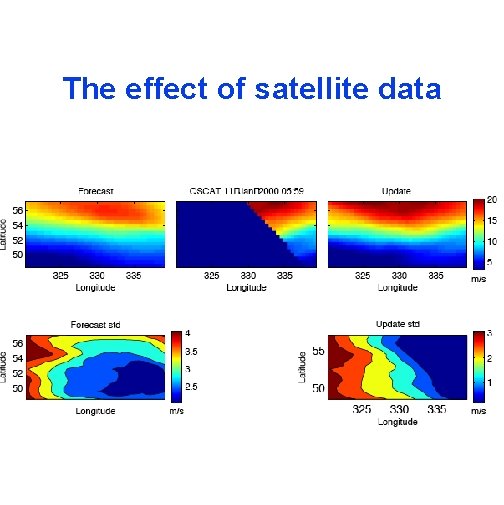
The effect of satellite data
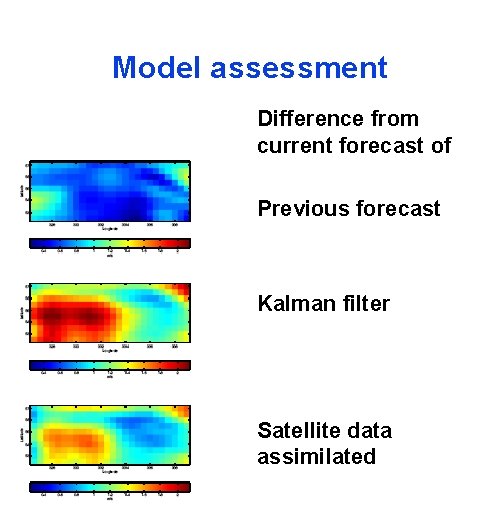
Model assessment Difference from current forecast of Previous forecast Kalman filter Satellite data assimilated
Statistical analysis of computer code output Often the process model is expensive to run (in time, at least), especially if different runs needed for MCMC Need to develop real-time approximation to process model Kalman filter is a dynamic linear model approximation SACCO is an alternative Bayesian approach
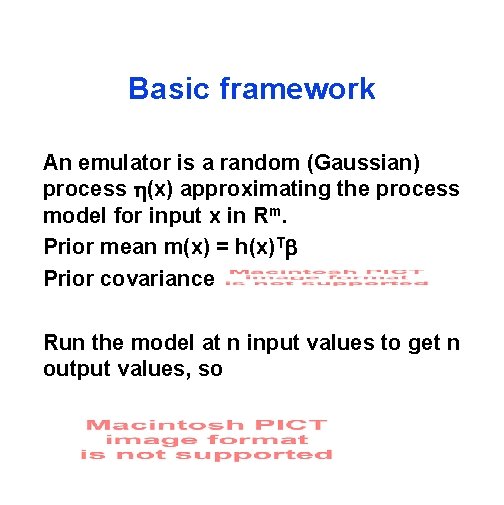
Basic framework An emulator is a random (Gaussian) process (x) approximating the process model for input x in Rm. Prior mean m(x) = h(x)T Prior covariance Run the model at n input values to get n output values, so
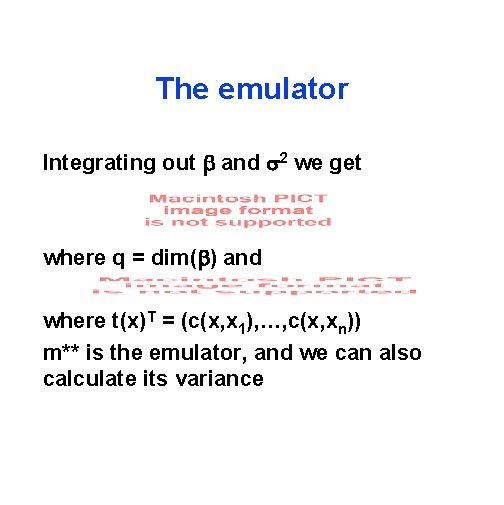
The emulator Integrating out and 2 we get where q = dim( ) and where t(x)T = (c(x, x 1), …, c(x, xn)) m** is the emulator, and we can also calculate its variance
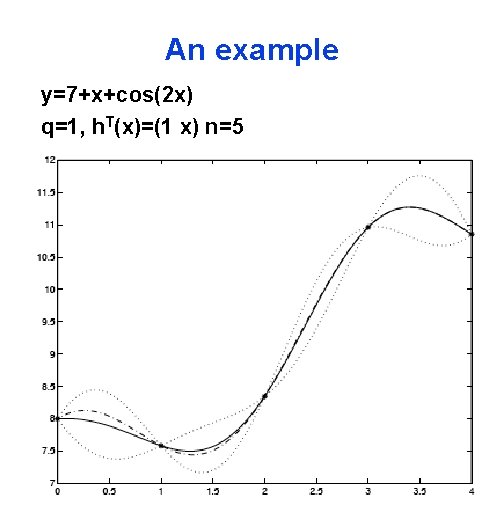
An example y=7+x+cos(2 x) q=1, h. T(x)=(1 x) n=5
Conclusions Model assessment constraints: • amount of data • data quality • ease of producing model runs • degree of misalignment Ideally the model should have • similar first and second order properties to the data • similar peaks and troughs to data (or simulations based on the data)