
STATE OWNED ENTERPRISES ARE THEY GOOD OR BAD
STATE OWNED ENTERPRISES: ARE THEY GOOD OR BAD FOR COMPETITION? A presentation made at the National Competition Symposium By Gideon Gobusamang Nkala 10 th April 2019 1
Presentation Outline 1. Introduction 2. Statutory Monopolies 3. Competition and State Monopolies 4. Are State Monopolies Anti-Competitive Conclusions

What is a state owned enterprise? ”Any enterprise with state ownership, a distinct legal form (separate from public administration) and having sales and revenue. ’’ World Bank ‘’These are companies or entities that are owned by government’’. 3
Key Features of a SOE: • It is an entity that executes a Government mandate. • It offers a specific product/service. • Often the offered service or product is at a regulated price. • The entity can be run by Government or be independent.
Rationale for SOE’s • Key public policy reasons: 1. Ensuring security of supply. 2. Ensuring Universal access 3. Providing basic services to a wider population 4. Avoiding costs of duplicating expensive distribution network (sunk costs) e. g water, railway etc. 5
Broad Competition Policy Objectives in Botswana • Enhance Economic Efficiency. • Promote Consumer Welfare and to Support Economic Growth and Diversification. • Prevent and Redress Anti-Competitive Practices in Botswana Economy and remove unnecessary Constraints in the Market. 6
Competition Policy Thrusts in other Jurisdictions 1. Maintain and Encourage Competition: Canada and New Zealand. 2. Public Interest: United Kingdom. 3. Consumer Welfare and Economic Efficiency: United States. 4. Market Integration and Prevention of Dominance: European Union. 5. Economic Efficiency: Most Developing Economies. 7
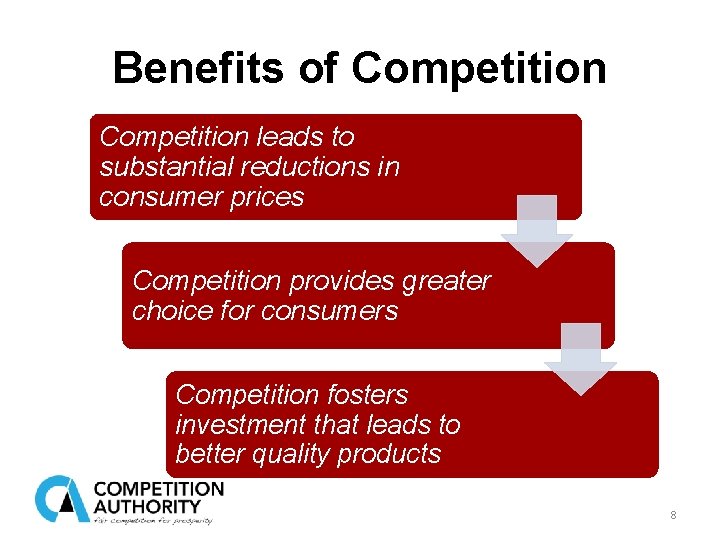
Benefits of Competition leads to substantial reductions in consumer prices Competition provides greater choice for consumers Competition fosters investment that leads to better quality products 8
Can Competition Law and SOE’s Co-exist? Competition Law • The primary function of competition law is to prevent restrictive business practices (mainly private). • To prevent public policies that impede competition. • To ensure fairness and predictability in the market. Statutory Monopolies(SOE) • Confer exemptions from competition law’s reach • The exemptions might result in inefficiency, inability to innovate and lack of choice. • SOEs are generally immune from competition law while private firms fall under scrutiny of Competition Law. 9
Competition Law and State Monopolies in Botswana • Competition regulation does not apply to state monopolies. • It only applies when these entities trade in a market open for participation by other enterprises. • “State” will only be held accountable or be regulated for competition issues to the extent that it engages in trade in any market that is open for participation by other enterprises. 10
Examples of SOE’s in Botswana • • • WUC BPC BMC BTC (fixed line) Botswana Railways 11
General Complaints about SOE’s in Botswana • Excessive pricing relative to private firms. • Extending monopoly to ancillary activities or adjacent market. • Arbitrary procurement determinations. • Raising barriers to entry, particularly in ancillary markets. • Because of immunity there is an incentive to engage in anti-competitive practices. 12
Are SOE’s Inherently Anti. Competitive? • Across the world competition agencies allow some form of exemptions. • There are instances where certain exemptions advance the objectives of competition policy e. g consumer welfare, innovation, R&D etc. • Exemptions advance the socio-economic policy of government • Efficiency may not be the sole Government policy consideration e. g. public interest or public welfare. 13
How has the CA Intervened in SOE’s Cases • SOE’s that are engaged in commercial activities – Meet thresholds of the law, market participants and compete in a defined market – GABCON (Gaborone Container Terminal) a Joint Venture between Botswana Railways and Transnet t/a Spoornet engaged in unilateral conduct, foreclose Truck & Haulier Companies at downstream market – BCL and Norilsk nickel merger in the mining of Cooper and Nickel • Agency intervened to control the merger and to redress the conduct of SOE • Jurisdiction conferred as SOE’s met thresholds as defined in Act • Prosecution to full extent of the law 14
Case Studies Cont’d • • Botswana Power Corporation – Formation of Tender for Electrical Works and Consulting – skewed towards one company – BPC not market participant BUT decision it made played a big role in influencing competition in relevant market – Analytically and with reference to the law, challenge to place the conduct within confines of the enabling legislation for purposes of prosecution – Engaged BPC on the overall holistic approach of removing this barrier – BPC changed its strategy and reformulated its Tender Botswana Meat Commission – Decision to sell its by product Tallow exclusively to one company – Marginalised some players out of the market – Raw material used in manufacturing soap – Engaging the SOE instead of prosecuting to full extent of law 15
Conclusions • The role of Government in markets has an impact on the function of competition. • The role could hinder or promote market competition. • Re - evaluation of the exceptions • Lifting the express and total immunity availed to Statutory Monopolies. • Competition Law does Government’s priorities. not override 16
Thank you for your audience Plot 28, Matsitama Road, Main mall Tel: +267 393 4278 Fax: +267 312 1013 Email: gideon. nkala@competitionauthority. co. bw Website: www. competitionauthority. co. bw Facebook: Competition Authority Botswana Twitter: @Competition. Bots 17
Q&A 18
- Slides: 18