
State of the Global Change Grand Challenge Report
State of the Global Change Grand Challenge Report to the Portfolio Committee on Science and Technology 15 September 2010
Last time we had the privilege of presenting to the Portfolio almost a year to the date – 16 September 2009
Structure of the presentation • Quick re-cap on the Grand Challenge – what we plan to achieve, – impact measures, – priority initiatives • Progress to date • Plans for the next 12 months – Human Capital Development – Key Research programmes – Risk and Vulnerability Atlas
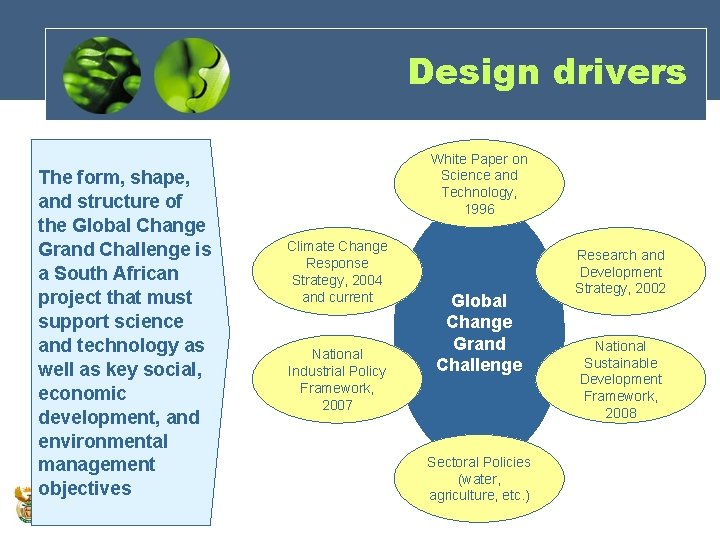
Design drivers The form, shape, and structure of the Global Change Grand Challenge is a South African project that must support science and technology as well as key social, economic development, and environmental management objectives White Paper on Science and Technology, 1996 Climate Change Response Strategy, 2004 and current National Industrial Policy Framework, 2007 Global Change Grand Challenge Sectoral Policies (water, agriculture, etc. ) Research and Development Strategy, 2002 National Sustainable Development Framework, 2008
Primary Impact Measures • Extent to which scientific understanding of global change has improved as a result of South African research efforts • Extent to which South Africa contributes to the development and deployment of innovative technologies that support appropriate responses to the negative impacts of environmental changes, particularly climate change • Extent to which decision-makers have used improved scientific understanding and technological development to achieve sustainable development goals in South Africa and Africa
Scorecard • Four key dimensions – Human capital development and transformation – Development of knowledge and research assets – Impact on policy, social, and economic development – Growing South Africa as a science destination
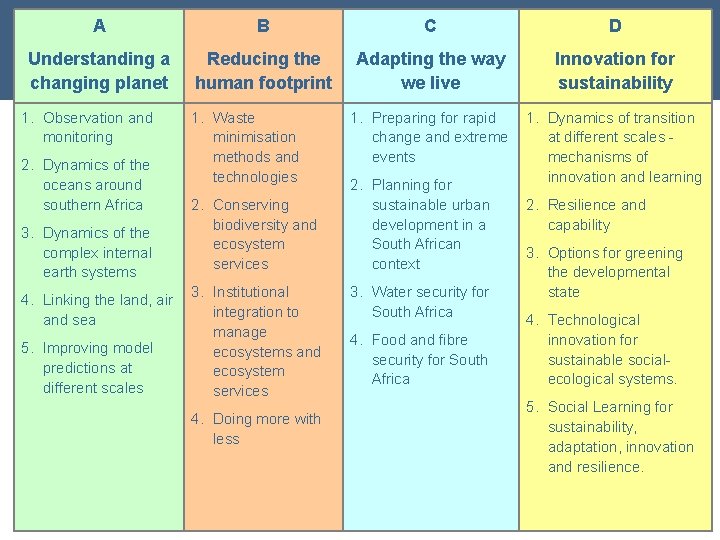
A B C D Understanding a changing planet Reducing the human footprint Adapting the way we live Innovation for sustainability 1. Preparing for rapid change and extreme events 1. Dynamics of transition at different scales mechanisms of innovation and learning 1. Observation and monitoring 2. Dynamics of the oceans around southern Africa 3. Dynamics of the complex internal earth systems 4. Linking the land, air and sea 5. Improving model predictions at different scales 1. Waste minimisation methods and technologies 2. Conserving biodiversity and ecosystem services 3. Institutional integration to manage ecosystems and ecosystem services 4. Doing more with less 2. Planning for sustainable urban development in a South African context 3. Water security for South Africa 4. Food and fibre security for South Africa 2. Resilience and capability 3. Options for greening the developmental state 4. Technological innovation for sustainable socialecological systems. 5. Social Learning for sustainability, adaptation, innovation and resilience.

Global Change Performance and Investment Council South African Environmental Observation Network (SAEON) Space Agency (Global Change Monitoring Network) SA Polar Research Entity Knowledge Brokering Support Unit Centre of Excellence Africa Earth Observation Network (AEON) programmes Inkaba ye Africa/ Ikhure Africa Applied Centre for Climate and Earth Systems Studies (ACCESS) Global Change, Society, and Sustainability South African Risk and Vulnerability Atlas (R&V Atlas) Bureau on Global Change Science
Mitigation and adaptation technologies • Technologies for environmental monitoring and observation • Waste management and minimisation industry • Water sector • Food and fibre-related technologies • Technologies to support resilience in the built environment
Notable Progress • Applied Centre for Climate and Earth Systems (ACCESS) in place • AEON-related programmes continue to deliver, particularly new human capital • Development of the electronic Risk and Vulnerability Atlas portal • Call issued for the establishment of Risk and Vulnerability Service Centres at rural universities • Planning for new integrated Masters programme/s
Key priorities – 2010/ 11 • • Bureau for Global Change Science Risk and Vulnerability Atlas and Service Centres HCD interventions Initiation of research programme on ‘Global Change, Society, and Sustainability’ • International partnerships • Technology development roadmaps • Africa partnership
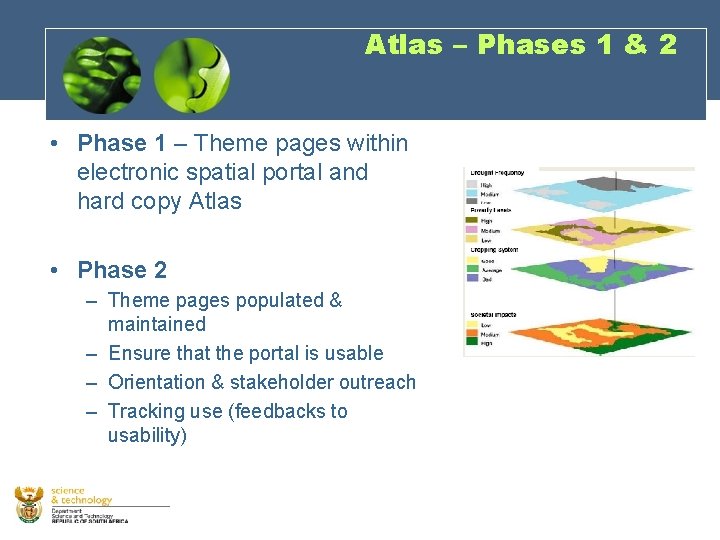
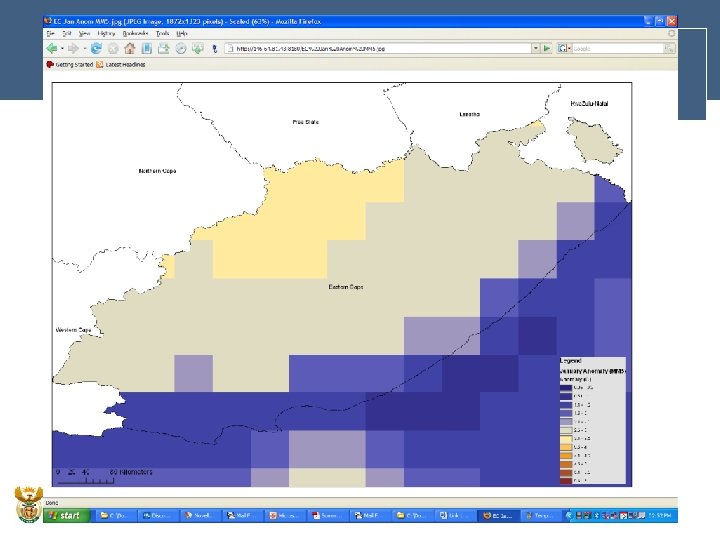
Atlas – Phases 1 & 2 • Phase 1 – Theme pages within electronic spatial portal and hard copy Atlas • Phase 2 – Theme pages populated & maintained – Ensure that the portal is usable – Orientation & stakeholder outreach – Tracking use (feedbacks to usability)
Theme page structure Themes represent a point of entry for users of the Atlas interested in particular sectors and/or subjects. Information, data and cited studies may further appear on more than one theme page, indicating the cross-sectoral nature of particular issues in South Africa. Pages & timeframe 1. Socio-economic (Phase 1) 2. Atmospheric/climate (Phase 1) 3. Disaster Management (interoperability with NDMC system) (2011 -12) 4. Agriculture (2010 -11) 5. Forestry (2011 -12) 6. Water (surface & ground) (2010 -11) 7. Health (2011 -12) 8. Air quality/Emissions (2010 -11) 9. Human Settlements (2010 -11) 10. Biodiversity (terrestrial & freshwater) (2010 -11) 11. Coastal/marine (2010 -11)
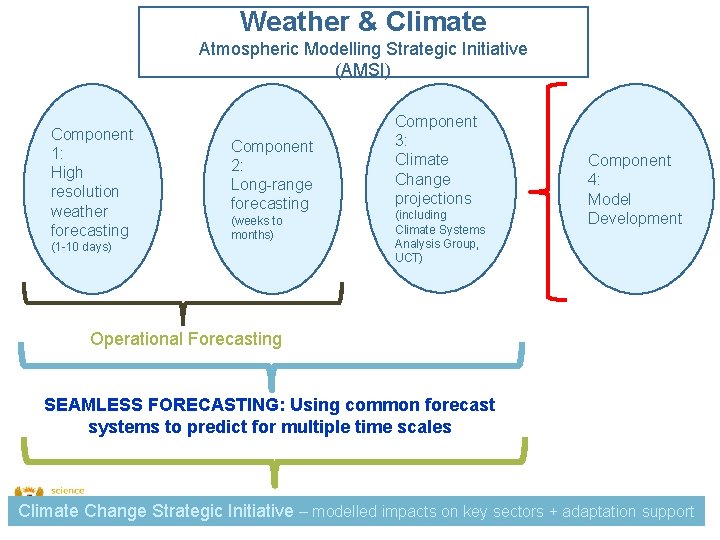
Weather & Climate Atmospheric Modelling Strategic Initiative (AMSI) Component 1: High resolution weather forecasting (1 -10 days) Component 2: Long-range forecasting (weeks to months) Component 3: Climate Change projections (including Climate Systems Analysis Group, UCT) Component 4: Model Development Operational Forecasting SEAMLESS FORECASTING: Using common forecast systems to predict for multiple time scales Climate Change Strategic Initiative – modelled impacts on key sectors + adaptation support
R&V Service Centres • Targeted at rural universities • Two complementary objectives – Capacity development – Decision support • Maximum of 5 Centres to be established over the next 18 -24 months
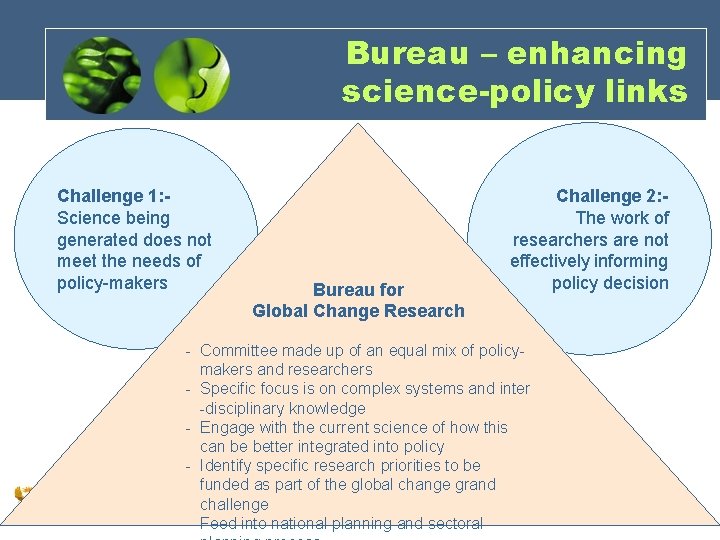
Bureau – enhancing science-policy links Challenge 1: Science being generated does not meet the needs of policy-makers Bureau for Global Change Research Challenge 2: The work of researchers are not effectively informing policy decision - Committee made up of an equal mix of policymakers and researchers - Specific focus is on complex systems and inter -disciplinary knowledge - Engage with the current science of how this can be better integrated into policy - Identify specific research priorities to be funded as part of the global change grand challenge - Feed into national planning and sectoral
Human Capital Development • Fully aligned with long-term environmental skills development process led by the Department of Environmental Affairs • Flagship – new innovative multi-disciplinary and interdisciplinary programmes (mainly at Masters level) • Close engagement with business and government who will be the eventual employers of • Targeted research chairs and other HCD support initiatives
International and African Partnerships • Strong portfolio of international partnerships – Need to be refined, improved and targeted to our objectives • SADC-level process – Process has started to developed a SADC-wide science and technology plan to support climate change – Four focus areas – mitigation, adaptation, risk and vulnerability and data and observation
Thank You
- Slides: 20