
State of the art building simulation software Case
State of the art building simulation software. . . Case Study: Marks & Spencer Oxford Street Environmental Design Solutions Ltd Copyright © 2010 EDSL www. edsl. net
State of the art building simulation software. . . Copyright © 2010 EDSL www. edsl. net
M&S Oxford Street State of the art building simulation software. . . Copyright © 2010 EDSL • The Brief: • Calibrate a base model using metered consumption figures – “existing building” • Apply changes required in the refurbishment brief to predict energy consumption – “proposed building”. • Information required to create base model: • • • Drawings Constructions Usage patterns Internal gains – lighting, occupants, equipment Plant operation www. edsl. net
State of the art building simulation software. . . Considerations… • Some aspects of operation will affect heating & cooling demands: • escalators • cooling effect to space from cold aisles • plinth heating of refrigeration units • small power, e. g. tills • Some items will not: • refrigeration compressor energy consumption, including cold rooms & freezer rooms • lifts Copyright © 2010 EDSL www. edsl. net
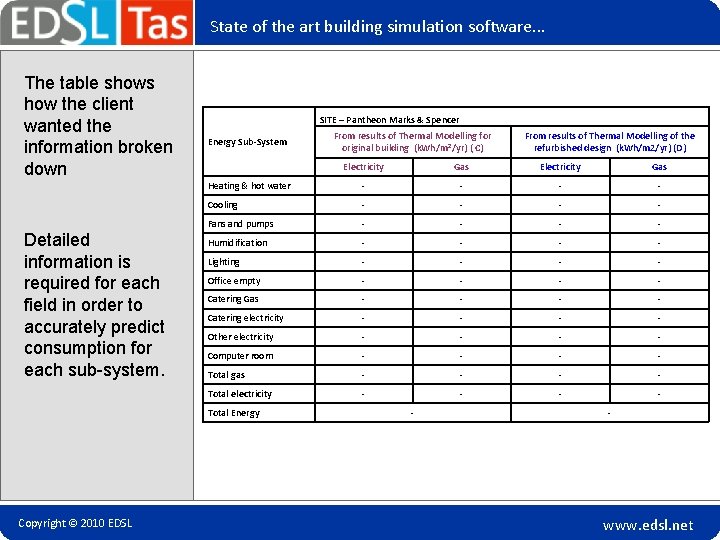
State of the art building simulation software. . . The table shows how the client wanted the information broken down Detailed information is required for each field in order to accurately predict consumption for each sub-system. SITE – Pantheon Marks & Spencer Energy Sub-System From results of Thermal Modelling of the refurbished design (k. Wh/m 2/yr) (D) Electricity Gas Heating & hot water - - Cooling - - Fans and pumps - - Humidification - - Lighting - - Office empty - - Catering Gas - - Catering electricity - - Other electricity - - Computer room - - Total gas - - Total electricity - - Total Energy Copyright © 2010 EDSL From results of Thermal Modelling for original building (k. Wh/m 2/yr) ( C) - - www. edsl. net

State of the art building simulation software. . . Indication of detail required • Heating & cooling efficiencies • Distribution losses • Pipe index circuit length & pressure drop • Fan SFPs • Hot water consumption, generator efficiency & distribution losses • Lighting installed density • Daily opening hours with hours of plant operation • Method of heating, cooling & ventilation • Ventilation rates Copyright © 2010 EDSL www. edsl. net
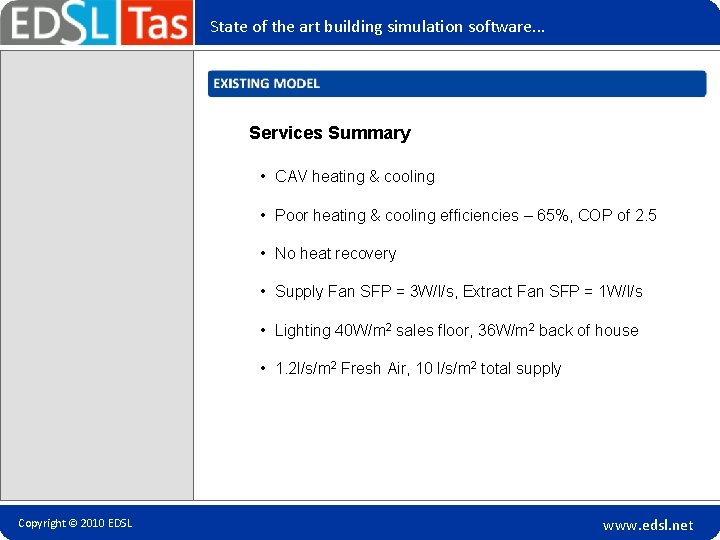
State of the art building simulation software. . . Services Summary • CAV heating & cooling • Poor heating & cooling efficiencies – 65%, COP of 2. 5 • No heat recovery • Supply Fan SFP = 3 W/l/s, Extract Fan SFP = 1 W/l/s • Lighting 40 W/m 2 sales floor, 36 W/m 2 back of house • 1. 2 l/s/m 2 Fresh Air, 10 l/s/m 2 total supply Copyright © 2010 EDSL www. edsl. net
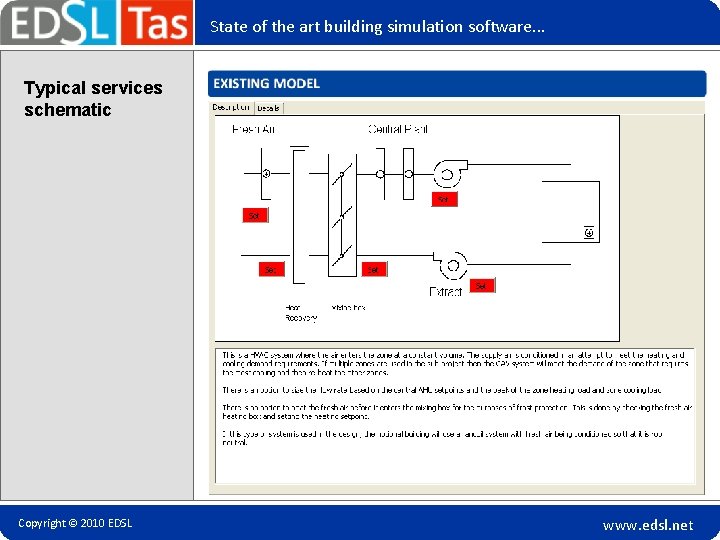
State of the art building simulation software. . . Typical services schematic Copyright © 2010 EDSL www. edsl. net
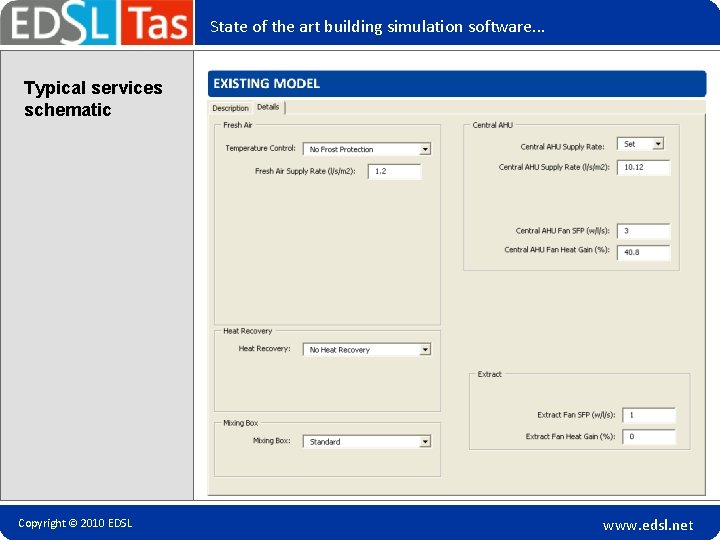
State of the art building simulation software. . . Typical services schematic Copyright © 2010 EDSL www. edsl. net
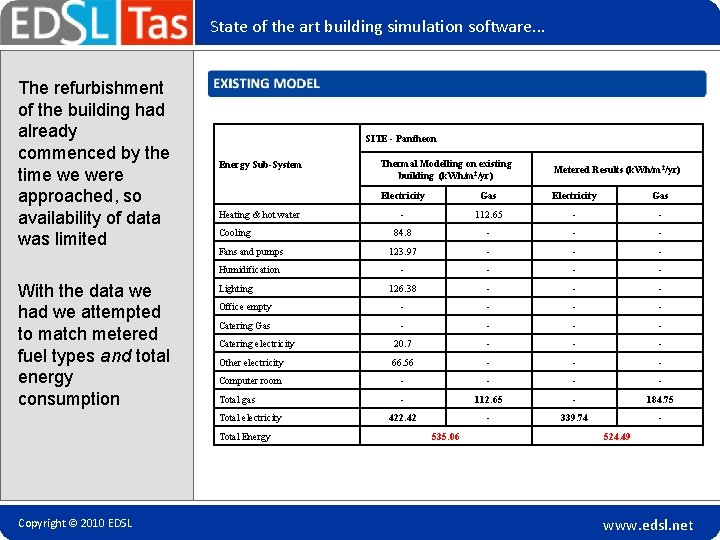
State of the art building simulation software. . . The refurbishment of the building had already commenced by the time we were approached, so availability of data was limited With the data we had we attempted to match metered fuel types and total energy consumption SITE - Pantheon Thermal Modelling on existing building (k. Wh/m 2/yr) Metered Results (k. Wh/m 2/yr) Electricity Gas - 112. 65 - - 84. 8 - - - Fans and pumps 123. 97 - - - Humidification - - 126. 38 - - - Office empty - - Catering Gas - - Catering electricity 20. 7 - - - Other electricity 66. 56 - - - Computer room - - Total gas - 112. 65 - 184. 75 422. 42 - 339. 74 - Energy Sub-System Heating & hot water Cooling Lighting Total electricity Total Energy Copyright © 2010 EDSL 535. 06 524. 49 www. edsl. net

State of the art building simulation software. . . With the base model complete, the next step was to include the changes put forward by our client Areas of investigation • Lighting • Replacing heating & cooling plant • Installation of local VRF • Changes to occupancy levels • Improved fan efficiencies • Addition of new staff & customer cafes • Addition of a new bakery & hot food sales area • Extra refrigerated aisles Copyright © 2010 EDSL www. edsl. net
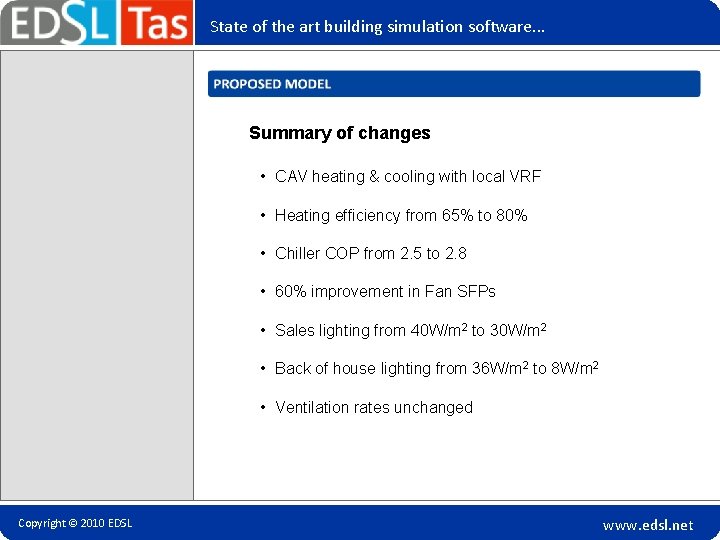
State of the art building simulation software. . . Summary of changes • CAV heating & cooling with local VRF • Heating efficiency from 65% to 80% • Chiller COP from 2. 5 to 2. 8 • 60% improvement in Fan SFPs • Sales lighting from 40 W/m 2 to 30 W/m 2 • Back of house lighting from 36 W/m 2 to 8 W/m 2 • Ventilation rates unchanged Copyright © 2010 EDSL www. edsl. net
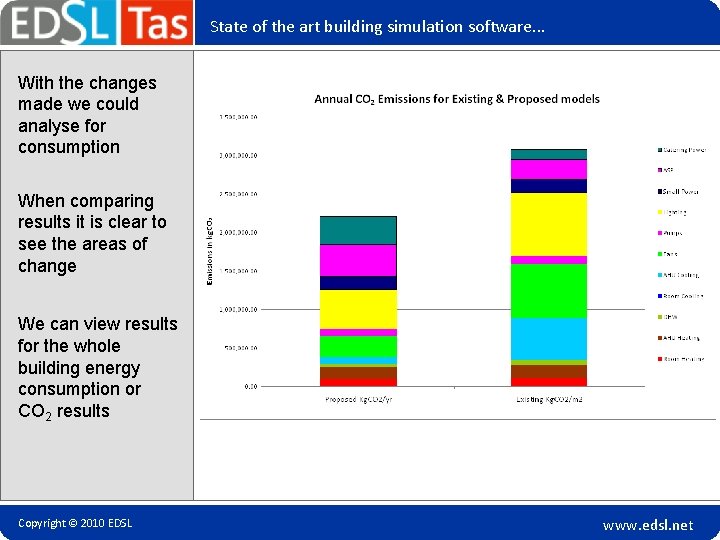
State of the art building simulation software. . . With the changes made we could analyse for consumption When comparing results it is clear to see the areas of change We can view results for the whole building energy consumption or CO 2 results Copyright © 2010 EDSL www. edsl. net
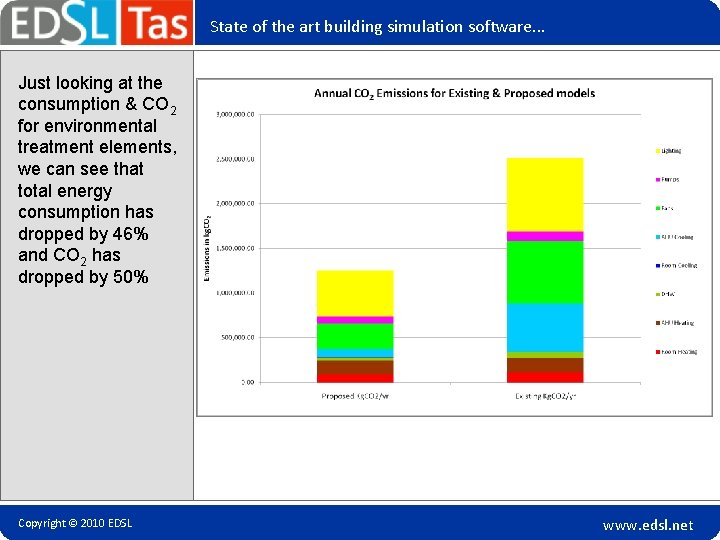
State of the art building simulation software. . . Just looking at the consumption & CO 2 for environmental treatment elements, we can see that total energy consumption has dropped by 46% and CO 2 has dropped by 50% Copyright © 2010 EDSL www. edsl. net
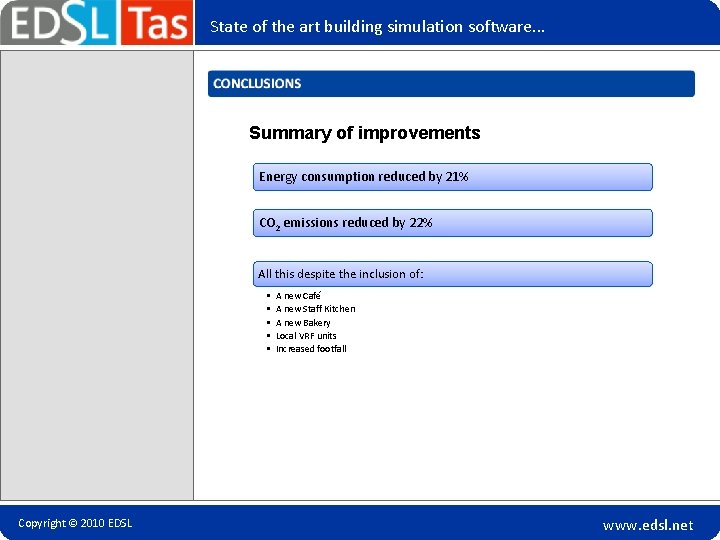
State of the art building simulation software. . . Summary of improvements Energy consumption reduced by 21% CO 2 emissions reduced by 22% All this despite the inclusion of: • • • Copyright © 2010 EDSL A new Café A new Staff Kitchen A new Bakery Local VRF units Increased footfall www. edsl. net
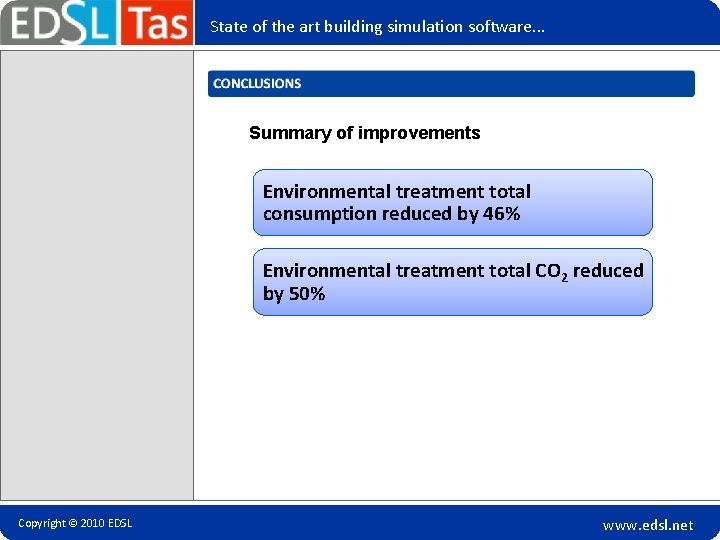
State of the art building simulation software. . . Summary of improvements Environmental treatment total consumption reduced by 46% Environmental treatment total CO 2 reduced by 50% Copyright © 2010 EDSL www. edsl. net
State of the art building simulation software. . . Benefits to end-client: Expected energy consumption broken down by fuel type & end use Indication of expected cuts in running costs Marketing potential Copyright © 2010 EDSL www. edsl. net
State of the art building simulation software. . . Environmental Design Solutions Ltd Copyright © 2010 EDSL www. edsl. net
- Slides: 18