
STATE OF NEVADA DEPARTMENT OF HEALTH AND HUMAN
- Slides: 48
STATE OF NEVADA DEPARTMENT OF HEALTH AND HUMAN SERVICES DIVISION OF CHILD AND FAMILY SERVICES AMBER L. HOWELL, ADMINISTRATOR
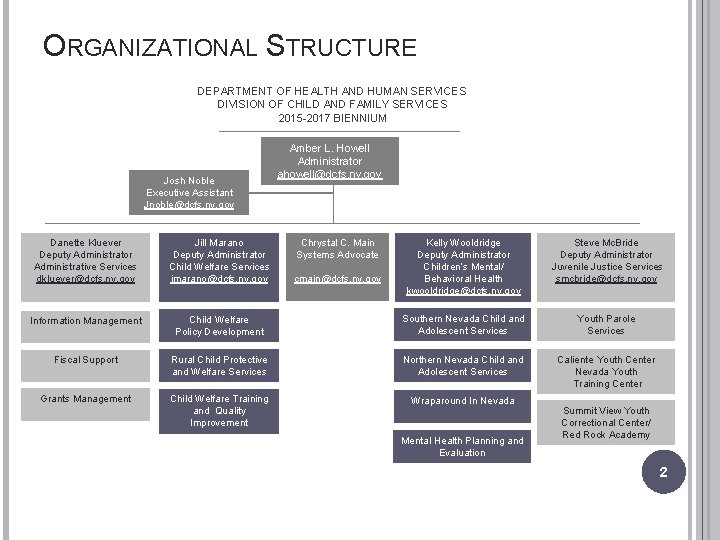
ORGANIZATIONAL STRUCTURE DEPARTMENT OF HEALTH AND HUMAN SERVICES DIVISION OF CHILD AND FAMILY SERVICES 2015 -2017 BIENNIUM Josh Noble Executive Assistant Jnoble@dcfs. nv. gov Danette Kluever Deputy Administrator Administrative Services dkluever@dcfs. nv. gov Jill Marano Deputy Administrator Child Welfare Services jmarano@dcfs. nv. gov Information Management Amber L. Howell Administrator ahowell@dcfs. nv. gov Kelly Wooldridge Deputy Administrator Children’s Mental/ Behavioral Health kwooldridge@dcfs. nv. gov Steve Mc. Bride Deputy Administrator Juvenile Justice Services smcbride@dcfs. nv. gov Child Welfare Policy Development Southern Nevada Child and Adolescent Services Youth Parole Services Fiscal Support Rural Child Protective and Welfare Services Northern Nevada Child and Adolescent Services Caliente Youth Center Nevada Youth Training Center Grants Management Child Welfare Training and Quality Improvement Wraparound In Nevada Chrystal C. Main Systems Advocate cmain@dcfs. nv. gov Mental Health Planning and Evaluation Summit View Youth Correctional Center/ Red Rock Academy 2
SUMMARY OF AGENCY OPERATIONS Division of Child and Family Services (DCFS) is responsible for child protective and welfare service delivery in rural Nevada and oversight of urban county-operated child protective and welfare services; children’s mental/behavioral health treatment and residential services (outpatient and inpatient acute) in urban Nevada; and, statewide juvenile justice services including state-operated youth training centers and youth parole. A non-exhaustive list of DCFS’ program areas includes: o Administrative and Other Services: child protective and welfare quality assurance/improvement and oversight, information management, central office fiscal support, personnel services, systems advocate services and grants management. Budgets include 3143 UNITY/SACWIS; 3145 Children, Youth and Family Administration; and 3181 Victims of Domestic Violence. o Children’s Mental/Behavioral Health Services: screenings and evaluations, early childhood services, outpatient therapy, wraparound case management and residential and inpatient/acute treatment services and mobile crisis. Budgets include 3281 Northern Nevada Child and Adolescent Services (NNCAS) and 3646 Southern Nevada Child and Adolescent Services (SNCAS). o Child Protective and Welfare Services: clinical and case management services and programs that respond to caregiver maltreatment/abuse of children and children’s need to achieve permanency such as intensive family preservation services, foster care, adoption services and independent living services. Budgets include 3141 Washoe County Child Welfare Integration; 3142 Clark County Child Welfare Integration; 3229 Rural Child Welfare; 3242 Child Welfare Trust; 3250 Transition from Foster Care; and 3251 Child Death Reviews. o Juvenile Justice Services: youth rehabilitation, treatment and community safety, and youth commitment to state-operated juvenile facilities with behavioral health services and supervision of youth upon release to their communities (parole). Budgets include 1383 Community Juvenile Justice programs; 3147 Youth Alternative Placement; 3148 Summit View Youth Correctional Center (SVYCC); 3179 Caliente Youth Center (CYC); 3259 Nevada Youth Training Center (NYTC); and 3263 Youth Parole Services. 3
MISSION STATEMENT The Division of Child and Family Services (DCFS), together in genuine partnership with families, communities and county governmental agencies, provides support and services to assist Nevada’s children and families in reaching their full human potential. We recognize that Nevada’s families are our future and families thrive when they: o Live in safe, permanent settings. o Experience a sense of sustainable emotional and physical well being. o Receive support to consistently make positive choices for family and common good. 4
VISION CHILD WELFARE o Strengthen and reinforce safety practices by continuing the implementation of Nevada’s safety assessment model and increasing consistency of the intake process by centralizing and standardizing and increasing the quality of case plans and goals. o Preserve connections and strengthen relationships by enhancing the capacity of child welfare staff to effectively engage children, youth and families in case decision making, creating a culture that values and supports the development of relationships between caseworkers and family members and recognizes the behavioral change process. o Expand service options and create flexibility for services to meet the needs of children and families by increasing the array of foster homes and treatment services available to children and families; and, strengthening foster parent skills. CHILDREN’S MENTAL HEALTH o Provide comprehensive mental health services for children and adolescents who are unable to access these criticallyneeded services elsewhere due to lack of insurance coverage or lack of capacity in the private sector and to meet the needs of youth under the Medicaid system. o Improve and restore a child’s functioning at home, in school and in the community, thus preserving families and reducing the number of children entering the child welfare and/or juvenile justice system. o Promote safety and well-being in the community by providing crisis assessment and intervention for children and adolescents and monitoring psychiatric care in acute care facilities. JUVENILE JUSTICE o Provide a comprehensive array of services to delinquent youth and their families which address their identified needs while maintaining community protection by holding youth accountable for their actions through community based, correctional and aftercare interventions. o Provide services and support to assist Nevada’s youth and families in reaching their full potential through a consistent, statewide continuum of care. Build strong communities through the strengthening of families, promoting family engagement at every level of service and intervention. o Promote positive value change for youths committed to the State of Nevada for correctional care due to delinquent offenses through a balanced, team-centered approach to service delivery. 5
CHILD WELFARE 6
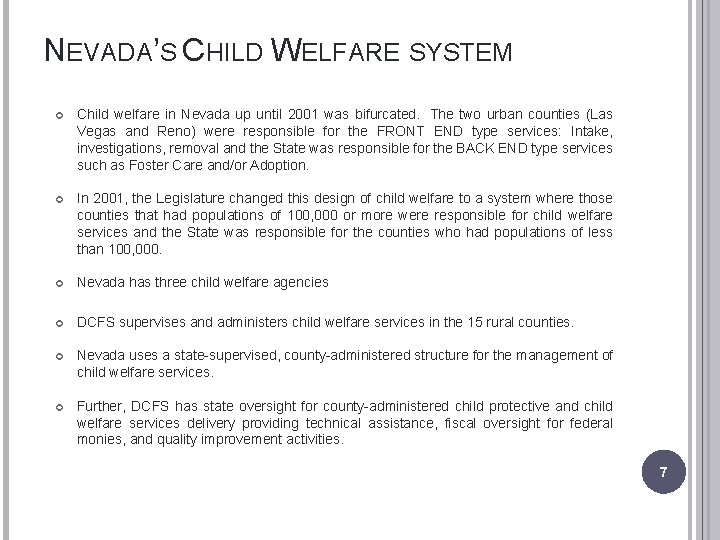
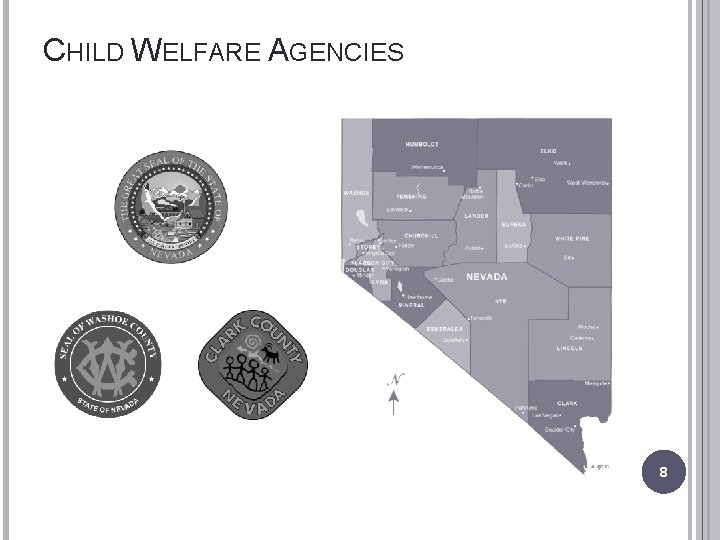
NEVADA’S CHILD WELFARE SYSTEM Child welfare in Nevada up until 2001 was bifurcated. The two urban counties (Las Vegas and Reno) were responsible for the FRONT END type services: Intake, investigations, removal and the State was responsible for the BACK END type services such as Foster Care and/or Adoption. In 2001, the Legislature changed this design of child welfare to a system where those counties that had populations of 100, 000 or more were responsible for child welfare services and the State was responsible for the counties who had populations of less than 100, 000. Nevada has three child welfare agencies DCFS supervises and administers child welfare services in the 15 rural counties. Nevada uses a state-supervised, county-administered structure for the management of child welfare services. Further, DCFS has state oversight for county-administered child protective and child welfare services delivery providing technical assistance, fiscal oversight for federal monies, and quality improvement activities. 7
CHILD WELFARE AGENCIES 8
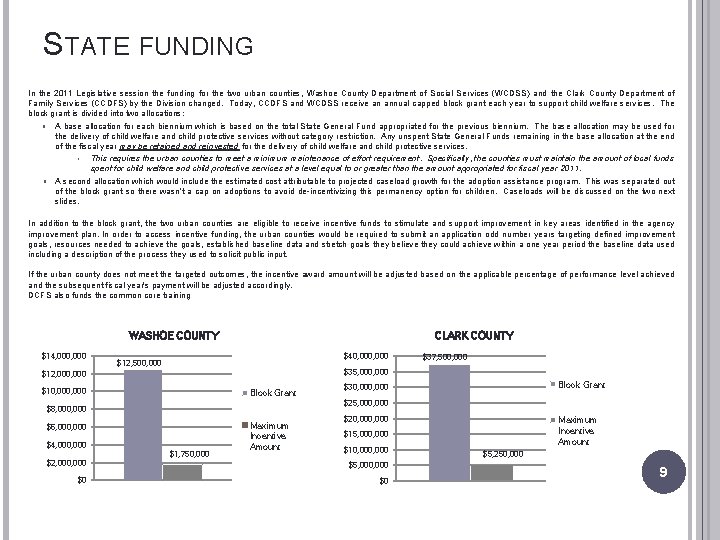
STATE FUNDING In the 2011 Legislative session the funding for the two urban counties, Washoe County Department of Social Services (WCDSS) and the Clark County Department of Family Services (CCDFS) by the Division changed. Today, CCDFS and WCDSS receive an annual capped block grant each year to support child welfare services. The block grant is divided into two allocations: § A base allocation for each biennium which is based on the total State General Fund appropriated for the previous biennium. The base allocation may be used for the delivery of child welfare and child protective services without category restriction. Any unspent State General Funds remaining in the base allocation at the end of the fiscal year may be retained and reinvested for the delivery of child welfare and child protective services. § This requires the urban counties to meet a minimum maintenance of effort requirement. Specifically, the counties must maintain the amount of local funds spent for child welfare and child protective services at a level equal to or greater than the amount appropriated for fiscal year 2011. § A second allocation which would include the estimated cost attributable to projected caseload growth for the adoption assistance program. This was separated out of the block grant so there wasn’t a cap on adoptions to avoid de-incentivizing this permanency option for children. Caseloads will be discussed on the two next slides. In addition to the block grant, the two urban counties are eligible to receive incentive funds to stimulate and support improvement in key areas identified in the agency improvement plan. In order to access incentive funding, the urban counties would be required to submit an application odd number years targeting defined improvement goals, resources needed to achieve the goals, established baseline data and stretch goals they believe they could achieve within a one year period the baseline data used including a description of the process they used to solicit public input. If the urban county does not meet the targeted outcomes, the incentive award amount will be adjusted based on the applicable percentage of performance level achieved and the subsequent fiscal year's payment will be adjusted accordingly. DCFS also funds the common core training WASHOE COUNTY $14, 000 CLARK COUNTY $40, 000 $12, 500, 000 $12, 000 $10, 000 Block Grant $6, 000 $2, 000 $0 Block Grant $30, 000 $25, 000 $8, 000 $4, 000 $37, 500, 000 $35, 000 $1, 750, 000 Maximum Incentive Amount $20, 000 Maximum Incentive Amount $15, 000 $10, 000 $5, 000 $0 $5, 250, 000 9
COUNTY ASSESSMENTS In the 2011 Legislative Session, SB 480 was enacted. SB 480 requires an assessment of the rural counties for the cost of child protective services. The assessment is determined based upon the percentage of the population for persons under 18 years old within each county. This assessment and percentage of the population is recalculated each year and notifications are sent out to each county prior to the upcoming fiscal year indicating the most recent amount due to the state. A report on or before December 1 of each year is submitted to the Governor and to each county whose population is less than 100, 000 that contains a statement of: (a) The total number of children who received child protective services in each county in the immediately preceding fiscal year; and (b) The amount and categories of the expenditures made by DCFS on child protective services in each county in the immediately preceding fiscal year; DCFS provides each county whose population is less than 100, 000, on or before May 1 of each year, with an estimate of the amount of the assessment. The estimate becomes the amount of the assessment unless the county is notified of a change. The county is required to pay the assessment: (a) In full within 30 days after the amount of the assessment becomes final; or (b) In equal quarterly installments on or before the first day of July, October, January and April, respectively 10
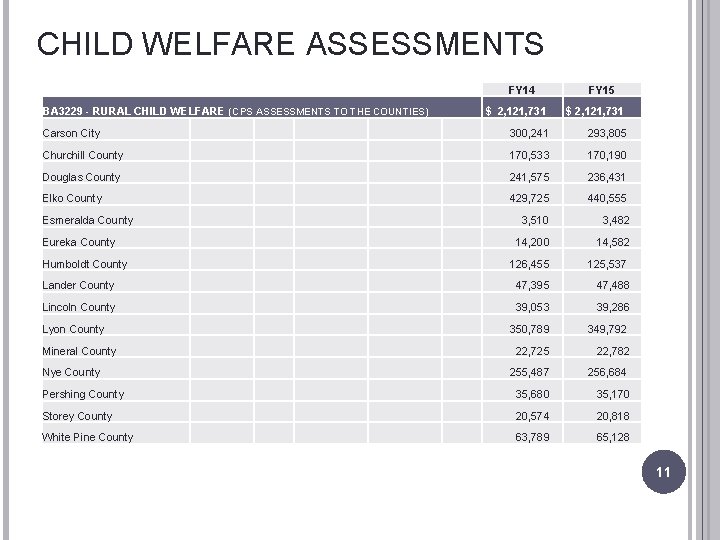
CHILD WELFARE ASSESSMENTS FY 14 FY 15 BA 3229 - RURAL CHILD WELFARE (CPS ASSESSMENTS TO THE COUNTIES) $ 2, 121, 731 Carson City 300, 241 293, 805 Churchill County 170, 533 170, 190 Douglas County 241, 575 236, 431 Elko County 429, 725 440, 555 Esmeralda County 3, 510 3, 482 Eureka County 14, 200 14, 582 Humboldt County 126, 455 125, 537 Lander County 47, 395 47, 488 Lincoln County 39, 053 39, 286 Lyon County 350, 789 349, 792 Mineral County 22, 725 22, 782 Nye County 255, 487 256, 684 Pershing County 35, 680 35, 170 Storey County 20, 574 20, 818 White Pine County 63, 789 65, 128 11
JUVENILE JUSTICE 12
A BIFURCATED JUVENILE JUSTICE SYSTEM The State of Nevada, Division of Child and Family Services (DCFS), Juvenile Services, operates state youth correctional care and youth parole services County level units of government operate juvenile detention centers, county based youth camps and juvenile probation. 13
STATE JUVENILE JUSTICE SERVICES Consists of Five Programs: • Caliente Youth Center-140 beds Only state facility serving female offenders- 40 beds. Serves younger, lower sanctioned male offenders- 100 beds. • Nevada Youth Training Center-60 Beds Male youth housed at Nevada Youth Training Center are generally older and have more severe delinquent background than males housed at Caliente Youth Center. This is a medium staff secure facility. • Red Rock Academy at Summit View – 50 beds The facility will be used for youth, who through the comprehensive assessment and classification process performed by the State, are too severe to be appropriately referred to the existing State operated facilities. Red Rock Academy is a contractual partnership between Rite of Passage and Nevada Division of Child and Family Services (DCFS). This facility has a capacity of 96 youth with DCFS contracting for 50 of those beds. This is a maximum secure facility. • Youth Parole Bureau Youth, 12 to 21 years, who are committed to the Division of Child and Family Services for correctional and/or mental health care. Supervise and assist youth released from a state correctional facility with reintegrating back into the community in which they reside. Youth transferred to Nevada through the Interstate Compact on Juveniles. • Juvenile Justice Programs Office Ensure that Nevada is in compliance with the four core requirements of the Office of Juvenile Justice and Delinquency Prevention. Distribute grant funds to local jurisdictions through the Juvenile Justice Commission’s Grant Review Committee. 14
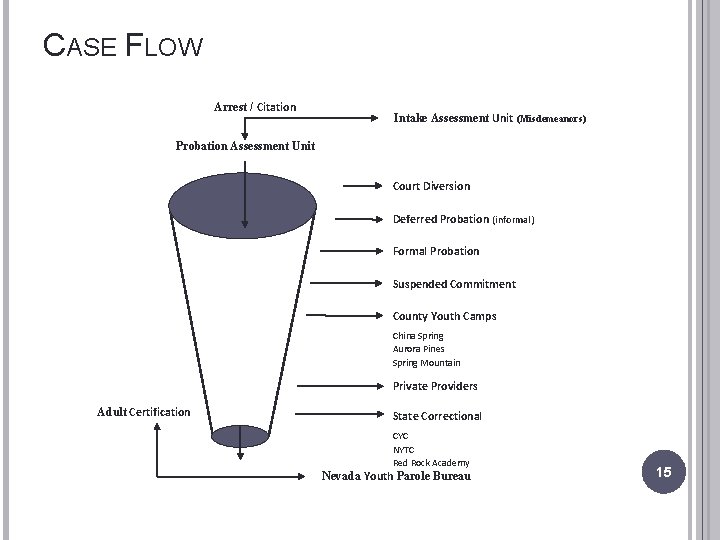
CASE FLOW Arrest / Citation Intake Assessment Unit (Misdemeanors) Probation Assessment Unit Court Diversion Deferred Probation (informal) Formal Probation Suspended Commitment County Youth Camps China Spring Aurora Pines Spring Mountain Private Providers Adult Certification State Correctional CYC NYTC Red Rock Academy Nevada Youth Parole Bureau 15
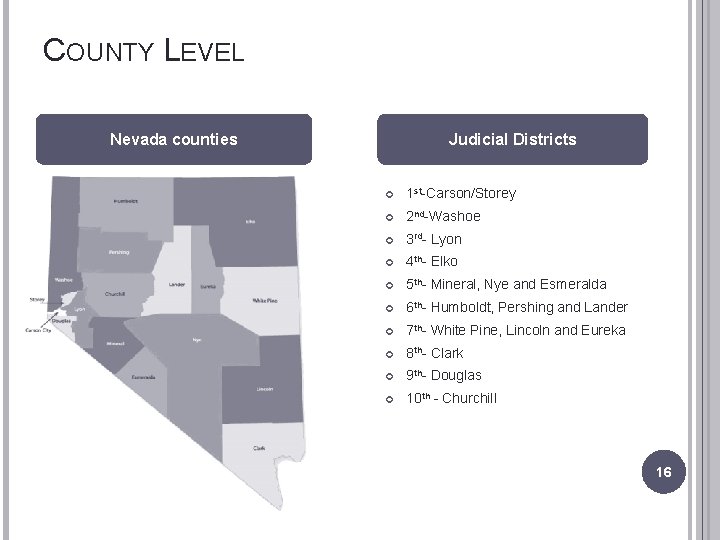
COUNTY LEVEL Nevada counties Judicial Districts 1 st-Carson/Storey 2 nd-Washoe 3 rd- Lyon 4 th- Elko 5 th- Mineral, Nye and Esmeralda 6 th- Humboldt, Pershing and Lander 7 th- White Pine, Lincoln and Eureka 8 th- Clark 9 th- Douglas 10 th - Churchill 16
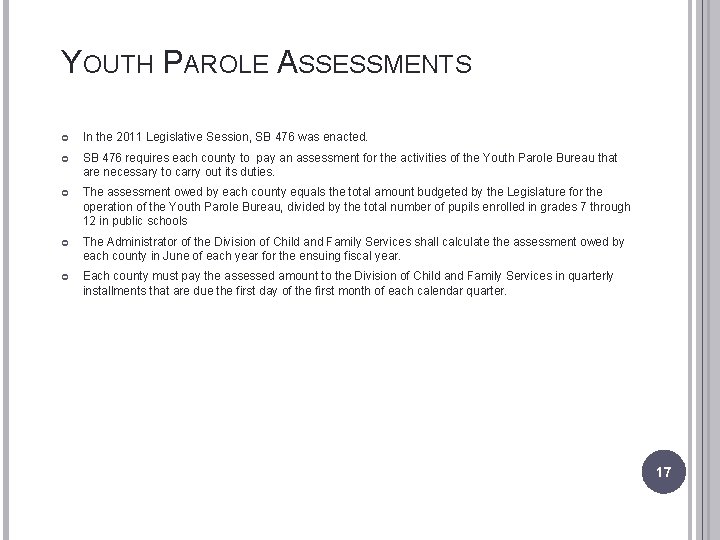
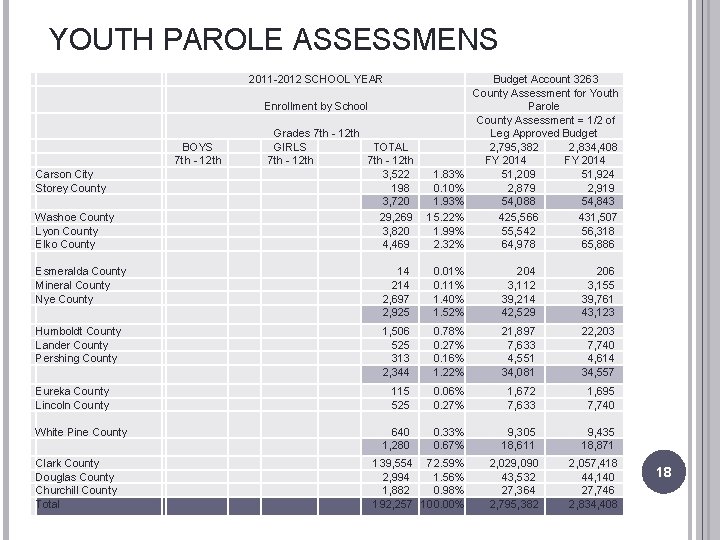
YOUTH PAROLE ASSESSMENTS In the 2011 Legislative Session, SB 476 was enacted. SB 476 requires each county to pay an assessment for the activities of the Youth Parole Bureau that are necessary to carry out its duties. The assessment owed by each county equals the total amount budgeted by the Legislature for the operation of the Youth Parole Bureau, divided by the total number of pupils enrolled in grades 7 through 12 in public schools The Administrator of the Division of Child and Family Services shall calculate the assessment owed by each county in June of each year for the ensuing fiscal year. Each county must pay the assessed amount to the Division of Child and Family Services in quarterly installments that are due the first day of the first month of each calendar quarter. 17
YOUTH PAROLE ASSESSMENS 2011 -2012 SCHOOL YEAR BOYS 7 th - 12 th Carson City Storey County Washoe County Lyon County Elko County Budget Account 3263 County Assessment for Youth Enrollment by School Parole County Assessment = 1/2 of Grades 7 th - 12 th Leg Approved Budget GIRLS TOTAL 2, 795, 382 2, 834, 408 7 th - 12 th FY 2014 3, 522 1. 83% 51, 209 51, 924 198 0. 10% 2, 879 2, 919 3, 720 1. 93% 54, 088 54, 843 29, 269 15. 22% 425, 566 431, 507 3, 820 1. 99% 55, 542 56, 318 4, 469 2. 32% 64, 978 65, 886 Esmeralda County Mineral County Nye County 14 214 2, 697 2, 925 0. 01% 204 0. 11% 3, 112 1. 40% 39, 214 1. 52% 42, 529 206 3, 155 39, 761 43, 123 1, 506 525 313 2, 344 0. 78% 21, 897 0. 27% 7, 633 0. 16% 4, 551 1. 22% 34, 081 22, 203 7, 740 4, 614 34, 557 115 525 0. 06% 1, 672 1, 695 0. 27% 7, 633 7, 740 0. 33% 9, 305 9, 435 0. 67% 18, 611 18, 871 Humboldt County Lander County Pershing County Eureka County Lincoln County White Pine County Clark County Douglas County Churchill County Total 640 1, 280 139, 554 72. 59% 2, 029, 090 2, 057, 418 2, 994 1. 56% 43, 532 44, 140 1, 882 0. 98% 27, 364 27, 746 192, 257 100. 00% 2, 795, 382 2, 834, 408 18
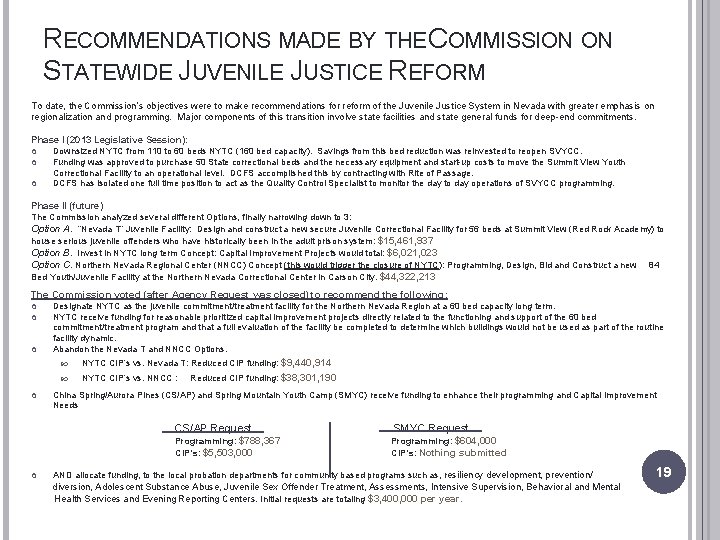
RECOMMENDATIONS MADE BY THE COMMISSION ON STATEWIDE JUVENILE JUSTICE REFORM To date, the Commission’s objectives were to make recommendations for reform of the Juvenile Justice System in Nevada with greater emphasis on regionalization and programming. Major components of this transition involve state facilities and state general funds for deep-end commitments. Phase I (2013 Legislative Session): Downsized NYTC from 110 to 60 beds NYTC (160 bed capacity). Savings from this bed reduction was reinvested to reopen SVYCC. Funding was approved to purchase 50 State correctional beds and the necessary equipment and start-up costs to move the Summit View Youth Correctional Facility to an operational level. DCFS accomplished this by contracting with Rite of Passage. DCFS has isolated one full time position to act as the Quality Control Specialist to monitor the day to day operations of SVYCC programming. Phase II (future) The Commission analyzed several different Options, finally narrowing down to 3: Option A. “Nevada T” Juvenile Facility: Design and construct a new secure Juvenile Correctional Facility for 56 beds at Summit View (Red Rock Academy) to house serious juvenile offenders who have historically been in the adult prison system: $15, 461, 937 Option B. Invest in NYTC long term Concept: Capital Improvement Projects would total: $6, 021, 023 Option C. Northern Nevada Regional Center (NNCC) Concept (this would trigger the closure of NYTC): Programming, Design, Bid and Construct a new 84 Bed Youth/Juvenile Facility at the Northern Nevada Correctional Center in Carson City. $44, 322, 213 The Commission voted (after Agency Request was closed) to recommend the following: Designate NYTC as the juvenile commitment/treatment facility for the Northern Nevada Region at a 60 bed capacity long term. NYTC receive funding for reasonable prioritized capital improvement projects directly related to the functioning and support of the 60 bed commitment/treatment program and that a full evaluation of the facility be completed to determine which buildings would not be used as part of the routine facility dynamic. Abandon the Nevada T and NNCC Options. NYTC CIP’s vs. Nevada T: Reduced CIP funding: $9, 440, 914 NYTC CIP’s vs. NNCC : Reduced CIP funding: $38, 301, 190 China Spring/Aurora Pines (CS/AP) and Spring Mountain Youth Camp (SMYC) receive funding to enhance their programming and Capital Improvement Needs CS/AP Request Programming: $788, 367 CIP’s: $5, 503, 000 SMYC Request Programming: $604, 000 CIP’s: Nothing submitted 19 AND allocate funding, to the local probation departments for community based programs such as, resiliency development, prevention/ diversion, Adolescent Substance Abuse, Juvenile Sex Offender Treatment, Assessments, Intensive Supervision, Behavioral and Mental Health Services and Evening Reporting Centers. Initial requests are totaling $3, 400, 000 per year.
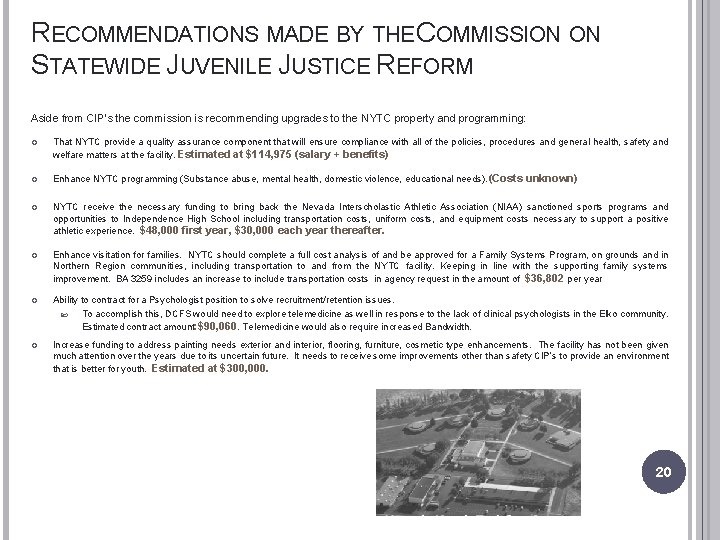
RECOMMENDATIONS MADE BY THE COMMISSION ON STATEWIDE JUVENILE JUSTICE REFORM Aside from CIP’s the commission is recommending upgrades to the NYTC property and programming: That NYTC provide a quality assurance component that will ensure compliance with all of the policies, procedures and general health, safety and welfare matters at the facility. Estimated at $114, 975 (salary + benefits) Enhance NYTC programming (Substance abuse, mental health, domestic violence, educational needs). (Costs unknown) NYTC receive the necessary funding to bring back the Nevada Interscholastic Athletic Association (NIAA) sanctioned sports programs and opportunities to Independence High School including transportation costs, uniform costs, and equipment costs necessary to support a positive athletic experience. $48, 000 first year, $30, 000 each year thereafter. Enhance visitation for families. NYTC should complete a full cost analysis of and be approved for a Family Systems Program, on grounds and in Northern Region communities, including transportation to and from the NYTC facility. Keeping in line with the supporting family systems improvement. BA 3259 includes an increase to include transportation costs in agency request in the amount of $36, 802 per year Ability to contract for a Psychologist position to solve recruitment/retention issues. To accomplish this, DCFS would need to explore telemedicine as well in response to the lack of clinical psychologists in the Elko community. Estimated contract amount: $90, 060. Telemedicine would also require increased Bandwidth. Increase funding to address painting needs exterior and interior, flooring, furniture, cosmetic type enhancements. The facility has not been given much attention over the years due to its uncertain future. It needs to receive some improvements other than safety CIP’s to provide an environment that is better for youth. Estimated at $300, 000. 20
MANDATES PREA COORDINATION AND IMPLEMENTATION PREA (Prison Rape Elimination Act) Compliance. The Prison Rape Elimination Act of 2003 was enacted by Congress to address the problem of sexual abuse of persons in the custody of U. S. correctional agencies. The National Institute of Corrections has been a leader in this topic area since 2004, providing assistance to many agencies through information and training resources. The Juvenile Justice Programs Office is applying for a Federal Grant Funding to assist with resources needed to achieve compliance. This funding is not guaranteed, nor would it be sustainable long term. If the Division is successful in obtaining the Federal Grant Funding, the grant will be administered from BA 1383 as regulatory oversight to compliance with the 3 Juvenile Facilities; Caliente Youth Center (CYC), Northern Nevada Youth Training Center (NYTC) and Summit View Youth Correctional Center (SVYCC), Red Rock Academy. If federal funds are NOT awarded to DCFS or are not adequate to cover full costs to be compliant, State General Funds will need to be allocated to this budget account as the Regulatory Oversight to ensure compliance for the 3 Juvenile Facilities. Major provisions of PREA include: o Adherence to a zero-tolerance standard for the incidence of inmate sexual assault and rape; o Development of standards for detection, prevention, reduction, and punishment of prison rape; o Collection and dissemination of information on the incidence of prison rape; and o Award of grant funds to help state and local governments implement the purposes of the Act. The Act applies to all public and private institutions that house adult or juvenile offenders and is also relevant to community based agencies. Funding requests supports the following activities: - FEDERAL AUDIT - EXTERNAL INVESTIGATIONS - TRAINING - RESIDENT REPORTING - SUPERVISION & VIDEO MONITORING - INTERCOM SYSTEM - EMERGENCY ASSESSMENTS 21
CHILDREN’S MENTAL HEALTH 22
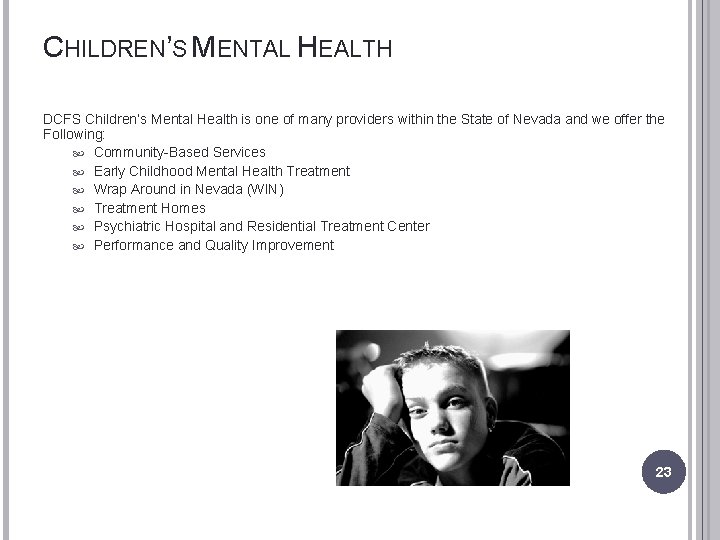
CHILDREN’S MENTAL HEALTH DCFS Children’s Mental Health is one of many providers within the State of Nevada and we offer the Following: Community-Based Services Early Childhood Mental Health Treatment Wrap Around in Nevada (WIN) Treatment Homes Psychiatric Hospital and Residential Treatment Center Performance and Quality Improvement 23
BUDGET ENHANCEMENTS RURAL INFRASTRUCTURE SPECIALIZED FOSTER CARE 24
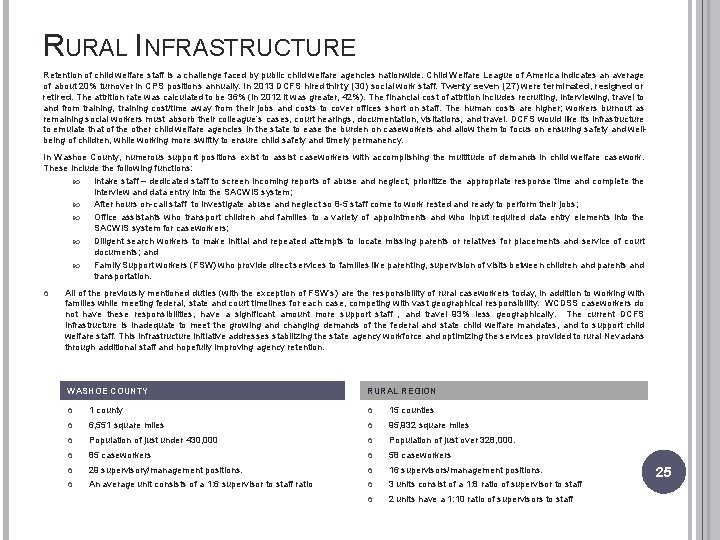
RURAL INFRASTRUCTURE Retention of child welfare staff is a challenge faced by public child welfare agencies nationwide. Child Welfare League of America indicates an average of about 20% turnover in CPS positions annually. In 2013 DCFS hired thirty (30) social work staff. Twenty seven (27) were terminated, resigned or retired. The attrition rate was calculated to be 36% (in 2012 it was greater, 42%). The financial cost of attrition includes recruiting, interviewing, travel to and from training, training cost/time away from their jobs and costs to cover offices short on staff. The human costs are higher; workers burnout as remaining social workers must absorb their colleague’s cases, court hearings, documentation, visitations, and travel. DCFS would like its infrastructure to emulate that of the other child welfare agencies in the state to ease the burden on caseworkers and allow them to focus on ensuring safety and wellbeing of children, while working more swiftly to ensure child safety and timely permanency. In Washoe County, numerous support positions exist to assist caseworkers with accomplishing the multitude of demands in child welfare casework. These include the following functions: Intake staff – dedicated staff to screen incoming reports of abuse and neglect, prioritize the appropriate response time and complete the interview and data entry into the SACWIS system; After hours on-call staff to investigate abuse and neglect so 8 -5 staff come to work rested and ready to perform their jobs; Office assistants who transport children and families to a variety of appointments and who input required data entry elements into the SACWIS system for caseworkers; Diligent search workers to make initial and repeated attempts to locate missing parents or relatives for placements and service of court documents; and Family Support workers (FSW) who provide direct services to families like parenting, supervision of visits between children and parents and transportation. All of the previously mentioned duties (with the exception of FSW’s) are the responsibility of rural caseworkers today, in addition to working with families while meeting federal, state and court timelines for each case, competing with vast geographical responsibility. WCDSS caseworkers do not have these responsibilities, have a significant amount more support staff , and travel 93% less geographically. The current DCFS infrastructure is inadequate to meet the growing and changing demands of the federal and state child welfare mandates, and to support child welfare staff. This infrastructure initiative addresses stabilizing the state agency workforce and optimizing the services provided to rural Nevadans through additional staff and hopefully improving agency retention. WASHOE COUNTY RURAL REGION 1 county 15 counties 6, 551 square miles 95, 932 square miles Population of just under 430, 000 Population of just over 328, 000. 85 caseworkers 58 caseworkers 29 supervisory/management positions. 16 supervisors/management positions. An average unit consists of a 1: 6 supervisor to staff ratio 3 units consist of a 1: 8 ratio of supervisor to staff 2 units have a 1: 10 ratio of supervisors to staff 25
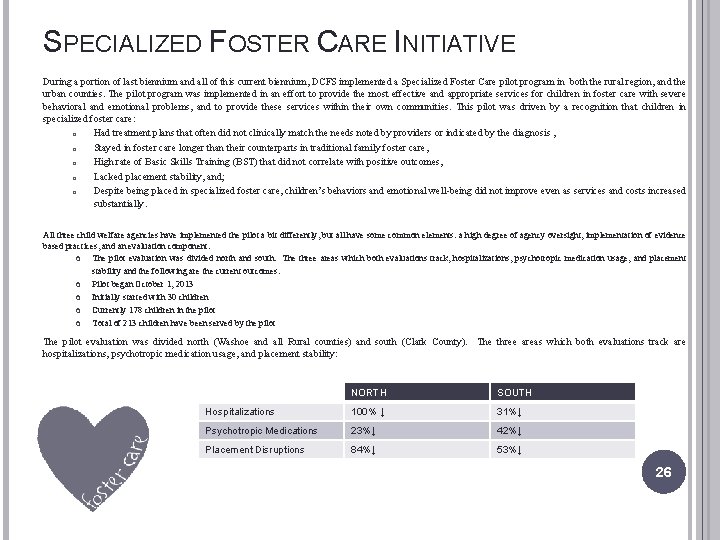
SPECIALIZED FOSTER CARE INITIATIVE During a portion of last biennium and all of this current biennium, DCFS implemented a Specialized Foster Care pilot program in both the rural region, and the urban counties. The pilot program was implemented in an effort to provide the most effective and appropriate services for children in foster care with severe behavioral and emotional problems, and to provide these services within their own communities. This pilot was driven by a recognition that children in specialized foster care: o Had treatment plans that often did not clinically match the needs noted by providers or indicated by the diagnosis , o Stayed in foster care longer than their counterparts in traditional family foster care, o High rate of Basic Skills Training (BST) that did not correlate with positive outcomes, o Lacked placement stability, and; o Despite being placed in specialized foster care, children’s behaviors and emotional well-being did not improve even as services and costs increased substantially. All three child welfare agencies have implemented the pilot a bit differently, but all have some common elements: a high degree of agency oversight, implementation of evidence based practices, and an evaluation component. The pilot evaluation was divided north and south. The three areas which both evaluations track, hospitalizations, psychotropic medication usage, and placement stability and the following are the current outcomes: Pilot began October 1, 2013 Initially started with 30 children Currently 178 children in the pilot Total of 213 children have been served by the pilot The pilot evaluation was divided north (Washoe and all Rural counties) and south (Clark County). The three areas which both evaluations track are hospitalizations, psychotropic medication usage, and placement stability: NORTH SOUTH Hospitalizations 100% ↓ 31%↓ Psychotropic Medications 23%↓ 42%↓ Placement Disruptions 84%↓ 53%↓ 26
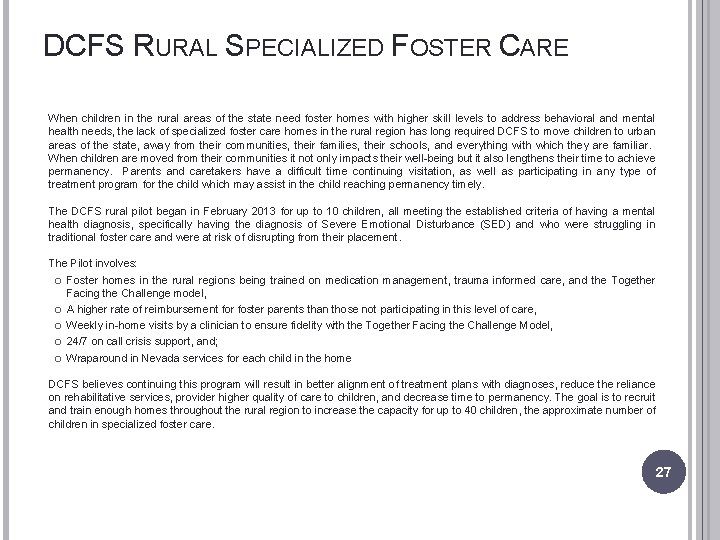
DCFS RURAL SPECIALIZED FOSTER CARE When children in the rural areas of the state need foster homes with higher skill levels to address behavioral and mental health needs, the lack of specialized foster care homes in the rural region has long required DCFS to move children to urban areas of the state, away from their communities, their families, their schools, and everything with which they are familiar. When children are moved from their communities it not only impacts their well-being but it also lengthens their time to achieve permanency. Parents and caretakers have a difficult time continuing visitation, as well as participating in any type of treatment program for the child which may assist in the child reaching permanency timely. The DCFS rural pilot began in February 2013 for up to 10 children, all meeting the established criteria of having a mental health diagnosis, specifically having the diagnosis of Severe Emotional Disturbance (SED) and who were struggling in traditional foster care and were at risk of disrupting from their placement. The Pilot involves: o Foster homes in the rural regions being trained on medication management, trauma informed care, and the Together Facing the Challenge model, o A higher rate of reimbursement for foster parents than those not participating in this level of care, o Weekly in-home visits by a clinician to ensure fidelity with the Together Facing the Challenge Model, o 24/7 on call crisis support, and; o Wraparound in Nevada services for each child in the home DCFS believes continuing this program will result in better alignment of treatment plans with diagnoses, reduce the reliance on rehabilitative services, provider higher quality of care to children, and decrease time to permanency. The goal is to recruit and train enough homes throughout the rural region to increase the capacity for up to 40 children, the approximate number of children in specialized foster care. 27
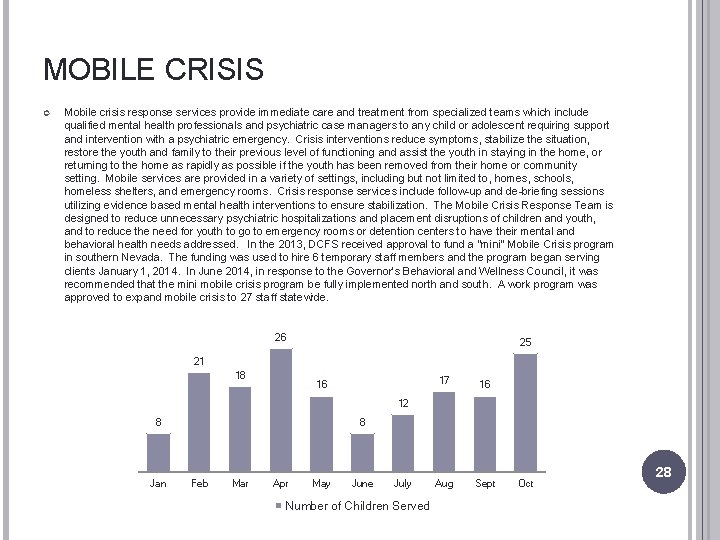
MOBILE CRISIS Mobile crisis response services provide immediate care and treatment from specialized teams which include qualified mental health professionals and psychiatric case managers to any child or adolescent requiring support and intervention with a psychiatric emergency. Crisis interventions reduce symptoms, stabilize the situation, restore the youth and family to their previous level of functioning and assist the youth in staying in the home, or returning to the home as rapidly as possible if the youth has been removed from their home or community setting. Mobile services are provided in a variety of settings, including but not limited to, homes, schools, homeless shelters, and emergency rooms. Crisis response services include follow-up and de-briefing sessions utilizing evidence based mental health interventions to ensure stabilization. The Mobile Crisis Response Team is designed to reduce unnecessary psychiatric hospitalizations and placement disruptions of children and youth, and to reduce the need for youth to go to emergency rooms or detention centers to have their mental and behavioral health needs addressed. In the 2013, DCFS received approval to fund a “mini” Mobile Crisis program in southern Nevada. The funding was used to hire 6 temporary staff members and the program began serving clients January 1, 2014. In June 2014, in response to the Governor’s Behavioral and Wellness Council, it was recommended that the mini mobile crisis program be fully implemented north and south. A work program was approved to expand mobile crisis to 27 staff statewide. 26 25 21 18 16 17 16 Aug Sept 12 8 Jan 8 Feb Mar Apr May June July Number of Children Served Oct 28
BILL DRAFT REQUEST BDR Most of the Child Welfare and Juvenile Justice policy recommendations that impact statutes have been discussed, vetted and recommended through the Child Welfare/Juvenile Justice Legislative Committee, therefore DCFS has only one BDR for the upcoming Legislative Session that is a housekeeping bill to allow the appropriate agencies to access the Central Registry System 29
DATA 30
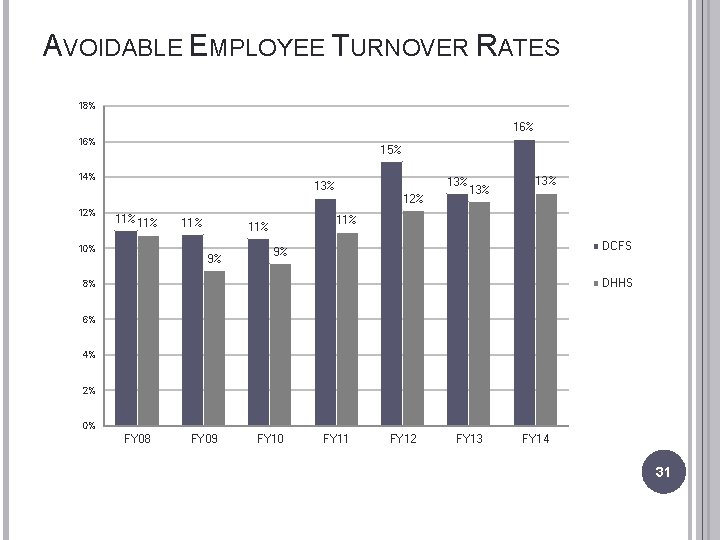
AVOIDABLE EMPLOYEE TURNOVER RATES 18% 16% 15% 14% 13% 12% 11%11% 10% 11% 13% 11% 9% 13% DCFS 9% DHHS 8% 6% 4% 2% 0% FY 08 FY 09 FY 10 FY 11 FY 12 FY 13 FY 14 31
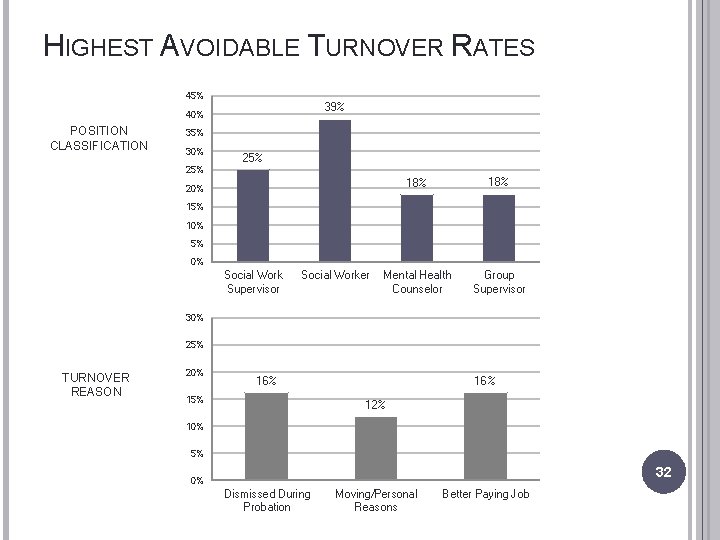
HIGHEST AVOIDABLE TURNOVER RATES 45% 39% 40% POSITION CLASSIFICATION 35% 30% 25% 18% Mental Health Counselor Group Supervisor 20% 15% 10% 5% 0% Social Work Supervisor Social Worker 30% 25% TURNOVER REASON 20% 16% 15% 16% 12% 10% 5% 32 0% Dismissed During Probation Moving/Personal Reasons Better Paying Job
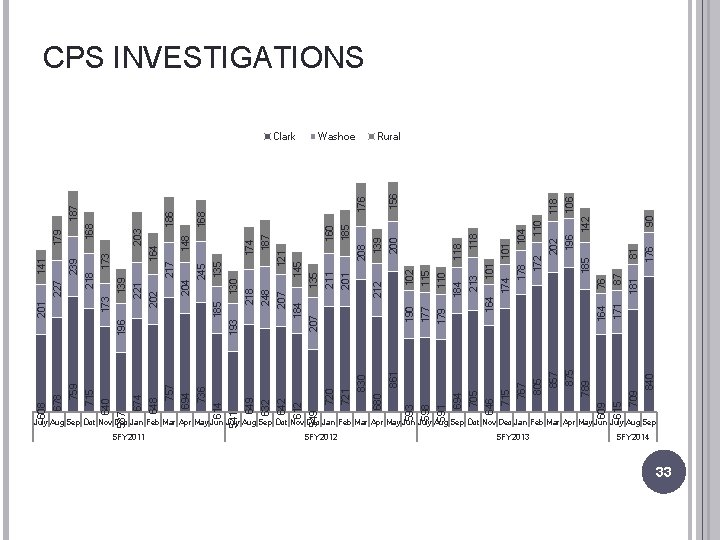
July Aug Sep Oct Nov Dec Jan Feb Mar Apr May Jun July Aug Sep SFY 2011 674 SFY 2012 179 591 SFY 2013 171 615 840 709 164 609 789 181 87 176 81 185 196 875 90 142 110 104 202 76 118 101 172 178 174 101 213 118 200 139 857 805 767 715 646 705 110 115 102 184 164 177 598 694 190 593 861 212 208 185 160 106 118 156 176 168 186 187 Washoe 680 201 721 830 211 135 145 720 207 187 174 121 135 148 164 203 168 179 Clark 549 184 207 642 612 248 130 632 185 217 245 204 202 221 139 218 193 196 173 239 141 218 227 173 201 649 541 614 736 694 757 648 537 640 715 759 678 608 CPS INVESTIGATIONS Rural SFY 2014 33
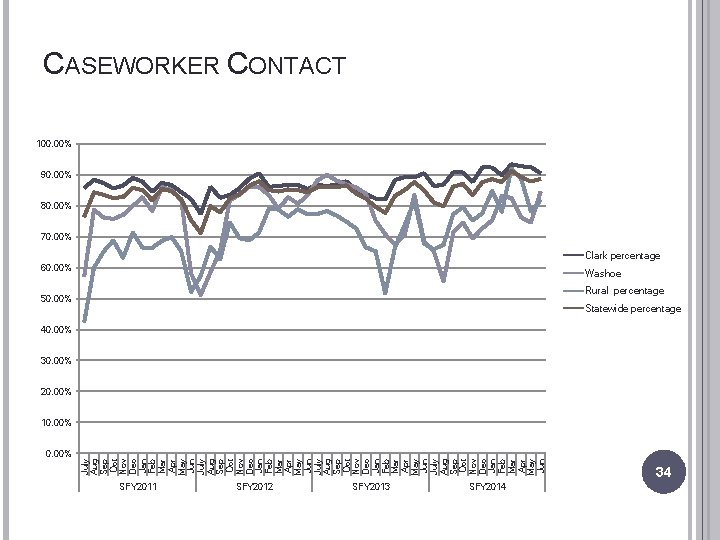
CASEWORKER CONTACT COMPLIANCE 100. 00% 90. 00% 80. 00% 70. 00% Clark percentage 60. 00% Washoe Rural percentage 50. 00% Statewide percentage 40. 00% 30. 00% 20. 00% 10. 00% July Aug Sep Oct Nov Dec Jan Feb Mar Apr May Jun 0. 00% SFY 2011 SFY 2012 SFY 2013 SFY 2014 34
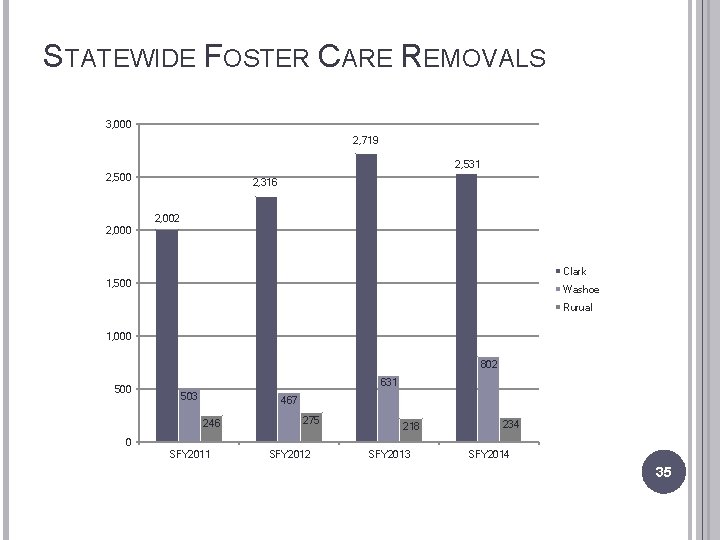
STATEWIDE FOSTER CARE REMOVALS 3, 000 2, 719 2, 531 2, 500 2, 316 2, 002 2, 000 Clark 1, 500 Washoe Rurual 1, 000 802 500 631 503 467 246 275 218 234 0 SFY 2011 SFY 2012 SFY 2013 SFY 2014 35
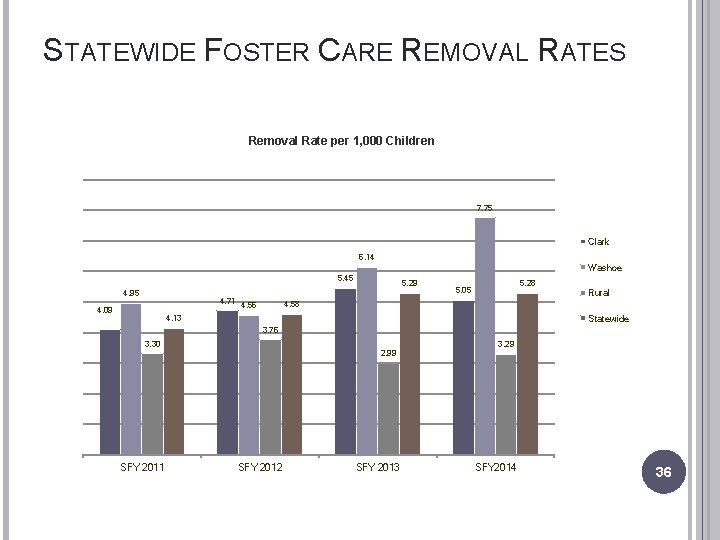
STATEWIDE FOSTER CARE REMOVAL RATES Removal Rate per 1, 000 Children 7. 75 Clark 6. 14 Washoe 5. 45 4. 95 4. 71 4. 09 5. 28 5. 05 Rural 4. 58 4. 56 Statewide 4. 13 3. 76 3. 30 3. 29 2. 99 SFY 2011 SFY 2012 SFY 2013 SFY 2014 36
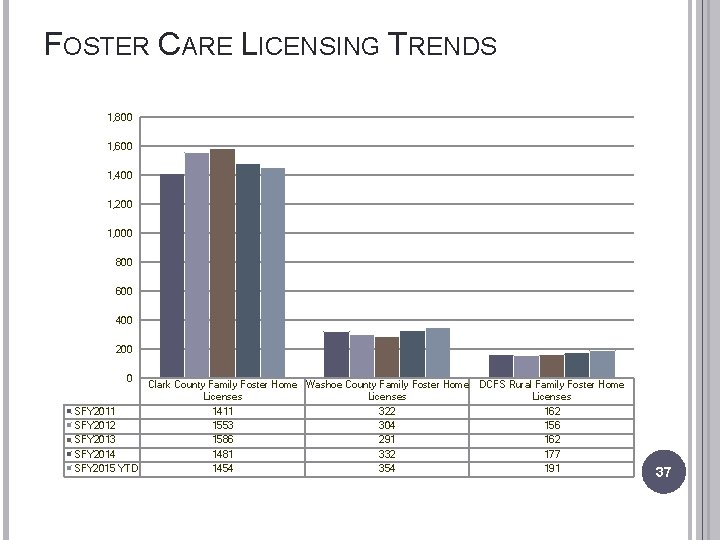
FOSTER CARE LICENSING TRENDS 1, 800 1, 600 1, 400 1, 200 1, 000 800 600 400 200 0 Clark County Family Foster Home Washoe County Family Foster Home DCFS Rural Family Foster Home Licenses SFY 2011 1411 322 162 SFY 2012 1553 304 156 SFY 2013 1586 291 162 SFY 2014 1481 332 177 SFY 2015 YTD 1454 354 191 37
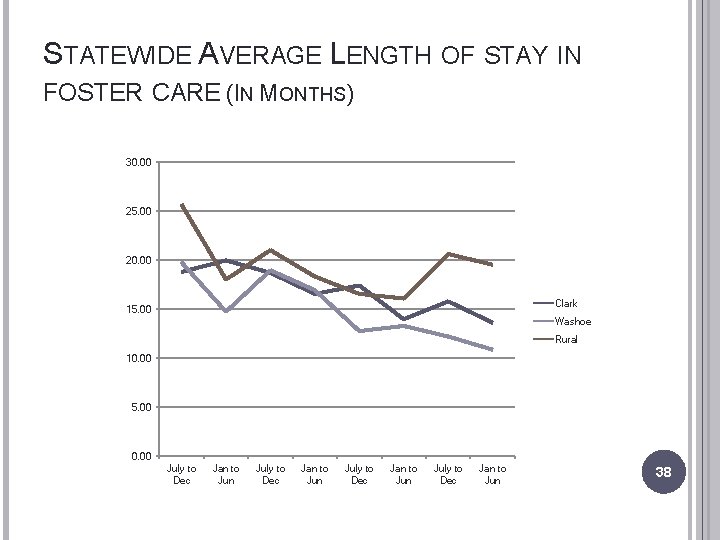
STATEWIDE AVERAGE LENGTH OF STAY IN FOSTER CARE (IN MONTHS) 30. 00 25. 00 20. 00 Clark 15. 00 Washoe Rural 10. 00 5. 00 0. 00 July to Dec Jan to Jun 38
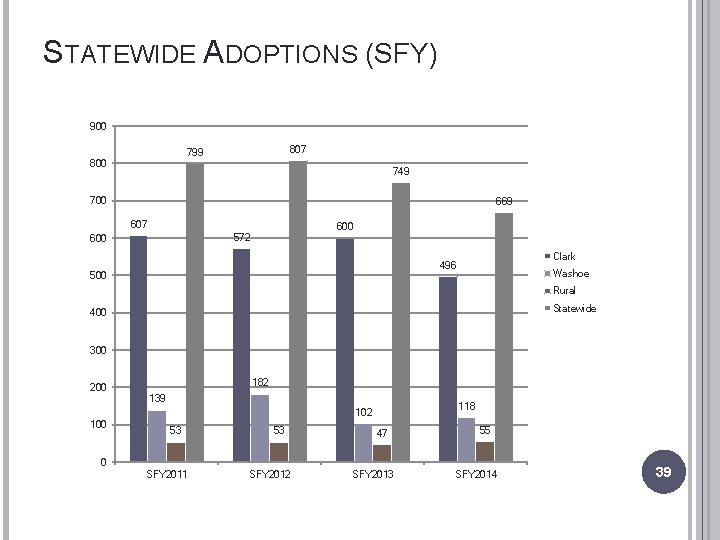
STATEWIDE ADOPTIONS (SFY) 900 807 799 800 749 700 669 607 600 572 600 Clark 496 500 Washoe Rural Statewide 400 300 200 182 139 118 102 100 53 53 47 55 0 SFY 2011 SFY 2012 SFY 2013 SFY 2014 39
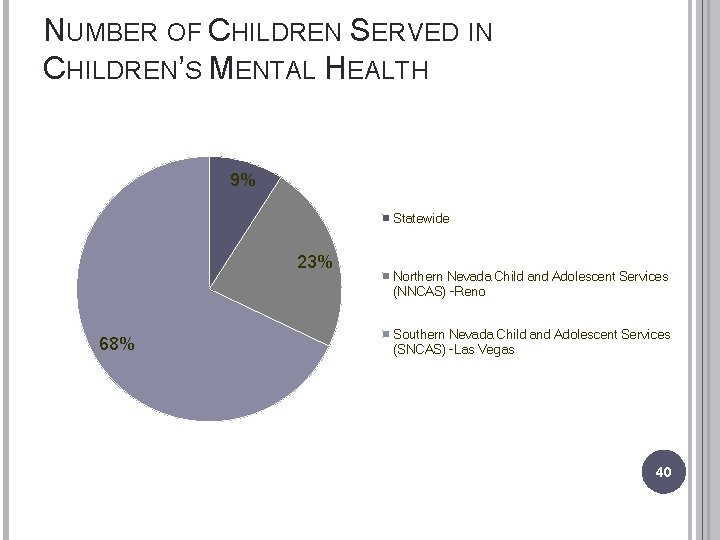
NUMBER OF CHILDREN SERVED IN CHILDREN’S MENTAL HEALTH 9% Statewide 23% 68% Northern Nevada Child and Adolescent Services (NNCAS) -Reno Southern Nevada Child and Adolescent Services (SNCAS) -Las Vegas 40
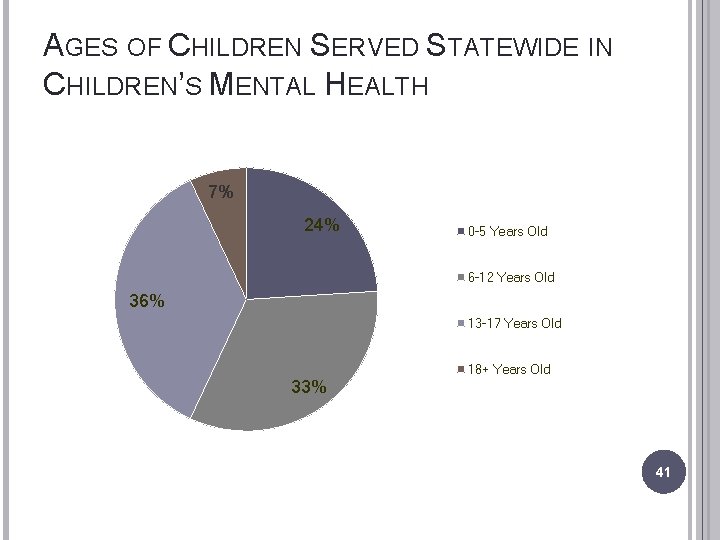
AGES OF CHILDREN SERVED STATEWIDE IN CHILDREN’S MENTAL HEALTH 7% 24% 0 -5 Years Old 6 -12 Years Old 36% 13 -17 Years Old 33% 18+ Years Old 41
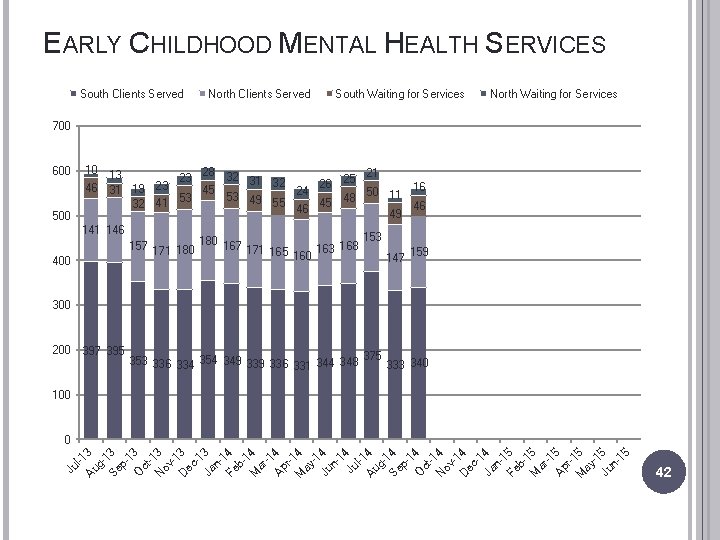
EARLY CHILDHOOD MENTAL HEALTH SERVICES South Clients Served North Clients Served South Waiting for Services North Waiting for Services 700 600 10 46 13 31 500 19 32 23 41 23 53 141 146 157 171 180 400 28 45 32 53 31 49 32 55 24 46 26 25 45 48 21 50 11 49 16 46 153 180 167 163 168 171 165 159 160 147 300 200 397 395 353 336 334 354 349 336 331 344 348 375 333 340 100 Ju l-1 Au 3 g 1 Se 3 p 1 O 3 ct -1 N 3 ov -1 D 3 ec -1 Ja 3 n 1 Fe 4 b 1 M 4 ar -1 Ap 4 r-1 M 4 ay -1 Ju 4 n 14 Ju l-1 Au 4 g 1 Se 4 p 1 O 4 ct -1 N 4 ov -1 D 4 ec -1 Ja 4 n 1 Fe 5 b 1 M 5 ar -1 Ap 5 r-1 M 5 ay -1 Ju 5 n 15 0 42
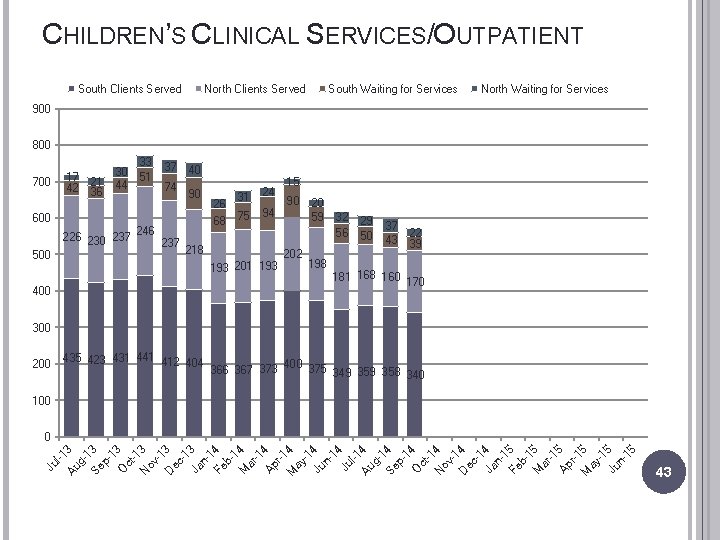
CHILDREN’S CLINICAL SERVICES/OUTPATIENT South Clients Served North Clients Served South Waiting for Services North Waiting for Services 900 800 700 17 42 21 36 30 44 33 51 37 74 40 90 600 500 246 226 230 237 26 68 31 24 75 94 218 193 201 193 400 15 90 202 20 59 198 32 56 29 50 37 43 22 39 181 168 160 170 300 200 435 423 431 441 412 404 400 375 366 367 373 349 358 340 100 Ju l-1 Au 3 g 1 Se 3 p 13 O ct -1 N 3 ov -1 D 3 ec -1 Ja 3 n 1 Fe 4 b 1 M 4 ar -1 Ap 4 r-1 M 4 ay -1 Ju 4 n 14 Ju l-1 Au 4 g 1 Se 4 p 14 O ct -1 N 4 ov -1 D 4 ec -1 Ja 4 n 1 Fe 5 b 1 M 5 ar -1 Ap 5 r-1 M 5 ay -1 Ju 5 n 15 0 43
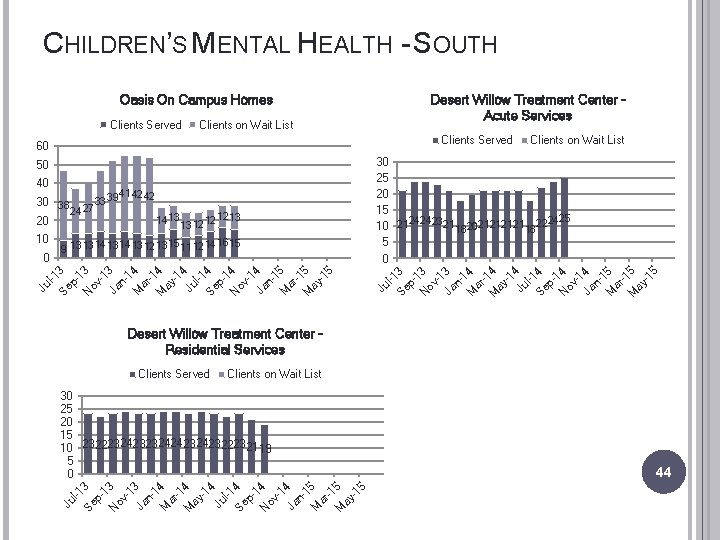
CHILDREN’S MENTAL HEALTH - SOUTH Oasis On Campus Homes Clients Served Clients on Wait List Clients Served 50 40 33 39 30 38 24 27 20 14 13 13 12 12 12 13 16 15 15 9 13 13 14 13 12 13 11 12 14 Ju l-1 Se 3 p 1 N 3 ov -1 Ja 3 n 1 M 4 ar -1 M 4 ay -1 4 Ju l-1 Se 4 p 1 N 4 ov -1 Ja 4 n 1 M 5 ar -1 M 5 ay -1 5 0 41 42 42 Clients on Wait List 30 25 20 15 2424 23 21 22 24 25 10 21 18 20 2121 18 5 0 Ju l-1 Se 3 p 1 N 3 ov -1 Ja 3 n 1 M 4 ar -1 M 4 ay -1 4 Ju l-1 Se 4 p 1 N 4 ov -1 Ja 4 n 1 M 5 ar -1 M 5 ay -1 5 60 10 Desert Willow Treatment Center Acute Services Desert Willow Treatment Center Residential Services Clients Served Clients on Wait List Ju l-1 Se 3 p 1 N 3 ov -1 3 Ja n 1 M 4 ar -1 M 4 ay -1 4 Ju l-1 Se 4 p 1 N 4 ov -1 4 Ja n 1 M 5 ar -1 M 5 ay -1 5 30 25 20 15 10 23 22 23 24 2323 2424 23 22 23 21 19 5 0 44
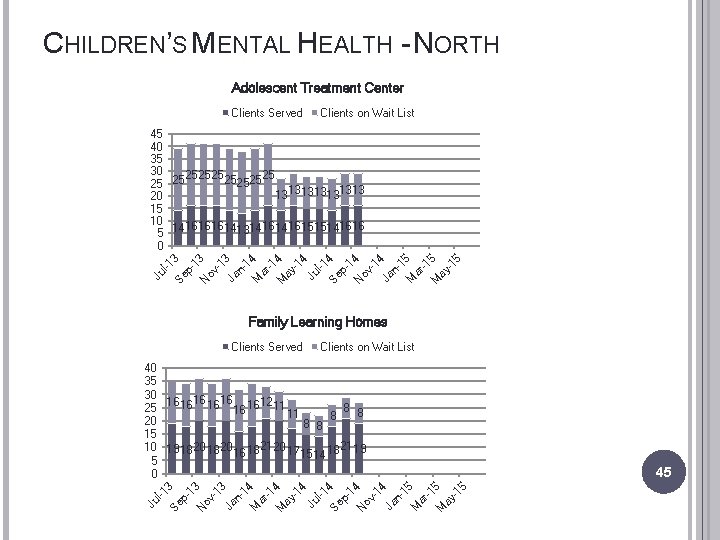
CHILDREN’S MENTAL HEALTH - NORTH Adolescent Treatment Center Clients Served Clients on Wait List Ju l-1 Se 3 p 1 N 3 ov -1 3 Ja n 1 M 4 ar -1 M 4 ay -1 4 Ju l-1 Se 4 p 1 N 4 ov -1 4 Ja n 1 M 5 ar -1 M 5 ay -1 5 45 40 35 30 252525 25 13 13 1313 20 15 10 161616 14 13 14 16 1515 14 1616 5 14 0 Family Learning Homes Clients Served Clients on Wait List Ju l-1 3 Se p 13 N ov -1 3 Ja n 14 M ar -1 M 4 ay -1 4 Ju l-1 4 Se p 14 N ov -1 4 Ja n 15 M ar -1 M 5 ay -1 5 40 35 30 16 16 25 16 16 16 12 11 8 8 11 8 20 8 8 15 21 10 19 18 20 16 18 21 20 17 15 14 18 19 5 0 45
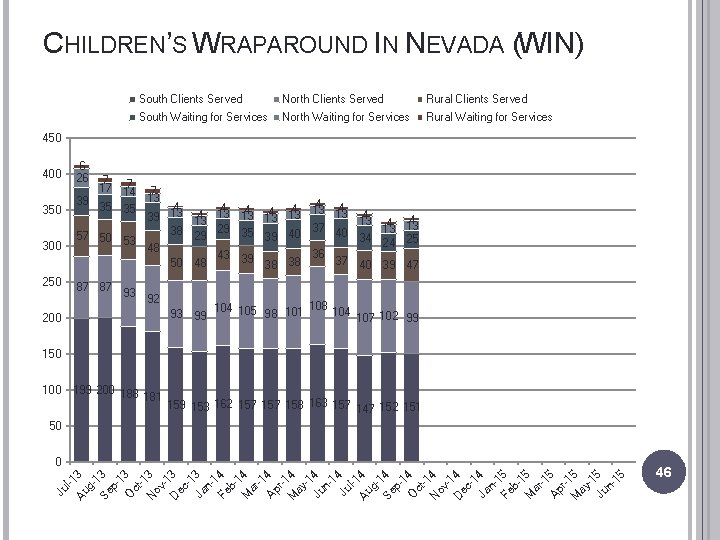
CHILDREN’S WRAPAROUND IN NEVADA (WIN) South Clients Served North Clients Served Rural Clients Served South Waiting for Services North Waiting for Services Rural Waiting for Services 450 400 350 300 250 6 26 39 57 87 7 14 35 35 50 87 53 93 7 13 39 4 13 38 4 13 29 50 48 93 99 48 92 200 4 13 29 4 13 35 39 40 43 39 38 38 4 13 37 36 4 13 40 37 4 13 34 4 13 25 40 39 47 108 104 105 104 98 101 107 102 99 150 100 199 200 188 181 159 153 162 157 158 163 157 147 152 151 50 Ju l-1 Au 3 g 1 Se 3 p 1 O 3 ct -1 N 3 ov -1 D 3 ec -1 Ja 3 n 1 Fe 4 b 1 M 4 ar -1 Ap 4 r-1 M 4 ay -1 Ju 4 n 14 Ju l-1 Au 4 g 1 Se 4 p 1 O 4 ct -1 N 4 ov -1 D 4 ec -1 Ja 4 n 1 Fe 5 b 1 M 5 ar -1 Ap 5 r-1 M 5 ay -1 Ju 5 n 15 0 46
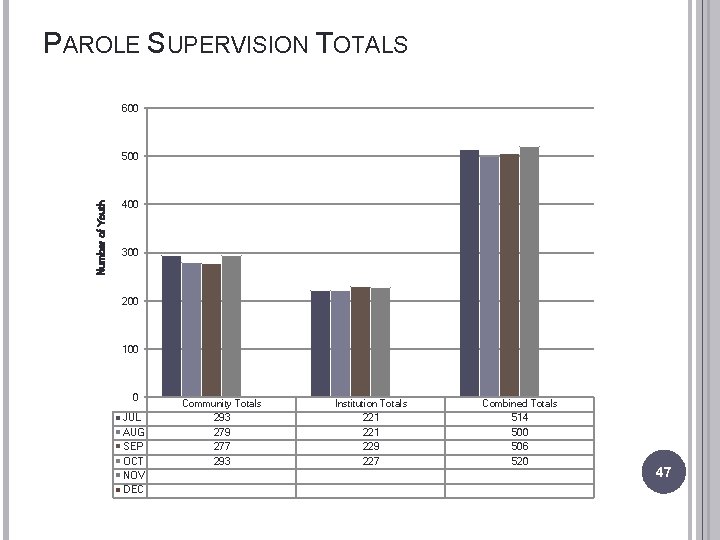
PAROLE SUPERVISION TOTALS 600 Number of Youth 500 400 300 200 100 0 JUL AUG SEP OCT NOV DEC Community Totals 293 279 277 293 Institution Totals 221 229 227 Combined Totals 514 500 506 520 47
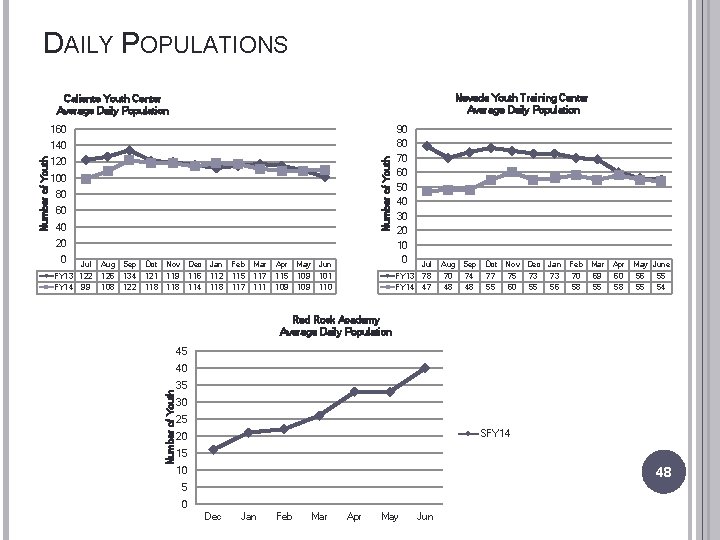
DAILY POPULATIONS Nevada Youth Training Center Average Daily Population Caliente Youth Center Average Daily Population 160 Number of Youth 120 100 80 60 40 20 0 Jul FY 13 122 FY 14 99 Aug Sep Oct 126 134 121 108 122 118 Nov Dec Jan 119 116 112 118 114 118 Feb 115 117 Mar 117 111 Apr May Jun 115 109 101 109 110 Jul FY 13 78 FY 14 47 Aug Sep Oct 70 74 77 48 48 55 Nov Dec Jan 75 73 73 60 55 56 Feb Mar 70 69 58 55 Apr May June 60 56 55 58 55 54 Red Rock Academy Average Daily Population 45 40 Number of Youth 140 90 80 70 60 50 40 30 20 10 0 35 30 25 SFY 14 20 15 48 10 5 0 Dec Jan Feb Mar Apr May Jun