
STATE OF MATTER SOLIDS By Paloma Rodello SHAPE
STATE OF MATTER- SOLIDS By Paloma Rodello
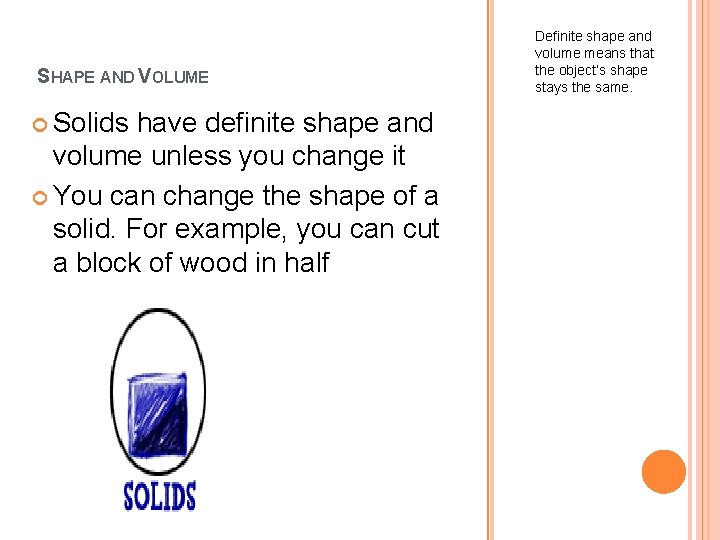
SHAPE AND VOLUME Solids have definite shape and volume unless you change it You can change the shape of a solid. For example, you can cut a block of wood in half Definite shape and volume means that the object’s shape stays the same.
PARTICLE ENERGY OF The particles in a solid don’t move easily. This means they do not change their shape easily and cannot be compressed easily.

EXAMPLES OF SOLIDS A lot of objects on Earth are solids. You can tell an object is a solid because it doesn’t change its shape like a liquid or a gas and it’s particles are tightly packed. One example of a solid is a rock. I can tell because it’s particles are close together. Another example of a solid is wood. I can tell because it doesn’t change it’s shape easily.

PARTICLES IN MOTION Explanation: These pictures symbolize particles in motion in a solid because the particles are tightly packed together. This doesn’t allow the particles to move very much at all or slide past each other to make the object move. The particles in a gas are very spread out, so they can move around as freely as they want. Solids’ particles are so crammed that they only vibrate a little and hold their shape.
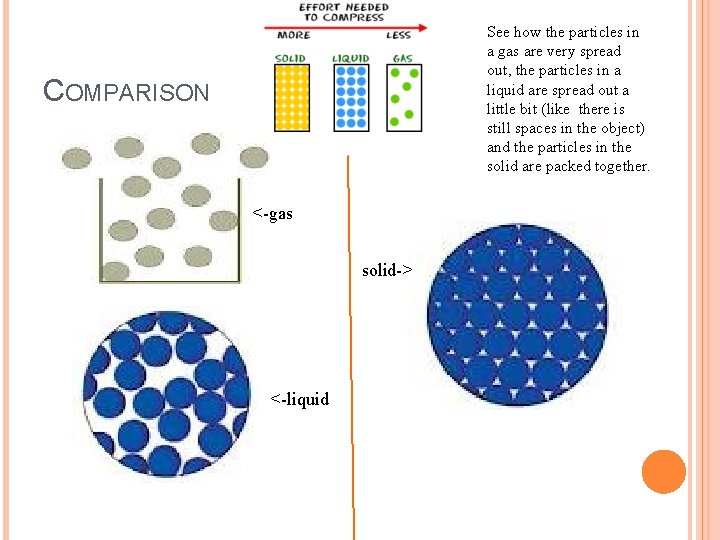
See how the particles in a gas are very spread out, the particles in a liquid are spread out a little bit (like there is still spaces in the object) and the particles in the solid are packed together. COMPARISON <-gas solid-> <-liquid
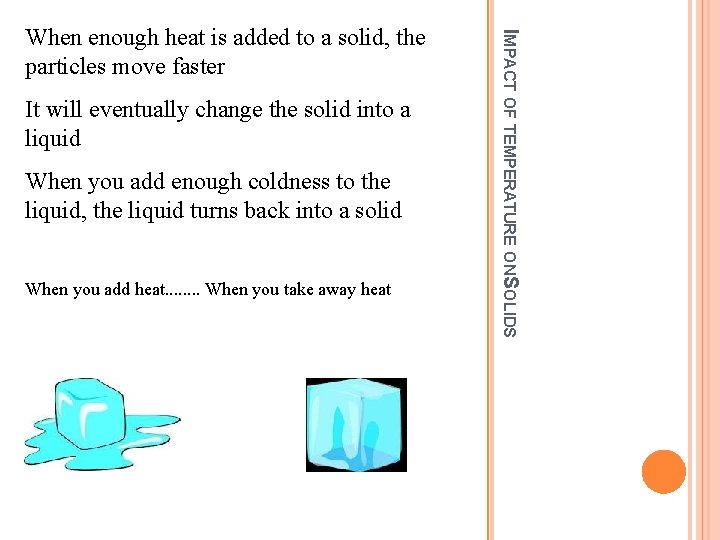
It will eventually change the solid into a liquid When you add enough coldness to the liquid, the liquid turns back into a solid When you add heat. . . . When you take away heat IMPACT OF TEMPERATURE ON SOLIDS When enough heat is added to a solid, the particles move faster
The particles in a solid are moving too slowly for us to see them move. Most times you can add energy to a solid to heat it. All different types of energy: electricity, friction and light. EXTRA INFORMATION Figuring out the state of matter is based on the distance between the particles. You can tell what state of matter an object is by looking at how far apart the particles are from each other.
WEBSITES USED: For this Power. Point, I used these sites: #1. wikipedia. org/wiki/solid #2. wacona. com/words/matter/solids. htm #3. http: //encyclopedia 2. thefreedictionary. com/solid+(state+of+matter+) #4. wiki. answers. com/Q/If_enough_energy_is_added_to_a_solid_what_will_particles_do #5. hop. concord. org/h 1/phys/h 1 p. html
MY SURVEY ON SOLIDS This is my survey that I did on solids. Take the survey!! Click on the orange survey button. Survey
- Slides: 10