
State of matter Classification Matter can be classified

State of matter

Classification � Matter can be classified according to its state into: 1. Gas Character 2. Liquid Solid 3. Solid Liquid Gas Particles close Closely packed Arranged totally arrangement together in a regular together in an irregular arrangement Shape Have fixed shape and volume Have no fixed shape but fixed volume Have no fixed shape and volume Motion of particles No freely motion but vibrate in its positions Move around past each other Move randomly Ability to compress No compression Little Easy
Gases in pharmacy � Gases and volatile substances are encountered in pharmacy mainly as anaesthetic gases, volatile drugs and aerosol propellants. � This part deals with the properties of gases and vapours, including the way in which the vapour pressure above solutions varies with the composition of the solution and the temperature. � The factors governing the solubility of gases in liquids are reviewed and related to the solubility of anaesthetic gases in the complex solvent systems comprising blood and tissues.
Gases Properties of gases 1. 2. 3. 4. 5. 6. Gases can be compressed into smaller volume Gases exert pressure on their surroundings and always form homogenous mixture with other gases Temperature affect either the volume or the pressure or both. Gas diffuse (move throughout any available space). Gases expand without limits. Gases measured in : pressure, volume, temperature and number of mole.
Gas laws �Boyle`s law �Charles`s law �Amonton`s law �Avogadro`s law �General gas law
Boyle`s law � At constant temperature, the volume of a definite mass of a gas is inversely proportional to the pressure. � This means that “ the product of the pressure and volume of a given mass is constant at constant temperature. PV = K (at constant n and T) � Where; P is the pressure, V is the volume and K is a constant that depends on the number of mole of the gas and the temperature. � If a definite mass of gas has a volume =V 1 and pressure = P 1 and either the volume or pressure is changed to V 2 or P 2 at constant temperature then P 1 V 1 = P 2 V 2
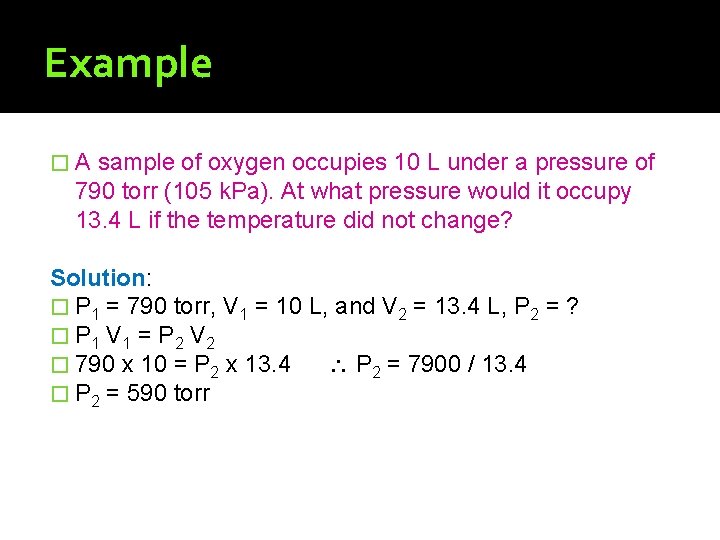
Example �A sample of oxygen occupies 10 L under a pressure of 790 torr (105 k. Pa). At what pressure would it occupy 13. 4 L if the temperature did not change? Solution: � P 1 = 790 torr, V 1 = 10 L, and V 2 = 13. 4 L, P 2 = ? � P 1 V 1 = P 2 V 2 � 790 x 10 = P 2 x 13. 4 P 2 = 7900 / 13. 4 � P 2 = 590 torr
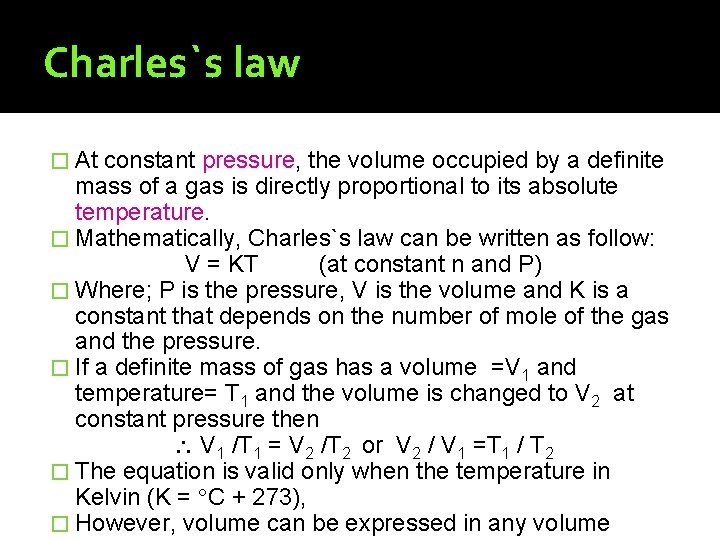
Charles`s law � At constant pressure, the volume occupied by a definite mass of a gas is directly proportional to its absolute temperature. � Mathematically, Charles`s law can be written as follow: V = KT (at constant n and P) � Where; P is the pressure, V is the volume and K is a constant that depends on the number of mole of the gas and the pressure. � If a definite mass of gas has a volume =V 1 and temperature= T 1 and the volume is changed to V 2 at constant pressure then V 1 /T 1 = V 2 /T 2 or V 2 / V 1 =T 1 / T 2 � The equation is valid only when the temperature in Kelvin (K = C + 273), � However, volume can be expressed in any volume
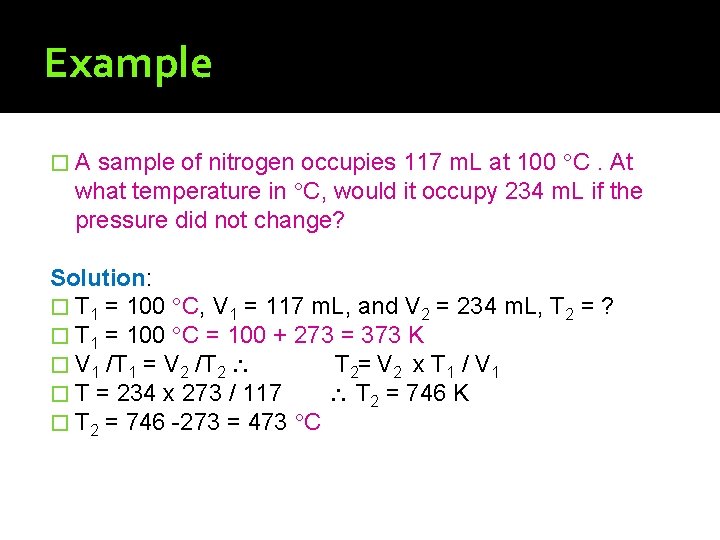
Example sample of nitrogen occupies 117 m. L at 100 C. At what temperature in C, would it occupy 234 m. L if the pressure did not change? �A Solution: � T 1 = 100 C, V 1 = 117 m. L, and V 2 = 234 m. L, T 2 = ? � T 1 = 100 C = 100 + 273 = 373 K � V 1 /T 1 = V 2 /T 2 T 2= V 2 x T 1 / V 1 � T = 234 x 273 / 117 T 2 = 746 K � T 2 = 746 -273 = 473 C
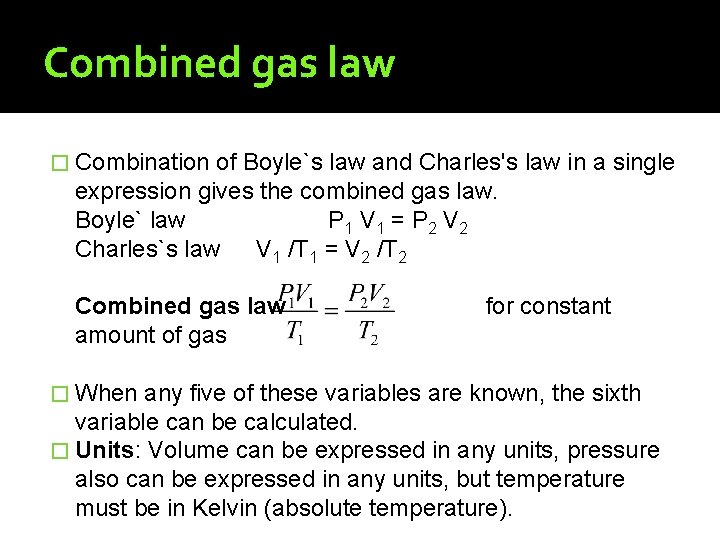
Combined gas law � Combination of Boyle`s law and Charles's law in a single expression gives the combined gas law. Boyle` law P 1 V 1 = P 2 V 2 Charles`s law V 1 /T 1 = V 2 /T 2 Combined gas law amount of gas � When for constant any five of these variables are known, the sixth variable can be calculated. � Units: Volume can be expressed in any units, pressure also can be expressed in any units, but temperature must be in Kelvin (absolute temperature).
Standard temperature and pressure STP � The pressure and temperature can affect the volume (and therefore the density) of a gas. � It is convenient to choose some standard temperature and pressure as a reference points. � By international agreement, the standard temperature is exactly 0 C and the pressure is one atmosphere (=760 torr) or (760 mm Hg).
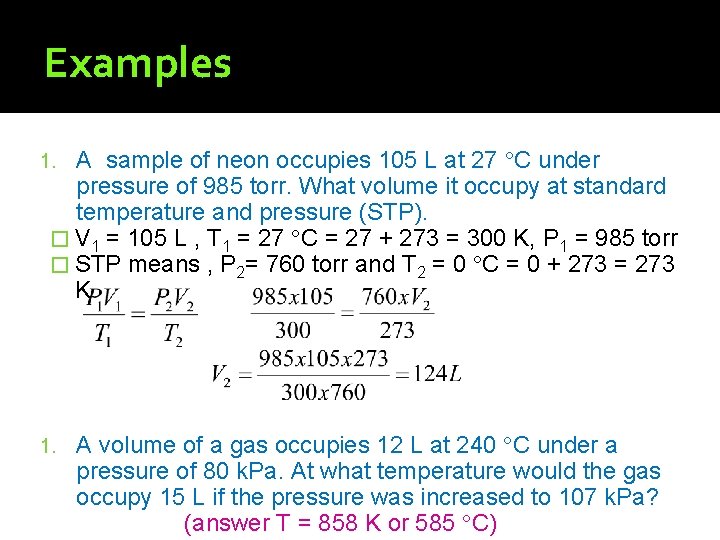
Examples A sample of neon occupies 105 L at 27 C under pressure of 985 torr. What volume it occupy at standard temperature and pressure (STP). � V 1 = 105 L , T 1 = 27 C = 27 + 273 = 300 K, P 1 = 985 torr � STP means , P 2= 760 torr and T 2 = 0 C = 0 + 273 = 273 K 1. A volume of a gas occupies 12 L at 240 C under a pressure of 80 k. Pa. At what temperature would the gas occupy 15 L if the pressure was increased to 107 k. Pa? (answer T = 858 K or 585 C)
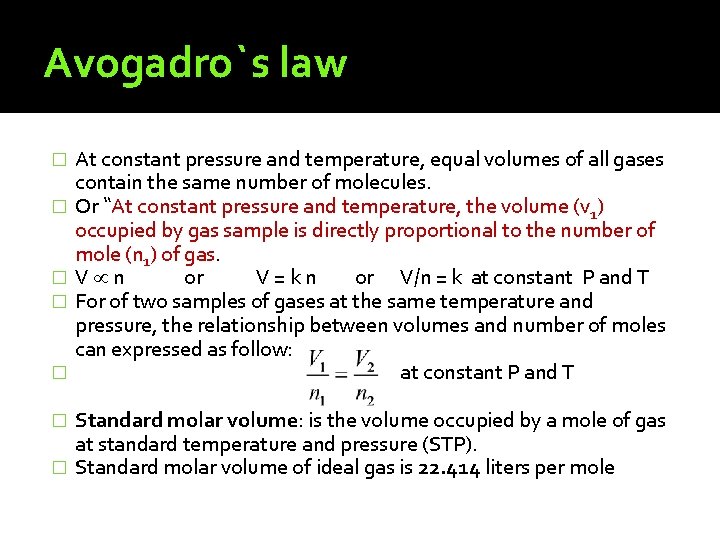
Avogadro`s law � � � At constant pressure and temperature, equal volumes of all gases contain the same number of molecules. Or “At constant pressure and temperature, the volume (v 1) occupied by gas sample is directly proportional to the number of mole (n 1) of gas. V n or V=kn or V/n = k at constant P and T For of two samples of gases at the same temperature and pressure, the relationship between volumes and number of moles can expressed as follow: at constant P and T Standard molar volume: is the volume occupied by a mole of gas at standard temperature and pressure (STP). � Standard molar volume of ideal gas is 22. 414 liters per mole �
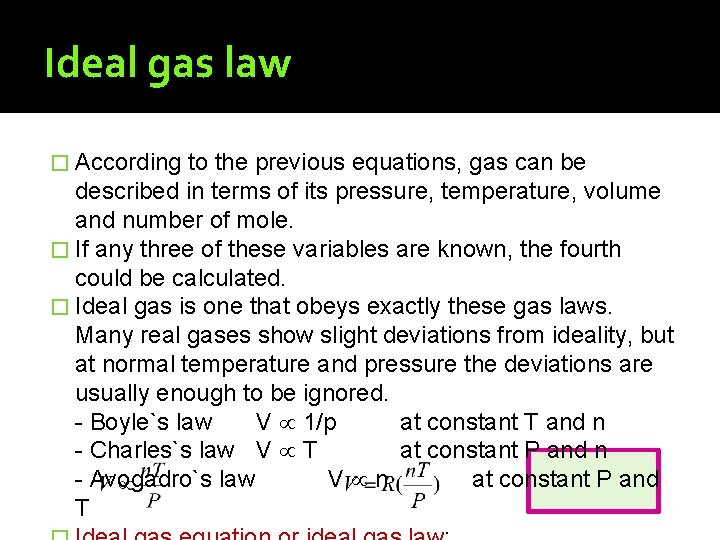
Ideal gas law � According to the previous equations, gas can be described in terms of its pressure, temperature, volume and number of mole. � If any three of these variables are known, the fourth could be calculated. � Ideal gas is one that obeys exactly these gas laws. Many real gases show slight deviations from ideality, but at normal temperature and pressure the deviations are usually enough to be ignored. - Boyle`s law V 1/p at constant T and n - Charles`s law V T at constant P and n - Avogadro`s law V n at constant P and T
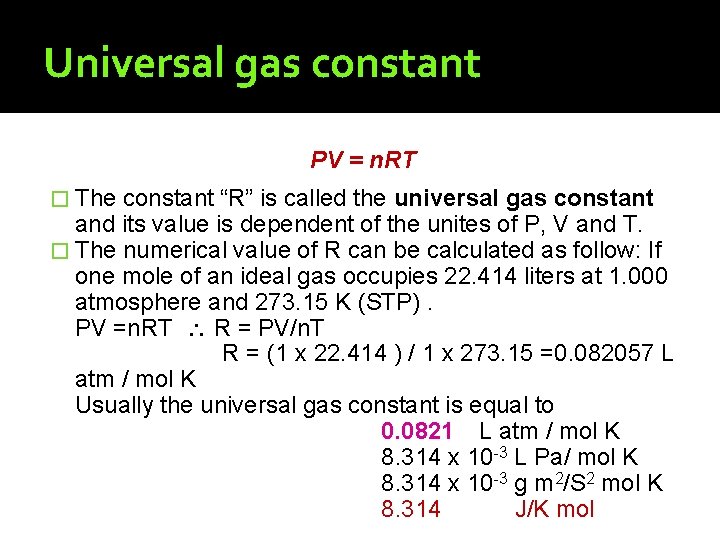
Universal gas constant PV = n. RT � The constant “R” is called the universal gas constant and its value is dependent of the unites of P, V and T. � The numerical value of R can be calculated as follow: If one mole of an ideal gas occupies 22. 414 liters at 1. 000 atmosphere and 273. 15 K (STP). PV =n. RT R = PV/n. T R = (1 x 22. 414 ) / 1 x 273. 15 =0. 082057 L atm / mol K Usually the universal gas constant is equal to 0. 0821 L atm / mol K 8. 314 x 10 -3 L Pa/ mol K 8. 314 x 10 -3 g m 2/S 2 mol K 8. 314 J/K mol
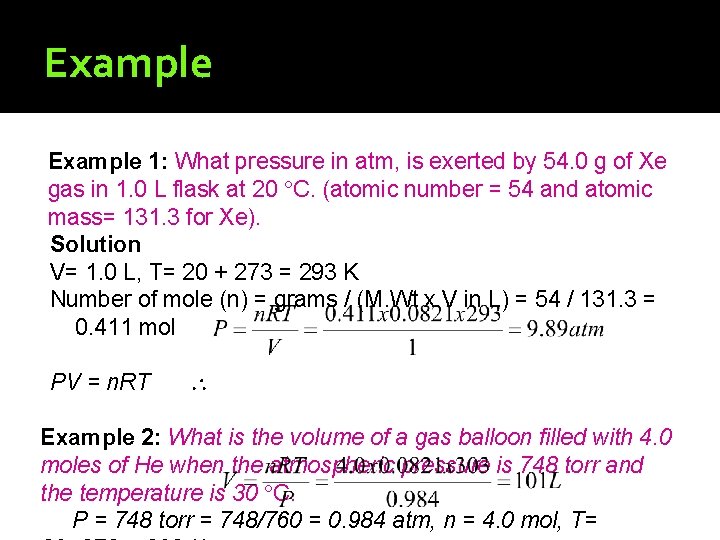
Example 1: What pressure in atm, is exerted by 54. 0 g of Xe gas in 1. 0 L flask at 20 C. (atomic number = 54 and atomic mass= 131. 3 for Xe). Solution V= 1. 0 L, T= 20 + 273 = 293 K Number of mole (n) = grams / (M. Wt x V in L) = 54 / 131. 3 = 0. 411 mol PV = n. RT Example 2: What is the volume of a gas balloon filled with 4. 0 moles of He when the atmospheric pressure is 748 torr and the temperature is 30 C. P = 748 torr = 748/760 = 0. 984 atm, n = 4. 0 mol, T=
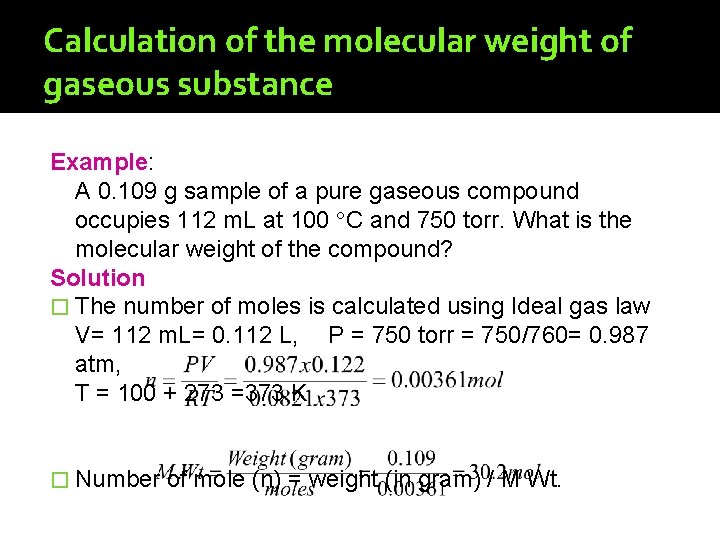
Calculation of the molecular weight of gaseous substance Example: A 0. 109 g sample of a pure gaseous compound occupies 112 m. L at 100 C and 750 torr. What is the molecular weight of the compound? Solution � The number of moles is calculated using Ideal gas law V= 112 m. L= 0. 112 L, P = 750 torr = 750/760= 0. 987 atm, T = 100 + 273 =373 K � Number of mole (n) = weight (in gram) / M Wt.
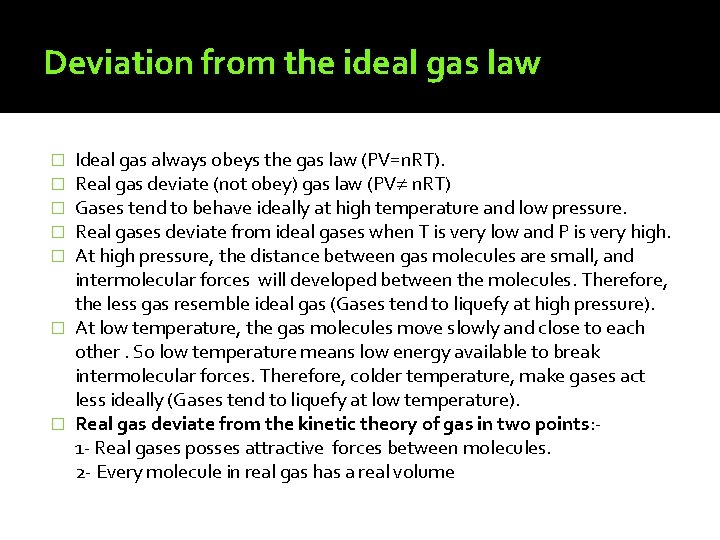
Deviation from the ideal gas law Ideal gas always obeys the gas law (PV=n. RT). Real gas deviate (not obey) gas law (PV n. RT) Gases tend to behave ideally at high temperature and low pressure. Real gases deviate from ideal gases when T is very low and P is very high. At high pressure, the distance between gas molecules are small, and intermolecular forces will developed between the molecules. Therefore, the less gas resemble ideal gas (Gases tend to liquefy at high pressure). � At low temperature, the gas molecules move slowly and close to each other. So low temperature means low energy available to break intermolecular forces. Therefore, colder temperature, make gases act less ideally (Gases tend to liquefy at low temperature). � Real gas deviate from the kinetic theory of gas in two points: 1 - Real gases posses attractive forces between molecules. 2 - Every molecule in real gas has a real volume � � �
The kinetic theory of gases assumes that the gas molecules behave as perfectly elastic spheres having negligible volume with no intermolecular attraction or repulsion. � In some types of aerosol (compressed gas aerosols) an inert gas under pressure is used to expel the product as a solid stream, a mist or a foam. The pressure of gas in an aerosol container of this type is readily calculated using the gas laws, as in Example 2. 1. �
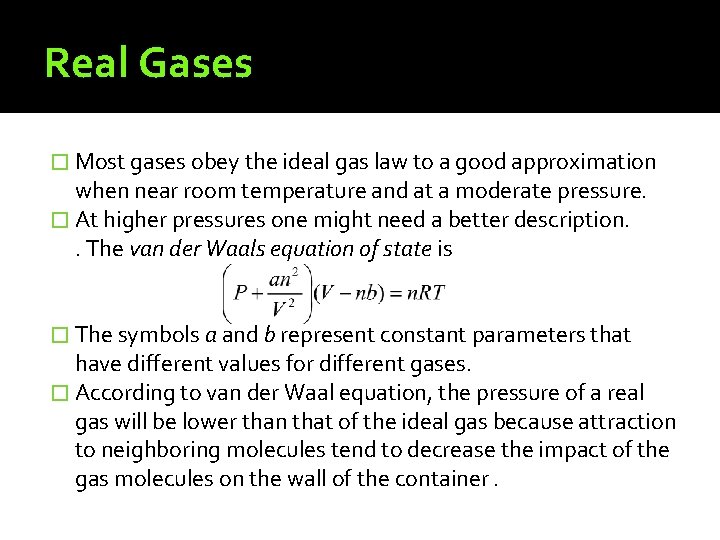
Real Gases � Most gases obey the ideal gas law to a good approximation when near room temperature and at a moderate pressure. � At higher pressures one might need a better description. . The van der Waals equation of state is � The symbols a and b represent constant parameters that have different values for different gases. � According to van der Waal equation, the pressure of a real gas will be lower than that of the ideal gas because attraction to neighboring molecules tend to decrease the impact of the gas molecules on the wall of the container.
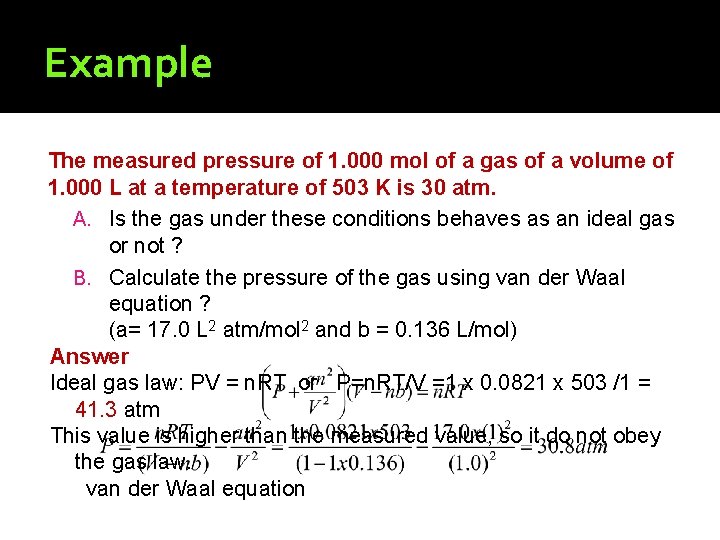
Example The measured pressure of 1. 000 mol of a gas of a volume of 1. 000 L at a temperature of 503 K is 30 atm. A. Is the gas under these conditions behaves as an ideal gas or not ? B. Calculate the pressure of the gas using van der Waal equation ? (a= 17. 0 L 2 atm/mol 2 and b = 0. 136 L/mol) Answer Ideal gas law: PV = n. RT or P=n. RT/V =1 x 0. 0821 x 503 /1 = 41. 3 atm This value is higher than the measured value, so it do not obey the gas law. van der Waal equation
- Slides: 21