
STATE OF ISRAEL Groundwater Recharge and Water Management


- Slides: 40
STATE OF ISRAEL Groundwater Recharge and Water Management in Israel Adi Tal Israel Hydrological Service Water authority Ministry of National Infrastructures, Energy and Water International seminar in groundwater recharge July 14 th 2017, Santiago, Chile 1
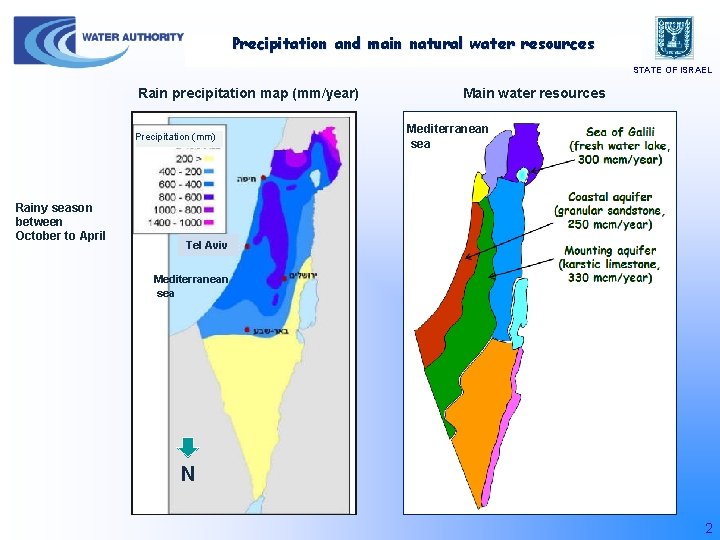
Precipitation and main natural water resources STATE OF ISRAEL Rain precipitation map (mm/year) Precipitation (mm) Rainy season between October to April Main water resources Mediterranean sea Tel Aviv Mediterranean sea N 2
Main Water Supply System (1964) STATE OF ISRAEL Haifa Eshkol reservoir Tel Aviv Saphir station Sea of Galilee (Kinneret) National carrier 108” Jerusalem The carrier diverted the water directly to the consumption areas. During the rainy season also for groundwater recharge into the coastal aquifer National carrier section National carrier- length section +200 -200 108” Sea of Galilee 3
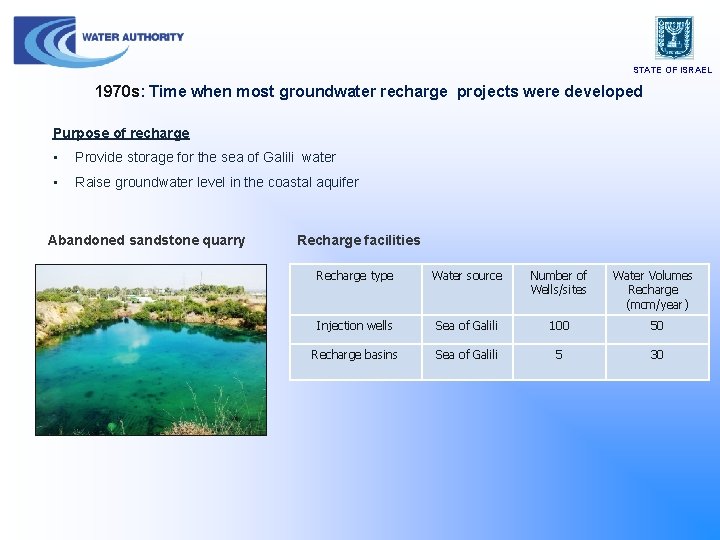
STATE OF ISRAEL 1970 s: Time when most groundwater recharge projects were developed Purpose of recharge • Provide storage for the sea of Galili water • Raise groundwater level in the coastal aquifer Abandoned sandstone quarry Recharge facilities Recharge type Water source Number of Wells/sites Water Volumes Recharge (mcm/year) Injection wells Sea of Galili 100 50 Recharge basins Sea of Galili 5 30
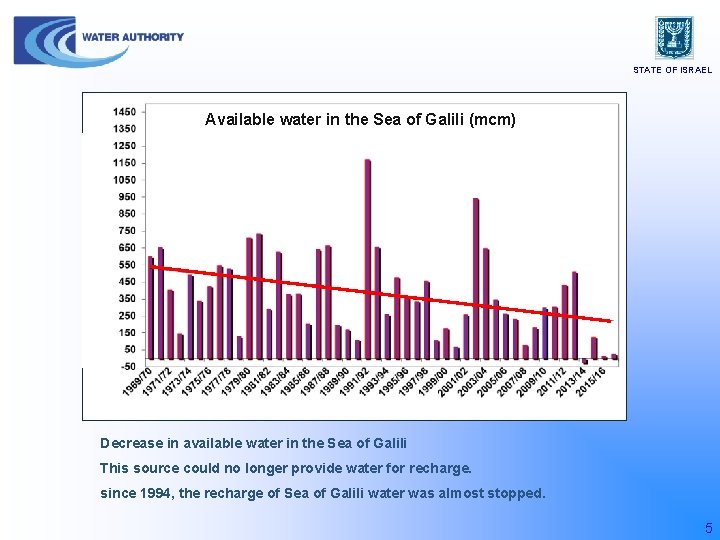
STATE OF ISRAEL Available water in the Sea of Galili (mcm) Decrease in available water in the Sea of Galili This source could no longer provide water for recharge. since 1994, the recharge of Sea of Galili water was almost stopped. 5
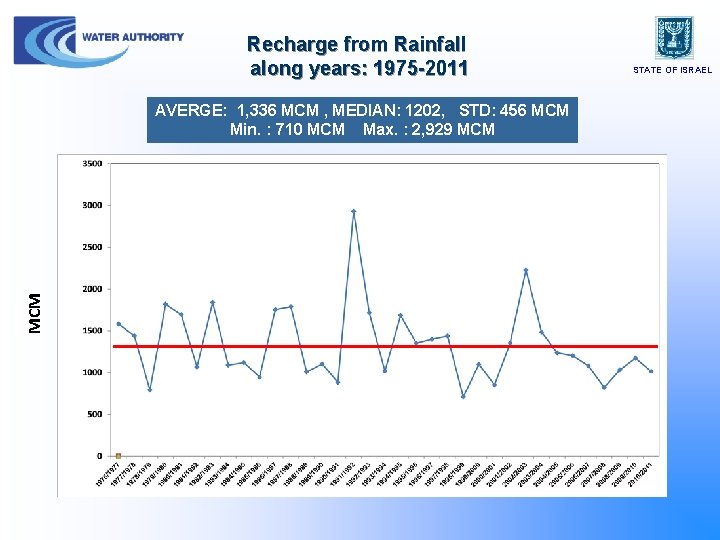
Recharge from Rainfall along years: 1975 -2011 MCM AVERGE: 1, 336 MCM , MEDIAN: 1202, STD: 456 MCM Min. : 710 MCM Max. : 2, 929 MCM STATE OF ISRAEL
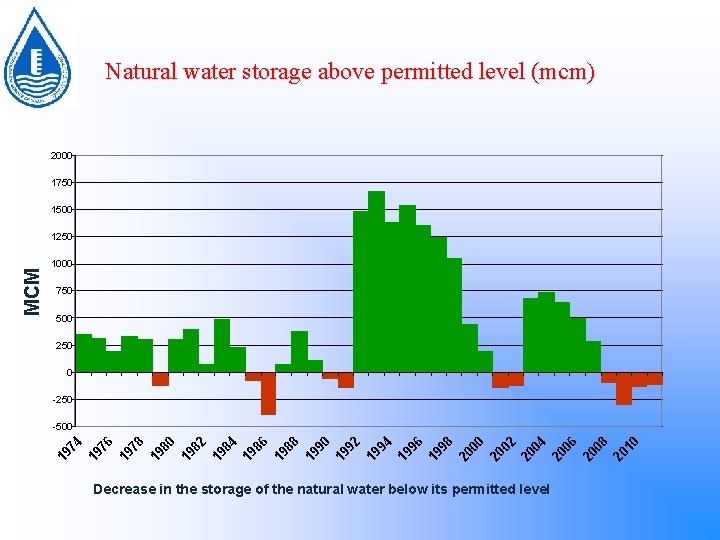
Natural water storage above permitted level (mcm) 2000 1750 1500 1000 750 500 250 0 -250 Decrease in the storage of the natural water below its permitted level 10 20 08 20 06 20 04 20 02 20 00 20 98 19 96 19 94 19 92 19 90 19 88 19 86 19 84 19 82 19 80 19 78 19 76 19 74 -500 19 MCM 1250
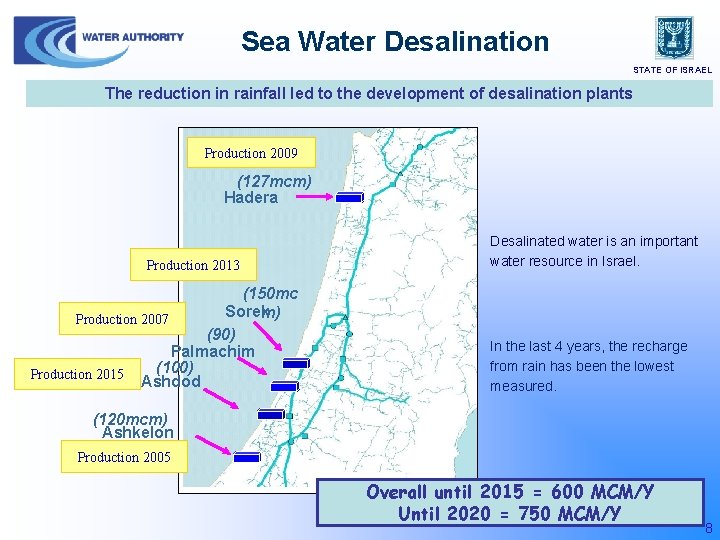
Sea Water Desalination STATE OF ISRAEL The reduction in rainfall led to the development of desalination plants Production 2009 (127 mcm) Hadera Production 2013 (150 mc Sorek m) Production 2007 (90) Palmachim (100) Production 2015 Ashdod Desalinated water is an important water resource in Israel. In the last 4 years, the recharge from rain has been the lowest measured. (120 mcm) Ashkelon Production 2005 Overall until 2015 = 600 MCM/Y Until 2020 = 750 MCM/Y 8
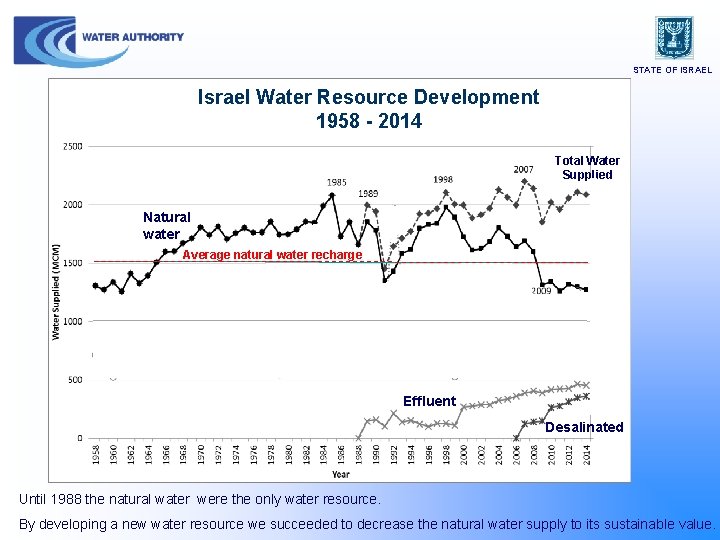
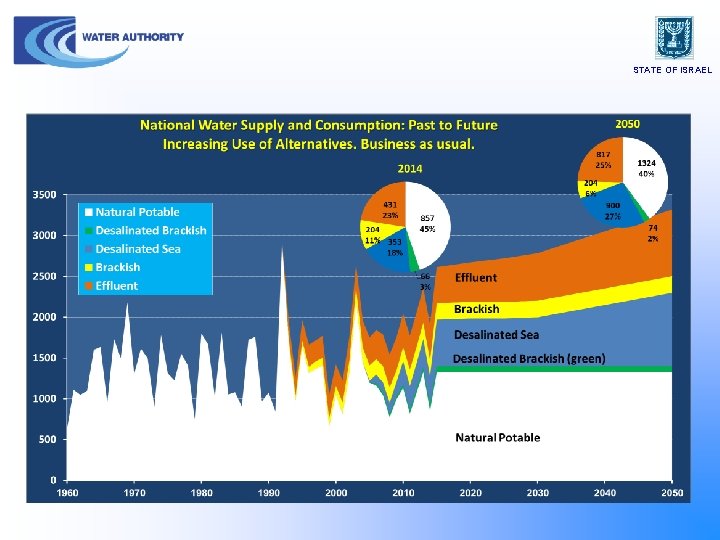
STATE OF ISRAEL Israel Water Resource Development 1958 - 2014 Total Water Supplied Natural water Average natural water recharge Effluent Desalinated Until 1988 the natural water were the only water resource. By developing a new water resource we succeeded to decrease the natural water supply to its sustainable value.
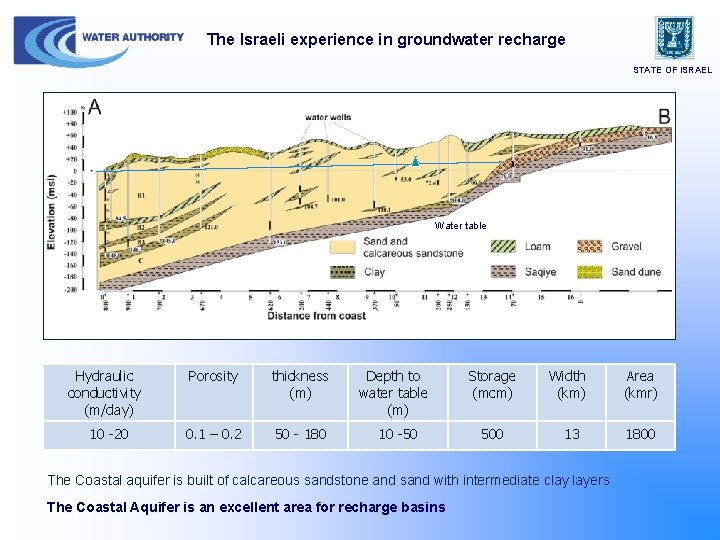
The Israeli experience in groundwater recharge STATE OF ISRAEL Water table Hydraulic conductivity (m/day) 10 -20 Porosity thickness (m) 0. 1 – 0. 2 50 - 180 Depth to water table (m) 10 -50 Storage (mcm) Width (km) Area (kmr) 500 13 1800 The Coastal aquifer is built of calcareous sandstone and sand with intermediate clay layers The Coastal Aquifer is an excellent area for recharge basins
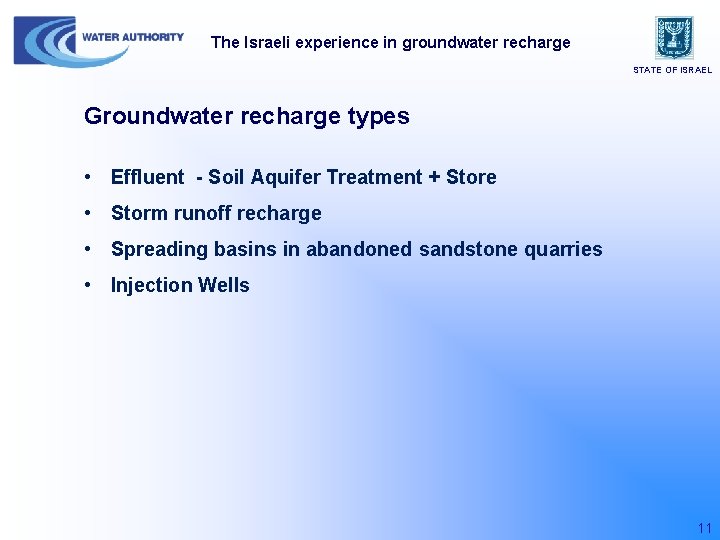
The Israeli experience in groundwater recharge STATE OF ISRAEL Groundwater recharge types • Effluent - Soil Aquifer Treatment + Store • Storm runoff recharge • Spreading basins in abandoned sandstone quarries • Injection Wells 11
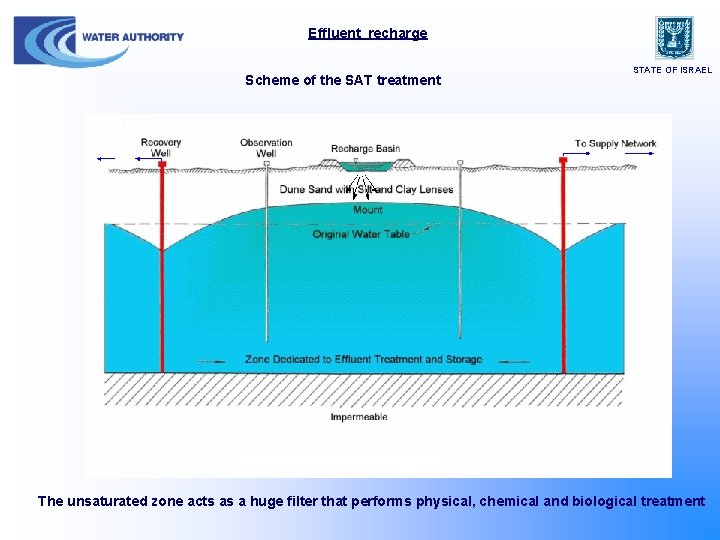
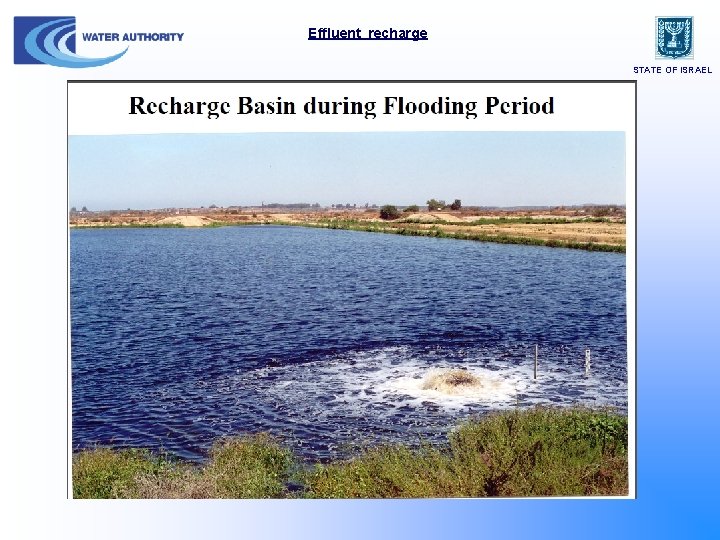
Effluent recharge Scheme of the SAT treatment STATE OF ISRAEL The unsaturated zone acts as a huge filter that performs physical, chemical and biological treatment
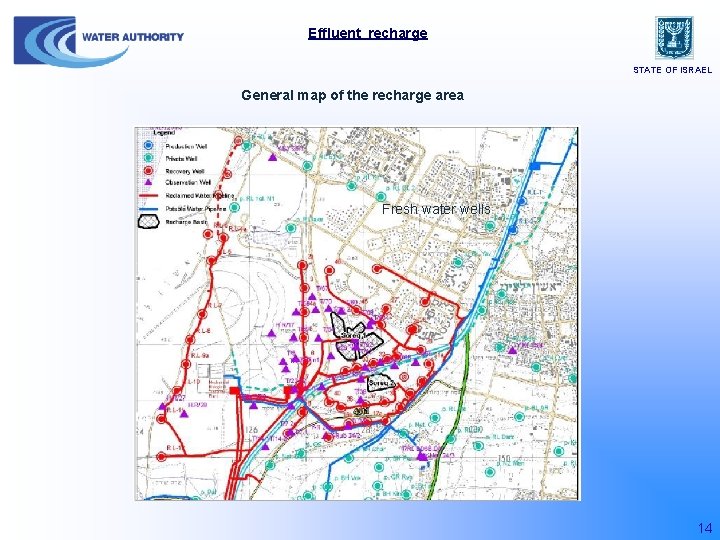
Effluent recharge STATE OF ISRAEL General map of the recharge area Fresh water wells 14
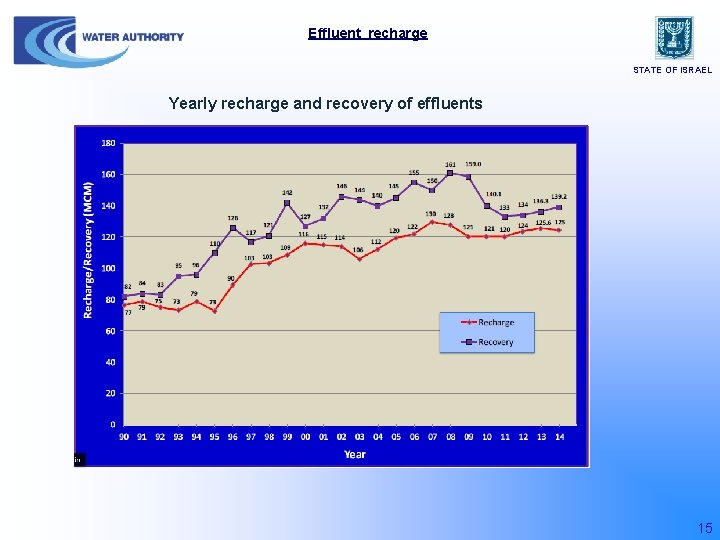
Effluent recharge STATE OF ISRAEL Yearly recharge and recovery of effluents 15
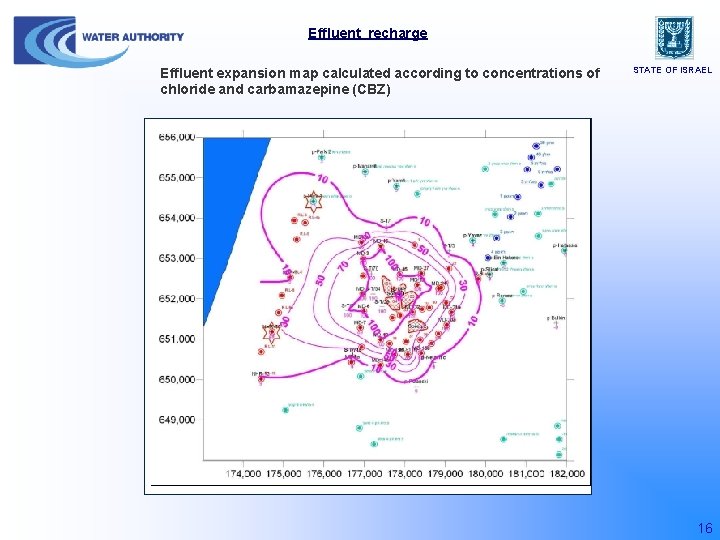
Effluent recharge Effluent expansion map calculated according to concentrations of chloride and carbamazepine (CBZ) STATE OF ISRAEL 16
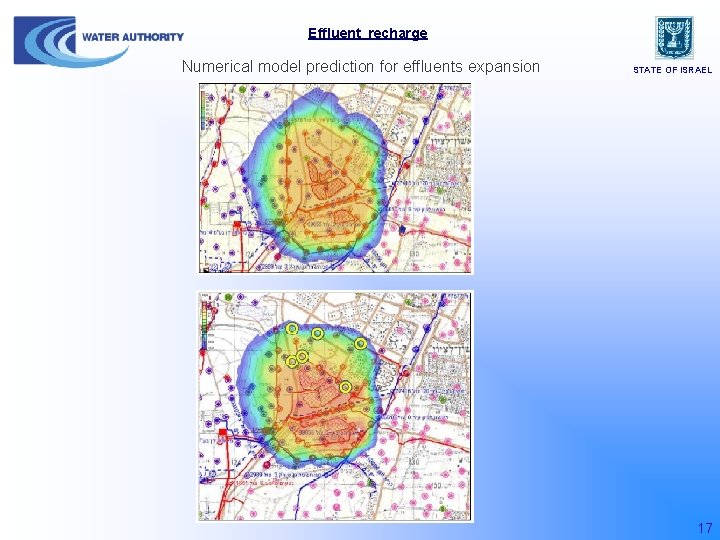
Effluent recharge Numerical model prediction for effluents expansion STATE OF ISRAEL 17
Effluent recharge STATE OF ISRAEL
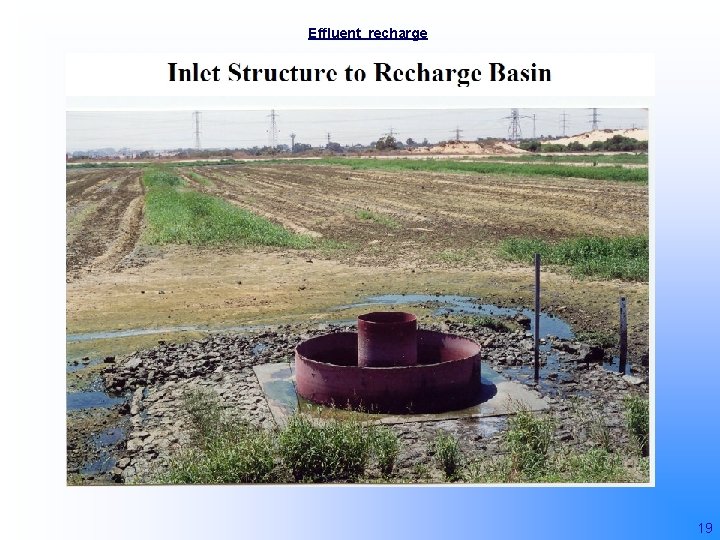
Effluent recharge 19
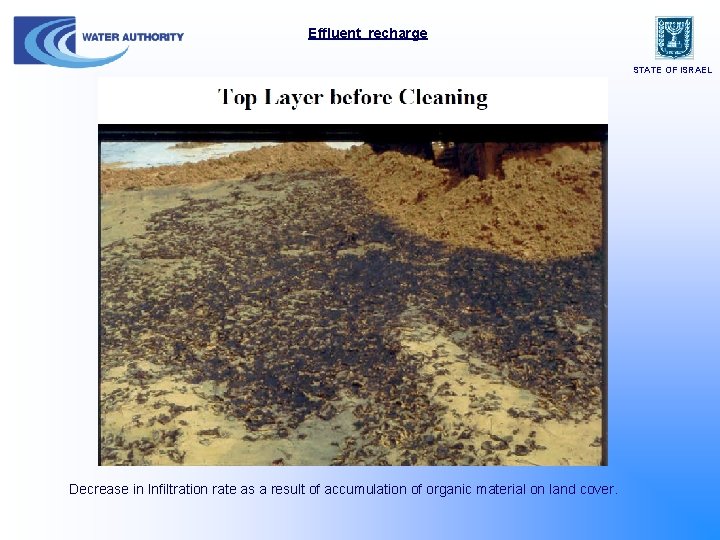
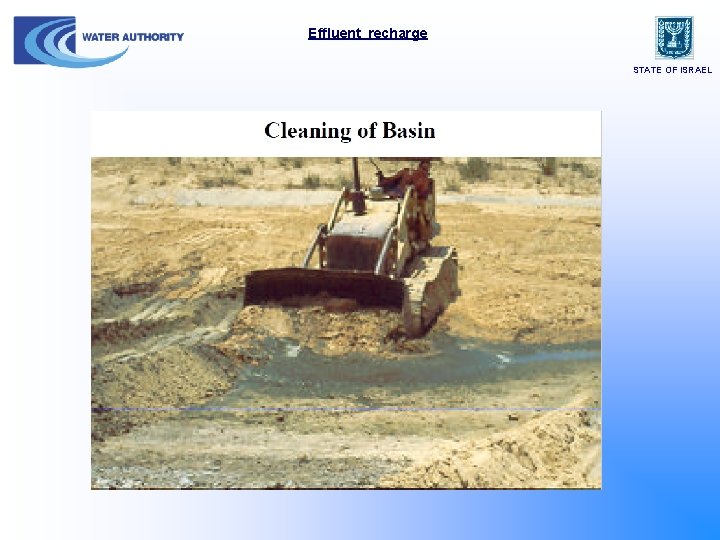
Effluent recharge STATE OF ISRAEL Decrease in Infiltration rate as a result of accumulation of organic material on land cover.
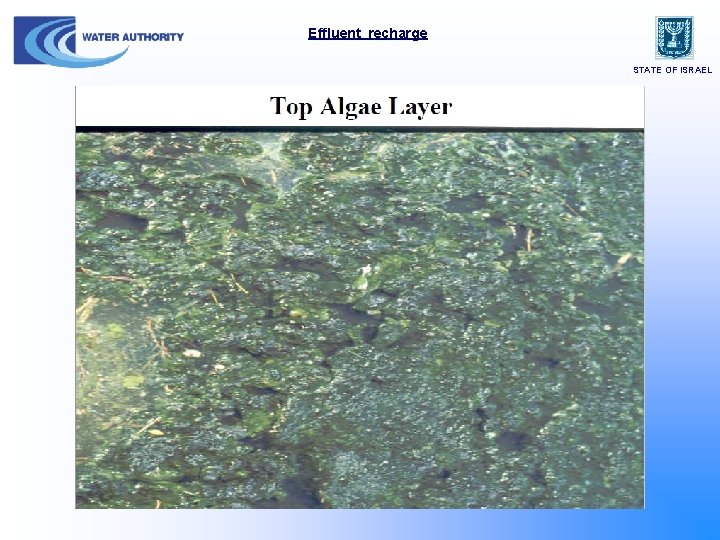
Effluent recharge STATE OF ISRAEL
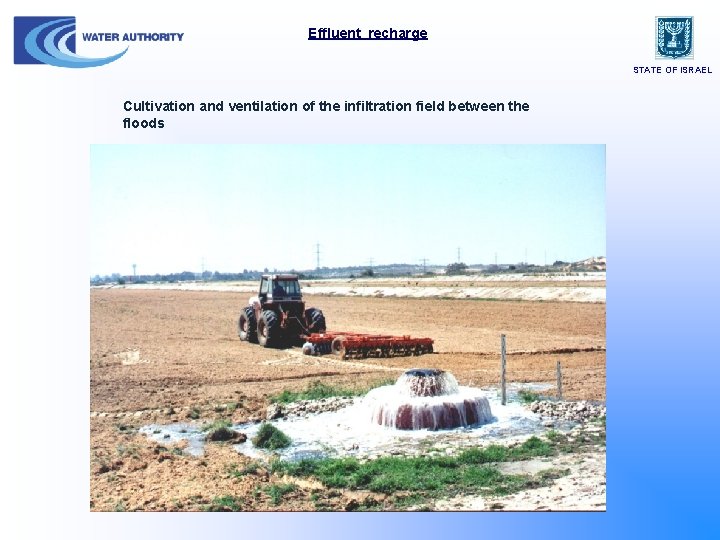
Effluent recharge STATE OF ISRAEL Cultivation and ventilation of the infiltration field between the floods
Effluent recharge STATE OF ISRAEL
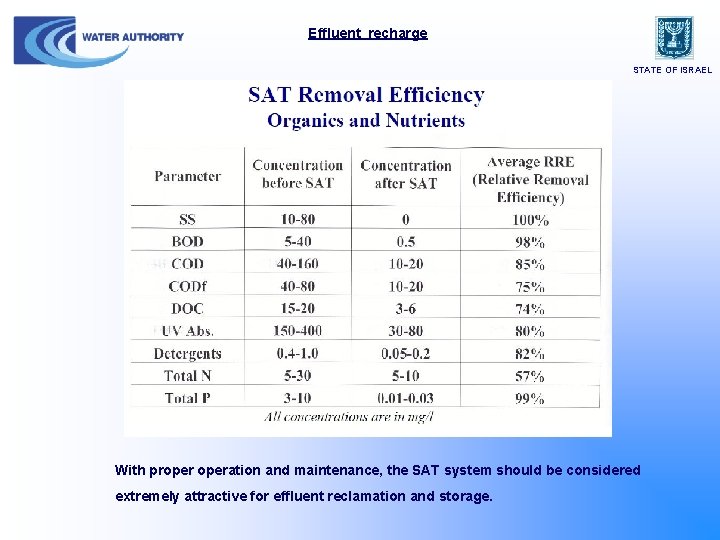
Effluent recharge STATE OF ISRAEL With properation and maintenance, the SAT system should be considered extremely attractive for effluent reclamation and storage.
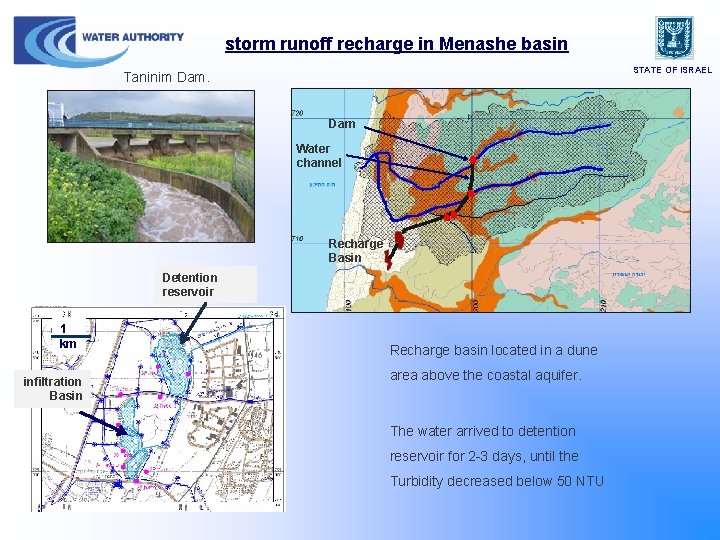
storm runoff recharge in Menashe basin STATE OF ISRAEL Taninim Dam dam Water channel Recharge Basin Detention reservoir 1 km infiltration Basin Recharge basin located in a dune area above the coastal aquifer. The water arrived to detention reservoir for 2 -3 days, until the Turbidity decreased below 50 NTU
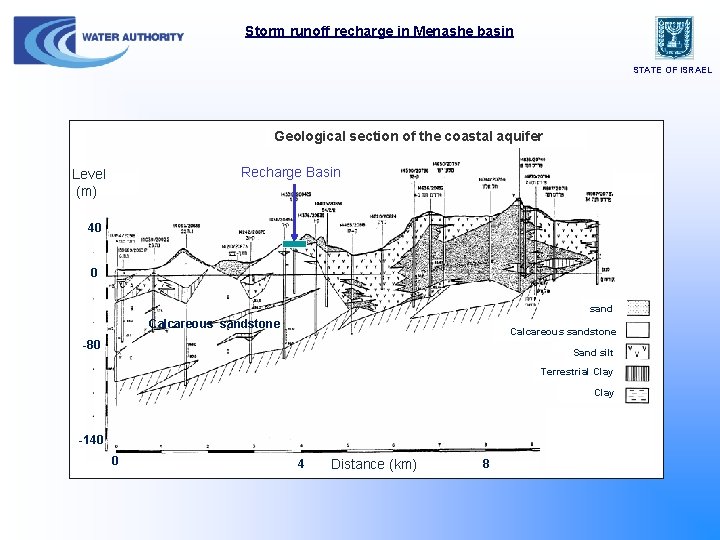
Storm runoff recharge in Menashe basin STATE OF ISRAEL Geological section of the coastal aquifer Recharge Basin Level (m) 40 0 sand Calcareous sandstone -80 Sand silt Terrestrial Clay -140 0 4 Distance (km) 8
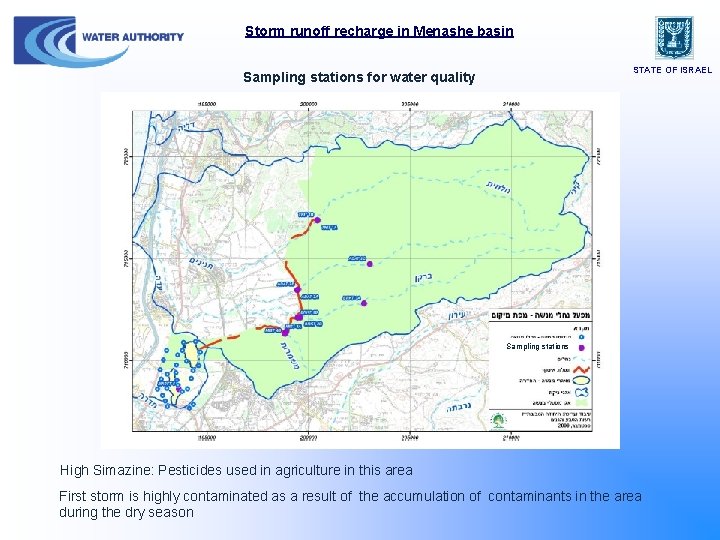
Storm runoff recharge in Menashe basin STATE OF ISRAEL Sampling stations for water quality Sampling stations High Simazine: Pesticides used in agriculture in this area First storm is highly contaminated as a result of the accumulation of contaminants in the area during the dry season
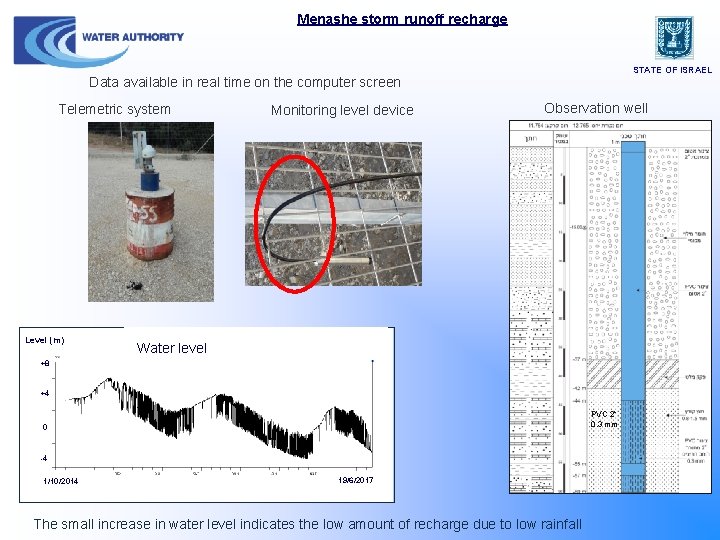
Menashe storm runoff recharge STATE OF ISRAEL Data available in real time on the computer screen Telemetric system Level (m) Monitoring level device Observation well Water level +8 +4 PVC 2” 0. 3 mm 0 -4 1/10/2014 19/6/2017 The small increase in water level indicates the low amount of recharge due to low rainfall
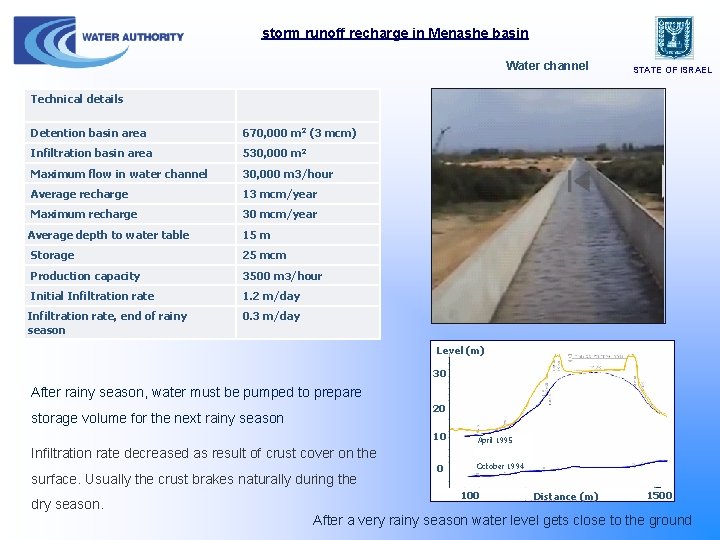
storm runoff recharge in Menashe basin Water channel STATE OF ISRAEL Technical details Detention basin area 670, 000 m 2 (3 mcm) Infiltration basin area 530, 000 m 2 Maximum flow in water channel 30, 000 m 3/hour Average recharge 13 mcm/year Maximum recharge 30 mcm/year Average depth to water table 15 m Storage 25 mcm Production capacity 3500 m 3/hour Initial Infiltration rate 1. 2 m/day Infiltration rate, end of rainy season 0. 3 m/day Level (m) 30 After rainy season, water must be pumped to prepare 20 storage volume for the next rainy season 10 Infiltration rate decreased as result of crust cover on the surface. Usually the crust brakes naturally during the dry season. 0 April 1995 October 1994 100 Distance (m) 1500 After a very rainy season water level gets close to the ground
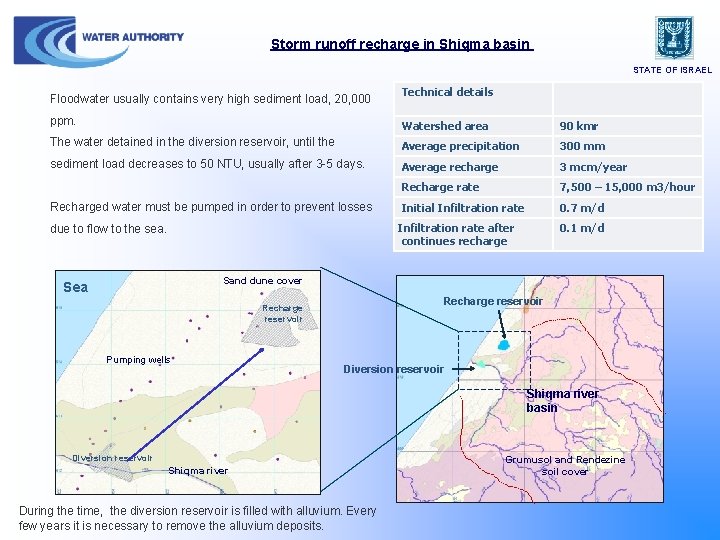
Storm runoff recharge in Shiqma basin STATE OF ISRAEL Floodwater usually contains very high sediment load, 20, 000 Technical details ppm. Watershed area 90 kmr The water detained in the diversion reservoir, until the Average precipitation 300 mm sediment load decreases to 50 NTU, usually after 3 -5 days. Average recharge 3 mcm/year Recharge rate 7, 500 – 15, 000 m 3/hour Recharged water must be pumped in order to prevent losses Initial Infiltration rate 0. 7 m/d due to flow to the sea. Infiltration rate after continues recharge 0. 1 m/d Sand dune cover Sea Recharge reservoir Pumping wells Diversion reservoir Shiqma river basin Diversion reservoir Shiqma river During the time, the diversion reservoir is filled with alluvium. Every few years it is necessary to remove the alluvium deposits. Grumusol and Rendezine soil cover
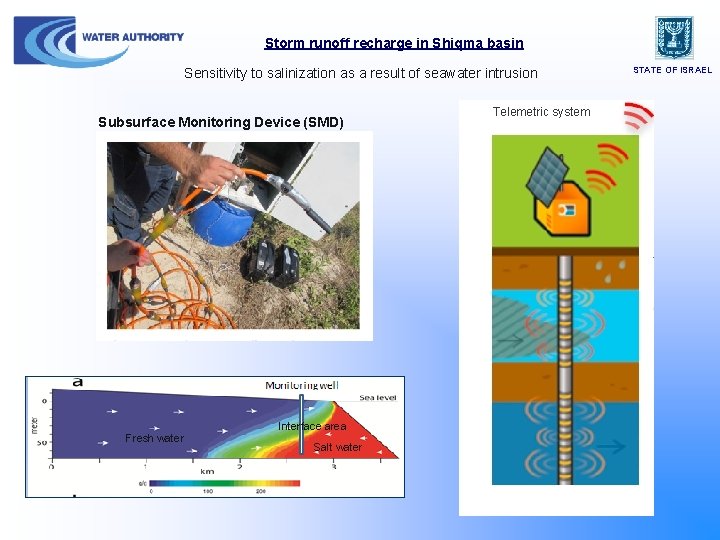
Storm runoff recharge in Shiqma basin Sensitivity to salinization as a result of seawater intrusion Subsurface Monitoring Device (SMD) Fresh water Interface area Salt water Telemetric system STATE OF ISRAEL
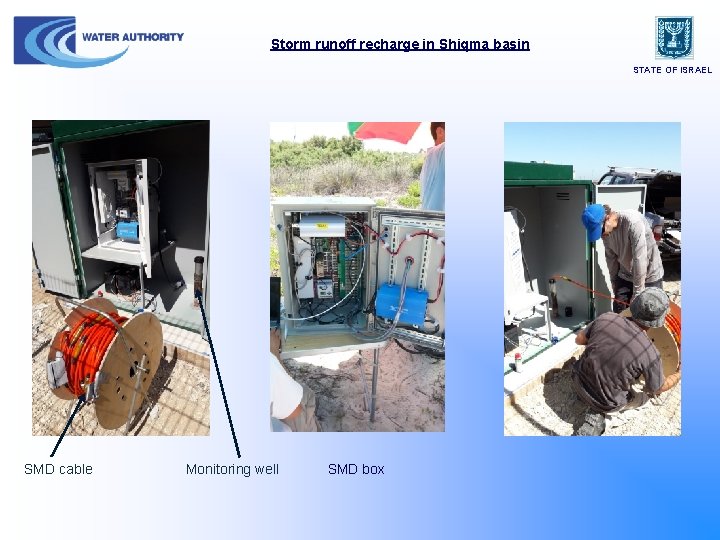
Storm runoff recharge in Shiqma basin STATE OF ISRAEL SMD cable Monitoring well SMD box
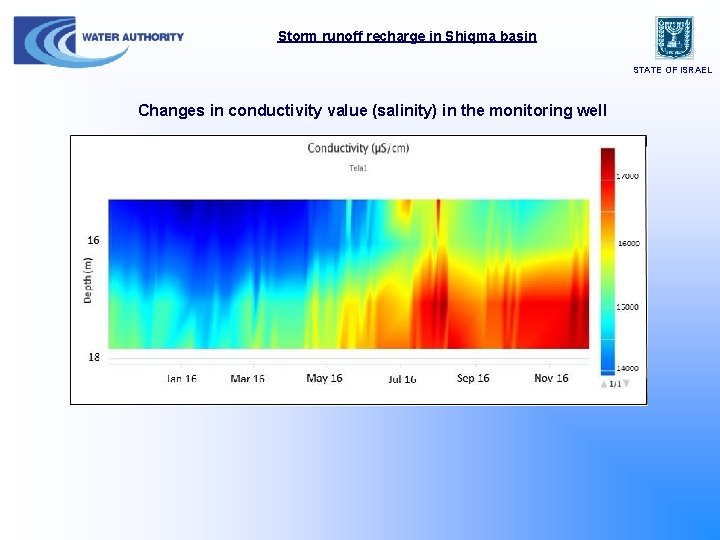
Storm runoff recharge in Shiqma basin STATE OF ISRAEL Changes in conductivity value (salinity) in the monitoring well
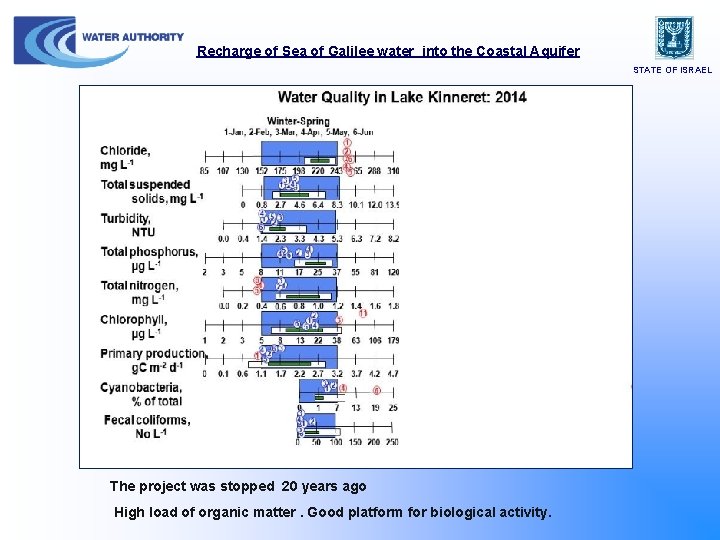
Recharge of Sea of Galilee water into the Coastal Aquifer STATE OF ISRAEL The project was stopped 20 years ago High load of organic matter. Good platform for biological activity.
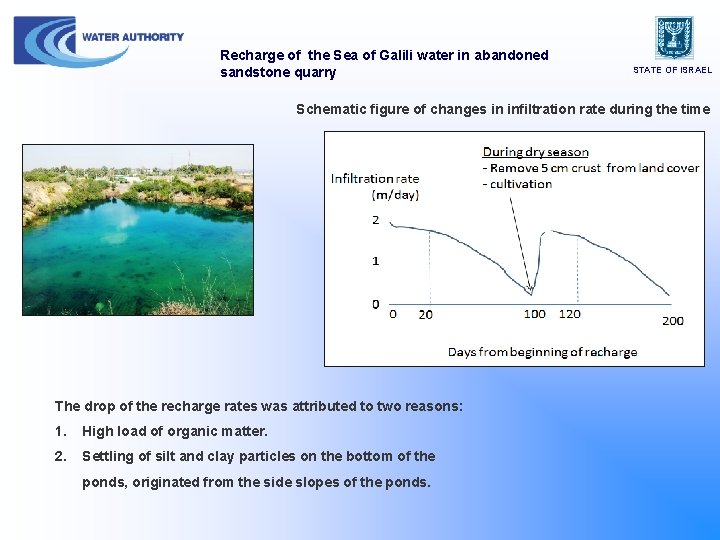
Recharge of the Sea of Galili water in abandoned sandstone quarry STATE OF ISRAEL Schematic figure of changes in infiltration rate during the time The drop of the recharge rates was attributed to two reasons: 1. High load of organic matter. 2. Settling of silt and clay particles on the bottom of the ponds, originated from the side slopes of the ponds.
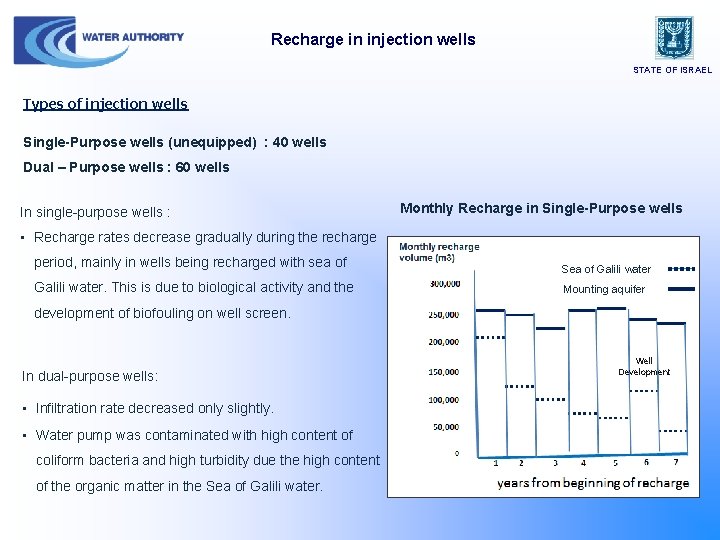
Recharge in injection wells STATE OF ISRAEL Types of injection wells Single-Purpose wells (unequipped) : 40 wells Dual – Purpose wells : 60 wells In single-purpose wells : Monthly Recharge in Single-Purpose wells • Recharge rates decrease gradually during the recharge period, mainly in wells being recharged with sea of Sea of Galili water. This is due to biological activity and the Mounting aquifer development of biofouling on well screen. In dual-purpose wells: • Infiltration rate decreased only slightly. • Water pump was contaminated with high content of coliform bacteria and high turbidity due the high content of the organic matter in the Sea of Galili water. Well Development
Recharge in Injection wells STATE OF ISRAEL Injection wells are sensitive to clogging The failure of some of the injection wells, was primarily because the quality of the water that was injected (Sea of Galili water with high load of organic matter ) Causes for clogging the injection wells At the time of drilling: Mud drilling residues on the screen walls (only by drilling methods using mud such as Reverse Circulation) At the time of injection: Penetration of air bubbles into the rock pores and blocking some of the flow paths During operation: • • • Biological activity - accumulation of microorganisms on the screen wall (biofouling). High content of suspended solids. Chemical sedimentation of minerals on the screen wall. All these factors should be taken very seriously in injection wells planning, which are supposed to work for many years.
Summary STATE OF ISRAEL • Recharge is an excellent way to store water and to increase the amount of available water. • With properation and maintenance, the SAT system should be considered an extremely attractive for effluent reclamation and storage. • High organic load in the recharged water is causing decrease in infiltration rate due to accumulation of microorganisms on the screen wall (biofouling). • Settling of silt and clay particles on the bottom of the ponds decreases recharge rates. • Infiltration rate is decreasing during the recharge season. Flooding and drying regime and soil cultivation between the floods increase the infiltration rate. • Injection wells are sensitive to clogging. The drilling, injection and operation should consider the local conditions and must be professionally planned to increase injection life time. • The location selection of the recharge basin should consider the permeability of the unsaturated zone and the ability to pump the water.
STATE OF ISRAEL THANK YOU
STATE OF ISRAEL