
State of Homelessness Findings from the 2020 Edition
- Slides: 23
State of Homelessness Findings from the 2020 Edition
Housekeeping & Announcements • All attendees are on mute. The Zoom Chat function has been disabled. Please enter your questions in the Zoom Q&A box. • Follow our COVID-19 Webinar Series here - NAEH COVID-19 Webinar Series https: //endhomelessness. org/resource/covid-19 -webinar-series/ • Join the Ending Homelessness Forum https: //forum. endhomelessness. org/login • A recording of this webinar will be emailed to attendees and it will be posted on our website along with the slides.
Presenters Joining the Call Today • Joy Moses, Director of the Homelessness Research Institute at the Alliance • Jackie Janosko, Research Associate at the Alliance
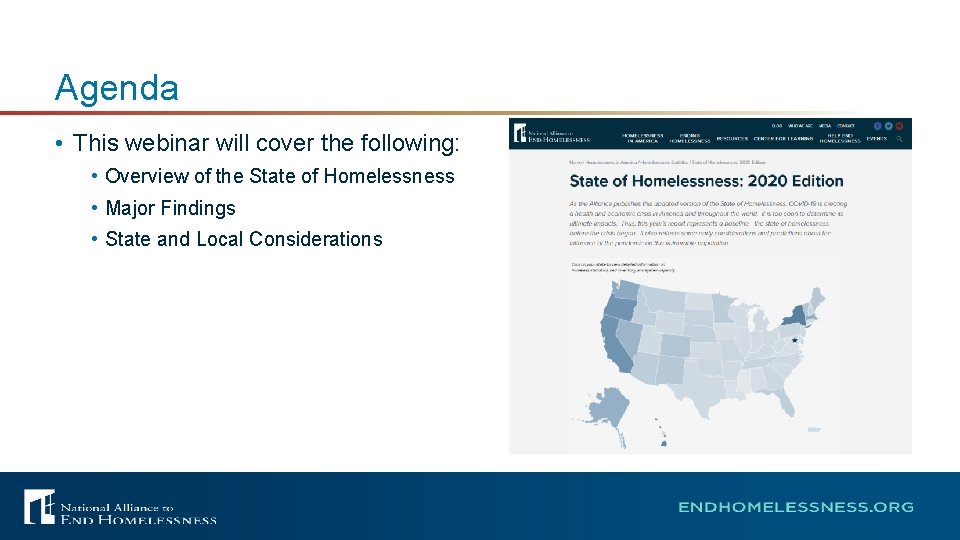
Agenda • This webinar will cover the following: • Overview of the State of Homelessness • Major Findings • State and Local Considerations
Overview of State of Homelessness: 2020 Edition • Annual analysis of HUD and Census data—status quo at various levels (federal, state, Co. C) and trends over time. • What’s new about this version? o Health Crisis Predictions o Emphasis on Rates o Detailed State- and Co. C-Level Pages o State- and Co. C-Level Rankings o Focus on Individuals • Where do I find the report and related materials? • http: //endhomelessness. org/data • https: //endhomelessness. org/blog/
Overview of SOH: 2020 Edition, ctd • Our goal is to use data to tell the story of homelessness in America. . . and to encourage states/Co. Cs to ponder and tell their own stories. • Current moment (COVID-19 and Policing Reforms) is likely rewriting the story o Consider 2019 a baseline year o Potential growths in homelessness o Infusions of new resources—CARES Act ($4 billion for ESG), pending HEROES Act, other legislation o Rethinking services—congregate shelter, rehousing best practices, policing reform o Where will be 2 years, 5 years from now. . .
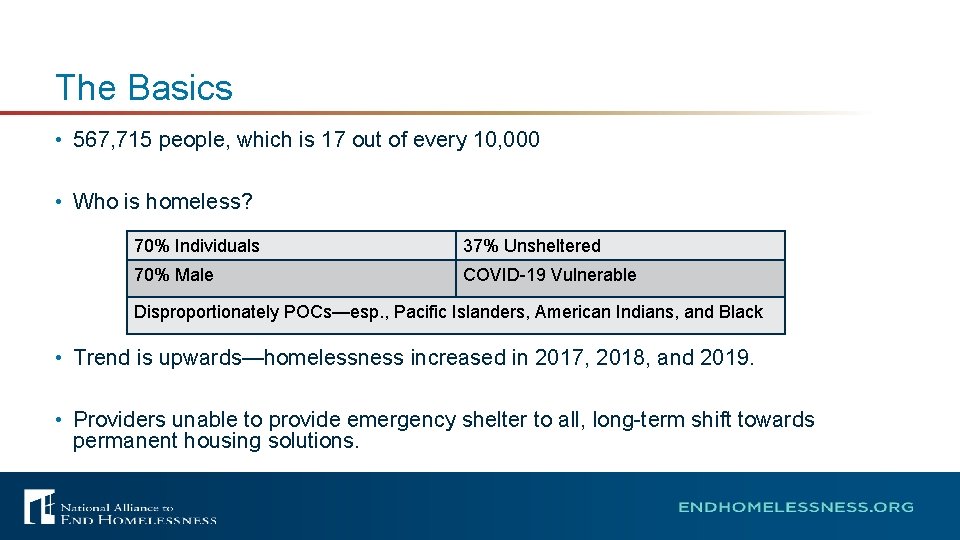
The Basics • 567, 715 people, which is 17 out of every 10, 000 • Who is homeless? 70% Individuals 37% Unsheltered 70% Male COVID-19 Vulnerable Disproportionately POCs—esp. , Pacific Islanders, American Indians, and Black • Trend is upwards—homelessness increased in 2017, 2018, and 2019. • Providers unable to provide emergency shelter to all, long-term shift towards permanent housing solutions.
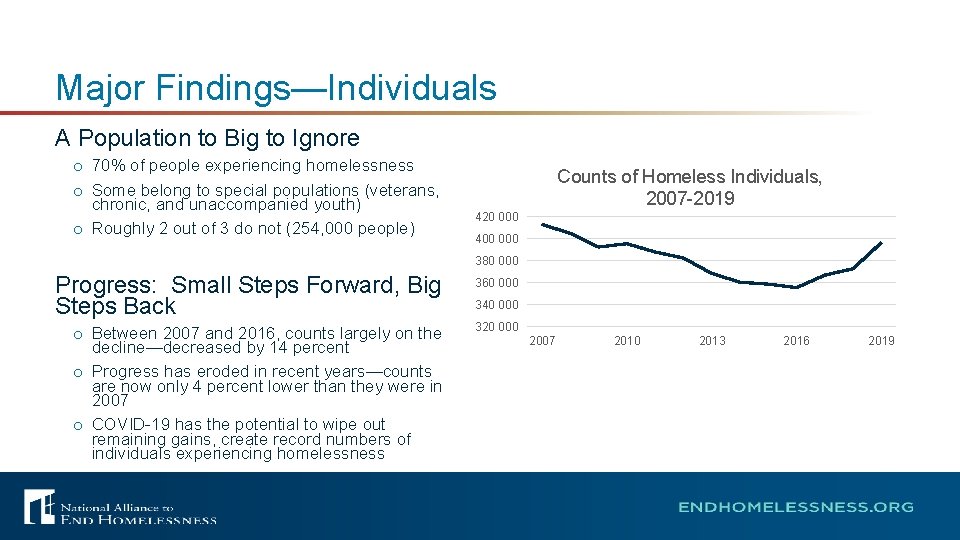
Major Findings—Individuals A Population to Big to Ignore o 70% of people experiencing homelessness o Some belong to special populations (veterans, chronic, and unaccompanied youth) o Roughly 2 out of 3 do not (254, 000 people) Counts of Homeless Individuals, 2007 -2019 420 000 400 000 380 000 Progress: Small Steps Forward, Big Steps Back 360 000 o Between 2007 and 2016, counts largely on the decline—decreased by 14 percent o Progress has eroded in recent years—counts are now only 4 percent lower than they were in 2007 o COVID-19 has the potential to wipe out remaining gains, create record numbers of individuals experiencing homelessness 320 000 340 000 2007 2010 2013 2016 2019
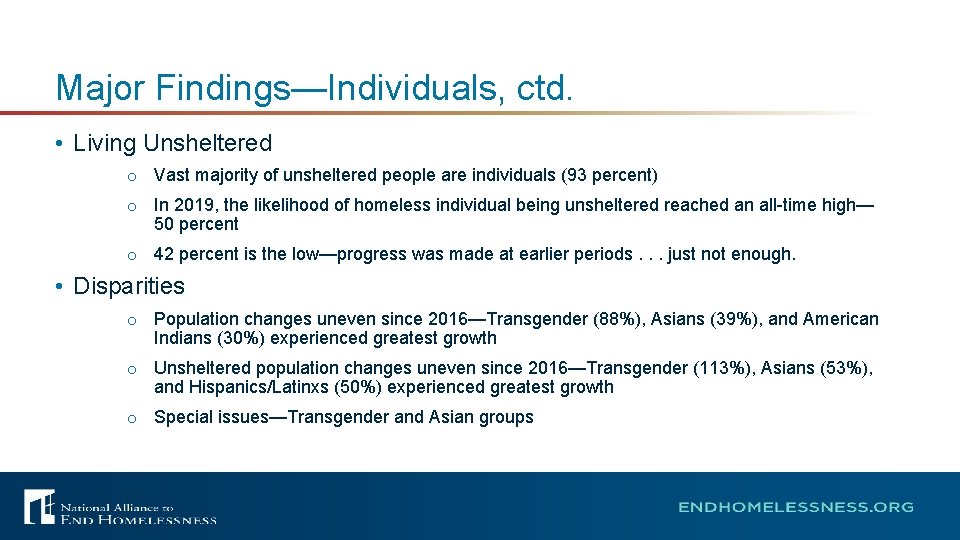
Major Findings—Individuals, ctd. • Living Unsheltered o Vast majority of unsheltered people are individuals (93 percent) o In 2019, the likelihood of homeless individual being unsheltered reached an all-time high— 50 percent o 42 percent is the low—progress was made at earlier periods. . . just not enough. • Disparities o Population changes uneven since 2016—Transgender (88%), Asians (39%), and American Indians (30%) experienced greatest growth o Unsheltered population changes uneven since 2016—Transgender (113%), Asians (53%), and Hispanics/Latinxs (50%) experienced greatest growth o Special issues—Transgender and Asian groups
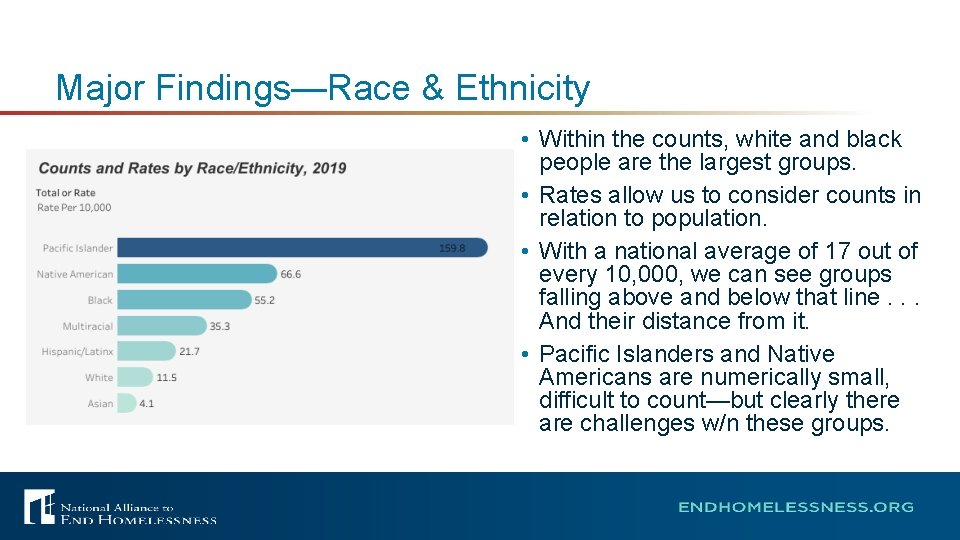
Major Findings—Race & Ethnicity • Within the counts, white and black people are the largest groups. • Rates allow us to consider counts in relation to population. • With a national average of 17 out of every 10, 000, we can see groups falling above and below that line. . . And their distance from it. • Pacific Islanders and Native Americans are numerically small, difficult to count—but clearly there are challenges w/n these groups.
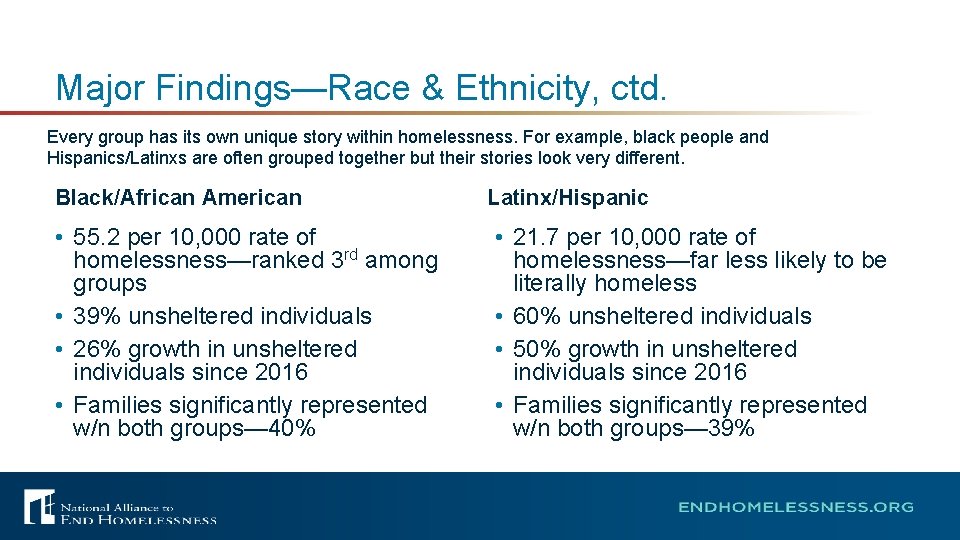
Major Findings—Race & Ethnicity, ctd. Every group has its own unique story within homelessness. For example, black people and Hispanics/Latinxs are often grouped together but their stories look very different. Black/African American • 55. 2 per 10, 000 rate of homelessness—ranked 3 rd among groups • 39% unsheltered individuals • 26% growth in unsheltered individuals since 2016 • Families significantly represented w/n both groups— 40% Latinx/Hispanic • 21. 7 per 10, 000 rate of homelessness—far less likely to be literally homeless • 60% unsheltered individuals • 50% growth in unsheltered individuals since 2016 • Families significantly represented w/n both groups— 39%
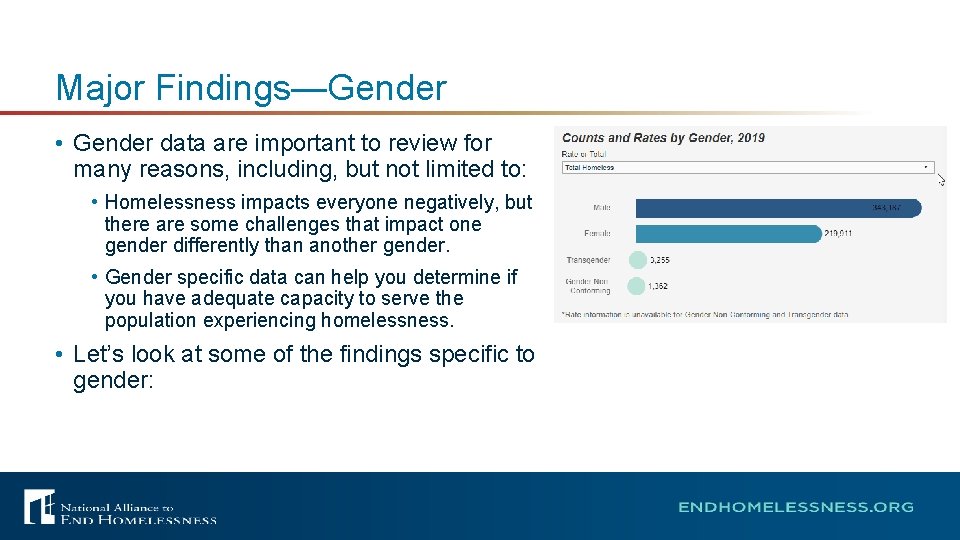
Major Findings—Gender • Gender data are important to review for many reasons, including, but not limited to: • Homelessness impacts everyone negatively, but there are some challenges that impact one gender differently than another gender. • Gender specific data can help you determine if you have adequate capacity to serve the population experiencing homelessness. • Let’s look at some of the findings specific to gender:
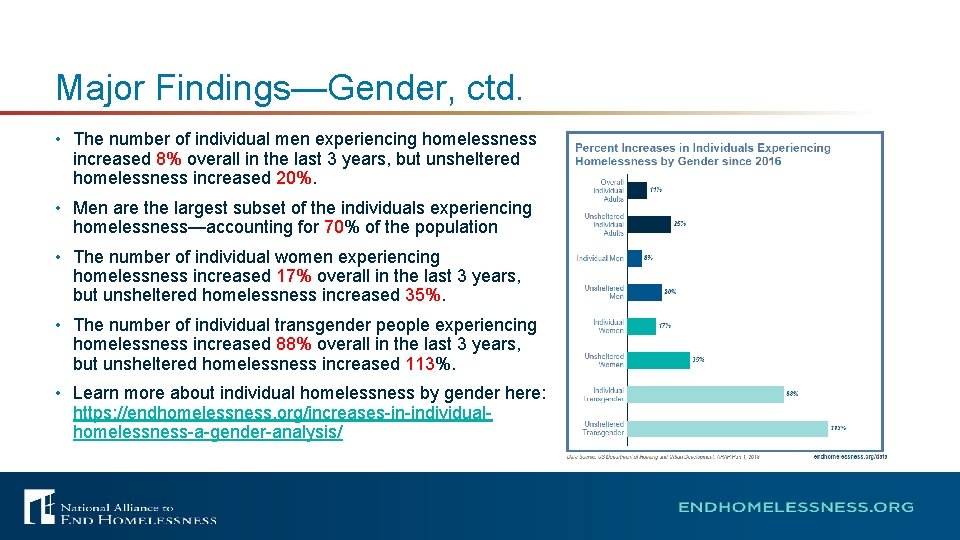
Major Findings—Gender, ctd. • The number of individual men experiencing homelessness increased 8% overall in the last 3 years, but unsheltered homelessness increased 20%. • Men are the largest subset of the individuals experiencing homelessness—accounting for 70% of the population • The number of individual women experiencing homelessness increased 17% overall in the last 3 years, but unsheltered homelessness increased 35%. • The number of individual transgender people experiencing homelessness increased 88% overall in the last 3 years, but unsheltered homelessness increased 113%. • Learn more about individual homelessness by gender here: https: //endhomelessness. org/increases-in-individualhomelessness-a-gender-analysis/
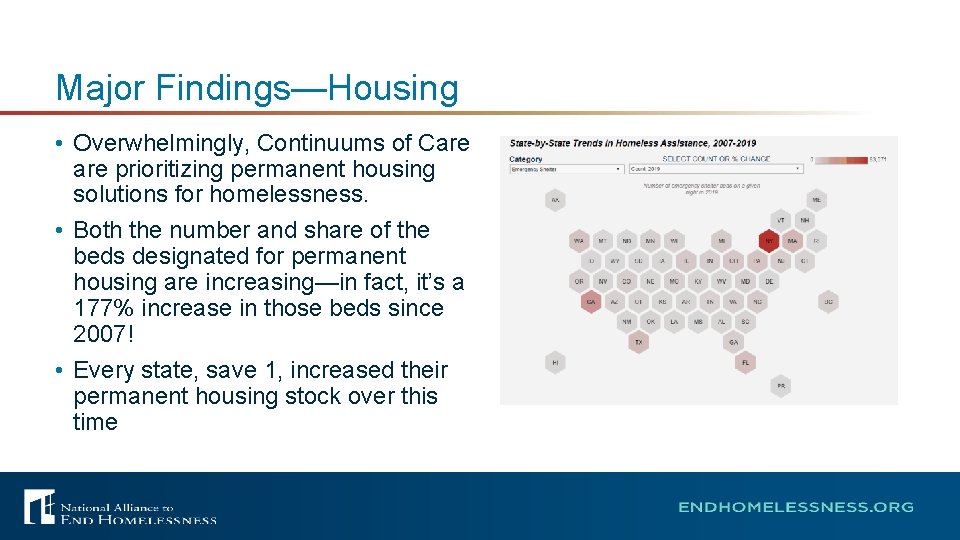
Major Findings—Housing • Overwhelmingly, Continuums of Care prioritizing permanent housing solutions for homelessness. • Both the number and share of the beds designated for permanent housing are increasing—in fact, it’s a 177% increase in those beds since 2007! • Every state, save 1, increased their permanent housing stock over this time
Major Findings—Housing, ctd. • 41% of system beds are in Permanent Supportive Housing—representing a 96% increase since 2007. • Rapid rehousing is continuing along a path of rapid growth. There are 87 percent more beds in this category than there were five years ago. • Learn more about the investments in permanent housing and why they are critical to ending homelessness here: https: //endhomelessness. org/permanent-housing-increases-showcommitment-to-ending-homelessness/
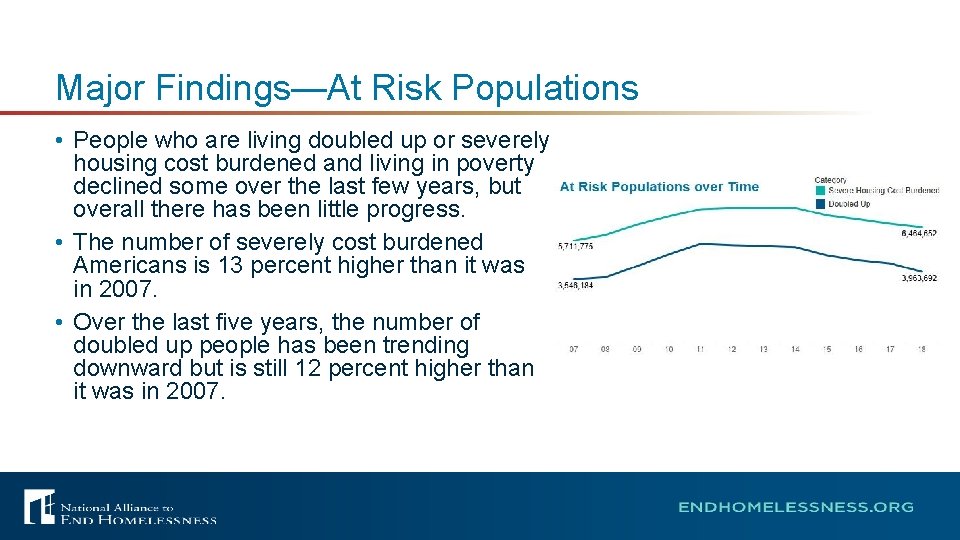
Major Findings—At Risk Populations • People who are living doubled up or severely housing cost burdened and living in poverty declined some over the last few years, but overall there has been little progress. • The number of severely cost burdened Americans is 13 percent higher than it was in 2007. • Over the last five years, the number of doubled up people has been trending downward but is still 12 percent higher than it was in 2007.
State/Local Data—Evaluating Your State and Co. C • One of the newest features of the State of Homelessness is the Data Dashboard • Click your desired state on the map at the top of the State of Homelessness report to load the page and start exploring the data by state or click a Co. C to view data on a more local level • These tools are helpful in tracking progress toward ending homelessness in several ways: • Homelessness trends by population type over time • Rate of homelessness per 10, 000 over time by state • Demographic details over time • Evaluation of system capacity • Temporary and permanent housing beds over time
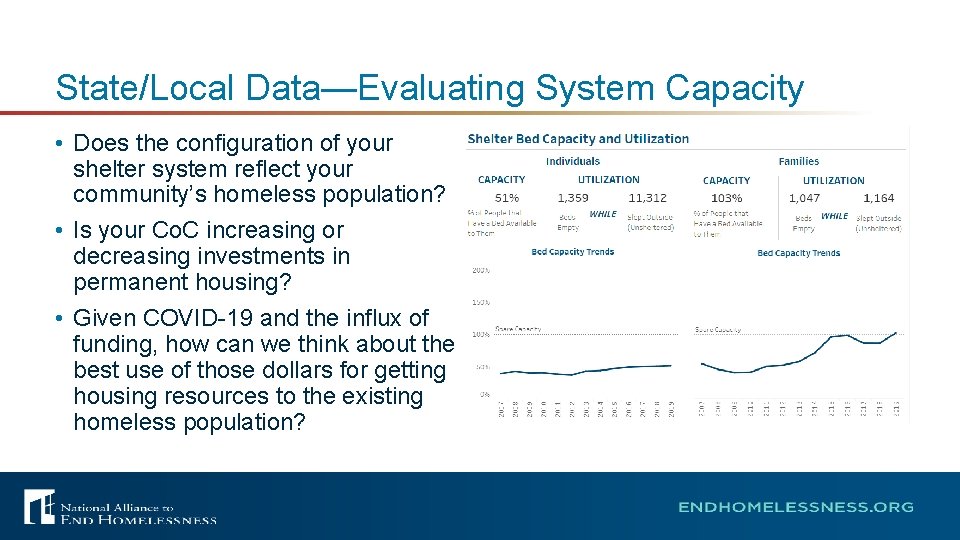
State/Local Data—Evaluating System Capacity • Does the configuration of your shelter system reflect your community’s homeless population? • Is your Co. C increasing or decreasing investments in permanent housing? • Given COVID-19 and the influx of funding, how can we think about the best use of those dollars for getting housing resources to the existing homeless population?
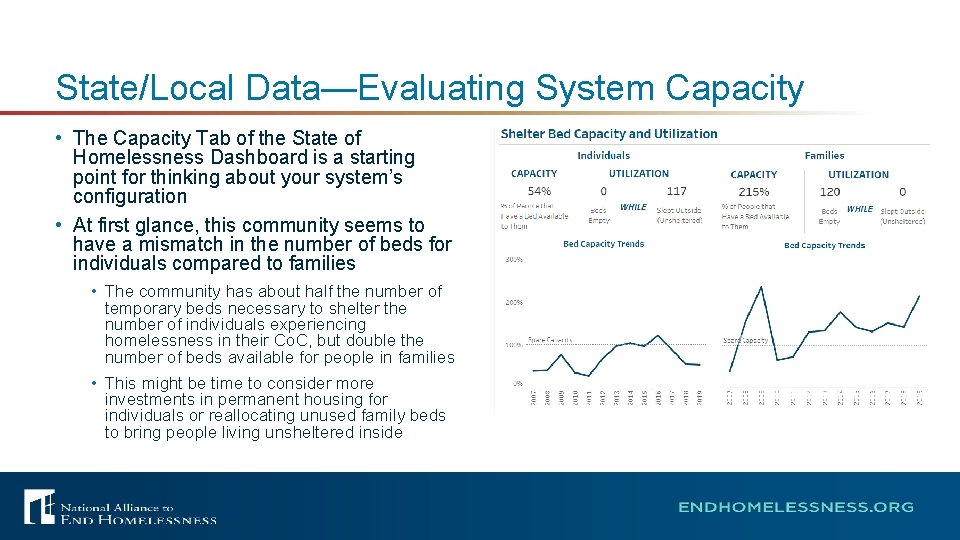
State/Local Data—Evaluating System Capacity • The Capacity Tab of the State of Homelessness Dashboard is a starting point for thinking about your system’s configuration • At first glance, this community seems to have a mismatch in the number of beds for individuals compared to families • The community has about half the number of temporary beds necessary to shelter the number of individuals experiencing homelessness in their Co. C, but double the number of beds available for people in families • This might be time to consider more investments in permanent housing for individuals or reallocating unused family beds to bring people living unsheltered inside
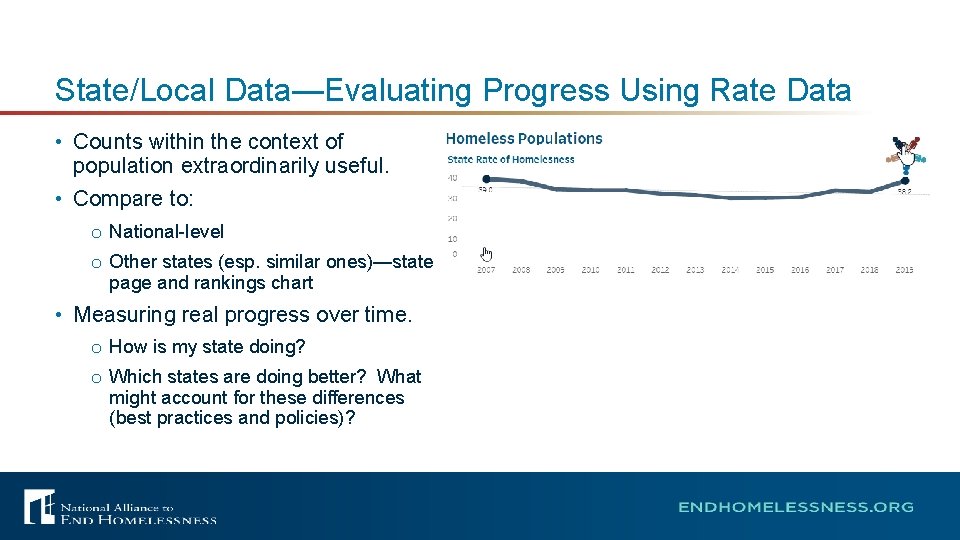
State/Local Data—Evaluating Progress Using Rate Data • Counts within the context of population extraordinarily useful. • Compare to: o National-level o Other states (esp. similar ones)—state page and rankings chart • Measuring real progress over time. o How is my state doing? o Which states are doing better? What might account for these differences (best practices and policies)?
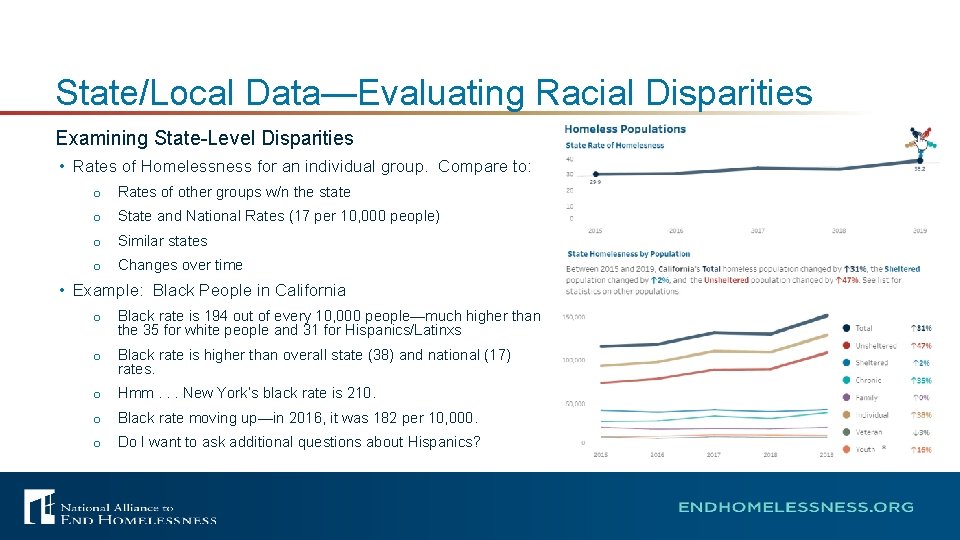
State/Local Data—Evaluating Racial Disparities Examining State-Level Disparities • Rates of Homelessness for an individual group. Compare to: o Rates of other groups w/n the state o State and National Rates (17 per 10, 000 people) o Similar states o Changes over time • Example: Black People in California o Black rate is 194 out of every 10, 000 people—much higher than the 35 for white people and 31 for Hispanics/Latinxs o Black rate is higher than overall state (38) and national (17) rates. o Hmm. . . New York’s black rate is 210. o Black rate moving up—in 2016, it was 182 per 10, 000. o Do I want to ask additional questions about Hispanics?
State/Local Data—Evaluating Racial Disparities, ctd COC-Level--Begin your analysis with counts • Groups w/ the greatest and least numbers • Consider w/n the overall story of the state • Example: San Francisco—the count line for Black people falls higher than it does for the state in general. Why? • Additional information in the AHAR Able to work with your system’s data? Try these: • The Alliances Race Equity Tool--https: //endhomelessness. org/resource/the-alliances -racial-equity-network-toolkit/ • HUD’s Co. C Analysis Tool (Race and Ethnicity)-https: //www. hudexchange. info/resource/5787/coc-analysis-tool-race-andethnicity/ • Stella
Thank you for attending. Time for Q&A. • Please use the Questions and Answers box to submit your questions • We will answer as many questions as we can in the time available • If you have additional questions, please reach out to us Our contact info: Joy Moses Director Homeless Research Institute jmoses@naeh. org Jackie Janosko Research Associate jjanosko@naeh. org