
STATE OF GEORGIA Department of Community Affairs Georgia

- Slides: 17
STATE OF GEORGIA Department of Community Affairs Georgia Rental Assistance Housing Conference
Hello! Ashley Hoffman, Outreach Specialist The Georgia Department of Community Affairs is a state agency that helps build strong, vibrant communities. We provide support to communities on their journey towards growth and prosperity, helping lay the groundwork for economic opportunities and local development efforts across the state.
INTRODUCTION • Overview of Georgia Rental Assistance program • Timeline • Financial Assistance provided • Process • Who Can Apply HOW TO APPLY • Landlord Requirements • Tenant Requirements • Submitted Application QUESTION + ANSWER
Program Overview GEORGIA RENTAL ASSISTANCE PROGRAM (GRA) § US Treasury Department allocated $25 billion to states and local governments § Georgia received $552 M in stimulus funds through the federal Emergency Rental Assistance Program § Funds are intended to provide relief to landlords and tenants who are behind on rental and utility payments due to the coronavirus pandemic § DCA has created an online application for individuals to apply to receive funding to bring past-due rent and utility balances current. § Does not cover 12 jurisdictions in Georgia that received their own ERA funding. All jurisdictions not covered by GRA are below: § § City of Atlanta Augusta-Richmond County Chatham County Cherokee County § § Clayton County Cobb County De. Kalb County Forsyth County § § Fulton County Gwinnett County Hall County Henry County
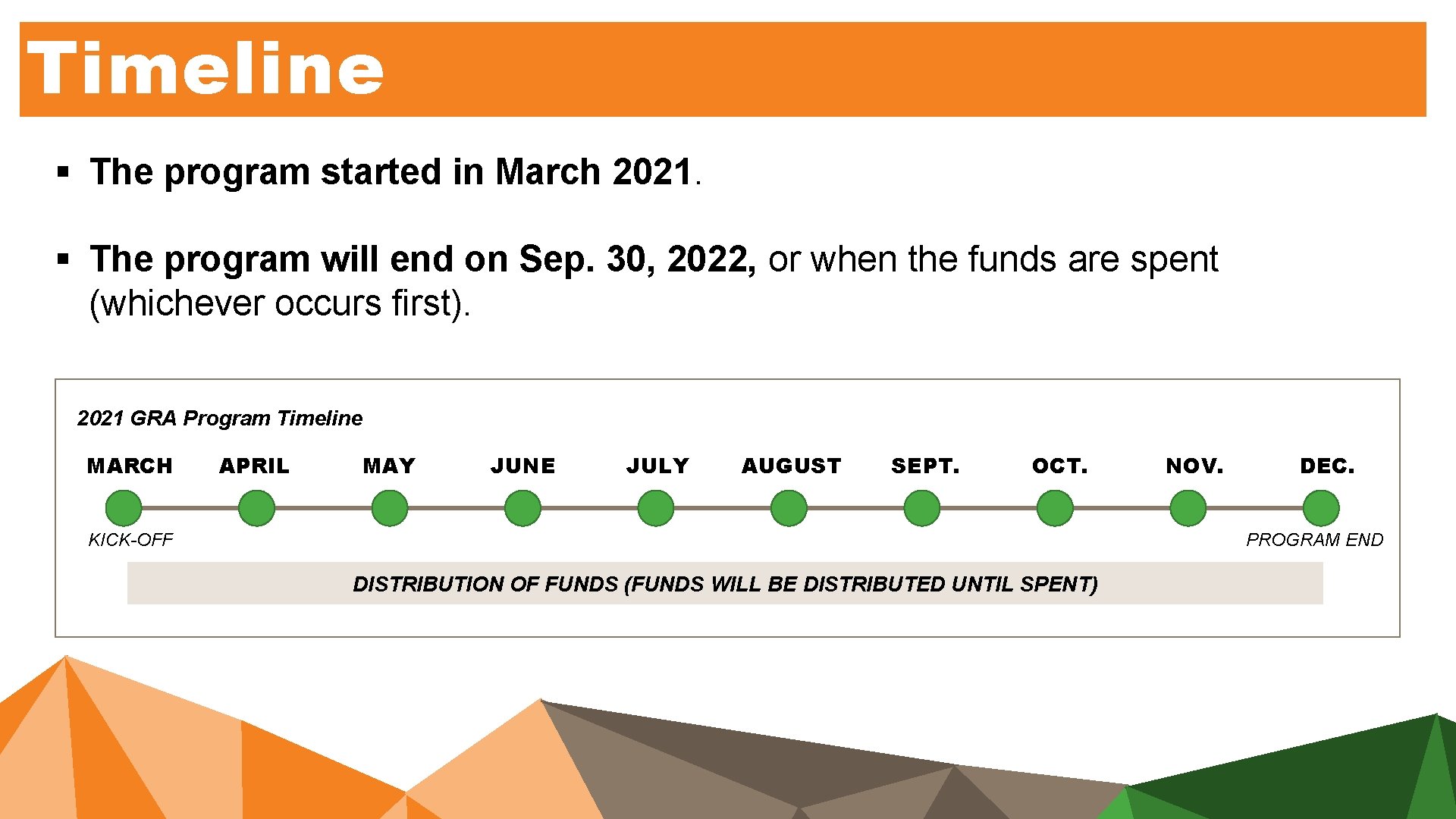
Timeline § The program started in March 2021. § The program will end on Sep. 30, 2022, or when the funds are spent (whichever occurs first). 2021 GRA Program Timeline MARCH APRIL MAY JUNE JULY AUGUST SEPT. OCT. KICK-OFF NOV. DEC. PROGRAM END DISTRIBUTION OF FUNDS (FUNDS WILL BE DISTRIBUTED UNTIL SPENT)
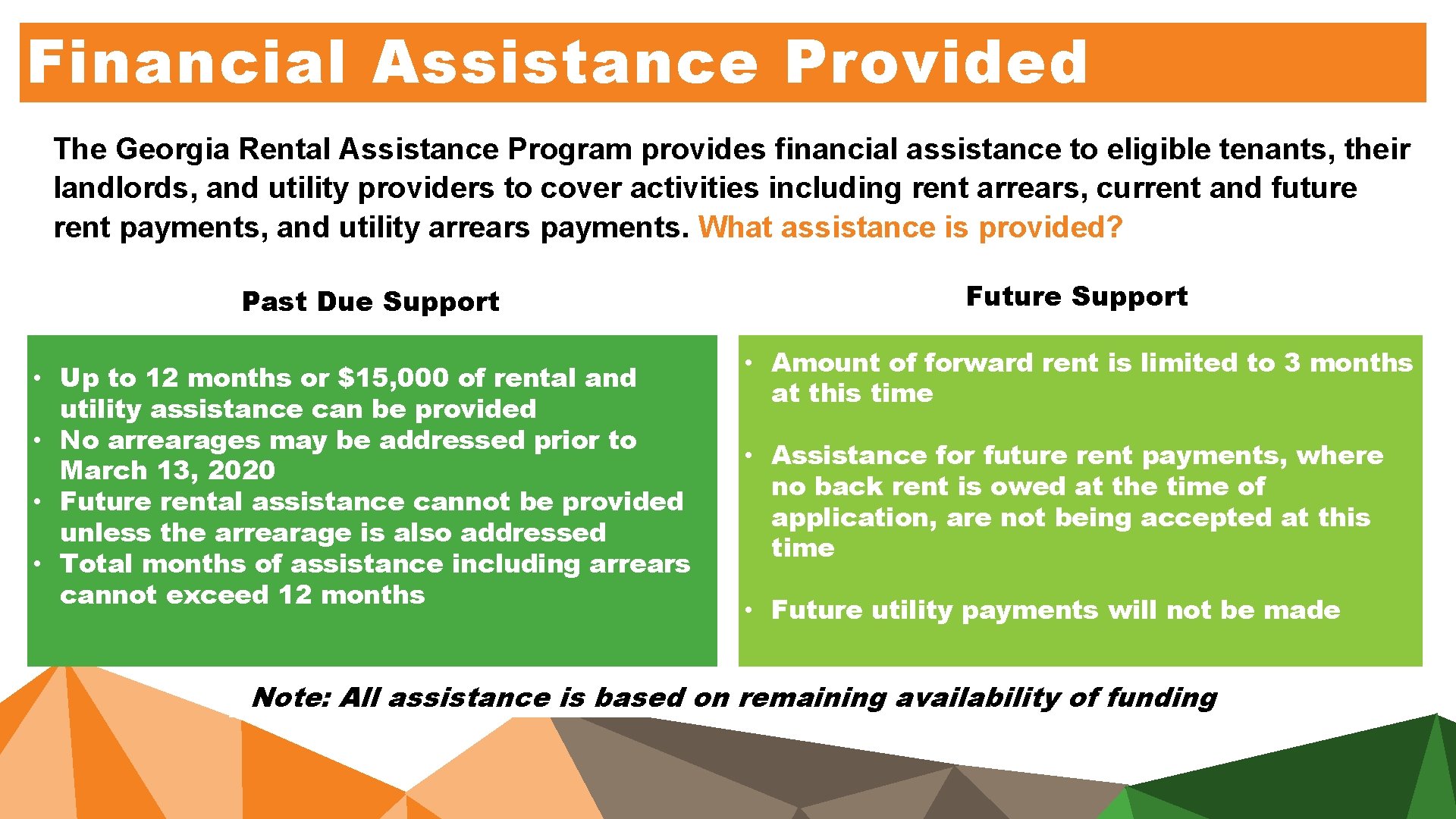
Financial Assistance Provided The Georgia Rental Assistance Program provides financial assistance to eligible tenants, their landlords, and utility providers to cover activities including rent arrears, current and future rent payments, and utility arrears payments. What assistance is provided? Past Due Support • Up to 12 months or $15, 000 of rental and utility assistance can be provided • No arrearages may be addressed prior to March 13, 2020 • Future rental assistance cannot be provided unless the arrearage is also addressed • Total months of assistance including arrears cannot exceed 12 months Future Support • Amount of forward rent is limited to 3 months at this time • Assistance for future rent payments, where no back rent is owed at the time of application, are not being accepted at this time • Future utility payments will not be made Note: All assistance is based on remaining availability of funding
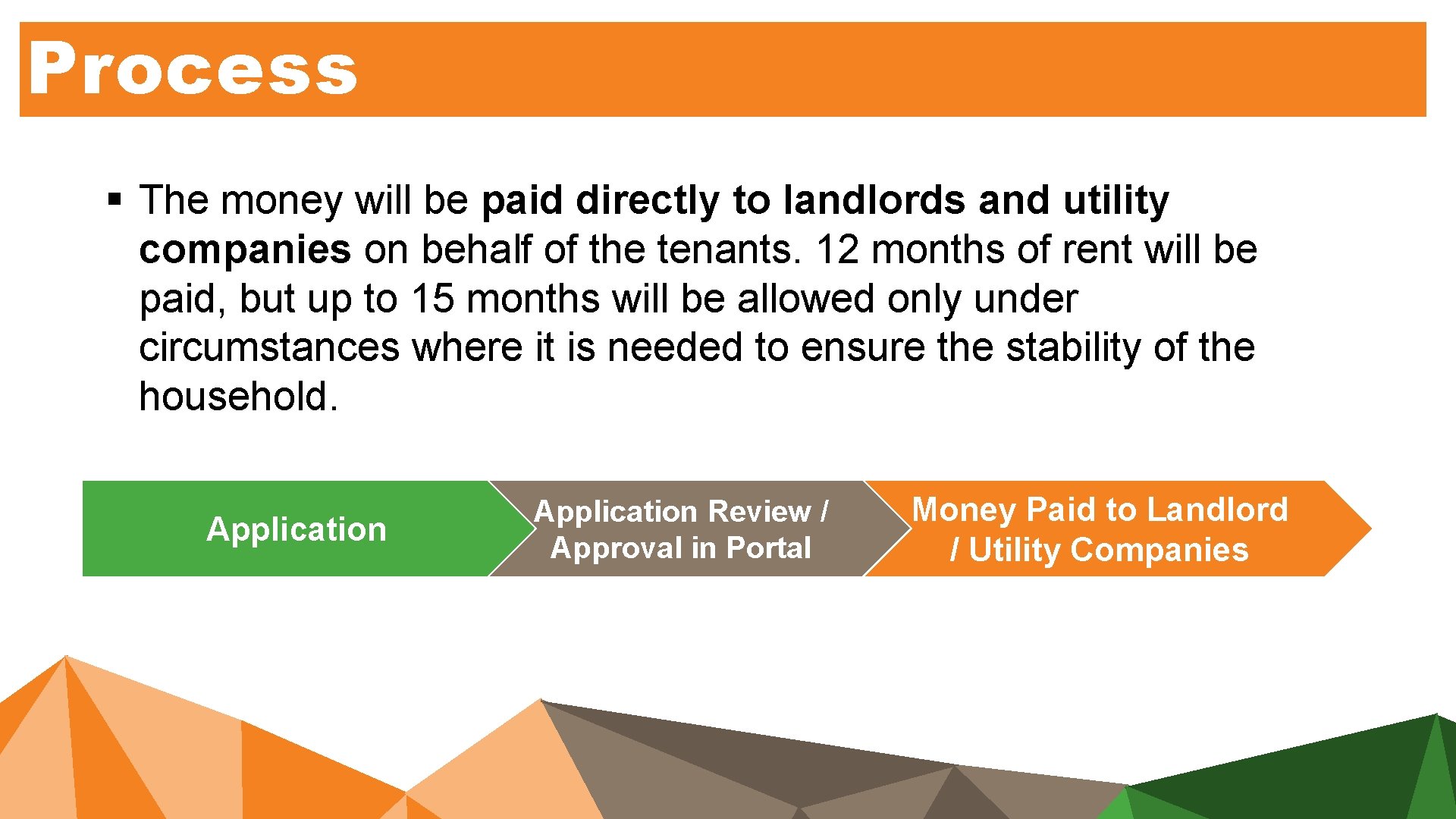
Process § The money will be paid directly to landlords and utility companies on behalf of the tenants. 12 months of rent will be paid, but up to 15 months will be allowed only under circumstances where it is needed to ensure the stability of the household. Application Review / Approval in Portal Money Paid to Landlord / Utility Companies
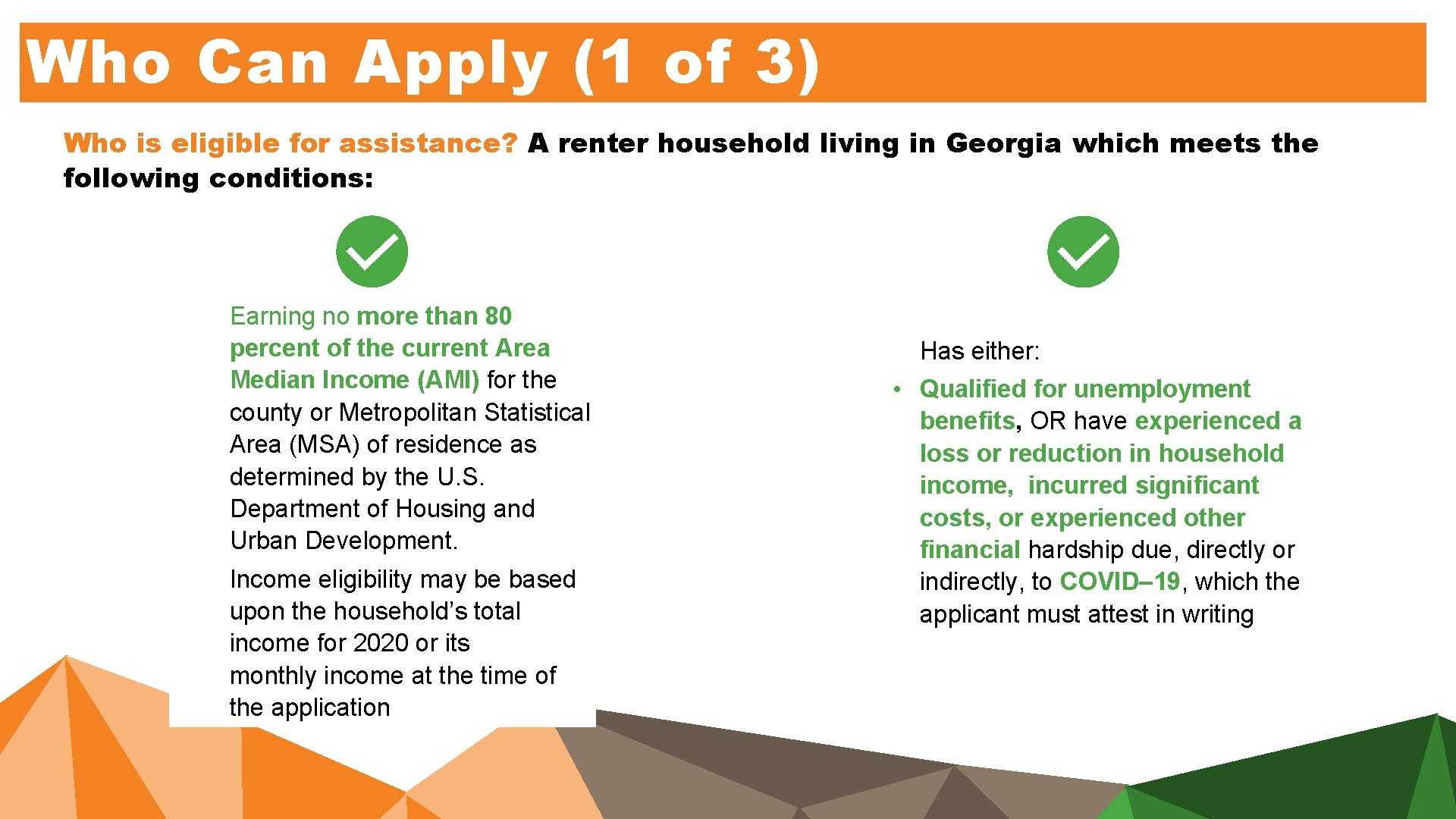
Who Can Apply (1 of 3) Who is eligible for assistance? A renter household living in Georgia which meets the following conditions: Earning no more than 80 percent of the current Area Median Income (AMI) for the county or Metropolitan Statistical Area (MSA) of residence as determined by the U. S. Department of Housing and Urban Development. Income eligibility may be based upon the household’s total income for 2020 or its monthly income at the time of the application Has either: • Qualified for unemployment benefits, OR have experienced a loss or reduction in household income, incurred significant costs, or experienced other financial hardship due, directly or indirectly, to COVID– 19, which the applicant must attest in writing
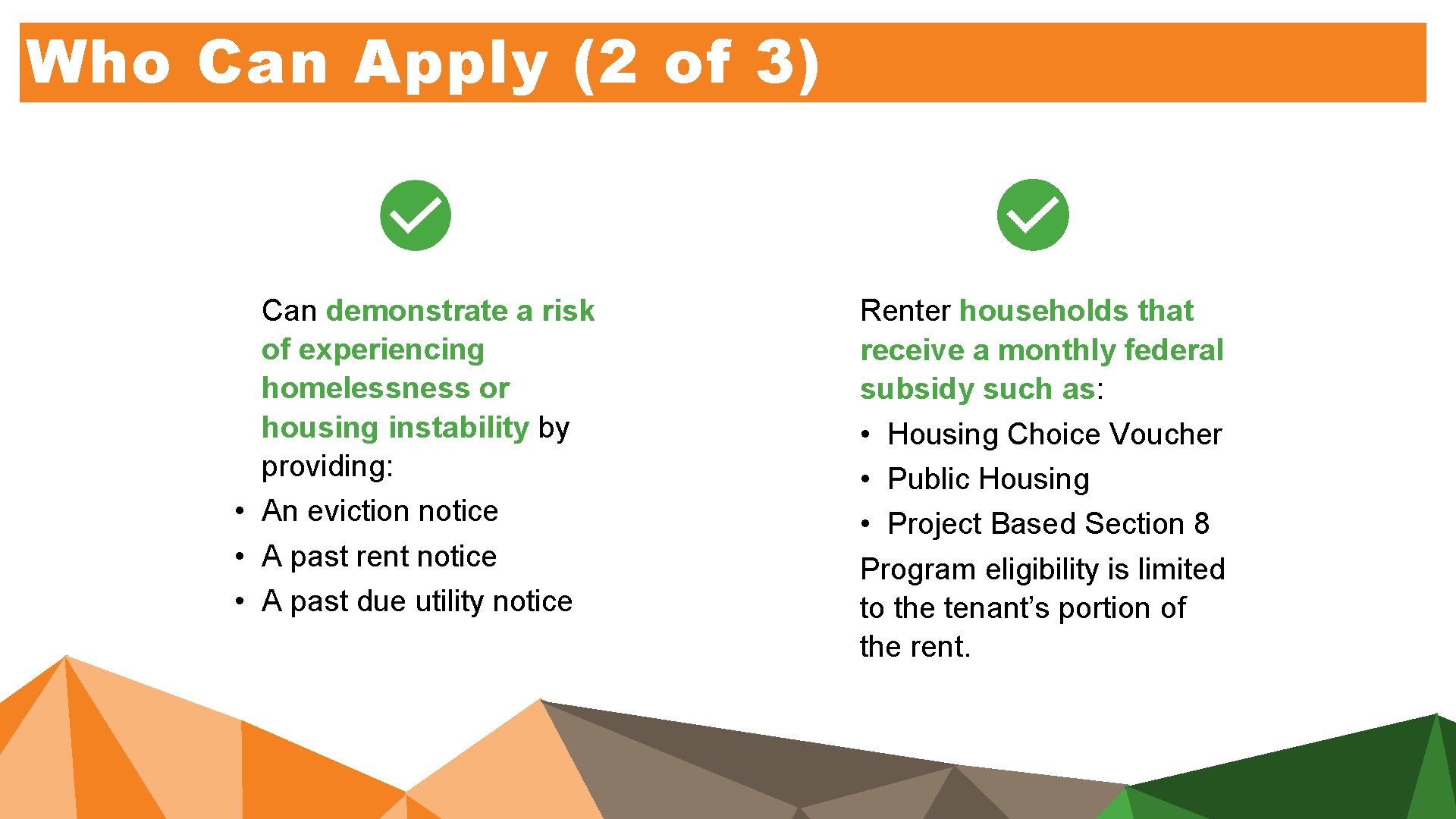
Who Can Apply (2 of 3) Can demonstrate a risk of experiencing homelessness or housing instability by providing: • An eviction notice • A past rent notice • A past due utility notice Renter households that receive a monthly federal subsidy such as: • Housing Choice Voucher • Public Housing • Project Based Section 8 Program eligibility is limited to the tenant’s portion of the rent.
Who Can Apply (3 of 3) Who Can Apply: An application for rental assistance may be submitted by either an eligible household or by a landlord on behalf of that eligible household. A landlord submitting on behalf of a tenant will need to inform the tenant and obtain their signature for the application, which may be documented electronically. In this situation the tenant may also submit a separate application for assistance with rent and utility arrearages.
Landlord Documents (1 of 3) Through their participation in the program, landlords must agree to accept these payments to satisfy any arrearages of the tenant for time period covered and to not pursue eviction proceedings based on this arrearage. DOCUMENTATION & INFORMATION q Proof of identity (person completing application) q Proof of ownership (may include warranty deed, current tax record, or an insurance binder) q Where applicable, a property management company or legal representative must attach documentation showing authorization to act on behalf of the property owner (Authorization Agreement Contract/Memorandum of Understanding (MOU)/Memorandum of Agreement (MOA). q Statement of Delinquent Rent (form) q IRS W-9 form q ACH payment form (direct deposit)
Landlord Documents (2 of 3) Through their participation in the program, landlords must agree to accept these payments to satisfy any arrearages of the tenant for time period covered and to not pursue eviction proceedings based on this arrearage. DOCUMENTATION & INFORMATION Other Information: q Landlords/legal representatives will provide (within application): q Valid tax identification number (Social Security Number/EIN) q Information on costs of any utilities included within the rent - Utilities covered by landlord within rent will be treated as rent q Attestation - The landlord/property management agent or company must abide by all Emergency Rental Assistance Program requirements and will be provided with a clear summary and details of payments to be made on behalf of eligible individuals and families. q Legal fees or other charges included in the amount requested as applicable are not permitted and they will be backed out of the total rental amounts owed. In order to participate in the program, landlords will be required to waive these fees. q Payments of reasonably accrued late fees included in rental or utility arrears, if incurred due to COVID-19, are allowed and limited to 8% of total arrearage
Landlord Documents (3 of 3) Through their participation in the program, landlords must agree to accept these payments to satisfy any arrearages of the tenant for time period covered and to not pursue eviction proceedings based on this arrearage. ADDITIONAL DOCUMENTATION/CONSIDERATIONS q Households that reside at a LIHTC (Low-Income Housing Tax Credit) or HOME-assisted property would be able to receive assistance for the portion of the rent that the tenant is responsible to cover, and only to the extent that it has not already been covered through another program. q Households that live in a unit where the landlord has a family relationship to anyone in the household may be eligible but must provide documentation that a true landlord-tenant relationship exists. This would include a copy of the lease as well as verification of a past rental payment history of no less than six months.
Renter Documents RENTER DOCUMENTATION What documents will a renter need to show eligibility? • Photo Identification • Driver’s license, Government-issued photo ID, U. S. Military photo ID. Tribal photo ID, Passport/Passport Card • Proof of Renter Status (lease, certification, evidence of utility payment, landlord attestation, other) • Additional documentation if landlord has a family relationship to anyone in the household (copy of the lease and verification of a past rental payment history of no less than six months). • Proof of Risk of Homelessness & Housing Instability (eviction notice, past-due rent, past-due utilities) • Income documents for household members (attestation in limited circumstances) • Verification of Hardship (attestation for unemployment qualification OR explanation/attestation for loss of income, incurred significant costs, or other financial hardship due directly/indirectly to COVID-19) • If applying for utility assistance in addition to rent, copies of most recent utility bills showing the amount owed, the utility provider and account number.
Submitted Applications When an application is submitted, but there are one or more issues with the supporting documents submitted, or an issue with information or certifications within the application, GRA will have a staff team dedicated to follow up with applicants to correct those issues. Once a GRA staff member begins the follow up process with an applicant to troubleshoot issues with the application, the applicant will have: - Ten (10) business days to provide the correct information or document(s) for the application to be considered complete. - If the applicant does not provide corrected information or is unresponsive after ten (10) business days where an application is still considered incomplete, DCA reserves the right to continue follow up with the applicant, refer the applicant to a partner agency for assistance, or consider the application closed. - Applications are only able to be reviewed when they are complete. When applicants resolve outstanding issues/errors, the application will be marked as complete to move forward for review.
QUESTION + ANSWER
EMAIL FOR MORE INFORMATION: gramarketing@dca. gov