
State of Connecticut Department of Public Health The
State of Connecticut Department of Public Health The Special Supplemental Nutrition Program for Women, Infants, and Children-WIC Program This institution is an equal opportunity provider.
Purpose of our program To serve nutritionally at-risk women, infants, and children up to age 5. To show participants that good nutrition leads to better health. To provide nutrition education and specific supplemental foods for good health and nutrition during critical times of growth and development. To provide referrals for health care and other services. Purpose for training To improve vendors' understanding of Program rules and requirements to enhance compliance and prevent errors.
CIVIL RIGHTS Post in your work areas so all staff are aware of this WIC Civil Rights protection information. All WIC authorized vendors must ensure that they are in compliance at all times with the State of Connecticut, Department of Public Health, WIC State Plan Policy 104 -03 Civil Rights Discrimination Complaints procedure Discrimination/Civil Rights Notice Complaints from WIC participants about authorized stores may be written or oral and filed anonymously. Understanding program requirements will help you stay in compliance with the terms of your signed WIC Vendor Agreement in which the store agrees to: • Comply with all the procedures for WIC transacting WIC benefits • Comply with all procedures for pricing and payment requirements • Provide regular review of WIC policies and procedures with all persons involved in WIC transactions • Comply with WIC customer confidentiality and treat a person using WIC benefits courteously. • Comply with nondiscrimination provisions of USDA regulations (7 CFR Parts 15, 15 a and 15 b of this title) including but not limited to; WIC PARTICIPANTS BEING UNFAIRLY DENIED SERVICES, DELAYED FROM RECEIVING SERVICES, OR TREATED DIFFERENTLY FROM OTHERS, AS THEY MAY HAVE A CLAIM OF DISCRIMINATION Please make sure that employees are not violating the civil rights of customers receiving federal financial assistance by refusing to serve them and providing inferior customer service. This includes, but is not limited to, not accepting valid WIC benefits from participants/customers, infant formula not being made available within 48 hours of the request and customers paying with WIC being identified and discriminated against due to their payment type. Cashiers should be polite and treat WIC customers with respect.
FOOD RESOURCE AND VENDOR MANAGEMENT UNIT (FRVM) Mission The Food Resource and Vendor Management Unit is committed to ensuring participants’ access to specific nutritious foods provided by the Connecticut WIC Program by authorizing retail stores and assuring program integrity and compliance through effective management, oversight and review of its authorized vendors. Purpose Strengthen the quality of vendor services to the community through; v Training v Monitoring/Evaluation v Recruitment v Ensuring Business Integrity v Quality Customer Service Through these efforts improving adequate participant access to support the shopping experience of our WIC participants.
Changes to Program Requirements in the last 3 years • Implemented online portal for applications • Revisions to WIC Vendor Agreement in March and December 2017 • New vendors must pay for their own equipment (if not needed for access) • Added New foods to Approved Food Guide • Allowed 12 ounce cereal and added Baby Food Fruit & Vegetable Mixtures • Standard Formula switch from Enfamil to Similac
Owner’s Responsibility for Training • You are responsible for training your store employees and cashiers before they handle WIC benefits • Inform and provide annual and regular training to existing store employees • Provide documentation of employee WIC training upon request • Owners are accountable for the actions of staff who handle WIC transactions • Owners, managers, and staff will be required to sign off on bulletins that contain vendor information. • Employees must be trained on transactions and owners/managers must be trained on minimum inventory requirements
Appendix A-Selection Criteria • Authorized vendors must meet the selection criteria at all times throughout the authorization period. • We may reassess you at any time during your agreement period using the vendor section criteria in effect at the time of the reassessment • The WIC program will terminate the authorization of vendors who fail to meet the criteria.
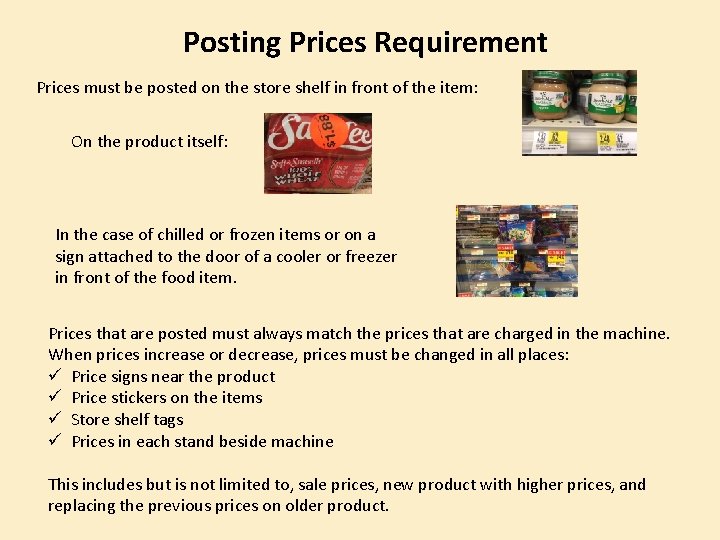
Posting Prices Requirement Prices must be posted on the store shelf in front of the item: On the product itself: In the case of chilled or frozen items or on a sign attached to the door of a cooler or freezer in front of the food item. Prices that are posted must always match the prices that are charged in the machine. When prices increase or decrease, prices must be changed in all places: ü Price signs near the product ü Price stickers on the items ü Store shelf tags ü Prices in each stand beside machine This includes but is not limited to, sale prices, new product with higher prices, and replacing the previous prices on older product.
Appendix B-Minimum Inventory Requirements At all times, you must maintain each of the following WIC approved foods in the quantities stated with future expiration dates on the shelves or on the store premises. To ensure constant availability of WIC approved foods to our WIC customers, you may have to stock these food items in larger quantities than is required. Refer to the WIC Approved Food Guide for specific products and brand names allowed. This minimum inventory requirement serves 2 -3 WIC customers. The WIC approved items that we find shortages on during monitoring are: • Cheese • Baby Food Fruit • Baby Food Vegetables • Formula
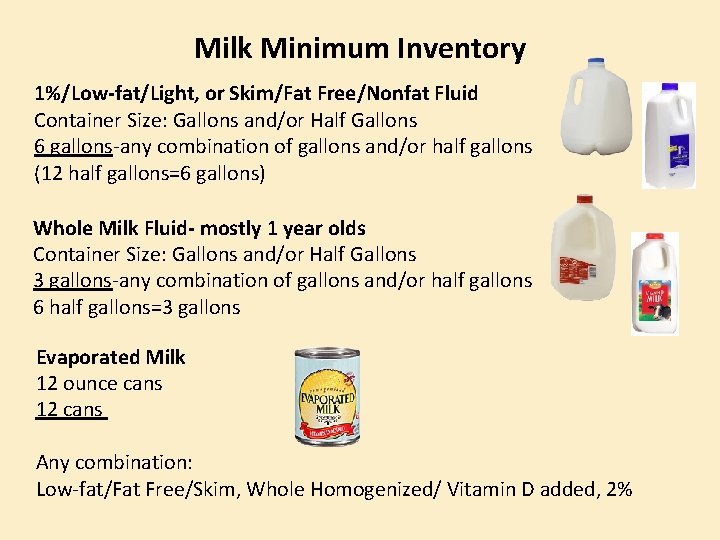
Milk Minimum Inventory 1%/Low-fat/Light, or Skim/Fat Free/Nonfat Fluid Container Size: Gallons and/or Half Gallons 6 gallons-any combination of gallons and/or half gallons (12 half gallons=6 gallons) Whole Milk Fluid- mostly 1 year olds Container Size: Gallons and/or Half Gallons 3 gallons-any combination of gallons and/or half gallons 6 half gallons=3 gallons Evaporated Milk 12 ounce cans 12 cans Any combination: Low-fat/Fat Free/Skim, Whole Homogenized/ Vitamin D added, 2%
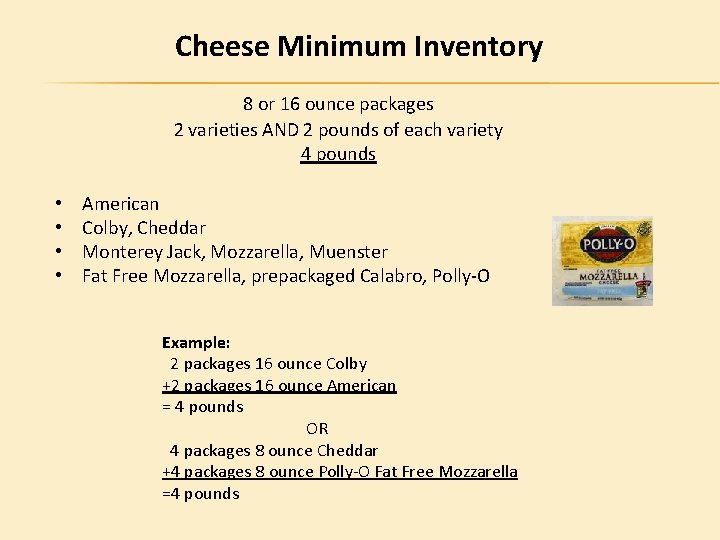
Cheese Minimum Inventory 8 or 16 ounce packages 2 varieties AND 2 pounds of each variety 4 pounds • • American Colby, Cheddar Monterey Jack, Mozzarella, Muenster Fat Free Mozzarella, prepackaged Calabro, Polly-O Example: 2 packages 16 ounce Colby +2 packages 16 ounce American = 4 pounds OR 4 packages 8 ounce Cheddar +4 packages 8 ounce Polly-O Fat Free Mozzarella =4 pounds
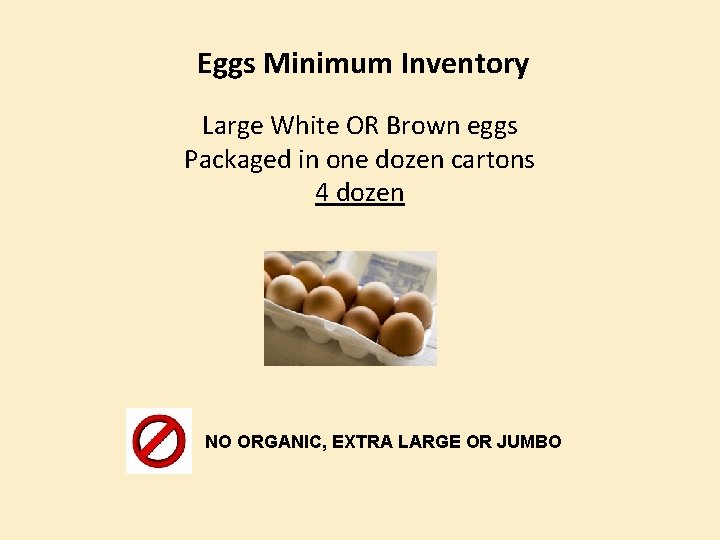
Eggs Minimum Inventory Large White OR Brown eggs Packaged in one dozen cartons 4 dozen NO ORGANIC, EXTRA LARGE OR JUMBO
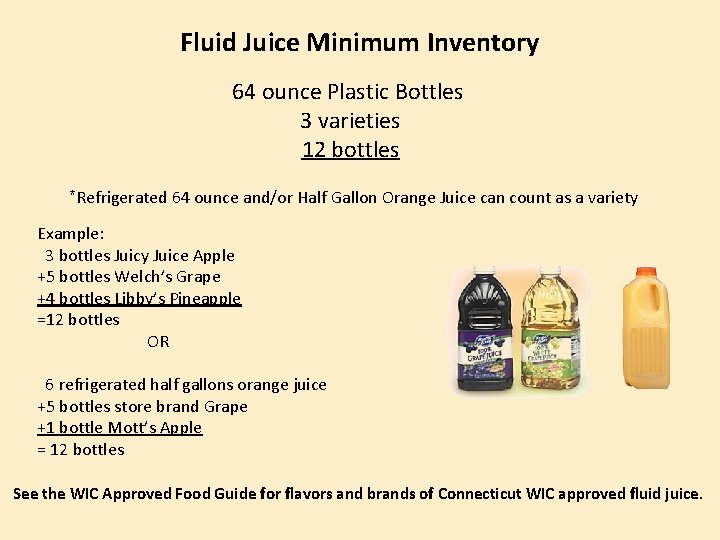
Fluid Juice Minimum Inventory 64 ounce Plastic Bottles 3 varieties 12 bottles *Refrigerated 64 ounce and/or Half Gallon Orange Juice can count as a variety Example: 3 bottles Juicy Juice Apple +5 bottles Welch’s Grape +4 bottles Libby’s Pineapple =12 bottles OR 6 refrigerated half gallons orange juice +5 bottles store brand Grape +1 bottle Mott’s Apple = 12 bottles See the WIC Approved Food Guide for flavors and brands of Connecticut WIC approved fluid juice.
Fruits-Fresh, Frozen, Canned Minimum Inventory Pounds, pieces, cans, bags, boxes $25. 00 worth fresh, frozen or canned 2 different varieties MUST be in fresh fruits (apples, bananas, oranges) Fresh Fruit-Any Variety • May be sold by the piece, packaged, pound, bag, or boxes • May be sold whole or pre-cut Frozen Fruit-Any Variety • May be sold as “mixed” fruit • Without added sugars, sweeteners, or syrup Canned Fruit-Any Variety • Must be packed in juice or water • Without added sugars, sweeteners, or syrup Example: $5. 00 apples + $5. 00 bananas +$15. 00 canned peaches = $25. 00
Vegetables-Fresh, Frozen, Canned Minimum Inventory Pounds, pieces, cans, bags, boxes $25. 00 worth fresh, frozen or canned 2 different varieties MUST be in fresh vegetables (onions, lettuce, potatoes) Fresh Vegetables-Any Variety • May be sold by the piece, package, pound, bag or box • May be sold whole, pre-cut, or shredded Frozen Vegetables-Any Variety • May be sold as “mixed” vegetables • Without added sugars, sweeteners, fats, oils, syrup, butter or sauces Canned Vegetables-Any Variety • May be regular or lower in sodium • Plain Canned Tomato or Spaghetti sauce • Without added sugars, sweeteners, fats, oils, or syrup Example: $10. 00 potatoes (fresh), $5. 00 tomatoes (fresh) and $10. 00 canned green beans=$25. 00
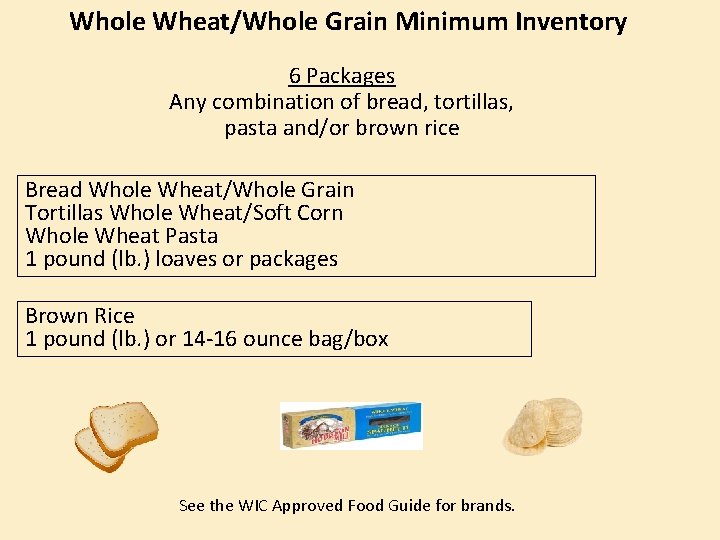
Whole Wheat/Whole Grain Minimum Inventory 6 Packages Any combination of bread, tortillas, pasta and/or brown rice Bread Whole Wheat/Whole Grain Tortillas Whole Wheat/Soft Corn Whole Wheat Pasta 1 pound (lb. ) loaves or packages Brown Rice 1 pound (lb. ) or 14 -16 ounce bag/box See the WIC Approved Food Guide for brands.
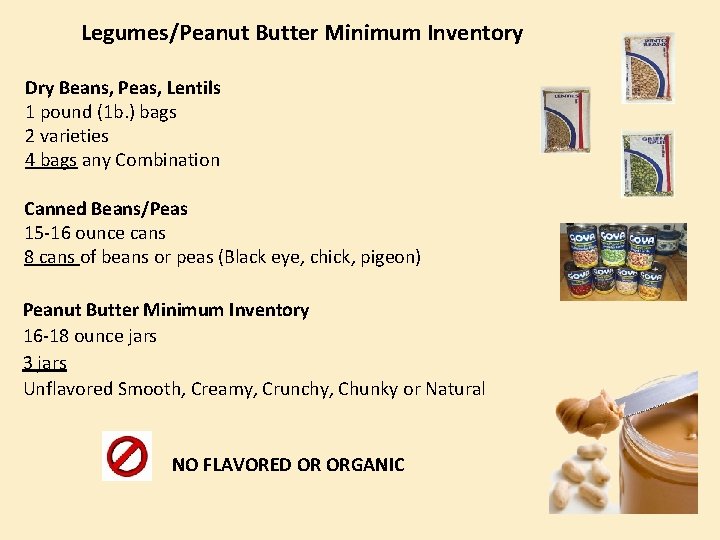
Legumes/Peanut Butter Minimum Inventory Dry Beans, Peas, Lentils 1 pound (1 b. ) bags 2 varieties 4 bags any Combination Canned Beans/Peas 15 -16 ounce cans 8 cans of beans or peas (Black eye, chick, pigeon) Peanut Butter Minimum Inventory 16 -18 ounce jars 3 jars Unflavored Smooth, Creamy, Crunchy, Chunky or Natural NO FLAVORED OR ORGANIC
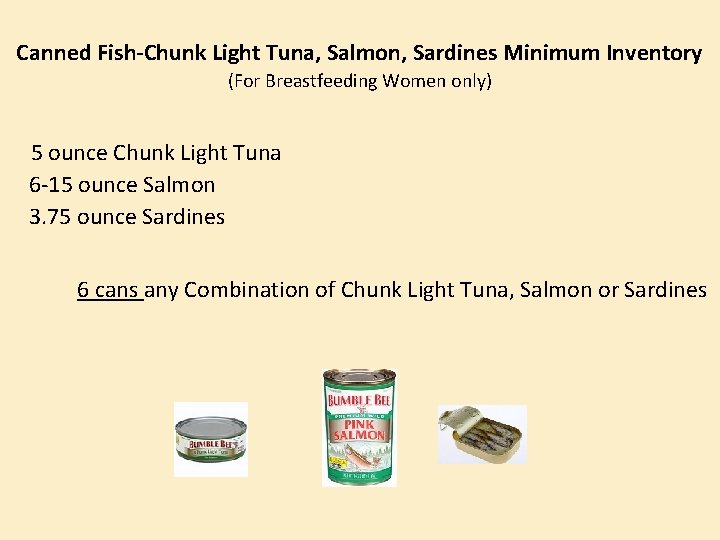
Canned Fish-Chunk Light Tuna, Salmon, Sardines Minimum Inventory (For Breastfeeding Women only) 5 ounce Chunk Light Tuna 6 -15 ounce Salmon 3. 75 ounce Sardines 6 cans any Combination of Chunk Light Tuna, Salmon or Sardines
Cold Cereal Minimum Inventory 12 ounce or larger bags/boxes 3 varieties, 3 boxes of each variety Total of 9 boxes *1 Variety must be Whole Grain See the WIC Approved Food Guide for types and brands of Connecticut WIC approved cereals.
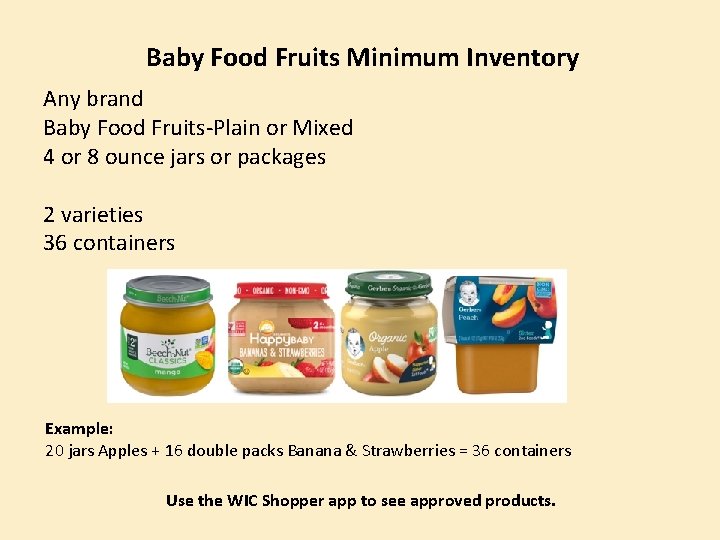
Baby Food Fruits Minimum Inventory Any brand Baby Food Fruits-Plain or Mixed 4 or 8 ounce jars or packages 2 varieties 36 containers Example: 20 jars Apples + 16 double packs Banana & Strawberries = 36 containers Use the WIC Shopper app to see approved products.
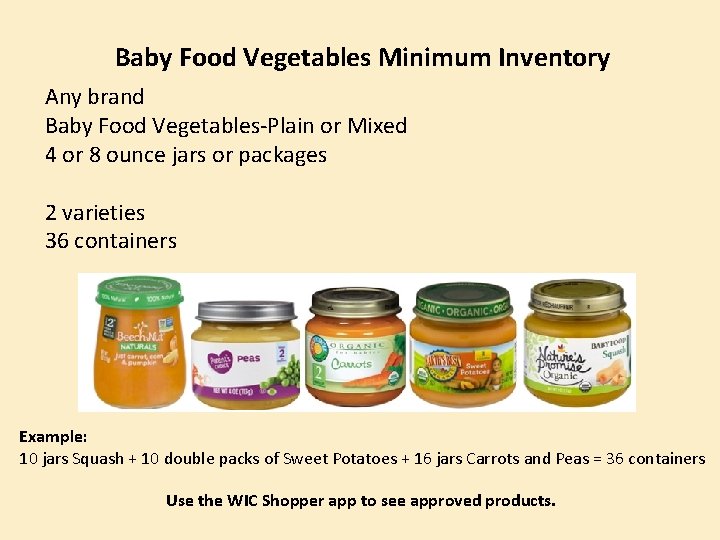
Baby Food Vegetables Minimum Inventory Any brand Baby Food Vegetables-Plain or Mixed 4 or 8 ounce jars or packages 2 varieties 36 containers Example: 10 jars Squash + 10 double packs of Sweet Potatoes + 16 jars Carrots and Peas = 36 containers Use the WIC Shopper app to see approved products.
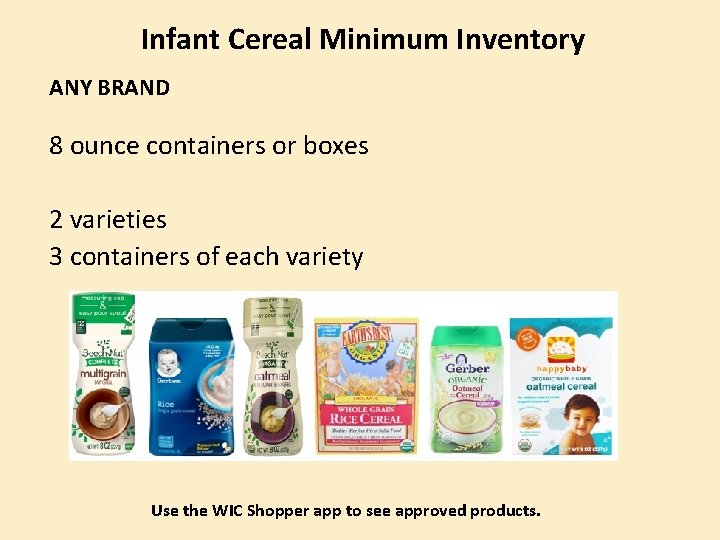
Infant Cereal Minimum Inventory ANY BRAND 8 ounce containers or boxes 2 varieties 3 containers of each variety Use the WIC Shopper app to see approved products.
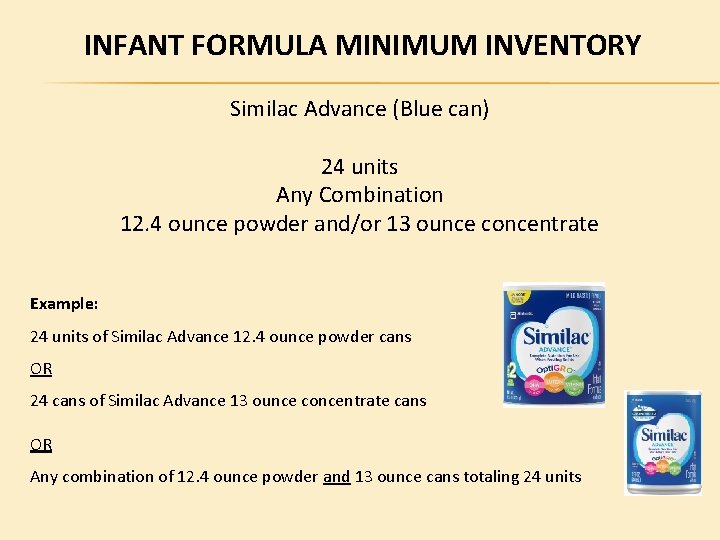
INFANT FORMULA MINIMUM INVENTORY Similac Advance (Blue can) 24 units Any Combination 12. 4 ounce powder and/or 13 ounce concentrate Example: 24 units of Similac Advance 12. 4 ounce powder cans OR 24 cans of Similac Advance 13 ounce concentrate cans OR Any combination of 12. 4 ounce powder and 13 ounce cans totaling 24 units
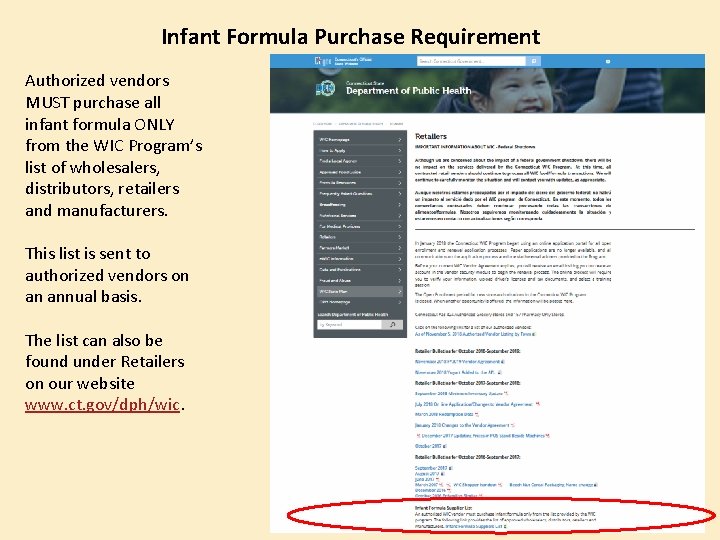
Infant Formula Purchase Requirement Authorized vendors MUST purchase all infant formula ONLY from the WIC Program’s list of wholesalers, distributors, retailers and manufacturers. This list is sent to authorized vendors on an annual basis. The list can also be found under Retailers on our website www. ct. gov/dph/wic.
Other WIC Approved Food The following items are WIC approved foods but are NOT required to be at the store at all times. Lactose Reduced/Lactose Free Milk Half gallons only of Skim/Fat Free/Lowfat/1%, Reduced Fat/2%, Whole UHT Milk Shelf Stable, Unflavored-1%, 2%, Whole Soy Milk 64 ounce/Half Gallon Refrigerated Cartons 8 th Continent Original, Silk Original only Pacific Ultra Soy Original Shelf Stable 32 oz. box, Regular and unflavored only Yogurt-Whole Milk/Low-Fat/Non-Fat 1 quart/32 oz. containers only, Plain, Vanilla, or Strawberry Plain Tofu-8 -16 ounce packages Kosher Milk- Any Brand Half gallons only of Skim/Fat Free/Lowfat/1%, Reduced Fat/2%, Whole Kosher Cheese-Any Brand 8 -16 ounce packages in the types that we allow Baby Food Meat 2. 5 ounce jars (Beef, Chicken, Turkey, Ham all with Broth)
Approved Product Listing (APL) • The APL is the approved product listing that contains ALL WIC approved products allowed to be purchased. • List is automatically updated daily to your stand beside terminal. • The scanner reads the UPC, which checks the APL to identify products. • The APL List is an Excel file with over 16, 000 items. It can be found on the WIC website: www. ct. gov/dph/wic. • The WIC Shopper will help you identify WIC Approved products. • Occasional errors that need to be fixed. Fruit and vegetable items with bar codes not going through=4469
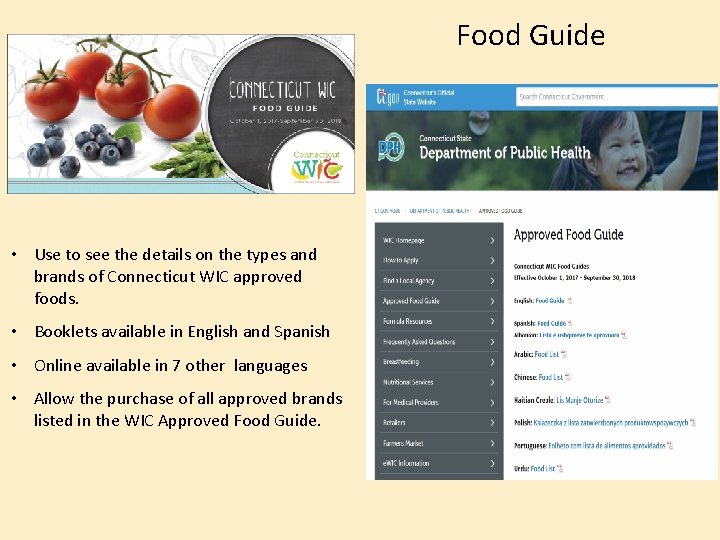
Food Guide • Use to see the details on the types and brands of Connecticut WIC approved foods. • Booklets available in English and Spanish • Online available in 7 other languages • Allow the purchase of all approved brands listed in the WIC Approved Food Guide.
Product is WIC approved, but not scanning A WIC customer or store personnel can contact the State WIC Office. The following information is needed: *The entire UPC number/all of the numbers or a photo of UPC bar code *Product Name or photo of the front of the product *Size of container *Send the information to: *Email: ctwic@ct. gov The product may be WIC approved; however, the UPC number is not listed in the WIC Program’s Approved Product Listing. Once approved, products will appear in the Approved Product Listing within 48 hours.
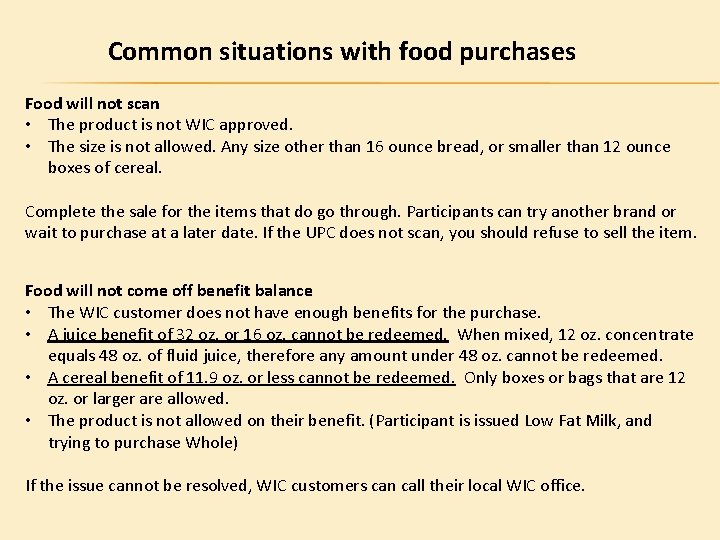
Common situations with food purchases Food will not scan • The product is not WIC approved. • The size is not allowed. Any size other than 16 ounce bread, or smaller than 12 ounce boxes of cereal. Complete the sale for the items that do go through. Participants can try another brand or wait to purchase at a later date. If the UPC does not scan, you should refuse to sell the item. Food will not come off benefit balance • The WIC customer does not have enough benefits for the purchase. • A juice benefit of 32 oz. or 16 oz. cannot be redeemed. When mixed, 12 oz. concentrate equals 48 oz. of fluid juice, therefore any amount under 48 oz. cannot be redeemed. • A cereal benefit of 11. 9 oz. or less cannot be redeemed. Only boxes or bags that are 12 oz. or larger are allowed. • The product is not allowed on their benefit. (Participant is issued Low Fat Milk, and trying to purchase Whole) If the issue cannot be resolved, WIC customers can call their local WIC office.
What are your experiences?
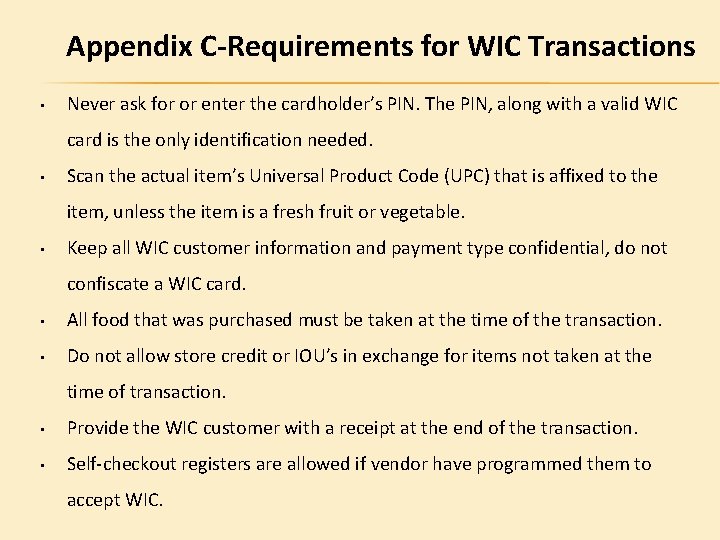
Appendix C-Requirements for WIC Transactions • Never ask for or enter the cardholder’s PIN. The PIN, along with a valid WIC card is the only identification needed. • Scan the actual item’s Universal Product Code (UPC) that is affixed to the item, unless the item is a fresh fruit or vegetable. • Keep all WIC customer information and payment type confidential, do not confiscate a WIC card. • All food that was purchased must be taken at the time of the transaction. • Do not allow store credit or IOU’s in exchange for items not taken at the time of transaction. • Provide the WIC customer with a receipt at the end of the transaction. • Self-checkout registers are allowed if vendor have programmed them to accept WIC.
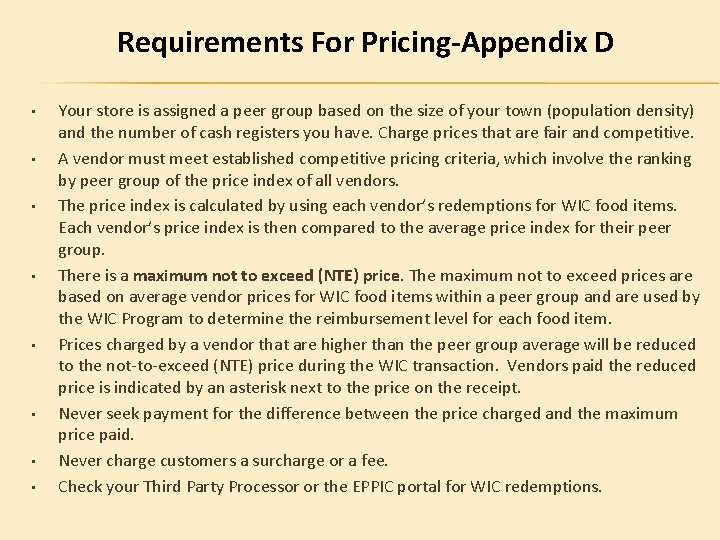
Requirements For Pricing-Appendix D • • Your store is assigned a peer group based on the size of your town (population density) and the number of cash registers you have. Charge prices that are fair and competitive. A vendor must meet established competitive pricing criteria, which involve the ranking by peer group of the price index of all vendors. The price index is calculated by using each vendor’s redemptions for WIC food items. Each vendor’s price index is then compared to the average price index for their peer group. There is a maximum not to exceed (NTE) price. The maximum not to exceed prices are based on average vendor prices for WIC food items within a peer group and are used by the WIC Program to determine the reimbursement level for each food item. Prices charged by a vendor that are higher than the peer group average will be reduced to the not-to-exceed (NTE) price during the WIC transaction. Vendors paid the reduced price is indicated by an asterisk next to the price on the receipt. Never seek payment for the difference between the price charged and the maximum price paid. Never charge customers a surcharge or a fee. Check your Third Party Processor or the EPPIC portal for WIC redemptions.
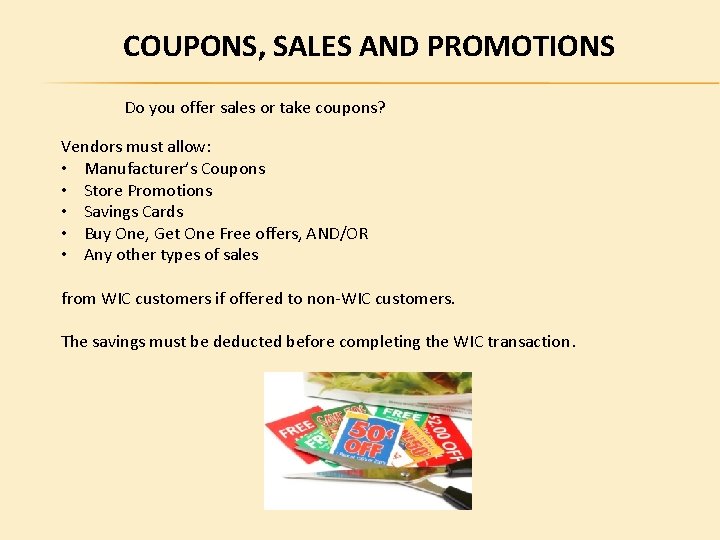
COUPONS, SALES AND PROMOTIONS Do you offer sales or take coupons? Vendors must allow: • Manufacturer’s Coupons • Store Promotions • Savings Cards • Buy One, Get One Free offers, AND/OR • Any other types of sales from WIC customers if offered to non-WIC customers. The savings must be deducted before completing the WIC transaction.
Do’s • Use Shelf labels to help WIC customers identify WIC approved items. • Rotate stock to avoid selling expired WIC products. Don’ts • Don’t ask to see benefit balance before transaction. • Don’t have a checkout lane designated only for WIC transactions. • Don’t offer, or intend to offer, incentive items solely to WIC customers. Vendors cannot offer free food or merchandise to entice WIC customers to use their benefits at the store. • Don’t process WIC transactions if machine/communication lines are down.
Appendix F-Disqualifications, Civil Money Penalties and Fines Violations are determined by investigation, which includes on-site monitoring, transaction audits, inventory audits and undercover compliance buys. Sanctions are imposed in order to protect the integrity and the nutritional goals of the WIC Program. Federal Mandatory Sanctions are as follows:
PERMANENT DISQUALIFICATION One Occurrence Judicial conviction of trafficking in WIC benefits or selling firearms, ammunition, explosives or controlled substances in exchange for WIC benefits. Disqualification 6 Years One Occurrence Administrative finding of buying or selling WIC benefits for cash (trafficking) or selling firearms, ammunition, explosives or controlled substances in exchange for WIC benefits. Disqualification 3 Years One Occurrence Sale of alcohol or alcoholic beverages or tobacco products in exchange for WIC benefits.
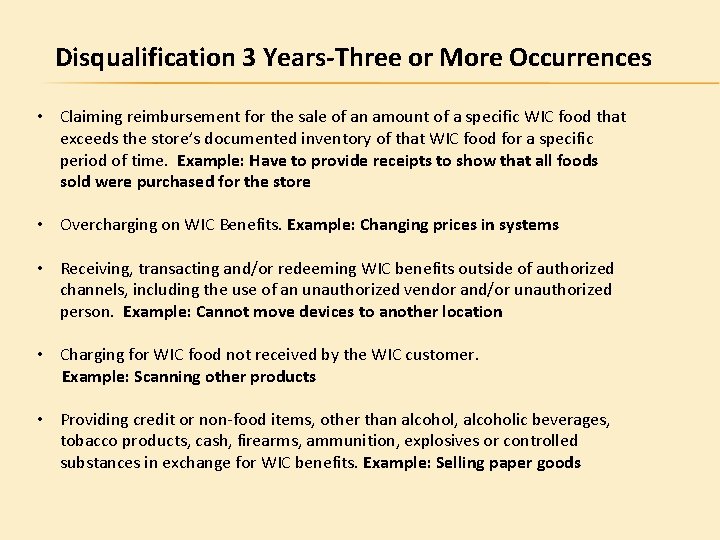
Disqualification 3 Years-Three or More Occurrences • Claiming reimbursement for the sale of an amount of a specific WIC food that exceeds the store’s documented inventory of that WIC food for a specific period of time. Example: Have to provide receipts to show that all foods sold were purchased for the store • Overcharging on WIC Benefits. Example: Changing prices in systems • Receiving, transacting and/or redeeming WIC benefits outside of authorized channels, including the use of an unauthorized vendor and/or unauthorized person. Example: Cannot move devices to another location • Charging for WIC food not received by the WIC customer. Example: Scanning other products • Providing credit or non-food items, other than alcohol, alcoholic beverages, tobacco products, cash, firearms, ammunition, explosives or controlled substances in exchange for WIC benefits. Example: Selling paper goods
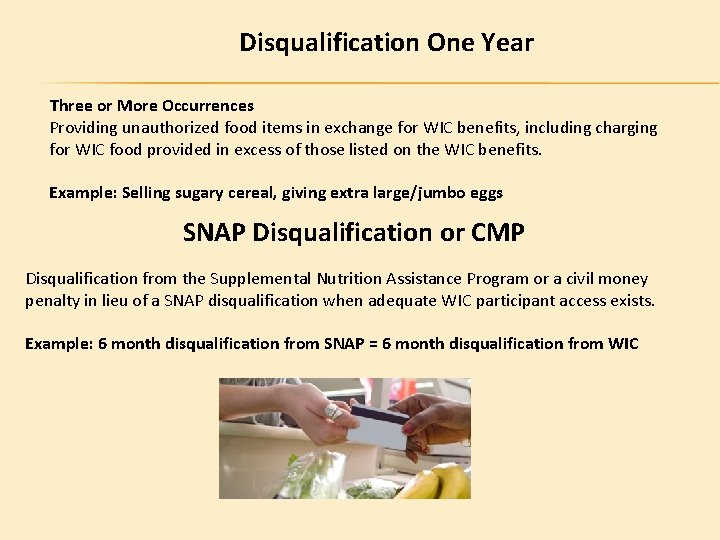
Disqualification One Year Three or More Occurrences Providing unauthorized food items in exchange for WIC benefits, including charging for WIC food provided in excess of those listed on the WIC benefits. Example: Selling sugary cereal, giving extra large/jumbo eggs SNAP Disqualification or CMP Disqualification from the Supplemental Nutrition Assistance Program or a civil money penalty in lieu of a SNAP disqualification when adequate WIC participant access exists. Example: 6 month disqualification from SNAP = 6 month disqualification from WIC
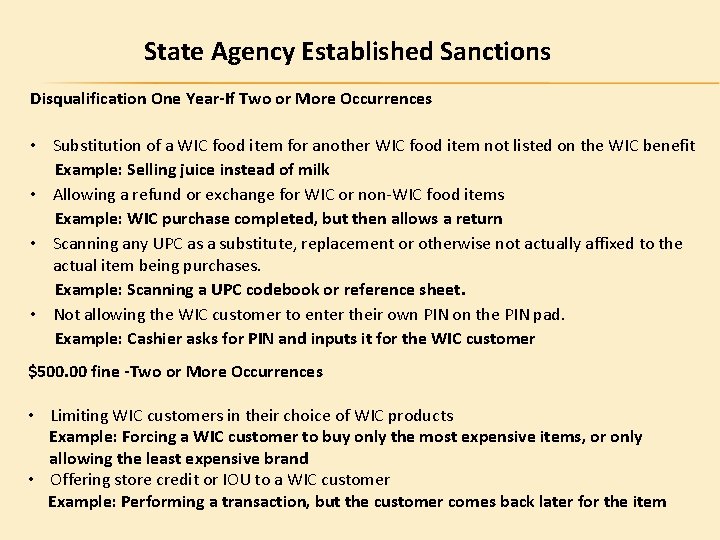
State Agency Established Sanctions Disqualification One Year-If Two or More Occurrences • Substitution of a WIC food item for another WIC food item not listed on the WIC benefit Example: Selling juice instead of milk • Allowing a refund or exchange for WIC or non-WIC food items Example: WIC purchase completed, but then allows a return • Scanning any UPC as a substitute, replacement or otherwise not actually affixed to the actual item being purchases. Example: Scanning a UPC codebook or reference sheet. • Not allowing the WIC customer to enter their own PIN on the PIN pad. Example: Cashier asks for PIN and inputs it for the WIC customer $500. 00 fine -Two or More Occurrences • Limiting WIC customers in their choice of WIC products Example: Forcing a WIC customer to buy only the most expensive items, or only allowing the least expensive brand • Offering store credit or IOU to a WIC customer Example: Performing a transaction, but the customer comes back later for the item
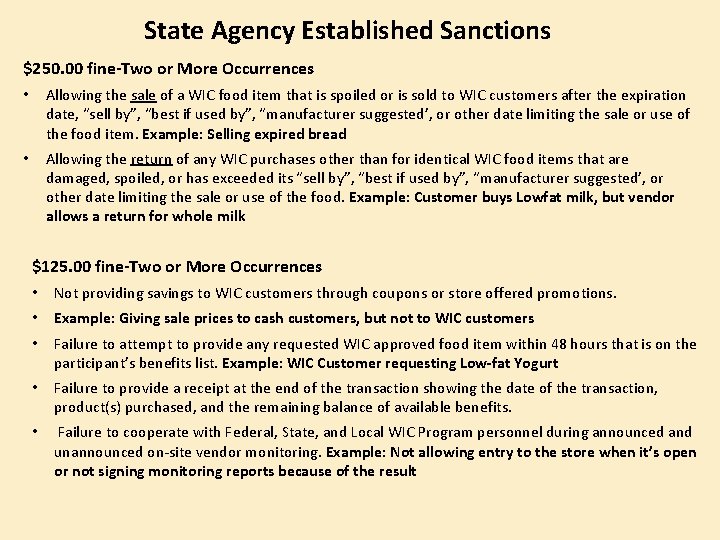
State Agency Established Sanctions $250. 00 fine-Two or More Occurrences • Allowing the sale of a WIC food item that is spoiled or is sold to WIC customers after the expiration date, “sell by”, “best if used by”, “manufacturer suggested’, or other date limiting the sale or use of the food item. Example: Selling expired bread • Allowing the return of any WIC purchases other than for identical WIC food items that are damaged, spoiled, or has exceeded its “sell by”, “best if used by”, “manufacturer suggested’, or other date limiting the sale or use of the food. Example: Customer buys Lowfat milk, but vendor allows a return for whole milk $125. 00 fine-Two or More Occurrences • Not providing savings to WIC customers through coupons or store offered promotions. • Example: Giving sale prices to cash customers, but not to WIC customers • Failure to attempt to provide any requested WIC approved food item within 48 hours that is on the participant’s benefits list. Example: WIC Customer requesting Low-fat Yogurt • Failure to provide a receipt at the end of the transaction showing the date of the transaction, product(s) purchased, and the remaining balance of available benefits. • Failure to cooperate with Federal, State, and Local WIC Program personnel during announced and unannounced on-site vendor monitoring. Example: Not allowing entry to the store when it’s open or not signing monitoring reports because of the result
Appendix E-Monetary Claims The Connecticut WIC Program may make monetary claims against vendors that have committed certain types of redemption abuse in addition to any other sanctions applied against such vendors. Those include but are not limited to: • Inventory Audits when a vendor cannot support all of its redemptions • Overcharges or errors made on WIC transactions discovered during undercover compliance buys • Transaction Audits review of a vendor’s redemptions to determine if the vendor has overcharged the WIC Program. All monetary claims must be paid within 15 days of the date of the notice. All remittances must be made with a certified bank check or money order and payable to Treasurer-State of Connecticut, Department of Public Health. The WIC program may non-select a vendor failure to pay a monetary claim within the required period of time.
VENDOR COMPLAINT PROCESS Vendors may file a complaint against WIC customers who abuse Program rules. Contact the State WIC Office with the last four digits of the card #. Example: Trying to exchange or purchase non-WIC items, is rude or has disruptive behavior. Notify the State WIC Office if the customer does not know what food to buy and/or indicates that they do not know how to use the WIC card. Additional training may be needed. Vendors may file a complaint against other vendors who suspect that WIC program rules are not being followed. Example: Vendor is giving non-food items or unapproved items Contact the State WIC FRVM unit: Email: ctwic@ct. gov Phone: 860 -509 -8084 or 800 -741 -2142 (in Connecticut only) Mail: Department of Public Health, WIC Program 410 Capitol Avenue, MS #11 WIC, Hartford, CT 06106
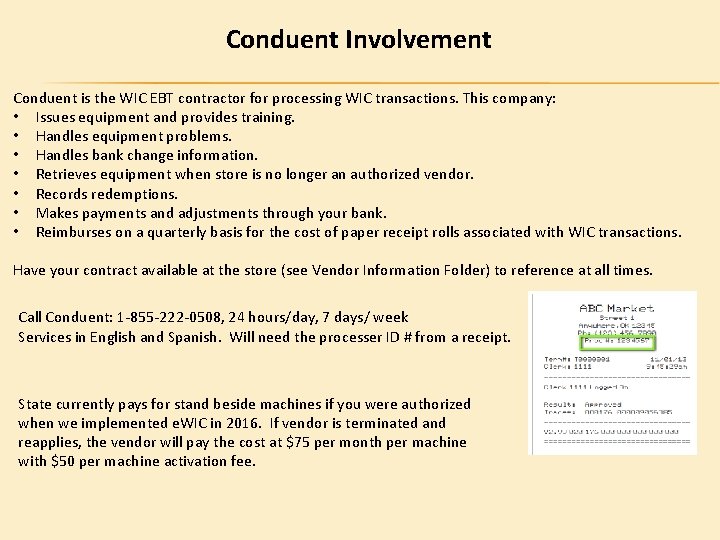
Conduent Involvement Conduent is the WIC EBT contractor for processing WIC transactions. This company: • Issues equipment and provides training. • Handles equipment problems. • Handles bank change information. • Retrieves equipment when store is no longer an authorized vendor. • Records redemptions. • Makes payments and adjustments through your bank. • Reimburses on a quarterly basis for the cost of paper receipt rolls associated with WIC transactions. Have your contract available at the store (see Vendor Information Folder) to reference at all times. Call Conduent: 1 -855 -222 -0508, 24 hours/day, 7 days/ week Services in English and Spanish. Will need the processer ID # from a receipt. State currently pays for stand beside machines if you were authorized when we implemented e. WIC in 2016. If vendor is terminated and reapplies, the vendor will pay the cost at $75 per month per machine with $50 per machine activation fee.
REQUIREMENTS FOR RE-AUTHORIZATION • Must meet all of the selection criteria in the Vendor Agreement at all times. • Must meet competitive pricing criteria within peer group. • Must meet and maintain the minimum inventory and pricing requirements. (Onsite monitors do not have any discretion for excusing missing food items or items not being priced at the time of inspections). • If monitoring visit is passed, the owner will receive an executed Agreement for 3 years. • If monitoring visit is not passed, vendor will have another opportunity. • Unannounced onsite monitoring visits to verify minimum inventory requirements and posted prices of WIC foods, will begin tomorrow. • Monitoring reports are now completed electronically on tablets, and the signature of the store contact is no longer captured. Reports are emailed to the address on file, and a paper copy will no longer be left in the store.
Program Integrity The Food Resource and Vendor Management Unit is committed to improving the health of CT’s most vulnerable children by ensuring authorized vendors are in compliance with providing healthy foods during the critical stages of early childhood development. Contact us anytime you feel additional training is needed or have questions regarding policies or procedures. Refer to the Retailers page on the WIC website www. ct. gov/dph/wic for program materials. Keep the WIC Vendor Information Folder at the store location at all times. Review the documents with your employees, so they know where to find important Program information. You play an important role in the health of our participants. We look forward to our continued partnership in providing nutritious food to Connecticut families.
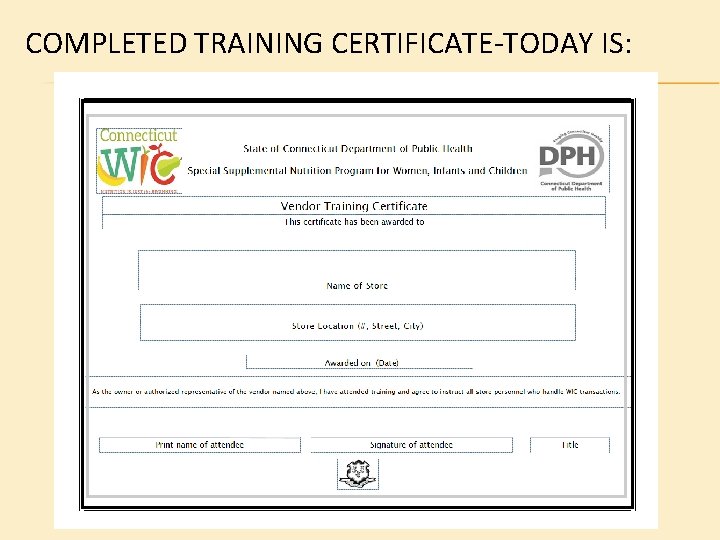
COMPLETED TRAINING CERTIFICATE-TODAY IS:
- Slides: 46