
State of Alaska Hearing Screening Guidelines for the
- Slides: 51
State of Alaska Hearing Screening Guidelines for the Pre-school/School Population ALASKA DIVISION OF PUBLIC HEALTH SCHOOL NURSING/SCHOOL HEALTH SERVICES PROGRAM APRIL 2016 School Age & Adolescent Health Unit Section of Women’s Children’s & Family Health
Objectives At the end of this presentation the participant will be able to : Explain the importance of hearing screening for the school-aged child. Discuss age appropriate screening techniques and procedures. Identify the steps of the screening process for pure tone audiometry. Discuss the pass/refer criteria and general steps in the referral and follow-up procedure. Section of Women’s Children’s & Family Health
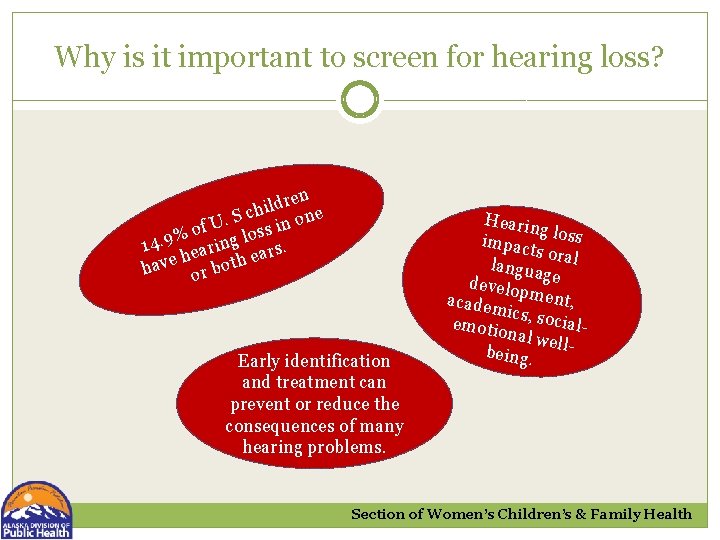
Why is it important to screen for hearing loss? ren d l i S ch in one. U of ss o % l 9. g 14 arin ears. e h have or both Early identification and treatment can prevent or reduce the consequences of many hearing problems. Hearin g impac loss ts oral langua develo ge academ pment, ic emotio s, socialnal we being. ll- Section of Women’s Children’s & Family Health
What is the Purpose of School Hearing Screening? �Identify students with potential hearing deficits at earliest stage possible in order to refer for diagnosis and treatment, if required. �To inform teachers of students with hearing problems and provide recommendations from hearing specialists regarding appropriate classroom environment and educational accommodations. Section of Women’s Children’s & Family Health
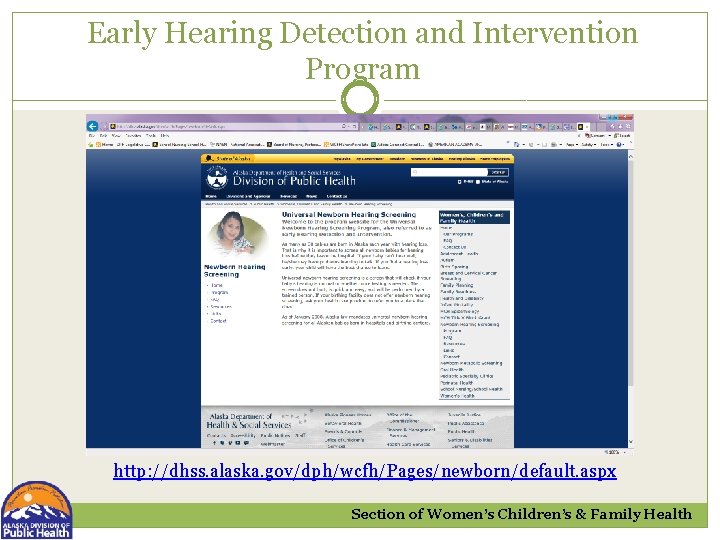
Early Hearing Detection and Intervention Program http: //dhss. alaska. gov/dph/wcfh/Pages/newborn/default. aspx Section of Women’s Children’s & Family Health
What does the state law say? Hearing screening in schools is mandated by Alaska Statute Sec. 14. 30. 127. A vision and hearing screening examination shall be given to each child attending school in the state. The examination shall be made when the child enters school or as soon thereafter as is practicable, and at regular intervals specified by regulation by the governing body of the district. http: //www. legis. state. ak. us/basis/folio. asp. Section of Women’s Children’s & Family Health
State of Alaska Hearing Screening Guidelines for the Pre-school/School Population Section of Women’s Children’s & Family Health
Who determines best practice for hearing screening? Section of Women’s Children’s & Family Health
Background Information REVIEW OF KNOWLEDGE Section of Women’s Children’s & Family Health
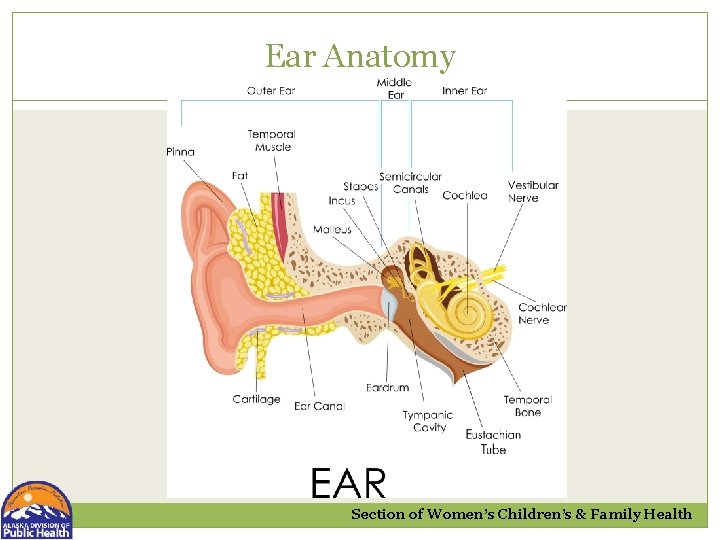
Ear Anatomy Section of Women’s Children’s & Family Health
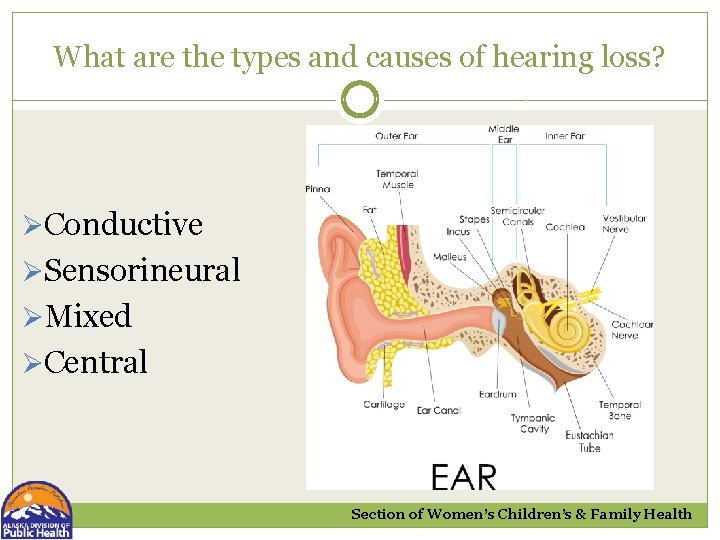
What are the types and causes of hearing loss? ØConductive ØSensorineural ØMixed ØCentral Section of Women’s Children’s & Family Health
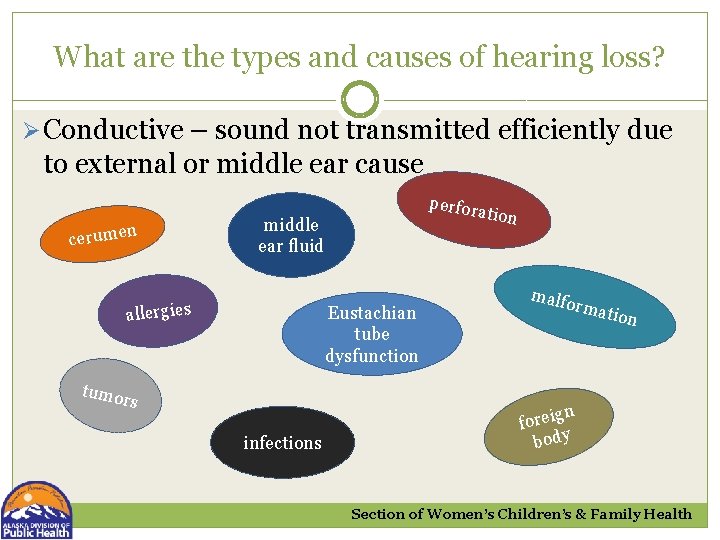
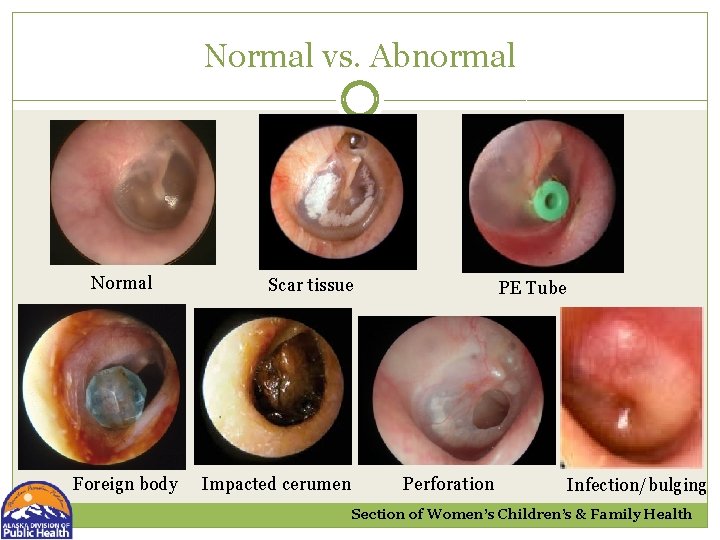
What are the types and causes of hearing loss? Ø Conductive – sound not transmitted efficiently due to external or middle ear cause n cerume perfor ation middle ear fluid allergies Eustachian tube dysfunction tumo rs infections malfo rmat ion gn forei body Section of Women’s Children’s & Family Health
Normal vs. Abnormal Normal Foreign body Scar tissue Impacted cerumen PE Tube Perforation Infection/bulging Section of Women’s Children’s & Family Health
What are the types and causes of hearing loss? Ø Sensorineural - results from pathology associated with the inner ear ü ü Congenital – genetic, prenatal, perinatal, postnatal infections Acquired – illness (e. g. meningitis), ototoxicity, loud noise, head trauma, aging Section of Women’s Children’s & Family Health
What are the types and causes of hearing loss? Ø Mixed – elements of both sensorineural and conductive Ø Ø Sensorineural component is typically permanent Conductive component may or may not be medically managed Ø Central – result of damage/dysfunction in central auditory system Ø Ø Space occupying lesions Perceptual processing difficulties Section of Women’s Children’s & Family Health
How is sound measured? Frequency (pitch) = Hertz (Hz) Human range is 20 to 20, 000 Hz Most important sounds are 500 -4000 Hz Intensity (loudness) = decibels (d. B) Normal range in children -10 to 15 d. B Normal conversation is 45 -60 d. B Section of Women’s Children’s & Family Health
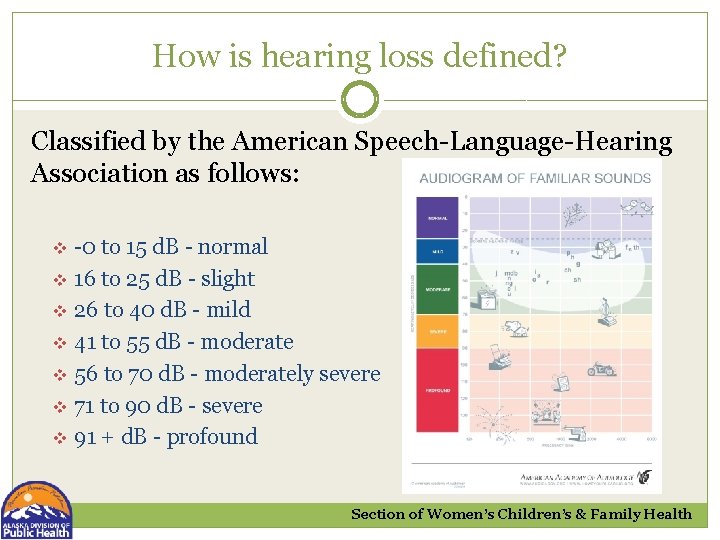
How is hearing loss defined? Classified by the American Speech-Language-Hearing Association as follows: v v v v -0 to 15 d. B - normal 16 to 25 d. B - slight 26 to 40 d. B - mild 41 to 55 d. B - moderate 56 to 70 d. B - moderately severe 71 to 90 d. B - severe 91 + d. B - profound Section of Women’s Children’s & Family Health
State of Alaska Hearing Screening Guidelines for the Pre-school/School Population REVIEW OF RECOMMENDATIONS Section of Women’s Children’s & Family Health
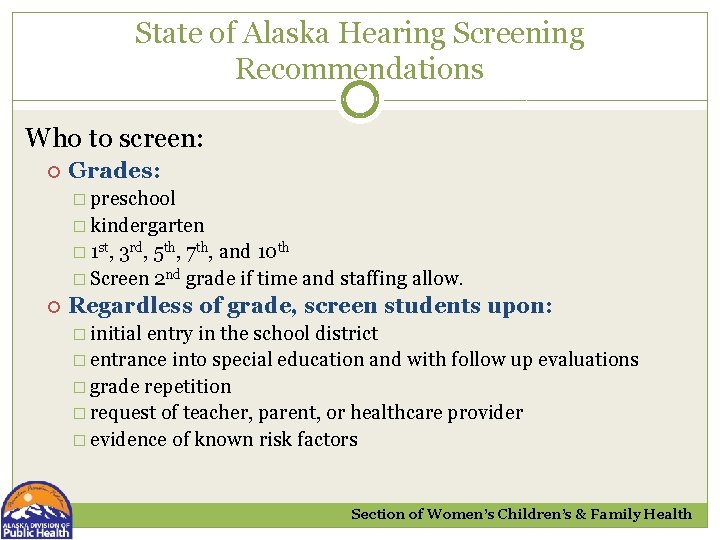
State of Alaska Hearing Screening Recommendations Who to screen: Grades: � preschool � kindergarten � 1 st, 3 rd, 5 th, 7 th, and 10 th � Screen 2 nd grade if time and staffing allow. Regardless of grade, screen students upon: � initial entry in the school district � entrance into special education and with follow up evaluations � grade repetition � request of teacher, parent, or healthcare provider � evidence of known risk factors Section of Women’s Children’s & Family Health
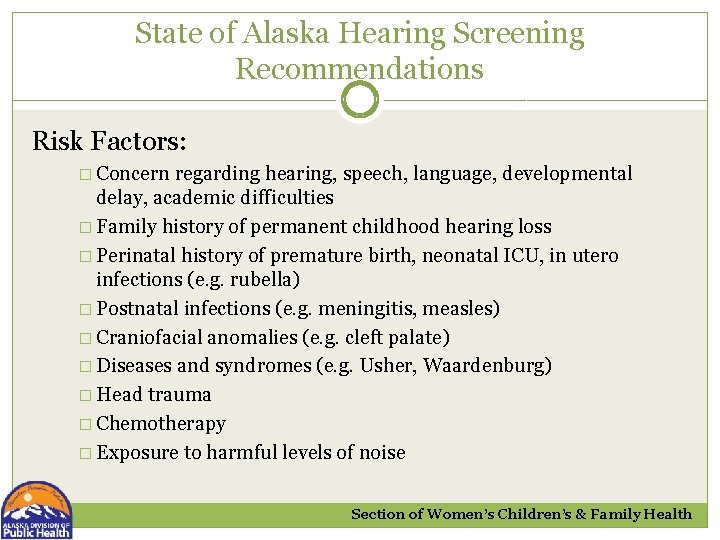
State of Alaska Hearing Screening Recommendations Risk Factors: � Concern regarding hearing, speech, language, developmental delay, academic difficulties � Family history of permanent childhood hearing loss � Perinatal history of premature birth, neonatal ICU, in utero infections (e. g. rubella) � Postnatal infections (e. g. meningitis, measles) � Craniofacial anomalies (e. g. cleft palate) � Diseases and syndromes (e. g. Usher, Waardenburg) � Head trauma � Chemotherapy � Exposure to harmful levels of noise Section of Women’s Children’s & Family Health
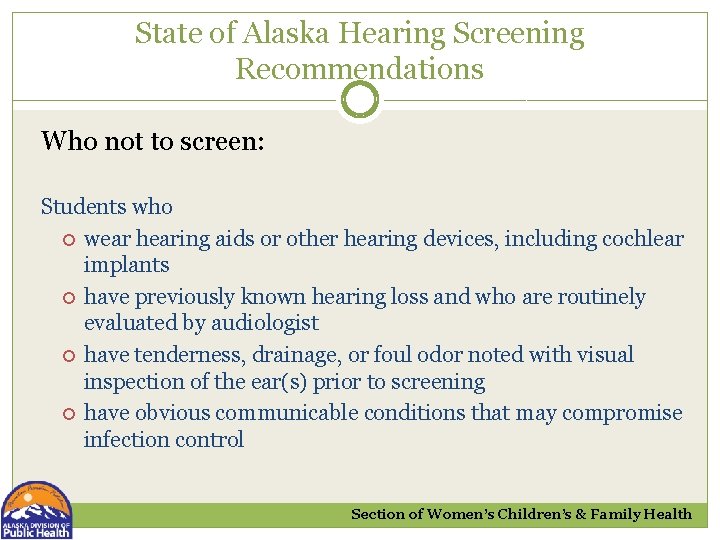
State of Alaska Hearing Screening Recommendations Who not to screen: Students who wear hearing aids or other hearing devices, including cochlear implants have previously known hearing loss and who are routinely evaluated by audiologist have tenderness, drainage, or foul odor noted with visual inspection of the ear(s) prior to screening have obvious communicable conditions that may compromise infection control Section of Women’s Children’s & Family Health
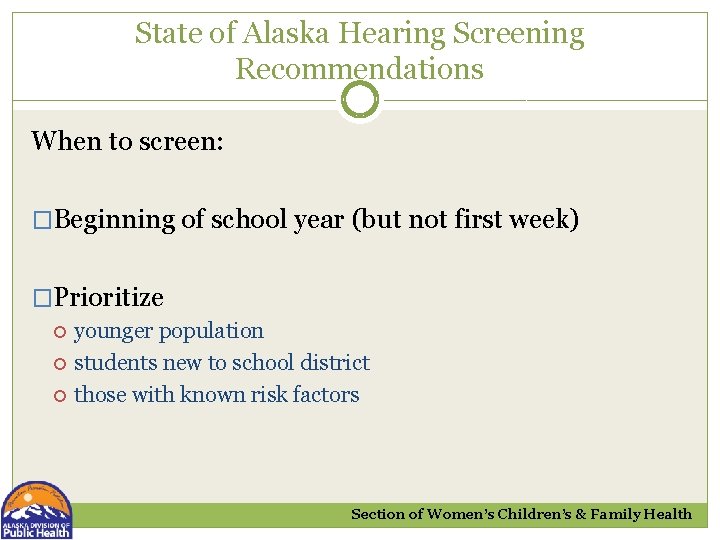
State of Alaska Hearing Screening Recommendations When to screen: �Beginning of school year (but not first week) �Prioritize younger population students new to school district those with known risk factors Section of Women’s Children’s & Family Health
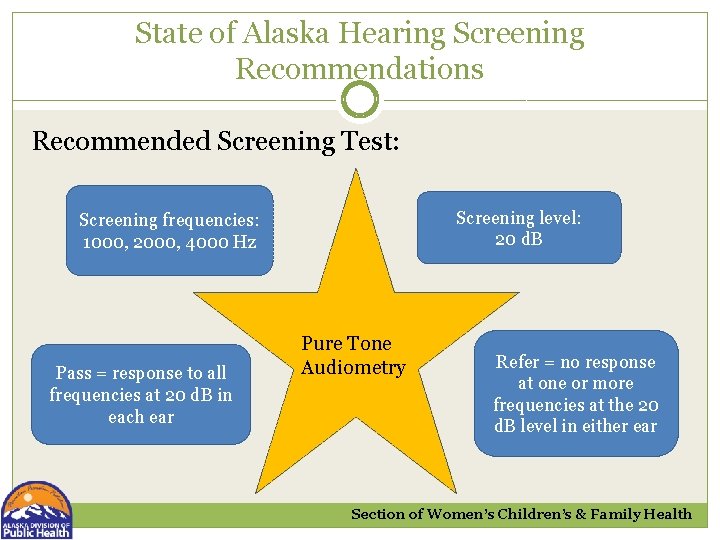
State of Alaska Hearing Screening Recommendations Recommended Screening Test: Screening level: 20 d. B Screening frequencies: 1000, 2000, 4000 Hz Pass = response to all frequencies at 20 d. B in each ear Pure Tone Audiometry Refer = no response at one or more frequencies at the 20 d. B level in either ear Section of Women’s Children’s & Family Health
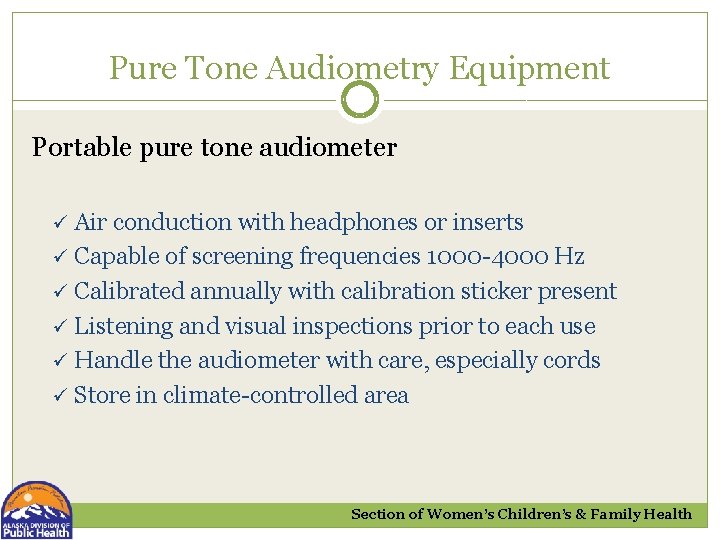
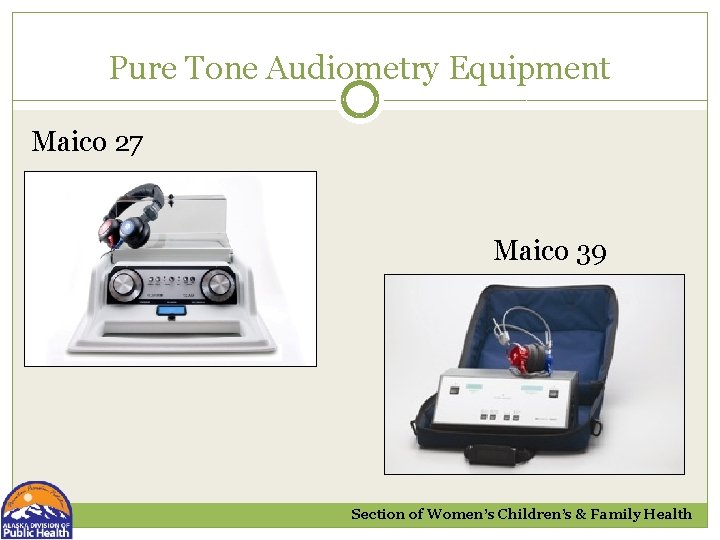
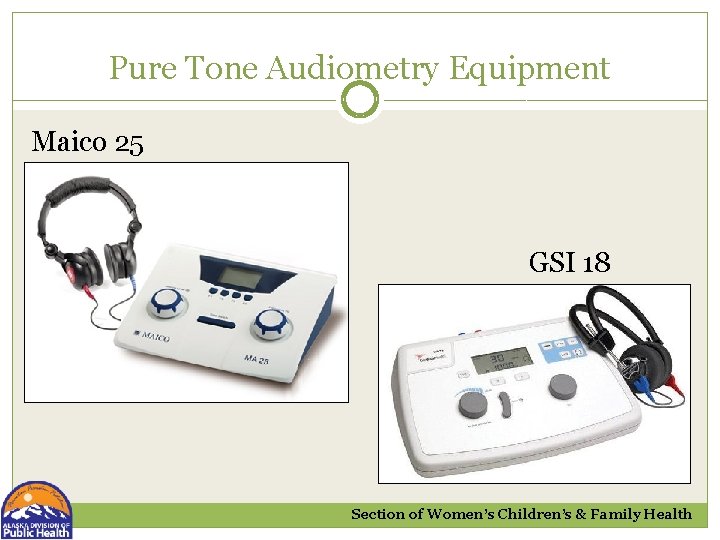
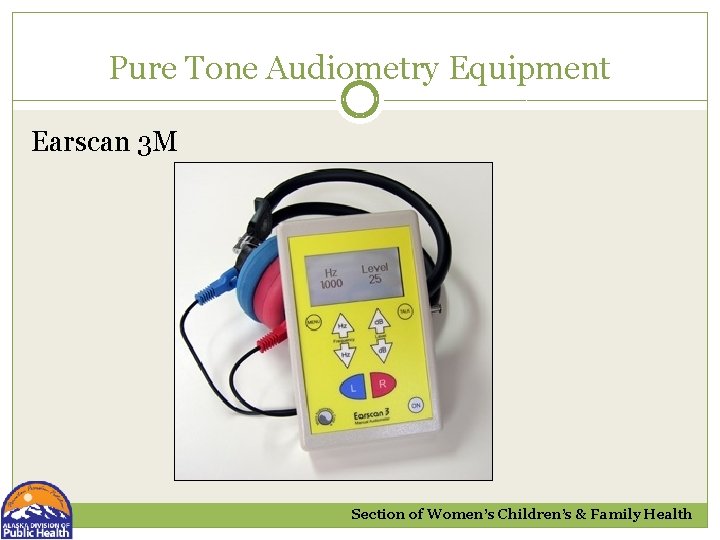
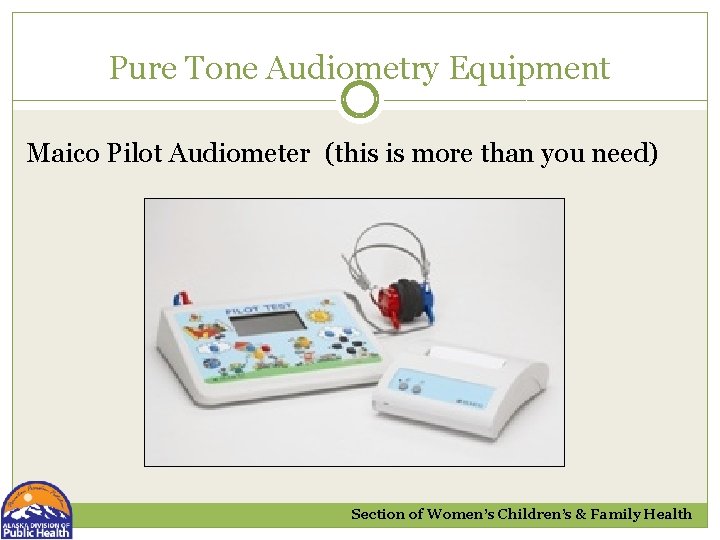
Pure Tone Audiometry Equipment Portable pure tone audiometer Air conduction with headphones or inserts ü Capable of screening frequencies 1000 -4000 Hz ü Calibrated annually with calibration sticker present ü Listening and visual inspections prior to each use ü Handle the audiometer with care, especially cords ü Store in climate-controlled area ü Section of Women’s Children’s & Family Health
Pure Tone Audiometry Equipment Maico 27 Maico 39 Section of Women’s Children’s & Family Health
Pure Tone Audiometry Equipment Maico 25 GSI 18 Section of Women’s Children’s & Family Health
Pure Tone Audiometry Equipment Earscan 3 M Section of Women’s Children’s & Family Health
Pure Tone Audiometry Equipment Maico Pilot Audiometer (this is more than you need) Section of Women’s Children’s & Family Health
Audiometer Check � Examine headphones and cords for cracks, splits, correct connection to audiometer (i. e. , red/right, blue/left) � Look for calibration sticker- date must be current � Perform listening check ü Check screening levels in both right and left ear twice ü Hold presentation button while changing decibel level from 0 -50 d. B at 1000 Hz- listen for “dead spots, ” abrupt volume changes and audible clicks ü Press tone button and listen for static when cords moved Section of Women’s Children’s & Family Health
Environment Check �Quiet environment is critical �Perform environment listening check before each day of screening and whenever the audiometer is moved �Perform listening check on a person with known, normal hearing �If necessary, move to an area with less noise and repeat �Do not increase decibel level to overcome noise �Postpone screenings if necessary- find an appropriate space. Section of Women’s Children’s & Family Health
Protocols Pure Tone Audiometry Preparation: � Set up chair for student in position facing away from audiometer. � Wash hands, clean headphones. � Confirm student identity. � Remove large earrings, glasses, and tuck hair behind ears � Perform Visual Inspection. Section of Women’s Children’s & Family Health
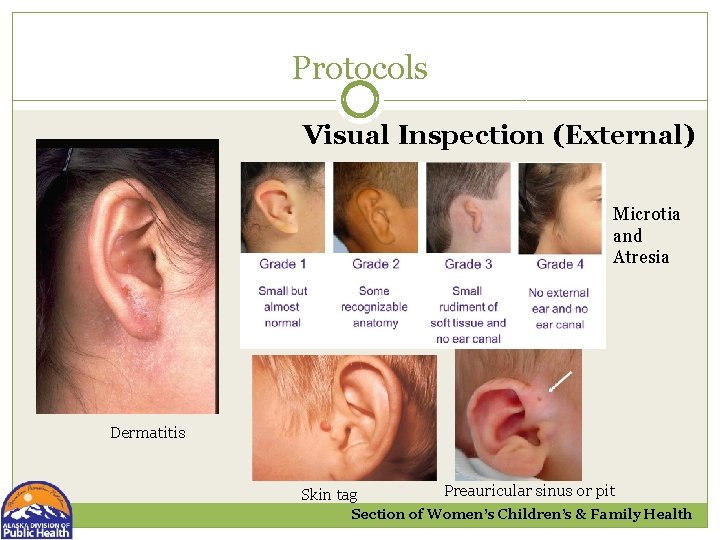
Protocols Visual Inspection (External) Microtia and Atresia Dermatitis Skin tag Preauricular sinus or pit Section of Women’s Children’s & Family Health
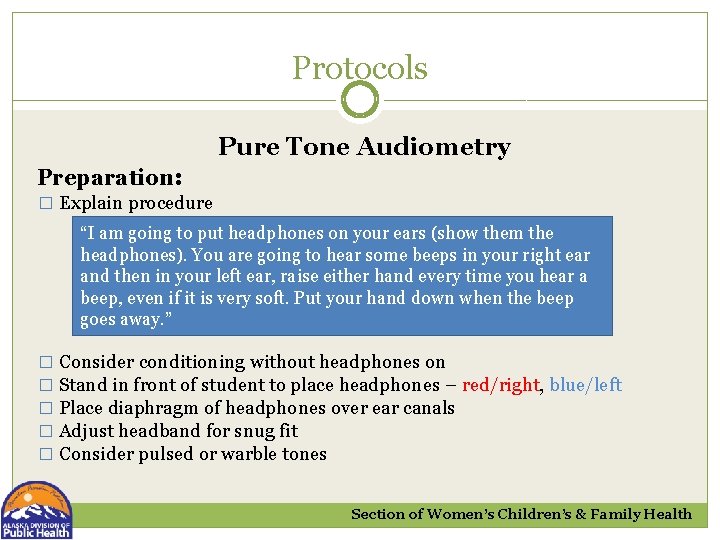
Protocols Pure Tone Audiometry Preparation: � Explain procedure “I am going to put headphones on your ears (show them the headphones). You are going to hear some beeps in your right ear and then in your left ear, raise either hand every time you hear a beep, even if it is very soft. Put your hand down when the beep goes away. ” � Consider conditioning without headphones on � Stand in front of student to place headphones – red/right, blue/left � Place diaphragm of headphones over ear canals � Adjust headband for snug fit � Consider pulsed or warble tones Section of Women’s Children’s & Family Health
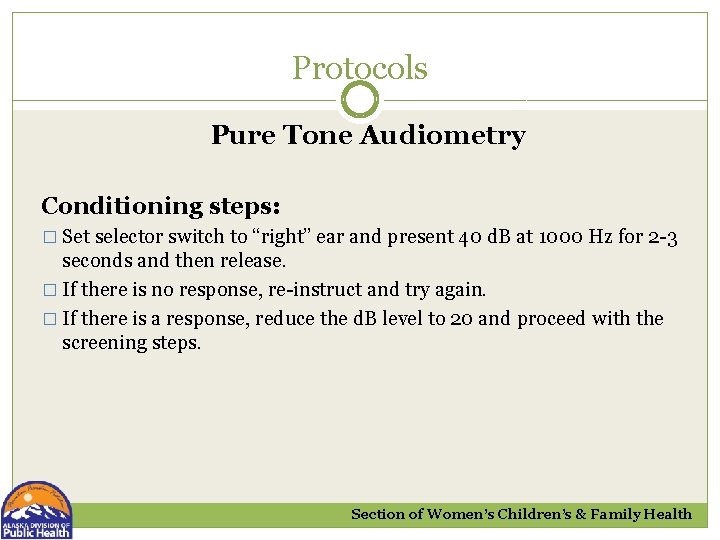
Protocols Pure Tone Audiometry Conditioning steps: � Set selector switch to “right” ear and present 40 d. B at 1000 Hz for 2 -3 seconds and then release. � If there is no response, re-instruct and try again. � If there is a response, reduce the d. B level to 20 and proceed with the screening steps. Section of Women’s Children’s & Family Health
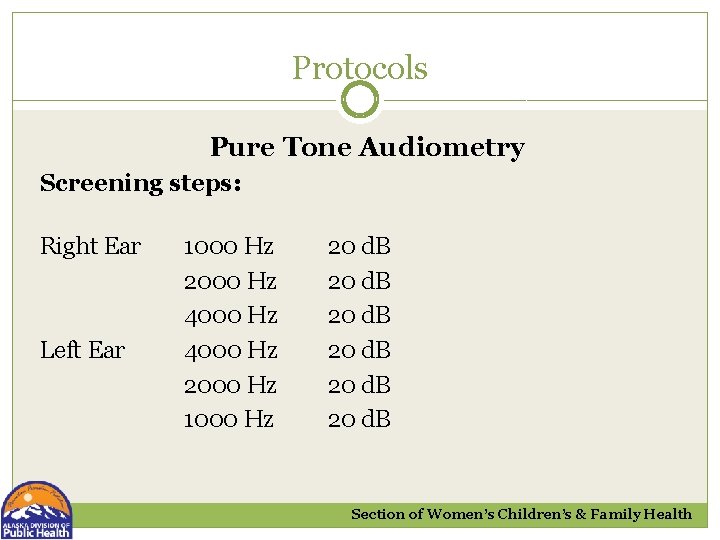
Protocols Pure Tone Audiometry Screening steps: Right Ear Left Ear 1000 Hz 2000 Hz 4000 Hz 2000 Hz 1000 Hz 20 d. B Section of Women’s Children’s & Family Health
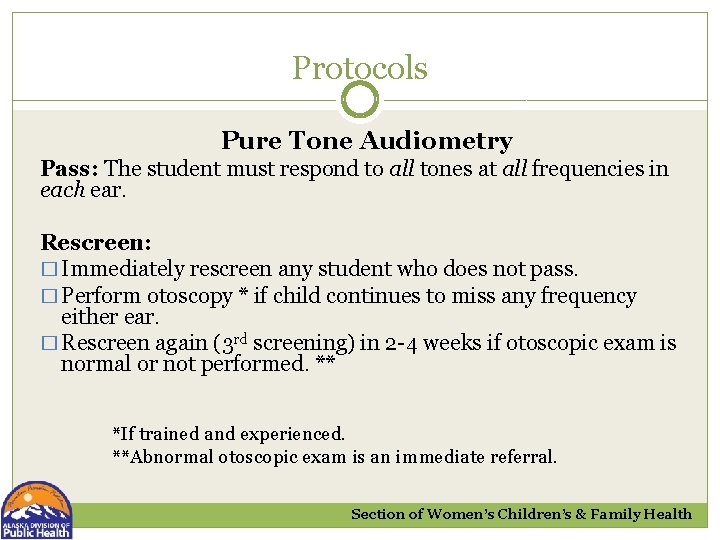
Protocols Pure Tone Audiometry Pass: The student must respond to all tones at all frequencies in each ear. Rescreen: � Immediately rescreen any student who does not pass. � Perform otoscopy * if child continues to miss any frequency either ear. � Rescreen again (3 rd screening) in 2 -4 weeks if otoscopic exam is normal or not performed. ** *If trained and experienced. **Abnormal otoscopic exam is an immediate referral. Section of Women’s Children’s & Family Health
Protocols Pure Tone Audiometry Refer: � To healthcare provider: any student with abnormal visual inspection/otoscopic exam � To audiologist and/or healthcare provider: Any student who fails the second rescreen (i. e. , 3 rd screening) Any student who is unable to perform audiometry Any student with known risk factors for hearing loss or who, in the judgement of the screener, may require further evaluation (regardless of screening outcomes) Section of Women’s Children’s & Family Health
Protocols Conditioned Play Audiometry �Use for younger students who are difficult-to-test, those who are developmentally delayed or who are non-English speaking. �Use a play task such as: Drop block in box Place peg in pegboard Place ring on tower Section of Women’s Children’s & Family Health
Protocols Conditioned Play Audiometry � Condition first with headphones off. � Explain the “listening game. ” “We’re going to play a listening game. When you hear a beep (any way you want to describe the test stimulus such as “whistle”, “bird”, “silly sound”, etc. ), drop the block into the box (peg in pegboard, ring on tower, etc. ). ” � Teach task at elevated intensity (i. e. , 2000 at 70 d. B) � Be sure child can perform task on own before attempting screening with headphones on at 20 d. B. Section of Women’s Children’s & Family Health
State of Alaska Hearing Screening Recommendations Additional Screening Considerations*: � Otoscopy – for those failing hearing screening � Otoacoustic Emissions (OAE) – for preschool and developmentally delayed � Tympanometry – as immediate next step and 2 nd stage screening method for those failing PTA or OAE � Threshold – as instructed by district audiologist and only as additional information for referral *If screener is trained and experienced Section of Women’s Children’s & Family Health
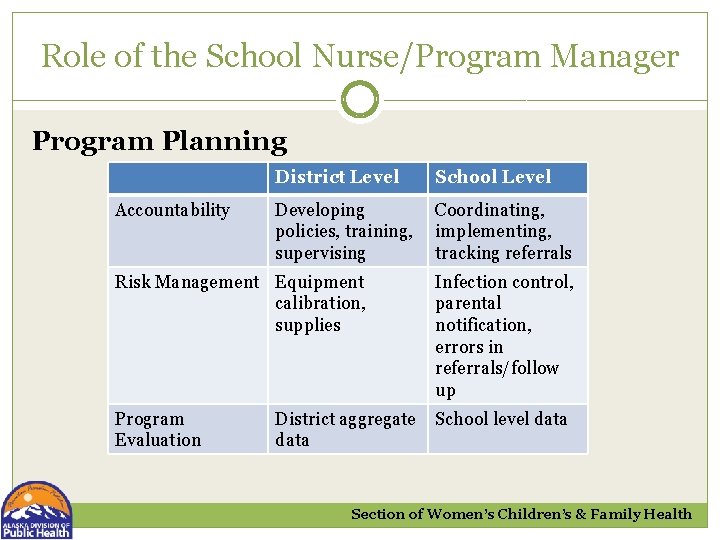
Role of the School Nurse/Program Manager Program Planning Accountability District Level School Level Developing policies, training, supervising Coordinating, implementing, tracking referrals Risk Management Equipment calibration, supplies Infection control, parental notification, errors in referrals/follow up Program Evaluation School level data District aggregate data Section of Women’s Children’s & Family Health
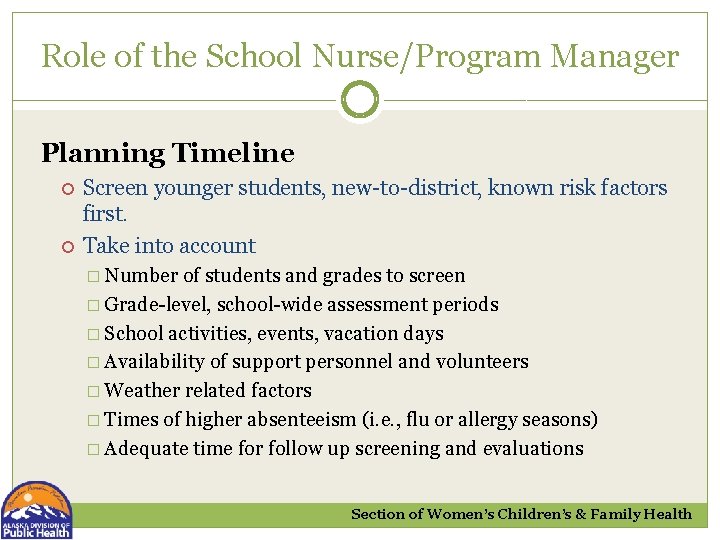
Role of the School Nurse/Program Manager Planning Timeline Screen younger students, new-to-district, known risk factors first. Take into account � Number of students and grades to screen � Grade-level, school-wide assessment periods � School activities, events, vacation days � Availability of support personnel and volunteers � Weather related factors � Times of higher absenteeism (i. e. , flu or allergy seasons) � Adequate time for follow up screening and evaluations Section of Women’s Children’s & Family Health
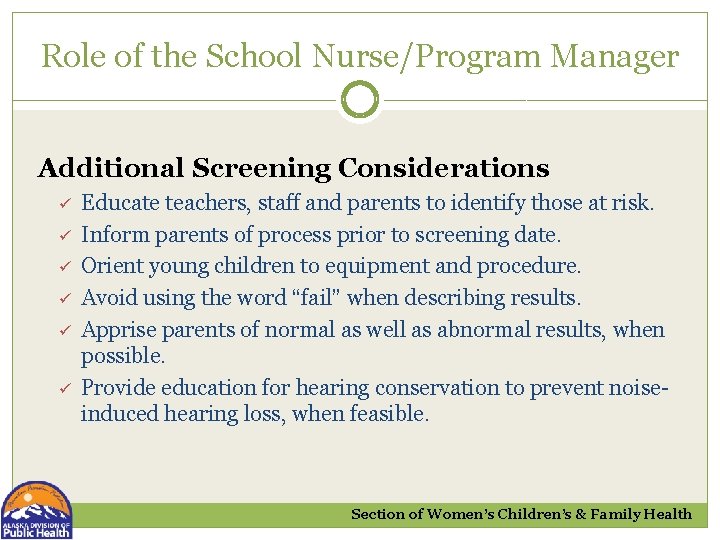
Role of the School Nurse/Program Manager Additional Screening Considerations ü ü ü Educate teachers, staff and parents to identify those at risk. Inform parents of process prior to screening date. Orient young children to equipment and procedure. Avoid using the word “fail” when describing results. Apprise parents of normal as well as abnormal results, when possible. Provide education for hearing conservation to prevent noiseinduced hearing loss, when feasible. Section of Women’s Children’s & Family Health
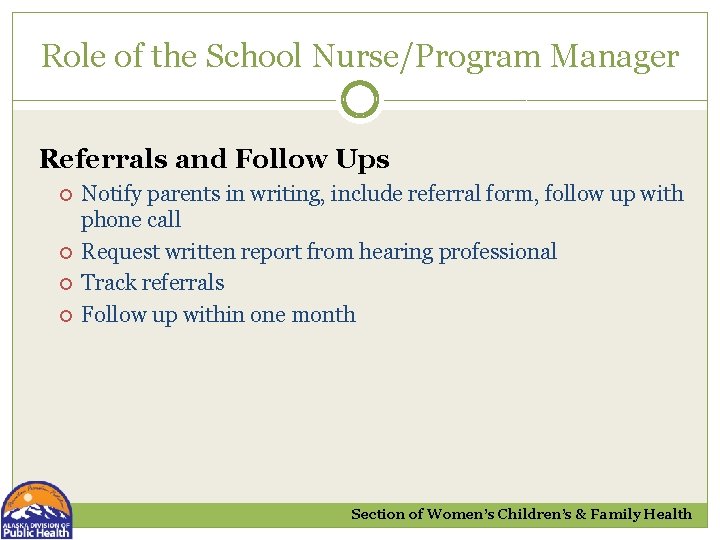
Role of the School Nurse/Program Manager Referrals and Follow Ups Notify parents in writing, include referral form, follow up with phone call Request written report from hearing professional Track referrals Follow up within one month Section of Women’s Children’s & Family Health
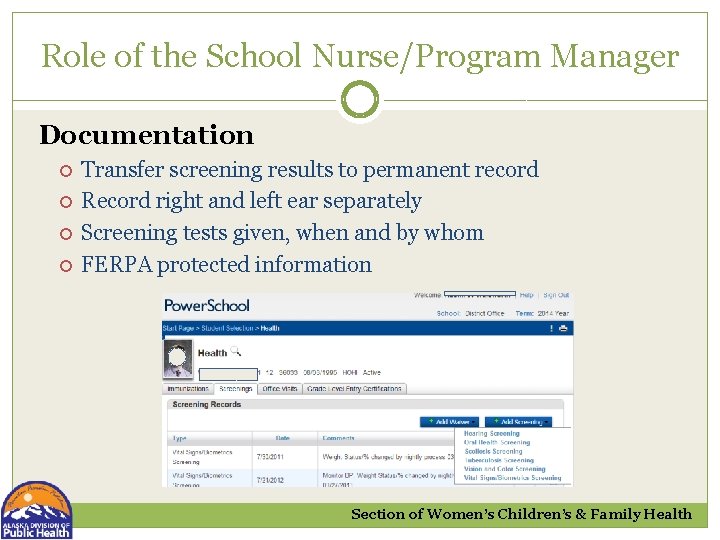
Role of the School Nurse/Program Manager Documentation Transfer screening results to permanent record Record right and left ear separately Screening tests given, when and by whom FERPA protected information Section of Women’s Children’s & Family Health
Role of the School Nurse/Program Manager Communication Notify teacher(s) and special education personnel, if indicated, of referral, evaluation results, and classroom accommodations � Examples include: Preferential seating near the source of instruction with better hearing ear nearest teacher, away from noise sources (i. e. , hallways, playground noise) Gain attention (i. e. , “secret sign”, tap desk) Give visual cues “Peer buddy” Provide longer processing time for responses Section of Women’s Children’s & Family Health
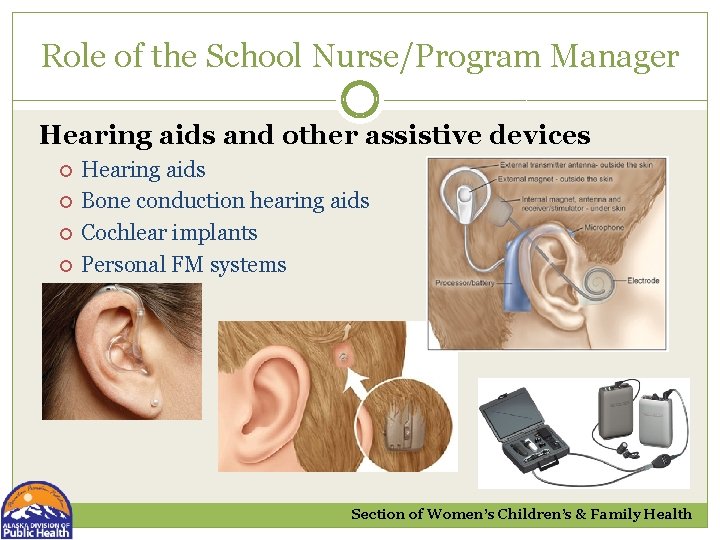
Role of the School Nurse/Program Manager Hearing aids and other assistive devices Hearing aids Bone conduction hearing aids Cochlear implants Personal FM systems Section of Women’s Children’s & Family Health
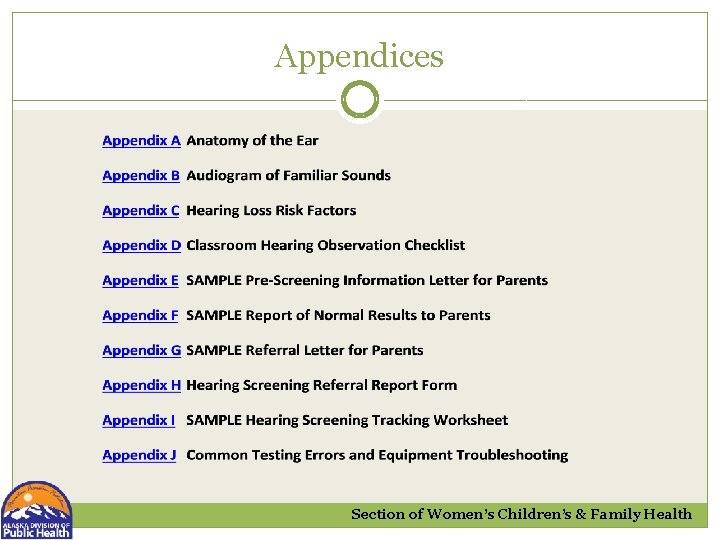
Appendices Section of Women’s Children’s & Family Health
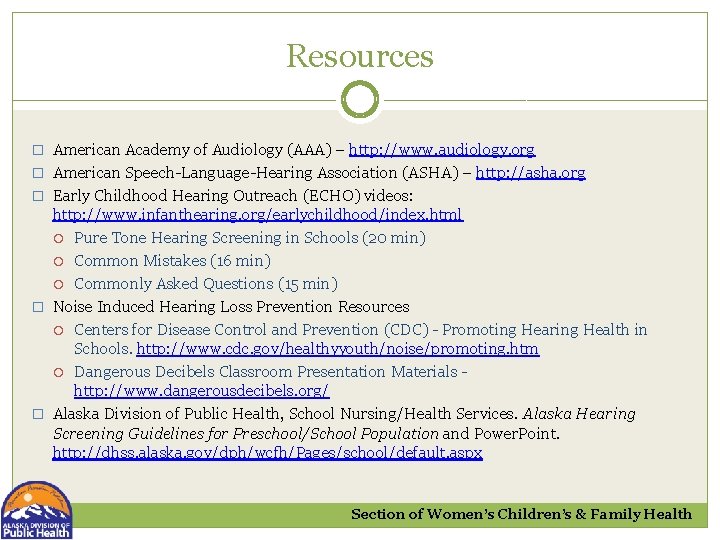
Resources � American Academy of Audiology (AAA) – http: //www. audiology. org � American Speech-Language-Hearing Association (ASHA) – http: //asha. org � Early Childhood Hearing Outreach (ECHO) videos: http: //www. infanthearing. org/earlychildhood/index. html Pure Tone Hearing Screening in Schools (20 min) Common Mistakes (16 min) Commonly Asked Questions (15 min) � Noise Induced Hearing Loss Prevention Resources Centers for Disease Control and Prevention (CDC) - Promoting Hearing Health in Schools. http: //www. cdc. gov/healthyyouth/noise/promoting. htm Dangerous Decibels Classroom Presentation Materials http: //www. dangerousdecibels. org/ � Alaska Division of Public Health, School Nursing/Health Services. Alaska Hearing Screening Guidelines for Preschool/School Population and Power. Point. http: //dhss. alaska. gov/dph/wcfh/Pages/school/default. aspx Section of Women’s Children’s & Family Health
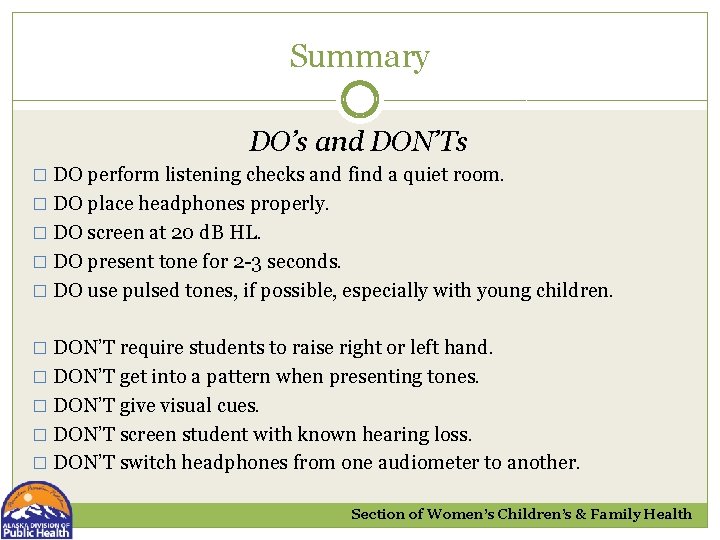
Summary DO’s and DON’Ts � DO perform listening checks and find a quiet room. � DO place headphones properly. � DO screen at 20 d. B HL. � DO present tone for 2 -3 seconds. � DO use pulsed tones, if possible, especially with young children. � DON’T require students to raise right or left hand. � DON’T get into a pattern when presenting tones. � DON’T give visual cues. � DON’T screen student with known hearing loss. � DON’T switch headphones from one audiometer to another. Section of Women’s Children’s & Family Health
Thank you! Contact information: School Health Nurse Consultant Section of Women’s, Children’s, and Family Health 3601 C Street, Suite 322 Anchorage, AK 99503 main office - 907 -269 -3400 School Nursing/School Health Services Program 907 -269 -7368 Section of Women’s Children’s & Family Health